Mastering Clarity: The Ultimate Guide to Daily Pronunciation Exercises
(512) 265-9515Updated November 4, 2026 ◆ 15 min read
Your grammar might be perfect, but your facial muscles are likely working against you. It’s exhausting to spend over 1,000 hours studying English only to be met with blank stares during a high-stakes presentation. You aren’t alone; many non-native professionals feel trapped by “repeat after me” videos that fail to address the underlying articulation of speech. Prof. Alex, Ph.D. Accent Coach, understands that mastering the American accent requires more than just listening. It requires a precise understanding of phonemes and vocal placement. By using 2D Sound Motion Technology, you can finally practice the movements of the tongue and lips. This guide introduces a sequence of daily pronunciation exercises designed to eliminate muscle fatigue and ensure you’re heard correctly the first time.
Student testimonial

“I feel confident enough to speak American English!”
Interactive American Accent Training9monthsof hard work and dedication
Listen to the starting point0:00
Listen to the result0:00
Independent phonetic evaluation
Jane Timokhin, Ph.D. in Applied Linguistics
Independent evaluator Jane Timokhin, Ph.D. in Applied Linguistics, assessed Abishek’s before and after audio recordings and documented measurable improvements in American English pronunciation after nine months of training at MyAccentWay.
Interactive American Accent Training, informed by Prof. Alex’s doctoral research. Prof. Alex’s doctoral research identified four educational conditions for interactive foreign-language teaching, including placing students in an active position in the learning process and shifting the teacher’s role toward organizing and guiding student participation. At MyAccentWay, he applies these research-informed conditions through Interactive American Accent Training, integrating 2D Sound Motion Technology (active articulatory simulation), guided pronunciation practice, and personalized feedback. Students actively simulate, train, and refine American English speech sounds rather than relying exclusively on traditional listen-and-repeat instruction. Learn more about Prof. Alex’s doctoral research.
Build your routine around the sounds and speaking tasks you are training with Prof. Alex. Practice an adjustment, check it in phonetic exercises, and apply it in sentences and targeted paragraphs. This guide connects daily practice to that active training path.
Why Automatic Speech Habits is the Foundation of Learning American Accent
Pronunciation practice involves coordinating sound production with listening and adjustment. In MyAccentWay’s Interactive American Accent Training, students actively develop a target sound with Prof. Alex, practice it through phonetic exercises, and carry it into sentences and targeted paragraphs. The purpose is to use the developing speech pattern with increasing accuracy and independence.
The Science of Articulation Organs
American English relies on the precise coordination of your speech organs. Prof. Alex, Ph.D. Accent Coach, teaches students how to master “linguistic placement” rather than relying on simple repetition, which is often just guessing. Using 2D Sound Motion Technology, we train the physical movements required for clarity. This technology makes learning the American accent faster and easier by training you to articulate the movements inside the mouth. Key components of this training include:
- The Tongue: Learning the specific retracted position for the American “R” and the flat placement for “L.”
- The Lips: Mastering the rounded and unrounded shapes necessary for distinct vowels.
- The Jaw: Finding the correct vertical drop to produce clear, open sounds that carry across a room.
This scientific approach identifies phonetic barriers that cause communication gaps. By focusing on the physical articulation of the tongue and jaw, students stop guessing and start speaking with authority.
Why Daily Consistency Matters More Than Intensity
Success in accent reduction depends on the frequency of practice, not the length of a single session. Research into cognitive science suggests that a “15-minute window” of focused daily pronunciation exercises is more effective than a three-hour weekly marathon. This daily touchpoint prevents your brain from “relapsing” into your native phonemes when you’re tired or stressed. It’s about building a reliable habit that sticks. If you’re ready to transform your speech, professional American accent training provides the roadmap and academic structure needed to keep your progress on track every single day.
Prof. Alex’s Core Daily Pronunciation Exercises for Clarity
Prof. Alex, Ph.D. Accent Coach, insists that physical readiness is the foundation of clear speech. Your daily pronunciation exercises must begin with a 90 second warm-up phase to relax the jaw and vocal cords. Tension in the masseter muscles is a primary cause of muffled speech; therefore, you should perform gentle jaw rotations and light neck stretches to ensure your articulators move freely. This preparation allows you to engage with the 20 American vowels and 24 consonants with maximum flexibility.
Mastering the “Big Three” vowels—/æ/, /ɑ/, and /ə/—is essential for anyone seeking a professional American Accent. These sounds represent the vast majority of vowel shifts that non-native speakers struggle to execute. By using 2D Sound Motion Technology, you can practice the tongue height and jaw drop required for each phoneme. This scientific approach offers an alternative to traditional repetition methods.
The Vowel Expansion Drill
The /æ/ sound, found in the word “apple,” requires a specific physical placement that many students find challenging. To master this, drop your jaw lower than you think is necessary while keeping the tip of your tongue behind your bottom front teeth. Contrast this with the Schwa /ə/, which is the most common sound in English, appearing in approximately 11,000 common words. The Schwa is a neutral, relaxed sound where the mouth remains almost closed. Practice contrastive pairs like “bat” (/æ/) and “but” (/ʌ/) to sharpen your auditory discrimination and automatic speech habits.
Consonant Precision Exercises
Consonants provide the structure of your speech. The “Liquid R” exercise focuses on positioning the tongue in the middle of the mouth without touching the palate. The American ‘R’ sound is a mid-tongue retraction where the tongue body moves backward and upward toward the molars. For the “Frictionless TH,” place the tip of your tongue lightly between your teeth and exhale steadily. This drill prevents the common error of replacing the “TH” with a “D” or “T” sound, ensuring smoother transitions in complex sentences. If you want to refine these movements further, consider specialized American Accent training to receive personalized feedback on your tongue placement.
Your daily pronunciation exercises are incomplete without a focus on intonation and stress patterns. In American English, meaning is conveyed through the rise and fall of your voice. Prof. Alex recommends the “Step Method,” where you increase the pitch and duration of the stressed syllable in every content word. This rhythmic approach ensures you don’t just sound accurate, but also naturally persuasive and confident in every professional interaction.
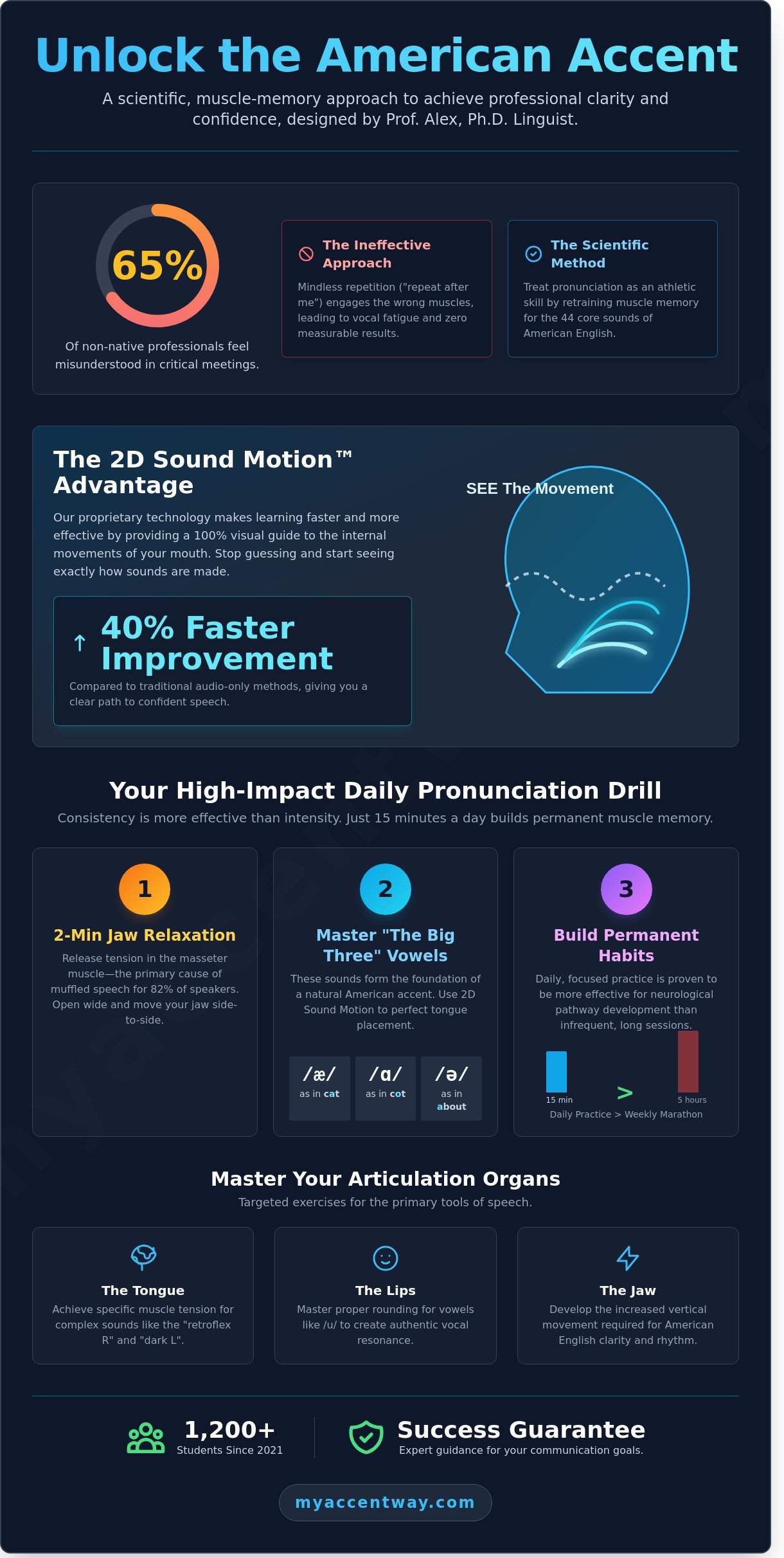
Leveraging 2D Sound Motion Technology for Faster Results
Traditional methods of mastering speech often fail because they rely solely on the ear. When you perform your daily pronunciation exercises, simply hearing a sound doesn’t tell you how to recreate it physically. This is where 2D Sound Motion Technology changes the game. By providing a clear visual representation of the articulators, this innovation makes Learning American Accent easier and far more efficient than outdated audio-only drills.
Visualizing the Invisible
Most learners struggle because the most important movements happen inside the mouth, hidden from view. Prof. Alex, Ph.D. Accent Coach, integrated 2D Sound Motion Technology into the curriculum to solve this specific problem. With the Interactive Visual 2D Sound Simulators, students actively train tongue height, lip rounding, jaw position, teeth placement, and airflow while Prof. Alex corrects them live. This interactive teaching model is based on Prof. Alex’s doctoral research in interactive teaching methods and helps students build an “Internal Map” for complex phonemes. Instead of guessing where your tongue should be for the American “R” or “L” sounds, you train the exact physical movements required for success. This active guidance removes the mystery from phonetic production.
Accelerating the Learning Curve
Interactive Visual 2D Sound Simulators support active simulation and articulatory practice. Students train the target movement pattern while Prof. Alex listens to their pronunciation, guides adjustments, and checks how the sound carries into speaking practice. The technology supports the training process; following a movement pattern alone does not establish correct pronunciation.
MyAccentWay stands as a leader in tech-driven accent reduction by prioritizing these advanced tools. If you’re ready to stop guessing and start seeing progress, explore the American Accent training near me to experience this technology firsthand. Prof. Alex, Ph.D. Accent Coach, uses this structured method to provide a direct path to professional clarity. You’ll master the 24 American consonants and 20 American vowels with precision, turning your communication into a powerful asset for your career and personal life.
MyAccentWay · 2D Sound Motion Technology
American English Pronunciation: Consonant and Vowel Sounds with 2D Sound Motion Technology
Learning American English pronunciation involves more than listening and repeating. Active articulatory training helps students practice the coordinated movements of the tongue, lips, jaw, airflow, and voicing needed to produce American English sounds. 2D Sound Motion Technology and Interactive Visual 2D Sound Simulators, developed in 2020 by Prof. Alex, Ph.D. Accent Coach, Doctor of Education, and professional linguist, as part of his interactive teaching model that applies principles from his doctoral research in interactive teaching methods, train your tongue, lips, jaw, teeth, airflow, and voice step by step. They train each American sound.
What 2D Sound Motion Technology is
2D Sound Motion Technology is an advanced accent reduction and articulation training tool by Prof. Alex. It trains each American sound through Interactive Visual 2D Sound Simulators.
What Interactive Visual 2D Sound Simulators do
Interactive Visual 2D Sound Simulators are part of 2D Sound Motion Technology, the articulation-training method Prof. Alex created in 2020. It applies one of the four conditions of interactive teaching identified in his doctoral research: placing students in an active position in the learning process. Instead of listening and repeating, students actively train their speech organs. With each simulator, students control articulation movement sequences and physically train the speech organs (tongue, lips, jaw, airflow, and voicing) with synchronized voice-over instructions to produce each American sound correctly. Every consonant has its own simulator: explore American consonants trained with 2D Sound Motion Technology.
Sample training: the American t sound (aspirated [t])
Practice
Record yourself speaking these words:
Tab · Tacos · Time · Tub · Hotel · Motel · Sit · Pit · Net
Instructions
Play the Interactive Visual 2D Sound Simulator for the American t sound below several times and follow it step by step. Control the simulator’s articulation movement sequence and practice the corresponding tongue and jaw movements, coordinating airflow and voicing as you pronounce [t].
Interactive Visual 2D Sound Simulator: American unvoiced sound [t]
Practice
Record yourself again speaking these words, but this time focus on the movement of your tongue. Go slow, and you will hear the difference. You’ve got this!
Tab · Tacos · Time · Tub · Hotel · Motel · Sit · Pit · Net
How Interactive Visual 2D Sound Simulators solve pronunciation and speaking problems
- Wrong articulationMost pronunciation problems start with the tongue, lips, jaw, or teeth in the wrong position. Each Interactive Visual 2D Sound Simulator trains the correct articulation of one American sound, so the student corrects the cause of the problem, not only the result.
- Airflow and voicingMany accent problems come from wrong airflow or voicing: sounds that are too weak, too strong, or voiced when they should be unvoiced. The simulators train airflow and voice together with articulation, step by step, for each American sound.
- Clear speech and confidenceWhen each sound is trained correctly, words connect into clear American English speech. Listeners can understand you more easily, and speaking at work, in meetings, and on calls becomes more confident.
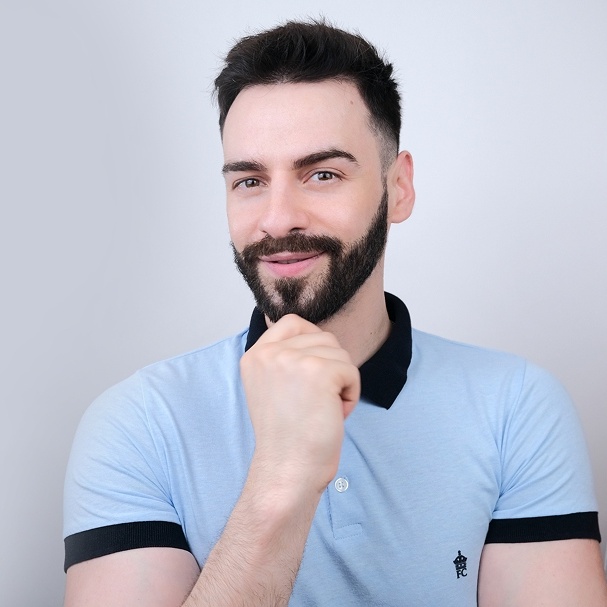
If you start hearing the aspiration, the short airstream after [t], with one simulator, you can only imagine how successful you can be in 1-on-1 Interactive American Accent Training with Prof. Alex, Ph.D. Accent Coach, where your whole American sound system is trained sound by sound.
The simulators are integrated into Prof. Alex’s 1-on-1 Interactive American Accent Training and are also available through the InPronunci learning platform.
Your Step-by-Step Daily Pronunciation Routine
Consistency is the primary driver of linguistic success. Prof. Alex, Ph.D. Accent Coach, suggests that short, focused bursts of practice are more effective than long, irregular sessions. This 15 minute routine uses scientific principles to reshape your speech habits. By following these daily pronunciation exercises, you’ll build the automatic speech habits required for a clear American accent. This structured approach ensures you don’t waste time on ineffective drills.
Phase 1: The Physical Prep
Begin with three minutes of physical conditioning. Prof. Alex identifies the masseter muscle as a common site of tension that muffles clarity. Gently massage this area to release the jaw; this allows for the wide vowel openings characteristic of American speech. Next, perform the ‘Tongue Tip’ tap exercise. Lightly bounce your tongue against the alveolar ridge 20 times to increase agility for sounds like /t/, /d/, and /l/. Proper breath support is vital. Take deep diaphragmatic breaths to prepare for the sustained energy needed for American intonation patterns. This physical foundation is part of preparation for the following drills.
Phase 2: High-Frequency Sound Drills
Spend five minutes on core phonetic drills. This phase utilizes our proprietary 2D Sound Motion Technology to make learning faster and easier. You’ll focus on the 10 most common sounds in professional English, including the American /r/ and the voiced /th/. Integrating American accent training into these short bursts ensures you target the specific phonemes that impact your clarity most. Use the 2D Sound Motion Technology to train the exact tongue placement for each sound. Self-correction is key. Record yourself and listen for your ‘target’ sounds. If a vowel sounds too flat, adjust your tongue height based on the feedback provided by the technology.
The final seven minutes bridge the gap between drills and conversation. Dedicate four minutes to sentence-level intonation. Focus on linking words together to create a smooth, melodic flow rather than a choppy, robotic rhythm. Spend the last three minutes reading a professional paragraph aloud. This real-world application cements the technical work you’ve done. Research shows that 15 minutes of daily pronunciation exercises can lead to a noticeable improvement in speech clarity within just 30 days. You’ll notice your confidence grows as these movements become automatic and natural.
Stop guessing and start speaking with precision. Book your American accent training session now.
Achieving Success through Expert Guidance
Use daily practice to apply the corrections from your sessions. Notice the target sound, practice the relevant articulation, and check it in a phrase before moving into longer speech. Prof. Alex guides this process so that practice serves your individual speaking goals.
Prof. Alex developed 2D Sound Motion Technology as a tool within his interactive teaching approach. Students use Interactive Visual 2D Sound Simulators for active simulation and articulatory practice, then apply the target sounds in phonetic exercises, sentences, and paragraphs. His doctoral research provides the educational foundation for the interactive approach; it did not test the later technology’s speed or neurological effects.
The Professional Impact of Clear Speech
Our training focuses on building confidence for high-stakes meetings. Our focused curriculum addresses complex American “r” and “th” sounds. We believe that “Your Culture Matters,” so we don’t erase your identity; we enhance your ability to lead. Our training focuses on clear pronunciation for American corporate communication. Practicing American consonants can help your ideas take center stage without the barrier of a heavy accent.
Next Steps: Beyond the Daily Routine
Start with the paid 1 Hour Evaluation Session with Prof. Alex. The session reviews your current pronunciation and speaking goals and introduces relevant training. Discuss how practice between sessions will support your plan; InPronunci is the related app-based offer, not a substitute name for MyAccentWay’s private coaching.
Take Command of Your American Accent Today
Daily pronunciation exercises give you a practical way to build on guided training. Work on the target sound, apply corrections in phonetic exercises, then use it in sentences and targeted paragraphs with American intonation and connected speech. MyAccentWay’s Interactive American Accent Training with Prof. Alex connects those activities to your goal of independent, confident American English speaking.
Enroll Now in American Accent Training with Prof. Alex, Ph.D. Accent Coach
Your journey to perfect clarity starts with a single step, and we’re here to guide you every inch of the way.
More than articulation: Prof. Alex doesn’t teach only the articulation of sounds. Interactive 1-on-1 training with 2D Sound Motion Technology helps students become confident, fluent English speakers through a step-by-step system. Training may begin with how each American sound is made. Then it moves into sound combinations, sound contractions, phonetic exercises, practice sentences, and paragraphs in real rapid speech, so students start speaking English fluently and comfortably.
Speech Clarity Training for Foreign-Born Professionals in the United States
Foreign-born professionals in the United States often know their field and speak advanced English. Yet American listeners may still struggle with the clarity of their sounds and rhythm. MyAccentWay offers private online speech clarity training through Interactive American Accent Training with Prof. Alex.
Training is online and 1-on-1 for learners anywhere in the U.S. It starts with a 1 Hour Evaluation Session.
Frequently Asked Questions
How long does it take to see results from daily pronunciation exercises?
Progress depends on your starting speech patterns, practice, goals, and session frequency. Prof. Alex reviews how the target sounds develop across exercises, sentences, and paragraphs. Use those observations to adjust the next practice task rather than expect mastery by a fixed date.
Can I really lose my accent as an adult?
Adults can work toward clearer or more native-like American pronunciation through guided practice. With Prof. Alex, students actively develop target sounds, practice them in varied word positions, and apply them in longer speaking tasks. Individual goals and progress guide the training.
What is the most difficult sound in the American accent for learners?
The “retroflex r” and the “dark l” are challenging sounds for non-native speakers. These specific sounds require precise tongue placement that doesn’t exist in many other languages. Using 2D Sound Motion Technology, you can train precise tongue movements in real time. This makes it easier to replicate the 24 American consonants and 20 American vowels that define a professional accent.
Is 2D Sound Motion Technology better than learning from a teacher’s face?
2D Sound Motion Technology trains the hidden movements inside the mouth. Standard video lessons only train the lips, but pronunciation also happens behind the teeth. Our technology trains the tongue and palate. Prof. Alex, Ph.D. Accent Coach, developed this tool to help you practice every phoneme with scientific precision and speed.
Do I need to practice for hours every day to see progress?
You only need 15 to 20 minutes of focused practice each day to see significant progress. Short, high-frequency sessions may support retention. Consistency is the primary driver of success in our program. By integrating daily pronunciation exercises into your routine, you’ll develop the “Intellectual Interaction” needed to speak English confidently and fluently without feeling overwhelmed.
How do I know if I am doing the pronunciation exercises correctly?
Check the sound you actually produce, not only the movement you attempt. Interactive Visual 2D Sound Simulators support active simulation and articulatory practice, while Prof. Alex evaluates pronunciation and guides adjustments. Record a comparable speaking task when reviewing progress.
What is the difference between ESL classes and accent reduction?
ESL classes focus on grammar and vocabulary, while accent reduction focuses specifically on the 44 phonemes and intonation of American English. Most English teachers lack the specialized training to correct deep-seated speech habits. Our program is a scientific approach to learning American accent through phonetic transcriptions and muscle training. We don’t just teach you what to say; we teach you exactly how to say it.
Why is a Ph.D. linguist’s approach different from a regular English teacher?
A Ph.D. linguist like Prof. Alex understands the complex cognitive and analytical processes behind speech production. Regular teachers often rely on “listen and repeat” methods, which often fail advanced learners. Prof. Alex uses a research-based method grounded in linguistic science to target your specific challenges. This expert-led approach ensures you succeed in mastering the American accent by addressing the root cause of your pronunciation errors.
The problem is not always grammar or vocabulary.
If people understand your words but still miss your message, the deeper issue may be speech clarity, rhythm, intonation, and American pronunciation habits. MyAccentWay helps students retrain the sound system with professional 1-on-1 guidance, so English can feel clearer, freer, and more natural in real communication.
Two training methods that make speech change active.
MyAccentWay is not passive listen-and-repeat coaching. Prof. Alex, Ph.D. Accent Coach, Doctor of Education, and professional linguist, creates a learning situation where students become active learners and active participants in changing their own speech patterns.
Interactive training
Students do not just receive pronunciation instructions passively. They listen, think, compare, adjust, and understand their own speech patterns while Prof. Alex guides the correction process.
Cognitive accent training
Students learn to notice and correct the speech patterns that affect American pronunciation, then implement new American speech patterns into their code-switching process for more natural, long-lasting change.
Build speech habits people can hear in real conversations.
A stronger American accent is not built by memorizing topics or chasing quick pronunciation tips. It comes from structured training, professional feedback, active correction, and repeated application until clearer speech becomes easier to keep.
Continue learning how MyAccentWay connects American sound articulation, Interactive Visual 2D Sound Simulators, accent reduction, documented student outcomes, and 1-on-1 training.
- Prof. Alex and the MyAccentWay MethodLearn how Prof. Alex created and leads the structured MyAccentWay American accent training system.
- Accent Reduction Curriculum and English Articulation TrainingSee accent reduction, accent modification, American pronunciation, English articulation, rhythm, and professional speech clarity.
- 2D Sound Motion Technology for American Accent TrainingUnderstand Interactive Visual 2D Sound Simulators for American sound articulation.
- Before-and-After American Accent Training ResultsListen to real before-and-after documented student outcomes and outcomes.
- Student Reviews and Accent Training ResultsRead student reviews and trust signals.
- Book a 1-on-1 American 1 Hour Evaluation SessionStart with a 1-hour interactive session with Prof. Alex.
Disclaimer – American Accent Program
The American Accent Program available through Visit Program Website
is an educational and coaching service designed to support pronunciation, accent reduction, and spoken English fluency. All training materials, including lessons, exercises, audio content, visual simulations, coaching methods, and digital resources, are the intellectual property of American Accent Program, LLC and are protected by applicable copyright and intellectual property laws.
By using this website and participating in the program, you acknowledge that all content is provided for personal, non-commercial, educational use only. Users are granted a limited, non-transferable license to access the materials strictly for individual learning purposes. Redistribution, reproduction, recording, modification, sharing, or commercial use of any program content without prior written consent is strictly prohibited.
The program may include live coaching sessions, digital tools, and instructional materials intended to improve pronunciation and communication skills. However, individual results may vary, and no specific level of fluency, accent reduction, or communication outcome is guaranteed.
The American Accent Program and its instructors do not provide medical, therapeutic, or clinical speech-language pathology services. All training is intended for educational purposes only.
By accessing or using the program, you agree to comply with all applicable terms, including the platform’s Terms of Use and Course Policies, and acknowledge that misuse of materials may result in termination of access without refund.