American English Elision and Reduction Explained
(512) 265-9515Updated October 14, 2026 ◆ 14 min read
Real student result

“I feel confident enough to speak American English!”
Interactive American Accent Training9monthsof hard work and dedication
Listen to the starting point0:00
Listen to the result0:00
“Many of my students once believed they could never sound like this. School taught them grammar and vocabulary, but not how to train their English speech. That is what we do together, step by step, until you speak English independently and with confidence.”
Abishek’s result was achieved through Prof. Alex’s research-based Interactive 1-on-1 American Accent Training. His doctoral research found this interactive method more effective than traditional, teacher-centered methods. See the research basis →
Do you want to keep collecting pronunciation tips, or actually change how you speak?
Elision and reduction are powerful only when students understand when to connect, when to reduce, and when to keep important words clear.
Prof. Alex’s method turns connected-speech knowledge into controlled practice for clearer professional communication.
The goal is not to copy a native speaker mechanically. The goal is to become an independent English speaker with clearer American pronunciation, stronger rhythm, better intonation, and speech clarity you can use in professional communication.
Turn Elision Practice into Smoother American Speech
This guide helps you understand how American English elision and reduction work. The next step is training your own speech so you can stop sounding too careful, disconnected, or word-by-word. In 1-on-1 accent training, Prof. Alex helps you practice connected speech patterns so your American English becomes smoother, clearer, faster, and easier to understand.
- Hear fast American speech more clearly: recognize reductions, linking, and sound changes native speakers use naturally.
- Speak with smoother flow: stop over-pronouncing every word and train connected American speech patterns.
- Get personal correction: identify which reductions, rhythm patterns, and sounds are affecting your clarity.
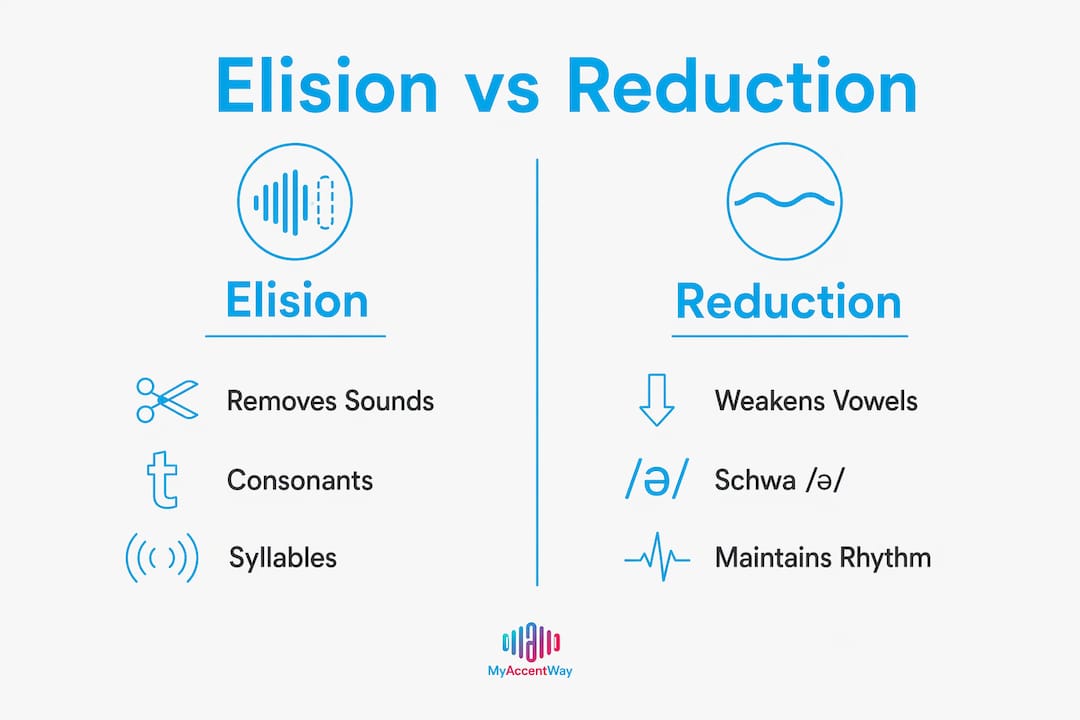
Elision in American English is the omission of sounds, such as consonants, vowels, or entire syllables, while reduction is the weakening of unstressed vowels, most often to the schwa sound /ə/. Together, these two processes define how native speakers actually talk, not how words appear in a dictionary. American English phonetics research confirms that native speakers merge, drop, and reduce sounds constantly, creating a flowing sound stream rather than a series of separate words. Understanding american english elision and reduction explained through a phonetic lens, not a spelling lens, is the single most important shift a non-native speaker can make to improve conversational fluency.
What are the main types of elision and reduction in american english?
Elision and reduction are the two core processes in American English connected speech, and they show up in every conversation, not just fast or casual talk.
Elision is the complete omission of a sound. The most common targets are /t/ and /d/ between consonants, and unstressed syllables in longer words. Elision involves omission of consonants, vowels, and syllables in natural speech. Here are the clearest examples:
- “next day” sounds like “nex day” (the /t/ disappears before /d/)
- “comfortable” is pronounced [ˈkʌmftəbl] (the middle syllable collapses)
- “family” becomes [fæmli] (the unstressed middle vowel drops entirely)
- “Wednesday” is spoken as [ˈwɛnzdeɪ] (the /d/ in the middle vanishes)
Practice American Accent for Free: Elision and Reduction
If you want to practice American accent for free, start with the connected speech patterns native speakers use every day. This article gives you free American English pronunciation practice for elision, reduction, rhythm, and clearer speech before you decide whether you need personalized 1-on-1 American accent training.
- American accent training: practice how sounds change in real conversation, not only in isolated words.
- Accent reduction practice: learn why sounds disappear, weaken, or connect in natural American English.
- Pronunciation coaching: use the audio examples below to hear and repeat elision patterns more accurately.
- Speech clarity training: build stronger connected speech for meetings, interviews, presentations, and daily conversations.
Practice Elision Word by Word
Say each example slowly first, then connect the sounds naturally. The goal is to feel how American English removes or weakens sounds in real connected speech.
next day
Elision pronunciation: /nɛks deɪ/
The /t/ sound disappears before /d/.
Say it like: nex day
Listen and repeatcomfortable
Elision pronunciation: /ˈkʌmftəbl/
The middle unstressed syllable becomes very weak or disappears.
Say it like: KUMF-tuh-bul
Listen and repeatfamily
Elision pronunciation: /ˈfæmli/
The unstressed middle vowel disappears.
Say it like: FAM-lee
Listen and repeatWednesday
Elision pronunciation: /ˈwɛnzdeɪ/
The /d/ sound in the middle disappears.
Say it like: WENZ-day
Listen and repeatReduction does not remove a sound completely. Instead, it weakens a full vowel into the schwa /ə/. Vowel reduction changes full vowels in unstressed function words to /ə/. The word “for” becomes /fər/, “of” becomes /əv/, and “the” before a consonant becomes /ðə/.
The table below compares both processes side by side:
| Phrase or Word | Written Form | Elision Example | Reduction Example |
|---|---|---|---|
| “next day” | /nɛkst deɪ/ | /nɛks deɪ/ (t dropped) | N/A |
| “comfortable” | /ˈkʌmfərtəbl/ | /ˈkʌmftəbl/ (syllable dropped) | N/A |
| “for you” | /fɔːr juː/ | N/A | /fər juː/ (vowel reduced) |
| “of the” | /ɒv ðə/ | N/A | /əv ðə/ (both reduced) |
| “temperature” | /ˈtɛmpərətʃər/ | /ˈtɛmprətʃər/ (syllable collapsed) | N/A |

Elision and reduction are distinct from assimilation, which is when one sound changes to match a neighboring sound (for example, “ten people” becoming “tem people”). All three belong to the broader category of connected speech features that include linking, elision, assimilation, and reduction.
Why do native american english speakers use elision and reduction so much?
The short answer is rhythm. American English flows at approximately 160 words per minute, faster than British Received Pronunciation at 145 WPM. That difference in pace requires speakers to reduce articulatory effort without losing meaning.
Elision and reduction are not signs of lazy or sloppy speech. Elision occurs across all speech registers and is a refined mechanism that maintains rhythm and fluency. A professor giving a formal lecture uses elision. A news anchor on CNN uses reduction. These are features of skilled, natural speech.
The linguistic principle behind both processes is called phonetic economy: speakers naturally minimize muscular effort while preserving the meaning of an utterance. Unstressed syllables and function words carry less semantic weight, so the brain deprioritizes their full articulation. The result is a speech pattern where content words stay clear and function words blur together.
“The problem most learners face is not that American English is fast. The problem is that they were taught to expect each word to sound the way it looks on paper. Once you stop listening for spelling and start listening for rhythm, everything changes.”
Pro Tip: Record a 30-second clip of a native American English speaker from a podcast or TV show. Listen once for meaning, then listen again specifically for words that disappear or sound shorter than expected. You will start hearing elision and reduction immediately.
How can non-native speakers recognize and practice elision and reduction?
Recognizing these patterns requires training your ear and your mouth at the same time. Here is a structured approach:
-
Start with authentic listening. Use podcasts, interviews, and TV shows where speakers talk naturally. Extensive listening practice improves your ability to decode elisions and reductions in real speech. Focus on function words like “to,” “for,” “of,” “and,” and “the” and notice how short they sound.
-
Learn the IPA for key sounds. The International Phonetic Alphabet shows you what a word actually sounds like, not how it is spelled. English spelling hides the phonetic reality, so learners who rely only on written forms miss the actual sound patterns entirely.
-
Study tense and lax vowels. Tense vowels require more muscular effort and last longer, while lax vowels are shorter and softer. Understanding this distinction helps you recognize when a vowel is being reduced versus when it is simply a naturally short sound. For example, the /ɪ/ in “bit” is lax by nature, while the /iː/ in “beat” is tense and would only reduce under strong connected speech conditions.
-
Practice minimal pairs with connected speech. Compare “I want to go” (formal) with “I wanna go” (reduced) and “Did you eat?” with “Didja eat?” Say both versions aloud until the reduced form feels natural in your mouth.
-
Use visual pronunciation tools. Myaccentway’s 2D Sound Motion Technology trains the tongue, lips, and jaw to move during American sounds. Practicing the physical movement makes it far easier to reproduce reduced sounds correctly, rather than guessing from audio alone.
Pro Tip: Practice linked sounds in English alongside elision drills. Linking and reduction often happen in the same phrase, so training them together builds more natural speech patterns faster.
MyAccentWay · 2D Sound Motion Technology
American English Pronunciation: Consonant and Vowel Sounds with 2D Sound Motion Technology
Learning American English pronunciation and the American accent is more effective when you train your speech organs, not only listen and repeat. 2D Sound Motion Technology and Interactive Visual 2D Sound Simulators, developed in 2020 by Prof. Alex, Ph.D. Accent Coach, Doctor of Education, and professional linguist, as part of his interactive teaching model based on his Ph.D. research in interactive teaching methods, train your tongue, lips, jaw, teeth, airflow, and voice step by step. They train each American sound and more than 30 sound combinations through Interactive 2D video simulation.
What 2D Sound Motion Technology is
2D Sound Motion Technology is an advanced accent reduction and articulation training tool by Prof. Alex. It corrects, develops, and trains each American sound and more than 30 sound combinations through Interactive 2D video simulation.
What Interactive Visual 2D Sound Simulators do
Interactive Visual 2D Sound Simulators are part of 2D Sound Motion Technology, the articulation-training method Prof. Alex created by applying his Ph.D. research in interactive teaching to American pronunciation. Instead of listening and repeating, students actively train their speech organs. Each simulator uses Interactive 2D mouth movement to train the speech organs (tongue, lips, jaw, teeth, airflow, and voice) to produce each American sound correctly. Every consonant has its own simulator: explore American consonants trained with 2D Sound Motion Technology.
Sample training: the American t sound (aspirated [t])
Practice
Record yourself speaking these words:
Tab · Tacos · Time · Tub · Hotel · Motel · Sit · Pit · Net
Instructions
Play the Interactive Visual 2D Sound Simulator for the American t sound below several times and follow it step by step. Move your tongue, jaw, and airflow together with the simulator and train your articulation.
Interactive Visual 2D Sound Simulator: American unvoiced sound [t]
Practice
Record yourself again speaking these words, but this time focus on the movement of your tongue. Go slow, and you will hear the difference. You’ve got this!
Tab · Tacos · Time · Tub · Hotel · Motel · Sit · Pit · Net
How Interactive Visual 2D Sound Simulators solve pronunciation and speaking problems
- Wrong articulationMost pronunciation problems start with the tongue, lips, jaw, or teeth in the wrong position. Each Interactive Visual 2D Sound Simulator trains the correct articulation of one American sound, so the student corrects the cause of the problem, not only the result.
- Airflow and voicingMany accent problems come from wrong airflow or voicing: sounds that are too weak, too strong, or voiced when they should be unvoiced. The simulators train airflow and voice together with articulation, step by step, for each American sound and more than 30 sound combinations.
- Clear speech and confidenceWhen each sound is trained correctly, words connect into clear American English speech. Listeners can understand you more easily, and speaking at work, in meetings, and on calls becomes more confident.

If you start hearing the aspiration, the short airstream after [t], with one simulator, you can only imagine how successful you can be in 1-on-1 Interactive American Accent Training with Prof. Alex, Ph.D. Accent Coach, where your whole American sound system is trained sound by sound.
In MyAccentWay, the Interactive Visual 2D Sound Simulators are only available in 1-on-1 accent coaching sessions with Prof. Alex.
How do elision and reduction affect listening comprehension and fluency?
Mastering these features directly changes how much of a conversation you understand and how natural you sound when you speak.
- Learners who rely on dictionary pronunciations often fail to recognize common words in fast speech. The word “probably” reduced to “prolly” or “going to” reduced to “gonna” can sound like completely different words to an untrained ear.
- Native speakers do not speak fast in the way learners assume. They merge and reduce sounds. Once you learn the patterns, speech that seemed impossibly fast becomes clear.
- Producing reduced forms yourself signals fluency to native speakers. When you say “I’m gonna grab some coffee” instead of “I am going to grab some coffee,” you sound like someone who belongs in the conversation.
- Ear training and pronunciation practice must develop together. Recognizing a reduced form in someone else’s speech and producing it yourself are two separate skills. Both require deliberate practice.
Understanding American English speech features like elision and reduction also improves your confidence in professional settings. Meetings, phone calls, and presentations become less stressful when you are no longer decoding every sentence from scratch.
What i’ve learned teaching elision and reduction for over a decade

Every student I work with at Myaccentway arrives with the same frustration: “I studied English for years, but I still can’t follow native speakers.” The cause is almost always the same. They were trained on written English and never taught that spoken American English follows different rules.
The biggest mistake I see is students focusing on individual word pronunciation while ignoring the spaces between words. That is where elision and reduction live. A student can pronounce “want” and “to” perfectly in isolation and still sound unnatural because they say “want to” as two full words instead of “wanna.”
The second mistake is treating these patterns as something to memorize. Elision and reduction are physical habits. They require muscle memory, not just intellectual knowledge. That is exactly why I developed the 2D Sound Motion Technology approach. When students actively train the tongue and jaw movement for a reduced American /T/ sound with the Interactive Visual 2D Sound Simulators while Prof. Alex corrects them live, the sound becomes trainable rather than mysterious.
Interactive Visual 2D Sound Simulator for American TBe patient with yourself. These patterns took native speakers years of childhood immersion to internalize. You can learn them faster with the right method, but they do require consistent practice. The reward is real: students like Vlad, a Russian speaker, made measurable progress in connected speech after structured training. You can hear the difference in his pronunciation results directly.
— Prof. Alex
How Myaccentway trains you to master connected speech
If you have read this far, you already understand that elision and reduction are learnable skills, not mysterious native-speaker habits. Myaccentway’s American accent training program gives you a structured path to master both.
Professor Alex, Ph.D., begins with a one-on-one assessment to identify exactly where your speech diverges from natural American connected speech patterns. From there, the program uses Interactive Mouth Training Technology, also called 2D Sound Motion Technology, to train the speech movements involved in every reduced and elided sound. You train the movement, not just the audio. Book Your 1 Hour Evaluation Session today and find out precisely which elision and reduction patterns are holding your fluency back.
Continue your American accent training
American Accent Training2D Sound Motion TechnologyProgram CurriculumConnected Speech Training for Foreign-Born Professionals in the United States
Foreign-born professionals in the United States often know their field and speak advanced English. Yet American listeners may still struggle with their linking and reductions. MyAccentWay offers private online connected speech training through Interactive American Accent Training.
Interactive American Accent Training is led by Prof. Alex, Ph.D. Accent Coach, Doctor of Education, and professional linguist. He first diagnoses each speaker’s native-language patterns. Then he trains American linking, reductions, and rhythm for real fast conversations.
Who this training is for
- Engineers, IT specialists, and data professionals presenting to U.S. teams and clients
- Doctors, nurses, and healthcare professionals explaining care to American patients
- Managers, executives, and founders leading meetings, pitches, and briefings
- Consultants, researchers, and academics speaking at conferences and webinars
- Professionals preparing for interviews, promotions, or client-facing roles
Online training across the U.S.
MyAccentWay is based in Austin, Texas, and all training is online. The program is especially relevant for professionals in Austin, Dallas, Houston, New York City, the San Francisco Bay Area, Los Angeles, Seattle, Boston, Chicago, Miami, Washington DC, Atlanta, and Raleigh.
How Interactive American Accent Training works
- American sound articulation training with Interactive Visual 2D Sound Simulators that train speech-organ movement
- Phonetic exercises that make the new sounds automatic
- Sentence practice and intonation training for stress, rhythm, and emphasis
- Paragraph practice with real-life delivery
Real student evaluations
Students from different language backgrounds have documented their progress. Abishek, a Tamil and Indian English speaker, moved from 62 to 84 in 9 months. Tian, a Mandarin speaker, moved from 58 to 85 in 8 months. Vlad, a Russian speaker, moved from 60 to 83 in 5 months.
The first step is a 1 Hour Evaluation Session with Prof. Alex.
FAQ
What is elision in american english?
Elision is the omission of a sound, such as a consonant, vowel, or syllable, in natural connected speech. Common examples include the word comfortable pronounced as [ˈkʌmftəbl] and the phrase next day spoken as nex day.
What is the difference between elision and reduction?
Elision removes a sound entirely, while reduction weakens a vowel to the schwa /ə/ without removing it. Both are features of American English connected speech and often occur in the same phrase.
Is elision considered incorrect or informal speech?
Elision occurs across all speech registers and is not informal or incorrect. It is a natural mechanism that maintains rhythm and fluency in American English, present in formal presentations as well as casual conversation.
How can i practice recognizing reduced speech?
Extensive listening to authentic American English, such as podcasts and interviews, combined with IPA study and accent reduction exercises, builds the ear training needed to decode reduced forms in real time.
Why does american english sound so fast to non-native speakers?
American English flows at approximately 160 words per minute, and speakers merge, drop, and reduce sounds constantly. Once you learn to recognize elision and reduction patterns, speech that seemed fast becomes clear and predictable.
Recommended
Accent Reduction vs. Elocution: What’s the Difference & Which Is for You?
Are you striving to speak English with greater clarity and confidence, but feel lost in the terminology? You’re not alone. The terms ‘elocution’ and...


English Minimal Pairs for American Pronunciation
Have you ever felt the frustration of using the perfect vocabulary, only to be met with a confused look? You know the words are correct, but...

What is Accent Reduction? A Guide to Speaking Clearer, More Confident English
Have you ever shared a brilliant idea in a meeting, only to be met with confused looks? Or found yourself repeating a simple coffee order for the...
Train connected speech without losing clarity
If listeners ask you to repeat yourself when you speak faster, or if your English sounds word-by-word instead of natural, this article should lead you to the Accent Reduction Curriculum.
Elision and reduction should not make your speech messy. In American accent training with Prof. Alex, students learn when sounds connect, weaken, or disappear, and how to keep speech clear in meetings, interviews, presentations, and professional conversations.
When articulation is involved, 2D Sound Motion Technology and Interactive Visual 2D Sound Simulators help make speech-organ movement easier to understand.
Knowledge is helpful. Feedback changes the practice.
This article attracts readers who want to understand natural American speech. The stronger next step is professional feedback, because connected speech is personal: the sounds you reduce, overpronounce, or connect incorrectly depend on your first language and your speaking habits.
Before booking, you can review real student experiences on the Student Reviews & Results page.
Stop guessing what is affecting your American pronunciation.
In a 1 Hour Evaluation Session, Prof. Alex can listen to your speech, identify the patterns that affect clarity, and explain how 1-on-1 American accent training can help you practice with a clear plan.
The problem is not always grammar or vocabulary.
If people understand your words but still miss your message, the deeper issue may be speech clarity, rhythm, intonation, and American pronunciation habits. MyAccentWay helps students retrain the sound system with professional 1-on-1 guidance, so English can feel clearer, freer, and more natural in real communication.
Two training methods that make speech change active.
MyAccentWay is not passive listen-and-repeat coaching. Prof. Alex, Ph.D. Accent Coach, Doctor of Education, and professional linguist, creates a learning situation where students become active learners and active participants in changing their own speech patterns.
Interactive training
Students do not just receive pronunciation instructions passively. They listen, think, compare, adjust, and understand their own speech patterns while Prof. Alex guides the correction process.
Cognitive accent training
Students learn to notice and correct the speech patterns that affect American pronunciation, then implement new American speech patterns into their code-switching process for more natural, long-lasting change.
Build speech habits people can hear in real conversations.
A stronger American accent is not built by memorizing topics or chasing quick pronunciation tips. It comes from structured training, professional feedback, active correction, and repeated application until clearer speech becomes easier to keep.
Continue learning how MyAccentWay connects student results, reviews, before-and-after proof, Prof. Alex’s method, and structured American accent training.
- Prof. Alex and the MyAccentWay MethodLearn how Prof. Alex, Ph.D. Accent Coach, Doctor of Education, and professional linguist, created and leads the structured MyAccentWay American accent training system.
- Accent Reduction Curriculum and English Articulation TrainingSee how MyAccentWay trains accent reduction, accent modification, American pronunciation, English articulation, rhythm, and professional speech clarity.
- 2D Sound Motion Technology for American Accent TrainingUnderstand Prof. Alex’s Interactive Visual 2D Sound Simulators for American sound articulation.
- Before-and-After American Accent Training ResultsListen to real before-and-after student proof and accent training outcomes.
- Student Reviews and Accent Training ResultsRead student reviews, testimonials, and trust signals from MyAccentWay learners.
- Book a 1-on-1 American 1 Hour Evaluation SessionStart with a 1-hour interactive American accent training session with Prof. Alex.