
Article by
Prof. Alex, Ph.D. Accent Coach
Doctor of Education, professional linguist,
Creator of 2D Sound Motion Technology,
Creator of “InPronunci:" American Accent Program App,
Professor of English as a Second Language,
American Accent Coach,
Life Coach.
Are you striving to speak English with greater clarity and confidence, but feel lost in the terminology? You’re not alone. The terms ‘elocution’ and ‘accent reduction’ are often used interchangeably, creating confusion and even anxiety-especially if you’re worried about losing your unique cultural identity. Understanding the fundamental differences in the accent reduction vs elocution debate is the first critical step toward achieving your communication goals. One path is rooted in historical standards of ‘proper’ speech, while the other is a modern, scientific approach focused on clarity and mutual understanding.
In this definitive guide, we will demystify these two distinct practices. As Ph.D. Linguists dedicated to your success, we will provide a clear, side-by-side comparison of their goals, methods, and outcomes. You will discover which approach aligns with your personal and professional ambitions, empowering you to pursue training that enhances your effectiveness and confidence. Let’s begin your journey to mastering communication on your own terms, celebrating both clarity and culture.
Key Takeaways
- Discover elocution’s roots as the classic art of formal public speaking, focusing on performance aspects like voice projection and posture.
- Understand how modern accent reduction uses linguistic science to improve clarity and intelligibility for a global audience.
- Grasp the fundamental difference in the accent reduction vs elocution debate: one targets clarity, while the other aims for a specific standard of formal delivery.
- Identify your personal and professional communication goals to confidently choose the right training path for your speech development.
What is Elocution? The Classic Art of ‘Speaking Well’
To truly understand the modern approach to speech training, we must first look back at its historical predecessor: elocution. Defined as the art of formal, expressive, and effective public speaking, elocution was the gold standard for anyone who used their voice professionally. Its primary focus wasn’t just on what you said, but on how you said it. This involved mastering key vocal components to achieve a powerful and polished delivery.
The core pillars of elocution training included:
- Diction and Articulation: Ensuring every syllable was pronounced with crisp precision.
- Voice Projection and Modulation: Learning to control volume, pitch, and tone to command a room or stage.
- Posture and Breath Control: Using the body as an instrument to support a strong, resonant voice.
Historically, elocution was directly tied to professions like acting, politics, and broadcasting. The goal was often to adopt a single ‘prestige’ accent, such as Received Pronunciation (RP) in Britain, which was seen as the most clear, correct, and socially desirable way of speaking. This distinction is central to the accent reduction vs elocution debate.
The Historical Goals of Elocution
The objectives of traditional elocution were deeply rooted in social and professional standards of its time. The primary goal was often conformity-neutralizing a regional accent in favor of a universally accepted ‘standard’ one. This was believed to enhance vocal clarity for stage performance and public addresses, but it was also strongly associated with social mobility, helping individuals conform to a perceived upper-class ideal and erase markers of their regional origin.
Who Traditionally Used Elocution Lessons?
Unlike modern accent training, elocution was almost exclusively for native English speakers. Its typical students were actors needing to perfect a ‘stage voice,’ politicians aiming to sound more authoritative, and broadcasters required to use a standard network accent. It also served native speakers who felt their strong regional dialect was a barrier to professional advancement. It was never designed as a tool for non-native speakers navigating the complexities of English as a second language.
Is Elocution Still Relevant Today?
While the term ‘elocution’ can feel dated, its foundational principles are far from obsolete. The techniques for improving voice projection, breath support, and articulation are still at the heart of modern public speaking coaching and voice training for performers. However, the philosophy has shifted. Today, the focus is less on erasing an accent and more on enhancing clarity. Many of its practical tools have been absorbed into modern fields like accent reduction, which aims to improve mutual understanding while respecting a speaker’s cultural and linguistic background. This evolution marks a significant change in the accent reduction vs elocution landscape, moving from conformity to confident communication.
What is Accent Reduction? The Modern Science of Clear Communication
Unlike its historical predecessor, accent reduction is a modern, scientific discipline focused on one primary goal: enhancing communicative clarity. The central debate in accent reduction vs elocution is a shift from conforming to a social standard to empowering the speaker with understandable speech. This practice is not about erasing your unique identity or cultural background. Instead, it’s about softening specific speech patterns so your message can be clearly and confidently understood by any audience, anywhere in the world.
Rooted in the fields of linguistics and phonetics, accent reduction provides you with the analytical tools to master the sounds and melody of a new language, ensuring your brilliant ideas are never lost in translation.
The Core Focus: Clarity, Not Elimination
True accent reduction training is a precise science. It’s a journey of mastering specific elements of speech that have the greatest impact on intelligibility. The focus is never on elimination, but on modification. This process involves:
- Phonemes: Learning the precise mouth, tongue, and lip movements to produce clear American English vowels and consonants.
- Intonation: Mastering the pitch patterns or “melody” of speech to convey the correct meaning and emotion.
- Stress & Rhythm: Understanding which words and syllables to emphasize to create the natural, flowing rhythm of American English.
By refining these skills, you gain the confidence to be more easily understood in high-stakes professional meetings and relaxed social conversations alike, all while celebrating the cultural background that makes you unique.
Who is Accent Reduction For?
This empowering training is designed for motivated individuals who feel their accent may be a barrier to effective communication. It is particularly transformative for non-native English speakers working in a global environment, including dedicated professionals in fields like technology, medicine, finance, and international business. If you want to ensure your expertise is always the center of the conversation, accent reduction provides the tools to make it happen.
The Scientific Approach: Beyond Simple Mimicry
Effective accent reduction is far more than simple mimicry; it is a cognitive and analytical process guided by experts. Taught by qualified linguists and speech professionals, this method emphasizes understanding the “how” and “why” behind sound production. In fact, the American Speech-Language-Hearing Association (ASHA) recognizes accent modification as an elective clinical service for non-native speakers seeking to improve their communication. This scientific foundation is the key differentiator in the accent reduction vs elocution discussion, shifting the practice from subjective performance to a proven, results-driven methodology.
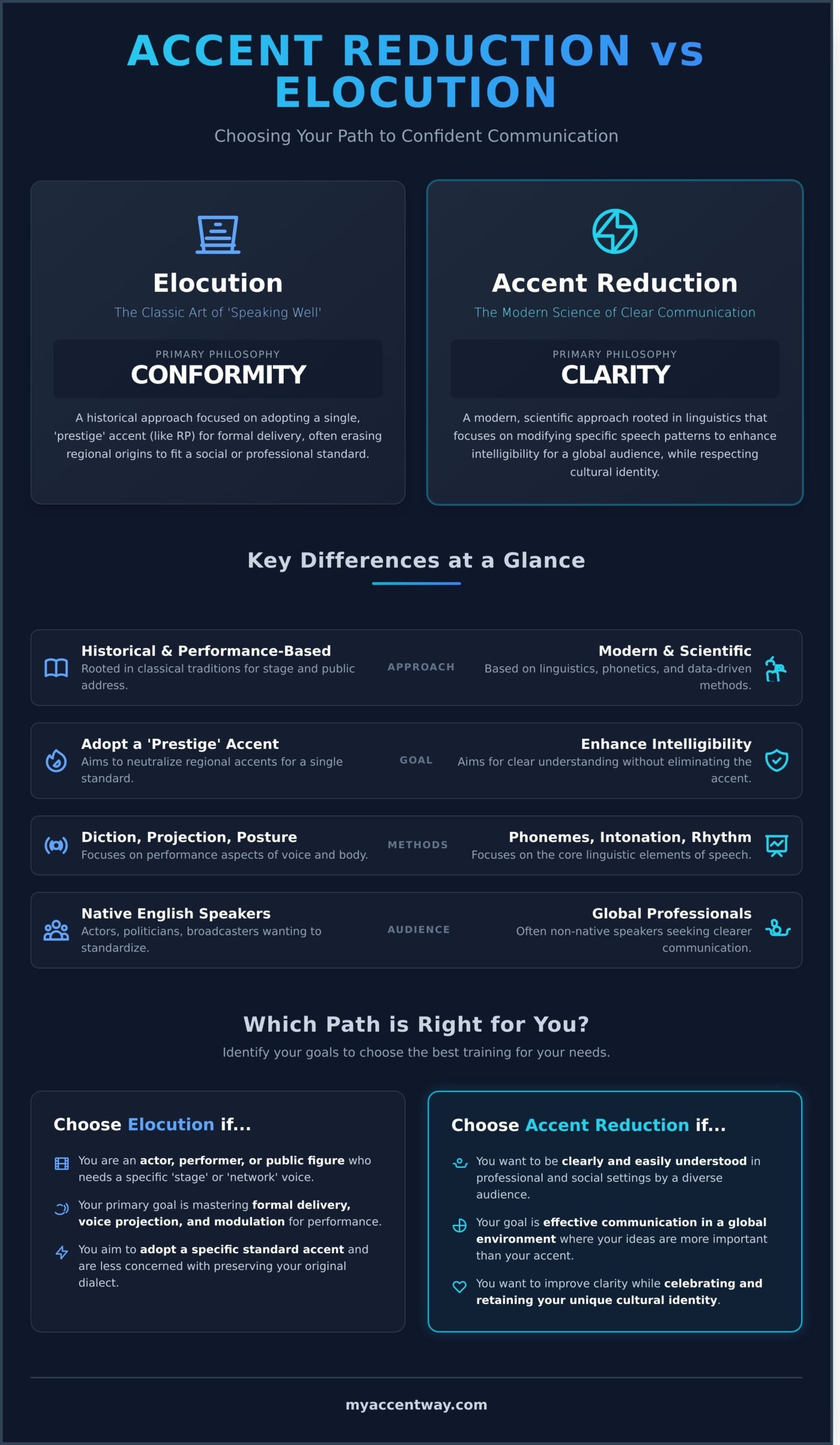
Key Differences at a Glance: A Head-to-Head Comparison
While both elocution and accent reduction involve the conscious practice of speech, their philosophies and goals couldn’t be more different. Understanding the core distinction in the accent reduction vs elocution debate comes down to one question: are you aiming for conformity or for communication? Elocution is the historical predecessor, rooted in social standards, while accent reduction is its modern, scientific evolution, focused on global clarity.
| Feature | Elocution | Accent Reduction |
|---|---|---|
| Primary Goal | Conform to a single, prestigious accent (e.g., Received Pronunciation). | Enhance clarity and mutual understanding with any listener. |
| Target Audience | Historically, native speakers aiming to erase a regional accent. | Primarily non-native speakers and global professionals. |
| Core Methodology | Performance-based drills: posture, breath, recitation, and articulation exercises. | Linguistic science: phonetic analysis, intonation mapping, and rhythm practice. |
| Underlying Philosophy | Prescriptive: There is one “correct” or “proper” way to speak. | Descriptive: Your accent is part of your identity; the goal is confident communication. |
Goal: Conforming to a Standard vs. Enhancing Clarity
The primary objective of elocution was to sound ‘correct’ by adopting a single, high-status accent, effectively erasing any regional or social variations. It was a prescriptive approach rooted in conformity. In contrast, modern accent reduction aims to empower you to be clearly and easily understood by anyone, regardless of their background. This reflects a significant shift toward a descriptive view of language, where the goal isn’t to eliminate your accent but to enhance your communicative confidence.
Audience: Native Speakers vs. Global Professionals
This difference in goals directly reflects the intended audience. Elocution was traditionally for native speakers who wished to change a regional accent to fit into a specific social class or profession. Accent reduction, however, primarily serves non-native speakers and global professionals navigating an English-speaking world. For them, the objective isn’t to sound like someone else but to ensure their brilliant ideas are not lost in translation. This is why top institutions now offer accent modification and communication training to help individuals succeed in academic and workplace settings.
Methodology: Performance Art vs. Applied Linguistics
Elocution methods were often theatrical, focusing on breath control, posture, vocal drills, and the recitation of poetry or prose. While beneficial for public speaking, these techniques lack a scientific foundation for accent modification. Modern accent reduction is grounded in applied linguistics. A skilled linguist uses phonetic analysis to pinpoint specific challenges with vowels and consonants, maps intonation patterns, and designs targeted rhythm exercises. This scientific approach, central to effective American accent training, ensures your progress is efficient, measurable, and tailored to your unique voice.
How to Choose Your Path: Which Training Is Right For You?
Navigating the choice between accent reduction vs elocution is a personal journey that depends entirely on your unique goals. One path focuses on mastering the specific sounds and rhythms of a new accent for clarity, while the other hones the art of delivery and persuasive speech. To find your answer, you must first define what success looks like for you.
Ask Yourself These 4 Questions to Find Your Answer
Reflecting on your motivations will bring immediate clarity. Consider these key points to determine whether accent reduction or elocution aligns with your aspirations:
- What is my primary goal? If you aim for powerful, persuasive delivery in public speaking, elocution is your tool. If your goal is to be clearly understood in daily professional and personal conversations, accent reduction is the direct path to achieving that.
- Am I a native or non-native English speaker? Elocution is often pursued by native speakers to refine their speech. Accent reduction is specifically designed for non-native speakers looking to master the phonemes, intonation, and rhythm of a new accent, like the American accent.
- Do I want to conform or enhance? Traditional elocution can focus on adopting a specific “standard” of speech. Modern accent training, however, is about enhancing your existing speech with new skills for greater clarity and impact.
- Is this a performance skill or a career tool? Think of elocution as a performance art for actors or broadcasters. Accent reduction is a practical communication tool for professionals-engineers, doctors, and executives-who need to convey their expertise with confidence.
Will I Lose My Accent? A Common Myth Debunked
A common fear is that accent training will erase your identity. This is a myth. The goal of modern accent reduction is not subtraction, but addition. You are learning a new skill that allows you to “code-switch”-to adapt your speech for different contexts, whether in a boardroom or at home with family. A quality coach respects your cultural and linguistic background. This is central to our ‘Your CULTURE MATTERS’ philosophy at American Accent Program, where we empower you, not change who you are.
What to Look For in a High-Quality Program
Once you’ve chosen your path, seek a program built on expertise and support. Look for these key markers of quality:
- Expertise: Is the coach a certified linguist or speech-language pathologist with a deep, scientific understanding of phonetics?
- Personalization: Does the program offer a one-on-one, individualized plan tailored to your specific speech patterns and goals?
- Focus on Confidence: The ultimate objective should be confident, effective communication-not an unattainable standard of “perfection.”
This focus on scientific expertise and personalized support is why our American accent training program is led by a Ph.D. Linguist, guaranteeing a method that is both effective and empowering.
Your Voice, Your Choice: The Path to Confident Speaking
Whether you’ve explored the classic art of elocution or the modern science of accent reduction, the key takeaway is clear: your personal goals dictate your path. Elocution shapes your delivery for performance and style, while accent reduction hones your pronunciation for clarity in professional and social settings. Ultimately, the debate of accent reduction vs elocution is less about which is superior and more about which is the right tool for your unique ambitions.
If your goal is to communicate with clarity and master the American accent, a scientific, personalized approach is essential. Our training, led by a Ph.D. Linguist, provides personalized, one-on-one coaching that focuses on tangible progress. We are so confident in our proven method that we offer a Success Guarantee for measurable results.
Ready to Speak with Confidence? Discover Our Proven Method. Your journey to becoming a more effective and self-assured speaker begins today. Take the first step and let your true voice be heard.
Frequently Asked Questions
Is elocution the same as accent softening or accent modification?
No, they are fundamentally different. The debate of accent reduction vs elocution highlights a shift from outdated performance-based training to modern, science-backed methods. Elocution is an older term focused on formal, often theatrical, public speaking. In contrast, modern accent modification is a linguistic-based approach designed to enhance clarity, build confidence, and help you master the specific sounds and rhythms of an accent, like the American Accent, for effective everyday communication.
Can you completely lose your original accent with this training?
Our goal is not to “lose” your accent, as it’s a vital part of your identity and culture. Instead, our proven method, guided by a Ph.D. Linguist, empowers you to gain control and mastery over your speech. You will learn to produce the sounds and intonation of a standard American Accent so effectively that you can choose how you want to speak. This is about adding a powerful communication skill, not erasing who you are.
How long does accent reduction training typically take?
The timeline for mastering an American Accent is a personal journey, but our students achieve remarkable results efficiently. With our structured, science-based curriculum and dedicated practice, most learners report a significant boost in confidence and clarity within just 3 to 4 months. Consistent application of our techniques is the key to unlocking rapid and lasting success, and we provide the expert guidance to guarantee your progress every step of the way.
What is the difference between accent reduction and learning English (ESL)?
ESL (English as a Second Language) training focuses on building foundational skills: grammar, vocabulary, and basic conversation. Accent reduction is the next step for fluent English speakers who want to achieve a higher level of mastery. Our programs concentrate on the nuanced phonemes, intonation, rhythm, and stress patterns of the American Accent. It is specialized training designed to refine your pronunciation for ultimate clarity and professional polish.
Can I learn an American accent effectively through online courses?
Absolutely. Modern online training, when structured by a linguistic expert, is incredibly effective. Our program uses advanced tools like 2D Sound Motion Technology to provide precise, personalized feedback that was once only possible in person. An online format offers the flexibility to learn from a world-class Ph.D. Linguist from anywhere in the world, ensuring you receive the highest quality instruction needed to confidently master the American Accent.
Is there a ‘best’ accent to have for professional success?
The most powerful accent for professional success is one that is clear, confident, and universally understood. While there is no single “best” accent, mastering a standard accent, such as the General American Accent, is a proven strategy for enhancing communication in international business and global industries. The ultimate goal is not to sound like someone else, but to ensure your ideas are heard with the clarity and authority they deserve.
Disclaimer – American Accent Program
The American Accent Program available through Visit Program Website
is an educational and coaching service designed to support pronunciation, accent reduction, and spoken English fluency. All training materials, including lessons, exercises, audio content, visual simulations, coaching methods, and digital resources, are the intellectual property of American Accent Program, LLC and are protected by applicable copyright and intellectual property laws.
By using this website and participating in the program, you acknowledge that all content is provided for personal, non-commercial, educational use only. Users are granted a limited, non-transferable license to access the materials strictly for individual learning purposes. Redistribution, reproduction, recording, modification, sharing, or commercial use of any program content without prior written consent is strictly prohibited.
The program may include live coaching sessions, digital tools, and instructional materials intended to improve pronunciation and communication skills. However, individual results may vary, and no specific level of fluency, accent reduction, or communication outcome is guaranteed.
The American Accent Program and its instructors do not provide medical, therapeutic, or clinical speech-language pathology services. All training is intended for educational purposes only.
By accessing or using the program, you agree to comply with all applicable terms, including the platform’s Terms of Use and Course Policies, and acknowledge that misuse of materials may result in termination of access without refund.
Speech clarity check
The problem is not always grammar or vocabulary.
If people understand your words but still miss your message, the deeper issue may be speech clarity, rhythm, intonation, and American pronunciation habits. MyAccentWay helps students retrain the sound system with professional 1-on-1 guidance, so English can feel clearer, freer, and more natural in real communication.
Why MyAccentWay works
Two training methods that make speech change active.
MyAccentWay is not passive listen-and-repeat coaching. Prof. Alex, Ph.D. Accent Coach, Doctor of Education, and professional linguist, creates a learning situation where students become active learners and active participants in changing their own speech patterns.
Interactive training
Students do not just receive pronunciation instructions passively. They listen, think, compare, adjust, and understand their own speech patterns while Prof. Alex guides the correction process.
U.S. & Canada online accent training
Accent Reduction vs. Elocution: What’s the Difference & Which Is for You? for professionals in the United States and Canada
This guide is useful for advanced English speakers, entrepreneurs, international professionals, and students in the U.S. and Canada who want clearer American pronunciation, stronger rhythm, better intonation, and more confident communication in meetings, interviews, presentations, and client conversations.
Prof. Alex, Ph.D. Accent Coach, Doctor of Education, and professional linguist, teaches online 1-on-1 American accent training for learners in major professional markets including New York, Los Angeles, San Francisco Bay Area, Seattle, Austin, Dallas, Houston, Chicago, Boston, Washington, D.C., Miami, Toronto, Vancouver, Montreal, Calgary, and Ottawa.
1-on-1 Accent Reduction Training helps students move beyond self-practice and build clearer American speech habits through interactive and cognitive accent training.
Cognitive accent training
Students learn to notice and correct the speech patterns that affect American pronunciation, then implement new American speech patterns into their code-switching process for more natural, long-lasting change.
Your next step
Build speech habits people can hear in real conversations.
A stronger American accent is not built by memorizing topics or chasing quick pronunciation tips. It comes from structured training, professional feedback, active correction, and repeated application until clearer speech becomes easier to keep.