Voice clarity exercises are targeted physical drills designed to refine the coordination of your articulators, allowing you to communicate with precision and authority in professional settings. For international professionals, these exercises are a vital component of successful accent reduction and specialized pronunciation coaching. By integrating American accent training into your daily routine, you can ensure your speech is crisp and rhythmic, effectively removing the barriers that lead to listener confusion and repetitive questioning during important presentations.
I’m Prof. Alex Obskov, Ph.D. Linguist, and I’ve dedicated my career to helping students master the American accent through a science-backed, sound-by-sound method. Studies indicate that professionals often see a marked improvement in their communication confidence within 8 to 12 weeks of focused practice. Using our proprietary 2D Sound Motion Technology, you will learn to visualize your progress and release the physical tension that often leads to vocal fatigue. This guide offers the practical techniques and linguistic insights needed to achieve your communication goals and project a powerful executive presence.
Key Takeaways
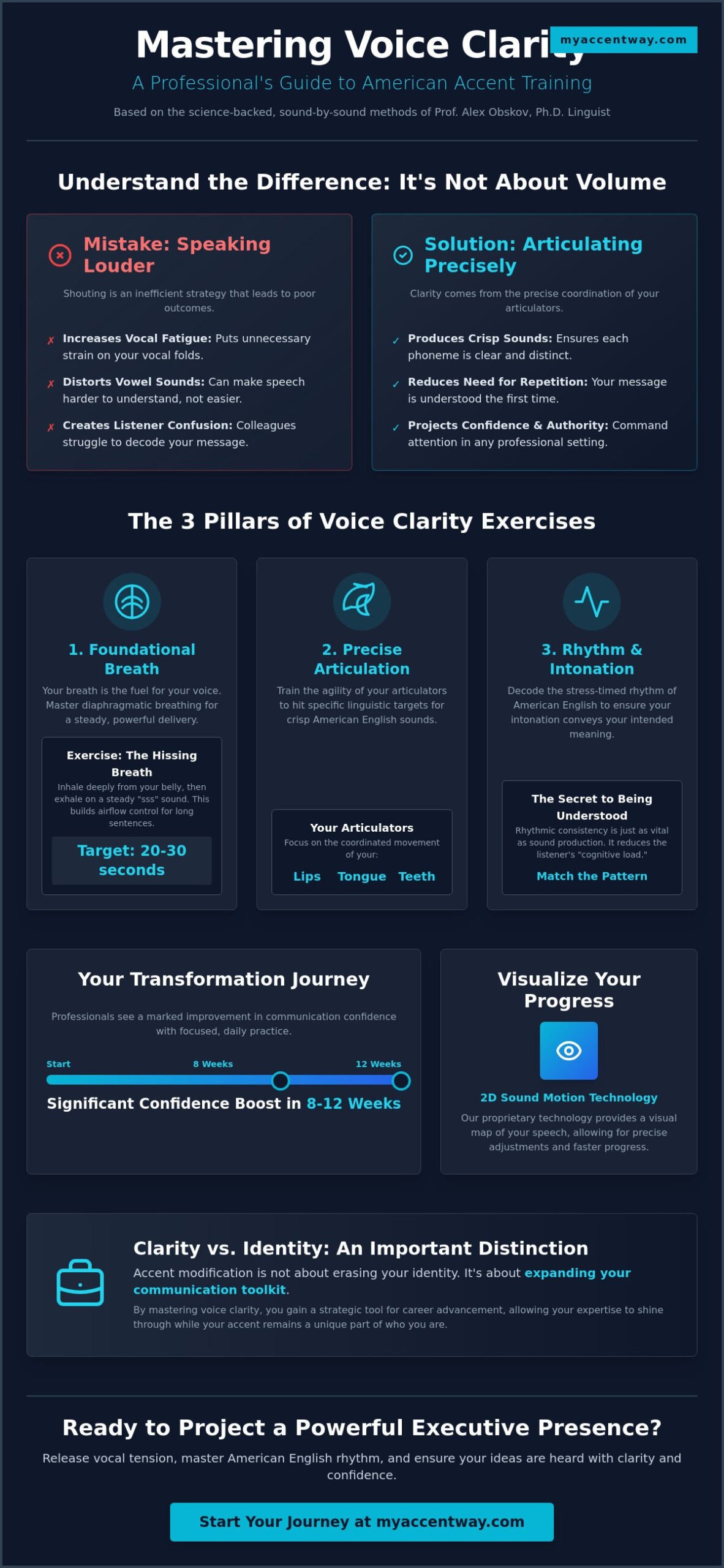
- Understand the vital distinction between speaking louder and articulating precisely to command attention in corporate environments.
- Implement daily voice clarity exercises designed to release vocal tension and harness diaphragmatic breathing for a steady, confident delivery.
- Master the coordination of your articulators—the lips, tongue, and teeth—to produce crisp American English sounds that reduce the need for repetition.
- Decode the stress-timed rhythm of American English to ensure your intonation conveys your intended meaning accurately and professionally.
- Explore how 2D Sound Motion Technology provides a visual map of your speech, allowing for precise adjustments and faster progress in your accent reduction journey.
Understanding Voice Clarity: Why Mechanics Matter for Professionals
Speech clarity is not simply a matter of speaking louder or slower. It is a precise physical coordination involving phoneme production and rhythmic consistency. For many international professionals, the frustration of being asked to repeat themselves in meetings stems from a breakdown in these mechanics rather than a lack of volume. Prof. Alex Obskov, Ph.D. Linguist, approaches this challenge through the lens of linguistic science, focusing on how the mechanics of the human voice function during high-stakes communication. True clarity is the successful transmission of intended sounds from the speaker to the listener without distortion.
In a corporate environment, there is a distinct difference between volume and articulation. Shouting often increases vocal fatigue and can even make speech more difficult to understand by distorting vowel sounds. Articulation, however, relies on the agility of your articulators. When you engage in targeted voice clarity exercises, you’re training your brain and muscles to hit specific linguistic targets. This technical precision ensures that your colleagues focus on your ideas rather than struggling to decode your sounds. Many professionals find that within 8 to 12 weeks of focused American accent training, their ability to command a room increases significantly because the physical effort of speaking decreases.
The Science of Speech Clarity
The human brain is wired to seek patterns. When speech is muffled or phonemes are misplaced, the listener’s brain must work harder to fill in the gaps. This creates a high “cognitive load,” which can lead to listener fatigue and a loss of interest in the topic. Scientific studies in linguistics show that rhythmic consistency is just as vital as sound production. If the timing of your speech doesn’t match the expected patterns of American English, the listener’s processing speed slows down. Speech clarity is defined as the successful transmission of intended sounds through precise physical execution.
Clarity vs. Identity: The Accent Modification Approach
A common misconception is that improving clarity requires you to “lose” your native accent or erase your cultural identity. This couldn’t be further from the truth. Accent modification is about expanding your communication toolkit, not replacing who you are. It is a strategic move for career advancement that builds executive presence. By mastering voice clarity exercises, you gain the confidence to speak up in Austin boardrooms or during virtual presentations across Texas. This professional clarity allows your expertise to shine through, ensuring that your accent remains a part of your unique identity while never acting as a barrier to your success.
Foundational Voice Clarity Exercises: Breath and Tension Release
Before you can master the intricate sounds of American English, you must prepare the physical engine that produces them. Speech is a physical act, and like any athletic endeavor, it requires proper fuel and a lack of restrictive tension. In my work as a linguist, I often see professionals struggle with clarity because they’re trying to speak from the throat rather than the core. By incorporating foundational voice clarity exercises into your morning routine, you’ll create the necessary resonance to be heard without straining your vocal folds.
Diaphragmatic Breathing for Speech Support
Think of your breath as the fuel for your voice. Most people use shallow chest breathing, which provides inconsistent air pressure and leads to “vocal fry” or trailing off at the end of sentences. To practice diaphragmatic breathing, place one hand on your belly and inhale slowly through your nose. You should feel your hand move outward while your shoulders stay still. This “belly breath” allows for sustained speech and a more authoritative tone.
To build control, try the hissing breath exercise. Inhale deeply, then exhale on a steady “sss” sound. Use a stopwatch to see how long you can maintain a consistent, unwavering hiss. Aim for 20 to 30 seconds. This specific training helps you manage airflow during long, complex sentences in professional presentations. It prevents the common “trailing off” effect where the most important words at the end of a phrase become unintelligible. If you’re looking to integrate these habits into a structured routine, you might explore our American Accent Training Program and Accent Reduction Curriculums designed for busy professionals.
Jaw and Tongue Tension Release
Physical tension in the jaw, tongue root, and shoulders acts as a muffler for your voice. If your jaw is tight, you can’t achieve the open positions required for American English vowels like the /æ/ in “strategy” or the /ɑ/ in “project.” One of the most effective voice clarity exercises is the “Yawn-Sigh.” Gently begin a yawn to drop the larynx and open the throat, then let out a soft, relaxed sigh. This immediately resets the vocal apparatus.
You should also practice gentle jaw massages and tongue circles. Close your eyes and use your fingertips to massage the joint where your jaw meets your skull. Follow this by circling your tongue around the inside of your lips five times in each direction. These movements improve the flexibility needed for crisp articulation. For additional academic resources on vocal health, these Articulation and Voice Exercises from William & Mary offer excellent supplementary drills. A 2-minute daily routine consisting of 30 seconds of belly breathing, 30 seconds of hissing, and a minute of tension release will significantly reduce vocal fatigue and prepare you for a full day of meetings.
Daily Articulation Drills for American English Clarity
Your breath provides the power, but your articulators provide the precision. To communicate effectively in a professional environment, you must master the coordination of your lips, teeth, tongue, and the alveolar ridge. Many students come to me after trying fast tongue twisters, only to find their speech becomes more “mushy.” I advocate for slow, deliberate voice clarity exercises that prioritize accuracy over speed. This method, rooted in the study of American Sounds, ensures that every phoneme you produce is distinct and recognizable to your listeners.
Prof. Alex Obskov, Ph.D. Linguist, emphasizes that articulation is a fine motor skill. Just as an athlete trains specific muscle groups, a professional must train the muscles of the face and mouth. When you practice slowly, you build the neural pathways necessary for consistent speech clarity. While you increase the intensity of your drills, it’s vital to protect your instrument. You can find excellent advice on maintaining your physical speaking tools in the NIDCD’s Guide to Vocal Health, which offers science-backed tips for vocal care.
The “Lip and Tongue” Workout
Start your routine with P-B-T-D drills. These are “stop consonants” that require a clean release of air. Repeat the sequence “Pa-Ba-Ta-Da” ten times, focusing on the sharp “pop” of the P and B sounds. Follow this with a lip trill, blowing air through relaxed lips to create a vibrating sound. This connects your breath support to your articulators without adding strain. Finally, practice exaggerated vowel stretching. Move your mouth fully for the “ee” in “meet” and the “ah” in “father.” This prevents the common pitfall of “lazy” articulation that often occurs during long workdays.
Mastering the Alveolar Ridge Sounds
The alveolar ridge is the firm, bony area directly behind your upper front teeth that serves as the primary contact point for many crisp English consonants. Sounds like [t], [d], [n], and [l] all rely on precise tongue placement against this ridge. If your tongue is too flat or too far back, these sounds become muffled. Practice the “T-D-N-L” sequence, ensuring the tip of your tongue taps the ridge firmly and quickly.
Another area where clarity often falters is the “th” sound. In American English, this requires the tongue to peeking slightly between the teeth. Many international professionals substitute this with a “d” or “z” sound, which can change the meaning of a word entirely. If you’re ready to refine these specific placements through a structured program, our American accent training provides the sound-by-sound guidance needed for lasting improvement. Consistent practice of these voice clarity exercises will ensure your speech remains crisp, even in high-pressure situations.
Rhythm and Intonation: The Secret to Being Understood
Even if you master every individual consonant and vowel, your speech might still feel “off” to a native listener if the rhythm is incorrect. American English is a stress-timed language. This means that we squeeze unstressed syllables into a shorter timeframe while stretching out the stressed ones. If you give every syllable equal weight, your speech will sound robotic or “choppy.” This rhythmic pattern is a core focus of our voice clarity exercises because it directly impacts how easily others can follow your train of thought during a fast-paced meeting.
The secret to this natural rhythm is the “Schwa” sound (/ə/). It is the most common sound in American English, appearing in almost every multi-syllable word. By reducing unstressed vowels to this neutral, relaxed sound, you create the contrast necessary for clear communication. Prof. Alex Obskov, Ph.D. Linguist, teaches that mastering the Schwa is the fastest way to improve your overall flow. For a deeper dive into these rhythmic mechanics, I recommend exploring our American Accent Training for U.S. Professionals guide.
Word Stress and Sentence Emphasis
To visualize word stress, I often suggest the “Rubber Band” method. Imagine holding a rubber band between your hands. When you reach the stressed syllable of a word, pull the band apart. This physical motion reminds you to make that syllable longer, louder, and higher in pitch. For example, in the word “strategy,” the stress is on the first syllable. In professional presentations, you can use this same principle to highlight key data points. Shifting the emphasis in a sentence can change its entire meaning. Consider the difference between “I didn’t say he stole the money” and “I didn’t say he stole the money.” The first implies someone else said it; the second implies he stole something else.
The Flow of Speech: Linking and Reductions
Native speakers don’t stop between every word. Instead, they use “Linked Sounds” to create a smooth, continuous stream of speech. When a word ends in a consonant and the next begins with a vowel, the consonant often slides over. “Pick up” sounds like “pi-kup.” “Turn on” sounds like “tur-non.” Choppy speech, where every word is isolated, is often perceived as less clear because it forces the listener’s brain to work harder to connect the ideas.
You can practice this by reading a short paragraph and intentionally drawing a line between words that should link. This is one of the most effective voice clarity exercises for developing a more fluid executive presence. If you want to see these links in action, you can Book Your 1 Hour Accent Training Session to observe how we use technology to map these speech patterns.
Visualizing Your Progress with 2D Sound Motion Technology
Traditional methods of improving speech often rely on a mirror, but that only shows the surface. True clarity is achieved through internal precision. At My Accent Way, we use 2D Sound Motion Technology to give you a clear view of what’s happening inside your mouth. This revolutionary tool transforms abstract concepts into visual targets, making your voice clarity exercises significantly more productive. By seeing the exact position of your tongue and the motion of your jaw, you remove the guesswork from your practice.
This technology is especially beneficial for international professionals who need to master the nuance of American Sounds. Whether you are in Austin, Round Rock, or attending sessions online across Texas, the ability to “see” your progress provides a level of certainty that audio-only coaching cannot match. You can easily find American accent training near me that utilizes these advanced simulators to accelerate your results and boost your professional presence.
Beyond the Mirror: Visualizing Articulation
2D Sound Simulators for American Sounds show tongue placement and movement in real-time. This visual feedback is vital for developing the muscle memory required for crisp articulation. Prof. Alex Obskov’s proprietary methods combine linguistic science with this tech-driven approach to ensure you aren’t just repeating sounds, but mastering the mechanics behind them. Seeing the “motion” of a sound helps you correct errors that are often invisible to the naked eye, leading to faster improvement in your accent reduction journey.
Your Personalized Clarity Roadmap
Your journey begins with a comprehensive initial assessment. We identify your specific clarity “blind spots,” such as subtle vowel distortions or inconsistent word stress. From there, we build a personalized roadmap that fits into your busy schedule. A consistent 15-minute daily routine, guided by our 2D simulators, is more effective than long, infrequent practice sessions. These targeted voice clarity exercises ensure that your practice is always high-quality. I invite you to explore our private accent reduction classes or Book Your 1 Hour Accent Training Session today to experience this technology firsthand and start your path toward confident, clear communication.
Step Into Your Most Confident Professional Self
Mastering your speech is a journey of personal and professional transformation. By focusing on the scientific mechanics of articulation and the rhythmic stress patterns of the American accent, you ensure your expertise is always the center of attention. We’ve explored how targeted voice clarity exercises, combined with the power of 2D Sound Motion Technology, can reduce vocal fatigue and build a lasting executive presence. This method moves beyond the surface to refine the cognitive and analytical processes behind clear communication.
As Prof. Alex Obskov, Ph.D. Linguist, I’ve seen how these science-backed techniques empower international professionals to lead meetings with newfound authority. Our approach focuses on your growth. With our proprietary technology and a Success Guarantee, you can confidently invest in your future. It’s time to let your expertise shine through without the barrier of physical tension or muffled sounds. Book your personalized accent assessment with Prof. Alex Obskov, Ph.D. today! and start speaking with the clarity you deserve. Your voice is your most powerful tool; let’s make it work for you.
Frequently Asked Questions
How long does it take to see results from voice clarity exercises?
Most professionals see significant improvements in their speech clarity within 8 to 12 weeks of consistent practice. This duration allows for the development of the muscle memory and neural pathways necessary for lasting change. While you’ll likely feel a reduction in vocal tension after your first few voice clarity exercises, achieving consistent results in high-stakes meetings requires a dedicated, sound-by-sound approach over several months.
Can I improve my clarity without removing my cultural identity?
Yes, because accent modification focuses on expanding your communication toolkit rather than erasing your background. True speech clarity ensures your expertise is understood without listener confusion, allowing your unique cultural voice to remain a professional asset. By mastering specific American sounds, you gain the flexibility to communicate confidently in any U.S. corporate environment while maintaining your personal identity.
Do I need special equipment to practice at home?
You don’t need any specialized hardware, but a consistent 15-minute daily routine is vital for professional growth. Success in voice clarity exercises comes from frequency and precision rather than expensive tools. However, integrating our 2D Sound Simulators for American Sounds into your practice offers a visual roadmap that is much more effective than a standard mirror for verifying tongue placement.
What is the most common clarity mistake for international professionals?
The most frequent error is applying equal weight to every syllable, which ignores the stress-timed rhythm of American English. This often results in the omission of the “Schwa” sound, making speech sound choppy and difficult for native listeners to process. Correcting your word stress and intonation is often more impactful for your overall clarity than mastering any single consonant or vowel sound.
How does 2D Sound Motion Technology differ from watching YouTube videos?
This technology provides a visual map of the internal articulators, whereas standard videos only show the external view of a speaker’s face. 2D Sound Motion Technology allows you to see exactly how your tongue and jaw move in real-time. This scientific visualization removes the guesswork from your practice, helping you hit linguistic targets with a level of precision that generic video tutorials cannot provide.
Disclaimer – American Accent Program
The American Accent Program available through Visit Program Website
is an educational and coaching service designed to support pronunciation, accent reduction, and spoken English fluency. All training materials, including lessons, exercises, audio content, visual simulations, coaching methods, and digital resources, are the intellectual property of American Accent Program, LLC and are protected by applicable copyright and intellectual property laws.
By using this website and participating in the program, you acknowledge that all content is provided for personal, non-commercial, educational use only. Users are granted a limited, non-transferable license to access the materials strictly for individual learning purposes. Redistribution, reproduction, recording, modification, sharing, or commercial use of any program content without prior written consent is strictly prohibited.
The program may include live coaching sessions, digital tools, and instructional materials intended to improve pronunciation and communication skills. However, individual results may vary, and no specific level of fluency, accent reduction, or communication outcome is guaranteed.
The American Accent Program and its instructors do not provide medical, therapeutic, or clinical speech-language pathology services. All training is intended for educational purposes only.
By accessing or using the program, you agree to comply with all applicable terms, including the platform’s Terms of Use and Course Policies, and acknowledge that misuse of materials may result in termination of access without refund.
Speech clarity check
The problem is not always grammar or vocabulary.
If people understand your words but still miss your message, the deeper issue may be speech clarity, rhythm, intonation, and American pronunciation habits. MyAccentWay helps students retrain the sound system with professional 1-on-1 guidance, so English can feel clearer, freer, and more natural in real communication.
Why MyAccentWay works
Two training methods that make speech change active.
MyAccentWay is not passive listen-and-repeat coaching. Prof. Alex, Ph.D. Accent Coach, creates a learning situation where students become active learners and active participants in changing their own speech patterns.
Interactive training
Students do not just receive pronunciation instructions passively. They listen, think, compare, adjust, and understand their own speech patterns while Prof. Alex guides the correction process.
U.S. & Canada online accent training
Mastering Voice Clarity Exercises: A Linguist’s Guide for Professionals for professionals in the United States and Canada
This guide is useful for advanced English speakers, entrepreneurs, international professionals, and students in the U.S. and Canada who want clearer American pronunciation, stronger rhythm, better intonation, and more confident communication in meetings, interviews, presentations, and client conversations.
Prof. Alex, Ph.D. Accent Coach, teaches online 1-on-1 American accent training for learners in major professional markets including New York, Los Angeles, San Francisco Bay Area, Seattle, Austin, Dallas, Houston, Chicago, Boston, Washington, D.C., Miami, Toronto, Vancouver, Montreal, Calgary, and Ottawa.
1-on-1 Accent Reduction Training helps students move beyond self-practice and build clearer American speech habits through interactive and cognitive accent training.
Cognitive accent training
Students learn to notice and correct the speech patterns that affect American pronunciation, then implement new American speech patterns into their code-switching process for more natural, long-lasting change.
Your next step
Build speech habits people can hear in real conversations.
A stronger American accent is not built by memorizing topics or chasing quick pronunciation tips. It comes from structured training, professional feedback, active correction, and repeated application until clearer speech becomes easier to keep.




One Response