What if the key to professional speech clarity isn’t hours of grueling study, but a focused window shorter than your morning commute? Many international professionals find themselves mentally exhausted after high-stakes meetings, worrying that their core message was lost because of pronunciation hurdles. You’ve likely felt the frustration of repeating yourself or the overwhelm of trying to find an effective routine for accent reduction. It’s a common challenge, but mastering your communication shouldn’t feel like a second full-time job.
At MyAccentWay, we’ve developed a science-backed approach that proves you can achieve significant results through a 15-minute daily accent practice. I’m Prof. Alex Obskov, Ph.D. Linguist, and through my specialized pronunciation coaching, I help professionals rewire their brain’s sound-motion pathways for clearer communication. In this guide, we’ll explore how to build a sustainable habit using 2D Sound Motion Technology and a balanced 5-5-5 framework to transform your professional presence with ease and precision.
Key Takeaways
- Learn how neuroplasticity allows you to build new motor pathways for speech clarity through consistent, high-frequency micro-learning sessions.
- Discover the 5-5-5 framework to ensure your 15-minute daily accent practice remains active, balanced, and highly effective for professional communication.
- Utilize 2D Sound Motion Technology to visualize tongue and lip placement for American sounds that are difficult to master by ear alone.
- Identify “trigger moments” in your typical workday to implement habit stacking, making your training a seamless and sustainable part of your schedule.
- Understand the limitations of self-study and how professional coaching provides the targeted, analytical feedback needed to reach your specific communication goals.
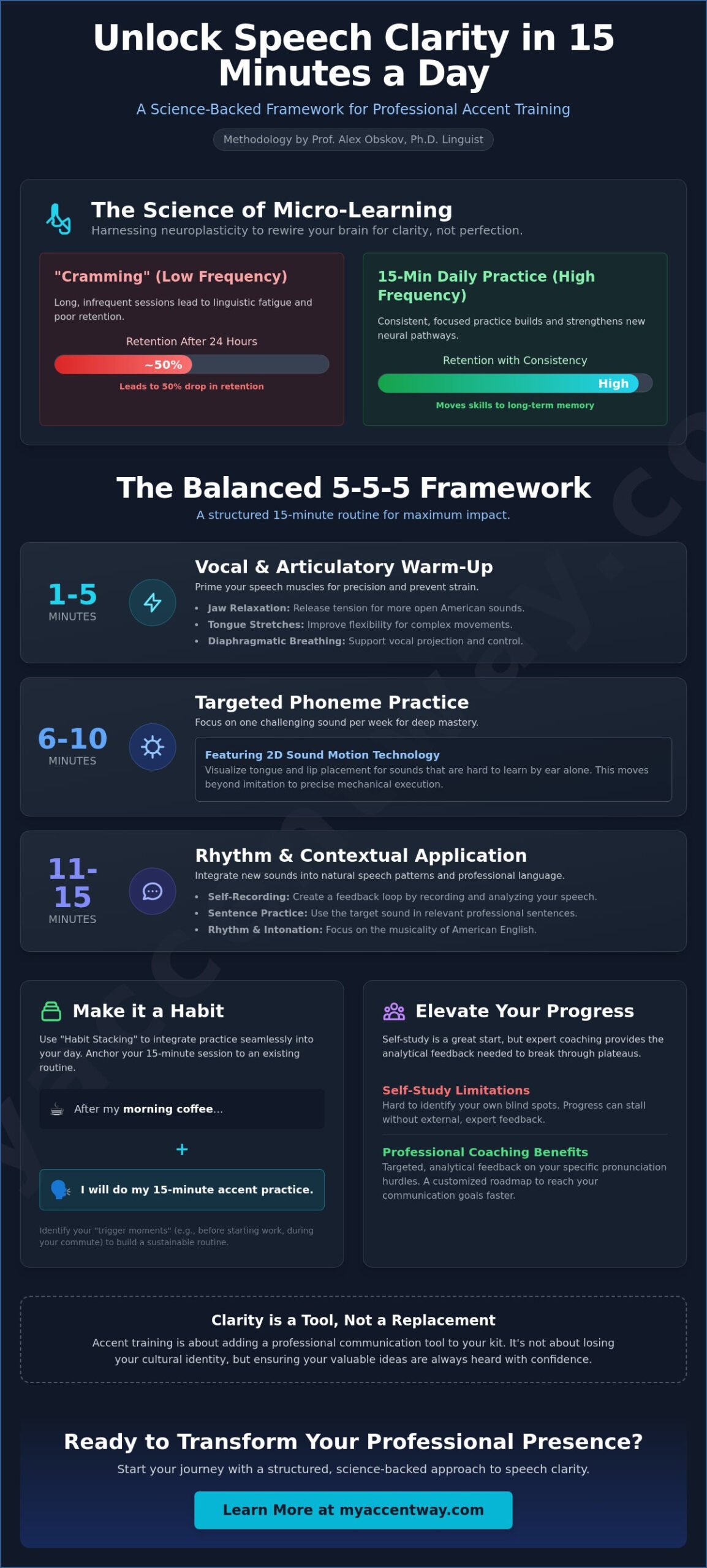
Why 15 Minutes? The Science of Micro-Learning in Accent Training
Effective American accent training isn’t about memorizing lists of words; it’s about a physical transformation of your speech organs. As a Ph.D. Linguist, I’ve observed that the most successful students treat their 15-minute daily accent practice like a workout for the vocal muscles. This process relies on neuroplasticity, the brain’s remarkable ability to reorganize itself by forming new neural connections. When you practice specific phonemes, you aren’t just learning a sound. You’re training your motor cortex to execute precise movements of the tongue, lips, and jaw. This scientific approach to accent modification focuses on building these new motor pathways rather than trying to delete existing ones.
Unlike “cramming” for a test, which leads to rapid forgetting, micro-learning ensures that new sounds move from short-term memory into long-term procedural memory. Cramming often results in a 50% drop in retention within 24 hours. In contrast, 15 minutes of focused practice triggers synaptic pruning, a biological process where the brain strengthens efficient neural connections while eliminating weaker, unused ones to refine your pronunciation. This efficiency is why the global accent reduction market is projected to grow at a CAGR of 16.7% through 2033; professionals are moving away from traditional, long-form classes toward targeted, science-backed methods.
Frequency Over Duration: Rewiring the Adult Brain
High-intensity training often leads to linguistic fatigue, a state where the brain becomes overstimulated and stops absorbing new phonetic patterns. Professionals who try to “cram” their training into a single weekly session find that their progress stalls. The motor cortex requires frequent, repeated stimulation to replace long-standing speech habits. By choosing a consistent 15-minute daily accent practice, you provide your brain with the steady input it needs to master American English sounds without the burnout. Consistency beats intensity every time when you’re modifying speech patterns that have been ingrained for decades.
The Myth of ‘Losing’ Your Identity
Many learners worry that modifying their speech means abandoning their cultural heritage. This is a complete misconception. Your culture matters, and your unique background is an asset, not a deficit. I frame this practice as adding a professional tool to your communication kit rather than subtracting a part of yourself. The goal is speech clarity and confidence, ensuring your ideas are heard in high-stakes meetings without being obscured by pronunciation hurdles. We focus on clarity over “perfection,” helping you navigate professional settings with authority while remaining authentically yourself.
Structuring Your 15-Minute Daily Accent Practice
To transform your speech, you need more than just intent; you need a strategic blueprint. I recommend a balanced 5-5-5 framework for your 15-minute daily accent practice. This structure ensures that you address the physical, analytical, and rhythmic aspects of communication in one efficient burst. This method is deeply rooted in the science of microlearning, which suggests that breaking complex skills into 2-5 minute segments significantly improves long-term retention. By focusing your energy in these short windows, you avoid the cognitive overload that often stops progress.
Active listening is the cornerstone of this framework. Unlike passive listening, where you might have a podcast playing in the background, active listening requires you to analyze the specific mechanics of a sound. I suggest focusing on just one phoneme or rhythm pattern per week. This prevents the “scattergun” approach and allows for deep, focused mastery. To create an effective feedback loop, record yourself on your phone. Listening to your own voice allows you to identify the gap between your current pronunciation and your target sound, facilitating faster self-correction.
Minutes 1-5: The Vocal and Articulatory Warm-Up
Your speech organs are muscles that require a proper warm-up to function with precision. Start by relaxing your jaw; many professionals carry tension here that restricts the “open” sounds characteristic of American English. Practice gentle tongue stretches and diaphragmatic breathing to support better projection. These simple drills prime your articulators, ensuring you’re physically ready to tackle more complex phonetic movements without strain.
Minutes 6-10: Targeted Phoneme and 2D Sound Practice
During this middle segment, dive into a specific target sound, such as the American R or the TH phoneme. This is where precision matters most. Use 2D Sound Simulators for American Sounds to visualize the exact position of the tongue and lips. Seeing the “motion” of the sound provides a cognitive anchor that hearing alone cannot provide. If you feel you need more personalized guidance during this phase, exploring American accent training near me can provide the professional oversight needed to ensure your placement is accurate.
Minutes 11-15: Flow, Intonation, and Rhythm
The final five minutes are dedicated to the “melody” of English. Practice linked sounds, where words blend together, to avoid a choppy or robotic delivery. Apply sentence stress rules to professional phrases you use daily, such as “I’d like to highlight the key findings.” By reading a short corporate paragraph aloud, you bridge the gap between isolated sounds and the natural flow required for high-stakes meetings. This consistent 15-minute daily accent practice builds the muscle memory needed for effortless, clear communication in any professional setting.
Visualizing Sound: Using 2D Sound Motion Technology
Traditional American accent training often relies on a “watch and repeat” method that can be deeply frustrating for international professionals. While looking at a coach’s mouth provides some information, it fails to reveal the complex articulatory movements happening inside the oral cavity. As Prof. Alex Obskov, Ph.D. Linguist, I’ve seen students struggle for months because they couldn’t visualize the specific tongue placement required for sounds like the American R or the subtle Schwa. 2D Sound Motion Technology represents a breakthrough in this field, offering what is essentially an “X-ray” view of the speech process. By seeing the internal motion of the tongue and lips, you move from guessing to knowing exactly how to produce a sound.
The Problem with Traditional ‘Watch and Repeat’
Many sounds in English are “invisible” from the outside. For instance, the distinction between various vowel phonemes often depends on the height of the tongue or the tension in the back of the throat. A mirror cannot show you these nuances. This lack of visual confirmation is why many learners experience mental fatigue; they’re trying to replicate a sound they can hear but cannot physically locate. 2D Sound Simulators for American Sounds bridge this gap by providing a clear, analytical model of speech. This visual feedback reduces the time spent in the “trial and error” phase, allowing you to achieve speech clarity much faster than through auditory imitation alone.
How to Integrate Simulators into Your 15 Minutes
Incorporating this technology into your 15-minute daily accent practice is straightforward and highly effective. I recommend dedicating at least 2 minutes of your core sound block to interacting with a simulator. Focus on one specific sound and compare your own articulatory motion to the professional model provided by the software. This real-time visual feedback allows you to make micro-adjustments to your tongue position that you might not even notice through hearing alone. It’s a precise, detail-oriented way to ensure your practice is accurate every single day.
To make this high-tech practice a permanent part of your life, you can use the concept of Habit Stacking for Professionals. By attaching your use of the simulator to an existing daily routine, like checking your morning emails or having your first cup of coffee, you ensure the habit sticks. In an era where 22% of Y Combinator’s 2025 startup cohort consists of voice agent companies, the demand for clear, professional communication is higher than ever. If you find that self-guided practice isn’t enough, you might consider the benefits of American accent training near me to get personalized feedback from a linguistic expert.
Habit Stacking: Daily Accent Practice for Professionals
Success in accent modification doesn’t require finding extra hours in your day; it requires finding the empty spaces within it. Habit stacking is a powerful psychological strategy where you anchor a new behavior to an established routine. For a busy executive or engineer, this means your 15-minute daily accent practice shouldn’t be a separate task on your to-do list. Instead, it becomes the thing you do while your morning espresso is brewing or while you’re walking from the parking garage to your office. By identifying these “trigger” moments, you ensure your training happens automatically, without the need for intense willpower.
I recommend starting in low-stakes environments to build your confidence. Practice your grocery list or a casual greeting to a neighbor before attempting to use new phonetic patterns in a board meeting. This gradual approach allows your motor cortex to stabilize new movements without the added pressure of professional performance. You’ll find that once a sound becomes habitual in casual conversation, it naturally carries over into your professional life.
The ‘Commute and Coffee’ Routine
Your morning commute is an ideal time for articulatory warm-ups. Use those 10 to 15 minutes in the car to practice jaw relaxation and resonance exercises. Since nobody is watching, you can be as expressive as needed to prime your vocal muscles. If you work from home, the time spent waiting for your coffee to brew is a perfect 2-minute window for intonation drills. These micro-sessions ensure that your 15-minute daily accent practice feels like a natural extension of your existing life rather than an added burden.
Applying Clarity to Meetings and Presentations
The true test of your training is how it performs under pressure. Before a major presentation, spend 2 minutes practicing your opening statement. Focus specifically on linked sounds in English to ensure your delivery is fluid and professional. During slide transitions, take a breath and consciously check your sentence stress. Emphasizing key data points with the correct pitch and duration ensures your audience grasps the most critical information immediately. This level of intentionality transforms a standard report into a commanding performance. If you’re ready to refine these skills with a customized plan, I invite you to explore American accent training near me to work directly with a linguistic expert.
Elevating Your Progress with Expert Coaching
While your 15-minute daily accent practice builds a vital foundation, self-study often hits a natural ceiling. I’ve observed that many professionals reach a plateau where they can no longer objectively analyze their own articulatory movements. At MyAccentWay, I provide the “Intellectual Interaction” necessary to bridge this gap. As Prof. Alex Obskov, Ph.D. Linguist, I help you identify the subtle phonological nuances that an app alone might miss, ensuring your accent reduction efforts translate into real-world results.
Whether you are seeking American accent training in Austin, Texas, or prefer the flexibility of online sessions across Dallas, Houston, and San Antonio, professional guidance keeps your progress on track. Our virtual coaching serves international professionals from Round Rock to the Texas Medical Center, providing the same sound-by-sound precision regardless of your location. This expert oversight ensures that every minute you spend practicing is directed toward your specific communication goals.
When to Seek a Professional Accent Coach
Consistent drills are essential, but high-stakes public speaking often requires a more personalized curriculum. If you find your progress stalling after several months of daily practice, it’s likely time for a specialized plan tailored to your native linguistic background. Professional pronunciation coaching is particularly effective when you need to master complex industry-specific terminology or prepare for a major corporate presentation where clarity is non-negotiable.
The MyAccentWay Difference
Our methodology is built on the belief that “Your CULTURE MATTERS.” We use 2D Sound Motion Technology to refine your speech clarity while honoring your unique identity and background. Because our method is rooted in linguistic science rather than imitation, we offer a Success Guarantee for professionals committed to their growth. I invite you to learn more about our 2D Sound Simulators or Book Your 1 Hour Accent Training Session to experience how an individualized approach can accelerate your journey toward confident communication.
Master Your Communication Journey with American Accent Training
Consistency is the engine of change. By leveraging the science of neuroplasticity through a structured 15-minute daily accent practice, you transform speech from an exhausting mental task into a reliable professional asset. This strategic approach to accent reduction ensures you maintain your cultural identity while achieving the speech clarity required for leadership in your field.
While self-guided study builds the foundation, professional American accent training provides the analytical precision needed for full mastery. Prof. Alex Obskov, Ph.D. Linguist, offers the specialized pronunciation coaching and Success Guarantee that international professionals need to thrive. It’s time to speak with the authority your experience deserves.
Speak English Confidently; Book Your 1 Hour Accent Training Session with Prof. Alex Obskov, Ph.D.
Your voice is your most powerful tool. Start refining it today and watch your professional impact grow.
Frequently Asked Questions
Is 15 minutes of daily accent practice really enough to see results?
Yes, 15 minutes is the optimal duration for the adult brain to absorb new phonetic patterns without reaching a state of cognitive overload. Research into the science of micro-learning suggests that short, high-frequency bursts are significantly more effective for motor skill acquisition than long, infrequent sessions. This consistent 15-minute daily accent practice allows your motor cortex to build and reinforce the neural pathways required for lasting speech clarity.
How soon will I notice an improvement in my speech clarity?
Most international professionals notice a measurable shift in their communication within 30 to 60 days of consistent training. While individual progress depends on your specific linguistic background, the cumulative effect of daily sessions often leads to a noticeable reduction in requests for repetition by the second month. Your internal confidence usually increases first as you become more aware of your own articulatory movements during high-stakes meetings.
Do I need special equipment for my daily accent reduction practice?
You don’t need expensive hardware, but a smartphone and a mirror are essential for recording yourself and providing immediate visual feedback. For the most precise results, I recommend using 2D Sound Simulators for American Sounds to visualize tongue and lip placement. This technology provides the “X-ray” view necessary to master sounds that are invisible from the outside, making your 15-minute daily accent practice much more effective.
Can I practice my American accent while driving or multi-tasking?
You can certainly perform vocal warm-ups and intonation drills while driving, but core phoneme practice requires your undivided attention. Mastering complex American sounds involves a high degree of analytical focus and often requires visual confirmation. While habit stacking is a great way to ensure consistency, you should dedicate at least five minutes of your routine to focused, single-task training to ensure your articulatory placement is accurate.
What should I do if I miss a day of practice?
If you miss a session, simply resume your routine the following day without trying to “double up” your practice time. The goal of accent modification is to build a sustainable, long-term habit rather than cramming hours of study into a single weekend. Missing one day won’t erase your progress, but returning to your 15-minute daily accent practice immediately is vital for maintaining the momentum of neuroplasticity.
How do I know which sounds I should focus on during my 15 minutes?
You should prioritize the sounds that occur most frequently in your professional vocabulary or those that cause the most misunderstandings. For many learners, this includes high-impact sounds like the American R, the TH phonemes, or the Schwa vowel. A professional assessment from a Ph.D. Linguist can provide a clear roadmap, ensuring you spend your time on the specific sounds that will yield the greatest improvement in your clarity.
Disclaimer – American Accent Program
The American Accent Program available through Visit Program Website
is an educational and coaching service designed to support pronunciation, accent reduction, and spoken English fluency. All training materials, including lessons, exercises, audio content, visual simulations, coaching methods, and digital resources, are the intellectual property of American Accent Program, LLC and are protected by applicable copyright and intellectual property laws.
By using this website and participating in the program, you acknowledge that all content is provided for personal, non-commercial, educational use only. Users are granted a limited, non-transferable license to access the materials strictly for individual learning purposes. Redistribution, reproduction, recording, modification, sharing, or commercial use of any program content without prior written consent is strictly prohibited.
The program may include live coaching sessions, digital tools, and instructional materials intended to improve pronunciation and communication skills. However, individual results may vary, and no specific level of fluency, accent reduction, or communication outcome is guaranteed.
The American Accent Program and its instructors do not provide medical, therapeutic, or clinical speech-language pathology services. All training is intended for educational purposes only.
By accessing or using the program, you agree to comply with all applicable terms, including the platform’s Terms of Use and Course Policies, and acknowledge that misuse of materials may result in termination of access without refund.
Speech clarity check
The problem is not always grammar or vocabulary.
If people understand your words but still miss your message, the deeper issue may be speech clarity, rhythm, intonation, and American pronunciation habits. MyAccentWay helps students retrain the sound system with professional 1-on-1 guidance, so English can feel clearer, freer, and more natural in real communication.
Why MyAccentWay works
Two training methods that make speech change active.
MyAccentWay is not passive listen-and-repeat coaching. Prof. Alex, Ph.D. Accent Coach, creates a learning situation where students become active learners and active participants in changing their own speech patterns.
Interactive training
Students do not just receive pronunciation instructions passively. They listen, think, compare, adjust, and understand their own speech patterns while Prof. Alex guides the correction process.
U.S. & Canada online accent training
The 15-Minute Daily Accent Practice: A Professional’s Guide to Speech Clarity for professionals in the United States and Canada
This guide is useful for advanced English speakers, entrepreneurs, international professionals, and students in the U.S. and Canada who want clearer American pronunciation, stronger rhythm, better intonation, and more confident communication in meetings, interviews, presentations, and client conversations.
Prof. Alex, Ph.D. Accent Coach, teaches online 1-on-1 American accent training for learners in major professional markets including New York, Los Angeles, San Francisco Bay Area, Seattle, Austin, Dallas, Houston, Chicago, Boston, Washington, D.C., Miami, Toronto, Vancouver, Montreal, Calgary, and Ottawa.
1-on-1 Accent Reduction Training helps students move beyond self-practice and build clearer American speech habits through interactive and cognitive accent training.
Cognitive accent training
Students learn to notice and correct the speech patterns that affect American pronunciation, then implement new American speech patterns into their code-switching process for more natural, long-lasting change.
Your next step
Build speech habits people can hear in real conversations.
A stronger American accent is not built by memorizing topics or chasing quick pronunciation tips. It comes from structured training, professional feedback, active correction, and repeated application until clearer speech becomes easier to keep.




2 Responses