
Article by
Prof. Alex., Ph.D. Accent Coach
Doctor of Education, Professional Linguist,
Creator of 2D Sound Motion Technology,
Creator of “InPronunci:" American Accent Program App,
Professor of English as a Second Language,
American Accent Coach,
Life Coach.
Have you ever noticed that the person who gets the most buy-in during a meeting isn’t always the one with the best data, but the one with the most convincing delivery? It’s incredibly frustrating to be interrupted or to feel that your accent is overshadowing the brilliance of your message. You’ve done the work and you have the facts, yet sounding hesitant can make your expertise feel invisible in a high-stakes professional setting.
I understand how it feels to have your ideas sidelined because of a lack of vocal authority. That’s why I’ve developed a method to help you master how to sound more persuasive in English by focusing on the linguistic mechanics of confidence. You’ll learn how to command the room and ensure your contributions are respected and acted upon every time you speak.
This guide breaks down the science of speech clarity, exploring how Prof. Alex Obskov, Ph.D. Linguist, uses 2D Sound Motion Technology to help international professionals find their powerful voice. We’ll look at the specific intonation patterns and rhythmic shifts that signal authority, giving you a clear roadmap to professional growth through better communication.
Key Takeaways
- Learn why “Falling Intonation” signals certainty and how to avoid the “uptalk” that can undermine your professional authority.
- Discover how to sound more persuasive in English by aligning your logical arguments with the scientific principles of speech clarity.
- Master the rhythm of American English by distinguishing between content and function words to ensure your most important ideas stand out.
- Implement practical techniques like the Shadowing Method to model your delivery after authoritative speakers and audit your own progress.
- Explore how a science-backed approach and 2D Sound Motion Technology can help you command the room while honoring your unique cultural identity.
The Science of Vocal Authority: Why Speech Clarity Matters
Persuasion isn’t just a list of the right words on a slide; it’s a physical act. When you’re figuring out how to sound more persuasive in English, you have to look at the intersection of your message and your voice. True persuasive speech occurs when your logical content aligns perfectly with an authoritative vocal delivery. If there’s a gap between what you say and how you sound, your audience will feel a sense of cognitive dissonance. They might trust your data, but they may doubt your leadership.
This brings us to the concept of Linguistic Ethos. This is the psychological phenomenon where listeners judge your credibility based on the clarity of your speech. It’s not about sounding like a different person or erasing your background. Instead, effective American accent training focuses on removing the barriers that prevent your expertise from being recognized. Persuasion isn’t about achieving a flawless, error-free performance. It’s about intentional communication that commands respect in every interaction.
Beyond Logic: The Role of Ethos and Pathos in Speech
Prof. Alex Obskov, Ph.D. Linguist, often emphasizes that phonetics and psychology are deeply linked. The art and science of persuasion involves more than just a strong argument; it requires making it easy for the listener to say “yes.” When your pronunciation is clear, you significantly reduce the cognitive load on your audience. If they don’t have to work hard to decode your sounds, they can spend that mental energy evaluating your ideas. This is a core part of learning how to sound more persuasive in English.
In my coaching sessions, I distinguish between accent reduction and accent modification. Modification is a strategic choice. It’s a tool for professional success that allows you to adjust your rhythm and melody to match the expectations of a U.S. business environment while keeping your cultural identity intact. You aren’t losing yourself; you’re gaining a broader reach and more impact.
The First 10 Seconds: Establishing Credibility Through Sound
Your opening pitch is won or lost in the first few seconds, and it often depends on your vocal “landing.” This is your final intonation at the end of a sentence. If your voice drifts upward, you sound like you’re asking a question rather than making a statement. This subtle shift can make even the most seasoned expert sound uncertain or hesitant.
Speech Clarity is the intentional alignment of sound, rhythm, and intonation that serves as the foundation of executive presence.
By mastering these mechanics, you ensure that your first impression is one of total authority. If you’re ready to dive deeper into these techniques, explore our comprehensive guide on American Accent Training for U.S. Professionals.
Mastering American Intonation: The Melody of Confidence
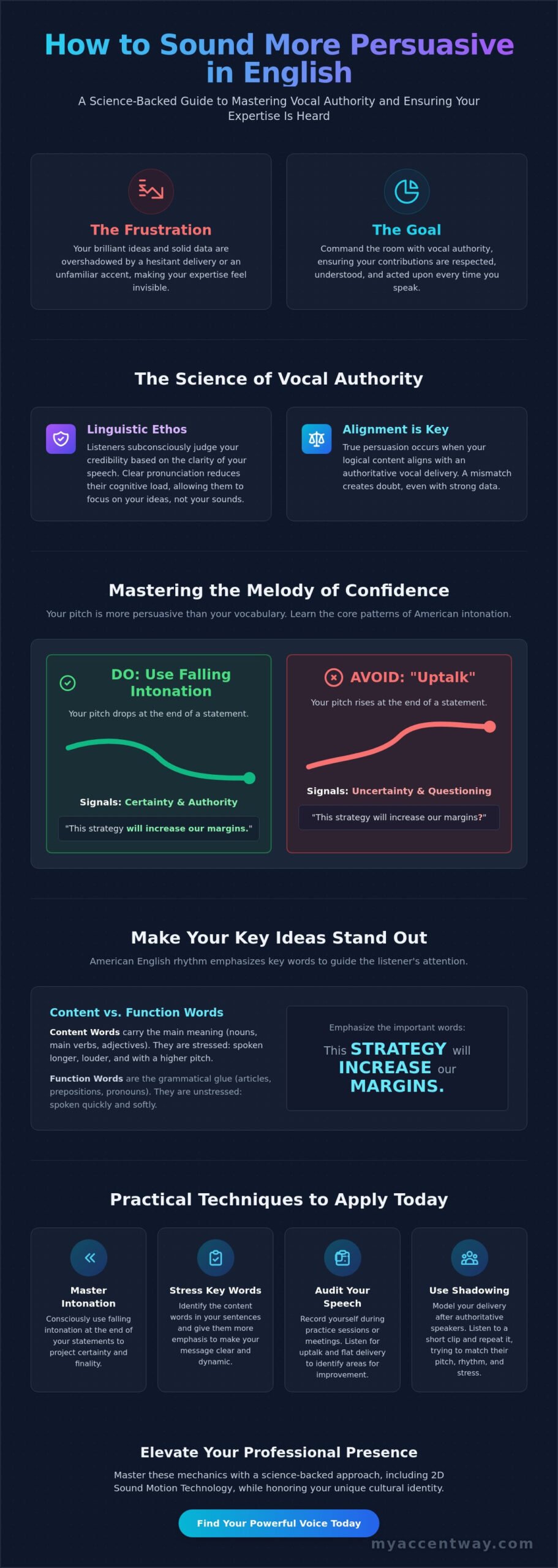
If you’re wondering how to sound more persuasive in English, the answer often lies in your pitch rather than your vocabulary. While Section 1 explored the concept of credibility, this section focuses on the physical mechanics of the voice. In the American accent, the melody of a sentence carries the emotional weight of your message. Specifically, statements of fact or authority require a “falling intonation.” This means your pitch should drop at the very end of your sentence. This downward slide signals to your audience that your thought is complete and your conviction is absolute.
Many international professionals inadvertently use “uptalk,” where the pitch rises at the end of a statement. This makes a definitive claim sound like a question. When you say, “This strategy will increase our margins” with a rising pitch, you’re subconsciously asking for permission to be right. This immediately undermines your authority. American English also utilizes a “staircase effect,” where we jump up to a stressed syllable and then step down through the rest of the phrase. This creates a sense of forward momentum that keeps your listeners engaged and moving toward your conclusion.
Pitch shifts also serve as vital transitions between ideas. By starting a new sentence on a slightly higher pitch, you signal that you’re introducing a new point. This keeps your delivery dynamic and prevents the “flat” sound that many listeners misinterpret as a lack of interest or expertise. Mastering these shifts is a core component of effective American accent training.
Eliminating the “Question Sound” in Statements
International speakers often carry over intonation patterns that feel natural in their native tongues but signal uncertainty in a U.S. business context. Consider a simple status update. A speaker might say, “The project is on schedule?” with a slight rise at the end. To sound persuasive, you must land that final word firmly: “The project is on schedule.” I recommend recording yourself during a low-stakes call and checking the pitch of your final words. If they sound like questions, practice sliding the pitch down until it feels like a period rather than a question mark.
Using Pitch to Signal Importance
In the science of persuasion, emotional appeal is a critical factor in swaying an audience. Pitch is your primary tool for adding this layer of “pathos” to your speech. When you jump to a higher pitch on the most important word in a sentence, you’re telling the listener exactly where to focus. This variety is what makes a speaker sound passionate and confident. If you find that your colleagues are frequently interrupting you, it may be because your flat pitch is signaling that you’ve finished speaking when you’re actually just pausing for breath. Varying your pitch ensures you maintain control of the conversation and communicate with true speech clarity.
Sentence Stress and Rhythm: Emphasizing Your Best Ideas
Understanding how to sound more persuasive in English requires a shift in how you perceive the rhythm of your sentences. Many professionals are told to simply repeat their main points for emphasis. While repetition can build familiarity, doing so without the correct stress patterns often sounds robotic or even annoying to the listener. American English is a stress-timed language. This means we compress the filler words and stretch out the meaning words. If you give equal time to every syllable, your message loses its punch and its persuasive power.
In my work as a Ph.D. Linguist, I help students identify Content Words, like nouns and verbs, and contrast them with Function Words, such as prepositions and articles. When you master this, you create a rhythmic heartbeat that guides your listener through your logic. Speech clarity isn’t just about the individual sounds; it’s about the vowel length of those stressed syllables. A longer vowel in a stressed word signals to the brain that this information is vital. When we look at the science of persuasion, we find that rhythmic predictability helps the listener process your ideas more efficiently, reducing their mental effort and making them more likely to agree with you.
Silence is another persuasive tool that many experts overlook. A well-placed pause before a Focus Word creates anticipation. It gives your audience a split second to prepare for your most important point. This use of silence, combined with rhythmic stress, ensures your best ideas don’t get lost in a sea of data.
The 2D Sound Motion Approach to Word Stress
Visualizing sound movement is a cornerstone of the My Accent Way method. Using 2D Sound Motion Technology, Prof. Alex Obskov, Ph.D. Linguist, helps you see the physical energy required for stress. For example, consider corporate terminology like “Alternative” where the stress is on the second syllable. Now look at “Alternation,” where the stress moves to the third. Without visual cues, these shifts can feel arbitrary and confusing. Our American accent training uses these simulators to ensure you hit the rhythmic target every time, building the muscle memory needed for effortless confidence.
Creating Impact with Contrastive Stress
Contrastive stress allows you to highlight a specific choice or comparison. If you say, “We should invest in *this* project, not *that* one,” you’re using rhythm to narrow the listener’s focus. This follows the Focus Word rule. In every persuasive sentence, one word carries the most weight. By applying specific American sounds and rhythmic rules to that one word, you clarify your intent without over-explaining. This precision is what separates a good speaker from a truly persuasive leader who commands the room with ease.
4 Practical Techniques to Sound More Persuasive Today
Generic advice often tells you to “just be confident,” but confidence isn’t a strategy; it’s a result of mastering specific linguistic techniques. If you want to know how to sound more persuasive in English, you need actionable steps that move beyond theory. When a speaker sounds hesitant, it’s often due to a choppy rhythm or a lack of phonetic precision rather than a lack of knowledge. By implementing a sound-by-sound audit and focusing on the physical mechanics of American English, you can transform how your expertise is perceived in the boardroom.
One of the most effective ways to eliminate the sound of uncertainty is through “Linked Sounds.” In American English, we don’t treat every word as an isolated island. Instead, we link the end of one word to the beginning of the next. For instance, saying “find out” as two distinct words can sound clinical or hesitant. Linking them to sound like “fin-dout” creates a smooth, authoritative flow. This professional “speech clarity” signals to your audience that you’re in total command of your message. To refine these habits, I recommend a 3-step auditing process: record a short professional snippet, identify one specific linking error, and re-record it until the transition feels seamless.
Step 1: The Daily Shadowing Ritual
The Shadowing Technique is a powerful tool for building the muscle memory required for persuasive speech. Choose a 30-second clip of a leader who embodies the executive presence you admire, such as a high-impact TED talk. At first, ignore the actual words and focus entirely on matching their intonation and rhythm. You’re essentially “singing” the melody of their speech. Repeat this exercise 5 times daily. This practice helps your brain internalize the “Staircase Effect” and falling intonation patterns we discussed earlier, making them second nature during high-pressure meetings.
Step 2: Mastering the High-Impact American Sounds
Professional precision is often heard in the final consonants of your words. Dropping the end of a word like “project” or “result” can make your delivery feel unfinished or weak. In my coaching, I use 2D Sound Motion Technology to help students visualize the tongue and lip placement for these critical sounds. Focusing on the American [r] and [l] is particularly important, as these are markers of executive clarity in a U.S. context. Additionally, mastering the “Schwa” sound—the neutral vowel in unstressed syllables—prevents you from sounding overly formal or robotic.
Using 2D Sound Simulators for American Sounds allows you to practice these phonemes with visual feedback, ensuring your mouth is moving correctly for maximum impact. If you’re ready to move past generic advice and start seeing real results, I invite you to explore our accent reduction program today.
Elevate Your Professional Presence with My Accent Way
Mastering how to sound more persuasive in English is a journey that goes beyond simple grammar; it’s about developing a presence that commands respect. At My Accent Way, our philosophy is simple: “Your Culture Matters, Your Clarity Counts.” We believe that your unique background is an asset, not something to be hidden. Instead of trying to strip away your identity, we focus on accent modification that empowers you to communicate with precision and authority in any U.S. professional setting.
Working with Prof. Alex Obskov, Ph.D. Linguist, gives you access to a level of expertise that generic programs simply can’t match. Most language courses focus on basic fluency, but they don’t address the complex phonetic and psychological barriers that prevent high-level professionals from being heard. Our science-backed method uses cognitive and analytical processes to help you master American sounds. Because we’re confident in our approach, we offer a Success Guarantee. This ensures that your investment in yourself leads to the tangible professional growth you deserve.
Personalized Coaching for Global Leaders
Generic ESL classes often fall short when you’re aiming for executive presence. They’re designed for basic communication, not for the high-stakes needs of global leaders who need to know how to sound more persuasive in English during a board meeting or a keynote. My Accent Way takes an Individual Approach. Prof. Alex Obskov, Ph.D. Linguist, looks at your specific speech patterns and professional goals to create a customized roadmap. Whether you’re leading a team in Austin, pitching a client in Dallas, or joining us from anywhere across Texas and the U.S., our online training fits your busy schedule and high standards.
Try a 1-Hour Session with Prof. Alex Obskov
If you’re ready to see a difference in your delivery, start with a 1-hour session. During this initial accent assessment, Prof. Alex Obskov, Ph.D. Linguist, will analyze your current speech patterns and show you how our proprietary 2D Sound Motion Technology works. You’ll get immediate feedback on your tongue and lip placement, allowing you to visualize the sounds you’re making. It’s an intellectual interaction that yields real-world results. You don’t have to guess if you’re making progress; you’ll be able to see and hear it. This is the most effective way to begin your journey toward total speech clarity and professional transformation. Explore our American Accent Training and speak with authority.
Take Control of Your Professional Narrative
Mastering how to sound more persuasive in English isn’t just about learning new words; it’s about reclaiming the authority that your expertise deserves. We’ve explored how falling intonation signals certainty and how strategic sentence stress ensures your most important ideas resonate with your audience. By shifting from a syllable-timed rhythm to the stress-timed melody of the American accent, you remove the linguistic barriers that lead to interruptions and hesitation.
Led by Prof. Alex Obskov, Ph.D. Linguist, our programs combine scientific precision with a deep respect for your cultural identity. With our Success Guarantee and proprietary 2D Sound Motion Technology, you have a proven path to achieving the speech clarity required for executive presence. You’ve done the hard work of building your career. Now, let’s make sure your voice reflects your true potential. Book Your 1 Hour Accent Training Session with Prof. Alex Obskov, Ph.D. today!
Your ideas are too valuable to be sidelined. It’s time to speak with the confidence that matches your talent.
Frequently Asked Questions
Is it possible to be persuasive while keeping my foreign accent?
Yes, you can be exceptionally persuasive while maintaining your unique cultural identity. Persuasion in a professional American context relies on speech clarity, rhythmic stress, and intonation rather than the total absence of a foreign accent. By mastering specific phonetic markers like falling intonation and vowel elongation on stressed syllables, you signal authority and confidence. This strategic approach ensures your ideas are heard and respected without requiring you to change the voice that represents your heritage.
How long does it take to see results in my persuasive speaking?
Most professionals begin to notice a shift in their vocal authority within the first few weeks of dedicated practice. While mastering every nuance of American sounds is a long-term journey, applying specific techniques like the “staircase effect” can produce immediate changes in how listeners perceive your certainty. Our program begins with a 90-minute orientation session for $90, which provides the initial linguistic breakthrough needed to begin self-correcting during real-world meetings and high-stakes presentations.
What is the biggest mistake non-native speakers make when trying to sound authoritative?
The most frequent mistake is using rising intonation, often called “uptalk,” at the end of definitive statements. This pattern makes an expert’s conclusion sound like a question, which subconsciously signals a lack of conviction to the audience. Learning how to sound more persuasive in English involves replacing this habit with a firm, downward pitch on your final words. This simple adjustment to your vocal landing can instantly transform a hesitant status update into a powerful, authoritative command.
Can I learn these techniques through an online accent reduction program?
Yes, a specialized online accent reduction program is a highly effective way to learn how to sound more persuasive in English. Digital coaching allows for deep intellectual interaction and real-time feedback from a Ph.D. Linguist. Online training is especially powerful when it incorporates visual simulators, enabling students in hubs like Austin, Dallas, or Houston to access world-class expertise and achieve professional growth from the convenience of their own office or home.
What is 2D Sound Motion Technology and how does it help with persuasion?
2D Sound Motion Technology is our proprietary system that utilizes 2D Sound Simulators for American Sounds to show the exact movement of the speech organs. It aids persuasion by removing the ambiguity from pronunciation, allowing you to see the physical energy needed to produce authoritative speech. When you can visualize the mechanics of a stressed syllable or a linked sound, you develop the muscle memory required to speak with a professional precision that naturally commands attention and respect.
Does accent training really help with career advancement in the U.S.?
Accent training is a vital tool for career advancement because it directly strengthens your executive presence. When your speech clarity is high and your intonation patterns signal confidence, you are more likely to be considered for leadership positions and high-visibility projects. Our American Accent Training for U.S. Professionals ensures that your technical brilliance is never obscured by communication barriers, allowing your ideas to be fully understood, respected, and acted upon by your colleagues.
Disclaimer – American Accent Program
The American Accent Program available through Visit Program Website
is an educational and coaching service designed to support pronunciation, accent reduction, and spoken English fluency. All training materials, including lessons, exercises, audio content, visual simulations, coaching methods, and digital resources, are the intellectual property of American Accent Program, LLC and are protected by applicable copyright and intellectual property laws.
By using this website and participating in the program, you acknowledge that all content is provided for personal, non-commercial, educational use only. Users are granted a limited, non-transferable license to access the materials strictly for individual learning purposes. Redistribution, reproduction, recording, modification, sharing, or commercial use of any program content without prior written consent is strictly prohibited.
The program may include live coaching sessions, digital tools, and instructional materials intended to improve pronunciation and communication skills. However, individual results may vary, and no specific level of fluency, accent reduction, or communication outcome is guaranteed.
The American Accent Program and its instructors do not provide medical, therapeutic, or clinical speech-language pathology services. All training is intended for educational purposes only.
By accessing or using the program, you agree to comply with all applicable terms, including the platform’s Terms of Use and Course Policies, and acknowledge that misuse of materials may result in termination of access without refund.
Speech clarity check
The problem is not always grammar or vocabulary.
If people understand your words but still miss your message, the deeper issue may be speech clarity, rhythm, intonation, and American pronunciation habits. MyAccentWay helps students retrain the sound system with professional 1-on-1 guidance, so English can feel clearer, freer, and more natural in real communication.
Why MyAccentWay works
Two training methods that make speech change active.
MyAccentWay is not passive listen-and-repeat coaching. Prof. Alex, Ph.D. Accent Coach, creates a learning situation where students become active learners and active participants in changing their own speech patterns.
Interactive training
Students do not just receive pronunciation instructions passively. They listen, think, compare, adjust, and understand their own speech patterns while Prof. Alex guides the correction process.
U.S. & Canada online accent training
How to Sound More Persuasive in English: A Linguistic Guide for Professionals for professionals in the United States and Canada
This guide is useful for advanced English speakers, entrepreneurs, international professionals, and students in the U.S. and Canada who want clearer American pronunciation, stronger rhythm, better intonation, and more confident communication in meetings, interviews, presentations, and client conversations.
Prof. Alex, Ph.D. Accent Coach, teaches online 1-on-1 American accent training for learners in major professional markets including New York, Los Angeles, San Francisco Bay Area, Seattle, Austin, Dallas, Houston, Chicago, Boston, Washington, D.C., Miami, Toronto, Vancouver, Montreal, Calgary, and Ottawa.
1-on-1 Accent Reduction Training helps students move beyond self-practice and build clearer American speech habits through interactive and cognitive accent training.
Cognitive accent training
Students learn to notice and correct the speech patterns that affect American pronunciation, then implement new American speech patterns into their code-switching process for more natural, long-lasting change.
Your next step
Build speech habits people can hear in real conversations.
A stronger American accent is not built by memorizing topics or chasing quick pronunciation tips. It comes from structured training, professional feedback, active correction, and repeated application until clearer speech becomes easier to keep.




One Response