How to Measure Accent Improvement: A Data-Driven Guide for Professionals
(512) 265-9515Updated November 4, 2026 ◆ 14 min read
To review accent progress, compare specific speech patterns across similar speaking tasks. Listen for the target sounds, rhythm, intonation, and connected speech you are practicing, and use Prof. Alex’s feedback to identify what to adjust next.
Student testimonial

“I feel confident enough to speak American English!”
Interactive American Accent Training9monthsof hard work and dedication
Listen to the starting point0:00
Listen to the result0:00
Independent phonetic evaluation
Jane Timokhin, Ph.D. in Applied Linguistics
Independent evaluator Jane Timokhin, Ph.D. in Applied Linguistics, assessed Abishek’s before and after audio recordings and documented measurable improvements in American English pronunciation after nine months of training at MyAccentWay.
Interactive American Accent Training, informed by Prof. Alex’s doctoral research. Prof. Alex’s doctoral research identified four educational conditions for interactive foreign-language teaching, including placing students in an active position in the learning process and shifting the teacher’s role toward organizing and guiding student participation. At MyAccentWay, he applies these research-informed conditions through Interactive American Accent Training, integrating 2D Sound Motion Technology (active articulatory simulation), guided pronunciation practice, and personalized feedback. Students actively simulate, train, and refine American English speech sounds rather than relying exclusively on traditional listen-and-repeat instruction. Learn more about Prof. Alex’s doctoral research.
Track accent improvement by comparing recordings and specific speech patterns against your own starting point. In MyAccentWay’s Interactive American Accent Training with Prof. Alex, progress is reviewed through pronunciation accuracy, sentence stress, intonation, and connected speech, with priorities tied to your speaking goals.
Understanding Accent Modification Progress Through Linguistic Science
Your goals may include clearer communication, more natural American pronunciation, or speech closer to a native American English model. Track the patterns that matter to those goals, using comparable speaking tasks rather than relying only on a general impression.
Clarity vs. Perfection: Setting Realistic Goals
The goal of modern training is communication excellence, not identity erasure. Your culture matters, and your unique voice is a professional asset. We focus on accent modification to ensure your message is heard clearly in global environments. This systematic approach for learning a new speech accent involves refining specific sounds that impact understandability. Prof. Alex, Ph.D. Accent Coach, teaches that successful American accent training is about expanding your linguistic toolkit. It’s a strategic professional growth move rather than a search for “perfect English.”
The Three Pillars of Measurable Improvement
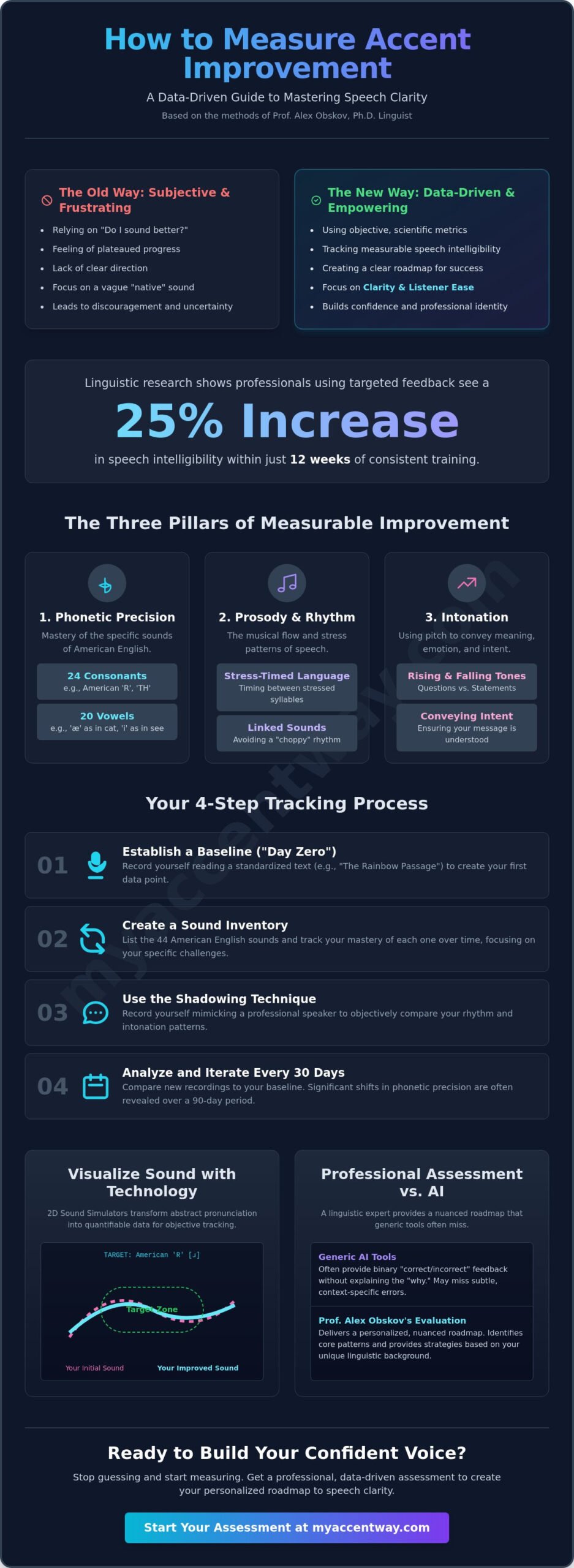
Review progress in three areas: target sound production, rhythm, and intonation. Use comparable recordings and clearly defined criteria so that you can identify specific changes.
- Sound accuracy: Compare how you produce the target vowels and consonants in words, phonetic exercises, and connected speech. Prof. Alex evaluates your pronunciation; Interactive Visual 2D Sound Simulators support active simulation and articulatory practice rather than measuring internal articulator positions.
- Rhythm: Compare the placement of stress, the reduction of unstressed syllables, and the phrasing of a sentence. Review whether these patterns support the message you intend to communicate.
- Intonation: Compare how pitch movement and emphasis support the intended meaning of a sentence. Practice the same message in different contexts and review it with Prof. Alex.
Real progress relies on “Intellectual Interaction.” This is the cognitive and analytical process where you learn to recognize sound patterns and consciously correct them in real-time. It’s a science-backed method that moves pronunciation from an abstract concept to a repeatable skill. If you’re looking for American accent training near me, focusing on these data-driven metrics is an effective way to build lasting confidence. By treating speech as a series of measurable patterns, you can see exactly how to measure accent improvement over a 12-week or 24-week period.
Step-by-Step: How to Track Your Phonetic and Intonation Milestones
Establishing a baseline is the first scientific step in understanding how to measure accent improvement. You can’t track what you don’t document. Start by recording yourself reading a standardized professional text, such as the “Rainbow Passage” or a specific industry script. This recording serves as your “Day Zero” data point. Prof. Alex, Ph.D. Accent Coach, emphasizes that this initial capture allows you to identify the specific phonetic patterns that require refinement. It’s not about changing who you are; it’s about adding a new tool to your communication toolkit.
To see real results, create a Sound Inventory. This is a personalized list where you track your mastery of the 24 American consonants and 20 vowels. Use the Shadowing Technique to compare your rhythm against a model. Record a 30-second clip of a professional speaker, then record yourself repeating the same lines. When you play them back side-by-side, you’ll hear exactly where your timing or pitch differs. Analyze these recording intervals every 30 days to identify long-term trends in your speech clarity. Data collected over a 90-day period usually reveals the most significant shifts in phonetic precision.
Conducting Your Own Accent Assessment
For maximum acoustic accuracy, record yourself in a quiet room using a high-quality external microphone. When you listen back, don’t just listen for general “fluency.” Look for specific markers like the American [t] in words like “better” (the flap t) or the neutral Schwa sound in “president.” Many international professionals find that seeking professional linguistic assessments provides a clearer 1-10 clarity scale than self-assessment alone. Use a checklist to grade your own clarity on a scale of 1 to 10 for each specific sound you’re targeting. This analytical approach turns a subjective feeling into a measurable metric.
Tracking Intonation and Sentence Stress
Intonation is the “music” of American English, and it’s vital for executive presence. You can measure this by applying sentence stress rules to your recordings. In American English, we typically stress content words while reducing function words. Track whether you’re using rising intonation for questions and falling intonation for statements correctly. If your pitch remains flat, your message might sound monotonous or even unintendedly aggressive to a listener. Using 2D Sound Motion Technology can help you practice these pitch shifts. If you want to dive deeper into these techniques, you can learn more about American accent training for professionals to see how these suprasegmental features impact your daily interactions.
If you’re ready to move beyond self-tracking and want a structured, science-backed approach to your growth, consider exploring our accent reduction program to work directly with a linguistic expert.
Using Interactive Visual 2D Sound Simulators to Train Sound Accuracy
Interactive Visual 2D Sound Simulators support active simulation and articulatory practice. Students train tongue, jaw, lip, and airflow movements while Prof. Alex evaluates their pronunciation and guides adjustments. This practice supports developing control of articulation; it is not an anatomical measurement of the student’s speech organs.
The Science of 2D Sound Motion Technology
2D Sound Motion Technology provides movement patterns for active sound development. Prof. Alex listens to the student’s spoken attempts and guides corrections. Recordings and clearly stated evaluation criteria document progress separately from the simulation.
Reviewing the Speech You Produce
Compare recordings of the same task where possible, noting specific changes in target sounds, stress, rhythm, and intonation. Use both controlled practice and a fresh speaking task to check whether a skill carries into less rehearsed speech. Useful areas to review include:
- Consistency: Ensuring that every vowel sound hits the same visual coordinate every time you speak.
- Efficiency: Reducing the time spent on trial and error by seeing the correct tongue placement instantly.
- Confidence: Knowing your sound is accurate because the simulator confirms it, which removes the anxiety of being misunderstood.
If you’re ready to see your progress in real time, exploring our American accent training options can help you integrate these advanced tools into your daily practice. We don’t just want you to sound better; we want you to have the data that proves your growth.
MyAccentWay · 2D Sound Motion Technology
American English Pronunciation: Consonant and Vowel Sounds with 2D Sound Motion Technology
Learning American English pronunciation involves more than listening and repeating. Active articulatory training helps students practice the coordinated movements of the tongue, lips, jaw, airflow, and voicing needed to produce American English sounds. 2D Sound Motion Technology and Interactive Visual 2D Sound Simulators, developed in 2020 by Prof. Alex, Ph.D. Accent Coach, Doctor of Education, and professional linguist, as part of his interactive teaching model that applies principles from his doctoral research in interactive teaching methods, train your tongue, lips, jaw, teeth, airflow, and voice step by step. They train each American sound.
What 2D Sound Motion Technology is
2D Sound Motion Technology is an advanced accent reduction and articulation training tool by Prof. Alex. It trains each American sound through Interactive Visual 2D Sound Simulators.
What Interactive Visual 2D Sound Simulators do
Interactive Visual 2D Sound Simulators are part of 2D Sound Motion Technology, the articulation-training method Prof. Alex created in 2020. It applies one of the four conditions of interactive teaching identified in his doctoral research: placing students in an active position in the learning process. Instead of listening and repeating, students actively train their speech organs. With each simulator, students control articulation movement sequences and physically train the speech organs (tongue, lips, jaw, airflow, and voicing) with synchronized voice-over instructions to produce each American sound correctly. Every consonant has its own simulator: explore American consonants trained with 2D Sound Motion Technology.
Sample training: the American t sound (aspirated [t])
Practice
Record yourself speaking these words:
Tab · Tacos · Time · Tub · Hotel · Motel · Sit · Pit · Net
Instructions
Play the Interactive Visual 2D Sound Simulator for the American t sound below several times and follow it step by step. Control the simulator’s articulation movement sequence and practice the corresponding tongue and jaw movements, coordinating airflow and voicing as you pronounce [t].
Interactive Visual 2D Sound Simulator: American unvoiced sound [t]
Practice
Record yourself again speaking these words, but this time focus on the movement of your tongue. Go slow, and you will hear the difference. You’ve got this!
Tab · Tacos · Time · Tub · Hotel · Motel · Sit · Pit · Net
How Interactive Visual 2D Sound Simulators solve pronunciation and speaking problems
- Wrong articulationMost pronunciation problems start with the tongue, lips, jaw, or teeth in the wrong position. Each Interactive Visual 2D Sound Simulator trains the correct articulation of one American sound, so the student corrects the cause of the problem, not only the result.
- Airflow and voicingMany accent problems come from wrong airflow or voicing: sounds that are too weak, too strong, or voiced when they should be unvoiced. The simulators train airflow and voice together with articulation, step by step, for each American sound.
- Clear speech and confidenceWhen each sound is trained correctly, words connect into clear American English speech. Listeners can understand you more easily, and speaking at work, in meetings, and on calls becomes more confident.

If you start hearing the aspiration, the short airstream after [t], with one simulator, you can only imagine how successful you can be in 1-on-1 Interactive American Accent Training with Prof. Alex, Ph.D. Accent Coach, where your whole American sound system is trained sound by sound.
The simulators are integrated into Prof. Alex’s 1-on-1 Interactive American Accent Training and are also available through the InPronunci learning platform.
Assessing Your Progress in High-Stakes Professional Environments
Effective communication in the workplace is the ultimate benchmark for any professional. Whether you’re leading a team in Austin, Texas, or presenting to stakeholders in Dallas, your ability to convey ideas clearly determines your impact. Understanding how to measure accent improvement involves looking at functional outcomes rather than just phonetic accuracy. Prof. Alex, Ph.D. Accent Coach, teaches that clarity is a professional asset that builds trust and authority. In high-stakes environments, the difference between a confused audience and a convinced one often comes down to the rhythm and flow of your speech.
The Repetition Log: A Real-World Metric
A simple yet powerful way to track your growth is through a repetition log. For one work week, keep a discreet tally of how many times you’re asked to repeat yourself. Requests like “Pardon?” or “Could you say that again?” are valuable data points. If requests decrease after targeted training, that may suggest improved functional clarity. This log also helps you identify “high-friction” words. These are terms specific to your industry that consistently cause misunderstandings, often due to complex American sounds like the /θ/ or /ɹ/. To get started, you can book an accent assessment session to find your specific friction points.
Measuring Confidence and Psychological Growth
You can also record your own confidence or comfort before and after a speaking task. Treat a personal rating as a reflection on your experience, not an objective pronunciation score or proof of the technology’s effects. Review it alongside the speech patterns you are practicing.
Some professionals worry they’ll lose their cultural identity by pursuing accent modification. This is a common misconception. Your culture matters, and it’s a vital part of your professional brand. Improving your speech clarity doesn’t mean you’re erasing your heritage. It means you’re removing the linguistic barriers that prevent your colleagues from seeing your full expertise. By mastering specific intonation patterns and word stress, you ensure your message is the focus, not the struggle to decipher your speech. This balance of clarity and identity is what defines modern leadership in the US corporate world. You’re gaining a professional tool, not changing who you are.
Ready to see how your clarity impacts your career? Schedule your professional accent assessment today.
The Role of professional linguistic Assessments in Your Mastery Journey
Individual feedback can explain which pronunciation patterns need attention and suggest a specific adjustment to practice. Automated scores may offer additional feedback, but they should be interpreted according to the tool’s stated purpose and limits.
Expert Analysis vs. Automated Tools
Speech recognition and pronunciation evaluation serve different purposes. A correct transcript alone does not establish accurate pronunciation. Prof. Alex reviews sound production and connected speech; any numerical assessment should identify its evaluator, criteria, and scale rather than imply that the simulator measures tongue placement.
Your Next Steps Toward American English Mastery
Record a short passage and a work-related speaking task, then review the target features with Prof. Alex. Use feedback to practice a specific adjustment and compare later attempts. Keep recording conditions similar so differences are easier to interpret.
Use assessment to choose the next practical training priority. MyAccentWay connects individual feedback with active practice toward your own American English speaking goals; the pace and extent of progress vary.
Take Control of Your Professional Communication Journey
MyAccentWay’s Interactive American Accent Training with Prof. Alex connects sound development, phonetic exercises, sentence and intonation practice, and targeted paragraphs. Interactive Visual 2D Sound Simulators support active simulation and articulatory practice. Review progress through the speech you produce, with clear criteria and comparable tasks, while working toward independent, confident American English speaking.
Prof. Alex, Ph.D. Accent Coach, provides the expert framework needed to turn these phonetic insights into lasting habits. Our program includes personalized training for professionals who are ready to elevate their speech clarity. You don’t have to navigate this path alone or rely on vague feedback from colleagues. Start your journey with a clear understanding of your current skills and a roadmap for where you want to go.
Your unique cultural background is an asset, and refining your clarity simply ensures your expertise is heard exactly as you intend. You’ve got the skills; now it’s time to let your voice match your professional potential.
More than articulation: Prof. Alex doesn’t teach only the articulation of sounds. Interactive 1-on-1 training with 2D Sound Motion Technology helps students become confident, fluent English speakers through a step-by-step system. Training may begin with how each American sound is made. Then it moves into sound combinations, sound contractions, phonetic exercises, practice sentences, and paragraphs in real rapid speech, so students start speaking English fluently and comfortably.
American Accent Training for Foreign-Born Tech Professionals in the United States
Foreign-born professionals in the United States often know their field and speak advanced English. Yet American listeners may still struggle with their sounds, stress, and rhythm. MyAccentWay offers private online American accent training through Interactive American Accent Training with Prof. Alex.
Training is online and 1-on-1 for learners anywhere in the U.S. It starts with a 1 Hour Evaluation Session.
Frequently Asked Questions
How long does it take to see measurable accent improvement?
There is no fixed timetable or percentage gain that applies to every student. Starting patterns, goals, practice, and session frequency affect progress. Compare recordings at useful intervals and review whether improvements carry from exercises into sentences and extended speech.
Can I measure my accent reduction progress by myself?
You can track your accent reduction progress by using a rubric based on the 44 phonemes of American English. Record yourself reading a standardized professional text once every 10 days and compare it to a model recording. Focus on specific markers like word stress or vowel length. Using our Interactive Visual 2D Sound Simulators for American Sounds provides a visual baseline to compare your mouth positioning against the scientific standard.
Is there an app that accurately measures American accent progress?
Interactive Visual 2D Sound Simulators are used for active simulation and articulatory practice. They guide practice of speech movements; they do not measure a student’s tongue or lip position or compare recorded sound waves. InPronunci app feedback is a separate function and should be interpreted according to its own scoring criteria.
Will improving my American accent make me sound like a different person?
No, accent modification is about enhancing clarity while preserving your unique cultural identity. Your voice remains yours, but the phonetic barriers that hinder professional communication are reduced. We focus on the science of intonation and rhythm so your expertise shines through. Prof. Alex, Ph.D. Accent Coach, believes that your culture matters; we simply give you the tools to speak English confidently in any professional setting.
What are the most important sounds to measure for professional clarity?
Vowels, consonants, word stress, rhythm, and intonation can all affect understanding. Select priorities from your own speech evaluation rather than assigning one fixed percentage of intelligibility to a feature.
How often should I record myself to track my speech progress?
You should record a 90 second speech sample every 7 days to maintain an accurate progress log. Frequent recording prevents you from missing subtle shifts in your intonation and rhythm. Listen to these clips alongside your initial baseline recording from your first session. This habit builds your “internal ear,” making it easier to self-correct during real-time conversations at work or during important presentations.
What results can I expect from accent training?
Our training program focuses on helping you make progress in your speech clarity when you follow the prescribed curriculum. This is a structured approach to phonetic improvement. If you complete the modules and practice with the Interactive Visual 2D Sound Simulators as directed, you can train your speech organs to produce American sounds accurately. We prioritize your growth and confidence in every training module.
The problem is not always grammar or vocabulary.
If people understand your words but still miss your message, the deeper issue may be speech clarity, rhythm, intonation, and American pronunciation habits. MyAccentWay helps students retrain the sound system with professional 1-on-1 guidance, so English can feel clearer, freer, and more natural in real communication.
Two training methods that make speech change active.
MyAccentWay is not passive listen-and-repeat coaching. Prof. Alex, Ph.D. Accent Coach, Doctor of Education, and professional linguist, creates a learning situation where students become active learners and active participants in changing their own speech patterns.
Interactive training
Students do not just receive pronunciation instructions passively. They listen, think, compare, adjust, and understand their own speech patterns while Prof. Alex guides the correction process.
Cognitive accent training
Students learn to notice and correct the speech patterns that affect American pronunciation, then implement new American speech patterns into their code-switching process for more natural, long-lasting change.
Build speech habits people can hear in real conversations.
A stronger American accent is not built by memorizing topics or chasing quick pronunciation tips. It comes from structured training, professional feedback, active correction, and repeated application until clearer speech becomes easier to keep.
Continue learning how MyAccentWay connects American sound articulation, Interactive Visual 2D Sound Simulators, accent reduction, documented student outcomes, and 1-on-1 training.
- Prof. Alex and the MyAccentWay MethodLearn how Prof. Alex created and leads the structured MyAccentWay American accent training system.
- Accent Reduction Curriculum and English Articulation TrainingSee accent reduction, accent modification, American pronunciation, English articulation, rhythm, and professional speech clarity.
- 2D Sound Motion Technology for American Accent TrainingUnderstand Interactive Visual 2D Sound Simulators for American sound articulation.
- Before-and-After American Accent Training ResultsListen to real before-and-after documented student outcomes and outcomes.
- Student Reviews and Accent Training ResultsRead student reviews and trust signals.
- Book a 1-on-1 American 1 Hour Evaluation SessionStart with a 1-hour interactive session with Prof. Alex.
Disclaimer – American Accent Program
The American Accent Program available through Visit Program Website
is an educational and coaching service designed to support pronunciation, accent reduction, and spoken English fluency. All training materials, including lessons, exercises, audio content, visual simulations, coaching methods, and digital resources, are the intellectual property of American Accent Program, LLC and are protected by applicable copyright and intellectual property laws.
By using this website and participating in the program, you acknowledge that all content is provided for personal, non-commercial, educational use only. Users are granted a limited, non-transferable license to access the materials strictly for individual learning purposes. Redistribution, reproduction, recording, modification, sharing, or commercial use of any program content without prior written consent is strictly prohibited.
The program may include live coaching sessions, digital tools, and instructional materials intended to improve pronunciation and communication skills. However, individual results may vary, and no specific level of fluency, accent reduction, or communication outcome is guaranteed.
The American Accent Program and its instructors do not provide medical, therapeutic, or clinical speech-language pathology services. All training is intended for educational purposes only.
By accessing or using the program, you agree to comply with all applicable terms, including the platform’s Terms of Use and Course Policies, and acknowledge that misuse of materials may result in termination of access without refund.