How Psychology is Important for American Accent Training: A Scientific Perspective
(512) 265-9515Updated November 4, 2026 ◆ 11 min read
Speaking confidence involves both the speech you produce and how you respond during conversation. MyAccentWay’s Interactive American Accent Training with Prof. Alex gives students an active role in developing American pronunciation, practicing adjustments, and applying their skills in real speaking tasks. The goal is an independent, confident speaker of American English.
Student testimonial

“I feel confident enough to speak American English!”
Interactive American Accent Training9monthsof hard work and dedication
Listen to the starting point0:00
Listen to the result0:00
Independent phonetic evaluation
Jane Timokhin, Ph.D. in Applied Linguistics
Independent evaluator Jane Timokhin, Ph.D. in Applied Linguistics, assessed Abishek’s before and after audio recordings and documented measurable improvements in American English pronunciation after nine months of training at MyAccentWay.
Interactive American Accent Training, informed by Prof. Alex’s doctoral research. Prof. Alex’s doctoral research identified four educational conditions for interactive foreign-language teaching, including placing students in an active position in the learning process and shifting the teacher’s role toward organizing and guiding student participation. At MyAccentWay, he applies these research-informed conditions through Interactive American Accent Training, integrating 2D Sound Motion Technology (active articulatory simulation), guided pronunciation practice, and personalized feedback. Students actively simulate, train, and refine American English speech sounds rather than relying exclusively on traditional listen-and-repeat instruction. Learn more about Prof. Alex’s doctoral research.
Psychology matters in accent training through attention, confidence, listening, and the willingness to practice and adjust. This article connects those factors to active speech training with Prof. Alex, with progress guided by individual goals and feedback.
The Cognitive Foundation of Learning an American Accent
First-language speech habits can influence how students perceive and produce American English sounds. During Interactive American Accent Training, students practice distinguishing target patterns, produce them aloud, and make adjustments with Prof. Alex’s feedback.
The Science of Phonemes and Mental Mapping
Established speech patterns can require focused practice to change. Students use 2D Sound Motion Technology, including Interactive Visual 2D Sound Simulators, for active simulation and articulatory practice while developing American sound production.
Neuroplasticity and Adult Speech Acquisition
Adults can work toward clearer or more native-like American pronunciation. At MyAccentWay, training focuses on concrete speaking tasks and individual feedback. General research about adult learning does not establish a particular neurological mechanism or guaranteed outcome for this program.
MyAccentWay · 2D Sound Motion Technology
American English Pronunciation: Consonant and Vowel Sounds with 2D Sound Motion Technology
Learning American English pronunciation involves more than listening and repeating. Active articulatory training helps students practice the coordinated movements of the tongue, lips, jaw, airflow, and voicing needed to produce American English sounds. 2D Sound Motion Technology and Interactive Visual 2D Sound Simulators, developed in 2020 by Prof. Alex, Ph.D. Accent Coach, Doctor of Education, and professional linguist, as part of his interactive teaching model that applies principles from his doctoral research in interactive teaching methods, train your tongue, lips, jaw, teeth, airflow, and voice step by step. They train each American sound.
What 2D Sound Motion Technology is
2D Sound Motion Technology is an advanced accent reduction and articulation training tool by Prof. Alex. It trains each American sound through Interactive Visual 2D Sound Simulators.
What Interactive Visual 2D Sound Simulators do
Interactive Visual 2D Sound Simulators are part of 2D Sound Motion Technology, the articulation-training method Prof. Alex created in 2020. It applies one of the four conditions of interactive teaching identified in his doctoral research: placing students in an active position in the learning process. Instead of listening and repeating, students actively train their speech organs. With each simulator, students control articulation movement sequences and physically train the speech organs (tongue, lips, jaw, airflow, and voicing) with synchronized voice-over instructions to produce each American sound correctly. Every consonant has its own simulator: explore American consonants trained with 2D Sound Motion Technology.
Sample training: the American t sound (aspirated [t])
Practice
Record yourself speaking these words:
Tab · Tacos · Time · Tub · Hotel · Motel · Sit · Pit · Net
Instructions
Play the Interactive Visual 2D Sound Simulator for the American t sound below several times and follow it step by step. Control the simulator’s articulation movement sequence and practice the corresponding tongue and jaw movements, coordinating airflow and voicing as you pronounce [t].
Interactive Visual 2D Sound Simulator: American unvoiced sound [t]
Practice
Record yourself again speaking these words, but this time focus on the movement of your tongue. Go slow, and you will hear the difference. You’ve got this!
Tab · Tacos · Time · Tub · Hotel · Motel · Sit · Pit · Net
How Interactive Visual 2D Sound Simulators solve pronunciation and speaking problems
- Wrong articulationMost pronunciation problems start with the tongue, lips, jaw, or teeth in the wrong position. Each Interactive Visual 2D Sound Simulator trains the correct articulation of one American sound, so the student corrects the cause of the problem, not only the result.
- Airflow and voicingMany accent problems come from wrong airflow or voicing: sounds that are too weak, too strong, or voiced when they should be unvoiced. The simulators train airflow and voice together with articulation, step by step, for each American sound.
- Clear speech and confidenceWhen each sound is trained correctly, words connect into clear American English speech. Listeners can understand you more easily, and speaking at work, in meetings, and on calls becomes more confident.

If you start hearing the aspiration, the short airstream after [t], with one simulator, you can only imagine how successful you can be in 1-on-1 Interactive American Accent Training with Prof. Alex, Ph.D. Accent Coach, where your whole American sound system is trained sound by sound.
The simulators are integrated into Prof. Alex’s 1-on-1 Interactive American Accent Training and are also available through the InPronunci learning platform.
Overcoming Mental Barriers and Foreign Language Anxiety
Speaking anxiety can make practice uncomfortable and draw attention away from a speaking task. A supportive training environment gives students opportunities to try, receive feedback, and practice again. The affective-filter hypothesis offers one perspective on emotion in language learning; it is not a direct measurement of a student’s brain or proof of this program’s effectiveness.
When speaking feels tense, slow the practice to a manageable pace and focus on one adjustment at a time. Prof. Alex guides repeated attempts in a supportive session, helping students work toward their pronunciation and confidence goals.
Identity and the Fear of Sounding ‘Fake’
Students choose their own speaking goals. Developing American English pronunciation can expand a speaker’s options while respecting their language background, cultural identity, and personal voice.
Treat each target pattern as a skill to practice in a meaningful speaking situation. Compare attempts, apply feedback, and carry the adjustment into the next exercise. Goals may include clearer communication, a more natural American accent, or both.
Reducing Speaking Anxiety in Professional Settings
For workplace speaking, practice a manageable sentence before expanding to longer speech. Prof. Alex guides articulation, rhythm, and emphasis so students can work on their chosen patterns within the messages they need to deliver.
Practice pauses, emphasis, and intonation in a meeting sentence, then in a short presentation. These are speaking activities, not treatment for anxiety or stuttering. Training focuses on the student’s speech goals and the adjustments they can practice.
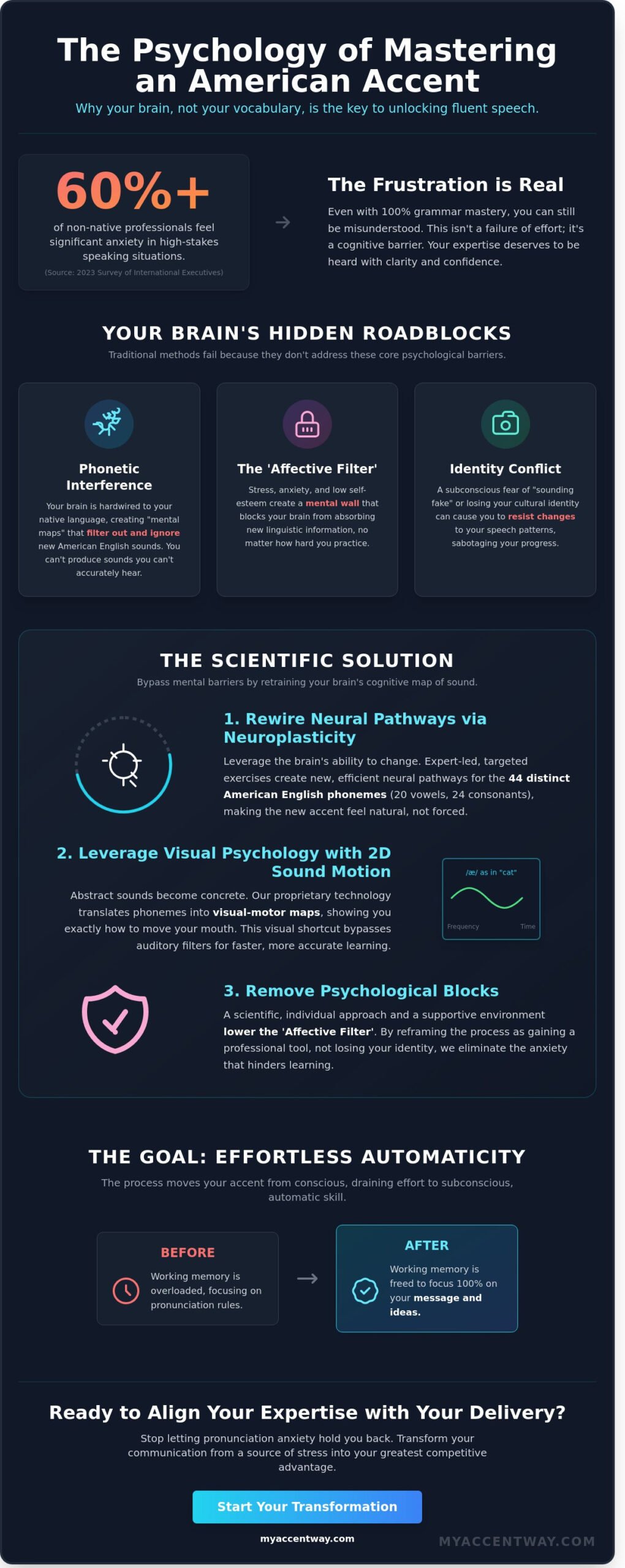
How 2D Sound Motion Technology Leverages Visual Psychology
During sound development, students actively use Interactive Visual 2D Sound Simulators to train articulation with Prof. Alex. The activity connects simulation with spoken attempts, feedback, and adjustment.
Active simulation and articulatory practice require students to participate in producing the target sound. Prof. Alex listens, guides a correction, and asks the student to apply it in another attempt. This describes the training activity without attributing its effects to an untested neural mechanism.
Bypassing the Auditory Filter with Visual Cues
Students control the simulation and practice the associated speech movements. Prof. Alex’s feedback concerns the student’s actual pronunciation. The simulator does not measure cognitive load or automatically establish whether an internal tongue position is correct.
Accelerated Learning Through Multi-Sensory Interaction
Prof. Alex’s doctoral research investigated interactive foreign-language teaching and identified four educational conditions. He later applied those conditions to Interactive American Accent Training at MyAccentWay. Students actively train, compare, and adjust their speech with guidance. The doctoral study did not test the later branded program or establish a quantified retention advantage for its simulators.
The Role of Auditory Perception and Working Memory
Speaking involves managing a message alongside pronunciation. Focused exercises give students opportunities to practice a target pattern before using it in sentences and paragraphs. As practice develops, the goal is to apply the skill with greater independence.
Prof. Alex focuses on moving students from conscious effort to natural speech through specific cognitive strategies. These include:
- Cognitive Load Reduction: Breaking down complex sounds into manageable fragments to prevent mental fatigue.
- Repetitive Cognitive Drills: Using targeted exercises that move speech patterns from the short-term memory to the long-term motor cortex.
- Pattern Recognition: Training the brain to identify American intonation and rhythm without needing to translate first.
Building a Better ‘Ear’ for American Sounds
Listening and sound production are connected training priorities. Practice contrasting sounds such as the vowels in “sheep” and “ship,” then produce them in phonetic exercises and sentences. Prof. Alex guides both comparison and articulatory adjustment.
From Intellectual Interaction to Automatic Speech Habits
Use manageable, regular practice to revisit feedback from a session. Practice a sound, carry it into a phrase, then try it in connected speech. Review whether the adjustment remains consistent as the speaking task becomes more complex.
Ready to master these cognitive techniques? Explore our American accent training near me to start your journey with Prof. Alex.
Building Progress through Psychological Coaching
Recognizing a specific improvement can help students choose a useful next step. Feedback should describe what changed in the speech and what still needs practice, without promising a fixed outcome.
Individual coaching adapts feedback to the student’s speech patterns and goals. Prof. Alex helps students identify an adjustment, practice it, and apply it in broader speaking tasks. The value lies in that personalized training process.
The Motivational Power of Measurable Results
Students use the simulation to practice a target movement pattern, then produce the sound aloud. Prof. Alex provides feedback on pronunciation and guides another attempt. Progress is discussed through specific speaking changes rather than inferred dopamine responses.
Your Path to Speaking English Confidently
Build confidence through purposeful speaking practice and individual feedback. MyAccentWay’s Interactive American Accent Training connects sound development with phonetic exercises, sentences, and targeted paragraphs for conversational and public-speaking goals.
Master Your Voice Through the Science of the Mind
The program follows four connected stages: sound development with active simulation and articulatory practice; phonetic exercises; sentence and intonation practice; and targeted paragraph practice. Each session focuses on two target sounds, with the aim of developing independent, confident American English speech.
Across the 24-session program, students build on earlier practice while training new target sounds. Progress depends on individual starting patterns, practice, and session frequency. Prof. Alex guides adjustments throughout the process.
Start with a professional evaluation of your speech and discuss the speaking goals you want to work toward.
More than articulation: Prof. Alex doesn’t teach only the articulation of sounds. Interactive 1-on-1 training with 2D Sound Motion Technology helps students become confident, fluent English speakers through a step-by-step system. Training may begin with how each American sound is made. Then it moves into sound combinations, sound contractions, phonetic exercises, practice sentences, and paragraphs in real rapid speech, so students start speaking English fluently and comfortably.
Interactive American Accent Training for Foreign-Born Professionals in the United States
Foreign-born professionals in the United States often know their field and speak advanced English. Yet American listeners may still struggle with their sounds, stress, and rhythm. MyAccentWay offers private online American accent training through Interactive American Accent Training with Prof. Alex.
Training is online and 1-on-1 for learners anywhere in the U.S. It starts with a 1 Hour Evaluation Session.
Frequently Asked Questions
Is it possible to learn an American accent as an adult?
Adults can practice new pronunciation patterns and work toward their chosen American English speaking goals. Outcomes vary. Prof. Alex provides individual feedback through active sound training and increasingly extended speaking tasks.
How long does it take to see results with 2D Sound Motion Technology?
Progress varies with the student’s starting patterns and practice. A session provides opportunities to attempt a target sound, receive feedback, and practice an adjustment; no particular improvement is promised within an hour.
Why is a Ph.D. Linguist better than a regular English teacher for accent training?
A pronunciation specialist evaluates speech patterns and guides targeted practice. Prof. Alex uses Interactive Visual 2D Sound Simulators for active simulation and articulatory practice, followed by feedback on the student’s spoken production.
Will I lose my original cultural identity if I change my accent?
American accent training can expand your speaking options while respecting your cultural identity. You choose the pronunciation and communication goals you want to pursue.
What is the ‘Affective Filter’ and how does it affect my speech?
The affective-filter hypothesis describes a proposed relationship between emotional factors and language acquisition. In practice, MyAccentWay emphasizes a supportive environment where students can speak, make adjustments, and continue practicing toward their goals.
How does psychology help in making accent training faster?
Attention, self-monitoring, and confidence support purposeful practice. Students actively simulate speech movements, produce target sounds, compare attempts, and apply feedback in sentences and paragraphs.
What results can I expect from American accent training?
We do not provide a formal Success Guarantee; results depend on your practice and consistency. Prof. Alex, Ph.D. Accent Coach, stands by the 2D Sound Motion Technology and our individualized approach. If you follow the prescribed curriculum and don’t see the progress discussed in your initial assessment, Prof. Alex can discuss next steps with you. Consistent effort can support progress toward a clear, confident American accent.
Do I need to live in the US to master the American accent?
Online sessions let students train with Prof. Alex remotely. Participation requires suitable audio and video access and time for practice. Location alone does not determine a student’s outcome.
The problem is not always grammar or vocabulary.
If people understand your words but still miss your message, the deeper issue may be speech clarity, rhythm, intonation, and American pronunciation habits. MyAccentWay helps students retrain the sound system with professional 1-on-1 guidance, so English can feel clearer, freer, and more natural in real communication.
Two training methods that make speech change active.
MyAccentWay is not passive listen-and-repeat coaching. Prof. Alex, Ph.D. Accent Coach, Doctor of Education, and professional linguist, creates a learning situation where students become active learners and active participants in changing their own speech patterns.
Interactive training
Students do not just receive pronunciation instructions passively. They listen, think, compare, adjust, and understand their own speech patterns while Prof. Alex guides the correction process.
Cognitive accent training
Students learn to notice and correct the speech patterns that affect American pronunciation, then implement new American speech patterns into their code-switching process for more natural, long-lasting change.
Build speech habits people can hear in real conversations.
A stronger American accent is not built by memorizing topics or chasing quick pronunciation tips. It comes from structured training, professional feedback, active correction, and repeated application until clearer speech becomes easier to keep.
Continue learning how MyAccentWay connects American sound articulation, Interactive Visual 2D Sound Simulators, accent reduction, documented student outcomes, and 1-on-1 training.
- Prof. Alex and the MyAccentWay MethodLearn how Prof. Alex created and leads the structured MyAccentWay American accent training system.
- Accent Reduction Curriculum and English Articulation TrainingSee accent reduction, accent modification, American pronunciation, English articulation, rhythm, and professional speech clarity.
- 2D Sound Motion Technology for American Accent TrainingUnderstand Interactive Visual 2D Sound Simulators for American sound articulation.
- Before-and-After American Accent Training ResultsListen to real before-and-after documented student outcomes and outcomes.
- Student Reviews and Accent Training ResultsRead student reviews and trust signals.
- Book a 1-on-1 American 1 Hour Evaluation SessionStart with a 1-hour interactive session with Prof. Alex.
Disclaimer – American Accent Program
The American Accent Program available through Visit Program Website
is an educational and coaching service designed to support pronunciation, accent reduction, and spoken English fluency. All training materials, including lessons, exercises, audio content, visual simulations, coaching methods, and digital resources, are the intellectual property of American Accent Program, LLC and are protected by applicable copyright and intellectual property laws.
By using this website and participating in the program, you acknowledge that all content is provided for personal, non-commercial, educational use only. Users are granted a limited, non-transferable license to access the materials strictly for individual learning purposes. Redistribution, reproduction, recording, modification, sharing, or commercial use of any program content without prior written consent is strictly prohibited.
The program may include live coaching sessions, digital tools, and instructional materials intended to improve pronunciation and communication skills. However, individual results may vary, and no specific level of fluency, accent reduction, or communication outcome is guaranteed.
The American Accent Program and its instructors do not provide medical, therapeutic, or clinical speech-language pathology services. All training is intended for educational purposes only.
By accessing or using the program, you agree to comply with all applicable terms, including the platform’s Terms of Use and Course Policies, and acknowledge that misuse of materials may result in termination of access without refund.