Speech clarity improves for non-native professionals when American sound articulation, rhythm, and connected speech are retrained together, not when grammar or vocabulary is studied further. Most advanced English speakers already have strong grammar and vocabulary; what’s missing is the phonetic and pronunciation pattern that governs how clearly words connect in real speech. Structured interactive accent training, like Prof. Alex’s 1-on-1 program at MyAccentWay, retrains articulation, stress, intonation, and delivery step by step, producing clearer, more confident speech for meetings, presentations, and client calls.
Why Grammar and Vocabulary Alone Don’t Fix Speech Clarity
Grammar and vocabulary govern what you say; pronunciation governs whether the listener understands it, and that third pattern is usually the one advanced speakers never trained.
Many non-native professionals reach an advanced level of English with strong grammar and a wide vocabulary, yet still get asked to repeat themselves in meetings. That gap is the starting point for anyone researching how to improve speech clarity: the issue rarely traces back to word choice or sentence structure. It traces back to sound production that was never structurally corrected.
The Three Patterns Fluent Speakers Master, and the One Most Learners Skip
Fluent English rests on three linguistic patterns: vocabulary, grammar, and pronunciation or phonetics. Most non-native professionals invest years in the first two, building word banks, mastering verb tenses, studying sentence construction, because that is how English is typically taught in school. Pronunciation and phonetics, the pattern that governs how sounds actually leave the mouth, gets far less structured attention. By the time a professional reaches an advanced level, vocabulary and grammar feel solid, but spoken delivery still sounds effortful or unclear.
The friction shows up in familiar ways: American vowel and consonant sounds that blur together, reduced forms like “gonna” or “wanna” that get skipped or over-enunciated, flat intonation that makes statements sound like questions, and missing connected speech that makes fluent sentences sound choppy. In a shift handoff, a client call, or a technical explanation, these gaps create real misunderstandings, not because the vocabulary was wrong, but because the listener couldn’t decode the sound stream.
How Your Native Language Shapes the Way You Hear and Produce American English
Your first language trains your ear before it ever trains your mouth. It teaches you which sound distinctions matter and which ones to ignore, so certain American sounds become genuinely hard to hear accurately, let alone reproduce. That’s why the gap persists even after years of study, the untrained pattern isn’t a knowledge problem. It has nothing to do with intelligence, education, or vocabulary size.
Years spent polishing grammar and vocabulary can leave this third pattern completely untouched. Working with Prof. Alex, Ph.D. Accent Coach and Linguist at MyAccentWay, is often how professionals first discover which specific sounds, stress patterns, or connected-speech habits have been holding their spoken English back.
How to Improve Speech Clarity With Interactive American Accent Training
Speech clarity improves when a speaker actively retrains articulation, stress, and rhythm under live correction, not when they simply become aware of a mistake. That distinction is the foundation of how to improve speech clarity in a way that holds up in real meetings, interviews, and presentations, and it’s the reason MyAccentWay built its program around Interactive Accent Training rather than a traditional lesson-and-homework model.
Why Repetition and Awareness Alone Don’t Create Lasting Change
Traditional accent training usually follows a fixed pattern: the teacher explains a sound, the student repeats it a few times, and homework is assigned for the following week. This process makes a student aware that a mistake exists, but awareness rarely transfers into automatic use during a live conversation or a fast-moving client call.
Interactive Accent Training with Prof. Alex, Ph.D. Accent Coach / Linguist, works differently. The student listens to the target sound, compares it against their own production, speaks it, adjusts based on immediate feedback, and repeats the cycle under live guidance. This active loop, listen, compare, speak, adjust, repeat, is what separates temporary correction from a speech pattern that actually changes.
How Cognitive Accent Training Builds Independent Self-Correction
Mechanical repetition treats a mispronounced sound as an isolated error to drill. Cognitive Accent Training treats it as the predictable result of native-language habits shaping how a speaker hears and produces American English sounds. When a student understands why their first language leads them to substitute one vowel for another, or drop a final consonant, correction becomes more stable and far less dependent on constant reminders.
During live 1-on-1 sessions, Prof. Alex listens for specific patterns: which consonants are softened or dropped, where word stress shifts away from the standard American pattern, and how sentence rhythm flattens or speeds up under pressure. Correction happens in real time, Prof. Alex adjusts the exercise, isolates the exact articulation point causing the breakdown, and guides the student through the fix immediately, rather than noting it for a later session.
This is also where the method differs from generic pronunciation apps or passive video courses: the student is placed in an active learning position from the first session, not left to self-monitor alone. The structured path behind this approach is laid out on the American Accent Training Curriculum page, which outlines how sound-level correction connects to sentence and paragraph-level fluency over a full program.

Train American Sound Articulation With 2D Sound Motion Technology
The starting point for how to improve speech clarity is stable American sound articulation, without it, rhythm, intonation, and connected speech have nothing solid to build on.
Many professionals try to fix rhythm or intonation before their underlying sounds are stable, and the correction does not hold. If a consonant or vowel is consistently mispronounced, no amount of rhythm coaching will make a sentence land clearly. Prof. Alex begins every Interactive Accent Training program at the sound level, because a trained American sound system is what makes every later stage, phonetic exercises, sentence practice, paragraph delivery, actually stick.
This is where 2D Sound Motion Technology does its work. Prof. Alex uses Interactive 2D Sound Motion Simulators to guide the movement of the tongue, lips, jaw, teeth, and airflow needed to produce accurate American vowels and consonants. This is not a static diagram or a passive video the student watches once. Students follow the simulator in real time, match the speech-organ movement pattern it shows, and get direct correction from Prof. Alex until the articulation becomes accurate and repeatable.
What the [t] Sound Simulator Reveals About Speech-Organ Movement
The Interactive 2D Sound Motion Simulator for the American unvoiced [t] sound shows exactly how tongue placement, airflow, and release timing combine to produce a clear, native-like [t], a sound many non-native speakers soften, drop, or distort in connected speech.
Watch how the simulator trains this articulation pattern in a 1-on-1 session:
Students see and follow where the tongue tip strikes the ridge behind the upper teeth, how airflow builds before release, and how timing separates a crisp American [t] from a softened or tapped version common in other language backgrounds. The simulator gives students a concrete movement target instead of an abstract description like “tap your tongue.” For a full explanation of the method, the 2D Sound Motion Technology page walks through how each simulator is built around specific vowels and consonants.
Moving From Trained Sounds Into Automatic Phonetic Patterns
Once a sound is trained in isolation, Prof. Alex moves the student into phonetic exercises, sound combinations, reductions, and assimilations, so the new articulation stops requiring conscious effort. This is the difference between producing a sound correctly once and using it automatically in a fast, unscripted sentence.
Practicing [t] inside words like “water,” “started,” and “won’t you” trains the reductions and assimilations that occur naturally in American speech. Repeating these patterns across dozens of phonetic drills is what converts a trained sound into a habit, which is what makes clearer pronunciation sustainable in real meetings and conversations rather than only in a coaching session.
Build Rhythm, Intonation, and Paragraph-Level Delivery
Sentence practice and paragraph practice are the final two stages that turn individually correct sounds into fluent, natural American speech under real conditions. This is where most people learn how to improve speech clarity for good, because clarity depends as much on rhythm and stress as on individual sounds.
How Sentence Stress and Connected Speech Turn Sounds Into Fluent Speech
A student can produce an accurate American /t/ or /r/ in isolation and still sound unclear in conversation. The reason is usually word stress, sentence stress, rhythm, and connected speech, the patterns that tell a listener which words carry meaning and which words compress. In sentence practice, Prof. Alex trains students to stress content words, reduce function words, and link sounds across word boundaries the way fluent American speech actually works.
- Students practice placing stress on the correct syllable and the correct word in a sentence, since misplaced stress often confuses listeners more than a mispronounced sound.
- They train intonation patterns, rising and falling pitch, that signal questions, emphasis, and confidence rather than uncertainty.
- They drill connected speech patterns, such as linking and reduction, so sentences flow instead of sounding like a string of separate words.
This stage moves students from “correct sounds” to sentence-level fluency, which is the bridge between phonetic accuracy and speaking American English the way it naturally sounds in a meeting or a client call.
What Real Student Progress Looks Like Across the Four Stages
Paragraph practice is where sentence-level skills get tested under longer speech control. Students work through full passages, presentation-style delivery, and topic-based communication that mirrors what they actually face at work: leading a meeting, answering interview questions, walking a client through a proposal, or explaining a technical issue to a colleague. This stage is the real-world proving ground for everything trained earlier, sound articulation, phonetic patterns, and sentence rhythm all have to hold up over several minutes of continuous speech, not just one sentence.
Improvement through these four connected stages builds progressively rather than overnight. Clarity gains compound as students move from sound articulation to phonetic exercises to sentence practice to paragraph delivery, and consistency across sessions is what makes the new patterns stable instead of temporary. Results vary by starting point, native-language background, and practice frequency, so no two students improve on exactly the same timeline.
Tian, a Mandarin speaker, and Vlad, a Russian speaker, both worked through this same four-stage structure and show measurable gains in clarity and rhythm, see the Tian pronunciation evaluation and the Vlad pronunciation evaluation for specifics on what changed. Abishek’s result, documented on the Abishek pronunciation evaluation, shows similar progress for an Indian English speaking background. None of these examples promise identical outcomes for every student, since accent patterns and starting points differ. For a broader view of what progress typically looks like, review the full American accent training before-and-after results page and the student reviews and results page.
Common Mistakes That Stall Speech Clarity Progress
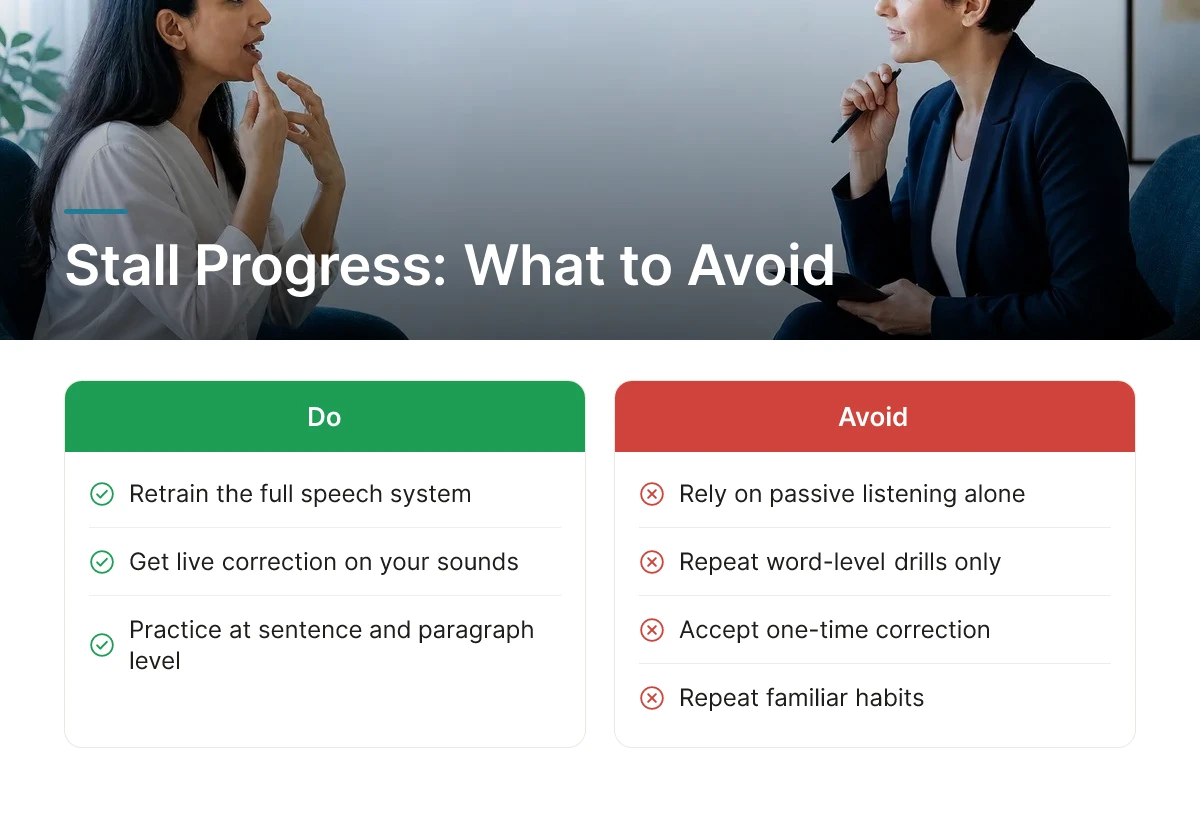
Most professionals stall because they repeat familiar habits, passive listening, word-level drills, one-time correction, instead of retraining the full speech system.
Understanding how to improve speech clarity starts with recognizing what keeps effort from turning into real change. These four mistakes show up repeatedly among non-native professionals who have already put in months, sometimes years, of independent work.
Mistake 1: Relying on passive listening and imitation
Watching shows, listening to podcasts, or practicing with an app can build vocabulary and familiarity with American speech patterns. None of these methods evaluate your individual sound production or correct it in real time. Without live feedback on where your tongue, lips, and jaw are actually placed, you can practice an inaccurate sound for months and reinforce the error rather than fix it.
Mistake 2: Training words instead of connected speech
Isolated word drills teach a sound in a vacuum. Real conversation, patient explanations, and presentations depend on rhythm, sentence stress, and connected speech, how words link, reduce, and flow together. A speaker who can pronounce a word perfectly in isolation often loses that clarity the moment it moves into a full sentence at conversational speed.
Mistake 3: Treating correction as a one-time fix
Pronunciation change is not a single lesson, it is a progressive retraining process that moves through sound articulation, phonetic patterns, sentence-level intonation, and paragraph delivery. Skipping stages, or expecting one correction to hold permanently, usually means the old pattern resurfaces under pressure, such as during interviews or live presentations.
Mistake 4: Ignoring native-language sound interference
Native-language habits shape how your brain perceives and categorizes American sounds, not just how you produce them. Without addressing that perceptual layer, learners keep repeating identical errors even after conscious correction, because the underlying awareness never changed.
MyAccentWay’s Cognitive Accent Training and 2D Sound Motion Technology exist specifically to close these gaps, evaluating your sound patterns live, training rhythm and connected speech alongside individual sounds, and building the sound-to-sentence-to-paragraph progression that makes clarity permanent. Review real student progress on the American accent training before-and-after results page, including the Tian pronunciation evaluation for Mandarin speakers.
If these mistakes sound familiar, book a 1-hour Interactive American Accent Training session with Prof. Alex through the booking page or visit the MyAccentWay homepage to start a structured path forward.
Frequently Asked Questions
Why do I still sound unclear in English even though my grammar and vocabulary are strong?
Grammar and vocabulary form only two of the three patterns fluent English requires; the missing piece is usually pronunciation and phonetics. Many advanced speakers can construct perfect sentences on paper but never trained American sound articulation, rhythm, or connected speech, so listeners still struggle to follow them in real conversation.
What specific American sounds and connected speech patterns most often cause clarity problems for non-native professionals?
Vowel distinctions, consonant clusters, word stress, and reductions like contractions and linked words cause most clarity breakdowns. Sounds such as short vowels, the American /r/, and final consonants often get dropped or distorted, and connected speech patterns—where words blend together in natural sentences—trip up listeners even when individual words are pronounced correctly on their own.
How is Interactive Accent Training with Prof. Alex different from repeating pronunciation drills on my own?
Interactive Accent Training places you in an active role where Prof. Alex evaluates your speech in real time, rather than leaving you to guess if self-directed repetition worked. You listen, compare, speak, and adjust with direct correction on articulation, rhythm, and intonation, so changes become stable habits instead of temporary awareness that fades once practice stops.
How long does it take to notice clearer speech with structured American accent training?
Many professionals notice measurable clarity improvements within the first several sessions of structured, interactive training. Full progression through American sound articulation, phonetic exercises, sentence practice, and paragraph practice with presentation-style delivery generally unfolds over weeks, with pace depending on starting point and practice consistency between sessions.
Can 2D Sound Motion Technology change how I physically produce American sounds?
Yes, because it trains actual speech-organ movement rather than just showing you what a sound looks like. The Interactive 2D Sound Motion Simulator for the American unvoiced sound [t] guides your tongue, jaw, lips, and airflow through the correct movement pattern, letting you retrain articulation directly instead of guessing from a verbal description.
Conclusion
Speech clarity problems rarely come from weak English skills, they come from an untrained sound system. Fixing that requires working through American sound articulation, phonetic exercises, sentence-level rhythm and intonation, and paragraph practice in that order, not isolated tips applied at random.
Prof. Alex’s Interactive Accent Training gives that structure through live 1-on-1 correction and 2D Sound Motion Technology, moving you from guesswork to guided, physical retraining. Review the before-and-after results from students like Tian and Vlad, then book a 1-hour Interactive American Accent Training Session with Prof. Alex to identify exactly which sound patterns are limiting your clarity.
Recommended Articles
Explore more from our content library: