Why Pronunciation Coaching Works for Professionals
(512) 265-9515Updated October 14, 2026 ◆ 11 min read
Real student result

“I feel confident enough to speak American English!”
Interactive American Accent Training9monthsof hard work and dedication
Listen to the starting point0:00
Listen to the result0:00
“Many of my students once believed they could never sound like this. School taught them grammar and vocabulary, but not how to train their English speech. That is what we do together, step by step, until you speak English independently and with confidence.”
Abishek’s result was achieved through Prof. Alex’s research-based Interactive 1-on-1 American Accent Training. His doctoral research found this interactive method more effective than traditional, teacher-centered methods. See the research basis →
Questions about pronunciation coaching?
Students can call our support center to ask questions and get help connecting with Professor Alex.
Pronunciation coaching is defined as personalized, expert-guided speech training that targets each learner’s specific sound errors, intonation patterns, and speech habits to build clear, confident English communication. For non-native professionals, this method consistently outperforms self-study tools because it combines real-time correction with structured motor training. Professor Alex, Ph.D., Linguist and Accent Coach at Myaccentway, applies this approach through one-on-one sessions and 2D Sound Motion Technology, giving students a measurable path from unclear speech to professional-level clarity.
Why Pronunciation Coaching Works Better Than Self-Study
By Professor Alex, Ph.D. Linguist
Pronunciation coaching works better than self-study because students receive personalized, immediate feedback. When you practice alone, you may repeat the same sound many times without realizing that your tongue, lips, jaw, airflow, rhythm, or stress pattern is incorrect. A trained pronunciation coach can hear the problem in real time, explain what is happening, and guide you toward the correct American sound pattern before the mistake becomes a habit.
Self-study apps can be helpful for extra practice, but they cannot fully replace one-on-one correction. Many apps give a score, but a score does not always explain why the pronunciation is unclear or what physical movement needs to change. In pronunciation training, the most important question is not only “Did I say it correctly?” but “What exactly do I need to change to produce the sound more clearly?”
One-on-one coaching allows the lesson to focus on the student’s specific speech patterns. Some students need help with vowels, others with consonants, rhythm, stress, intonation, reductions, or connected speech. A coach can adjust the lesson immediately based on what the student needs, instead of following a generic path created for everyone.
The biggest advantage of pronunciation coaching is that it helps prevent error fossilization. If a student practices the wrong sound pattern again and again, that mistake can become automatic. Later, it takes much more effort to correct. Immediate feedback helps students build better pronunciation habits from the beginning.
Key Advantages of One-on-One Pronunciation Coaching
-
Immediate correction helps students notice and fix pronunciation mistakes before they become permanent habits.
-
Personalized feedback targets the student’s exact weaknesses in consonants, vowels, rhythm, stress, intonation, and connected speech.
-
Adaptive pacing allows the coach to slow down, repeat, or increase difficulty based on the student’s real progress.
-
Physical sound training helps students understand how to use the tongue, lips, jaw, airflow, and speech organs correctly.
-
Confidence building helps students feel more comfortable speaking in meetings, interviews, presentations, and daily communication.
-
Structured progression moves students from individual sounds to words, sentences, paragraphs, and real conversation.
Professor Alex’s Pro Tip
Record your speech before your first pronunciation coaching session. Then record yourself again after four weeks of focused training. Listen for changes in clarity, rhythm, stress, intonation, and confidence. This comparison helps you hear your progress and understand which American sound patterns are beginning to change.
How ear training and deliberate practice drive real progress
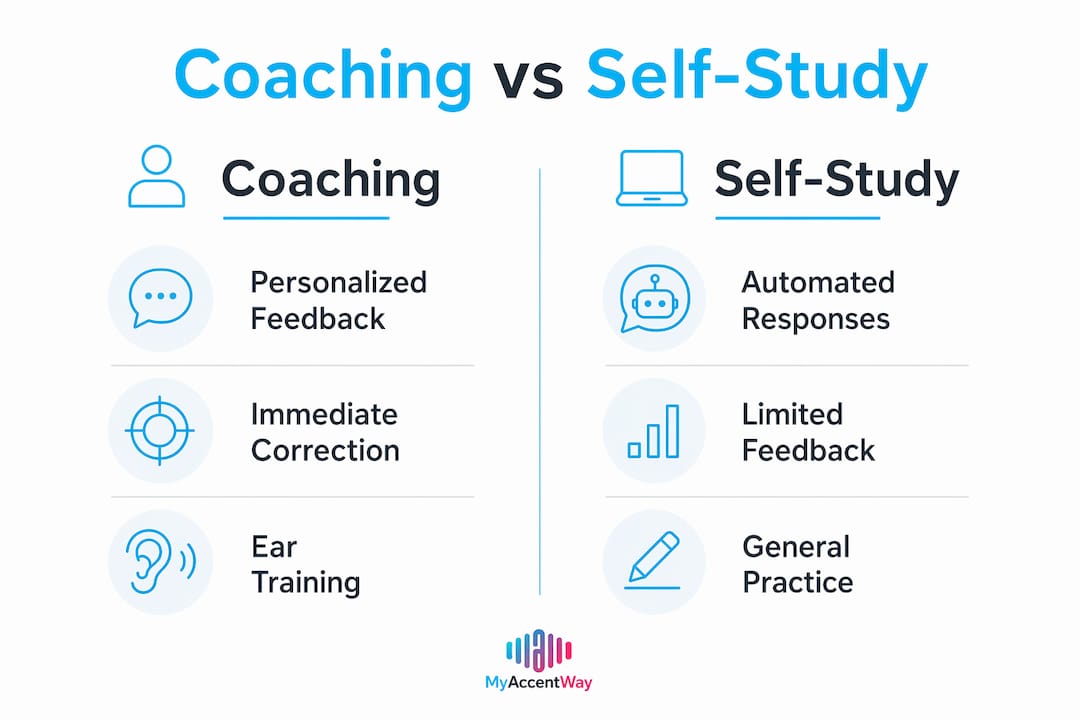
Pronunciation is inseparable from listening. Coaching trains the ear first to hear sound contrasts clearly before the mouth can produce them accurately. Without that auditory target, your speech organs are guessing, and guessing produces inconsistent results.

This is the neurological barrier most self-study learners never overcome. Your brain filters incoming sounds through the phonetic patterns of your first language. American English sounds like the flap T, the schwa vowel, or the voiced TH do not exist in many languages. Until your ear recognizes them as distinct targets, your mouth cannot reliably produce them.
Effective coaching addresses this in a specific sequence:
-
Identify the target sound through careful listening exercises that isolate the contrast
-
Train the ear with minimal pair drills and focused listening before any production attempt
-
Practice production slowly with full attention to articulation placement
-
Increase speed gradually only after the correct motor pattern is stable
-
Transfer to connected speech through sentence-level and conversation practice
The danger of skipping steps three and four is significant. Fast practice cements inaccurate habits at the motor level. Once a wrong movement pattern becomes automatic, it takes deliberate, supervised repetition to reprogram it. A coach guides you through this reprogramming at the right speed.
“The ear gives the mouth its target. Without hearing the contrast clearly, the mouth has to guess, slowing progress significantly.”
Intelligibility vs. accent elimination: what coaching actually targets
Pronunciation coaching focuses on intelligibility, not accent elimination. Over 75% of English speakers worldwide are non-native. That statistic reframes the entire goal of coaching. You are not trying to sound like a native speaker from Ohio. You are training your speech to be understood clearly and confidently by the widest possible audience.
This distinction matters practically. Focusing on clear communication reduces listener effort, creates better professional impressions, and builds real confidence faster than chasing an idealized native accent. Professionals who shift their goal from “sound American” to “be understood clearly” report faster progress and less anxiety.
| Coaching Goal | Intelligibility Focus | Accent Elimination Focus |
|---|---|---|
| Primary target | Clear, confident speech | Native-like sound |
| Timeline | Faster, measurable gains | Longer, often frustrating |
| Professional impact | Immediate workplace benefit | Marginal beyond clarity |
| Learner confidence | Builds steadily | Often undermined by perfectionism |
| Coaching approach | Practical, communication-driven | Phonetically rigid |
The accent reduction field has shifted decisively toward intelligibility-oriented training. This is the approach Professor Alex applies at Myaccentway. The goal is speech that works in your professional environment, not speech that erases your identity.
Does technology enhance pronunciation coaching results?
Technology, when combined with expert coaching, produces stronger outcomes than either method alone. Hybrid coaching models that pair daily AI-driven drills with weekly human tutor sessions consistently outperform solo methods by combining repetitive drilling with expert prosody and cadence refinement. The AI handles volume and repetition. The coach handles judgment and nuance.
Myaccentway takes this further with 2D Sound Motion Technology, also called Interactive Mouth Training Technology. With the Interactive Visual 2D Sound Simulators, students actively train the movement of the tongue, lips, jaw, teeth, and airflow for American English sounds while Prof. Alex corrects them live. Instead of only listening and repeating, students train their speech organs to produce each sound. The simulators are part of Prof. Alex’s interactive teaching model, based on his Ph.D. research in interactive teaching methods. This active practice accelerates motor learning.
Practice the American T sound with 2D Sound Motion Technology:
A 2024 hybrid coaching study found that participants reported reduced speaking anxiety after combined AI practice and human coaching. That reduction in anxiety directly translates to more confident, clearer speech in professional settings.
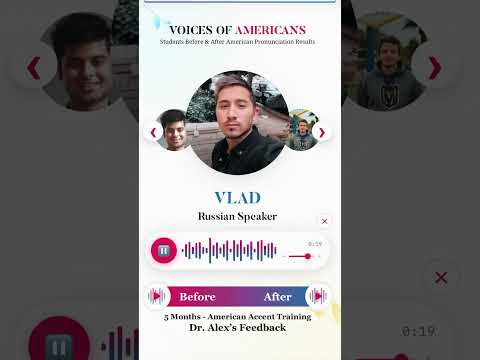
See the real results this approach produces. Vlad, a Russian-speaking professional, completed training with Professor Alex and achieved measurable improvement in American English pronunciation:
Pro Tip: When practicing with any app or audio tool, slow the playback speed to 75% and focus on one sound at a time. Speed is the enemy of accurate motor learning in early pronunciation training.
MyAccentWay · 2D Sound Motion Technology
American English Pronunciation: Consonant and Vowel Sounds with 2D Sound Motion Technology
Learning American English pronunciation and the American accent is more effective when you train your speech organs, not only listen and repeat. 2D Sound Motion Technology and Interactive Visual 2D Sound Simulators, developed in 2020 by Prof. Alex, Ph.D. Accent Coach, Doctor of Education, and professional linguist, as part of his interactive teaching model based on his Ph.D. research in interactive teaching methods, train your tongue, lips, jaw, teeth, airflow, and voice step by step. They train each American sound and more than 30 sound combinations through Interactive 2D video simulation.
What 2D Sound Motion Technology is
2D Sound Motion Technology is an advanced accent reduction and articulation training tool by Prof. Alex. It corrects, develops, and trains each American sound and more than 30 sound combinations through Interactive 2D video simulation.
What Interactive Visual 2D Sound Simulators do
Interactive Visual 2D Sound Simulators are part of 2D Sound Motion Technology, the articulation-training method Prof. Alex created by applying his Ph.D. research in interactive teaching to American pronunciation. Instead of listening and repeating, students actively train their speech organs. Each simulator uses Interactive 2D mouth movement to train the speech organs (tongue, lips, jaw, teeth, airflow, and voice) to produce each American sound correctly. Every consonant has its own simulator: explore American consonants trained with 2D Sound Motion Technology.
Sample training: the American t sound (aspirated [t])
Practice
Record yourself speaking these words:
Tab · Tacos · Time · Tub · Hotel · Motel · Sit · Pit · Net
Instructions
Play the Interactive Visual 2D Sound Simulator for the American t sound below several times and follow it step by step. Move your tongue, jaw, and airflow together with the simulator and train your articulation.
Interactive Visual 2D Sound Simulator: American unvoiced sound [t]
Practice
Record yourself again speaking these words, but this time focus on the movement of your tongue. Go slow, and you will hear the difference. You’ve got this!
Tab · Tacos · Time · Tub · Hotel · Motel · Sit · Pit · Net
How Interactive Visual 2D Sound Simulators solve pronunciation and speaking problems
- Wrong articulationMost pronunciation problems start with the tongue, lips, jaw, or teeth in the wrong position. Each Interactive Visual 2D Sound Simulator trains the correct articulation of one American sound, so the student corrects the cause of the problem, not only the result.
- Airflow and voicingMany accent problems come from wrong airflow or voicing: sounds that are too weak, too strong, or voiced when they should be unvoiced. The simulators train airflow and voice together with articulation, step by step, for each American sound and more than 30 sound combinations.
- Clear speech and confidenceWhen each sound is trained correctly, words connect into clear American English speech. Listeners can understand you more easily, and speaking at work, in meetings, and on calls becomes more confident.
If you start hearing the aspiration, the short airstream after [t], with one simulator, you can only imagine how successful you can be in 1-on-1 Interactive American Accent Training with Prof. Alex, Ph.D. Accent Coach, where your whole American sound system is trained sound by sound.
In MyAccentWay, the Interactive Visual 2D Sound Simulators are only available in 1-on-1 accent coaching sessions with Prof. Alex.
Key takeaways
Pronunciation coaching works because personalized, expert-guided feedback trains both the ear and the speech organs to produce clear, intelligible American English faster than any self-study method.
| Point | Details |
|---|---|
| Personalized feedback accelerates progress | One-on-one coaching doubles proficiency gains by targeting your exact errors in real time. |
| Ear training precedes sound production | Coaching trains you to hear target sounds clearly before your mouth attempts to produce them. |
| Slow practice builds accurate motor patterns | Deliberate, supervised repetition prevents bad habits from becoming automatic. |
| Intelligibility is the professional goal | Coaching targets clear, confident speech rather than accent elimination for faster workplace results. |
| Technology amplifies coaching outcomes | 2D Sound Motion Technology and hybrid AI practice strengthen motor learning alongside expert guidance. |
What i have learned after years of coaching non-native professionals
Most students arrive believing their accent is the problem. After years of working with non-native professionals from Russia, China, India, Brazil, and across the world, I can tell you the accent is rarely the real barrier. The real barrier is that no one has ever shown them exactly where to place their tongue for the American R, or how the jaw drops differently for the short A vowel, or why their intonation pattern signals uncertainty to American listeners even when their words are correct.
That is what coaching solves. Not the accent. The specific, physical, auditory gaps that self-study tools cannot identify because they were not built to see your individual speech pattern.
I also want to address a common misperception: that pronunciation training is only for people with heavy accents. The professionals who benefit most from coaching are often highly articulate in their native language and in written English. They simply have untrained speech habits in American English that create friction in meetings, presentations, and client calls. One targeted session on connected speech or sentence stress can shift how colleagues perceive your confidence and authority.
The students who progress fastest are not the ones who practice the most hours. They are the ones who practice slowly, with full attention, under expert supervision. Doubt becomes clarity when you understand exactly what you are training and why.
If you are a non-native professional who wants clearer American English speech, the path is not longer practice. It is better practice, guided by someone who can see what you cannot hear yet.
— Prof.
Start your personalized american accent training with professor alex
Myaccentway offers one-on-one American accent training designed specifically for non-native professionals who need clearer, more confident English speech in real workplace settings.
Professor Alex begins every program with a personalized speech assessment to identify your exact pronunciation patterns, then builds a structured training plan around your specific needs. Sessions integrate 2D Sound Motion Technology to make American sounds physically trainable, not just audible. Whether you are preparing for presentations, client calls, or daily professional communication, the American accent training program at Myaccentway gives you a clear, science-backed path to speech clarity. Book Your 1 Hour Evaluation Session today and hear the difference expert coaching makes.
Interactive American Accent Training for Foreign-Born Professionals in the United States
Foreign-born professionals in the United States often know their field and speak advanced English. Yet American listeners may still struggle with their sounds, stress, and rhythm. MyAccentWay offers private online American accent training through Interactive American Accent Training.
Interactive American Accent Training is led by Prof. Alex, Ph.D. Accent Coach, Doctor of Education, and professional linguist. He first diagnoses each speaker’s native-language patterns. Then he trains American sound articulation, stress, rhythm, and intonation for real real conversations.
Who this training is for
- Engineers, IT specialists, and data professionals presenting to U.S. teams and clients
- Doctors, nurses, and healthcare professionals explaining care to American patients
- Managers, executives, and founders leading meetings, pitches, and briefings
- Consultants, researchers, and academics speaking at conferences and webinars
- Professionals preparing for interviews, promotions, or client-facing roles
Online training across the U.S.
MyAccentWay is based in Austin, Texas, and all training is online. The program is especially relevant for professionals in Austin, Dallas, Houston, New York City, the San Francisco Bay Area, Los Angeles, Seattle, Boston, Chicago, Miami, Washington DC, Atlanta, and Raleigh.
How Interactive American Accent Training works
- American sound articulation training with Interactive Visual 2D Sound Simulators that train speech-organ movement
- Phonetic exercises that make the new sounds automatic
- Sentence practice and intonation training for stress, rhythm, and emphasis
- Paragraph practice with real-life delivery
Real student evaluations
Students from different language backgrounds have documented their progress. Abishek, a Tamil and Indian English speaker, moved from 62 to 84 in 9 months. Tian, a Mandarin speaker, moved from 58 to 85 in 8 months. Vlad, a Russian speaker, moved from 60 to 83 in 5 months.
The first step is a 1 Hour Evaluation Session with Prof. Alex.
FAQ
Does pronunciation coaching actually work?
Yes. One-on-one coaching doubles proficiency gains compared to group instruction by providing immediate, personalized feedback that self-study tools cannot replicate.
How long does it take to see results from pronunciation coaching?
Participants reported reduced speaking anxiety after hybrid coaching. Consistent, coached practice can support pronunciation improvement.
What is the difference between pronunciation coaching and accent reduction?
Pronunciation coaching is the broader, industry-standard term for expert-guided speech training. Accent reduction is a specific application focused on shifting speech patterns toward a target variety, such as American English, with the goal of improving intelligibility rather than eliminating an accent entirely.
Why is one-on-one coaching better than a language app?
Apps cannot identify your individual speech errors or correct them in real time. A coach catches and corrects errors immediately, preventing bad habits from forming and adapting each session to your exact needs.
What is 2d sound motion technology?
2D Sound Motion Technology is a method used by Professor Alex at Myaccentway that trains the tongue, lips, jaw, and airflow for American English sounds, allowing students to practice correct articulation instead of only listening and repeating.
Recommended
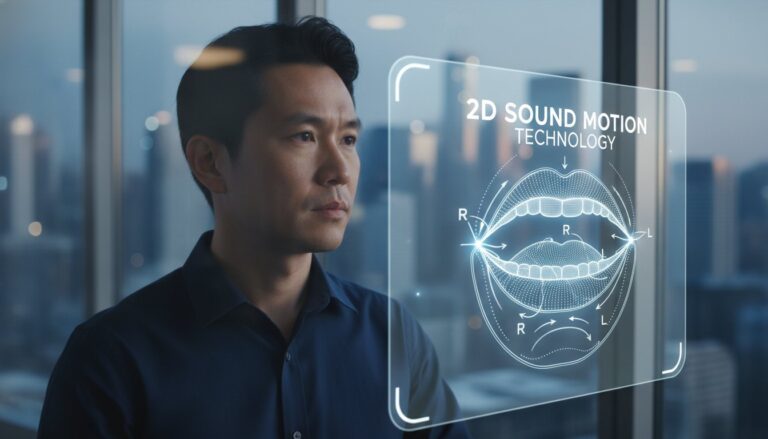
Translators and Interpreters Improving American Pronunciation
American accent training and accent reduction guide for translators and interpreters who want clearer pronunciation, speech clarity, intonation, rhythm, connected speech, and confident professional English in the United States.

Is Accent Coaching Worth It for Professionals? Real Feedback vs. AI Feedback
Learn when accent coaching is worth it, how real feedback compares with AI pronunciation feedback, and why professional speech clarity needs more than a score.
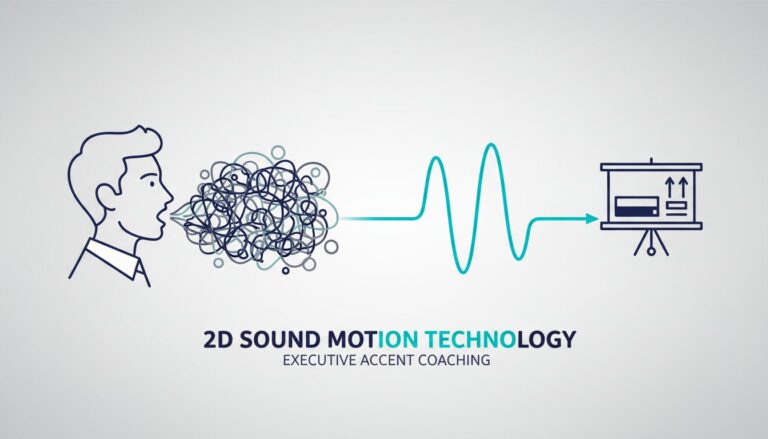
Accent Coaching for Executives: Mastering Communication with Prof. Alex, Ph.D. Linguist
According to 2023 linguistic perception studies, listeners often judge a speaker's professional credibility within the first 500 milliseconds of...
The problem is not always grammar or vocabulary.
If people understand your words but still miss your message, the deeper issue may be speech clarity, rhythm, intonation, and American pronunciation habits. MyAccentWay helps students retrain the sound system with professional 1-on-1 guidance, so English can feel clearer, freer, and more natural in real communication.
Two training methods that make speech change active.
MyAccentWay is not passive listen-and-repeat coaching. Prof. Alex, Ph.D. Accent Coach, Doctor of Education, and professional linguist, creates a learning situation where students become active learners and active participants in changing their own speech patterns.
Interactive training
Students do not just receive pronunciation instructions passively. They listen, think, compare, adjust, and understand their own speech patterns while Prof. Alex guides the correction process.
Cognitive accent training
Students learn to notice and correct the speech patterns that affect American pronunciation, then implement new American speech patterns into their code-switching process for more natural, long-lasting change.
Build speech habits people can hear in real conversations.
A stronger American accent is not built by memorizing topics or chasing quick pronunciation tips. It comes from structured training, professional feedback, active correction, and repeated application until clearer speech becomes easier to keep.
Continue learning how MyAccentWay connects accent reduction, accent modification, English articulation, Prof. Alex’s method, student proof, and 1-on-1 American accent training.
- Prof. Alex and the MyAccentWay MethodLearn how Prof. Alex, Ph.D. Accent Coach, Doctor of Education, and professional linguist, created and leads the structured MyAccentWay American accent training system.
- Accent Reduction Curriculum and English Articulation TrainingSee how MyAccentWay trains accent reduction, accent modification, American pronunciation, English articulation, rhythm, and professional speech clarity.
- 2D Sound Motion Technology for American Accent TrainingUnderstand Prof. Alex’s Interactive Visual 2D Sound Simulators for American sound articulation.
- Before-and-After American Accent Training ResultsListen to real before-and-after student proof and accent training outcomes.
- Student Reviews and Accent Training ResultsRead student reviews, testimonials, and trust signals from MyAccentWay learners.
- Book a 1-on-1 American 1 Hour Evaluation SessionStart with a 1-hour interactive American accent training session with Prof. Alex.