Why Adults Can Learn New Pronunciation: The Science
(512) 265-9515Updated October 16, 2026 ◆ 11 min read
Adults retain the ability to learn new pronunciation because neuroplasticity persists in the brain’s auditory and somatosensory systems well into adulthood. This is not a motivational claim. fMRI scans from 2025–2026 reveal measurable anatomical brain changes in bilingual adults who undergo phonetic training. That finding overturns the long-held belief that pronunciation learning is a young person’s game. Adults also bring cognitive strengths that children simply do not have: pattern recognition, metalinguistic awareness, and deliberate learning strategies. With the right method, including Myaccentway’s structured approach and 2D Sound Motion Technology, clear and confident American English pronunciation is fully achievable.
Real student result

“I feel confident enough to speak American English!”
Interactive American Accent Training9monthsof hard work and dedication
Listen to the starting point0:00
Listen to the result0:00
“Many of my students once believed they could never sound like this. School taught them grammar and vocabulary, but not how to train their English speech. That is what we do together, step by step, until you speak English independently and with confidence.”
Abishek’s result was achieved through Prof. Alex’s research-based Interactive 1-on-1 American Accent Training. His doctoral research found this interactive method more effective than traditional, teacher-centered methods. See the research basis →
Why adults can learn new pronunciation: the neuroplasticity answer
The adult brain does not stop rewiring itself after childhood. Auditory and somatosensory regions remain structurally adaptable, and targeted phonetic training activates that adaptability directly. This is the core reason why adults learning pronunciation can make real, measurable progress at any age.
The auditory cortex plays a more central role in pronunciation than the motor cortex. Disrupting auditory feedback impairs speech production more severely than disrupting motor control. This means that training your ear to hear American sounds accurately is the first and most critical step in retraining how you produce them.
One common misconception is that neuroplasticity disappears after the critical period of childhood language acquisition. The research does not support that view. What changes in adulthood is the type of plasticity, not its absence. The brain shifts from rapid, passive absorption to slower, deliberate restructuring. That shift actually favors adults who use structured phonetic training rather than passive immersion.
Effective phonetic exercises activate this plasticity by creating new auditory and sensory pathways. When you practice a specific American consonant or vowel with awareness of how your tongue, lips, and breath move, you give your brain the precise input it needs to form a new neural pattern. Repetition then strengthens that pattern until the sound becomes automatic.

Pro Tip: Focus on hearing a sound accurately before you try to produce it. Your auditory cortex leads the process. If you can hear the difference between two sounds clearly, your production will follow much faster.
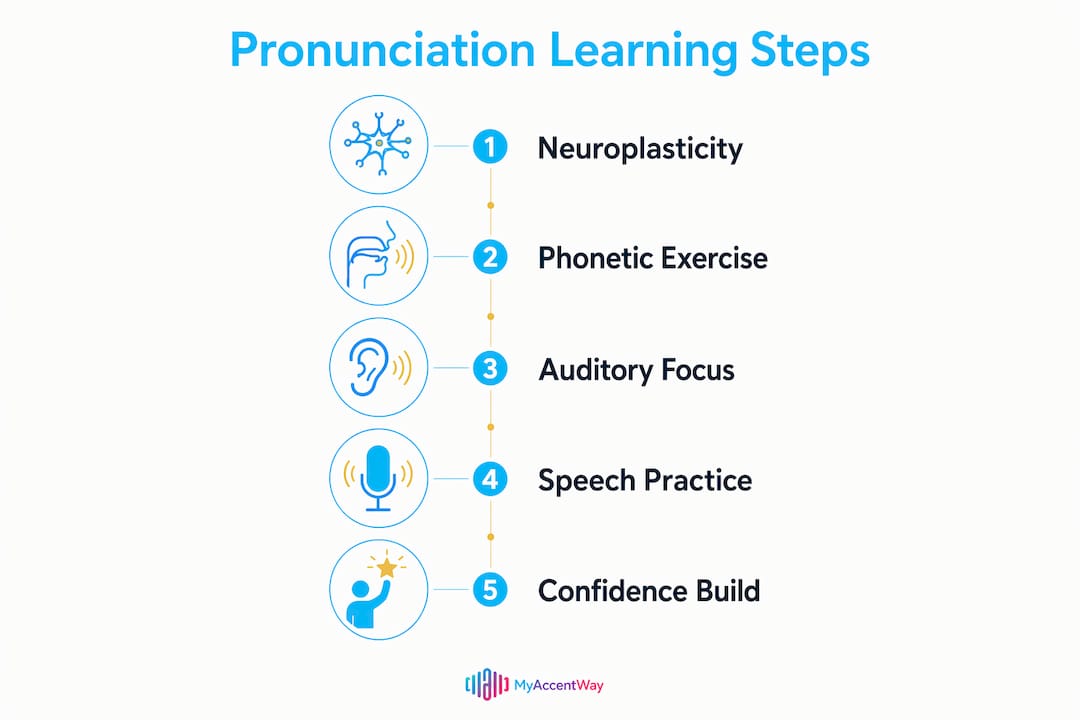
How do adult cognitive strengths help with pronunciation learning?
Adults are not disadvantaged learners. They are differently advantaged learners. Research confirms that motivation and deliberate strategy are the primary determinants of adult pronunciation success, not age.
Adults bring several cognitive tools to pronunciation training that children lack:
-
Metalinguistic awareness. Adults can analyze how a sound is formed, compare it to their native language, and consciously adjust. A child imitates. An adult understands.
-
Pattern recognition. Adults identify recurring sound patterns in American English, such as the reduced vowel schwa or the rhythm of stressed and unstressed syllables, and apply those patterns across new words.
-
Planning and strategy. Adults can set specific goals, track their progress, and adjust their practice based on feedback. This makes their learning more efficient per hour of study.
-
Motivation. Professional adults learning American English pronunciation have clear, concrete reasons to improve: career advancement, clearer meetings, stronger presentations. That motivation sustains the consistent practice that produces results.
The data on outside-class practice is striking. A 2026 study found that adults who practiced English word stress deliberately outside the classroom reached 83.4% accuracy in suprasegmental elements. That figure shows that mastery is not a classroom outcome alone. It is a practice outcome. Adults who understand this and commit to daily, intentional repetition outside their sessions achieve results that passive learners do not.
For a broader look at how adult language learning differs from childhood acquisition, the cognitive advantages described here apply across languages, not just English.
What challenges do adults face in pronunciation, and how do they overcome them?
Adult pronunciation challenges are real, but they are not biological deficits. Foreign accents in adults reflect deeply ingrained perceptual filters formed by decades of native language use, not a broken speech system. Understanding this distinction changes everything about how you approach training.
The two most common barriers are L1 interference and over-monitoring.
-
L1 interference. Your native language trained your brain to hear and produce a specific set of sounds. American English uses sounds that may not exist in your first language. Your brain filters incoming speech through those existing categories, which is why certain American vowels or consonants sound identical to you even when they are distinct to a native speaker. The solution is not to try harder. The solution is to retrain your auditory perception first, then your production.
-
Over-monitoring. The mature prefrontal cortex in adults creates self-consciousness during speech that children do not experience. You notice every mistake. You correct yourself mid-sentence. That tension physically tightens the muscles involved in speech and blocks fluent production. Over-monitoring is one of the most underestimated barriers in adult pronunciation work.
-
Perfectionism. Waiting to speak until you are certain you will sound correct prevents the very practice that builds certainty. Tolerance for mistakes is not optional. It is a core skill in adult pronunciation progress.
An effective strategy for overcoming over-monitoring is to shift attention from the sound itself to the physical sensation of producing it. Successful learners concentrate on where their tongue touches, how their lips move, and how their breath flows rather than on whether the sound is “correct.” This sensory focus reduces self-consciousness and accelerates the shift from conscious effort to subconscious habit.
Pro Tip: When you catch yourself over-monitoring, pause and place your attention on your tongue position or lip shape instead of the sound. Physical awareness short-circuits the anxiety loop and keeps your speech muscles relaxed.
What methods and technologies accelerate adult pronunciation improvement?
Effective methods for adult pronunciation improvement combine auditory training, speech-organ awareness, and consistent deliberate practice. Passive listening alone does not produce the neural changes needed for lasting improvement. Active auditory-cognitive analysis drives the results.

Myaccentway’s structured training follows a specific sequence: speech-organ awareness first, then American consonants and vowels, then rhythm and intonation. Each stage builds on the previous one. Students do not guess at sounds or simply repeat after audio. They learn exactly where the tongue goes, how the lips shape, and how the breath supports each American sound.
The Interactive Visual 2D Sound Simulators train students to actively practice the movement of the tongue, lips, jaw, teeth, and airflow while Prof. Alex corrects them live. They are part of Prof. Alex’s interactive teaching model, based on his Ph.D. research in interactive teaching methods. This somatosensory feedback activates the same neural pathways that fMRI research identifies as central to pronunciation learning.
Thiago, a Portuguese speaker, went through Myaccentway’s structured program and achieved measurable improvement in his American English clarity and confidence.
Watch Thiago’s results to see what structured phonetic training produces in a real adult learner.
Mindset is the final accelerator. Dr. Krashen’s Input Hypothesis identifies belief in achievability as one of the strongest predictors of adult accent acquisition success. Students who approach training with confidence, not perfectionism, progress faster and retain more. The goal of Myaccentway’s program is not a perfect accent. The goal is clear, confident American English that works in professional settings.
For daily practice outside sessions, structured pronunciation exercises for adults reinforce what is learned in 1-on-1 coaching and build the habit of accurate production.
Key Takeaways
Adults can learn new pronunciation because neuroplasticity, cognitive strengths, and structured training combine to make measurable speech improvement achievable at any professional stage.
| Point | Details |
|---|---|
| Neuroplasticity persists in adults | Auditory and somatosensory brain regions adapt with phonetic training well into adulthood. |
| Cognitive strengths accelerate learning | Adults use pattern recognition, strategy, and metalinguistic awareness to learn sounds more deliberately than children. |
| Outside-class practice drives mastery | Deliberate practice beyond coaching sessions produces significantly higher accuracy in suprasegmental elements. |
| L1 filters and over-monitoring are the main barriers | Both are addressable through sensory awareness techniques and a shift from perfectionism to intelligibility. |
| Structured training with visual feedback works | Speech-organ awareness combined with 2D Sound Motion Technology produces measurable, lasting pronunciation change. |
What 20+ years of teaching adults has taught me about pronunciation
Adults come to me convinced that their window for pronunciation improvement has closed. That belief is the biggest obstacle I face in my work, and it is not supported by the science or by what I see in my students every week.
The students who progress fastest are not the youngest ones. They are the ones who commit to understanding how a sound is made, not just what it sounds like. When a student finally practices tongue positioning with an Interactive Visual 2D Sound Simulator and understands why they have been producing a sound incorrectly for years, something shifts. Doubt becomes clarity. That moment is not available in traditional “repeat after me” teaching.
My approach through American Accent Training starts with the speech organs because you cannot follow a coach’s instructions if you do not know what your tongue, lips, and jaw are doing. Once students have that awareness, retraining American consonants, vowels, rhythm, and intonation becomes a structured process rather than a guessing game. The goal is always the same: students stop overthinking each word and start speaking the way they do in their native language, with confidence and without hesitation.
Pronunciation is not a talent. It is a skill. And skills, at any age, respond to the right kind of deliberate practice.
— Prof. Alex, Ph.D. Accent Coach
Myaccentway’s science-backed approach to American accent training
Myaccentway offers 1-on-1 American accent training built on linguistics research and 20+ years of practical coaching experience with non-native English professionals. The program is not a generic pronunciation course. It is a structured retraining system that begins with speech-organ awareness and moves through American consonants, vowels, rhythm, and intonation in a sequence designed for adult learners.

Prof. Alex’s accent reduction program uses Interactive Visual 2D Sound Simulators available exclusively in 1-on-1 sessions. Students from Russian, Mandarin, Portuguese, and dozens of other language backgrounds have achieved measurable gains in speech clarity and professional confidence. The program is fully online and accessible across the U.S.
Explore Curriculum | Book Your 1 Hour Evaluation Session | Read Reviews
Interactive American Accent Training for Foreign-Born Professionals in the United States
Foreign-born professionals in the United States often know their field and speak advanced English. Yet American listeners may still struggle with their sounds, stress, and rhythm. MyAccentWay offers private online American accent training through Interactive American Accent Training.
Interactive American Accent Training is led by Prof. Alex, Ph.D. Accent Coach, Doctor of Education, and professional linguist. He first diagnoses each speaker’s native-language patterns. Then he trains American sound articulation, stress, rhythm, and intonation for real real conversations.
Who this training is for
- Engineers, IT specialists, and data professionals presenting to U.S. teams and clients
- Doctors, nurses, and healthcare professionals explaining care to American patients
- Managers, executives, and founders leading meetings, pitches, and briefings
- Consultants, researchers, and academics speaking at conferences and webinars
- Professionals preparing for interviews, promotions, or client-facing roles
Online training across the U.S.
MyAccentWay is based in Austin, Texas, and all training is online. The program is especially relevant for professionals in Austin, Dallas, Houston, New York City, the San Francisco Bay Area, Los Angeles, Seattle, Boston, Chicago, Miami, Washington DC, Atlanta, and Raleigh.
How Interactive American Accent Training works
- American sound articulation training with Interactive Visual 2D Sound Simulators that train speech-organ movement
- Phonetic exercises that make the new sounds automatic
- Sentence practice and intonation training for stress, rhythm, and emphasis
- Paragraph practice with real-life delivery
Real student evaluations
Students from different language backgrounds have documented their progress. Abishek, a Tamil and Indian English speaker, moved from 62 to 84 in 9 months. Tian, a Mandarin speaker, moved from 58 to 85 in 8 months. Vlad, a Russian speaker, moved from 60 to 83 in 5 months.
The first step is a 1 Hour Evaluation Session with Prof. Alex.
MyAccentWay · 2D Sound Motion Technology
American English Pronunciation: Consonant and Vowel Sounds with 2D Sound Motion Technology
Learning American English pronunciation and the American accent is more effective when you train your speech organs, not only listen and repeat. 2D Sound Motion Technology and Interactive Visual 2D Sound Simulators, developed in 2020 by Prof. Alex, Ph.D. Accent Coach, Doctor of Education, and professional linguist, as part of his interactive teaching model based on his Ph.D. research in interactive teaching methods, train your tongue, lips, jaw, teeth, airflow, and voice step by step. They train each American sound and more than 30 sound combinations through Interactive 2D video simulation.
What 2D Sound Motion Technology is
2D Sound Motion Technology is an advanced accent reduction and articulation training tool by Prof. Alex. It corrects, develops, and trains each American sound and more than 30 sound combinations through Interactive 2D video simulation.
What Interactive Visual 2D Sound Simulators do
Interactive Visual 2D Sound Simulators are part of 2D Sound Motion Technology, the articulation-training method Prof. Alex created by applying his Ph.D. research in interactive teaching to American pronunciation. Instead of listening and repeating, students actively train their speech organs. Each simulator uses Interactive 2D mouth movement to train the speech organs (tongue, lips, jaw, teeth, airflow, and voice) to produce each American sound correctly. Every consonant has its own simulator: explore American consonants trained with 2D Sound Motion Technology.
Sample training: the American t sound (aspirated [t])
Practice
Record yourself speaking these words:
Tab · Tacos · Time · Tub · Hotel · Motel · Sit · Pit · Net
Instructions
Play the Interactive Visual 2D Sound Simulator for the American t sound below several times and follow it step by step. Move your tongue, jaw, and airflow together with the simulator and train your articulation.
Interactive Visual 2D Sound Simulator: American unvoiced sound [t]
Practice
Record yourself again speaking these words, but this time focus on the movement of your tongue. Go slow, and you will hear the difference. You’ve got this!
Tab · Tacos · Time · Tub · Hotel · Motel · Sit · Pit · Net
How Interactive Visual 2D Sound Simulators solve pronunciation and speaking problems
- Wrong articulationMost pronunciation problems start with the tongue, lips, jaw, or teeth in the wrong position. Each Interactive Visual 2D Sound Simulator trains the correct articulation of one American sound, so the student corrects the cause of the problem, not only the result.
- Airflow and voicingMany accent problems come from wrong airflow or voicing: sounds that are too weak, too strong, or voiced when they should be unvoiced. The simulators train airflow and voice together with articulation, step by step, for each American sound and more than 30 sound combinations.
- Clear speech and confidenceWhen each sound is trained correctly, words connect into clear American English speech. Listeners can understand you more easily, and speaking at work, in meetings, and on calls becomes more confident.
If you start hearing the aspiration, the short airstream after [t], with one simulator, you can only imagine how successful you can be in 1-on-1 Interactive American Accent Training with Prof. Alex, Ph.D. Accent Coach, where your whole American sound system is trained sound by sound.
In MyAccentWay, the Interactive Visual 2D Sound Simulators are only available in 1-on-1 accent coaching sessions with Prof. Alex.
FAQ
Can adults really master American English pronunciation?
Yes. Adult brains retain neuroplasticity in auditory and somatosensory regions, enabling real pronunciation change with structured phonetic training. Mastery of clear, professional American English is achievable regardless of age.
Why do adults struggle more with pronunciation than children?
Adults have decades of native language sound categories that filter incoming speech. These perceptual filters are habits, not biological deficits, and they respond to targeted auditory and phonetic retraining.
How long does it take an adult to improve pronunciation noticeably?
Progress depends on practice frequency and method quality. Adults who practice deliberately outside coaching sessions reach significantly higher accuracy faster than those who rely on classroom time alone.
What is the most effective method for adult pronunciation improvement?
Structured training that combines speech-organ awareness, auditory perception work, and sensory feedback techniques produces the fastest and most lasting results. Interactive Visual 2D Sound Simulators train students to move their tongue, lips, jaw, and teeth and control airflow while Prof. Alex corrects them live, as part of his interactive teaching model based on his Ph.D. research in interactive teaching methods.
Does mindset affect pronunciation learning outcomes?
Yes. Believing pronunciation improvement is achievable is one of the strongest predictors of success in adult accent acquisition. Students who focus on intelligibility rather than perfection progress more consistently.
How does accent modification work for adults?
Adults can learn new pronunciation when they understand and retrain their speech patterns. At MyAccentWay, Prof. Alex first evaluates the student’s speech and native-language influence, then trains American sound articulation, phonetic exercises, sentence rhythm and intonation, and paragraph-level delivery in private 1-on-1 sessions.
Recommended
English Pronunciation Course 2026: Master the American Accent with Science
Have you ever felt the frustration of repeating yourself in a professional meeting, worried that your accent is overshadowing your expertise? Many...

How to Improve Pronunciation and Fluency: A Scientific Approach to the American Accent
A senior software engineer sits in a high-stakes boardroom meeting, his brilliant ideas silenced by the fear of being...
What Makes an Accent Hard to Understand? The Science of Speech Clarity
Last Tuesday, a senior software engineer named David sat in a boardroom in Austin, Texas, and felt his confidence sink as he was asked to repeat his...
The problem is not always grammar or vocabulary.
If people understand your words but still miss your message, the deeper issue may be speech clarity, rhythm, intonation, and American pronunciation habits. MyAccentWay helps students retrain the sound system with professional 1-on-1 guidance, so English can feel clearer, freer, and more natural in real communication.
Two training methods that make speech change active.
MyAccentWay is not passive listen-and-repeat coaching. Prof. Alex, Ph.D. Accent Coach, Doctor of Education, and professional linguist, creates a learning situation where students become active learners and active participants in changing their own speech patterns.
Interactive training
Students do not just receive pronunciation instructions passively. They listen, think, compare, adjust, and understand their own speech patterns while Prof. Alex guides the correction process.
Cognitive accent training
Students learn to notice and correct the speech patterns that affect American pronunciation, then implement new American speech patterns into their code-switching process for more natural, long-lasting change.
Build speech habits people can hear in real conversations.
A stronger American accent is not built by memorizing topics or chasing quick pronunciation tips. It comes from structured training, professional feedback, active correction, and repeated application until clearer speech becomes easier to keep.
Continue learning how MyAccentWay connects American sound articulation, Interactive Visual 2D Sound Simulators, accent reduction, student proof, and 1-on-1 training.
- Prof. Alex and the MyAccentWay MethodLearn how Prof. Alex, Ph.D. Accent Coach, Doctor of Education, and professional linguist, created and leads the structured MyAccentWay American accent training system.
- Accent Reduction Curriculum and English Articulation TrainingSee how MyAccentWay trains accent reduction, accent modification, American pronunciation, English articulation, rhythm, and professional speech clarity.
- 2D Sound Motion Technology for American Accent TrainingUnderstand Prof. Alex’s Interactive Visual 2D Sound Simulators for American sound articulation.
- Before-and-After American Accent Training ResultsListen to real before-and-after student proof and accent training outcomes.
- Student Reviews and Accent Training ResultsRead student reviews, testimonials, and trust signals from MyAccentWay learners.
- Book a 1-on-1 American 1 Hour Evaluation SessionStart with a 1-hour interactive American accent training session with Prof. Alex.