What Is the General American Accent? A Clear Guide
(512) 265-9515Updated October 24, 2026 ◆ 13 min read
Real student result

“It feels amazing when people say, ‘Your accent is so good. Where did you learn it?’ My answer is always, ‘Thanks to my great teacher, Alex.’”
Interactive American Accent Training5monthsof hard work and dedication
Listen to the starting point0:00
Listen to the result0:00
“Many of my students once believed they could never sound like this. School taught them grammar and vocabulary, but not how to train their English speech. That is what we do together, step by step, until you speak English independently and with confidence.”
Vlad’s result was achieved through Prof. Alex’s research-based Interactive 1-on-1 American Accent Training. His doctoral research found this interactive method more effective than traditional, teacher-centered methods. See the research basis →
A clear, professional guide to the sound system, rhythm, and speech patterns many non-native English speakers use as a target for American accent training.
Start General American accent training with Prof. Alex, Ph.D. Accent Coach.
If you already speak English well but still feel that your pronunciation, rhythm, or intonation does not sound clear enough, this is the moment to train with purpose. Prof. Alex helps serious learners understand what is happening in their speech, correct the patterns that affect clarity, and develop stronger General American speech habits for real professional communication.
This guide explains the target. Your 1 Hour Evaluation Session helps you understand where your own General American accent training should begin. For structured 1-on-1 practice of these features, explore American accent training with Prof. Alex.
General American AccentTL;DR:
- The General American accent is a neutral, widely recognized speech style lacking regional, ethnic, or socioeconomic markers. It features rhoticity, the cot-caught merger, T-flapping, and stress-timed prosody, making it ideal for clarity and professionalism. Non-native speakers can effectively adopt its features through physical practice and personalized coaching focused on rhythm, rhoticity, and connected speech.
The General American accent is defined as a continuum of American English speech perceived as lacking identifiable regional, ethnic, or socioeconomic markers, making it the primary prestige accent in broadcast media and professional communication. If you are a non-native English speaker working to improve your clarity and confidence, understanding this accent gives you a concrete, widely recognized target. As of 2026, General American serves as training data for global generative AI voice models. That single fact tells you everything about its reach and authority.
What is the general american accent, linguistically?
The General American accent, also called General American English or GA, is not one uniform accent. Linguists define it as a spectrum of speech patterns that share key neutral phonological features. These features are absent of the strong regional markers you hear in New York City, Boston, or the American South. The result is speech that sounds clear, educated, and broadly intelligible to American English listeners across the country.

The core phonological features
These are the defining characteristics of General American accent phonetics:
- Rhoticity. General American speakers pronounce the “r” sound clearly after vowels. In words like car, bird, and butter, the “r” is fully voiced. This contrasts sharply with non-rhotic accents like Boston or New York English, where the “r” disappears.
- The cot-caught merger. The vowels in “cot” and “caught” sound identical in General American. This merger is a reliable marker that separates GA from many Eastern and Southern dialects.
- T-flapping. The “t” between vowels softens into a sound closer to a “d.” The word water sounds like wader, and butter sounds like budder. T-flapping and rhoticity are two of the most essential markers for sounding fluent and natural in American English.
- Stress-timed prosody. American English is stress-timed, meaning stressed syllables carry the rhythm and unstressed syllables reduce aggressively. The vowel in unstressed syllables often collapses into a schwa sound, like the “a” in about.
- Absence of regional vowel shifts. General American avoids the Northern Cities Vowel Shift heard in Chicago and Detroit, and it avoids the Southern Vowel Shift heard in Georgia and Texas.
Pro Tip: Focus on T-flapping and rhoticity before perfecting individual vowels. These two features signal fluency to American listeners faster than any other phonological change.
How did the general american accent develop?
The term “General American” was popularized by linguist George Philip Krapp in 1925 to describe speech that was “Western” and “not local in character.” Krapp’s original concept was imprecise by modern standards, but it planted the idea of a neutral American English baseline. Linguists today treat it as a socially constructed prestige ideology rather than a natural dialect with fixed geographic boundaries.
The regions most commonly associated with General American features follow a recognizable pattern:
- The North Midland. States like Ohio, Indiana, and Pennsylvania (outside Philadelphia) show strong GA features.
- The Western United States. California, Oregon, Washington, and Colorado speakers are frequently cited as GA-adjacent.
- Western New England. Parts of this region share rhoticity and the cot-caught merger.
- Educated formal speech nationwide. GA is as much a social register as a geographic one. Speakers from any region can adopt its features in professional contexts.
General American Accent“General American is best understood as a set of neutral speech markers rather than a pure natural dialect tied to any single location.” — General American English, Handwiki
Rhoticity was institutionalized in broadcast media starting in the 1940s to maximize intelligibility across regions. Network news anchors and radio broadcasters adopted rhotic, merger-neutral speech as the professional standard. That institutional adoption is why General American still dominates educational materials and accent training programs today.
How does the general american accent differ from other accents?
Understanding what General American is becomes clearer when you see what it is not. The table below compares GA features with other prominent American English accents.
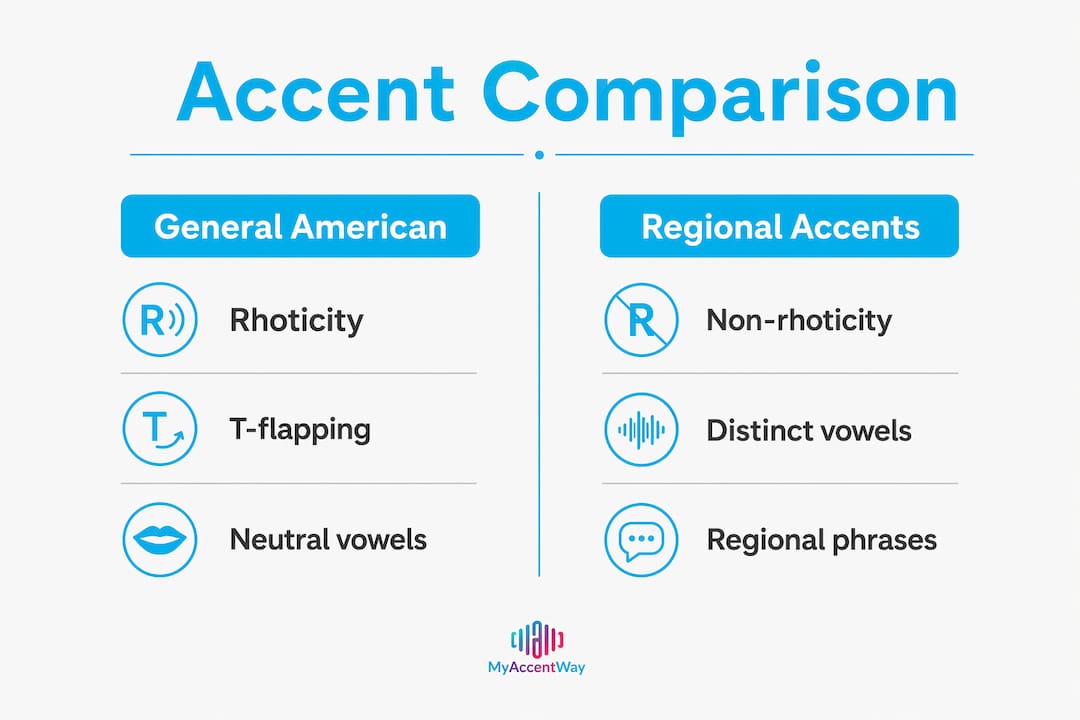
| Feature | General American | New York / Boston | Southern American |
|---|---|---|---|
| Rhoticity | Fully rhotic (“r” always pronounced) | Non-rhotic (“r” dropped after vowels) | Variable rhoticity |
| Cot-caught merger | Merged (same vowel) | Distinct (different vowels) | Distinct in many areas |
| T-flapping | Consistent between vowels | Present but variable | Present but variable |
| Vowel shifts | None prominent | New York Vowel Shift | Southern Vowel Shift |
| Prosody | Stress-timed, strong reduction | Stress-timed, distinct rhythm | Slower, drawled vowels |
One distinction that confuses many learners is the difference between the General American accent and Standard American English. Standard American English refers to grammar and style, not pronunciation. A speaker from Georgia can use perfect grammar and still carry a Southern accent. General American is about phonology, not grammar rules.
Pro Tip: When you study American English pronunciation, separate your grammar goals from your accent goals. You can have flawless grammar and still benefit from working on rhoticity, T-flapping, and vowel reduction independently.
How can non-native speakers adopt general american features?
Accent coaching experts agree that General American should be a clarity-focused style, not a tool for erasing your cultural identity. The goal is intelligibility, not imitation. When listeners understand you without effort, your ideas carry more weight in meetings, presentations, and professional conversations.
Here is where to focus your training:
- Rhoticity first. If your native language does not use an “r” sound after vowels, this is your highest-priority feature. Practice words like work, first, and doctor with a clear, sustained “r.”
- Prosody and rhythm. Stress-timing with vowel reduction is more critical than perfect vowel mimicry. American listeners process rhythm as a fluency signal before they process individual sounds.
- T-flapping in connected speech. Practice phrases like “a lot of water” and “better butter” until the flap T feels automatic. This feature appears constantly in natural American speech.
- Avoid over-correcting vowels. Many learners spend excessive time on vowel perfection while ignoring prosody. Vowels matter, but rhythm and connected speech carry more weight for overall intelligibility.
An effective way to train these features is through physical practice, not passive listening. Myaccentway’s 2D Sound Motion Technology trains the tongue, lips, jaw, and airflow for each American sound. With practice, you can replicate the movement with precision.
Pro Tip: Record yourself reading a paragraph aloud, then compare it to a native General American speaker reading the same text. Listen for rhythm differences before you listen for vowel differences. Rhythm mismatches are almost always the bigger gap.
Hearing General American is easier than producing it under pressure.
You may know the rule for R, T-flapping, stress, or connected speech, but your mouth can still return to old patterns when you speak naturally. That is not a motivation problem. It is a speech-habit problem, and it needs guided correction.
MyAccentWay · 2D Sound Motion Technology
American English Pronunciation: Consonant and Vowel Sounds with 2D Sound Motion Technology
Learning American English pronunciation and the American accent is more effective when you train your speech organs, not only listen and repeat. 2D Sound Motion Technology and Interactive Visual 2D Sound Simulators, developed in 2020 by Prof. Alex, Ph.D. Accent Coach, Doctor of Education, and professional linguist, as part of his interactive teaching model based on his Ph.D. research in interactive teaching methods, train your tongue, lips, jaw, teeth, airflow, and voice step by step. They train each American sound and more than 30 sound combinations through Interactive 2D video simulation.
What 2D Sound Motion Technology is
2D Sound Motion Technology is an advanced accent reduction and articulation training tool by Prof. Alex. It corrects, develops, and trains each American sound and more than 30 sound combinations through Interactive 2D video simulation.
What Interactive Visual 2D Sound Simulators do
Interactive Visual 2D Sound Simulators are part of 2D Sound Motion Technology, the articulation-training method Prof. Alex created by applying his Ph.D. research in interactive teaching to American pronunciation. Instead of listening and repeating, students actively train their speech organs. Each simulator uses Interactive 2D mouth movement to train the speech organs (tongue, lips, jaw, teeth, airflow, and voice) to produce each American sound correctly. Every consonant has its own simulator: explore American consonants trained with 2D Sound Motion Technology.
Sample training: the American t sound (aspirated [t])
Practice
Record yourself speaking these words:
Tab · Tacos · Time · Tub · Hotel · Motel · Sit · Pit · Net
Instructions
Play the Interactive Visual 2D Sound Simulator for the American t sound below several times and follow it step by step. Move your tongue, jaw, and airflow together with the simulator and train your articulation.
Interactive Visual 2D Sound Simulator: American unvoiced sound [t]
Practice
Record yourself again speaking these words, but this time focus on the movement of your tongue. Go slow, and you will hear the difference. You’ve got this!
Tab · Tacos · Time · Tub · Hotel · Motel · Sit · Pit · Net
How Interactive Visual 2D Sound Simulators solve pronunciation and speaking problems
- Wrong articulationMost pronunciation problems start with the tongue, lips, jaw, or teeth in the wrong position. Each Interactive Visual 2D Sound Simulator trains the correct articulation of one American sound, so the student corrects the cause of the problem, not only the result.
- Airflow and voicingMany accent problems come from wrong airflow or voicing: sounds that are too weak, too strong, or voiced when they should be unvoiced. The simulators train airflow and voice together with articulation, step by step, for each American sound and more than 30 sound combinations.
- Clear speech and confidenceWhen each sound is trained correctly, words connect into clear American English speech. Listeners can understand you more easily, and speaking at work, in meetings, and on calls becomes more confident.

If you start hearing the aspiration, the short airstream after [t], with one simulator, you can only imagine how successful you can be in 1-on-1 Interactive American Accent Training with Prof. Alex, Ph.D. Accent Coach, where your whole American sound system is trained sound by sound.
In MyAccentWay, the Interactive Visual 2D Sound Simulators are only available in 1-on-1 accent coaching sessions with Prof. Alex.
Why intelligibility beats perfection every time
After years of working with non-native English-speaking professionals, I have seen one pattern repeat itself without exception. Students who chase perfect vowel sounds plateau quickly. Students who prioritize rhythm, rhoticity, and connected speech make real, measurable progress within weeks.
General American is not a destination. It is a set of tools. When you internalize T-flapping, you stop sounding like you are reading from a script. When you master stress-timing, your sentences start to flow the way American listeners expect them to. When you add clear rhoticity, your speech gains the authority that broadcast English has carried since the 1940s.
The students I work with at Myaccentway do not aim to sound like someone else. They aim to be understood clearly, every time, in every professional context. That shift in mindset, from imitation to intelligibility, is where real progress begins. The science-backed approach to American accent training confirms what I see in the coaching room: structured, physical practice of neutral markers produces results that passive listening never will.
General American Accent— Prof.

Start training the General American accent with MyAccentWay
MyAccentWay offers one-on-one American accent training led by Prof. Alex, Ph.D. Accent Coach. The program begins with a personalized assessment to identify your specific speech patterns, then builds a structured training plan around the features that matter most for your clarity and professional goals. Prof. Alex uses 2D Sound Motion Technology with Interactive Visual 2D Sound Simulators to train the movement of your tongue, lips, jaw, teeth, and airflow while he corrects you live, so you train the movement, not just the sound. See real results from Vlad, a Russian-speaking professional, in the video results below.
More than articulation: Prof. Alex doesn’t teach only the articulation of sounds. Interactive 1-on-1 training with 2D Sound Motion Technology helps students become confident, fluent English speakers through a step-by-step system. Training may begin with how each American sound is made. Then it moves into sound combinations, sound contractions, phonetic exercises, practice sentences, and paragraphs in real rapid speech, so students start speaking English fluently and comfortably.
Interactive American Accent Training for Foreign-Born Professionals in the United States
Foreign-born professionals in the United States often know their field and speak advanced English. Yet American listeners may still struggle with their sounds, stress, and rhythm. MyAccentWay offers private online American accent training through Interactive American Accent Training.
Interactive American Accent Training is led by Prof. Alex, Ph.D. Accent Coach, Doctor of Education, and professional linguist. He first diagnoses each speaker’s native-language patterns. Then he trains American sound articulation, stress, rhythm, and intonation for real real conversations.
Who this training is for
- Engineers, IT specialists, and data professionals presenting to U.S. teams and clients
- Doctors, nurses, and healthcare professionals explaining care to American patients
- Managers, executives, and founders leading meetings, pitches, and briefings
- Consultants, researchers, and academics speaking at conferences and webinars
- Professionals preparing for interviews, promotions, or client-facing roles
Online training across the U.S.
MyAccentWay is based in Austin, Texas, and all training is online. The program is especially relevant for professionals in Austin, Dallas, Houston, New York City, the San Francisco Bay Area, Los Angeles, Seattle, Boston, Chicago, Miami, Washington DC, Atlanta, and Raleigh.
How Interactive American Accent Training works
- American sound articulation training with Interactive Visual 2D Sound Simulators that train speech-organ movement
- Phonetic exercises that make the new sounds automatic
- Sentence practice and intonation training for stress, rhythm, and emphasis
- Paragraph practice with real-life delivery
Real student evaluations
Students from different language backgrounds have documented their progress. Abishek, a Tamil and Indian English speaker, moved from 62 to 84 in 9 months. Tian, a Mandarin speaker, moved from 58 to 85 in 8 months. Vlad, a Russian speaker, moved from 60 to 83 in 5 months.
The first step is a 1 Hour Evaluation Session with Prof. Alex.
FAQ
What is the general american accent in simple terms?
The General American accent is a neutral American English accent that lacks strong regional markers such as Boston r-dropping or the Southern drawl. It is the standard used in broadcast media, professional settings, and AI voice training.
Is the general american accent the same as standard american english?
No. Standard American English refers to grammar and writing style, while the General American accent refers to pronunciation and phonology. A speaker can use Standard grammar while still carrying a regional accent.
Which US regions speak with a general american accent?
The North Midland, Western United States, and parts of Western New England are most closely associated with General American features. The accent is also strongly tied to educated, formal speech rather than any single geographic area.
What are the most important features to learn first?
Rhoticity and T-flapping are the two features that most signal General American fluency to listeners. After those, focus on stress-timing and vowel reduction in unstressed syllables.
Can non-native speakers realistically learn the general american accent?
Yes. General American is a socially constructed set of neutral markers, not a natural dialect you must be born into. With structured physical training and personalized coaching, non-native speakers can acquire its core features at any age.
General American Accent Training for US Professionals
MyAccentWay helps non-native English-speaking professionals in the United States and worldwide improve American English pronunciation, speech clarity, rhythm, stress, intonation, reductions, connected speech, and confidence in professional communication.
American accent training, General American accent, accent reduction, American English pronunciation, pronunciation coaching, speech clarity training, speech modification, online accent coach, American pronunciation for non-native speakers, professional communication in the US, rhythm and intonation training, connected speech, reductions, T-flapping, rhotic R, vowels, consonants, and clear English speaking for work.
Recommended

American Accent Vowels and Consonants: A Complete Linguistics Guide
Few linguistic systems reveal as much about identity, history, and phonological complexity as the sounds that define American English.

American Accent Training: The Ultimate Guide to Speaking Clearly & Confidently
Have you ever felt a pang of self-consciousness in a meeting, worried that your accent might be clouding your message? Or experienced the frustration...

American Accent for German Speakers: The 2026 Guide to Mastery
What if your perfect grammar is actually the very thing making you sound robotic in a high-stakes boardroom? You've likely spent years mastering...
Move from accent awareness to advanced accent refinement.
General American is not only a list of sounds. It is how your speech system handles rhythm, stress, intonation, R, vowels, reductions, and connected speech when you communicate in real time.
- For professionals: clearer speech in meetings, client calls, presentations, and interviews.
- For advanced speakers: refinement closer to native-speaker patterns without losing identity.
- With Prof. Alex: personal correction instead of generic “repeat after me” practice.
Knowledge is helpful. Personal feedback changes the practice.
Articles can teach you what General American means. They cannot hear your R, your vowel placement, your rhythm, your sentence stress, or the sound habits that appear when you speak naturally.
That is why students work with Prof. Alex: they want to stop guessing, hear the exact problem, and train a correction they can carry into real communication.
Related American accent training guides
American Vowel Sounds: The Ultimate Guide by Prof. Alex, Ph.D. Accent Coach
Learn how to pronounce American vowels with clear mouth-position cues, male voice audio, and practice words for American vowel sounds. A guide to American vowels for pronunciation, accent reduction, and speech clarity with Prof.…
10 Common Pronunciation Mistakes & How to Fix Them for a Clear American Accent
Have you ever felt the frustration of being asked to repeat yourself, even when you know your vocabulary and grammar are perfect? Do you worry that...

Accurate English vs MyAccentWay: Which American Accent Training Fits You?
Compare Accurate English and MyAccentWay: who teaches, training methods, formats, and first steps, so you can choose the right American accent training.
Stop wondering whether you sound American enough. Let Prof. Alex identify what is actually affecting your speech.
If this article helped you understand the General American accent, the next step is personal. In a 1-on-1 1 Hour Evaluation Session, Prof. Alex listens to your pronunciation, rhythm, intonation, and connected speech, then explains what your training should focus on first.
No promise of instant or native-like results. The goal is clearer, more controlled American pronunciation through guided practice.
The problem is not always grammar or vocabulary.
If people understand your words but still miss your message, the deeper issue may be speech clarity, rhythm, intonation, and American pronunciation habits. MyAccentWay helps students retrain the sound system with professional 1-on-1 guidance, so English can feel clearer, freer, and more natural in real communication.
Two training methods that make speech change active.
MyAccentWay is not passive listen-and-repeat coaching. Prof. Alex, Ph.D. Accent Coach, Doctor of Education, and professional linguist, creates a learning situation where students become active learners and active participants in changing their own speech patterns.
Interactive training
Students do not just receive pronunciation instructions passively. They listen, think, compare, adjust, and understand their own speech patterns while Prof. Alex guides the correction process.
Cognitive accent training
Students learn to notice and correct the speech patterns that affect American pronunciation, then implement new American speech patterns into their code-switching process for more natural, long-lasting change.
Build speech habits people can hear in real conversations.
A stronger American accent is not built by memorizing topics or chasing quick pronunciation tips. It comes from structured training, professional feedback, active correction, and repeated application until clearer speech becomes easier to keep.
Continue learning how MyAccentWay connects American sound articulation, Interactive Visual 2D Sound Simulators, accent reduction, student proof, and 1-on-1 training.
- Prof. Alex and the MyAccentWay MethodLearn how Prof. Alex, Ph.D. Accent Coach, Doctor of Education, and professional linguist, created and leads the structured MyAccentWay American accent training system.
- Accent Reduction Curriculum and English Articulation TrainingSee how MyAccentWay trains accent reduction, accent modification, American pronunciation, English articulation, rhythm, and professional speech clarity.
- 2D Sound Motion Technology for American Accent TrainingUnderstand Prof. Alex’s Interactive Visual 2D Sound Simulators for American sound articulation.
- Before-and-After American Accent Training ResultsListen to real before-and-after student proof and accent training outcomes.
- Student Reviews and Accent Training ResultsRead student reviews, testimonials, and trust signals from MyAccentWay learners.
- Book a 1-on-1 American 1 Hour Evaluation SessionStart with a 1-hour interactive American accent training session with Prof. Alex.