
Article by
Prof. Alex., Ph.D. Accent Coach
Doctor of Education, Professional Linguist,
Creator of 2D Sound Motion Technology,
Creator of “InPronunci:” American Accent Program App,
Professor of English as a Second Language,
American Accent Coach,
Life Coach.
Do you ever feel like you have the right vocabulary, but the fear of being misunderstood or sounding ‘foreign’ holds you back? For many ambitious professionals and passionate learners, the journey of how to get an American accent can feel overwhelming, filled with confusing phonetic rules and no clear starting point. You’re not just learning a language; you’re striving for a new level of connection and confidence, both in your career and your daily life.
But what if you could bypass the frustration with a proven, scientific method? As a Ph.D. Linguist, I’m here to show you that mastering an accent isn’t about imitation-it’s about understanding the science of sound. In this guide, I will reveal my 5-step method, grounded in linguistic principles, to help you master the core sounds, rhythm, and intonation of American English. Forget the guesswork. Prepare to unlock the tools you need to speak clearly, confidently, and naturally.
Key Takeaways
- Master the core American vowel sounds by focusing on the physical placement of your tongue, jaw, and lips-this is the true foundation of clear pronunciation.
- Go beyond individual words by learning the secrets of connected speech, including how key consonants change to create a natural, fluid American sound.
- The key to how to get an american accent isn’t just sounds; it’s mastering the “music” of the language through sentence stress and intonation patterns.
- Transform your knowledge into a real skill by building a simple, sustainable practice routine that fits into your daily life for long-term success.
The Foundation: Understanding the ‘Sound’ of American English
Embarking on the journey of how to get an American accent is an exciting step toward confident, fluent communication. But before diving into specific sounds, it’s crucial to understand that an accent is far more than just how you pronounce individual words. It’s a complex system of music, rhythm, and physical habits. Mastering it involves retraining not just your ear, but also the muscle memory in your tongue, lips, and jaw. Our goal isn’t to erase your unique voice, but to equip you with the tools for exceptional clarity.
What is the General American (GenAm) Accent?
The ‘American accent’ we focus on is known as General American (GenAm). Think of it as the neutral, ‘standard’ accent you often hear from national news broadcasters. It isn’t tied to a specific region like New York or Texas, which makes it the most widely understood model for clear communication across North America. Linguists have extensively documented the phonology and characteristics of General American English, providing a clear, scientific blueprint for learners.
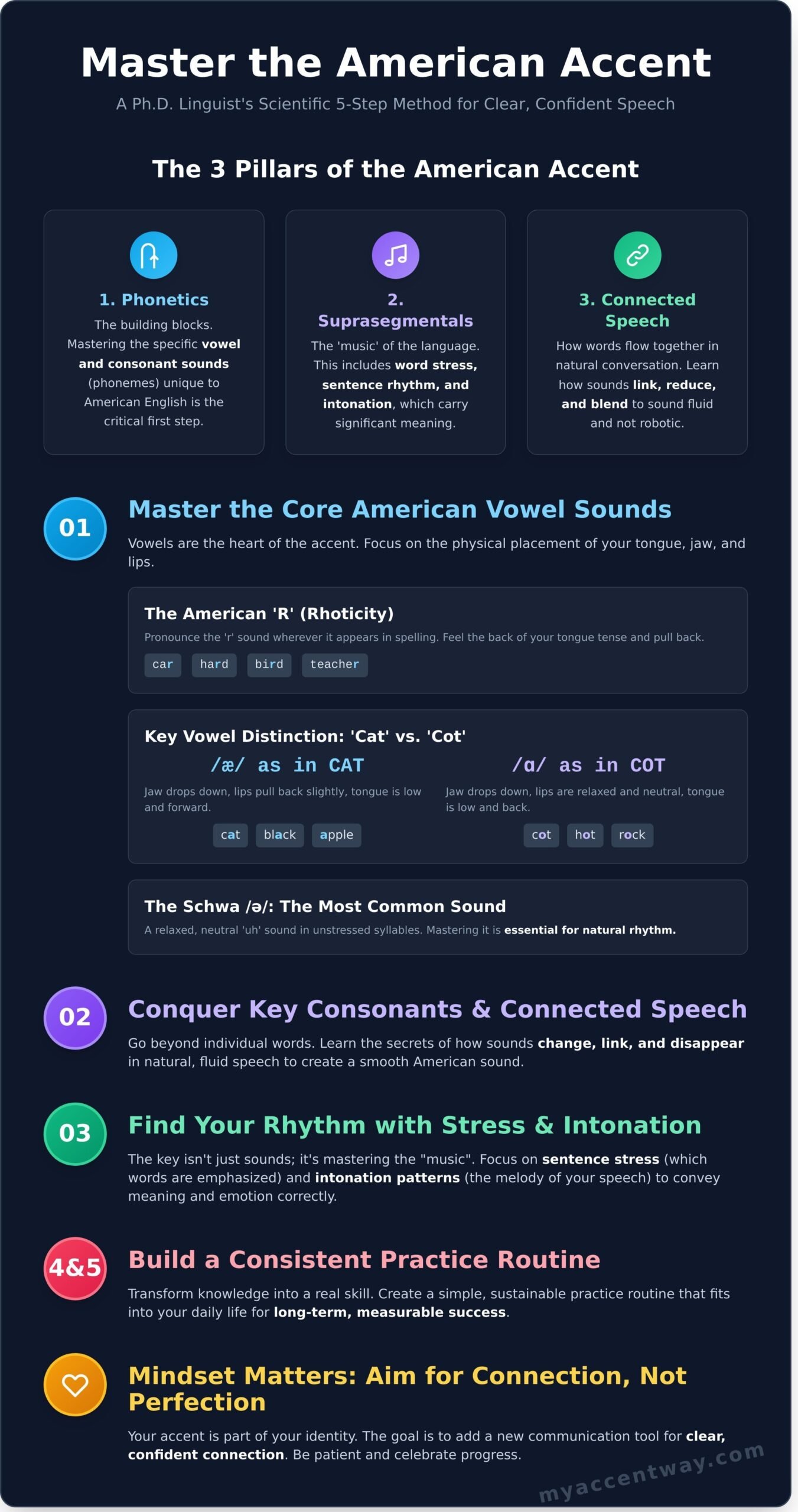
The 3 Pillars of the American Accent
To truly master the sound of American English, we must build upon three foundational pillars. This systematic approach, grounded in linguistic science, is the most effective way to see real, measurable progress.
- Pillar 1: Phonetics. These are the building blocks-the specific vowel and consonant sounds (phonemes) that are unique to American English. Precision here is key.
- Pillar 2: Suprasegmentals. This is the ‘music’ of the language. It includes word stress, sentence rhythm, and intonation (the melody of your speech), which often carry more meaning than the words themselves.
- Pillar 3: Connected Speech. In fluent conversation, words don’t exist in isolation. We’ll explore how sounds link, reduce, and blend together when spoken at a natural pace.
Mindset Matters: Aim for Connection, Not Perfection
Your accent is a part of your identity and your story. Our philosophy is that you are adding a new communication tool, not replacing who you are. The ultimate goal is connection through clear, confident speech. Be patient with the process, celebrate every small victory, and remember that progress, not perfection, is the key to success. This positive mindset is fundamental when learning how to get an American accent and will fuel your entire journey.
Step 1: Master the Core American Vowel Sounds
If you are serious about how to get an American accent, your journey must begin with the vowels. Vowels are the heart of any accent, creating its unique melody and character. Unlike consonants, which involve obstructing airflow, vowels are open sounds shaped by the precise position of your jaw, lips, and tongue. Mastering them is the foundational step toward clear and authentic American speech.
In this section, we will focus on the most distinct and impactful vowel sounds that define the General American accent. A powerful technique we’ll use is practicing with ‘minimal pairs’-pairs of words that differ by only a single sound. This trains your ear and mouth to recognize and produce subtle but critical differences.
The American ‘R’ Sound (Rhoticity)
One of the most recognizable features of the American accent is its rhoticity. This simply means the ‘r’ sound is pronounced wherever it appears in a word’s spelling. Unlike in standard British English, where the ‘r’ is often silent at the end of a syllable, Americans pronounce it clearly. Focus on feeling the back of your tongue tense and pull back slightly to produce this sound.
- Practice these words: car, hard, bird, teacher
Key Vowel Distinctions: ‘Cat’ vs. ‘Cot’
Two core vowels that often challenge learners are the ‘æ’ in ‘cat’ and the ‘ɑ’ in ‘cot’. Correctly distinguishing between them will instantly make your speech clearer.
- The ‘æ’ in ‘cat’: For this sound, your jaw should drop down, your lips pull back slightly (almost like a subtle grimace), and your tongue stays low and forward. Practice with: cat, black, apple.
- The ‘ɑ’ in ‘cot’: For this sound, your jaw also drops, but your lips are relaxed and neutral, and your tongue is low and further back in your mouth. Practice with: cot, hot, rock.
Now, practice these minimal pairs: tack/tock, black/block, hat/hot.
The Schwa /ə/: The Most Common and Important Sound
Meet the schwa /ə/-the most common vowel sound in American English and the secret to its natural rhythm. It’s a relaxed, neutral ‘uh’ sound that appears in unstressed syllables. Mastering it is non-negotiable for anyone learning how to get an American accent. Because it is so subtle, it’s often a key focus in advanced pronunciation training; even the Tricky American English Pronunciation course from UC Irvine emphasizes mastering these fundamental sounds. Think of it as a quick, soft, and lazy vowel.
You can find it in words like:
- about (uh-BOUT)
- sofa (SO-fuh)
- banana (buh-NAN-uh)
- problem (PROB-luhm)
Step 2: Conquer Key Consonants and Connected Speech
After mastering the core vowel sounds, your journey to fluency continues with consonants and the rhythm of natural speech. This is where we move beyond individual words and unlock the secrets to sounding fluid and connected. Many of the rigid pronunciation ‘rules’ you learned in a textbook don’t apply in fast, everyday American conversation. Mastering connected speech is one of the most effective strategies for how to get an american accent that is both clear and authentic.
The American ‘T’ Sound and its Variations
The letter ‘T’ is a chameleon in American English. As a trained linguist, I can tell you its sound changes dramatically based on its position in a word or phrase. Understanding these variations is a huge step toward sounding natural.
- The Flap ‘T’: When a ‘t’ falls between two vowel sounds, it softens to sound like a quick ‘d’. Think of water (wah-der), butter (buh-der), or city (sih-dee).
- The Glottal Stop: Before an ‘n’ sound, the ‘t’ is often stopped in the back of the throat-you don’t release the air. You’ll hear this in words like button (buh-un) and mountain (moun-un).
- The True ‘T’: This is the crisp, aspirated /t/ sound you likely first learned. It appears at the beginning of words (top, take) or in stressed syllables (until, attack).
Linking: How to Connect Words for Smooth Speech
Native speakers don’t pause between every word. Instead, they link them together to create a smooth, continuous flow. This technique, known as linking, is essential for eliminating choppiness and improving your rhythm.
- Consonant-to-Vowel Linking: The final consonant sound of one word connects to the beginning vowel sound of the next. For example, “an apple” flows together to sound like “a-napple.”
- Vowel-to-Vowel Linking: To avoid a pause between two vowel sounds, a small /w/ or /j/ sound is inserted. “Go away” becomes “go-w-away,” and “I agree” sounds more like “I-y-agree.”
Reductions: Common Short-cuts in American Speech
Reductions are standard “short-cuts” used constantly in casual American English. Using them correctly will make your speech sound significantly more relaxed and authentic. They are not slang; they are a fundamental feature of the spoken language.
Here are a few of the most common reductions to master:
- going to → gonna (“I’m gonna go.”)
- want to → wanna (“I wanna learn.”)
- got to → gotta (“You gotta practice.”)
By conquering these key consonants and integrating connected speech techniques, you are building the framework for true vocal confidence. This is a sophisticated step in your training, moving you from simply saying words correctly to speaking with the natural cadence of a native. It’s an essential piece of the puzzle for how to get an american accent that truly connects with listeners.
Step 3: Find Your Rhythm with Stress and Intonation
If individual sounds are the building blocks of speech, then rhythm, stress, and intonation are the music. This is where you move beyond simply pronouncing words correctly and begin to speak with the natural flow and melody of American English. Mastering this step is fundamental to how to get an American accent that sounds authentic and engaging, because where you place emphasis can completely change the meaning of your message.
Word Stress: The ‘Heartbeat’ of Every Word
In American English, every word with two or more syllables has one primary stressed syllable. This syllable is the ‘heartbeat’ of the word-it’s pronounced slightly longer, louder, and often at a higher pitch than the others. This is a critical rule that can even distinguish between a noun and a verb. For example:
- RE-cord (noun): “Please keep a record of the meeting.”
- re-CORD (verb): “Please record the meeting.”
Learning to identify and produce the correct word stress will instantly make your speech clearer to native listeners.
Sentence Stress: Highlighting What’s Important
Just as words have a heartbeat, sentences have a focus. In American English, we emphasize the words that carry the most meaning. These are called ‘content words’ (nouns, main verbs, adjectives, adverbs). We tend to glide over ‘function words’ (articles, prepositions, auxiliary verbs). By stressing content words, you guide your listener’s attention to the most important parts of your message. Consider how changing the stress in one sentence creates entirely different meanings:
- “I didn’t steal your book.” (Someone else did.)
- “I didn’t steal your book.” (I just borrowed it.)
- “I didn’t steal your book.” (I stole someone else’s book.)
American Intonation Patterns: The Melody of Speech
Intonation is the rise and fall of your voice-the melody of your speech. It conveys emotion and grammatical meaning. While complex, you can begin by mastering two core patterns. In general, American English uses:
- Falling Intonation: Your pitch goes down at the end of statements and ‘Wh-‘ questions (who, what, where, when, why).
- Rising Intonation: Your pitch goes up at the end of yes/no questions.
This melodic aspect of learning how to get an American accent is often the most challenging to master on your own. It requires dedicated listening and structured practice, which is a core focus in any effective American accent training program. By focusing on these patterns, you will sound more confident, clear, and natural.
Step 4 & 5: Build a Consistent Practice Routine
You have now learned the foundational elements of American English pronunciation, from individual sounds to the musicality of intonation. However, knowledge alone will not change how you speak. The most critical phase in your journey of how to get an American accent is transforming this intellectual understanding into a physical, subconscious habit. This requires a simple, sustainable, and consistent practice routine.
Effective practice is not about speaking for hours on end; it’s about focused, deliberate exercises that build muscle memory and retrain your ear. A powerful routine combines three core activities: active listening, self-analysis, and expert feedback.
Active Listening and the Shadowing Technique
Shadowing is a highly effective technique to master the rhythm and flow of American English. Start by choosing a short audio or video clip (1-2 minutes) of a native speaker you admire. First, listen to it to understand the context. Then, play it again and try to speak along with them in real-time. Don’t worry about perfection; your goal is to mimic their pitch, rhythm, and intonation as closely as possible. This exercise directly connects your listening skills to your speaking production.
Record and Analyze Your Own Voice
You cannot fix what you cannot hear. Use your smartphone to record yourself reading a short paragraph or speaking spontaneously on a topic for one minute. Listen back to the recording with a critical ear. Compare it to a recording of a native speaker. Instead of feeling overwhelmed, identify just one or two specific areas for improvement-perhaps the “R” sound or the intonation on a question. This focused approach makes progress manageable and measurable.
Find a Professional Accent Coach
While self-study is valuable, it has limits. A professional accent coach provides the personalized, expert feedback you simply cannot get on your own. A trained linguist can accurately diagnose the specific pronunciation challenges stemming from your native language and create a targeted plan to overcome them. This is, without question, the fastest and most effective way to achieve significant, lasting improvement. For those serious about mastering the accent, expert guidance is an investment that guarantees results. Explore the American Accent Program’s training options to connect with a specialist who can accelerate your progress.
By integrating these practices into a daily or weekly schedule, you create a powerful feedback loop that will steadily transform your speech and build lasting confidence. At the American Accent Program, we design these personalized routines to ensure every student succeeds.
Your Journey to a Confident American Accent Starts Now
Mastering an American accent is a journey of precision and practice. As we’ve explored, success hinges on a few core principles: mastering the distinct American vowel sounds, understanding the unique rhythm and intonation, and committing to a consistent practice routine. This 5-step method provides a clear roadmap for how to get an American accent, transforming a complex goal into achievable milestones.
But you don’t have to do it alone. To truly accelerate your progress, expert guidance is key. Our method, guided by a Ph.D. Linguist and enhanced by our proprietary 2D Sound Motion Technology, is the most effective way to achieve your goals. We’re so confident in your transformation that it’s backed by our Success Guarantee.
Your voice is powerful, and the path to speaking with clarity and confidence is right in front of you. Ready to speak confidently? Try a 1-Hour Session with a Ph.D. Linguist.
Frequently Asked Questions About Developing an American Accent
How long does it take to get an American accent?
The timeline for how to get an American accent is deeply personal and depends on your dedication, native language, and training quality. With consistent, guided practice-at least 3-5 hours per week-many students see significant improvement in clarity and confidence within 3-6 months. Mastering the nuances of intonation and specific phonemes is a longer journey, but achieving clear, natural-sounding speech is an attainable goal with a proven scientific approach.
Can I completely lose my original accent? Should I?
The goal of accent training is not to erase your identity but to enhance your communication. While it is technically possible to significantly reduce a native accent, we believe your background is a strength. Our philosophy, “Your CULTURE MATTERS,” focuses on adding the General American accent as a tool for clear, confident communication, not replacing your unique voice. The aim is to be clearly understood and to feel empowered in any professional or social setting.
What is the ‘General American’ accent and why should I learn it?
The General American (GenAm) accent is the standardized, region-neutral accent often heard in national news media, business, and entertainment. It lacks the distinct markers of regional dialects (like a Southern or Boston accent), making it the most widely understood version of American English. Learning GenAm is a strategic choice because it ensures you are clearly understood by the broadest possible audience across the United States and internationally, which is key for professional success.
What are the most difficult American English sounds for non-native speakers?
Many learners find specific American English phonemes challenging. The “R” sound (as in “car” and “world”), the “TH” sounds (voiced /ð/ in “this” and voiceless /θ/ in “think”), and the distinction between vowels like the /æ/ in “cat” and the /ɛ/ in “bet” are common hurdles. Mastering these requires precise mouth and tongue placement, which is why visual aids and expert feedback are so effective for targeted, successful practice.
Is it better to learn a British or American accent for international communication?
While both accents are prestigious, the American accent holds a dominant position in global business, technology, science, and entertainment. Due to the widespread influence of American media, the General American accent is arguably the most recognized and understood English accent worldwide. For professionals aiming for maximum clarity and impact in international circles, mastering the American accent is an incredibly powerful and strategic communication tool that opens doors globally.
What are some common mistakes to avoid when practicing?
A frequent mistake is focusing only on individual sounds while neglecting the “music” of the language-rhythm, stress, and intonation. Another is practicing inconsistently without expert feedback, which can ingrain errors. To truly succeed, avoid silent reading; always practice speaking aloud. Finally, don’t aim for perfection overnight. Embrace the process as a cognitive and analytical journey, celebrating small, consistent victories along the way to build lasting confidence.
Disclaimer – American Accent Program
The American Accent Program available through Visit Program Website
is an educational and coaching service designed to support pronunciation, accent reduction, and spoken English fluency. All training materials, including lessons, exercises, audio content, visual simulations, coaching methods, and digital resources, are the intellectual property of American Accent Program, LLC and are protected by applicable copyright and intellectual property laws.
By using this website and participating in the program, you acknowledge that all content is provided for personal, non-commercial, educational use only. Users are granted a limited, non-transferable license to access the materials strictly for individual learning purposes. Redistribution, reproduction, recording, modification, sharing, or commercial use of any program content without prior written consent is strictly prohibited.
The program may include live coaching sessions, digital tools, and instructional materials intended to improve pronunciation and communication skills. However, individual results may vary, and no specific level of fluency, accent reduction, or communication outcome is guaranteed.
The American Accent Program and its instructors do not provide medical, therapeutic, or clinical speech-language pathology services. All training is intended for educational purposes only.
By accessing or using the program, you agree to comply with all applicable terms, including the platform’s Terms of Use and Course Policies, and acknowledge that misuse of materials may result in termination of access without refund.
Speech clarity check
The problem is not always grammar or vocabulary.
If people understand your words but still miss your message, the deeper issue may be speech clarity, rhythm, intonation, and American pronunciation habits. MyAccentWay helps students retrain the sound system with professional 1-on-1 guidance, so English can feel clearer, freer, and more natural in real communication.
Why MyAccentWay works
Two training methods that make speech change active.
MyAccentWay is not passive listen-and-repeat coaching. Prof. Alex, Ph.D. Accent Coach, creates a learning situation where students become active learners and active participants in changing their own speech patterns.
Interactive training
Students do not just receive pronunciation instructions passively. They listen, think, compare, adjust, and understand their own speech patterns while Prof. Alex guides the correction process.
U.S. & Canada online accent training
How to Get an American Accent: A Linguist’s 5-Step Method for professionals in the United States and Canada
This guide is useful for advanced English speakers, entrepreneurs, international professionals, and students in the U.S. and Canada who want clearer American pronunciation, stronger rhythm, better intonation, and more confident communication in meetings, interviews, presentations, and client conversations.
Prof. Alex, Ph.D. Accent Coach, teaches online 1-on-1 American accent training for learners in major professional markets including New York, Los Angeles, San Francisco Bay Area, Seattle, Austin, Dallas, Houston, Chicago, Boston, Washington, D.C., Miami, Toronto, Vancouver, Montreal, Calgary, and Ottawa.
1-on-1 Accent Reduction Training helps students move beyond self-practice and build clearer American speech habits through interactive and cognitive accent training.
Cognitive accent training
Students learn to notice and correct the speech patterns that affect American pronunciation, then implement new American speech patterns into their code-switching process for more natural, long-lasting change.
Your next step
Build speech habits people can hear in real conversations.
A stronger American accent is not built by memorizing topics or chasing quick pronunciation tips. It comes from structured training, professional feedback, active correction, and repeated application until clearer speech becomes easier to keep.




One Response