Everyday American Expressions Pronunciation Practice Guide
(512) 265-9515Updated October 16, 2026 ◆ 11 min read
Everyday American expressions pronunciation practice is the process of training your speech to sound natural, clear, and fluent by mastering rhythm, stress, intonation, and connected speech patterns common to American English. Linguists call this suprasegmental training, meaning you go beyond individual sounds to work on the melody and flow of whole sentences. Non-native speakers who focus only on isolated words often sound robotic in real conversations, because natural speech clarity depends on mastering both segmental sounds and features like stress and intonation. Techniques like shadowing, stress marking, and connected speech drills, supported by tools like ELSA Speak and Myaccentway’s 2D Sound Motion Technology, give you a structured path to sound genuinely American.
Real student result

“I feel confident enough to speak American English!”
Interactive American Accent Training9monthsof hard work and dedication
Listen to the starting point0:00
Listen to the result0:00
“Many of my students once believed they could never sound like this. School taught them grammar and vocabulary, but not how to train their English speech. That is what we do together, step by step, until you speak English independently and with confidence.”
Abishek’s result was achieved through Prof. Alex’s research-based Interactive 1-on-1 American Accent Training. His doctoral research found this interactive method more effective than traditional, teacher-centered methods. See the research basis →
What is everyday American expressions pronunciation practice and why does it work?
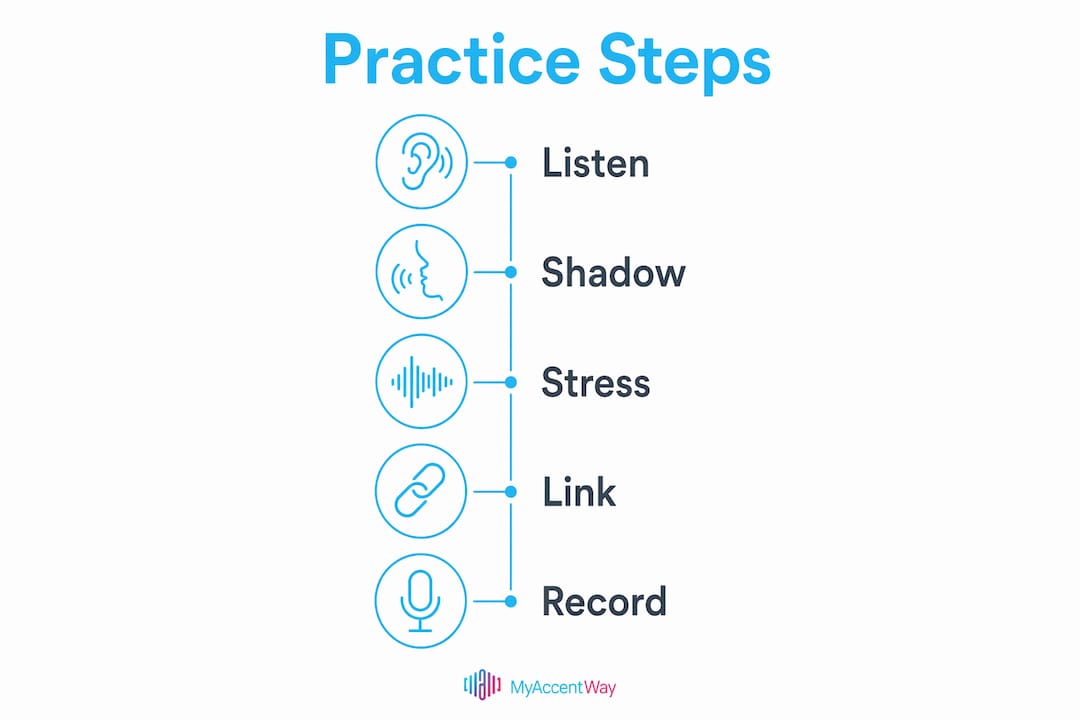
Shadowing is an effective technique for practicing daily phrases pronunciation. It requires you to listen to a native speaker and imitate the speech immediately, in real time, matching rhythm, stress, and intonation as closely as possible. A 2026 study found that shadowing with ELSA Speak improved student pronunciation scores from 66.62 to 83.72 across 29 learners. That kind of measurable gain shows shadowing is not just a classroom exercise. It is a research-based method for building real fluency.
Shadowing works because it forces your brain and mouth to coordinate simultaneously. Passive listening lets your mind wander. Shadowing keeps you locked in, producing sounds at the exact moment you hear them. Students who use this method report increased confidence and engagement, even when they find the initial coordination challenging.
Here is how to apply shadowing to common English expressions:
- Choose a short clip. Pick a 20–30 second audio or video clip of a native American English speaker using everyday phrases like “I was gonna say” or “What are you up to?”
- Listen once without speaking. Focus on the rhythm and melody of the sentence, not individual words.
- Shadow at reduced speed. Use a tool that slows audio without distorting pitch, then imitate each phrase immediately after you hear it.
- Increase speed gradually. Once you match the rhythm at slow speed, bring it up to normal conversational pace.
- Record yourself. Compare your recording to the original clip and note differences in stress and intonation.
Pro Tip: Gradual speed increases are critical for shadowing success. Starting too fast causes learners to focus on keeping up rather than matching the melody. Begin at 70% speed and work up over several sessions.
How to practice stress, rhythm, and intonation in everyday American expressions
Stress and rhythm are the backbone of how to pronounce American sayings correctly. Stressed syllables should be clearly louder, longer, and clearer than unstressed ones. When you flatten all syllables to the same volume and length, you lose the natural music of American English. Listeners work harder to understand you, and you sound less confident.
Practicing stress and intonation requires a deliberate, physical approach. You cannot just listen and hope the patterns transfer. You need to mark them, exaggerate them, and record them.
Use these methods to train stress and rhythm in your daily practice:
- Mark stressed syllables in writing. Take a common expression like “I didn’t MEAN to” and underline or capitalize the stressed word. Say it aloud, making that word noticeably louder and longer.
- Exaggerate first, then normalize. Over-enunciating stress during practice helps your brain register the contrast between stressed and unstressed syllables. Once the pattern feels natural, reduce the exaggeration to a conversational level.
- Practice falling and rising intonation. Statements in American English typically end with a falling pitch. Questions with “yes/no” answers often rise. Practice phrases like “Are you coming?” with a clear rise and “I’ll be there at five” with a clear fall.
- Use American stress patterns as a reference. Structured guides help you identify which syllables carry stress in multi-syllable words and compound phrases.
Pro Tip: Record yourself saying a sentence, then listen back and ask: does one word stand out clearly above the others? If every word sounds equal, your stress pattern needs work. Exaggerate the stressed word until the contrast is obvious, then record again.
What are linking, reductions, and connected speech, and how do they improve naturalness?
Connected speech is the system by which American English words blend, reduce, and link together in natural conversation. English pronunciation changes systematically in connected speech through linking, reductions, and rhythm, and these changes convey meaning. Learners who practice only isolated words miss this entirely, which is why they can pass a vocabulary test but still struggle in real conversations.
Three features define connected speech in American English:
Linking occurs when the final sound of one word connects directly to the opening sound of the next. “Turn it off” becomes “tur-ni-toff.” The words flow without a pause between them.
Reductions happen when unstressed words shrink. “Want to” becomes “wanna.” “Going to” becomes “gonna.” “Did you” becomes “didja.” These are not lazy speech. They are the standard forms native speakers use in casual and professional conversation alike.
Elisions are sounds that disappear entirely. “Next day” often sounds like “nex day” because the [T] is dropped before a consonant.
The table below shows how common expressions shift in connected speech:
| Written form | Connected speech form | What changes |
|---|---|---|
| “I have to go” | “I hafta go” | “have to” reduces to “hafta” |
| “What do you want?” | “Whaddya want?” | “what do you” blends and reduces |
| “Let me know” | “Lemme know” | “let me” reduces to “lemme” |
| “Did you eat?” | “Didja eat?” | “did you” links and reduces |
| “Going to call” | “Gonna call” | “going to” reduces to “gonna” |
Practicing American English reductions with authentic conversational clips trains your ear and mouth to expect these patterns. Connected speech reductions are predictable and systematic, which means you can learn to anticipate them rather than being surprised every time.
How to self-monitor and correct your pronunciation of everyday American expressions
Self-monitoring is the skill that separates students who plateau from students who keep improving. Recording yourself and listening critically is the most direct path to identifying your own pronunciation gaps. Most non-native speakers are surprised by what they hear when they play back their own speech.
Follow these steps for effective self-monitoring:
- Record a spontaneous sentence. Do not read from a script. Say something natural like “I was just about to call you” without preparation.
- Transcribe what you actually said. Write down exactly what you hear in your recording, including reductions and linked sounds. This forces you to notice what you are actually producing versus what you think you are saying.
- Compare to a native speaker version. Find a native speaker saying the same phrase, or use a structured resource. Note differences in stress placement, reductions, and linking.
- Mark the gaps. Circle the specific sounds, stress points, or reductions that differ from the native version.
- Drill the gap, not the whole sentence. Isolate the specific phrase or word cluster where you differ and shadow it repeatedly before recording again.
Self-recording and transcription help identify linking and reductions that learners often miss, building deeper awareness and faster correction. This method works because it makes the invisible visible. You stop guessing and start fixing specific, real problems.
Pro Tip: After recording, slow the playback to 75% speed. Reductions and linking patterns that blur at normal speed become clear when slowed down. This makes transcription far more accurate and your gap analysis much sharper.
Vlad, a Russian speaker, worked with Professor Alex and achieved clear, natural American English:
Key takeaways
Effective pronunciation of everyday American expressions requires training stress, rhythm, connected speech, and self-monitoring together, not in isolation.
| Point | Details |
|---|---|
| Shadowing beats passive listening | Immediate vocal imitation with feedback produces measurable pronunciation gains faster than listening alone. |
| Stress must be physically exaggerated | Over-stress syllables during practice first, then normalize to build natural contrast between stressed and unstressed sounds. |
| Connected speech follows rules | Linking, reductions, and elisions are systematic patterns you can learn to anticipate and produce. |
| Self-recording reveals real gaps | Transcribing your own spontaneous speech shows exactly where your pronunciation differs from native patterns. |
| Suprasegmental features drive naturalness | Rhythm and intonation matter as much as individual sounds for sounding clear and fluent in American English. |
What I have learned from training non-native professionals in American pronunciation
After years of working with non-native professionals, one pattern stands out clearly. Students arrive focused on individual sounds, convinced that fixing their [R] or [TH] will solve everything. That focus is understandable, but it misses the bigger problem. Most miscommunication in professional settings comes from flat rhythm and missing reductions, not from a single mispronounced consonant.
The students who improve fastest are the ones who commit to recording themselves from day one. Not to feel embarrassed, but to build an honest picture of where they actually are. Doubt becomes clarity the moment you hear your own speech objectively. That clarity is what makes targeted practice possible.
The other thing I have seen consistently is that linked sounds in English feel unnatural to learners at first because they were taught to pronounce every word separately. Retraining that habit takes deliberate repetition, not just awareness. The students who use Myaccentway’s 2D Sound Motion Technology gain an advantage here because it trains the tongue and lips to move during connected speech, rather than relying on listening alone. This physical training clicks much faster.
American accent training is achievable at any stage. The method matters more than the starting point.
— Prof.
MyAccentWay · 2D Sound Motion Technology
American English Pronunciation: Consonant and Vowel Sounds with 2D Sound Motion Technology
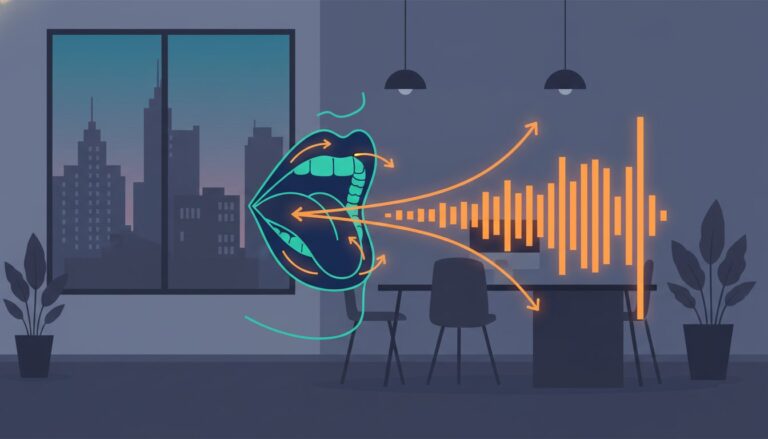
Learning American English pronunciation and the American accent is more effective when you train your speech organs, not only listen and repeat. 2D Sound Motion Technology and Interactive Visual 2D Sound Simulators, developed in 2020 by Prof. Alex, Ph.D. Accent Coach, Doctor of Education, and professional linguist, as part of his interactive teaching model based on his Ph.D. research in interactive teaching methods, train your tongue, lips, jaw, teeth, airflow, and voice step by step. They train each American sound and more than 30 sound combinations through Interactive 2D video simulation.
What 2D Sound Motion Technology is
2D Sound Motion Technology is an advanced accent reduction and articulation training tool by Prof. Alex. It corrects, develops, and trains each American sound and more than 30 sound combinations through Interactive 2D video simulation.
What Interactive Visual 2D Sound Simulators do
Interactive Visual 2D Sound Simulators are part of 2D Sound Motion Technology, the articulation-training method Prof. Alex created by applying his Ph.D. research in interactive teaching to American pronunciation. Instead of listening and repeating, students actively train their speech organs. Each simulator uses Interactive 2D mouth movement to train the speech organs (tongue, lips, jaw, teeth, airflow, and voice) to produce each American sound correctly. Every consonant has its own simulator: explore American consonants trained with 2D Sound Motion Technology.
Sample training: the American t sound (aspirated [t])
Practice
Record yourself speaking these words:
Tab · Tacos · Time · Tub · Hotel · Motel · Sit · Pit · Net
Instructions
Play the Interactive Visual 2D Sound Simulator for the American t sound below several times and follow it step by step. Move your tongue, jaw, and airflow together with the simulator and train your articulation.
Interactive Visual 2D Sound Simulator: American unvoiced sound [t]
Practice
Record yourself again speaking these words, but this time focus on the movement of your tongue. Go slow, and you will hear the difference. You’ve got this!
Tab · Tacos · Time · Tub · Hotel · Motel · Sit · Pit · Net
How Interactive Visual 2D Sound Simulators solve pronunciation and speaking problems
- Wrong articulationMost pronunciation problems start with the tongue, lips, jaw, or teeth in the wrong position. Each Interactive Visual 2D Sound Simulator trains the correct articulation of one American sound, so the student corrects the cause of the problem, not only the result.
- Airflow and voicingMany accent problems come from wrong airflow or voicing: sounds that are too weak, too strong, or voiced when they should be unvoiced. The simulators train airflow and voice together with articulation, step by step, for each American sound and more than 30 sound combinations.
- Clear speech and confidenceWhen each sound is trained correctly, words connect into clear American English speech. Listeners can understand you more easily, and speaking at work, in meetings, and on calls becomes more confident.

If you start hearing the aspiration, the short airstream after [t], with one simulator, you can only imagine how successful you can be in 1-on-1 Interactive American Accent Training with Prof. Alex, Ph.D. Accent Coach, where your whole American sound system is trained sound by sound.
In MyAccentWay, the Interactive Visual 2D Sound Simulators are only available in 1-on-1 accent coaching sessions with Prof. Alex.
Myaccentway’s American accent training for everyday expression clarity
Myaccentway offers structured American accent training led by Professor Alex, Ph.D., Linguist and Accent Coach, designed specifically for non-native professionals who need clearer, more natural speech in daily and professional settings.
Professor Alex begins with a one-on-one assessment to identify your specific speech patterns, then builds a personalized training plan covering stress, rhythm, intonation, and connected speech. Myaccentway’s 2D Sound Motion Technology lets you actively train the movement of your tongue, lips, jaw, teeth, and airflow with the Interactive Visual 2D Sound Simulators while Prof. Alex corrects you live. The simulators are part of Prof. Alex’s interactive teaching model, based on his Ph.D. research in interactive teaching methods.
Book Your 1 Hour Evaluation Session at Myaccentway to get a personalized pronunciation evaluation and start training with a method built on linguistics, not guesswork.
Interactive American Accent Training for Foreign-Born Professionals in the United States
Foreign-born professionals in the United States often know their field and speak advanced English. Yet American listeners may still struggle with their sounds, stress, and rhythm. MyAccentWay offers private online American accent training through Interactive American Accent Training.
Interactive American Accent Training is led by Prof. Alex, Ph.D. Accent Coach, Doctor of Education, and professional linguist. He first diagnoses each speaker’s native-language patterns. Then he trains American sound articulation, stress, rhythm, and intonation for real real conversations.
Who this training is for
- Engineers, IT specialists, and data professionals presenting to U.S. teams and clients
- Doctors, nurses, and healthcare professionals explaining care to American patients
- Managers, executives, and founders leading meetings, pitches, and briefings
- Consultants, researchers, and academics speaking at conferences and webinars
- Professionals preparing for interviews, promotions, or client-facing roles
Online training across the U.S.
MyAccentWay is based in Austin, Texas, and all training is online. The program is especially relevant for professionals in Austin, Dallas, Houston, New York City, the San Francisco Bay Area, Los Angeles, Seattle, Boston, Chicago, Miami, Washington DC, Atlanta, and Raleigh.
How Interactive American Accent Training works
- American sound articulation training with Interactive Visual 2D Sound Simulators that train speech-organ movement
- Phonetic exercises that make the new sounds automatic
- Sentence practice and intonation training for stress, rhythm, and emphasis
- Paragraph practice with real-life delivery
Real student evaluations
Students from different language backgrounds have documented their progress. Abishek, a Tamil and Indian English speaker, moved from 62 to 84 in 9 months. Tian, a Mandarin speaker, moved from 58 to 85 in 8 months. Vlad, a Russian speaker, moved from 60 to 83 in 5 months.
The first step is a 1 Hour Evaluation Session with Prof. Alex.
FAQ
What is the shadowing technique for pronunciation practice?
Shadowing is a method where you listen to a native speaker and imitate their speech immediately, matching rhythm, stress, and intonation in real time. Research shows it produces measurable pronunciation gains and builds learner confidence.
How do I practice American stress and intonation at home?
Mark stressed syllables in writing, exaggerate them during practice, and record yourself to check whether the contrast between stressed and unstressed syllables is clear. Structured guides like those at Myaccentway provide reference patterns for American English stress.
What are reductions in American English?
Reductions are shortened forms of common words and phrases used in natural speech, such as “gonna” for “going to” or “wanna” for “want to.” They are standard in both casual and professional American English conversation.
How does self-recording improve pronunciation?
Recording your spontaneous speech and transcribing it reveals the exact gaps between what you produce and what native speakers say. This targeted feedback makes correction faster and more specific than general listening practice.
What is 2D Sound Motion Technology?
2D Sound Motion Technology, offered by Myaccentway, trains students to coordinate the tongue, lips, jaw, and speech organs during American English pronunciation. It lets students physically train each sound by following the movement, not just hearing it.
Recommended
American English Pronunciation Practice: The 2026 Expert Guide
Last week, a senior project manager was asked to repeat his quarterly report findings for the third time. He knew his data was flawless, but the...


How to Practice Your American Accent: A Step-by-Step Guide
Have you ever felt lost trying to practice your American accent, unsure where to begin or if your efforts are even making a difference? Many...
Mastering Clarity: The Ultimate Guide to Daily Pronunciation Exercises
Your grammar might be perfect, but your facial muscles are likely working against you. It's exhausting to spend over 1,000 hours studying English...
The problem is not always grammar or vocabulary.
If people understand your words but still miss your message, the deeper issue may be speech clarity, rhythm, intonation, and American pronunciation habits. MyAccentWay helps students retrain the sound system with professional 1-on-1 guidance, so English can feel clearer, freer, and more natural in real communication.
Two training methods that make speech change active.
MyAccentWay is not passive listen-and-repeat coaching. Prof. Alex, Ph.D. Accent Coach, Doctor of Education, and professional linguist, creates a learning situation where students become active learners and active participants in changing their own speech patterns.
Interactive training
Students do not just receive pronunciation instructions passively. They listen, think, compare, adjust, and understand their own speech patterns while Prof. Alex guides the correction process.
Cognitive accent training
Students learn to notice and correct the speech patterns that affect American pronunciation, then implement new American speech patterns into their code-switching process for more natural, long-lasting change.
Build speech habits people can hear in real conversations.
A stronger American accent is not built by memorizing topics or chasing quick pronunciation tips. It comes from structured training, professional feedback, active correction, and repeated application until clearer speech becomes easier to keep.
Continue learning how MyAccentWay connects American sound articulation, Interactive Visual 2D Sound Simulators, accent reduction, student proof, and 1-on-1 training.
- Prof. Alex and the MyAccentWay MethodLearn how Prof. Alex, Ph.D. Accent Coach, Doctor of Education, and professional linguist, created and leads the structured MyAccentWay American accent training system.
- Accent Reduction Curriculum and English Articulation TrainingSee how MyAccentWay trains accent reduction, accent modification, American pronunciation, English articulation, rhythm, and professional speech clarity.
- 2D Sound Motion Technology for American Accent TrainingUnderstand Prof. Alex’s Interactive Visual 2D Sound Simulators for American sound articulation.
- Before-and-After American Accent Training ResultsListen to real before-and-after student proof and accent training outcomes.
- Student Reviews and Accent Training ResultsRead student reviews, testimonials, and trust signals from MyAccentWay learners.
- Book a 1-on-1 American 1 Hour Evaluation SessionStart with a 1-hour interactive American accent training session with Prof. Alex.