Connected Speech in American English: A Practical Guide
(512) 265-9515Updated October 14, 2026 ◆ 14 min read
Train the linking, reductions, rhythm, and sound changes that make American English flow naturally without losing professional clarity.
Connected speech is how American English links, shortens, and blends words in natural speech: linking, reduction, elision, and assimilation. At MyAccentWay, Prof. Alex, Ph.D. Accent Coach, trains connected speech in live 1-on-1 sessions so non-native professionals sound natural, not word-by-word.
Real student result

“I feel confident enough to speak American English!”
Interactive American Accent Training9monthsof hard work and dedication
Listen to the starting point0:00
Listen to the result0:00
“Many of my students once believed they could never sound like this. School taught them grammar and vocabulary, but not how to train their English speech. That is what we do together, step by step, until you speak English independently and with confidence.”
Abishek’s result was achieved through Prof. Alex’s research-based Interactive 1-on-1 American Accent Training. His doctoral research found this interactive method more effective than traditional, teacher-centered methods. See the research basis →
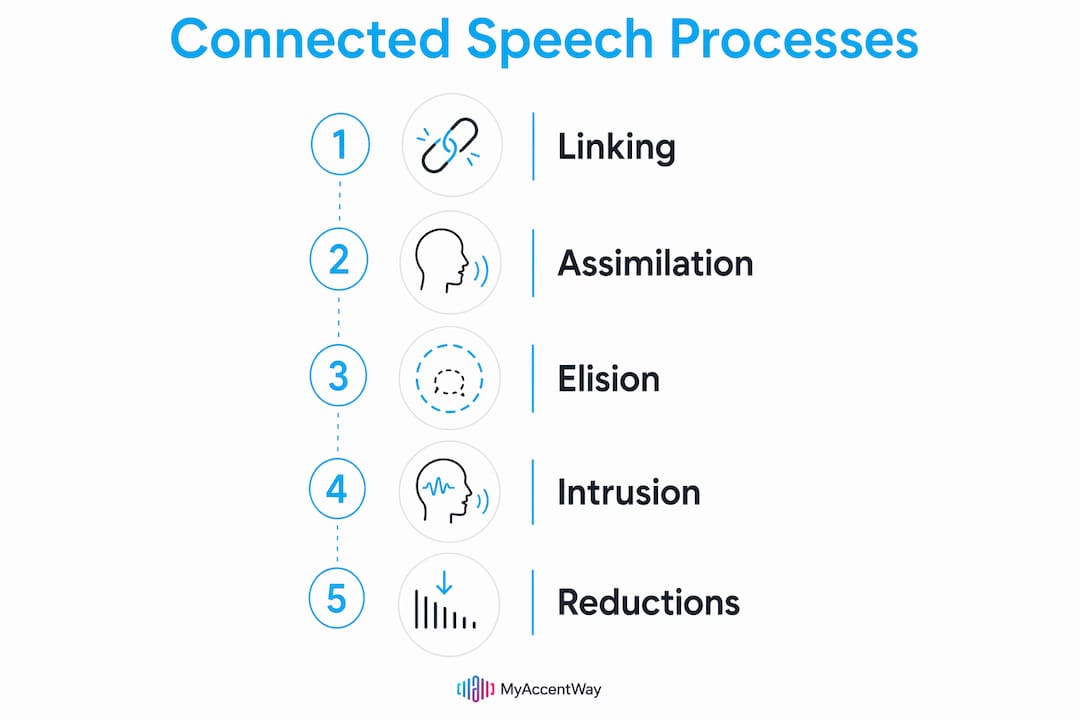
Connected speech in American English is the natural process where sounds link, change, or disappear between words, creating smooth, flowing speech instead of isolated word pronunciation. Linguists call the full set of these processes “connected speech phenomena,” and they include linking, assimilation, elision, intrusion, and reductions. Native speakers use these patterns automatically. Non-native speakers who miss them often sound overly formal, struggle to follow fast conversations, or both. Daily practice of 15–20 minutes is sufficient to build real recognition and fluency in these patterns. The good news: these processes follow predictable rules, and structured training makes them learnable.
Do you want to keep collecting pronunciation tips, or actually change how you speak?
Connected speech is not about speaking faster. It is about learning how American English moves through thought groups without losing clarity.
MyAccentWay helps students train connected speech, rhythm, pauses, and emphasis so their English sounds smoother and easier to understand.
The goal is not to copy a native speaker mechanically. The goal is to become an independent English speaker with clearer American pronunciation, stronger rhythm, better intonation, and speech clarity you can use in professional communication.
What are the main connected speech processes in American English?
Connected speech processes include linking, assimilation, elision, intrusion, and weak forms. Each one alters sounds across word boundaries, making native speech sound like a continuous flow rather than a sequence of separate words. Understanding each process gives you a clear target to practice.
-
Linking (catenation): A consonant at the end of one word joins the vowel at the start of the next. “Pick it up” becomes “pi-ki-tup.” “Turn it off” sounds like “tur-ni-toff.” This is the most common connected speech pattern in American English and the first one learners notice when they start listening carefully.
-
Assimilation: A sound changes because of the sound next to it. “Did you” becomes “didja.” “Would you” becomes “wouldja.” Regressive assimilation, where a following sound influences the preceding one, is especially frequent in American English.
-
Elision: A sound disappears entirely to make articulation easier. “Next day” often sounds like “nex day.” The /t/ in “mostly” frequently drops. Elision is why fast American speech can sound like words are missing letters.
-
Intrusion: A sound is inserted between words for smoother transitions. “I am” gains a brief /j/ glide: “I-yam.” “Go on” gains a /w/: “go-won.” These inserted sounds are not written anywhere but appear naturally in fluent speech.
-
Reductions and weak forms: Function words like “and,” “to,” “for,” and “of” reduce to near-inaudible sounds. “And” becomes /ən/, “to” becomes /tə/, “for” becomes /fər/. Functional words reduce to near-inaudible sounds in natural speech, which is why learners often feel native speakers are mumbling.
-
Flapping: In American English, the /t/ and /d/ between vowels often become a quick tap called a flap. “Water,” “better,” and “ladder” all use this sound. British English does not flap in the same way, which is one reason American speech sounds distinct.
Pro Tip: Start by listening for elision and flapping in American English. These two patterns appear constantly and will immediately improve your ability to follow fast conversations.
How does connected speech affect listening comprehension and speaking clarity?
Connected speech makes native speech sound fast because sounds merge, drop, or shift across word boundaries. A learner who has only studied written English hears “gonna” and does not recognize “going to.” They hear “wanna” and miss “want to.” The gap between written and spoken form is the core challenge for non-native speakers.
Recognizing connected speech patterns directly improves listening comprehension. Training connected speech builds recognition and natural rhythm, which translates into stronger performance in real listening situations. When you know that “did you eat yet” sounds like “didja eatyet,” you stop searching for words that were never fully pronounced.
The risk of over-enunciation is real and often overlooked. Over-articulation reduces speech naturalness and fluency, making a speaker sound robotic or overly formal in casual conversation. Colleagues may understand every word but still feel the speech sounds unnatural, which affects professional credibility.
“The goal is not to drop every sound carelessly. The goal is to connect sounds the way American English actually works, so your speech flows with the rhythm native speakers expect, while keeping key vocabulary clear and precise.”
Technical terms and proper nouns require clear articulation even in fast speech. A doctor saying “metformin” or an engineer saying “load-bearing” cannot reduce those words. Connected speech applies most powerfully to function words, common phrases, and everyday expressions.
What practical techniques improve connected speech skills?
Structured daily practice is the most reliable path to improvement. Industry guidance recommends 15–20 minutes of steady, moderate daily sessions rather than long, infrequent practice. Short, consistent sessions build the muscle memory and auditory recognition that connected speech requires.
-
Shadowing: Listen to a native speaker and repeat simultaneously, matching rhythm, speed, and connected sounds. Shadowing and self-recording help learners internalize connected speech patterns and identify over-enunciation. Myaccentway’s guide to the shadowing technique explains how to use this method effectively.
-
Self-recording: Record yourself reading a passage, then compare it to a native speaker recording. Listen specifically for where you separate words that should connect. This exercise makes over-articulation visible and correctable.
-
Focus on 2–3 patterns weekly: Learners should master 2–3 connected speech patterns weekly, starting with simple reductions like “gonna” and “wanna” before moving to assimilation and intrusion. Trying to fix everything at once produces no lasting change.
-
Use transcripts with audio: Read a transcript while listening to the audio. Mark every place where the spoken version differs from the written form. This trains your ear to expect connected speech and stops you from searching for sounds that were never produced.
-
Practice elision and reduction separately: Myaccentway’s resource on elision and reduction provides targeted exercises for these two patterns, which are among the most frequent in American English.
Pro Tip: Record yourself reading the same paragraph once per week. Compare recordings across four weeks. You will hear the improvement in rhythm and connection that daily practice builds.
The table below shows how to prioritize connected speech practice by pattern type and difficulty level.
| Pattern | Example | Practice priority |
|---|---|---|
| Linking (catenation) | “pick it up” → “pi-ki-tup” | Start here: most frequent |
| Reductions and weak forms | “and” → /ən/, “to” → /tə/ | Week 1–2: builds rhythm fast |
| Flapping | “water” → “wa-der” | Week 2–3: American-specific |
| Elision | “next day” → “nex day” | Week 3–4: improves speed |
| Assimilation | “did you” → “didja” | Week 4+: advanced fluency |
How do connected speech patterns vary across American English accents?
American English connected speech features accent-specific traits such as flapping and linking patterns that differ from British or Australian English. This matters for learners because exposure to only one accent creates gaps when speaking with Americans from different regions.
-
General American, the accent used in most national media, uses heavy flapping and strong linking. It is the most useful accent to target for professional communication.
-
Southern American English uses slower speech rates and different vowel patterns, which changes how connected speech sounds in practice.
-
New York and Boston accents include distinct linking and elision patterns that differ from General American norms.
-
British English does not flap /t/ between vowels and uses different weak forms for some function words. Learners trained on British English often need to retrain these specific patterns for American contexts.
Exposure to multiple American accents builds stronger listening skills. Practice with news broadcasts, podcasts, and films from different regions. Do not force connected speech reductions in formal presentations or technical explanations. Reserve full connected speech for conversational and professional casual contexts where naturalness matters most.
Key Takeaways
Mastering connected speech in American English requires learning five core processes, practicing them daily in short sessions, and balancing natural reductions with clear articulation of technical vocabulary.
| Point | Details |
|---|---|
| Five core processes | Linking, assimilation, elision, intrusion, and reductions form the foundation of connected speech. |
| Daily practice works | 15–20 minutes of focused daily practice builds recognition and fluency faster than long, infrequent sessions. |
| Start with reductions | Begin with “gonna,” “wanna,” and weak forms before advancing to assimilation and intrusion. |
| Avoid over-enunciation | Separating every word reduces naturalness and makes speech sound formal or robotic in conversation. |
| Accent exposure matters | Listening to multiple American accents builds stronger comprehension across real-world speaking situations. |
What I have learned from 20 years of teaching connected speech
After two decades of working with non-native speakers from Russian, Mandarin, Portuguese, Arabic, and dozens of other language backgrounds, I can tell you the single most common mistake: students try to learn connected speech by ear alone. They listen, they repeat, and they still cannot produce the pattern consistently. The reason is that they do not understand what their speech organs are doing.
Connected speech is not just an auditory phenomenon. It is a physical one. Linking happens because the tongue, lips, and jaw move continuously between sounds without stopping. Elision happens because certain articulatory positions are skipped when the surrounding sounds make them unnecessary. When a student understands the physical movement behind a pattern, they stop guessing and start producing it correctly.
This is exactly why I developed the Interactive Visual 2D Sound Simulators at Myaccentway. Traditional “repeat after me” methods ask students to copy a sound they cannot produce yet. As part of Prof. Alex’s interactive teaching model, grounded in his Ph.D. research in interactive teaching methods, the simulators help students actively train the movement of the tongue, lips, jaw, teeth, and airflow for each American sound while Prof. Alex corrects them live. Once the physical movement is clear, connected speech patterns become far easier to produce and maintain. MyAccentWay uses Interactive Visual 2D Sound Simulators to train sound articulation, sound formation, and speech production more effectively during live 1-on-1 accent training sessions.
Thiago, a Portuguese speaker, came to Myaccentway struggling with American rhythm and connected speech. After structured training with speech-organ awareness and phonetic exercises, his speech clarity and natural rhythm improved measurably.
Watch Thiago’s results to see what structured pronunciation training produces.
My advice: do not chase every connected speech pattern at once. Build one pattern until it feels automatic, then add the next. The goal is for connected speech to become unconscious, the way it is in your native language. That is when real fluency begins.
— Prof. Alex, Ph.D. Accent Coach
How Myaccentway supports connected speech mastery
Myaccentway’s American Accent Training program is built around the exact challenges described in this article. Prof. Alex begins with speech-organ awareness so students understand the physical movements behind American sounds. The program then moves through consonants, vowels, rhythm, and intonation in a structured sequence that builds lasting fluency.

The Interactive Visual 2D Sound Simulators help students actively train the movement of their tongue, lips, jaw, teeth, and airflow while Prof. Alex corrects them live. As part of Prof. Alex’s interactive teaching model, based on his Ph.D. research in interactive teaching methods, they help students learn why sounds link and change, not just that they do. This understanding accelerates progress and helps students apply patterns to new words independently. All training is delivered 1-on-1 with Prof. Alex, tailored to each student’s language background and professional goals. Explore the full curriculum or Book Your 1 Hour Evaluation Session to experience the method in action.
Connected Speech Training for Foreign-Born Professionals in the United States
Foreign-born professionals in the United States often know their field and speak advanced English. Yet American listeners may still struggle with their linking and reductions. MyAccentWay offers private online connected speech training through Interactive American Accent Training.
Interactive American Accent Training is led by Prof. Alex, Ph.D. Accent Coach, Doctor of Education, and professional linguist. He first diagnoses each speaker’s native-language patterns. Then he trains American linking, reductions, and rhythm for real fast conversations.
Who this training is for
- Engineers, IT specialists, and data professionals presenting to U.S. teams and clients
- Doctors, nurses, and healthcare professionals explaining care to American patients
- Managers, executives, and founders leading meetings, pitches, and briefings
- Consultants, researchers, and academics speaking at conferences and webinars
- Professionals preparing for interviews, promotions, or client-facing roles
Online training across the U.S.
MyAccentWay is based in Austin, Texas, and all training is online. The program is especially relevant for professionals in Austin, Dallas, Houston, New York City, the San Francisco Bay Area, Los Angeles, Seattle, Boston, Chicago, Miami, Washington DC, Atlanta, and Raleigh.
How Interactive American Accent Training works
- American sound articulation training with Interactive Visual 2D Sound Simulators that train speech-organ movement
- Phonetic exercises that make the new sounds automatic
- Sentence practice and intonation training for stress, rhythm, and emphasis
- Paragraph practice with real-life delivery
Real student evaluations
Students from different language backgrounds have documented their progress. Abishek, a Tamil and Indian English speaker, moved from 62 to 84 in 9 months. Tian, a Mandarin speaker, moved from 58 to 85 in 8 months. Vlad, a Russian speaker, moved from 60 to 83 in 5 months.
The first step is a 1 Hour Evaluation Session with Prof. Alex.
MyAccentWay · 2D Sound Motion Technology
American English Pronunciation: Consonant and Vowel Sounds with 2D Sound Motion Technology
Learning American English pronunciation and the American accent is more effective when you train your speech organs, not only listen and repeat. 2D Sound Motion Technology and Interactive Visual 2D Sound Simulators, developed in 2020 by Prof. Alex, Ph.D. Accent Coach, Doctor of Education, and professional linguist, as part of his interactive teaching model based on his Ph.D. research in interactive teaching methods, train your tongue, lips, jaw, teeth, airflow, and voice step by step. They train each American sound and more than 30 sound combinations through Interactive 2D video simulation.
What 2D Sound Motion Technology is
2D Sound Motion Technology is an advanced accent reduction and articulation training tool by Prof. Alex. It corrects, develops, and trains each American sound and more than 30 sound combinations through Interactive 2D video simulation.
What Interactive Visual 2D Sound Simulators do
Interactive Visual 2D Sound Simulators are part of 2D Sound Motion Technology, the articulation-training method Prof. Alex created by applying his Ph.D. research in interactive teaching to American pronunciation. Instead of listening and repeating, students actively train their speech organs. Each simulator uses Interactive 2D mouth movement to train the speech organs (tongue, lips, jaw, teeth, airflow, and voice) to produce each American sound correctly. Every consonant has its own simulator: explore American consonants trained with 2D Sound Motion Technology.
Sample training: the American t sound (aspirated [t])
Practice
Record yourself speaking these words:
Tab · Tacos · Time · Tub · Hotel · Motel · Sit · Pit · Net
Instructions
Play the Interactive Visual 2D Sound Simulator for the American t sound below several times and follow it step by step. Move your tongue, jaw, and airflow together with the simulator and train your articulation.
Interactive Visual 2D Sound Simulator: American unvoiced sound [t]
Practice
Record yourself again speaking these words, but this time focus on the movement of your tongue. Go slow, and you will hear the difference. You’ve got this!
Tab · Tacos · Time · Tub · Hotel · Motel · Sit · Pit · Net
How Interactive Visual 2D Sound Simulators solve pronunciation and speaking problems
- Wrong articulationMost pronunciation problems start with the tongue, lips, jaw, or teeth in the wrong position. Each Interactive Visual 2D Sound Simulator trains the correct articulation of one American sound, so the student corrects the cause of the problem, not only the result.
- Airflow and voicingMany accent problems come from wrong airflow or voicing: sounds that are too weak, too strong, or voiced when they should be unvoiced. The simulators train airflow and voice together with articulation, step by step, for each American sound and more than 30 sound combinations.
- Clear speech and confidenceWhen each sound is trained correctly, words connect into clear American English speech. Listeners can understand you more easily, and speaking at work, in meetings, and on calls becomes more confident.
If you start hearing the aspiration, the short airstream after [t], with one simulator, you can only imagine how successful you can be in 1-on-1 Interactive American Accent Training with Prof. Alex, Ph.D. Accent Coach, where your whole American sound system is trained sound by sound.
In MyAccentWay, the Interactive Visual 2D Sound Simulators are only available in 1-on-1 accent coaching sessions with Prof. Alex.
FAQ
What is connected speech in American English?
Connected speech in American English is the natural linking and modification of sounds between words in fluent speech. It includes processes like linking, elision, assimilation, intrusion, and reductions that make spoken English sound continuous rather than word by word.
Why do non-native speakers struggle with connected speech patterns?
Non-native speakers typically learn English from written text, which does not reflect how sounds change in fast speech. Patterns like “gonna” for “going to” or “didja” for “did you” are not visible in writing, so learners miss them until they train specifically for connected speech recognition.
How long does it take to improve connected speech?
Daily practice of 15–20 minutes produces measurable improvement in recognition and production within weeks. Mastering 2–3 patterns per week is a realistic and effective pace for most learners.
Should I use connected speech in formal or professional settings?
Connected speech applies most naturally in conversational and casual professional contexts. Technical terms and key vocabulary require clear articulation even in fast speech. Over-articulation reduces naturalness in everyday conversation, but precision remains necessary for specialized terminology.
What is the best first connected speech pattern to practice?
Start with reductions and weak forms, such as “gonna,” “wanna,” and the reduced forms of “and,” “to,” and “for.” These patterns appear in nearly every sentence of natural American speech and build rhythm recognition faster than any other starting point.
Recommended
American English Informal Speech: A Guide for Non-Native Speakers
Learn informal American English speech with Prof. Alex. American accent training, accent reduction, pronunciation coaching, slang, rhythm, and intonation for US and Canada.

American English Connected Speech Rules: A Professional Guide to Natural Flow
Speaking English clearly isn't about pronouncing every single letter. In fact, trying to be too perfect is exactly why you might sound robotic or...
American English Social Communication Explained for Professionals
Discover the nuances of american english social communication explained. Enhance your professional interactions with essential verbal and nonverbal skills.
The problem is not always grammar or vocabulary.
If people understand your words but still miss your message, the deeper issue may be speech clarity, rhythm, intonation, and American pronunciation habits. MyAccentWay helps students retrain the sound system with professional 1-on-1 guidance, so English can feel clearer, freer, and more natural in real communication.
Two training methods that make speech change active.
MyAccentWay is not passive listen-and-repeat coaching. Prof. Alex, Ph.D. Accent Coach, Doctor of Education, and professional linguist, creates a learning situation where students become active learners and active participants in changing their own speech patterns.
Interactive training
Students do not just receive pronunciation instructions passively. They listen, think, compare, adjust, and understand their own speech patterns while Prof. Alex guides the correction process.
Cognitive accent training
Students learn to notice and correct the speech patterns that affect American pronunciation, then implement new American speech patterns into their code-switching process for more natural, long-lasting change.
Build speech habits people can hear in real conversations.
A stronger American accent is not built by memorizing topics or chasing quick pronunciation tips. It comes from structured training, professional feedback, active correction, and repeated application until clearer speech becomes easier to keep.
Call us if you have any questions.
If you are not sure whether connected speech, rhythm, pronunciation clarity, or intonation should be your first training focus, contact MyAccentWay before booking your 1 Hour Evaluation Session.
Continue learning how MyAccentWay connects student results, reviews, before-and-after proof, Prof. Alex’s method, and structured American accent training.
- Prof. Alex and the MyAccentWay MethodLearn how Prof. Alex, Ph.D. Accent Coach, Doctor of Education, and professional linguist, created and leads the structured MyAccentWay American accent training system.
- Accent Reduction Curriculum and English Articulation TrainingSee how MyAccentWay trains accent reduction, accent modification, American pronunciation, English articulation, rhythm, and professional speech clarity.
- 2D Sound Motion Technology for American Accent TrainingUnderstand Prof. Alex’s Interactive Visual 2D Sound Simulators for American sound articulation.
- Before-and-After American Accent Training ResultsListen to real before-and-after student proof and accent training outcomes.
- Student Reviews and Accent Training ResultsRead student reviews, testimonials, and trust signals from MyAccentWay learners.
- Book a 1-on-1 American 1 Hour Evaluation SessionStart with a 1-hour interactive American accent training session with Prof. Alex.