The Shadowing Technique for English: A Linguist’s Guide to Sounding Natural
(512) 265-9515Updated October 6, 2026 ◆ 13 min read
Shadowing can make English sound smoother, but only when the student already has enough control over the American sound system, intonation, rhythm, and word stress. If a student shadows too early, the technique may simply repeat native-language pronunciation and native-language melody with more confidence.
Shadowing can help your ear, but repeating audio alone does not retrain the way your mouth, rhythm, and intonation work in real communication.
Real student result

“I feel confident enough to speak American English!”
Interactive American Accent Training9monthsof hard work and dedication
Listen to the starting point0:00
Listen to the result0:00
“Many of my students once believed they could never sound like this. School taught them grammar and vocabulary, but not how to train their English speech. That is what we do together, step by step, until you speak English independently and with confidence.”
Abishek’s result was achieved through Prof. Alex’s research-based Interactive 1-on-1 American Accent Training. His doctoral research found this interactive method more effective than traditional, teacher-centered methods. See the research basis →
If you keep copying native speakers but your speech still does not feel clear, the next step is structured accent training that makes you an active participant in the change.
The goal is not to copy a native speaker mechanically. The goal is to become an independent English speaker with clearer American pronunciation, stronger rhythm, better intonation, and speech clarity you can use in professional communication.
Explore the Curriculum Read Reviews
Shadowing works after sound-system training. Alone, it can repeat the wrong habits.
If your mouth is still producing English through your first-language sound system, shadowing may only help you practice your native-language pronunciation and intonation faster.
This is the part many students miss. They choose a podcast, repeat after the speaker, and believe more repetition will automatically create a natural American accent. But the student may be copying the words while keeping the same old vowel quality, consonant placement, rhythm, word stress, sentence stress, and melody from their native language.
That is why MyAccentWay teaches students to improve the American sound system and accent awareness first. Once students know how the sound should be formed, how stress should move, and how American intonation should flow, shadowing becomes a strong tool for fluency instead of a way to reinforce fossilized habits.
Use shadowing only after your American accent foundation is ready.
Build sound awareness
Students first need to hear the difference between their current pronunciation and the American target. Without awareness, the brain cannot correct what it does not notice.
Train sound production
American vowels, consonants, linking, and stress patterns must be trained directly. This is where 2D Sound Motion Technology helps students follow sound movement.
Apply rhythm and melody
After individual sounds become clearer, students practice sentence stress, reduced sounds, connected speech, and American intonation so speech begins to flow naturally.
Then start shadowing
Now shadowing becomes useful because the student is not only repeating words. The student is copying sound quality, rhythm, timing, melody, and speaking control.
Record and compare
Students should record themselves and compare their speech to the model. This reveals small pronunciation, stress, and intonation differences that are easy to miss while speaking.
Book expert feedback
A 1 Hour Evaluation Session gives students a professional breakdown of what is really happening in their accent and what needs to be trained first.
MyAccentWay · 2D Sound Motion Technology
American English Pronunciation: Consonant and Vowel Sounds with 2D Sound Motion Technology
Learning American English pronunciation and the American accent is more effective when you train your speech organs, not only listen and repeat. 2D Sound Motion Technology and Interactive Visual 2D Sound Simulators, developed in 2020 by Prof. Alex, Ph.D. Accent Coach, Doctor of Education, and professional linguist, as part of his interactive teaching model based on his Ph.D. research in interactive teaching methods, train your tongue, lips, jaw, teeth, airflow, and voice step by step. They train each American sound and more than 30 sound combinations through Interactive 2D video simulation.
What 2D Sound Motion Technology is
2D Sound Motion Technology is an advanced accent reduction and articulation training tool by Prof. Alex. It corrects, develops, and trains each American sound and more than 30 sound combinations through Interactive 2D video simulation.
What Interactive Visual 2D Sound Simulators do
Interactive Visual 2D Sound Simulators are part of 2D Sound Motion Technology, the articulation-training method Prof. Alex created by applying his Ph.D. research in interactive teaching to American pronunciation. Instead of listening and repeating, students actively train their speech organs. Each simulator uses Interactive 2D mouth movement to train the speech organs (tongue, lips, jaw, teeth, airflow, and voice) to produce each American sound correctly. Every consonant has its own simulator: explore American consonants trained with 2D Sound Motion Technology.
Sample training: the American t sound (aspirated [t])
Practice
Record yourself speaking these words:
Tab · Tacos · Time · Tub · Hotel · Motel · Sit · Pit · Net
Instructions
Play the Interactive Visual 2D Sound Simulator for the American t sound below several times and follow it step by step. Move your tongue, jaw, and airflow together with the simulator and train your articulation.
Interactive Visual 2D Sound Simulator: American unvoiced sound [t]
Practice
Record yourself again speaking these words, but this time focus on the movement of your tongue. Go slow, and you will hear the difference. You’ve got this!
Tab · Tacos · Time · Tub · Hotel · Motel · Sit · Pit · Net
How Interactive Visual 2D Sound Simulators solve pronunciation and speaking problems
- Wrong articulationMost pronunciation problems start with the tongue, lips, jaw, or teeth in the wrong position. Each Interactive Visual 2D Sound Simulator trains the correct articulation of one American sound, so the student corrects the cause of the problem, not only the result.
- Airflow and voicingMany accent problems come from wrong airflow or voicing: sounds that are too weak, too strong, or voiced when they should be unvoiced. The simulators train airflow and voice together with articulation, step by step, for each American sound and more than 30 sound combinations.
- Clear speech and confidenceWhen each sound is trained correctly, words connect into clear American English speech. Listeners can understand you more easily, and speaking at work, in meetings, and on calls becomes more confident.

If you start hearing the aspiration, the short airstream after [t], with one simulator, you can only imagine how successful you can be in 1-on-1 Interactive American Accent Training with Prof. Alex, Ph.D. Accent Coach, where your whole American sound system is trained sound by sound.
In MyAccentWay, the Interactive Visual 2D Sound Simulators are only available in 1-on-1 accent coaching sessions with Prof. Alex.
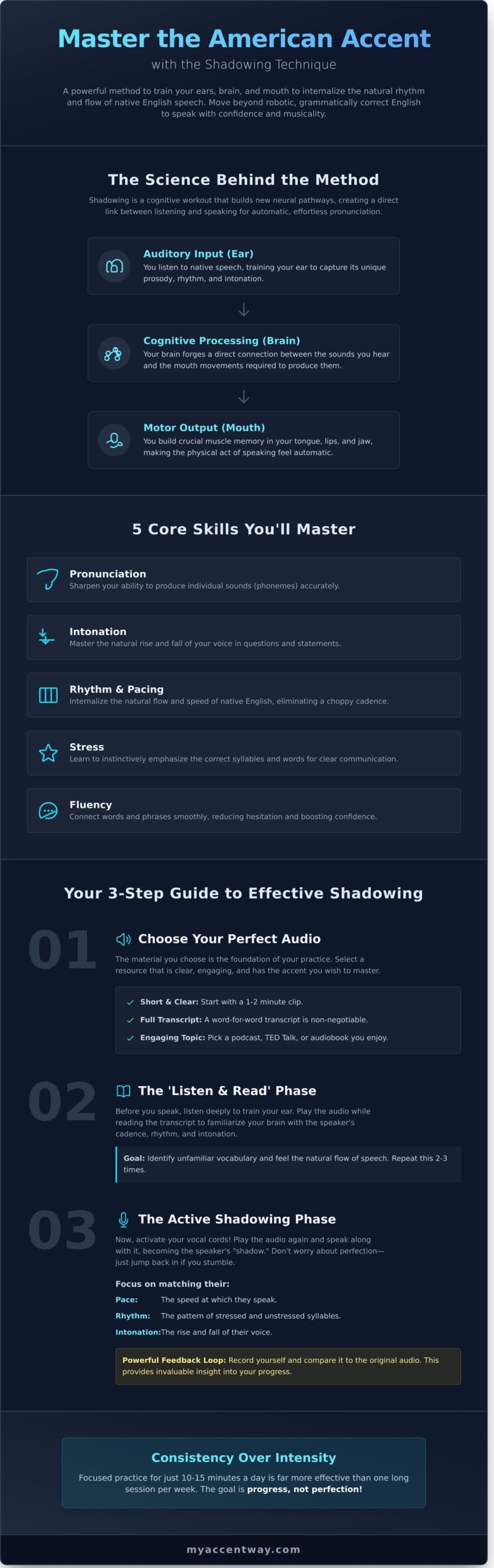
What is the Shadowing Technique? The Science Behind the Method
Do you ever feel that your English is grammatically correct, but still sounds robotic or unnatural? It’s a common frustration for dedicated learners. You know the words, but the rhythm, intonation, and flow do not feel right, which can seriously undermine your confidence.
The shadowing technique is the practice of listening to a piece of audio and repeating it aloud in real time, just a split second behind the original speaker, almost like an echo. This process is known in psycholinguistics as speech shadowing.
But shadowing is not simple mimicry. It is a listening-speaking exercise that connects auditory input with motor output. When it is done correctly, it can improve pronunciation, intonation, rhythm, pacing, stress, and fluency.
The important question is not whether shadowing is useful. The important question is whether the student is ready to shadow correctly. If the student cannot yet produce American sounds accurately, shadowing may reinforce the same accent patterns they want to change.
Why It Works: A Look at the Linguistics
Shadowing engages your brain on both a cognitive and physical level. By speaking while you listen, you build a connection between what you hear and how your mouth moves. You also train your ear to internalize the music of the language: prosody, rhythm, stress, reduction, and intonation.
At MyAccentWay, this method becomes more effective when students combine it with sound-system retraining. Students need to know how American vowels and consonants are formed before they expect shadowing to change their accent deeply.
The 5 Key Skills You Will Improve with Shadowing
- Pronunciation: Sharpen your ability to produce sounds more accurately once the correct sound target has been trained.
- Intonation: Practice the natural rise and fall of American English in questions, statements, and emotional emphasis.
- Rhythm and pacing: Internalize the timing of stressed and unstressed syllables so speech becomes smoother.
- Stress: Learn to emphasize the right syllables and the right words so your message becomes easier to understand.
- Fluency: Connect words and phrases more naturally with less hesitation and stronger speaking confidence.
How to Start Shadowing: A Step-by-Step Guide for Beginners
Embarking on your shadowing journey is an exciting step toward English fluency. To ensure success, approach your first session with a clear framework. The goal is progress, not perfection.
However, if your main goal is American accent improvement, do not start with shadowing alone. First, check whether your sound system, intonation, and rhythm are ready. This is why a 1-hour 1 Hour Evaluation Session can save months of unfocused practice.
Step 1: Choose Your Perfect Audio Source
The material you choose is the foundation of your practice. Your goal is to find a resource that is clear, short, and appropriate for American English. Start with a clip that is only 1-2 minutes long. The speaker should have clear speech and the accent you wish to master.
- Short and clear: Start with 30 seconds to 2 minutes, not long speeches.
- Full transcript: A transcript helps you verify words, linking, reductions, and pronunciation.
- Engaging topic: Choose something you actually want to repeat so practice stays consistent.
Step 2: The Foundational Listen and Read Phase
Before you speak, listen deeply. Play the audio while reading the transcript. Identify unfamiliar vocabulary, difficult sound combinations, stress patterns, and places where the speaker reduces or links words. This preparatory step is useful for shadowing for beginners.
Step 3: The Active Shadowing Phase
Now speak along with the speaker while reading the transcript. Focus on matching pace, rhythm, and intonation. Do not worry if you stumble. Pause, reset, and try again.
For a stronger feedback loop, record yourself and compare your recording to the original. Notice where your vowel quality, consonant clarity, word stress, sentence stress, and melody differ from the model.
Finding the Best Materials for Your Shadowing Practice
To truly master the American accent, the quality of your source material matters. High-quality input creates better practice. The right audio does not just make your shadowing technique English practice more effective; it makes it sustainable.
There is scientific evidence for shadowing and its impact on pronunciation, but its success depends on how the technique is used and whether the student is ready to imitate accurately.
- Crystal-clear audio: The recording should be free from background noise so you can hear subtle sounds.
- A single standard speaker: Begin with one consistent American English model.
- A natural pace: Avoid audio that is too slow or too fast.
- An accurate transcript: A transcript gives your brain a map for sound, rhythm, and meaning.
Recommended resources include TED Talks, NPR podcasts, audiobooks, and high-quality educational YouTube channels. They are useful after you understand what to listen for and what to correct in your own speech.
Top 4 Shadowing Mistakes and How to Correct Them
The shadowing technique is powerful, but only when practiced correctly. Without proper form, students may reinforce pronunciation and intonation habits from their native language instead of building new American English habits.
Mistake 1: Mumbling or Speaking Too Quietly
A lack of confidence often leads to mumbling or speaking too softly. Shadowing is about clear speech production. Stand up straight, project your voice, and speak with enough energy to train a confident sound.
Mistake 2: Focusing Only on Words, Not the Music
Many learners pronounce the words but miss the music. American English depends on rhythm, stress, reduction, and intonation. Before shadowing with words, listen to the melody, hum the pattern, and then add the words.
Mistake 3: Choosing Material That is Too Difficult
Fast movie dialogue or complex lectures can create frustration. Start simple. Choose a short, clear clip and master it completely before moving to something harder.
Mistake 4: Not Reviewing Your Own Performance
You cannot fix errors you do not hear. Always record yourself. Then compare your recording to the native-speaker model. For a professional linguistic breakdown, consider getting expert feedback through MyAccentWay.
When Self-Study Isn’t Enough: Combining Shadowing with Expert Coaching
The shadowing technique can support dedicated independent learners. It connects listening and speaking and helps students develop smoother rhythm. But self-study has a blind spot: most students cannot accurately hear the exact difference between their current sound system and the American target.
Without expert feedback, subtle patterns may become fossilized. The student may imitate the general flow of a sentence but still miss vowel quality, consonant release, sentence stress, or intonation movement.
This is where a professional linguist transforms practice from repetition into a targeted training system. A 1 Hour Evaluation Session can identify the sounds, rhythm patterns, and intonation habits that block clear speech. Then shadowing becomes a strategic tool, not guessing.
Discover how professional American accent training can provide the structure and feedback needed to make your practice more efficient.
Before you shadow for another month, find out what your accent is really doing.
Most serious English speakers do not need more random practice. They need to know which sounds, stress patterns, reductions, and intonation habits are holding them back. In a 1-hour 1 Hour Evaluation Session, Prof. Alex can show you what to train first, so your shadowing practice becomes more accurate and productive.
Interactive American Accent Training for Foreign-Born Professionals in the United States
Foreign-born professionals in the United States often know their field and speak advanced English. Yet American listeners may still struggle with their sounds, stress, and rhythm. MyAccentWay offers private online American accent training through Interactive American Accent Training.
Interactive American Accent Training is led by Prof. Alex, Ph.D. Accent Coach, Doctor of Education, and professional linguist. He first diagnoses each speaker’s native-language patterns. Then he trains American sound articulation, stress, rhythm, and intonation for real real conversations.
Who this training is for
- Engineers, IT specialists, and data professionals presenting to U.S. teams and clients
- Doctors, nurses, and healthcare professionals explaining care to American patients
- Managers, executives, and founders leading meetings, pitches, and briefings
- Consultants, researchers, and academics speaking at conferences and webinars
- Professionals preparing for interviews, promotions, or client-facing roles
Online training across the U.S.
MyAccentWay is based in Austin, Texas, and all training is online. The program is especially relevant for professionals in Austin, Dallas, Houston, New York City, the San Francisco Bay Area, Los Angeles, Seattle, Boston, Chicago, Miami, Washington DC, Atlanta, and Raleigh.
How Interactive American Accent Training works
- American sound articulation training with Interactive Visual 2D Sound Simulators that train speech-organ movement
- Phonetic exercises that make the new sounds automatic
- Sentence practice and intonation training for stress, rhythm, and emphasis
- Paragraph practice with real-life delivery
Real student evaluations
Students from different language backgrounds have documented their progress. Abishek, a Tamil and Indian English speaker, moved from 62 to 84 in 9 months. Tian, a Mandarin speaker, moved from 58 to 85 in 8 months. Vlad, a Russian speaker, moved from 60 to 83 in 5 months.
The first step is a 1 Hour Evaluation Session with Prof. Alex.
Frequently Asked Questions About the Shadowing Technique
How often should I practice the shadowing technique?
Short, focused sessions of 15-20 minutes every day are usually better than one long session per week. But if your pronunciation foundation is not ready, first train the sound system and then use shadowing to build fluency.
What is the difference between shadowing and simple mimicking?
Mimicking is delayed repetition. Shadowing is simultaneous repetition. You speak along with the native speaker in real time, focusing on sound, rhythm, stress, intonation, and flow.
Can shadowing help me reduce my native accent?
Yes, but only when it is used correctly. Shadowing can help reduce accent patterns after students understand the American sound system. If students shadow too early, they may repeat English with their native-language pronunciation and intonation.
How long does it take to see results from shadowing?
Many learners feel improvement in rhythm and flow within several weeks of consistent practice. Deeper accent change usually takes longer because the student must retrain sound production, listening awareness, intonation, and speaking habits.
Should I use video or just audio for my shadowing practice?
Both can help, but video is stronger for pronunciation because students can observe articulation, facial movement, timing, and expression. For accent training, visual support becomes even more effective when it is combined with direct sound-system training.
Can I do shadowing without a transcript?
You can, but a transcript is more effective for serious learners. It lets you study linking, reductions, word stress, sentence stress, and meaning before you begin speaking.
Disclaimer – American Accent Program
The American Accent Program available through MyAccentWay is an educational and coaching service designed to support pronunciation, accent reduction, and spoken English fluency. All training materials, including lessons, exercises, audio content, visual simulations, coaching methods, and digital resources, are the intellectual property of American Accent Program, LLC and are protected by applicable copyright and intellectual property laws.
By using this website and participating in the program, you acknowledge that all content is provided for personal, non-commercial, educational use only. Users are granted a limited, non-transferable license to access the materials strictly for individual learning purposes. Redistribution, reproduction, recording, modification, sharing, or commercial use of any program content without prior written consent is strictly prohibited.
The program may include live coaching sessions, digital tools, and instructional materials intended to improve pronunciation and communication skills. However, individual results may vary, and no specific level of fluency, accent reduction, or communication outcome is guaranteed. The American Accent Program and its instructors do not provide medical, therapeutic, or clinical speech-language pathology services. All training is intended for educational purposes only.
The problem is not always grammar or vocabulary.
If people understand your words but still miss your message, the deeper issue may be speech clarity, rhythm, intonation, and American pronunciation habits. MyAccentWay helps students retrain the sound system with professional 1-on-1 guidance, so English can feel clearer, freer, and more natural in real communication.
Two training methods that make speech change active.
MyAccentWay is not passive listen-and-repeat coaching. Prof. Alex, Ph.D. Accent Coach, Doctor of Education, and professional linguist, creates a learning situation where students become active learners and active participants in changing their own speech patterns.
Interactive training
Students do not just receive pronunciation instructions passively. They listen, think, compare, adjust, and understand their own speech patterns while Prof. Alex guides the correction process.
Cognitive accent training
Students learn to notice and correct the speech patterns that affect American pronunciation, then implement new American speech patterns into their code-switching process for more natural, long-lasting change.
Build speech habits people can hear in real conversations.
A stronger American accent is not built by memorizing topics or chasing quick pronunciation tips. It comes from structured training, professional feedback, active correction, and repeated application until clearer speech becomes easier to keep.
Continue learning how MyAccentWay connects student results, reviews, proof, Prof. Alex’s method, and American accent training.
- Prof. Alex and the MyAccentWay MethodLearn how Prof. Alex created and leads the structured MyAccentWay American accent training system.
- Accent Reduction Curriculum and English Articulation TrainingSee accent reduction, accent modification, American pronunciation, English articulation, rhythm, and professional speech clarity.
- 2D Sound Motion Technology for American Accent TrainingUnderstand Interactive Visual 2D Sound Simulators for American sound articulation.
- Before-and-After American Accent Training ResultsListen to real before-and-after student proof and outcomes.
- Student Reviews and Accent Training ResultsRead student reviews and trust signals.
- Book a 1-on-1 American 1 Hour Evaluation SessionStart with a 1-hour interactive session with Prof. Alex.