
Have you ever spoken English with perfect grammar, only to be met with a confused look? You know the words are right, but something is missing-the natural rhythm that makes speech flow. If you feel like you sound robotic or that native speakers struggle to catch your meaning, you are not alone. This common frustration isn’t about your vocabulary; it’s about the hidden ‘music’ of the language. The key to unlocking that melody and being clearly understood lies in mastering a few simple but powerful sentence stress rules.
As linguistic experts, we’ve crafted this ultimate guide to demystify this crucial aspect of the American accent. We will move beyond theory and give you the practical, actionable techniques you need to identify which words to emphasize in any sentence. You will learn to control your pitch and timing, transforming your speech from monotonous to magnetic. Get ready to finally understand the core of English intonation, improve your listening skills, and start speaking with the clear, confident, and natural rhythm you’ve always wanted.
Key Takeaways
- Discover why English is a “stress-timed” language and how mastering its unique rhythm is the first step to being clearly understood.
- Learn the fundamental principle of stressing “content words” to instantly stop sounding robotic and add natural flow to your speech.
- Go beyond the basics with 3 advanced sentence stress rules that will help you navigate exceptions and sound truly fluent.
- Find out how to train your ear to hear the “music” of English, which is the most effective way to make natural stress an automatic skill.
Why Sentence Stress is Your Secret Weapon for Fluency
Have you ever felt that even with perfect grammar and a strong vocabulary, your English still sounds… off? The missing piece isn’t another verb tense; it’s the rhythm. Mastering sentence stress is the key that unlocks natural, confident, and truly fluent speech. It transforms your communication from a series of disconnected words into a compelling message that native speakers understand effortlessly. This is where you move beyond just speaking English and begin to feel it.
From Robotic to Rhythmic: The ‘Music’ of English
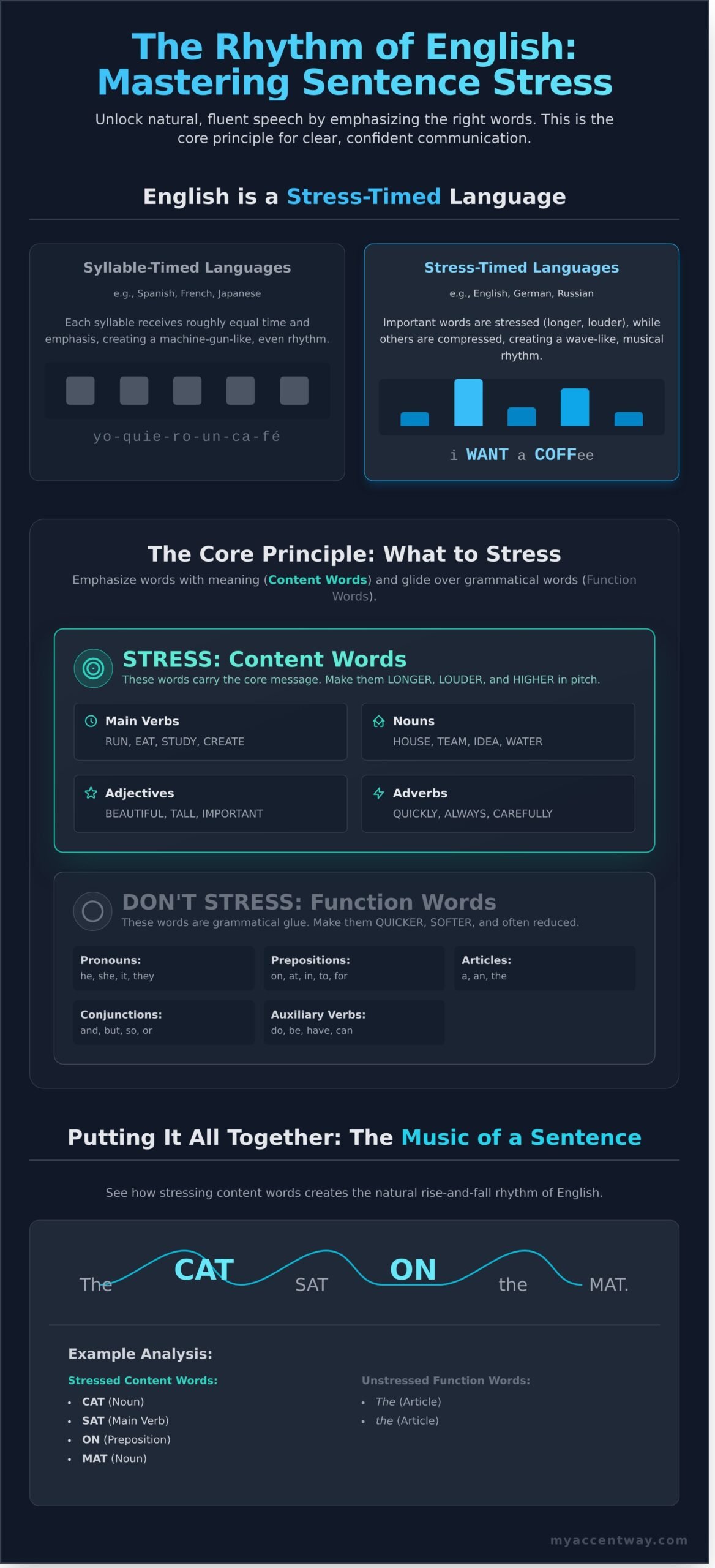
English is what linguists call a stress-timed language. This is fundamentally different from syllable-timed languages like Spanish, French, or Japanese, where each syllable receives a relatively equal amount of time. In English, sentences have a beat, much like a song. The most important words in the sentence land on the main beat and are spoken more clearly and for longer. The other, less important words are rushed and compressed between these beats. This creates the characteristic rise-and-fall melody that is essential for sounding native.
- Syllable-timed (e.g., Spanish): Yo-quie-ro-ir-a-la-tien-da. (Each syllable is even.)
- Stress-timed (English): I want to go to the store. (The bolded words get the beat.)
The Difference Between Being Heard and Being Understood
When you ignore the natural rhythm of English, you force your listener to work much harder. Native speakers are subconsciously trained to listen for the stressed words to quickly grasp the core meaning of a sentence. If your stress is flat or placed on the wrong words, the message can become confusing or even completely misunderstood. Applying the correct sentence stress rules isn’t just about sounding better-it’s about being a clear and effective communicator. It’s the difference between a listener straining to decode your words and them absorbing your message with ease.
Word Stress vs. Sentence Stress: A Quick Clarification
It’s important to distinguish between two levels of emphasis. Word stress is the emphasis on a specific syllable within a single word (e.g., IM-portant vs. im-POR-tant). Sentence stress, our focus here, is about which words are emphasized within an entire sentence to convey meaning. Both are crucial components of English prosody, and the broader concept of Stress (linguistics) covers both the emphasis within a word and across a phrase. While you need both, mastering sentence stress is what governs the overall flow and rhythm of your speech, making it your most powerful tool for fluency.
The Core Principle: Stressing Content Words, Not Function Words
If you’re looking for the single most impactful change you can make to your spoken English, this is it. Think of this as the 80/20 rule for sounding more natural: mastering this one principle will give you 80% of the results with just 20% of the effort. The core idea is simple yet profound: in English, we emphasize the words that carry the most meaning and glide over the words that provide grammatical structure.
This fundamental distinction between “meaning” words and “grammar” words is at the heart of all professional sentence stress guidelines and is your key to unlocking a more natural, native-like rhythm. Let’s break down these two crucial categories of words, which are the foundation of all sentence stress rules.
What Are Content Words? (The Words You STRESS)
Content words are the heart of your message. They carry the essential information and meaning. If you were sending a telegram, these are the words you would keep! Strive to make these words longer, louder, and slightly higher in pitch. They include:
- Main Verbs: RUN, EAT, THINK, STUDY
- Nouns: HOUSE, MUSIC, KNOWLEDGE, ANNA
- Adjectives: BEAUTIFUL, RED, INTERESTING
- Adverbs: QUICKLY, LOUDLY, ALWAYS
What Are Function Words? (The Words You DON’T Stress)
Function words are the grammatical glue. They connect the content words to form correct sentences, but they don’t carry the main meaning. These words are typically unstressed, spoken more quickly, and often reduced to a softer sound. They include:
- Pronouns: he, she, it, they
- Prepositions: on, at, in, to
- Articles: a, an, the
- Conjunctions: and, but, so
- Auxiliary Verbs: do, be, have, can
Putting It Together: See and Hear the Difference
When you correctly stress the content words, the unstressed function words naturally get reduced. This creates the characteristic rhythm-or “music”-of spoken English. Notice how the function words in these examples become quieter and quicker.
- The cat sat on the mat. (“on the” becomes a quick “on-thuh”)
- She wants to buy a new car. (“to” becomes “tuh” and “a” becomes “uh”)
- They’ve been studying for the test. (“for the” becomes “fer-thuh”)
Practice saying these sentences aloud, focusing on making the bolded words stand out. This simple shift from stressing every word equally to stressing only the content words will immediately make your speech sound more confident and fluent.
Beyond the Basics: 3 ‘Special’ Rules for Advanced Stress
Once you have a solid grasp of stressing content words, it’s time to elevate your speech to a truly advanced level. The basic guidelines are your foundation, but the exceptions are where you add nuance, emotion, and precise meaning. Mastering these special sentence stress rules is the key that unlocks genuine conversational fluency, separating proficient speakers from those who sound authentically native.
These aren’t just minor tweaks; they are powerful linguistic tools that allow you to command a conversation with confidence. Let’s explore the three rules that will transform your American accent.
Rule #1: Stress on New Information
In a conversation, native speakers naturally emphasize the newest piece of information being introduced. The stress isn’t random; it follows the flow of dialogue, highlighting what’s most important in that specific moment. Notice how the stress shifts as the conversation evolves:
- Person A: “What are you doing this evening?”
- Person B: “I’m reading a BOOK.” (The new information is the book.)
- Person A: “Oh? What kind of book is it?”
- Person B: “It’s a book about American HISTORY.” (Now, history is the new, specific detail.)
Rule #2: Contrastive Stress to Change Meaning
This is one of the most powerful tools in your accent toolkit. By simply shifting the stress to a different word in the exact same sentence, you can completely change its underlying meaning. This allows for incredible precision in communication. Understanding these subtle shifts is key to mastering complex linguistic stress patterns and conveying your exact intention. Take this one sentence:
- “I didn’t steal your money.” (Implication: Someone else did.)
- “I DIDN’T steal your money.” (Implication: I’m strongly denying the accusation.)
- “I didn’t steal YOUR money.” (Implication: I stole someone else’s money.)
- “I didn’t steal your MONEY.” (Implication: I stole something else of yours, but not the money.)
Rule #3: Emphatic Stress for Emotion and Correction
While we typically stress content words (nouns, verbs, etc.), we can intentionally break this rule to add strong emotion or to correct a misunderstanding. By stressing function words like auxiliary verbs (am, is, do, did), you make your point with undeniable force. This is a clear sign of an advanced, confident speaker.
- Person A: “You aren’t listening to me.”
- Person B: “I AM listening to you!”
- Person A: “He can’t be the new manager.”
- Person B: “He IS the new manager!”
Internalizing these advanced rules will dramatically improve your clarity and impact. This is the level of nuanced control over the American accent that we help you master at myaccentway.com.
How to Practice Sentence Stress and Develop Your Rhythm
Understanding the theoretical sentence stress rules is a fantastic start, but it’s only half the journey. To truly master the rhythm of American English, you must move from intellectual knowledge to intuitive skill. This requires consistent, targeted practice that trains both your ears and your voice.
Effective practice involves two key stages: first, training your ears to accurately hear the stress patterns, and second, training your voice to reproduce them. By combining the following techniques, you will develop the natural-sounding cadence that is crucial for clear and confident communication.
Technique 1: Listen and Shadow
Shadowing is a powerful method for internalizing the music of a language. It’s simple but incredibly effective for developing your rhythm and intonation.
- Find short audio or video clips of native speakers (e.g., from news reports, TED Talks, or movies).
- Listen once, focusing only on the rhythm. Which words pop out? Try tapping your finger to the beat.
- Play the clip again and speak along with the speaker in real-time. Your goal is to mimic their stress and pitch as closely as possible.
Technique 2: Mark Up a Text
This exercise transforms passive reading into an active analysis of English rhythm. Take a short paragraph from a book or news article and read it aloud. As you do, use a pen to underline or highlight the content words you naturally stress. This trains your brain to consciously identify the ‘beat’ of the language, making it easier to apply the sentence stress rules you’ve learned in your own speech.
Technique 3: Get Expert Feedback
While self-study is valuable, the fastest way to improve is with guidance from a trained professional. An accent coach can hear subtle patterns in your speech that you might miss and provide immediate, personalized corrections. This expert feedback is critical for avoiding the trap of practicing and reinforcing mistakes, ensuring your efforts are effective and dramatically accelerating your progress. See how our American Accent Training can perfect your rhythm and help you achieve your fluency goals with confidence.
From Rules to Rhythm: Master the Sound of Fluent English
You now hold the blueprint to transforming your English pronunciation. Understanding that the rhythm of English comes from stressing key content words-not just knowing vocabulary-is a giant leap toward fluency. By moving beyond the basics and practicing consistently, you can turn robotic-sounding sentences into natural, engaging speech.
But truly internalizing the sentence stress rules requires more than just reading; it requires expert guidance and personalized feedback. Theory is powerful, but guided practice is where real transformation happens. That’s why we created a program designed for mastery. Under the guidance of a Ph.D. Linguist, our proven method provides the personalized, one-on-one coaching you need to succeed. We are so confident in our approach that we offer a Success Guarantee.
Ready to master the rhythm of English? Enroll in our course today!
Your journey to speaking clear, confident, and fluent English is within reach. Let’s take the final step together.
Frequently Asked Questions About Sentence Stress
Does sentence stress change when you ask a question?
Yes, absolutely. The stress in a question shifts to highlight the specific information you are asking for. For example, “Did you buy the car?” asks about the person, while “Did you buy the car?” asks about the object. This intentional shift is a critical part of English intonation patterns. Mastering this allows you to convey precise meaning and is a key step toward achieving the confident fluency we guarantee in our programs.
What are the most common sentence stress mistakes for non-native speakers?
The most frequent mistake is stressing every word equally, which is common in syllable-timed languages. English, however, is a stress-timed language. This means speakers often incorrectly emphasize function words (like ‘to’, ‘a’, ‘is’) instead of the more important content words (nouns, main verbs, adjectives). Overcoming this habit is fundamental to developing a natural rhythm and is a core focus of our scientifically-proven method for accent mastery.
How long does it take to master English sentence stress?
The timeline varies for every learner, as it depends on your native language and the consistency of your practice. However, with dedicated, expert-led training, our students often report a significant boost in confidence and clarity within weeks. Our Individual Approach, guided by a Ph.D. Linguist, accelerates your progress by focusing on your unique cognitive processes. The goal is not just practice, but precise, effective practice that delivers tangible results.
Do American and British English have different sentence stress rules?
While the fundamental sentence stress rules are very similar-both prioritize content words-there are noticeable differences in word stress and intonation. For example, Americans say “aDULT” while the British often say “Adult.” The overall melody, or pitch contour, can also differ. Our curriculum is specifically designed to master the phonemes and rhythmic patterns of the General American Accent, ensuring you achieve authentic and clear pronunciation.
Why do native speakers seem to ‘swallow’ or reduce certain words?
This is a key feature of natural, fluent English called “reduction.” To maintain the rhythm between stressed syllables, native speakers naturally shorten, or reduce, unstressed function words. For instance, “I am going to go” becomes “I’m gonna go.” This isn’t lazy speech; it’s a crucial phonetic rule for sounding natural. Mastering these reductions is an advanced skill that we break down into simple, achievable steps in our courses.
Can I learn sentence stress just by watching movies?
While movies are excellent for passive listening and exposure, they are rarely sufficient for mastery. Without expert feedback, it’s difficult to identify and correct your own ingrained patterns. True progress requires an active, intellectual approach that combines listening with targeted exercises and a deep understanding of the phonetic rules. Our method provides this structured, scientific framework, turning passive imitation into active, conscious skill-building for guaranteed success.
Disclaimer – American Accent Program
The American Accent Program available through Visit Program Website
is an educational and coaching service designed to support pronunciation, accent reduction, and spoken English fluency. All training materials, including lessons, exercises, audio content, visual simulations, coaching methods, and digital resources, are the intellectual property of American Accent Program, LLC and are protected by applicable copyright and intellectual property laws.
By using this website and participating in the program, you acknowledge that all content is provided for personal, non-commercial, educational use only. Users are granted a limited, non-transferable license to access the materials strictly for individual learning purposes. Redistribution, reproduction, recording, modification, sharing, or commercial use of any program content without prior written consent is strictly prohibited.
The program may include live coaching sessions, digital tools, and instructional materials intended to improve pronunciation and communication skills. However, individual results may vary, and no specific level of fluency, accent reduction, or communication outcome is guaranteed.
The American Accent Program and its instructors do not provide medical, therapeutic, or clinical speech-language pathology services. All training is intended for educational purposes only.
By accessing or using the program, you agree to comply with all applicable terms, including the platform’s Terms of Use and Course Policies, and acknowledge that misuse of materials may result in termination of access without refund.




One Response