TL;DR:
- Native American speech features rhoticity, the flapped T, vowel mergers, and stress-timed rhythm. Mastering these elements helps non-native speakers sound more natural and confident in American English.
Native American speech is defined by four core phonetic features: rhoticity, the flapped T, vowel distinctions like the cot-caught merger, and a stress-timed rhythm. These are not stylistic preferences. They are the structural elements of American English phonetics that trained linguists and everyday listeners use to identify a native speaker. If you are a non-native professional working in the United States, understanding what makes speech sound natively American is the first step toward clearer, more confident communication.
Which phonetic features define the native American English sound?
American English is fully rhotic, meaning speakers pronounce the “r” sound in every position of a word. This separates General American from British Received Pronunciation, where the “r” disappears after vowels in words like “car” or “butter.” Rhoticity is not a modern development. The American rhotic accent actually preserves an older, more prestigious form of English that early colonists brought from Britain before non-rhotic speech became fashionable in England. That historical fact surprises most learners.
The second defining feature is the flapped T. The alveolar tap converts the “t” sound between vowels into a soft “d” sound. “Water” becomes “wadder.” “Butter” becomes “budder.” This is not sloppy speech. It is a rule-governed feature of American connected speech that native speakers apply automatically.
Vowel sounds complete the picture. Approximately 60% of American English speakers have the cot-caught merger, where “cot” and “caught” are pronounced identically. That means the majority of Americans you meet in professional settings use this merged vowel system. Non-native speakers who maintain a distinction between these sounds can sound subtly foreign even when their grammar is perfect.
Key features to recognize and practice:
- Rhoticity: The “r” is always pronounced, including in words like “bird,” “car,” and “butter”
- Flapped T: The “t” between vowels becomes a soft tap, as in “city,” “water,” and “better”
- Cot-caught merger: The vowels in “cot” and “caught” collapse into one sound for most American speakers
- Vowel inventory: American English uses distinct vowel sounds that differ from British, Australian, and many non-native speaker systems
Pro Tip: Record yourself saying “butter,” “water,” and “city.” If the “t” sounds crisp and hard, you are over-articulating. A native American speaker taps through it quickly.
How do rhythm, stress, and intonation contribute to sounding American?
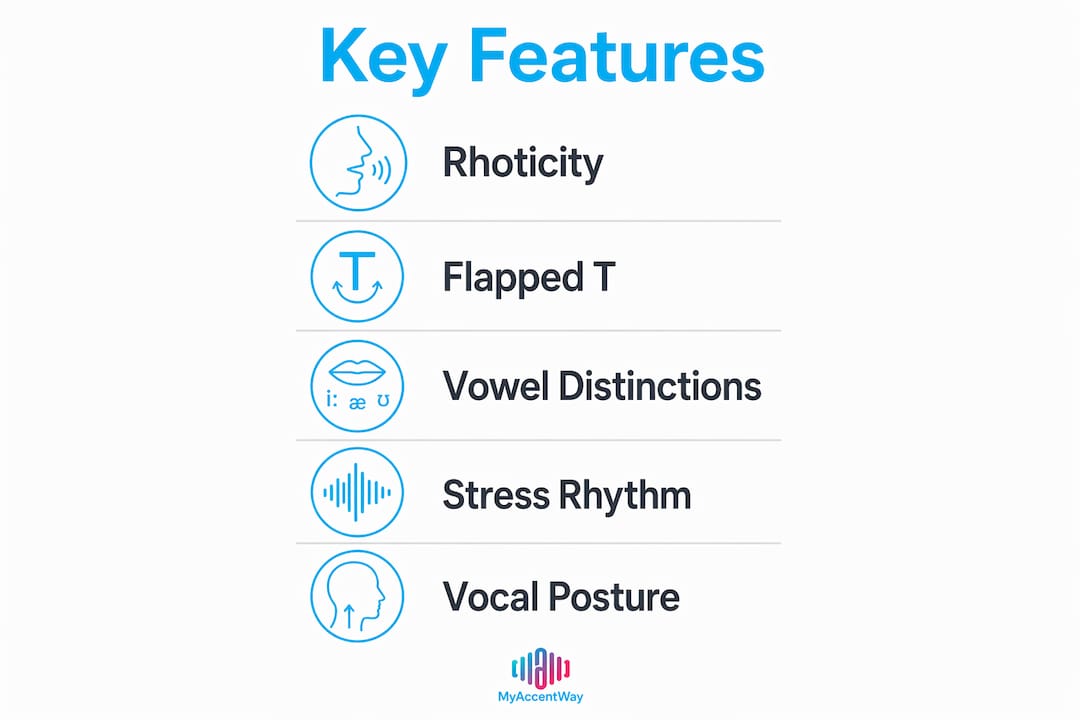
American English is stress-timed, meaning stressed syllables occur at roughly regular intervals while unstressed syllables compress and reduce. Spanish, Mandarin, and many other languages are syllable-timed, where every syllable receives roughly equal weight. This difference in rhythm is one of the most noticeable markers of a foreign accent, even when individual sounds are correct.
The schwa is the engine of American rhythm. Unstressed syllables collapse into a neutral “uh” sound. “About” becomes “uh-BOUT.” “Canada” becomes “CAN-uh-duh.” Speakers who give full vowel value to every syllable sound formal and unnatural to American ears. Mastering stress and intonation matters more for perceived fluency than perfecting any single consonant.
American intonation also has a distinctive shape. Statements fall in pitch at the end. Yes-or-no questions rise. Wh-questions fall. Emphasis shifts meaning: “I didn’t say HE took it” versus “I didn’t say he TOOK it” are two different sentences with the same words. Professionals who place emphasis incorrectly can confuse listeners even when every word is pronounced correctly.
Practice these rhythm and intonation patterns in sequence:
- Identify the stressed syllable in every new word you learn. Mark it before you practice the word aloud.
- Reduce unstressed vowels to schwa. Practice “banana” as “buh-NAN-uh,” not “ba-NA-na.”
- Link words together in phrases. “Did you eat?” becomes “Didja eat?” in natural American speech.
- Practice sentence stress by reading sentences aloud and shifting emphasis to change meaning.
- Record and compare your intonation against a native speaker reading the same sentence.
Pro Tip: Choose one American podcast or news clip and shadow it out loud, matching the speaker’s rhythm and pitch exactly. Do this for ten minutes daily. Rhythm improves faster through imitation than through drills alone.
What physical vocal tract adjustments help achieve a native American sound?
Native American speech depends on total vocal tract posture, not just individual sounds. The jaw is relaxed and slightly lowered. The tongue body sits lower in the mouth. The throat is open. This posture creates the warm, resonant quality that characterizes General American English. Speakers who hold tension in the jaw or keep the tongue high produce a tighter, more clipped sound that reads as foreign.

The American “r” is the most misunderstood sound in accent training. The American /r/ uses a bunched tongue posture near the molars, where the tongue body bunches up rather than the tip curling back. This makes the American “r” function more like a vowel than a consonant. Many learners attempt a retroflex “r” by curling the tongue tip, which produces a different and less natural sound. The bunched R configuration is the correct target.
Chest resonance also matters. American English phonation tends to use a lower, more open vocal tract than many other languages. Speakers who produce sound primarily in the nose or upper throat sound thinner and less natural. Allowing the voice to resonate in the chest produces the warmth listeners associate with confident American speech.
| Adjustment | What to do | Common mistake |
|---|---|---|
| Jaw position | Relax and lower the jaw slightly | Holding the jaw tight and high |
| Tongue posture | Lower the tongue body; bunch near molars for “r” | Curling the tongue tip back for “r” |
| Vocal resonance | Allow chest resonance; open the throat | Producing sound primarily in the nose |
| Muscle tension | Keep facial muscles relaxed during speech | Over-articulating with stiff lip movements |
Common pitfalls that reduce naturalness:
- Over-articulating consonants: Native speakers do not hit every sound with equal force
- Holding tension in the lips: American speech uses relatively relaxed lip movement compared to many other languages
- Ignoring vowel space: Vowels need room to form; a tight jaw collapses vowel distinctions
How can professionals practically train to sound more American?
Speech shadowing combined with visualization technology accelerates muscle memory development faster than passive listening alone. Shadowing means speaking simultaneously with a native audio source, matching every rhythm, stress, and sound in real time. This trains the motor patterns of speech, not just the ear.
Myaccentway uses 2D Sound Motion Technology, also called Interactive Mouth Training Technology, to make this physical training visible. The technology shows exactly how the tongue, lips, jaw, and airflow move during each American sound. Students see the mechanics of a sound, then practice replicating the movement. This turns pronunciation from guesswork into a physical skill with a clear target.
Practical training methods that produce results:
- Shadowing: Use native American audio from news broadcasts or podcasts and speak along in real time
- 2D Sound Motion drills: Watch articulation animations for target sounds, then practice the physical movement
- Stress and rhythm drills: Read sentences aloud with exaggerated stress first, then normalize the rhythm
- Targeted vowel practice: Work through the American vowel and consonant system sound by sound with a coach
Professor Alex, Ph.D., conducts one-on-one assessments to identify each student’s specific speech patterns before building a customized training plan. This matters because a Spanish speaker and a Mandarin speaker have different interference patterns. Generic practice addresses neither effectively. Personalized coaching from a trained linguist targets the exact sounds and rhythms that need adjustment for your native language background.
Key takeaways
Native American speech requires mastering rhoticity, the flapped T, vowel mergers, stress-timed rhythm, and a relaxed vocal tract posture working together as a system.
| Point | Details |
|---|---|
| Rhoticity is non-negotiable | The American “r” appears in all word positions and must be produced with a bunched tongue posture. |
| Flapped T signals fluency | Converting “t” between vowels to a soft tap is a rule of American connected speech, not an error. |
| Rhythm matters more than sounds | Stress-timed rhythm and schwa reduction affect perceived fluency more than any single consonant. |
| Vocal tract posture is the foundation | A relaxed jaw, lowered tongue, and open throat produce the warmth of General American English. |
| Personalized coaching accelerates progress | Targeted training based on your native language background produces faster and more lasting results. |
What I have learned coaching professionals toward native American speech
The most common mistake I see from professionals is trying too hard. They hear American English and attempt to exaggerate every feature. The “r” becomes theatrical. The flapped T gets over-practiced until it sounds forced. Over-articulating American sounds actually reduces naturalness. Native American speech is efficient and relaxed, not performed.
What surprises most of my students is how much rhythm matters compared to individual sounds. A student can produce a perfect American “r” in isolation and still sound foreign in a sentence because the stress pattern is wrong. The melody of American English, the rise and fall of pitch, the compression of unstressed syllables, carries as much identity as any phoneme.
The historical dimension also reframes the learning mindset. American rhoticity is not an accent. It is the older, more preserved form of English. When my students realize they are learning to restore a sound that was once universal in English, the work feels less like imitation and more like linguistic archaeology. That shift in perspective matters. Doubt becomes clarity when you understand what you are actually doing.
My advice to every professional student is this: commit to the physical training first. Get the jaw relaxed. Get the tongue posture right for the “r.” Let the chest open. Once the posture is correct, the sounds follow more naturally than you expect. Technology like 2D Sound Motion makes this physical work visible and precise. Patience combined with the right method produces real results, regardless of your starting point.
— Prof.
Discover Myaccentway’s American accent training for professionals
Myaccentway offers one-on-one American accent coaching led by Professor Alex, Ph.D., designed specifically for non-native professionals. The program combines personalized assessment, structured pronunciation training, and 2D Sound Motion Technology to make every sound visible and trainable.
Watch the 2D Sound Simulator for the American [T] sound and see exactly how the tongue and airflow work:
https://youtu.be/3EzjosgnzJE. Hear real results from Vlad, a Russian speaker who trained with Professor Alex: https://youtube.com/shorts/OE0q7Y8cV74?si=xxmZVxedUPbunfdZ. Book Your 1 Hour Accent Training Session through Myaccentway’s training program to identify your specific speech patterns and start building a plan that fits your professional goals.
FAQ
What is the most important feature of native American speech?
Rhoticity is the single most recognized feature. American English speakers pronounce the “r” in all word positions, which immediately distinguishes them from British and many non-native speakers.
Why does my speech still sound foreign even when my words are correct?
Rhythm and intonation are the most likely cause. American English uses stress-timed rhythm with schwa reductions, and incorrect stress placement signals a foreign accent even when individual sounds are accurate.
What is the cot-caught merger?
The cot-caught merger is a vowel feature where “cot” and “caught” are pronounced identically. Approximately 60% of American English speakers use this merged vowel, making it a core trait of General American pronunciation.
How does 2D Sound Motion Technology help with accent training?
2D Sound Motion Technology shows the movement of the tongue, lips, jaw, and airflow during American sounds. Students see the physical target for each sound and practice replicating the movement, which builds muscle memory faster than listening alone.
How long does it take to sound more American?
Progress depends on your native language background, practice frequency, and whether you receive personalized coaching. Professionals working with a trained linguist like Professor Alex typically notice measurable improvement in rhythm and key sounds within weeks of consistent, targeted practice.
Recommended
- How to Sound More American: The Scientific Guide to Accent Mastery in 2026
- American Accent Vowels and Consonants: A Complete Linguistics Guide – MyAccentWay
- How to Get an American Accent: A Linguist’s 5-Step Method
- Speech Sounds: Vowels and Consonants in American English – MyAccentWay
Speech clarity check
The problem is not always grammar or vocabulary.
If people understand your words but still miss your message, the deeper issue may be speech clarity, rhythm, intonation, and American pronunciation habits. MyAccentWay helps students retrain the sound system with professional 1-on-1 guidance, so English can feel clearer, freer, and more natural in real communication.
Why MyAccentWay works
Two training methods that make speech change active.
MyAccentWay is not passive listen-and-repeat coaching. Prof. Alex, Ph.D. Accent Coach, creates a learning situation where students become active learners and active participants in changing their own speech patterns.
Interactive training
Students do not just receive pronunciation instructions passively. They listen, think, compare, adjust, and understand their own speech patterns while Prof. Alex guides the correction process.
U.S. & Canada online accent training
What Makes Speech Sound Natively American: A Pro Guide for professionals in the United States and Canada
This guide is useful for advanced English speakers, entrepreneurs, international professionals, and students in the U.S. and Canada who want clearer American pronunciation, stronger rhythm, better intonation, and more confident communication in meetings, interviews, presentations, and client conversations.
Prof. Alex, Ph.D. Accent Coach, teaches online 1-on-1 American accent training for learners in major professional markets including New York, Los Angeles, San Francisco Bay Area, Seattle, Austin, Dallas, Houston, Chicago, Boston, Washington, D.C., Miami, Toronto, Vancouver, Montreal, Calgary, and Ottawa.
1-on-1 Accent Reduction Training helps students move beyond self-practice and build clearer American speech habits through interactive and cognitive accent training.
Cognitive accent training
Students learn to notice and correct the speech patterns that affect American pronunciation, then implement new American speech patterns into their code-switching process for more natural, long-lasting change.
Your next step
Build speech habits people can hear in real conversations.
A stronger American accent is not built by memorizing topics or chasing quick pronunciation tips. It comes from structured training, professional feedback, active correction, and repeated application until clearer speech becomes easier to keep.