Reduce Indian Accent in the American Workplace: 2026 Guide
(512) 265-9515Updated October 14, 2026 ◆ 15 min read
American English clarity is possible when speech is trained by a professional linguist.
Real student result

“I feel confident enough to speak American English!”
Interactive American Accent Training9monthsof hard work and dedication
Listen to the starting point0:00
Listen to the result0:00
“Many of my students once believed they could never sound like this. School taught them grammar and vocabulary, but not how to train their English speech. That is what we do together, step by step, until you speak English independently and with confidence.”
Abishek’s result was achieved through Prof. Alex’s research-based Interactive 1-on-1 American Accent Training. His doctoral research found this interactive method more effective than traditional, teacher-centered methods. See the research basis →
Reducing your Indian accent for the American workplace means improving speech clarity through targeted pronunciation and pacing strategies, not erasing your accent entirely. The real goal is intelligibility: being easily understood by American colleagues in meetings, presentations, and daily conversations. Accent “removal” is the wrong goal; trying to sound 100% native creates unnatural speech that actually weakens professional communication. This guide covers the specific phonetic patterns, pacing habits, and daily practice methods that produce measurable clarity gains, and introduces MyAccentWay’s 2D Sound Motion Technology as a structured path forward.
Professor Alex Note
In more than 10 years of training speakers from India, Prof. Alex has seen the same pattern again and again: the student knows English, works professionally in English, and still feels that pronunciation, pacing, or rhythm creates friction in meetings. The solution is not generic repetition. The solution is a precise speech assessment, physical sound training, and structured practice that targets the exact patterns affecting clarity.
Which aspects of Indian English affect clarity in the American workplace?
Indian English is a fully developed variety of English with its own phonological rules. The challenge is not that it is incorrect. The challenge is that certain features create friction when American listeners process your speech.
The most common clarity barriers include:
- The V/W swap. Indian English often uses the same sound for both “v” and “w.” American listeners hear “vine” and “wine” as identical, which causes real confusion in technical and business contexts.
- Retroflex T and D. Indian English produces T and D sounds with the tongue curled back. American English uses a forward tongue position. This single difference affects dozens of common words.
- The “th” sounds. Both the voiced “th” (as in “the”) and the voiceless “th” (as in “think”) are frequently replaced with D or T. American listeners notice this immediately.
- Syllable-timed rhythm. Indian English gives roughly equal time to every syllable. American English is stress-timed: stressed syllables are longer and louder, while unstressed syllables compress. This rhythm difference affects comprehension more than any single sound.
- Speech pace. Most Indian English speakers speak at 170–200 words per minute. The American workplace norm is 130–150 words per minute. That gap alone reduces how much listeners retain.
Beyond phonetics, deferential communication style is often misread as a lack of confidence in American performance contexts. Directness and assertiveness are not rude in American professional culture. They signal competence.
Pro Tip: Record yourself in a mock meeting scenario and count your words per minute. Most Indian professionals are surprised to find they speak 40–50 words per minute faster than the American workplace norm.
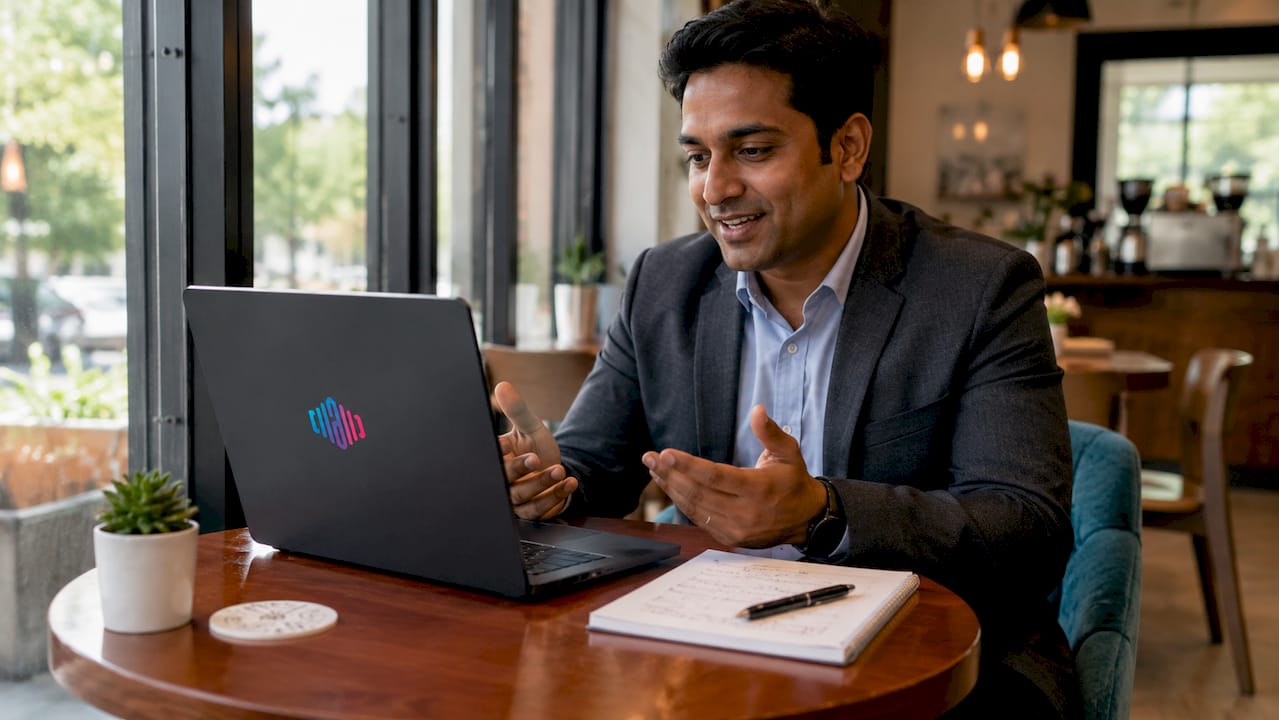
Find out which Indian English patterns affect your clarity
In a 1-hour 1 Hour Evaluation Session, Prof. Alex will assess your pronunciation, rhythm, stress, and speech clarity, then explain what can be improved with structured American accent training.
What tools and techniques improve American English clarity?
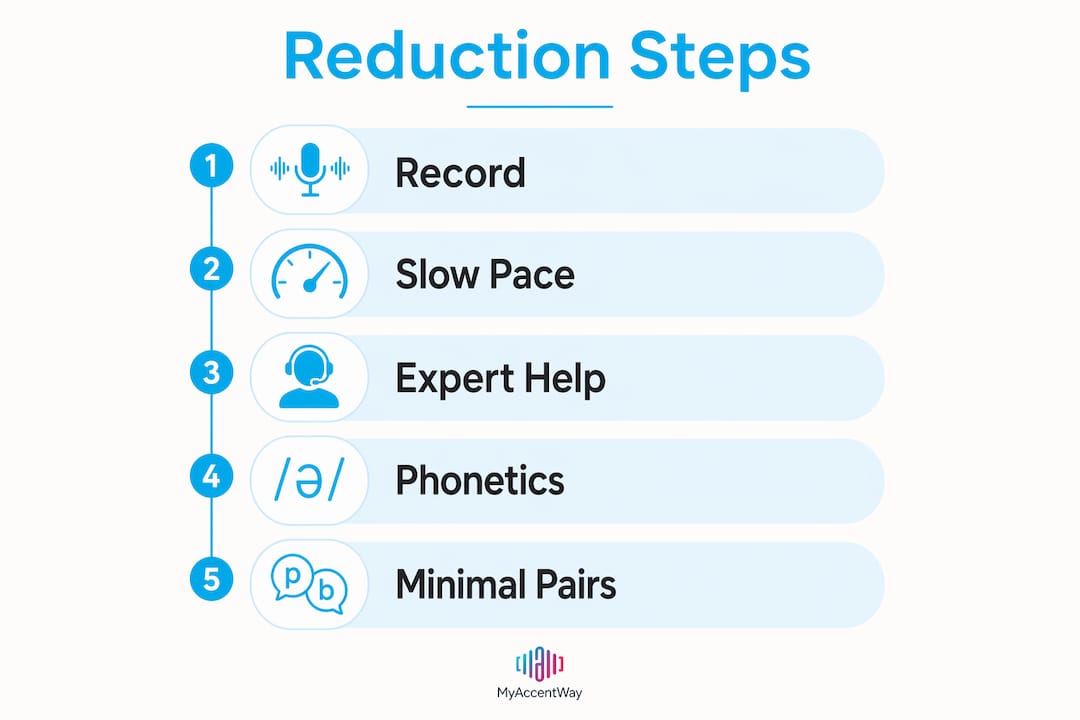
Phoneme clarity, word stress, and connected speech contribute most to comprehensibility. That finding shapes every recommendation below.
1. Use a recording and feedback loop
Recording your own speech is the most reliable diagnostic tool available. A recording-feedback loop is one way to practice clarity. Record a two-minute work scenario, listen back, and note the three moments where you lost clarity. Repeat the same passage the next day.
2. Slow your pace deliberately
Slowing speech by 20% with deliberate pauses at sentence boundaries greatly improves clarity. Set a target of 130–150 words per minute and use a free metronome app to practice speaking in rhythm. The pause at a period or comma is not silence. It is a signal that helps listeners process what you just said.
3. Work with a TESOL-certified expert
Real-time feedback from a TESOL-certified expert prevents you from reinforcing incorrect speech habits during solo practice. Solo drilling without expert correction can lock in errors. One live session per week produces more durable progress than five hours of unsupervised repetition.
4. Use phonetic visualization
Myaccentway’s 2D Sound Motion Technology trains the speech organs to coordinate the tongue, lips, jaw, and airflow during American English sounds. Instead of guessing where your tongue should go, practice its placement.
5. Practice minimal pairs daily
Minimal pairs are word sets that differ by one sound only, such as “vine/wine,” “den/then,” and “true/through.” Drilling these trains your ear and your mouth simultaneously. Ten minutes of minimal pairs practice daily produces noticeable results within four to six weeks.
| Technique | Primary benefit | Time per day |
|---|---|---|
| Recording and playback | Self-diagnosis and monitoring | 10 minutes |
| Pace control with pauses | Comprehension and listener retention | 5 minutes |
| Minimal pairs drills | Phoneme accuracy | 10 minutes |
| Expert live session | Error correction and real-time feedback | 3x per week |
| 2D Sound Motion training | Articulatory precision | 5 minutes |
Pro Tip: Focus your first month entirely on the “th” sounds and speech pace. These two changes produce the fastest perceived improvement by American listeners.
MyAccentWay · 2D Sound Motion Technology
American English Pronunciation: Consonant and Vowel Sounds with 2D Sound Motion Technology
Learning American English pronunciation and the American accent is more effective when you train your speech organs, not only listen and repeat. 2D Sound Motion Technology and Interactive Visual 2D Sound Simulators, developed in 2020 by Prof. Alex, Ph.D. Accent Coach, Doctor of Education, and professional linguist, as part of his interactive teaching model based on his Ph.D. research in interactive teaching methods, train your tongue, lips, jaw, teeth, airflow, and voice step by step. They train each American sound and more than 30 sound combinations through Interactive 2D video simulation.
What 2D Sound Motion Technology is
2D Sound Motion Technology is an advanced accent reduction and articulation training tool by Prof. Alex. It corrects, develops, and trains each American sound and more than 30 sound combinations through Interactive 2D video simulation.
What Interactive Visual 2D Sound Simulators do
Interactive Visual 2D Sound Simulators are part of 2D Sound Motion Technology, the articulation-training method Prof. Alex created by applying his Ph.D. research in interactive teaching to American pronunciation. Instead of listening and repeating, students actively train their speech organs. Each simulator uses Interactive 2D mouth movement to train the speech organs (tongue, lips, jaw, teeth, airflow, and voice) to produce each American sound correctly. Every consonant has its own simulator: explore American consonants trained with 2D Sound Motion Technology.
Sample training: the American t sound (aspirated [t])
Practice
Record yourself speaking these words:
Tab · Tacos · Time · Tub · Hotel · Motel · Sit · Pit · Net
Instructions
Play the Interactive Visual 2D Sound Simulator for the American t sound below several times and follow it step by step. Move your tongue, jaw, and airflow together with the simulator and train your articulation.
Interactive Visual 2D Sound Simulator: American unvoiced sound [t]
Practice
Record yourself again speaking these words, but this time focus on the movement of your tongue. Go slow, and you will hear the difference. You’ve got this!
Tab · Tacos · Time · Tub · Hotel · Motel · Sit · Pit · Net
How Interactive Visual 2D Sound Simulators solve pronunciation and speaking problems
- Wrong articulationMost pronunciation problems start with the tongue, lips, jaw, or teeth in the wrong position. Each Interactive Visual 2D Sound Simulator trains the correct articulation of one American sound, so the student corrects the cause of the problem, not only the result.
- Airflow and voicingMany accent problems come from wrong airflow or voicing: sounds that are too weak, too strong, or voiced when they should be unvoiced. The simulators train airflow and voice together with articulation, step by step, for each American sound and more than 30 sound combinations.
- Clear speech and confidenceWhen each sound is trained correctly, words connect into clear American English speech. Listeners can understand you more easily, and speaking at work, in meetings, and on calls becomes more confident.

If you start hearing the aspiration, the short airstream after [t], with one simulator, you can only imagine how successful you can be in 1-on-1 Interactive American Accent Training with Prof. Alex, Ph.D. Accent Coach, where your whole American sound system is trained sound by sound.
In MyAccentWay, the Interactive Visual 2D Sound Simulators are only available in 1-on-1 accent coaching sessions with Prof. Alex.
How to build a daily practice routine to reduce Indian accent
A structured 25–30 minute daily session produces faster results than occasional long study blocks. Consistency matters more than duration.
- Minutes 1–5: Warm up with phonetic training. Practice with one 2D Sound Motion clip for a target sound. Practice the tongue and lip position in a mirror before speaking.
- Minutes 6–15: Shadow a native speaker. Choose a two-minute clip from a business podcast or TED Talk. Play a sentence, pause, and repeat it at the same pace and rhythm. Focus on stress patterns, not individual sounds.
- Minutes 16–22: Minimal pairs and target sounds. Drill your two or three priority sounds. Use a list of 20 word pairs and say each one clearly before moving to the next.
- Minutes 23–28: Record a workplace scenario. Simulate a meeting update, a client call, or a presentation opening. Record it, play it back, and note one specific improvement for tomorrow.
- Minutes 29–30: Review and log. Write one sentence about what felt different today. Progress tracking builds motivation and reveals patterns over time.
Daily practice combining shadowing, minimal pairs, and recording leads to faster progress and better retention of correct sounds. The key is that each activity targets a different layer of speech: rhythm, phoneme accuracy, and self-monitoring.
Avoid the most common pitfall: speeding up under pressure. When you feel nervous in a real meeting, your pace increases and your clarity drops. Practice your workplace scenarios at a deliberately slow pace so that the slower rhythm becomes your default under stress.
Pro Tip: Hear real results from Vlad, a Russian speaker who trained with Prof. Alex. His before-and-after recordings show what consistent structured practice produces:
What challenges arise during accent reduction and how do you fix them?
Every professional working to improve speech clarity hits predictable obstacles. Knowing them in advance keeps you moving forward.
- The self-consciousness loop. The accent self-consciousness loop causes hesitation and disfluency, which worsens comprehension. The fix is to shift your focus from “how do I sound?” to “is my message landing?” Fluency under pressure breaks the loop faster than any drill.
- Reinforcing errors in solo practice. Without expert feedback, you can practice a sound incorrectly for weeks and make it harder to correct later. Schedule at least one live session per week with a qualified coach.
- Non-linear progress. Clarity gains are not steady. You will have strong weeks and flat weeks. Flat weeks are normal. They do not mean you are regressing.
- Communication style gaps. Assertiveness training is part of accent modification, not separate from it. Practice direct statements in your workplace scenarios: “I recommend X” instead of “Perhaps we could consider X.”
- Schedule pressure. Busy professionals skip practice when workloads spike. A 10-minute session on a hard day is worth more than a skipped session waiting for a perfect 30-minute block.
Accent clarity is not about sounding like someone else. It is about making sure your ideas land with the full weight they deserve.
Why clarity, not imitation, is the real professional advantage
I have worked with hundreds of non-native English-speaking professionals, and the ones who make the fastest progress share one mindset shift: they stop trying to sound American and start trying to be understood. Those are different goals, and they produce different results.
The professionals who chase a “native” sound often develop a kind of performance anxiety that makes their speech worse under pressure. The professionals who focus on clarity, pace, and phoneme accuracy gain confidence quickly because they measure something real: whether their colleagues understand them the first time.
What I find most powerful about 2D Sound Motion Technology is that it removes the guesswork from physical speech training. When a student can see exactly where the tongue should be for the American R or the “th” sound, doubt becomes clarity. The sound becomes trainable rather than mysterious.
The other thing I want to say directly: your accent is part of your identity. The goal of accent modification is not to erase that. It is to give you full control over your speech so that your ideas, your expertise, and your professional presence come through without friction. That is a skill worth building, and it is absolutely achievable with structured practice and the right guidance.
— Prof. Alex, Ph.D. Accent Coach
Clearer English for meetings, interviews, and client calls
If you work in software engineering, IT, data, product, consulting, healthcare, or leadership, your speech clarity can affect how your ideas are received. Start with a 1 Hour Evaluation Session and see what targeted coaching can change.
Student Review · Tamil SpeakerDinesh’s Review: From Tamil Pronunciation Patterns to Clearer American English
Dinesh worked with Prof. Alex for about eight months. His training focused on American English pronunciation, mouth movement, rhythm, pacing, and the speech challenges that became especially important after mouth surgery.
I have worked with Prof. Alex for about eight months, and he was able to transform my accent closer to an American accent. Due to the complications of my mouth surgery, he was able not only to change the way I speak from Tamil pronunciation into English pronunciation, but also help me work through speech problems I used to have after the mouth surgery.
— Dinesh, MyAccentWay student
For Prof. Alex, this is exactly why accent training must be personal. A student does not need generic repetition. A student needs a trained ear, a linguistic system, and a physical understanding of how the tongue, lips, jaw, airflow, rhythm, and intonation work together.
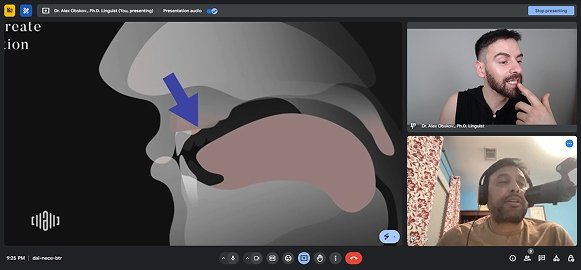

Abishek’s Result: Hard Work, Belief, and Precise Coaching
Abishek came to MyAccentWay because he wanted stronger voice confidence and clearer American English pronunciation. His result shows what can happen when a professional speaker from India trains sound placement, rhythm, pacing, and speech confidence with a structured linguistic method.
Listen to the difference between his before and after recordings. The goal is not to erase identity. The goal is to help the speaker become easier to understand, more confident, and more in control of professional English communication.
Before trainingAfter trainingMyAccentWay’s American accent training for Indian professionals
MyAccentWay offers one-on-one American accent training online led by Prof. Alex, Ph.D. Accent Coach. Every program begins with a personalized assessment that identifies your specific speech patterns, so your training targets exactly what affects your clarity in the American workplace.
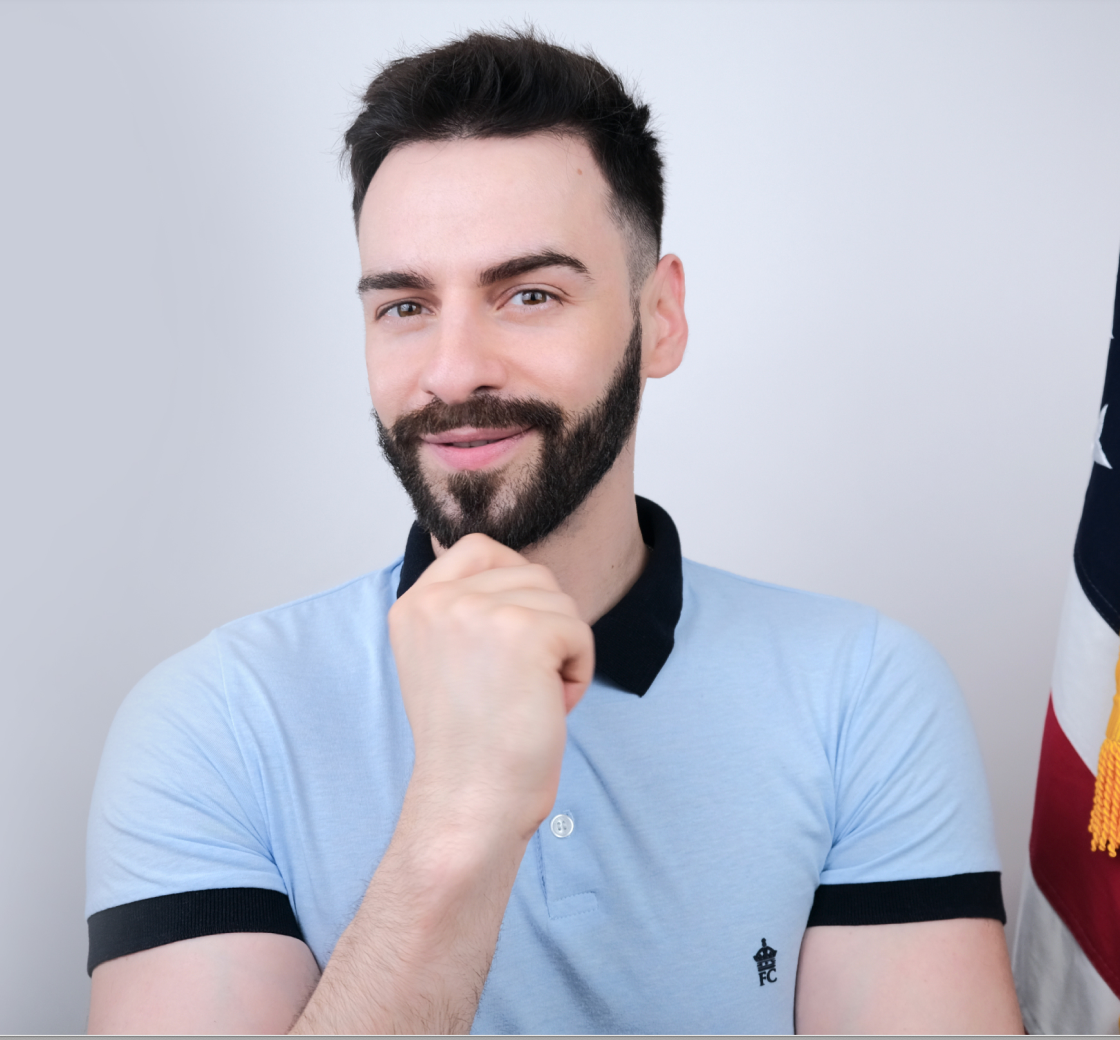
Personal assessment. Physical sound training. Clearer workplace English.
Prof. Alex uses a linguistics-based coaching method to identify the exact pronunciation, pacing, rhythm, and sound-placement patterns that affect clarity for Indian professionals in the American workplace.
Indian English clarity American rhythm 2D Sound Motion TechnologyProf. Alex uses 2D Sound Motion Technology to train you to position your tongue, lips, and jaw for each American English sound. Sessions are online, flexible, and designed for working professionals with demanding schedules. Book Your 1 Hour Evaluation Session to identify your priority areas and start building the speech clarity your career deserves. Visit Myaccentway’s accent training program to get started.
Book your 1-on-1 American 1 Hour Evaluation Session
Get a personalized assessment and learn exactly how MyAccentWay can help you reduce Indian accent patterns, improve American pronunciation, and speak more clearly in professional English.
American Accent Training for Indian Professionals in the United States
Foreign-born professionals in the United States often know their field and speak advanced English. Yet American listeners may still struggle with their sounds, stress, and rhythm. MyAccentWay offers private online American accent training through Interactive American Accent Training.
Interactive American Accent Training is led by Prof. Alex, Ph.D. Accent Coach, Doctor of Education, and professional linguist. He first diagnoses each speaker’s native-language patterns. Then he trains American sound articulation, stress, rhythm, and intonation for real meetings, calls, and presentations.
Who this training is for
- Engineers, IT specialists, and data professionals presenting to U.S. teams and clients
- Doctors, nurses, and healthcare professionals explaining care to American patients
- Managers, executives, and founders leading meetings, pitches, and briefings
- Consultants, researchers, and academics speaking at conferences and webinars
- Professionals preparing for interviews, promotions, or client-facing roles
Online training across the U.S.
MyAccentWay is based in Austin, Texas, and all training is online. The program is especially relevant for professionals in Austin, Dallas, Houston, New York City, the San Francisco Bay Area, Los Angeles, Seattle, Boston, Chicago, Miami, Washington DC, Atlanta, and Raleigh.
How Interactive American Accent Training works
- American sound articulation training with Interactive Visual 2D Sound Simulators that train speech-organ movement
- Phonetic exercises that make the new sounds automatic
- Sentence practice and intonation training for stress, rhythm, and emphasis
- Paragraph practice with real-life delivery
Real student evaluations
Real students have documented their progress. Abishek, a Tamil and Indian English speaker, moved from 62 to 84 in 9 months.
The first step is a 1 Hour Evaluation Session with Prof. Alex.
FAQ
What does it mean to reduce an Indian accent for work?
Accent reduction, formally called accent modification, means improving speech clarity so American colleagues understand you easily. The goal is intelligibility, not eliminating your accent entirely.
How long does it take to improve speech clarity?
Most professionals notice measurable clarity gains within four to six weeks of consistent daily practice. Sustained improvement in rhythm and connected speech typically takes three to six months of structured training.
What is the single most impactful change Indian professionals can make?
Slowing speech pace to 130–150 words per minute produces the fastest perceived improvement. Most Indian English speakers speak at 170–200 words per minute, and that pace gap is the leading cause of comprehension difficulty.
Does accent coaching work for busy professionals?
Yes. A 25–30 minute daily routine combined with one live expert session per week produces durable results without requiring large time blocks. Consistency matters more than session length.
What is 2D Sound Motion Technology?
2D Sound Motion Technology is a method developed by Prof. Alex. As part of his interactive teaching model, based on his Ph.D. research in interactive teaching methods, the Interactive Visual 2D Sound Simulators help students actively train the movement of the tongue, lips, jaw, teeth, and airflow for American English sounds while Prof. Alex corrects them live. This allows students to physically train correct articulation rather than relying on listening and imitation alone.
Recommended
American Accent for Indian Speakers: The 2026 Mastery Guide
Last Tuesday, Arjun, a Senior Lead Developer, felt his confidence evaporate when his Seattle-based director asked him to repeat his strategy update...

How to Sound More American: The Scientific Guide to Accent Mastery in 2026
A scientific guide for non-native English speakers who want to sound more American through American accent training, pronunciation coaching, consonant T practice, rhythm, intonation, connected speech, and 2D Sound Motion Technology.
Accent Reduction Exercises for Adults: The Professional’s Guide to American Speech Clarity
Imagine presenting a breakthrough strategy in a high-stakes boardroom in Austin, Texas, only to have your audience ask you to repeat yourself for the...
Tamil and Indian English speaker proof
Abishek’s before-and-after pronunciation evaluation
For Indian professionals, Tamil speakers, and Indian English speakers, read the detailed Abishek pronunciation evaluation for Tamil and Indian English speakers to see the sound-by-sound American pronunciation changes, including vowels, R, TH, stress, rhythm, intonation, and connected speech.
The problem is not always grammar or vocabulary.
If people understand your words but still miss your message, the deeper issue may be speech clarity, rhythm, intonation, and American pronunciation habits. MyAccentWay helps students retrain the sound system with professional 1-on-1 guidance, so English can feel clearer, freer, and more natural in real communication.
Two training methods that make speech change active.
MyAccentWay is not passive listen-and-repeat coaching. Prof. Alex, Ph.D. Accent Coach, Doctor of Education, and professional linguist, creates a learning situation where students become active learners and active participants in changing their own speech patterns.
Interactive training
Students do not just receive pronunciation instructions passively. They listen, think, compare, adjust, and understand their own speech patterns while Prof. Alex guides the correction process.
Cognitive accent training
Students learn to notice and correct the speech patterns that affect American pronunciation, then implement new American speech patterns into their code-switching process for more natural, long-lasting change.
Build speech habits people can hear in real conversations.
A stronger American accent is not built by memorizing topics or chasing quick pronunciation tips. It comes from structured training, professional feedback, active correction, and repeated application until clearer speech becomes easier to keep.
Continue learning how MyAccentWay connects student results, reviews, before-and-after proof, Prof. Alex’s method, and structured American accent training.
- Prof. Alex and the MyAccentWay MethodLearn how Prof. Alex, Ph.D. Accent Coach, Doctor of Education, and professional linguist, created and leads the structured MyAccentWay American accent training system.
- Accent Reduction Curriculum and English Articulation TrainingSee how MyAccentWay trains accent reduction, accent modification, American pronunciation, English articulation, rhythm, and professional speech clarity.
- 2D Sound Motion Technology for American Accent TrainingUnderstand Prof. Alex’s Interactive Visual 2D Sound Simulators for American sound articulation.
- Before-and-After American Accent Training ResultsListen to real before-and-after student proof and accent training outcomes.
- Student Reviews and Accent Training ResultsRead student reviews, testimonials, and trust signals from MyAccentWay learners.
- Book a 1-on-1 American 1 Hour Evaluation SessionStart with a 1-hour interactive American accent training session with Prof. Alex.