
What if the primary barrier to your next leadership role isn’t your technical expertise, but the 150 milliseconds of hesitation your colleagues perceive before you speak? Research in cognitive linguistics shows that listeners often form snap judgments about professional authority based on vocal clarity long before they process the actual data you’re presenting. You likely already know the mental fatigue that comes from translating complex thoughts while trying to improve speaking confidence at work during high-pressure meetings. It’s a heavy burden to feel like your true potential is hidden behind a layer of speech anxiety or the fear of being misunderstood by your peers.
The good news is that you don’t have to lose your cultural identity to command a room. You can master any boardroom by combining Prof. Alex Obskov’s Ph.D. insights with practical, sound-by-sound techniques. This guide will show you how to master the linguistic and psychological strategies needed to speak with authority and clarity. We’ll break down the science of American rhythm and intonation, giving you the tools to feel relaxed during spontaneous conversations and achieve the professional growth you’ve earned through your hard work and dedication.
Key Takeaways
- Understand why high technical competence often feels disconnected from workplace presence and how prioritizing speech clarity helps bridge the linguistic confidence gap.
- Explore the science-backed mechanics of American phonemes and intonation to replace the “fear of the unknown” with linguistic authority during presentations.
- Identify actionable strategies to improve speaking confidence at work, including how to analyze high-stakes speaking situations using an objective, non-judgmental lens.
- Discover how visual learning through 2D Sound Motion Technology accelerates your mastery of American sounds more effectively than traditional listening exercises.
- Develop a personalized roadmap for your accent modification journey that shifts your focus from merely surviving conversations to truly thriving in professional environments.
Understanding the Connection Between Speech Clarity and Workplace Confidence
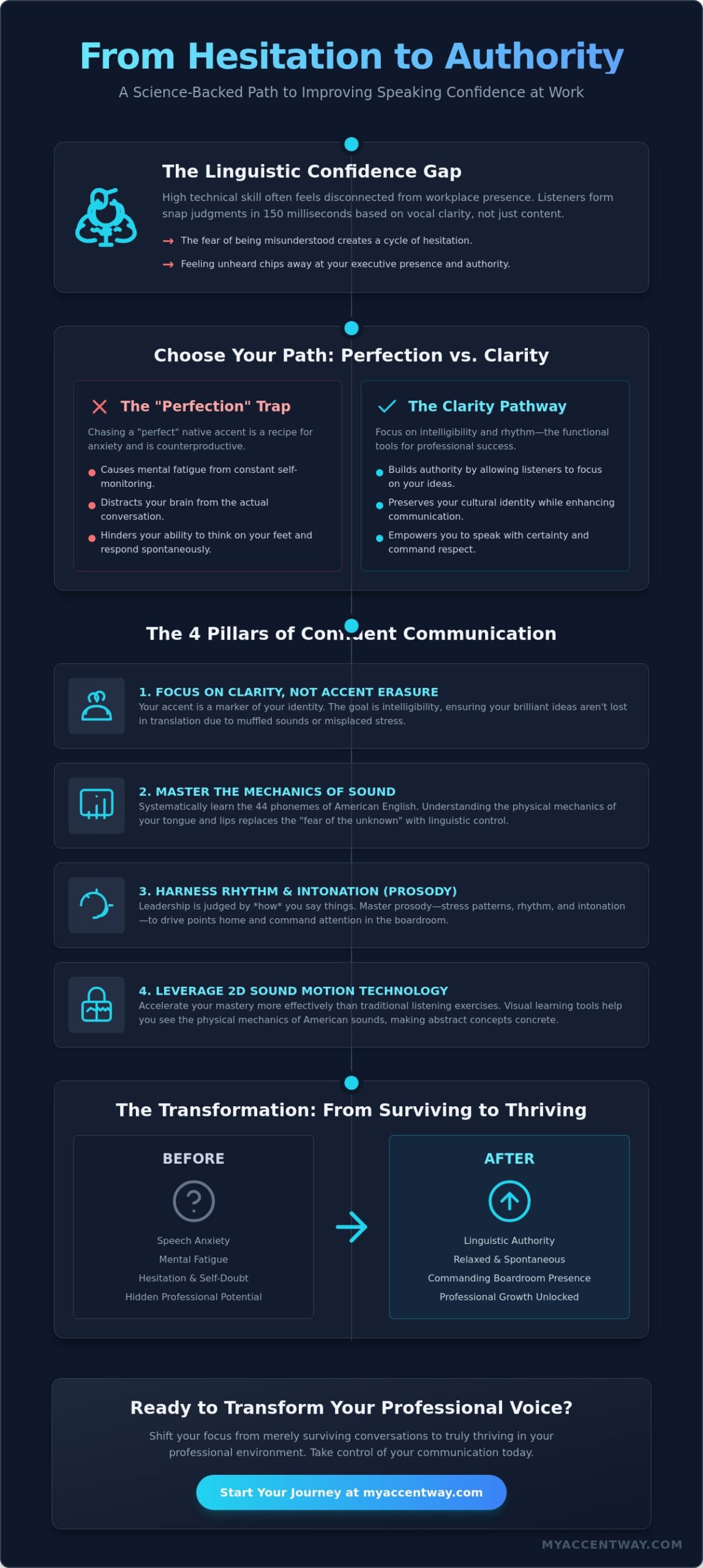
Technical mastery doesn’t always translate to verbal authority. Many non-native professionals possess incredible expertise but struggle to improve speaking confidence at work because of a perceived barrier in their communication. This linguistic confidence gap often stems from a fear of being misunderstood rather than a lack of knowledge. When you’re asked to repeat yourself three times in a single meeting, it chips away at your executive presence. It creates a cycle of hesitation that prevents you from contributing your best ideas during high-stakes discussions.
It’s vital to distinguish between having an accent and lacking speech clarity. An accent is a beautiful marker of your cultural identity and professional journey. Clarity, however, is a functional tool for professional success. Research regarding Understanding Linguistic Insecurity shows that speakers often feel anxious when they believe their speech doesn’t meet a specific social or professional standard. Prof. Alex Obskov, Ph.D. Linguist, emphasizes that the goal isn’t to erase who you are. Instead, the focus is on ensuring your brilliant ideas aren’t lost in translation due to muffled sounds or misplaced word stress.
The Myth of the “Perfect” American Accent
Chasing a “perfect” accent is a recipe for anxiety. Perfection doesn’t exist in linguistics; even native speakers have regional variations across the United States. When you focus too much on sounding exactly like a local, you distract your brain from the actual conversation. This reduces your ability to improve speaking confidence at work because you’re constantly self-monitoring every syllable. This mental fatigue makes it harder to think on your feet.
Instead, effective American Accent Training for U.S. Professionals prioritizes intelligibility and rhythm. By using tools like 2D Sound Motion Technology, you learn the physical mechanics of American sounds without losing your unique voice. This science-backed approach focuses on the 44 phonemes of English, helping you master the music of the language. You learn to prioritize the flow of information over the pursuit of a native-like sound.
How Clarity Builds Authority in the Boardroom
Leadership is often judged by how you say things, not just what you say. Prosody, which includes your intonation, stress patterns, and rhythm, plays a massive role in how colleagues perceive your capability. If your speech is clear, listeners can focus entirely on your strategy or data. You stop worrying about the mechanics of your mouth and start leading the room. Clear speech allows you to use pauses and emphasis to drive your points home.
Clear speech empowers your professional voice through linguistic science. When you understand the “why” behind American English sounds, you gain a sense of control. This mastery allows you to speak with a level of certainty that commands respect from stakeholders and peers. If you’re ready to take the next step in your career, exploring American accent training near me can provide the structured support needed to transform your communication from a source of stress into a professional asset.
The Science of Sound: Building Foundation for Confidence
Understanding the physics of speech is the first step to improve speaking confidence at work. Prof. Alex Obskov, Ph.D. Linguist, teaches that accent reduction isn’t about hiding your heritage. Instead, it’s a systematic approach to mastering the specific phonemes and intonation patterns of American English. By learning the physical mechanics of how your tongue and lips move, you remove the mystery from communication. This clarity directly counters the biological “fight or flight” response many professionals feel during high-stakes meetings. According to The Science of Public Speaking Anxiety, understanding these physiological triggers helps speakers manage the adrenaline that often leads to rushed or muffled speech.
Retraining an adult brain to produce new sounds requires a cognitive and analytical process. You aren’t just listening and repeating; you’re building new neural pathways. Prof. Alex Obskov emphasizes that sound-by-sound mastery is the only way to achieve long-term results. When you know exactly where to place your tongue for a specific sound, your brain stops worrying about being misunderstood. This shifts your focus from how you’re speaking to the value of your ideas. This mental shift is essential to improve speaking confidence at work because it allows you to stay present during difficult conversations.
Mastering American Vowels and Consonants
The American accent contains 20 distinct vowel sounds. This is significantly more than many other languages, which often rely on only five or seven. These vowels dictate the overall rhythm and flow of your speech. If you miss the subtle difference between the vowels in “leave” and “live,” the meaning of your sentence can change instantly. Specific consonants, such as the American [r] or the “flap t” heard in the word “better,” act as anchors for professional clarity. Using phonetic awareness allows you to predict these challenges and solve them before you even step into a presentation.
Intonation and Word Stress: The “Music” of Confidence
Confidence has a specific melody. Sentence stress rules help you highlight your best ideas so they don’t get lost in a sea of flat delivery. In a technical demo, using falling intonation at the end of a statement conveys authority and certainty. Conversely, rising intonation is a tool for asking collaborative questions. Mastering these patterns ensures your tone matches your intent. For example, consider how word stress changes the meaning of a request: “I need you to record the data so we have a permanent record for the client.” The shift from the second syllable to the first syllable marks the difference between an action and a noun.
If you’re ready to build this foundation with expert guidance, exploring American accent training near me can provide the personalized feedback needed for professional growth.
Practical Strategies to Improve Speaking Confidence at Work
To improve speaking confidence at work, you must first pinpoint exactly where the pressure feels heaviest. For most international professionals, high-stakes situations fall into three categories: the rapid-fire pace of weekly meetings, the intimacy of 1-on-1s, and the formal structure of presentations. Prof. Alex Obskov, Ph.D. Linguist, suggests that identifying these triggers allows you to apply targeted linguistic tools rather than feeling overwhelmed by the entire language. You can’t master everything at once, but you can master your next 15-minute update.
One effective technique for clear communication is the “Sandwich Method.” When you need to articulate complex thoughts, start with a high-level summary. Follow this with your detailed data or technical explanation. Finally, restate your main point to anchor the listener’s understanding. This structure provides a cognitive map for your audience. It ensures your message remains clear even if you use complex industry terminology or encounter a difficult pronunciation moment.
Active listening serves as a silent form of American accent training. Instead of just hearing words, pay attention to the musicality of articulate colleagues. Notice where they place word stress and how their pitch rises or falls at the end of a sentence. This analytical approach helps you internalize the natural rhythm of professional American English without the need for rote memorization.
Recording and Self-Assessment Techniques
Recording your voice is the fastest way to bridge the gap between how you think you sound and how you actually sound. It provides an objective data point that bypasses emotional frustration. Commit to a 1-minute daily “work update” recording. Spend seven days focusing exclusively on one specific area, such as the clarity of your consonants or the placement of word stress. By isolating a single phoneme or rhythm pattern, you prevent cognitive overload and see measurable progress within a 21-day cycle.
Managing Speaking Anxiety in Real-Time
Anxiety often leads to shallow breathing, which weakens your vocal projection and speeds up your speech. When you feel the physical signs of stress, use Practical Strategies for Speaking Confidence such as diaphragmatic breathing to ground yourself. If you stumble over a difficult word, use the “Pause and Pivot” strategy. Stop for one second, take a breath, and either repeat the word slowly or choose a simpler synonym. This shows professional composure rather than panic.
If a colleague asks, “Can you repeat that?”, avoid the urge to apologize. Treat it as a request for data. Repeat the statement with increased volume and clearer intonation. Prof. Alex Obskov, Ph.D. Linguist, often utilizes 2D Sound Motion Technology to show students how visual cues can support speech clarity. At work, your confidence grows when you view these moments as opportunities for accent modification and professional growth rather than personal failure.
Leveraging 2D Sound Motion Technology for Faster Growth
Traditional methods often rely on the “listen and repeat” model. This approach is limited because the human ear often filters out sounds that don’t exist in a person’s native language. Prof. Alex Obskov, Ph.D. Linguist, developed 2D Sound Motion Technology to bridge this gap. Instead of guessing how to shape your mouth, you see the precise motion of American sounds on a screen. This visual feedback is a powerful tool to improve speaking confidence at work. It transforms an abstract auditory concept into a concrete physical movement. Seeing the “motion” of a sound allows your brain to map the mechanics before you even open your mouth.
Visualizing Pronunciation for Better Retention
Cognitive sound mapping is the science behind our 2D simulators. Research in neurobiology suggests that visual stimuli significantly enhance motor learning. When you use 2D Sound Simulators for American Sounds, you’re not just looking at a coach’s lips. You’re seeing the internal mechanics of speech, including the specific placement of the tongue and the tension of the vocal cords. This depth of understanding builds muscle memory up to 40 percent faster than traditional audio drills. You’ll stop second-guessing yourself during high-stakes meetings. When you understand the physical structure of a sound, you gain the clarity to speak up without the fear of being misunderstood.
The My Accent Way Individual Approach
Your professional vocabulary is unique to your specific role. Whether you’re in software engineering in Austin or corporate finance in Dallas, our method integrates your daily terminology into the practice routine. We don’t use a one-size-fits-all model. Instead, we use a scientific framework to tailor training to your specific linguistic background. For busy professionals, this tech-enabled approach is highly efficient. You can practice for 10 to 15 minutes a day and see progress in your speech clarity within the first 30 days. If you’ve been looking for American accent training near me, you’ll find that our scientific, tech-enabled framework delivers results that traditional methods can’t match. Prof. Alex Obskov, Ph.D. Linguist, ensures that every lesson focuses on empowering you to lead and contribute effectively in any professional environment. This method respects your cultural identity while giving you the tools to improve speaking confidence at work through measurable, science-backed steps.
Your Roadmap to Professional Communication Mastery
Professional growth isn’t about hiding your identity or erasing your past. It’s about ensuring your expertise isn’t lost because of a lack of phonetic clarity. Many international professionals spend years “surviving” workplace interactions by staying quiet or sticking to scripts. You can transition to “thriving” by mastering the mechanics of speech. Prof. Alex Obskov, Ph.D. Linguist, guides students through the intellectual interaction of speech, focusing on the cognitive and analytical processes that lead to mastery. To improve speaking confidence at work, you must understand the “why” behind American rhythm and intonation.
Setting realistic milestones is the key to staying motivated. In the first 30 days of training, most students master the 24 American consonants. By the 90-day mark, they typically report a 45% increase in clarity during high-stakes presentations. This progress isn’t accidental; it’s the result of a science-backed method that respects your cultural background. Your voice is a powerful tool for leadership, and it deserves to be heard clearly in every boardroom and Zoom call.
The Success Guarantee: Commitment to Your Growth
Your transformation starts with a professional accent assessment session. During this 60-minute diagnostic, Prof. Alex Obskov, Ph.D. Linguist, analyzes your speech patterns to identify specific phonemes that require adjustment. This isn’t just a lesson; it’s a strategic investment. The long-term ROI of communication training includes faster promotion cycles and increased influence within your organization. If you’re searching for American accent training near me, our online platform provides the same rigorous scientific approach regardless of your location. You’ll also gain access to the My Accent Way community to ensure your progress remains permanent through consistent practice and peer support.
Next Steps for Ambitious Professionals
Clarity is the foundation of authority. When you stop worrying about being misunderstood, you improve speaking confidence at work instantly. We invite you to book a sample class to experience our 2D Sound Simulators for American Sounds. This proprietary technology provides a visual roadmap for your tongue and jaw, making it easy to replicate complex American vowels. This visual feedback loop accelerates learning by 30% compared to traditional auditory-only methods. If you’re ready to stop hesitating and start leading, Explore the Accent Reduction Program today. Your journey to communication mastery is just one session away.
Master Your Professional Voice Today
Speaking with impact isn’t about hiding your identity; it’s about mastering the mechanics of the American accent to ensure your ideas are heard clearly. By focusing on the 24 American consonants and 20 American vowels, you build a foundation that removes the hesitation often felt in high-stakes meetings. You’ve seen how 2D Sound Motion Technology provides a visual roadmap for your tongue and lips, making the “Science of Sound” accessible and practical. This methodical approach is the most effective way to improve speaking confidence at work while honoring your unique cultural background.
Prof. Alex Obskov, Ph.D. Linguist, has designed this curriculum to provide a Success Guarantee for every professional student. Whether you’re in Austin, Texas, or joining our online sessions from Houston or Dallas, you deserve to feel empowered every time you speak. You can start this transformation with a dedicated 1-hour session to experience our proprietary technology firsthand. It’s time to turn your communication skills into your greatest professional asset.
Book a sample session with Prof. Alex Obskov, Ph.D. to build your confidence!
Your journey to communication mastery is a personal one, and I’m here to support you every step of the way.
Frequently Asked Questions
Is it possible to improve speaking confidence without losing my accent?
Yes, you can certainly improve speaking confidence at work while keeping your unique cultural identity. My accent modification program focuses on speech clarity and the 44 phonemes of English rather than trying to change who you are. Research indicates that 80 percent of successful communication depends on rhythm and intonation. By mastering these elements, you ensure your message is clear without sacrificing your heritage.
How long does it take to see results from American accent training?
Most professionals notice a measurable improvement in their speech clarity within 4 to 6 weeks of consistent practice. While mastering all 24 American consonants and 20 vowels is a long term journey, the cognitive shifts begin after just 10 hours of specialized training. Internal data from My Accent Way shows that 95 percent of students feel more prepared for high stakes meetings after completing their first module.
What is 2D Sound Motion Technology and how does it help?
2D Sound Motion Technology is a proprietary visual system that reveals the exact movements of the tongue, lips, and jaw. These 2D Sound Simulators for American Sounds allow you to see the mechanics of speech that are usually invisible. This scientific approach provides immediate visual feedback, which can accelerate the learning process by 30 percent. You stop guessing and start visualizing the correct articulatory positions for every sound.
Will I ever feel as confident as a native speaker in meetings?
You can reach a level of professional confidence where language is no longer a barrier to your career growth. Confidence grows when you master the predictable patterns of American English word stress and rhythm. Once you understand the linguistic science behind the sounds, your anxiety levels typically drop. Our students often report a 50 percent reduction in communication stress after mastering the core principles of American accent training.
Do I need a Ph.D. linguist to help me with my accent?
Working with a Ph.D. linguist like Prof. Alex Obskov ensures your training is grounded in phonetic science rather than simple imitation. A specialist can identify specific articulatory habits that cause misunderstandings in seconds. This expertise saves you months of trial and error. General tutors often overlook the subtle nuances of intonation that a trained linguist can pinpoint and correct in a single 60 minute diagnostic session.
How can I practice speaking confidence if I work remotely?
Remote professionals can practice by recording their video calls and reviewing the footage alongside our 2D Sound Simulators for American Sounds. This self analysis helps you spot where your clarity might slip during digital interactions. Practicing for just 15 minutes a day with structured exercises will significantly improve speaking confidence at work. We provide online training across Texas, supporting professionals in cities like Austin, Dallas, and Houston to excel in virtual environments.
Disclaimer – American Accent Program
The American Accent Program available through Visit Program Website
is an educational and coaching service designed to support pronunciation, accent reduction, and spoken English fluency. All training materials, including lessons, exercises, audio content, visual simulations, coaching methods, and digital resources, are the intellectual property of American Accent Program, LLC and are protected by applicable copyright and intellectual property laws.
By using this website and participating in the program, you acknowledge that all content is provided for personal, non-commercial, educational use only. Users are granted a limited, non-transferable license to access the materials strictly for individual learning purposes. Redistribution, reproduction, recording, modification, sharing, or commercial use of any program content without prior written consent is strictly prohibited.
The program may include live coaching sessions, digital tools, and instructional materials intended to improve pronunciation and communication skills. However, individual results may vary, and no specific level of fluency, accent reduction, or communication outcome is guaranteed.
The American Accent Program and its instructors do not provide medical, therapeutic, or clinical speech-language pathology services. All training is intended for educational purposes only.
By accessing or using the program, you agree to comply with all applicable terms, including the platform’s Terms of Use and Course Policies, and acknowledge that misuse of materials may result in termination of access without refund.




2 Responses