Accent Reduction for Doctors, Nurses, and Pharmacists
(512) 265-9515Updated October 22, 2026 ◆ 12 min read
Accent reduction for doctors, nurses, and pharmacists is private 1-on-1 American accent training that helps foreign-born healthcare professionals be understood the first time by patients, families, and colleagues. At MyAccentWay, Prof. Alex, Ph.D. Accent Coach, Doctor of Education, and professional linguist, trains the American sounds, word stress, rhythm, and intonation that matter most in clinical speech: medication names, dosage numbers, handoffs, phone calls, and patient instructions.
Real student result

“I feel confident enough to speak American English!”
Interactive American Accent Training9monthsof hard work and dedication
Listen to the starting point0:00
Listen to the result0:00
“Many of my students once believed they could never sound like this. School taught them grammar and vocabulary, but not how to train their English speech. That is what we do together, step by step, until you speak English independently and with confidence.”
Abishek’s result was achieved through Prof. Alex’s research-based Interactive 1-on-1 American Accent Training. His doctoral research found this interactive method more effective than traditional, teacher-centered methods. See the research basis →
Many international medical graduates, internationally educated nurses, and foreign-born pharmacists speak excellent English and still hear “Sorry, can you repeat that?” several times a day. The problem is rarely vocabulary or grammar. It is usually a small set of sounds and stress patterns that your native language changes. This guide explains what changes, how training works, and how to start.
Book Accent Training for Healthcare Professionals
- Who it is for: foreign-born doctors, residents, international medical graduates, nurses, pharmacists, dentists, and other clinicians working in the United States and Canada.
- How you start: a 1-hour evaluation for $100. Prof. Alex checks your American sounds one by one, along with your word stress and intonation, using clinical phrases you say every day.
- What you leave with: a sound-by-sound plan for your patient conversations, handoffs, and presentations.
- How training works: Interactive Visual 2D Sound Simulators train your speech organs for each American sound. Then you practice the sounds in your own clinical phrases with live correction from Prof. Alex.
For the full program for clinical teams and individual clinicians, see private American accent training for healthcare professionals.
Why Clear Speech Matters in Clinical Care
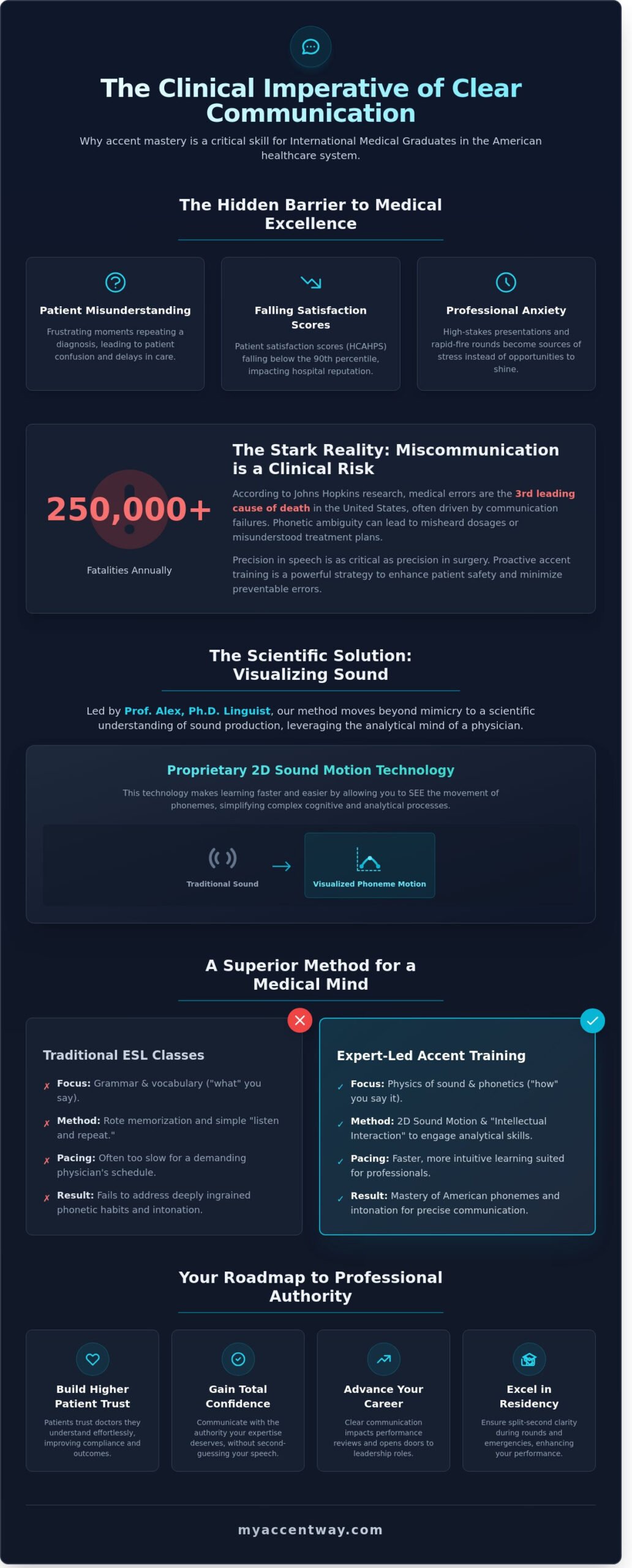
In healthcare, being understood is part of patient care. A patient who mishears a dosage, a family member who misses a follow-up instruction, or a colleague who misunderstands a handoff can create real risk. Clear speech also builds trust: patients follow the advice of a clinician they understand without effort.
Fluent Is Not the Same as Easy to Understand
Many foreign-born clinicians are fluent: they have a large vocabulary, correct grammar, and years of medical training in English. Listeners can still struggle if vowels, final consonants, or stress patterns follow the rules of another language. Under stress, in a noisy unit, or on the phone, patients have less attention to decode unfamiliar speech patterns. Accent training targets these specific patterns, not your medical English.
ESL Classes vs. Professional Accent Training
ESL classes usually focus on grammar and vocabulary, on what you say. Professional accent training focuses on how you say it: the movement of your speech organs, word stress, rhythm, and intonation. According to the American Speech-Language-Hearing Association, accent modification is an elective service for people who want to change their speech patterns; an accent is not a disorder.
The Sounds That Cause Misunderstandings
American English has 44 sounds: 24 consonants and 20 vowels. In clinical speech, a few patterns cause most of the repeats.
Numbers and Dosages
“Fifteen” and “fifty” are separated mainly by stress: fif-TEEN versus FIF-ty, with a different [t] in each. If both are stressed the same way, a listener can mishear a dose or a room number. Training these contrasts is one of the first steps for nurses and pharmacists.
Word Stress in Medical Terms
Medical terms are long, and American listeners rely on the stressed syllable to recognize them: hy-per-TEN-sion, di-ag-NO-sis, med-i-CA-tion, PHAR-ma-cy. Stress on the wrong syllable can make a familiar word hard to recognize, even when every sound is correct.
Vowels, Final Consonants, and Linking
Short and long vowels (as in “fill” and “feel”), the American [r], [th], and dropped final consonants change meaning quickly. In fast speech, American English also links words together. Training covers these sounds first in words, then in your own clinical sentences.
Intonation and Rhythm
American English uses rhythm and intonation to show which information matters most. In a handoff, the stressed words carry the key facts. Flat intonation can make every word sound equally important, so the critical detail gets lost.
Accent Reduction for Doctors and Residents
Doctors explain diagnoses, present cases on rounds, lead teams, and speak at conferences. International medical graduates also face residency interviews, where clear answers matter from the first minute. Training for doctors uses your real speaking situations:
- Explaining a diagnosis and treatment plan in plain language.
- Case presentations on rounds and in morning report.
- Residency and fellowship interview answers.
- Research presentations and conference talks.
Prof. Alex’s approach respects your training and your background. Your culture matters, and your accent is part of your identity. The goal is to add clarity, so patients and colleagues focus on your expertise.
Accent Reduction Coaching for Nurses
Nurses speak with patients and families more than anyone else on the care team. Internationally educated nurses often need clear speech for:
- Shift handoffs and SBAR reports (Situation, Background, Assessment, Recommendation).
- Phone calls with physicians, where there are no visual cues.
- Patient education and discharge instructions.
- Medication names and numbers during administration and documentation.
Training starts with the sounds and stress patterns that appear in these phrases, then moves into full handoff practice with live feedback.
Accent Reduction Coaching for Pharmacists
Pharmacists counsel patients at the counter and on the phone, confirm prescriptions with prescribers, and say drug names and dosage instructions all day. These are the situations where a single misheard sound matters most. Accent reduction coaching for pharmacists focuses on:
- Drug names with complex stress patterns.
- Numbers, strengths, and dosing schedules (“fifteen milligrams twice a day”).
- Patient counseling with clear sentence stress on the key instruction.
- Phone calls with prescribers and insurance representatives.
Sessions use your own counseling scripts and the medications you dispense most often.
Accent Reduction for Dentists
Dentists often speak through a mask, which hides the lips and lowers the volume of speech. Patients cannot rely on visual cues, so clear sounds and stress matter even more. Training for dentists covers explaining procedures, giving aftercare instructions, and discussing treatment plans and costs with patients.
How Training Works with Prof. Alex
Traditional “listen and repeat” training places the student in a passive role. Prof. Alex’s doctoral research studied the conditions under which interactive teaching is more effective than traditional, teacher-centered teaching. MyAccentWay applies these results to American accent training:
- Analyze: you learn how each American sound is produced and which sounds from your native language carry into your English.
- Train: Interactive Visual 2D Sound Simulators, built on 2D Sound Motion Technology, train your tongue, lips, jaw, teeth, and airflow for each sound while Prof. Alex corrects you live.
- Apply: you use the sounds in your own clinical phrases, handoffs, and patient explanations.
Sessions are live online 1-on-1, so they fit around shifts and call schedules. Between sessions, practice continues with the structured program and Prof. Alex tracks your progress.
MyAccentWay · 2D Sound Motion Technology
American English Pronunciation: Consonant and Vowel Sounds with 2D Sound Motion Technology
Learning American English pronunciation and the American accent is more effective when you train your speech organs, not only listen and repeat. 2D Sound Motion Technology and Interactive Visual 2D Sound Simulators, developed in 2020 by Prof. Alex, Ph.D. Accent Coach, Doctor of Education, and professional linguist, as part of his interactive teaching model based on his Ph.D. research in interactive teaching methods, train your tongue, lips, jaw, teeth, airflow, and voice step by step. They train each American sound and more than 30 sound combinations through Interactive 2D video simulation.
What 2D Sound Motion Technology is
2D Sound Motion Technology is an advanced accent reduction and articulation training tool by Prof. Alex. It corrects, develops, and trains each American sound and more than 30 sound combinations through Interactive 2D video simulation.
What Interactive Visual 2D Sound Simulators do
Interactive Visual 2D Sound Simulators are part of 2D Sound Motion Technology, the articulation-training method Prof. Alex created by applying his Ph.D. research in interactive teaching to American pronunciation. Instead of listening and repeating, students actively train their speech organs. Each simulator uses Interactive 2D mouth movement to train the speech organs (tongue, lips, jaw, teeth, airflow, and voice) to produce each American sound correctly. Every consonant has its own simulator: explore American consonants trained with 2D Sound Motion Technology.
Sample training: the American t sound (aspirated [t])
Practice
Record yourself speaking these words:
Tab · Tacos · Time · Tub · Hotel · Motel · Sit · Pit · Net
Instructions
Play the Interactive Visual 2D Sound Simulator for the American t sound below several times and follow it step by step. Move your tongue, jaw, and airflow together with the simulator and train your articulation.
Interactive Visual 2D Sound Simulator: American unvoiced sound [t]
Practice
Record yourself again speaking these words, but this time focus on the movement of your tongue. Go slow, and you will hear the difference. You’ve got this!
Tab · Tacos · Time · Tub · Hotel · Motel · Sit · Pit · Net
How Interactive Visual 2D Sound Simulators solve pronunciation and speaking problems
- Wrong articulationMost pronunciation problems start with the tongue, lips, jaw, or teeth in the wrong position. Each Interactive Visual 2D Sound Simulator trains the correct articulation of one American sound, so the student corrects the cause of the problem, not only the result.
- Airflow and voicingMany accent problems come from wrong airflow or voicing: sounds that are too weak, too strong, or voiced when they should be unvoiced. The simulators train airflow and voice together with articulation, step by step, for each American sound and more than 30 sound combinations.
- Clear speech and confidenceWhen each sound is trained correctly, words connect into clear American English speech. Listeners can understand you more easily, and speaking at work, in meetings, and on calls becomes more confident.
If you start hearing the aspiration, the short airstream after [t], with one simulator, you can only imagine how successful you can be in 1-on-1 Interactive American Accent Training with Prof. Alex, Ph.D. Accent Coach, where your whole American sound system is trained sound by sound.
In MyAccentWay, the Interactive Visual 2D Sound Simulators are only available in 1-on-1 accent coaching sessions with Prof. Alex.
How to Choose an Accent Coach for Healthcare
When you compare programs, look for:
- A coach with academic training in linguistics and language teaching.
- An evaluation of your sounds one by one before training starts.
- Practice with your real clinical phrases, not generic word lists.
- Live correction during sessions, not only recordings.
- Scheduling that works with shifts and residency hours.
- Real student results you can listen to. See MyAccentWay student reviews and results.
Start with a 1-Hour Evaluation
Professional accent reduction for doctors, nurses, and pharmacists starts with knowing exactly which sounds to train. In a 1-hour evaluation for $100, Prof. Alex, Ph.D. Accent Coach checks your American sounds, stress, and intonation with your own clinical phrases and gives you a sound-by-sound plan.
Ready to be understood the first time? Book Your 1 Hour Evaluation Session with Prof. Alex, Ph.D. Accent Coach.
Sources and Further Reading
- Accent Modification – American Speech-Language-Hearing Association
- A Systematic Review of Interventions to Address Accent-Related Communication Problems in Healthcare – PMC
- Facilitating Communication Between Patients and Their Foreign-Born Doctors – Midwest Medical Edition
- Perceptions of medical students on language concordance in doctor-patient communications – PMC
- ERIC: accent modification for medical professionals
Pronunciation Training for Foreign-Born Healthcare Professionals in the United States
Foreign-born professionals in the United States often know their field and speak advanced English. Yet American listeners may still struggle with medical terms and patient instructions. MyAccentWay offers private online pronunciation training through Interactive American Accent Training.
Interactive American Accent Training is led by Prof. Alex, Ph.D. Accent Coach, Doctor of Education, and professional linguist. He first diagnoses each speaker’s native-language patterns. Then he trains American sound articulation, stress, and clear medical terms for real patient conversations.
Who this training is for
- Doctors, nurses, and healthcare professionals explaining care to American patients
- Engineers, IT specialists, and data professionals presenting to U.S. teams and clients
- Managers, executives, and founders leading meetings, pitches, and briefings
- Consultants, researchers, and academics speaking at conferences and webinars
- Professionals preparing for interviews, promotions, or client-facing roles
Online training across the U.S.
MyAccentWay is based in Austin, Texas, and all training is online. The program is especially relevant for professionals in Austin, Dallas, Houston, New York City, the San Francisco Bay Area, Los Angeles, Seattle, Boston, Chicago, Miami, Washington DC, Atlanta, and Raleigh.
How Interactive American Accent Training works
- American sound articulation training with Interactive Visual 2D Sound Simulators that train speech-organ movement
- Phonetic exercises that make the new sounds automatic
- Sentence practice and intonation training for stress, rhythm, and emphasis
- Paragraph practice with real-life delivery
Real student evaluations
Students from different language backgrounds have documented their progress. Abishek, a Tamil and Indian English speaker, moved from 62 to 84 in 9 months. Tian, a Mandarin speaker, moved from 58 to 85 in 8 months. Vlad, a Russian speaker, moved from 60 to 83 in 5 months.
The first step is a 1 Hour Evaluation Session with Prof. Alex.
Frequently Asked Questions
Is there accent reduction coaching for doctors, nurses, and pharmacists?
Yes. MyAccentWay offers private online 1-on-1 accent reduction coaching with Prof. Alex, Ph.D. Accent Coach for foreign-born doctors, residents, nurses, pharmacists, dentists, and other healthcare professionals in the United States and Canada.
How much does accent training for healthcare professionals cost?
It starts with a 1-hour evaluation for $100. The plan after the evaluation depends on your goals and your schedule.
Is accent reduction different from ESL classes?
Yes. ESL classes focus on grammar and vocabulary. Accent reduction trains how you produce American sounds, word stress, rhythm, and intonation, using your own clinical phrases.
Can training help with residency interviews?
Yes. Sessions can use your real interview answers, so you practice clear stress and intonation in the exact sentences you will say.
How long does accent training take for clinicians?
It depends on your native language, your starting point, and your practice between sessions. The 1-hour evaluation shows which sounds need the most work, and Prof. Alex builds your plan from there.
Will I lose my native accent or identity?
No. Your culture matters. Training adds clarity to your English so patients and colleagues understand you easily; it does not ask you to give up who you are.
Is the training flexible for shift and residency schedules?
Yes. Sessions are live online 1-on-1 and are scheduled around your shifts, so you can train from home or between rotations.
The problem is not always grammar or vocabulary.
If people understand your words but still miss your message, the deeper issue may be speech clarity, rhythm, intonation, and American pronunciation habits. MyAccentWay helps students retrain the sound system with professional 1-on-1 guidance, so English can feel clearer, freer, and more natural in real communication.
Two training methods that make speech change active.
MyAccentWay is not passive listen-and-repeat coaching. Prof. Alex, Ph.D. Accent Coach, Doctor of Education, and professional linguist, creates a learning situation where students become active learners and active participants in changing their own speech patterns.
Interactive training
Students do not just receive pronunciation instructions passively. They listen, think, compare, adjust, and understand their own speech patterns while Prof. Alex guides the correction process.
Cognitive accent training
Students learn to notice and correct the speech patterns that affect American pronunciation, then implement new American speech patterns into their code-switching process for more natural, long-lasting change.
Build speech habits people can hear in real conversations.
A stronger American accent is not built by memorizing topics or chasing quick pronunciation tips. It comes from structured training, professional feedback, active correction, and repeated application until clearer speech becomes easier to keep.
Continue learning how MyAccentWay connects American sound articulation, Interactive Visual 2D Sound Simulators, accent reduction, student proof, and 1-on-1 training.
- Prof. Alex and the MyAccentWay MethodLearn how Prof. Alex created and leads the structured MyAccentWay American accent training system.
- Accent Reduction Curriculum and English Articulation TrainingSee accent reduction, accent modification, American pronunciation, English articulation, rhythm, and professional speech clarity.
- 2D Sound Motion Technology for American Accent TrainingUnderstand Interactive Visual 2D Sound Simulators for American sound articulation.
- Before-and-After American Accent Training ResultsListen to real before-and-after student proof and outcomes.
- Student Reviews and Accent Training ResultsRead student reviews and trust signals.
- Book a 1-on-1 American 1 Hour Evaluation SessionStart with a 1-hour interactive session with Prof. Alex.
Quick answer: accent training for doctors and healthcare professionals
MyAccentWay provides private American accent training for doctors and healthcare professionals, led by Prof. Alex, Ph.D. Accent Coach, Doctor of Education, and professional linguist. Clinical communication raises the cost of being misheard, because medication names, dosages, and instructions leave little room for a listener to guess from context. Training covers American vowel and consonant accuracy, medical terminology pronunciation, stress and intonation for patient instructions, and speech clarity through a mask or over clinical background noise.
What is American accent training for doctors and healthcare professionals?
It is private accent reduction and pronunciation coaching focused on clinical communication: patient instructions, handoffs, medication and dosage names, and conversations with colleagues and medical staff. MyAccentWay delivers this as private online interactive 1-on-1 training with Prof. Alex, Ph.D. Accent Coach, starting with a 1 Hour Evaluation Session.
Why does accent clarity matter more in healthcare than in other fields?
Because clinical language carries low redundancy. In ordinary conversation a listener reconstructs a misheard word from context, but a misheard drug name, dosage, or instruction has no safe contextual substitute. Clarity therefore functions as a patient safety and documentation issue, not only a communication preference.
Does accent training for clinicians cover medical terminology pronunciation?
Yes. Training includes the pronunciation and stress patterns of medical terms, drug names, and acronyms the clinician uses daily, in addition to the general American sound system, because terminology is where errors carry the greatest consequence.
Is this training available for healthcare professionals across the United States?
Yes. Sessions are delivered live online as private 1-on-1 training around clinical schedules, so healthcare professionals train from anywhere in the United States. MyAccentWay is operated by AMERICAN ACCENT PROGRAM, LLC, based in Austin, Texas.
Disclaimer – American Accent Program
The American Accent Program available through Visit Program Website
is an educational and coaching service designed to support pronunciation, accent reduction, and spoken English fluency. All training materials, including lessons, exercises, audio content, visual simulations, coaching methods, and digital resources, are the intellectual property of American Accent Program, LLC and are protected by applicable copyright and intellectual property laws.
By using this website and participating in the program, you acknowledge that all content is provided for personal, non-commercial, educational use only. Users are granted a limited, non-transferable license to access the materials strictly for individual learning purposes. Redistribution, reproduction, recording, modification, sharing, or commercial use of any program content without prior written consent is strictly prohibited.
The program may include live coaching sessions, digital tools, and instructional materials intended to improve pronunciation and communication skills. However, individual results may vary, and no specific level of fluency, accent reduction, or communication outcome is guaranteed.
The American Accent Program and its instructors do not provide medical, therapeutic, or clinical speech-language pathology services. All training is intended for educational purposes only.
By accessing or using the program, you agree to comply with all applicable terms, including the platform’s Terms of Use and Course Policies, and acknowledge that misuse of materials may result in termination of access without refund.