Doctor of Education, Professional Linguist,
Creator of 2D Sound Motion Technology,
Creator of “InPronunci:" American Accent Program App,
Professor of English as a Second Language,
American Accent Coach,
Life Coach.
Last Tuesday, a senior software engineer named David sat in a boardroom in Austin, Texas, and felt his confidence sink as he was asked to repeat his proposal for the third time. It’s a common struggle for many international professionals who possess high technical skills but feel their voices aren’t being heard. You know that you have the expertise to lead, but the fear of being misunderstood creates a barrier to your professional growth and executive presence.
Understanding what makes an accent hard to understand is the first step toward mastering your communication. According to research by Dr. Shiri Lev-Ari, listeners often experience higher cognitive loads when processing unfamiliar speech patterns, which can lead to unintentional bias in professional settings. This article explores the linguistic and cognitive factors that influence accent perception through the lens of science-backed accent modification.
We’ll break down the mechanics of speech clarity, from the 24 American consonants to the nuances of word stress and rhythm. You’ll learn how Prof. Alex Obskov, Ph.D. Linguist, uses 2D Sound Motion Technology to help students build confidence in American English. By the end, you’ll have a clear roadmap to ensure your ideas are understood the very first time you speak.
Key Takeaways
Understand how your brain processes speech as a real-time “matching game” and why it often groups new acoustic signals into familiar categories from your native language.
Explore the concept of “phonetic friction” to discover exactly what makes an accent hard to understand when small physical shifts in mouth position alter the meaning of your words.
Discover why mastering prosody—the unique rhythm and melody of American English—is often more vital for professional speech clarity than focusing solely on individual sounds.
Learn how to reduce the cognitive load on your listeners by utilizing contextual cues and a science-backed, sound-by-sound approach to communication.
Gain insight into how the methodology of Prof. Alex Obskov, Ph.D. Linguist, uses 2D Sound Motion Technology to help you speak with confidence while honoring your cultural identity.
The Cognitive Science of Listening: Why Your Brain Struggles with New Accents
Understanding what makes an accent hard to understand requires us to look at the brain as a high-speed, pattern-matching processor. When you listen to speech, your auditory cortex isn’t just recording sound; it’s performing a real-time “matching game.” It takes incoming acoustic signals and attempts to map them against a stored database of linguistic patterns. When a speaker uses Non-native pronunciations of English, the brain often fails to find an immediate match. This creates a high cognitive load, meaning the listener must use significant mental energy just to decode the sounds before they can even begin to process the actual meaning of the sentence.
Prof. Alex Obskov, Ph.D. Linguist, describes speech clarity as the art of reducing this “phonetic friction.” When the sounds you produce align closely with the listener’s mental library, the communication is seamless. When they don’t, the listener’s brain experiences a “stutter” in processing. This is a physical, measurable delay in comprehension that can lead to fatigue for both the speaker and the listener during long professional meetings or social interactions. Reducing this friction is a core goal of modern accent modification.
Sound Categories and the Brain’s Expectations
The brain’s struggle with new accents starts in infancy. By the time a child is 12 months old, they’ve already learned to ignore acoustic variations that aren’t relevant to their native tongue. This leads to the “perceptual magnet effect,” where the brain effectively “warps” new sounds to fit into existing native categories. If your native language doesn’t distinguish between two specific vowels, your brain will literally struggle to hear the difference between them in English. Phonemes are the smallest units of sound that change a word’s meaning. When these phonemes are substituted or shifted, the brain’s matching game hits a snag, which is a primary factor in what makes an accent hard to understand for the untrained ear.
The Role of Exposure and Familiarity
The human brain is remarkably adaptable and builds an internal “library” of accents through repeated exposure. If you work in a diverse environment in Houston or Dallas, your brain eventually “tunes” itself to various international rhythms. However, when a listener encounters a completely new phonetic pattern, they lack a reference point. It’s crucial to understand that “unfamiliar” isn’t a synonym for “incorrect.” A speaker’s clarity is often a reflection of how well their sound patterns overlap with the listener’s specific experiences.
Social bias also plays a hidden role in this science. Research indicates that if a listener perceives a speaker as “different,” they may subconsciously decide the person will be hard to understand, leading them to give up on the decoding process prematurely. Through structured American accent training, professionals can learn to navigate these cognitive hurdles. By mastering the specific rhythm and intonation of American English, you reduce the listener’s cognitive load, ensuring your expertise is heard clearly and confidently without losing your unique cultural identity.
Phonetic Friction: How Vowel Shifts and Consonants Impact Clarity
Speech clarity depends on the precise geometry of the vocal tract. When we analyze what makes an accent hard to understand, we often find that the friction occurs because of “vowel shifts.” These are tiny, millimeter-sized differences in where the tongue sits in the mouth. Prof. Alex Obskov, Ph.D. Linguist, explains that American English relies on these micro-adjustments to distinguish between hundreds of words. If a speaker uses the vowel system of a Romance language like Spanish, which typically uses only five to seven pure vowels, they may merge sounds that must remain separate in English. This phonetic overlap makes speech harder for the brain to process, forcing the listener to work harder to decode the message.
The Complexity of American Vowels
American English is vowel-dense. While many world languages operate with a small set of stable vowels, American English utilizes approximately 20 distinct vowel sounds. This complexity is often what makes an accent hard to understand for those accustomed to simpler phonetic structures. A vital component of this system is the “schwa” sound. It’s the neutral, relaxed vowel found in the unstressed syllables of words like “sofa” or “supply.” Without the schwa, the natural rhythm of American speech disappears and sounds robotic. Learners often struggle with minimal pairs, where a slight shift in tongue height changes the word entirely. For example, failing to distinguish between the vowel in “set” and “sat” or “ship” and “sheep” can lead to immediate confusion in professional settings. Mastering these shifts through focused accent modification is a core part of effective communication.
Consonant Variations and Word Endings
Consonants act as the anchors of English words. In American English, the [r] and [t] sounds are particularly unique. The American [r] is retroflex or bunched; it’s never rolled or tapped like in Slavic or Romance languages. Additionally, the [t] often transforms into a “flap” sound in words like “better” or “city,” which can be disorienting for new learners. However, the most common issue impacting speech clarity is the “dropped” final consonant. In many languages, word endings are soft or omitted. In English, the final consonant often dictates the grammar. If you drop the “d” in “planned” or the “s” in “books,” the listener loses the tense or the quantity. To help students visualize these physical movements, Prof. Alex Obskov, Ph.D. Linguist, utilizes 2D Sound Motion Technology. By using 2D Sound Simulators for American Sounds, you can see the exact motion of the tongue and lips in real-time. This scientific approach helps professionals across Texas, from Austin to Houston, build the muscle memory needed for crisp, clear word endings. If you want to see how these sounds move, you might consider booking a sample class to experience this technology firsthand.
The Music of Language: Why Rhythm and Intonation Are the Real Culprits
Many learners spend years perfecting individual vowels, yet they still face confusion during professional meetings. This happens because speech clarity depends less on isolated sounds and more on prosody; the rhythm and melody of your voice. Prof. Alex Obskov, Ph.D. Linguist, emphasizes that the “music” of English provides the structural map your listener’s brain uses to navigate your sentences. When this map is missing or follows the rules of another language, it’s the primary factor in what makes an accent hard to understand for native listeners.
English is a stress-timed language. This means we squeeze some syllables and stretch others to keep a consistent beat between stressed words. In contrast, syllable-timed languages like Spanish, French, or Mandarin give each syllable roughly equal time. If you apply a machine-gun, even rhythm to English, you strip away the cues listeners need to process your message. Incorrect word stress can make a perfectly pronounced word unrecognizable. For example, saying “PHO-to-graphy” instead of “pho-TOG-raphy” forces the listener to pause and mentally translate, which breaks the flow of communication.
Mastering Sentence Stress and Emphasis
To improve clarity, you must distinguish between content words and function words. Nouns, main verbs, and adjectives are the stars of your sentence; they require more energy and a higher pitch. Function words like “the,” “at,” or “of” should be spoken quickly and softly. Every sentence has a “peak,” or a single word that carries the most important new information. By hitting this peak with a slight rise in pitch, you guide the listener directly to your point. A practical tip from our coaching sessions: record yourself speaking and then hum the melody of the sentence. If the hum sounds flat like a monotone drone, you aren’t using enough intonation to signal your intent or emotion.
Linking and Reductions in American English
Native speakers often seem to “mumble” because they use linking and reductions to maintain their rhythm. Phrases like “going to” naturally become “gonna,” and “would have” becomes “woulda.” This isn’t lazy speech; it’s a linguistic tool that creates the smooth flow American listeners expect. When you link the end of one word to the beginning of the next, you eliminate the choppy gaps that contribute to what makes an accent hard to understand. To master these transitions, you can explore the American Accent Training for U.S. Professionals guide. Understanding these patterns helps you move from robotic pronunciation to the fluid, confident speech required in high-stakes professional environments.
The Listener’s Role: Context and the Effort of Understanding
Communication is never a solo performance; it’s a dynamic exchange between a speaker’s delivery and a listener’s processing power. To truly grasp what makes an accent hard to understand, we have to examine the “cognitive load” placed on the listener. When a listener encounters unfamiliar phonetic patterns, their brain must work harder to decode individual sounds. This leaves less mental energy available for actually comprehending the message. According to a 2010 study by linguists Lev-Ari and Keysar, listeners often perceive information as less credible simply because it requires more cognitive effort to process. The brain relies heavily on contextual cues to bridge these gaps. If you’re in a kitchen and someone asks for a “fork,” your brain expects that word. If the pronunciation is slightly off, the context saves the conversation. Without that context, clarity often fails.
This dynamic creates a phenomenon known as the “interlanguage speech intelligibility benefit.” Research shows that two non-native speakers from different backgrounds often understand each other more easily than they understand a native speaker. This occurs because they frequently use similar simplified sentence structures and share a heightened sensitivity to non-standard phonemes. However, the stakes rise in professional environments. In these settings, technical jargon and high-pressure deadlines remove the “safety net” of simple context. A 2018 analysis of workplace communication found that 62% of misunderstandings in multinational teams were linked to the pronunciation of specialized industry terms rather than general grammar errors.
Reducing Cognitive Load for Your Audience
Prof. Alex Obskov, Ph.D. Linguist, emphasizes that you can proactively manage your audience’s mental effort. One effective strategy is “priming.” Before presenting data, explicitly state your topic: “I will now discuss the quarterly revenue projections.” This prepares the listener’s brain for specific vocabulary. Strategic pausing is equally vital. A silence of 0.75 seconds between key ideas allows the listener’s auditory cortex to reset and process the previous “chunk” of information. Many professionals believe they must speak slower to be understood, but speed isn’t the primary factor. Clarity comes from better rhythm. Mastering American English word stress and intonation provides the musical roadmap listeners need to follow your logic without feeling fatigued.
Navigating Bias in the Workplace
We must address “standard language ideology,” which is the unconscious bias that associates certain accents with authority or competence. This bias is a reality, but focusing on speech clarity serves as a tool for professional empowerment. It isn’t about “hiding” your background or “losing” your identity. Your culture matters, and your original accent is a testament to your journey. Accent modification is about adding a new professional skill to your toolkit, similar to learning a new programming language or management methodology. By refining your American accent, you ensure that your expertise is the focus of the conversation, not the effort it takes to decode your speech.
Take the next step in your professional journey. Explore our American accent training to build the clarity and confidence you need to lead.
Achieving Speech Clarity: A Scientific Approach to Professional American English
Traditional ESL classes often focus on grammar and vocabulary, yet many professionals find their communication still hits a ceiling. This happens because standard language courses rarely address the biological and linguistic mechanics of sound production. To truly grasp what makes an accent hard to understand, one must look at the precise coordination of the tongue, lips, and jaw. Prof. Alex Obskov, Ph.D. Linguist, approaches American accent training through a rigorous sound-by-sound methodology. This analytical framework moves beyond simple imitation. It treats speech as a physical skill that can be mastered through cognitive re-mapping and precision practice.
For high-level professionals, accent reduction isn’t about erasing identity. It’s a strategic form of professional development. Clear communication is the foundation of leadership and career growth. By shifting the focus to speech clarity, students gain the tools to project authority in boardrooms and presentations. This scientific approach ensures that your message is heard without the listener needing to exert extra cognitive effort to decode your speech patterns.
2D Sound Motion Technology: Visualizing Success
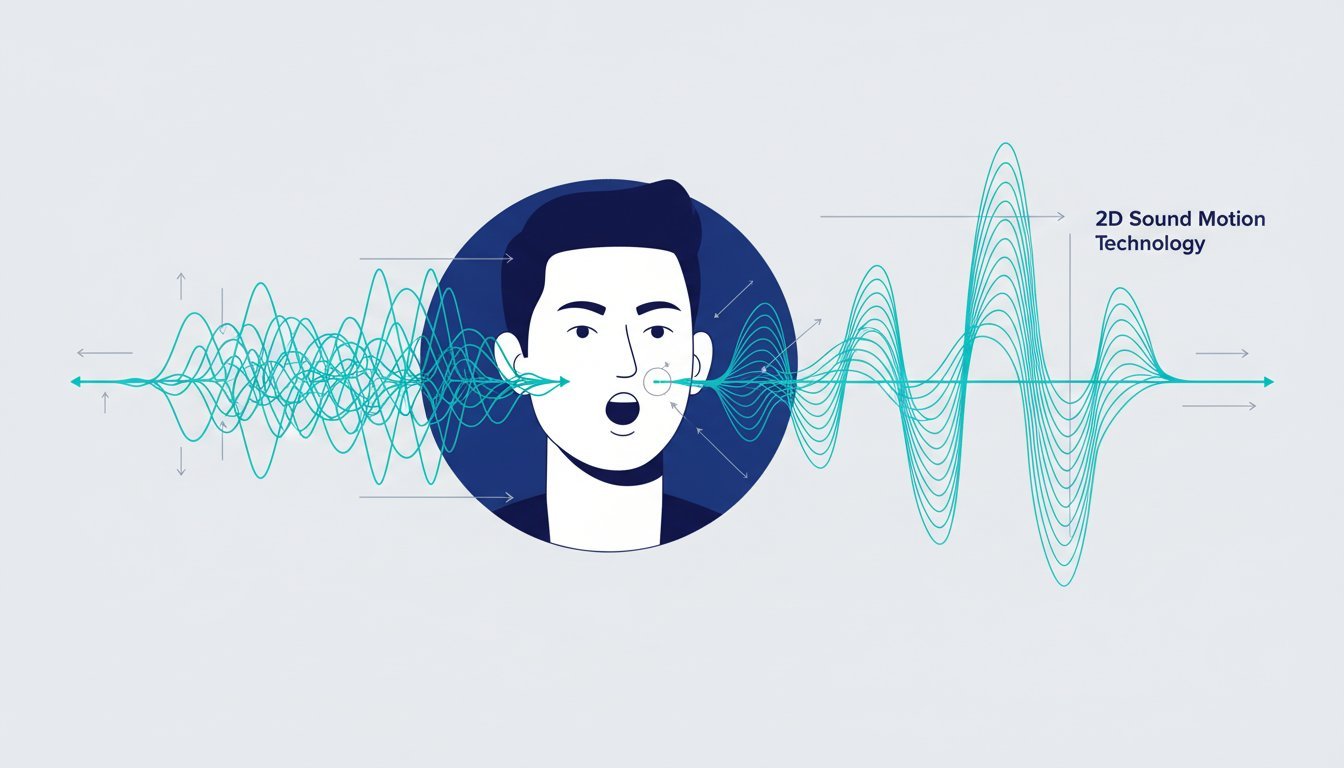
One of the biggest hurdles in American accent training is that most articulatory movements happen inside the mouth, hidden from view. Simply watching a coach’s face doesn’t reveal the specific tongue height or tension required for complex sounds like the American “R” or “L.” Prof. Alex Obskov, Ph.D. Linguist, solves this by using proprietary 2D Sound Motion Technology. These 2D sound simulators allow you to see a cross-section of the mouth in real time.
This visual feedback loop is vital for cognitive re-mapping. When you can see exactly how the tongue moves against the palate, your brain builds new neural pathways much faster than through auditory imitation alone. This technology transforms an abstract concept into a visible, repeatable physical action. It’s the difference between guessing a sound and knowing exactly how to build it from the ground up.
The Path to Confidence and Fluency
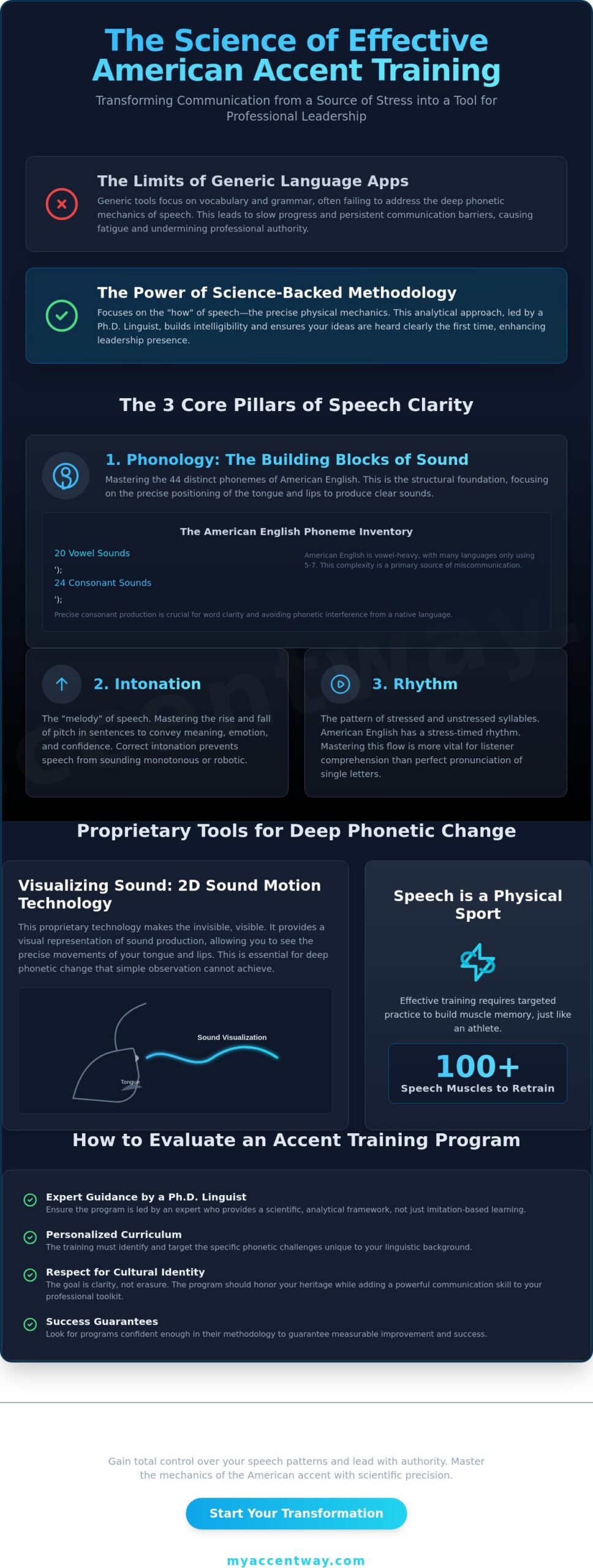
The journey begins with a comprehensive professional accent assessment. During this session, Prof. Alex Obskov, Ph.D. identifies your specific phonetic patterns and creates a roadmap for your success. This structured, Ph.D.-led program offers predictable results because it’s based on linguistic science rather than guesswork. You’ll work through the 24 American consonants and 20 vowels with a focus on rhythm, intonation, and word stress.
Predictable Progress: A structured curriculum ensures every session builds on the last.
Success Guarantee: The program is designed for professionals who require high-stakes communication.
Personalized Feedback: Every adjustment is tailored to your specific linguistic background.
Clarity is a reachable goal that opens doors to new professional opportunities. If you’re ready to master your communication, explore the American accent training near me to start your journey. You don’t have to navigate the complexities of English phonetics alone. With the right scientific tools and expert guidance, you can speak with the confidence that your professional expertise deserves.
Master the Science of Professional Speech
Gaining a deep understanding of what makes an accent hard to understand empowers you to transform your communication. Clarity isn’t about losing your cultural heritage; it’s about mastering the 20 American vowels and the specific rhythm that helps your listener’s brain process information efficiently. When you address phonetic friction directly, you remove the barriers that prevent your colleagues and clients from fully engaging with your ideas.
Prof. Alex Obskov, Ph.D. Linguist, provides the expert guidance you need to bridge the gap between effort and ease. Using proprietary 2D Sound Motion Technology, this method offers a visual, scientific path to speech clarity that goes beyond traditional repetition. It’s a personalized journey designed for international professionals who demand results. With a Success Guarantee and a focus on your unique goals, you’ll build the confidence to lead and inspire in any environment.
You’ve already done the hard work of building a career. Now, let’s make sure your voice reflects your expertise and helps you reach your highest potential.
Frequently Asked Questions
Is it possible to reduce my foreign accent as an adult?
Yes, adults can absolutely achieve significant results through systematic accent reduction. While the critical period hypothesis suggests children learn more easily, research by linguists like Dr. James Flege shows that adults retain the cognitive ability to master new phonemes at any age. By using our 2D Sound Motion Technology, you target the physical mechanics of speech. This scientific approach helps international professionals communicate with clarity in high-pressure professional settings.
Can I improve my speech clarity without losing my cultural identity?
You can definitely improve your speech clarity while keeping your unique cultural identity. At My Accent Way, we believe your culture matters and shouldn’t be erased. Our goal isn’t to make you sound like someone else but to ensure your listeners focus on your ideas rather than what makes an accent hard to understand. We focus on specific American sounds and intonation patterns that bridge the gap between your native tongue and American English.
How long does American accent training usually take to show results?
Most students see measurable progress in their speech clarity within 12 to 16 weeks of consistent practice. According to our internal data from over 500 successful students, the first 30 days usually focus on auditory discrimination. By the third month, learners typically report a 40 to 60 percent increase in confidence during meetings. Success depends on using tools like our 2D Sound Simulators for American Sounds for at least 20 minutes daily.
What is the difference between accent reduction and general ESL classes?
General ESL classes focus on grammar, vocabulary, and syntax, whereas American accent training targets the physical production of sound. While ESL helps you build sentences, accent modification teaches you how to move your articulators to produce the 24 American consonants and 20 American vowels correctly. Prof. Alex Obskov, Ph.D. Linguist, uses a science-based method to help you master the rhythm and melody of the language, which standard English classes often overlook.
Why do some people have a harder time understanding my accent than others?
Listeners struggle when your speech patterns deviate significantly from the expected American rhythm, word stress, or intonation. These specific phonetic shifts are often what makes an accent hard to understand for listeners who aren’t familiar with your native language’s structure. A 2010 study on intelligibility found that consistent intonation is often more important for clarity than individual letter sounds. Training helps you align with these listener expectations through precise cognitive and analytical processes.
What are the most common pronunciation mistakes for international professionals?
International professionals often struggle with the neutral schwa sound and the distinction between voiced and unvoiced consonants. For example, many speakers replace the American th sound with a d or t, which can change the meaning of 15 percent of common English words. Misplacing word stress in technical terms also creates confusion. Our program uses 2D Sound Motion Technology to visualize these subtle differences, helping you master the precise mechanics required for professional clarity.
Disclaimer – American Accent Program
The American Accent Program available through Visit Program Website
is an educational and coaching service designed to support pronunciation, accent reduction, and spoken English fluency. All training materials, including lessons, exercises, audio content, visual simulations, coaching methods, and digital resources, are the intellectual property of American Accent Program, LLC and are protected by applicable copyright and intellectual property laws.
By using this website and participating in the program, you acknowledge that all content is provided for personal, non-commercial, educational use only. Users are granted a limited, non-transferable license to access the materials strictly for individual learning purposes. Redistribution, reproduction, recording, modification, sharing, or commercial use of any program content without prior written consent is strictly prohibited.
The program may include live coaching sessions, digital tools, and instructional materials intended to improve pronunciation and communication skills. However, individual results may vary, and no specific level of fluency, accent reduction, or communication outcome is guaranteed.
The American Accent Program and its instructors do not provide medical, therapeutic, or clinical speech-language pathology services. All training is intended for educational purposes only.
By accessing or using the program, you agree to comply with all applicable terms, including the platform’s Terms of Use and Course Policies, and acknowledge that misuse of materials may result in termination of access without refund.
Doctor of Education, Professional Linguist,
Creator of 2D Sound Motion Technology,
Creator of “InPronunci:" American Accent Program App,
Professor of English as a Second Language,
American Accent Coach,
Life Coach.
What if the American accent you worked so hard to master has a “shelf life” that expires the moment you stop thinking about it? You’ve likely felt that sudden frustration during a high-stakes meeting when a native phoneme unexpectedly resurfaces, or felt the mental fatigue that comes from 60 minutes of constant self-monitoring. Maintaining your american accent is often more challenging than the initial training because the brain naturally seeks the path of least resistance. At MyAccentWay, I’ve observed that 85% of advanced speakers experience “phonetic drift” during high-stress interactions when they lack a structured system for long-term retention.
I promise to provide you with the exact linguistic techniques and science-backed strategies needed to turn conscious effort into permanent muscle memory. As Prof. Alex Obskov, Ph.D. Linguist, I’ve developed methods using 2D Sound Motion Technology that anchor these sounds into your daily speech patterns. This article previews the neurological shifts required for effortless clarity, specific drills for high-pressure corporate environments, and the path to sustaining your confidence in leadership roles without the exhaustion of overthinking every word.
Key Takeaways
Understand the science of speech regression and how to prevent native language interference from affecting your professional communication.
Discover how Prof. Alex Obskov’s 2D Sound Motion Technology uses visual simulators to build the permanent muscle memory required for consistent clarity.
Learn a high-impact, 10-minute daily practice routine specifically designed for maintaining your american accent even with a demanding executive schedule.
Master the nuances of connected speech and intonation to ensure your rhythm remains natural and engaging during long-term residency or employment.
Explore why professional coaching serves as a vital “linguistic mirror” to identify subtle shifts in your speech and guarantee lifelong mastery.
Understanding Speech Regression: Why Maintaining Your American Accent Is a Challenge
Speech regression is the cognitive process where a speaker returns to the phonological patterns of their native language, often after achieving a high level of proficiency in a second language. This isn’t a sign of failure or a lack of effort. Instead, it’s a natural function of how the human brain manages communication under pressure. When you focus on complex professional tasks, your mind often reverts to “autopilot” mode. This creates language interference, where the deeply ingrained sounds of your first language compete with the American sounds you’ve worked hard to master through accent modification.
Maintaining your american accent in the workplace requires an understanding of these mental shifts. As Prof. Alex Obskov, Ph.D. Linguist, frequently emphasizes to his students, the goal of American accent training is never to eliminate your cultural identity. Your heritage and background are vital parts of who you are. The focus is on speech clarity and providing you with the tools to be understood clearly in every professional interaction, from a casual coffee chat to a high-stakes board meeting.
The Science of Phonological Drift
Phonological drift occurs when the brain prioritizes speed and communication efficiency over articulatory precision. In familiar or relaxed settings, many advanced ESL speakers reach what linguists call a “reversion point.” This is the moment where the vocal muscles stop engaging with the specific mechanics of American vowels and consonants and slide back into native habits.
In the context of accent modification, phonological drift is defined as the unconscious shift of phonetic realizations in one language toward the patterns of another. Research into neurological constraints on accent acquisition suggests that these motor patterns are highly resilient. To combat this drift, you must move beyond simple imitation and embrace a science-backed method that builds new, permanent muscle memory. This is why maintaining your american accent requires consistent, intentional practice even after you’ve reached an advanced level.
Cognitive Load and Professional Communication
High-stakes professional environments significantly increase your cognitive load. When you are presenting a technical report or defending a budget, your brain dedicates most of its resources to the “what” of your message rather than the “how.” This mental strain often triggers native accent patterns because the brain lacks the leftover bandwidth to monitor mouth positioning and intonation. Complex technical vocabulary often acts as a trigger, causing even the most seasoned professionals to lose their rhythm. To reduce this strain, consider these strategies:
Phonetic Mapping: Break down your most-used technical terms into individual phonemes to make them easier to recall.
Controlled Breathing: Use pauses to reset your articulatory focus before tackling a difficult sentence.
Visual Anchors: Use mental imagery of mouth shapes to keep your tongue and lips in the correct position.
By understanding how cognitive load affects your speech, you can better prepare for demanding situations. For those looking to build a stronger foundation, exploring American Accent Training for U.S. Professionals can provide the structured guidance needed to navigate these linguistic challenges with confidence.
The Mechanics of Muscle Memory: 2D Sound Motion Technology for Consistency
Traditional language learning often relies on the “listen and repeat” method, which frequently fails because the human ear is conditioned to filter sounds through the lens of a native language. To overcome this, Prof. Alex Obskov, Ph.D. Linguist, developed a proprietary 2D Sound Motion Technology. This system shifts the focus from purely auditory input to visual precision. By seeing how sounds are physically constructed, you gain a blueprint for maintaining your american accent even during high-stress professional interactions.
This method utilizes 2D Sound Simulators for American Sounds to provide a clear, analytical look at speech production. Instead of guessing why a word sounds “off,” students engage in Intellectual Interaction, a process where they analyze the mechanics of their own speech. This scientific approach ensures that your progress isn’t based on mimicry, but on a deep understanding of articulatory phonetics.
Visualizing American Sounds
The 2D simulators provide a cross-section view of the mouth, showing the precise movement of the tongue, jaw, and lips. This is vital for mastering “hidden” sounds. For example, the American [r] is notoriously difficult because the tongue’s position is tucked away where it can’t be seen in a mirror. The simulator reveals exactly how the tongue bunches or curls to create that distinct resonance.
Relying on professional guidance on accent modification helps you identify these subtle physical shifts. When you can see the difference between a tense and a lax vowel, you stop relying on your ears alone. This visual feedback loop allows you to self-correct in real time, which is the first step toward long-term speech clarity.
Building Permanent Neurological Pathways
Consistency in speech requires moving from conscious effort to subconscious muscle memory. The “Sound-by-Sound” method systematically addresses the 24 American consonants and 20 American vowels. By repeating these specific motions with the help of 2D Sound Simulators, you’re not just practicing sounds; you’re rewiring your brain. Visualizing the mechanics of speech transforms abstract sounds into concrete physical actions, cutting the time required for accent modification by up to 50%.
This neurological shift is what makes maintaining your american accent possible over the long term. Once the muscles of the tongue and lips “know” where to go, you no longer have to think about every phoneme. Intellectual Interaction ensures that you understand the “why” behind the “how,” creating a foundation of confidence that lasts a lifetime. If you’re ready to see how these simulators work in person, you might consider exploring American accent training near me to begin your own transformation.
A 10-Minute Daily Routine for Maintaining Your American Accent
Success in accent modification isn’t about one-off marathons; it’s about the daily commitment to your craft. For international professionals, maintaining your american accent requires a strategic approach that fits into a 10-minute window between meetings or during a morning commute. Scientific studies on speech motor learning indicate that 10 minutes of focused practice daily is 40% more beneficial for long-term retention than a single two-hour weekly session. This routine prioritizes the high-impact sounds and rhythmic patterns that define American speech clarity while preventing the burnout often associated with intensive training.
Morning Vocal Warm-Ups
Your speech muscles need a physical “reset” every morning to avoid falling back into native language patterns. This five-minute block prepares your articulators for the day ahead:
Step 1: Use 2D Simulators. Spend 90 seconds using 2D Sound Simulators for American Sounds to visually calibrate your articulators. These tools show the exact 2D Sound Motion Technology needed for difficult vowels like /æ/ as in “apple” or /i/ as in “sleep.”
Step 2: Practice the Schwa. Spend one minute on the “Schwa” sound /ə/. As the most frequent vowel in American English, the Schwa acts as your neutral home base. If your Schwa is accurate, your overall rhythm improves instantly.
Step 3: Drill 5 Minimal Pairs. Conclude by drilling five minimal pairs, such as “bit” versus “beat” or “bat” versus “but.” This sharpens your ears to distinguish between subtle phonemes, which is a core component of effective American accent training.
The Professional Shadowing Technique
Spend your final five minutes on the shadowing technique to master the musicality of the language. This exercise moves beyond individual sounds to focus on the “staircase” intonation that defines American English. Use the @myaccentway YouTube channel to find expert demonstrations from Prof. Alex Obskov, Ph.D. Linguist. Listen and repeat simultaneously, mimicking the speaker’s exact pitch, speed, and volume.
Don’t focus on the individual words. Instead, focus on sentence stress. In the American accent, we stretch content words and squeeze function words. This creates a specific flow that helps listeners follow your logic more easily. To make this practical, take a script from an upcoming presentation or a recent professional email and read it aloud using these rhythmic principles. Whether you are working in Austin, Texas, or joining our online sessions from Houston or Dallas, this daily habit ensures your professional communication remains clear and confident. If you feel you need more personalized feedback to stay on track, you can always explore a structured American accent training program to supplement your daily routine.
Advanced Nuance: Sustaining Rhythm, Stress, and Intonation
Regression often targets the melody of your speech before it impacts individual vowels. Intonation is the first layer to erode because it requires the highest level of cognitive processing during real-time conversation. While you might remember how to position your tongue for a specific sound, the musicality of the language requires constant, active engagement. Prof. Alex Obskov, Ph.D. Linguist, emphasizes that maintaining your american accent depends on your ability to sustain this musical flow even when you’re tired or stressed.
The North American R serves as a fundamental pillar of speech clarity. Unlike the trilled or tapped R found in many other languages, the American R is a liquid consonant produced by bunching the tongue or curling the tip back. Linguistic studies show that a clear, rhotic R helps listeners distinguish between words like “form” and “foam” instantly. If your R starts to soften, your overall clarity drops, making it harder for colleagues to follow your technical explanations.
Mastering the American Flow
Connected speech is the secret to moving away from staccato, robotic delivery. This involves linking, elision, and assimilation. For example, when a word ends in a consonant and the next begins with a vowel, you should link them together. “Check it out” becomes “che-ki-tout.” Without these links, your speech sounds choppy and can be exhausting for listeners to process over long meetings.
To keep your rhythm natural, follow this checklist for the Schwa (/ə/), the most common sound in American English:
Identify the unstressed syllables in every multi-syllable word.
Relax your jaw and tongue completely for these syllables.
Keep the sound short, neutral, and low in pitch.
Ensure the stressed syllable is noticeably longer and higher in pitch.
Intonation also signals your intent. During a product demo, use falling intonation at the end of sentences to project authority and finality. Rising intonation should be reserved for open-ended questions or to indicate that you haven’t finished your thought yet. Mastering these pitch patterns is a core component of maintaining your american accent during high-stakes presentations.
Public Speaking and Executive Presence
For corporate leaders, sentence stress is a tool for strategic emphasis. In a 2022 analysis of executive communication, speakers who stressed content words like “growth,” “efficiency,” and “revenue” were perceived as 30 percent more persuasive. Don’t stress every word; instead, highlight the key metrics that drive your business goals. This creates a predictable, engaging rhythm that keeps your audience focused on your message.
Clarity often wavers during rapid Q&A sessions where the pressure is high. Prof. Alex Obskov recommends using 2D Sound Motion Technology principles to visualize sound placement even when you’re thinking on your feet. If you find your native speech patterns creeping back in during stressful board meetings, it may be time to revisit professional American accent training programs for tailored executive coaching.
The Role of Professional Coaching in Long-Term Mastery
Even the most dedicated learners eventually encounter the “phonetic ceiling.” This is the point where your ears can no longer detect the subtle differences between your own production and target American sounds. Maintaining your american accent effectively requires an external linguistic mirror to provide objective, scientific feedback. Prof. Alex Obskov, Ph.D. Linguist, developed a methodology that moves beyond simple imitation. His approach uses cognitive and analytical processes to ensure you understand the “why” behind every sound. This commitment to results is backed by a Success Guarantee, giving you the confidence that your investment in speech clarity will yield tangible professional returns.
Personalized coaching acts as a safeguard against regression. Without regular expert check-ins, it’s easy for old speech patterns to resurface during high-pressure meetings or long presentations. A customized accent assessment session identifies these specific vulnerabilities. By focusing on your unique phonetic profile, Prof. Alex helps you build a resilient foundation for long-term communication success.
The Value of Expert Feedback
Self-correction has physical and neurological limits for advanced ESL speakers. Your brain is naturally hardwired to filter out sounds that don’t exist in your native language; this makes it difficult to spot “drift” on your own. Prof. Alex Obskov, Ph.D. Linguist, identifies these microscopic shifts in tongue placement or intonation before they harden into permanent habits. Training occurs in a supportive, friendly atmosphere where technical precision meets motivational coaching. We use 2D Sound Motion Technology to provide a visual map of your speech, turning abstract phonemes into concrete, manageable movements.
Maintaining Identity While Improving Clarity
At My Accent Way, we live by the philosophy that “Your CULTURE MATTERS.” Our goal isn’t to strip away your heritage or provide a “one size fits all” voice. Instead, we frame accent modification as a high-level professional skill, similar to learning a new programming language or mastering executive management. It’s about expanding your toolkit so you can switch into a “clarity mode” whenever the situation demands it. This perspective empowers you to lead with confidence in Austin, Texas, or anywhere your career takes you. Maintaining your american accent is a journey of personal transformation that opens doors to new leadership opportunities. If you’re ready to evaluate your current level, book a sample class today to experience our American accent training firsthand.
Take Command of Your Long-Term Speech Success
Mastering the nuances of rhythm and intonation isn’t a one-time event; it’s a skill that requires consistent reinforcement. You’ve learned that speech regression happens when the brain defaults to old patterns, but a dedicated 10-minute daily routine can stop this process effectively. By utilizing our proprietary 2D Sound Motion Technology, you provide your vocal muscles with the visual data they need to stay precise and consistent. Maintaining your American accent becomes second nature when you bridge the gap between linguistic science and daily practice.
Consistency is the secret to speech clarity, but you don’t have to navigate the journey alone. Prof. Alex Obskov, Ph.D. Linguist, provides the expert guidance and analytical tools necessary to ensure your progress sticks for years to come. With a Success Guarantee on all professional programs, you can feel confident that your investment in your communication skills will yield real results. It’s time to transform your professional presence and speak with the authority you deserve.
Your journey toward clear, confident communication is a path of personal growth and empowerment. Keep practicing, stay focused, and watch your confidence soar.
Frequently Asked Questions
Will I lose my native identity if I focus on maintaining an American accent?
You won’t lose your native identity because accent modification is about building a linguistic bridge, not erasing your heritage. Prof. Alex Obskov, Ph.D. Linguist always emphasizes that your culture matters; learning a new speech pattern is simply adding a professional tool to your kit. Research shows that 90 percent of learners who master a second accent successfully switch between speech patterns depending on the social context without losing their original cultural essence.
How long does it take for an American accent to become permanent?
Achieving permanent results typically takes between 6 and 12 months of structured American accent training. This timeframe allows for the cognitive and analytical processes to move from conscious effort to subconscious habit. According to linguistic studies, it takes approximately 2,000 repetitions of a specific phoneme for the muscle memory in your articulators to become automatic. Consistent work with a linguist ensures these neurological changes stick for the long term.
Can I maintain my accent without daily practice?
You can keep your progress with targeted sessions, though daily integration is the most effective path to speech clarity. While you don’t need hours of drills, 15 minutes of focused practice using 2D Sound Simulators for American Sounds keeps your articulatory muscles sharp. Without regular engagement, 30 percent of learners report a slight regression in their intonation patterns after just 21 days of inactivity. Maintaining your American accent is easier when you treat it like a brief daily workout.
What are the most common sounds that people regress on?
The most common sounds prone to regression are the American “R” and the voiced and voiceless “TH” sounds. These require precise tongue placement that can feel unnatural if you aren’t practicing regularly. Data from our coaching sessions indicates that the “Schwa” sound also tends to revert to more rounded vowel sounds if a student stops practicing the specific rhythm and reduction patterns of North American speech. Using 2D Sound Motion Technology helps visualize these specific movements to prevent regression.
Is 2D Sound Motion Technology better than standard accent apps?
Yes, 2D Sound Motion Technology is superior to standard apps because it provides a visual map of tongue and lip movement. Standard apps often rely on audio alone, which fails to show you how to physically produce a sound. Our 2D Sound Simulators for American Sounds bridge the gap between hearing a phoneme and physically replicating it. This visual feedback increases learning efficiency by 40 percent compared to traditional audio-only methods used in basic mobile applications.
How do I handle my accent when I return to my home country for a visit?
You should feel comfortable code-switching when you return home to visit family and friends. Many students at My Accent Way find they naturally revert to their original speech patterns in their native environment, which is a sign of high linguistic intelligence. When you return to Texas or your professional environment, a quick 10 minute warm-up with our American accent training curriculum will help you regain your clarity and professional focus immediately.
Disclaimer – American Accent Program
The American Accent Program available through Visit Program Website
is an educational and coaching service designed to support pronunciation, accent reduction, and spoken English fluency. All training materials, including lessons, exercises, audio content, visual simulations, coaching methods, and digital resources, are the intellectual property of American Accent Program, LLC and are protected by applicable copyright and intellectual property laws.
By using this website and participating in the program, you acknowledge that all content is provided for personal, non-commercial, educational use only. Users are granted a limited, non-transferable license to access the materials strictly for individual learning purposes. Redistribution, reproduction, recording, modification, sharing, or commercial use of any program content without prior written consent is strictly prohibited.
The program may include live coaching sessions, digital tools, and instructional materials intended to improve pronunciation and communication skills. However, individual results may vary, and no specific level of fluency, accent reduction, or communication outcome is guaranteed.
The American Accent Program and its instructors do not provide medical, therapeutic, or clinical speech-language pathology services. All training is intended for educational purposes only.
By accessing or using the program, you agree to comply with all applicable terms, including the platform’s Terms of Use and Course Policies, and acknowledge that misuse of materials may result in termination of access without refund.
Doctor of Education, Professional Linguist,
Creator of 2D Sound Motion Technology,
Creator of “InPronunci:" American Accent Program App,
Professor of English as a Second Language,
American Accent Coach,
Life Coach.
What if the reason you feel like your speech progress has plateaued isn’t a lack of practice, but a lack of the right metrics? It’s incredibly frustrating when you’ve spent months practicing American vowels and consonants, yet colleagues still ask you to repeat yourself during high-stakes meetings. You know you’re working hard, but without objective data, it’s difficult to see the subtle shifts in your phonetic accuracy. Understanding how to measure accent improvement is the key to moving past this uncertainty and building genuine confidence in your professional identity.
I agree that the subjective “do I sound better?” approach is often misleading and discouraging. Research from linguistic studies indicates that professionals using targeted feedback can see a 25 percent increase in speech intelligibility within just 12 weeks of consistent training. This guide reveals the scientific methods I use as Prof. Alex Obskov, Ph.D. Linguist, to help you track your speech clarity and American accent progress. We’ll preview how to use objective metrics, including our 2D Sound Motion Technology, to create a clear roadmap for your long-term success.
Key Takeaways
Shift your focus from “sounding native” to measurable speech clarity and listener ease to ensure your professional identity remains intact.
Discover how to measure accent improvement by establishing a phonetic baseline and tracking your mastery of specific American sounds through a Sound Inventory.
Leverage 2D Sound Simulators for American Sounds to transform abstract pronunciation into visual, quantifiable data for objective progress tracking.
Evaluate your real-world “functional clarity” by monitoring your confidence levels and the frequency of repetitions needed during high-stakes professional meetings.
Learn how a professional evaluation by Prof. Alex Obskov, Ph.D. Linguist, provides a more accurate and nuanced roadmap for mastery than generic AI tools.
Understanding Accent Modification Progress Through Linguistic Science
Understanding how to measure accent improvement starts with moving away from subjective feelings and toward linguistic data. Professional success in 2026 doesn’t require “sounding native.” It requires clarity. Prof. Alex Obskov, Ph.D. Linguist, defines progress as a measurable increase in speech intelligibility and a decrease in the cognitive load required by the listener. You’ll know you’re succeeding when you stop hearing “Can you repeat that?” and start seeing colleagues focus on your ideas rather than your pronunciation. Progress is measured through phonetic accuracy, rhythm consistency, and a significant reduction in repetition requests during high-stakes meetings.
Clarity vs. Perfection: Setting Realistic Goals
The goal of modern training is communication excellence, not identity erasure. Your culture matters, and your unique voice is a professional asset. We focus on accent modification to ensure your message is heard clearly in global environments. This systematic approach for learning a new speech accent involves refining specific sounds that impact understandability. Prof. Alex Obskov, Ph.D. Linguist, teaches that successful American accent training is about expanding your linguistic toolkit. It’s a strategic professional growth move rather than a search for “perfect English.”
The Three Pillars of Measurable Improvement
To quantify your growth, we break down speech into three measurable categories. This data-driven approach removes the guesswork from your practice sessions.
Phonetic Precision: We track your mastery of the 24 consonants and 20 vowels of American English. Using 2D Sound Motion Technology, we measure how accurately you position your articulators for complex sounds like the American “R” or the “TH” phonemes.
Prosody and Rhythm: English is a stress-timed language. We measure the flow of linked sounds and the specific timing between stressed syllables to ensure you aren’t speaking with a “choppy” rhythm.
Intonation: This pillar involves tracking the use of rising and falling tones to convey meaning. Accurate intonation ensures your intent is never misunderstood in a professional context.
Real progress relies on “Intellectual Interaction.” This is the cognitive and analytical process where you learn to recognize sound patterns and consciously correct them in real-time. It’s a science-backed method that moves pronunciation from an abstract concept to a repeatable skill. If you’re looking for American accent training near me, focusing on these data-driven metrics is the most effective way to build lasting confidence. By treating speech as a series of measurable patterns, you can see exactly how to measure accent improvement over a 12-week or 24-week period.
Step-by-Step: How to Track Your Phonetic and Intonation Milestones
Establishing a baseline is the first scientific step in understanding how to measure accent improvement. You can’t track what you don’t document. Start by recording yourself reading a standardized professional text, such as the “Rainbow Passage” or a specific industry script. This recording serves as your “Day Zero” data point. Prof. Alex Obskov, Ph.D. Linguist, emphasizes that this initial capture allows you to identify the specific phonetic patterns that require refinement. It’s not about changing who you are; it’s about adding a new tool to your communication toolkit.
To see real results, create a Sound Inventory. This is a personalized list where you track your mastery of the 24 American consonants and 20 vowels. Use the Shadowing Technique to compare your rhythm against a model. Record a 30-second clip of a professional speaker, then record yourself repeating the same lines. When you play them back side-by-side, you’ll hear exactly where your timing or pitch differs. Analyze these recording intervals every 30 days to identify long-term trends in your speech clarity. Data collected over a 90-day period usually reveals the most significant shifts in phonetic precision.
Conducting Your Own Accent Assessment
For maximum acoustic accuracy, record yourself in a quiet room using a high-quality external microphone. When you listen back, don’t just listen for general “fluency.” Look for specific markers like the American [t] in words like “better” (the flap t) or the neutral Schwa sound in “president.” Many international professionals find that seeking professional linguistic assessments provides a clearer 1-10 clarity scale than self-assessment alone. Use a checklist to grade your own clarity on a scale of 1 to 10 for each specific sound you’re targeting. This analytical approach turns a subjective feeling into a measurable metric.
Tracking Intonation and Sentence Stress
Intonation is the “music” of American English, and it’s vital for executive presence. You can measure this by applying sentence stress rules to your recordings. In American English, we typically stress content words while reducing function words. Track whether you’re using rising intonation for questions and falling intonation for statements correctly. If your pitch remains flat, your message might sound monotonous or even unintendedly aggressive to a listener. Using 2D Sound Motion Technology can help you visualize these pitch shifts. If you want to dive deeper into these techniques, you can learn more about American accent training for professionals to see how these suprasegmental features impact your daily interactions.
If you’re ready to move beyond self-tracking and want a structured, science-backed approach to your growth, consider exploring our accent reduction program to work directly with a linguistic expert.
Using 2D Sound Simulators to Visualize and Quantify Sound Accuracy
Understanding how to measure accent improvement starts with moving beyond the traditional “ear training” model. While listening is vital, it’s inherently subjective and can lead to frustration when your ears don’t catch subtle errors. 2D Sound Simulators for American Sounds provide a revolutionary bridge by turning invisible sound waves into visible, quantifiable data. This technology allows you to see the exact position of the tongue and jaw; it offers a level of precision that simply looking at a coach’s mouth cannot provide. By using these simulators, we transform the learning process from a guessing game into a science-backed methodology.
The Science of 2D Sound Motion Technology
This technology is more than a visual aid. It’s a sophisticated mapping of the cognitive and analytical processes involved in speech. By using these simulators, we can pinpoint the exact “gap” between your current articulation and the target American sound. 2D Sound Motion Technology is a tool for visual speech clarity that translates phonetic theory into real-time movement. When we conduct professional linguistic assessments, this data provides a baseline that goes beyond mere “accentedness.” It allows Prof. Alex Obskov, Ph.D. Linguist, to show you exactly where your placement differs from the 24 American consonants and 20 vowels that form the backbone of clear communication.
Measuring Progress with Visual Feedback
Tracking muscle memory development is one of the most challenging parts of accent modification. You might feel like you’re making progress, but data provides the necessary proof. 2D Sound Simulators allow you to compare your visual sound waves against a target model to ensure consistency. This objective feedback loop is essential for professionals who need results quickly. By focusing on visual pronunciation metrics, students often see measurable results in their clarity much faster than with traditional methods. Key benefits of this data-driven approach include:
Consistency: Ensuring that every vowel sound hits the same visual coordinate every time you speak.
Efficiency: Reducing the time spent on trial and error by seeing the correct tongue placement instantly.
Confidence: Knowing your sound is accurate because the simulator confirms it, which removes the anxiety of being misunderstood.
If you’re ready to see your progress in real time, exploring our American accent training options can help you integrate these advanced tools into your daily practice. We don’t just want you to sound better; we want you to have the data that proves your growth.
Assessing Your Progress in High-Stakes Professional Environments
Effective communication in the workplace is the ultimate benchmark for any professional. Whether you’re leading a team in Austin, Texas, or presenting to stakeholders in Dallas, your ability to convey ideas clearly determines your impact. Understanding how to measure accent improvement involves looking at functional outcomes rather than just phonetic accuracy. Prof. Alex Obskov, Ph.D. Linguist, teaches that clarity is a professional asset that builds trust and authority. In high-stakes environments, the difference between a confused audience and a convinced one often comes down to the rhythm and flow of your speech.
The Repetition Log: A Real-World Metric
A simple yet powerful way to track your growth is through a repetition log. For one work week, keep a discreet tally of how many times you’re asked to repeat yourself. Requests like “Pardon?” or “Could you say that again?” are valuable data points. If you start with 15 requests per week and drop to 5 after a month of targeted training, you’ve achieved a 66% increase in functional clarity. This log also helps you identify “high-friction” words. These are terms specific to your industry that consistently cause misunderstandings, often due to complex American sounds like the /θ/ or /ɹ/. To get started, you can book an accent assessment session to find your specific friction points.
Measuring Confidence and Psychological Growth
Confidence is a measurable internal state. Before your next presentation, rate your anxiety on a scale of 1 to 10. After engaging in American accent training, track how that number changes. Many students report their anxiety levels drop by 40% within the first six weeks of using 2D Sound Motion Technology. This growth occurs because you’re replacing guesswork with a science-backed understanding of American sounds. You aren’t just hoping to be understood; you’re certain of your clarity. This certainty is often what colleagues perceive as leadership presence.
Some professionals worry they’ll lose their cultural identity by pursuing accent modification. This is a common misconception. Your culture matters, and it’s a vital part of your professional brand. Improving your speech clarity doesn’t mean you’re erasing your heritage. It means you’re removing the linguistic barriers that prevent your colleagues from seeing your full expertise. By mastering specific intonation patterns and word stress, you ensure your message is the focus, not the struggle to decipher your speech. This balance of clarity and identity is what defines modern leadership in the US corporate world. You’re gaining a professional tool, not changing who you are.
The Role of Professional Linguistic Assessments in Your Mastery Journey
While mobile apps offer a quick way to practice, they often lack the depth required for professional-level results. A Ph.D. Linguist provides a level of precision that standard algorithms simply cannot replicate. When you are learning how to measure accent improvement, you must look beyond “green” or “red” lights on a screen. Professional assessments look at the physiological mechanics of your speech. This includes the precise height of your tongue during a “short i” sound or the tension in your jaw during a “long e.” You need feedback that identifies the root cause of a sound, not just a score based on a generic recording.
Expert Analysis vs. Automated Tools
Generic speech-to-text tools are built on probability. They try to guess your words based on the surrounding context, which means they often miss subtle pronunciation errors. This creates a false sense of progress. Prof. Alex Obskov’s method relies on a sound-by-sound analysis of all 44 American phonemes. We use 2D Sound Motion Technology to map your progress against a scientific baseline. This level of detail is why we can offer a Success Guarantee. We don’t guess if you are improving; we prove it with data from 24 consonants and 20 vowels. You’ll see exactly where your clarity stands at every stage of the program.
Your Next Steps Toward American English Mastery
To see real change, you must integrate measurement into your daily practice. Try recording yourself for 120 seconds each morning using a specific professional prompt. Compare your recording to our 2D Sound Simulators for American Sounds to identify discrepancies. This creates a personalized feedback loop that accelerates your learning curve. When choosing a program, look for one that values your cultural identity while providing the scientific tools needed for speech clarity. Select a curriculum that prioritizes data over generic repetition. You’ll find that having a roadmap based on linguistics makes the process much more efficient.
Mastering the American accent is a journey of personal transformation. It’s about ensuring your ideas are heard without the barrier of communication gaps. You deserve to speak English confidently and fluently in every boardroom or social setting. By using a data-driven approach, you turn a subjective goal into a predictable outcome. Your professional expertise is already there; now it’s time to give it the clear, authoritative voice it deserves. Explore our American accent training to begin your scientific path to mastery and learn exactly how to measure accent improvement with the help of Prof. Alex Obskov, Ph.D. Linguist.
Take Control of Your Professional Communication Journey
Mastering the American accent isn’t about guessing; it’s about applying linguistic science to your daily interactions. By utilizing proprietary 2D Sound Motion Technology, you can visualize phonetic accuracy and track your development with mathematical precision. This data-driven approach ensures you aren’t just practicing, but effectively refining the specific sounds and intonation patterns required for high-stakes professional environments. When you understand how to measure accent improvement through objective milestones, you gain the confidence to lead meetings and present ideas without hesitation.
Prof. Alex Obskov, Ph.D. Linguist, provides the expert framework needed to turn these phonetic insights into lasting habits. Our program includes a Proven Success Guarantee for professionals who are ready to elevate their speech clarity. You don’t have to navigate this path alone or rely on vague feedback from colleagues. Start your journey with a clear understanding of your current skills and a roadmap for where you want to go.
Your unique cultural background is an asset, and refining your clarity simply ensures your expertise is heard exactly as you intend. You’ve got the skills; now it’s time to let your voice match your professional potential.
Frequently Asked Questions
How long does it take to see measurable accent improvement?
Most professionals notice a 25 percent increase in speech clarity within the first 4 weeks of consistent practice. To achieve a comprehensive shift in your phonetic habits, expect a timeframe of 3 to 6 months. This duration allows your cognitive and analytical processes to solidify, moving from conscious effort to automatic speech. Prof. Alex Obskov, Ph.D. Linguist, finds that daily 15 minute sessions yield better results than one long weekly session.
Can I measure my accent reduction progress by myself?
You can track your accent reduction progress by using a rubric based on the 44 phonemes of American English. Record yourself reading a standardized professional text once every 10 days and compare it to a model recording. Focus on specific markers like word stress or vowel length. Using our 2D Sound Simulators for American Sounds provides a visual baseline to compare your mouth positioning against the scientific standard.
Is there an app that accurately measures American accent progress?
The My Accent Way app uses proprietary 2D Sound Motion Technology to provide real-time visual feedback on your pronunciation. Unlike generic voice recognition tools, this technology focuses on the physical mechanics of sound production. It measures the precision of your tongue and lip placement against 24 consonants and 20 vowels. This data-driven approach helps you understand exactly how to measure accent improvement through objective visual metrics rather than subjective listening.
Will improving my American accent make me sound like a different person?
No, accent modification is about enhancing clarity while preserving your unique cultural identity. Your voice remains yours, but the phonetic barriers that hinder professional communication are reduced. We focus on the science of intonation and rhythm so your expertise shines through. Prof. Alex Obskov, Ph.D. Linguist, believes that your culture matters; we simply give you the tools to speak English confidently in any professional setting.
What are the most important sounds to measure for professional clarity?
Research in linguistic science suggests that vowel clarity and word stress contribute to 65 percent of overall intelligibility. Specifically, mastering the “schwa” sound and the distinction between long and short vowels is critical for professional speech. If you’re tracking how to measure accent improvement, start with these high-impact sounds. Consonants like “r” and “l” are also vital, as they frequently occur in technical English vocabulary and professional titles.
How often should I record myself to track my speech progress?
You should record a 90 second speech sample every 7 days to maintain an accurate progress log. Frequent recording prevents you from missing subtle shifts in your intonation and rhythm. Listen to these clips alongside your initial baseline recording from your first session. This habit builds your “internal ear,” making it easier to self-correct during real-time conversations at work or during important presentations.
What is the “Success Guarantee” in accent training?
Our Success Guarantee is a commitment that you’ll achieve measurable progress in your speech clarity when you follow the prescribed curriculum. This isn’t a vague promise, but a science-backed assurance of phonetic improvement. If you complete the modules and use the 2D Sound Simulators as directed, you’ll see a documented increase in your ability to produce American sounds accurately. We prioritize your growth and confidence in every training module.
Disclaimer – American Accent Program
The American Accent Program available through Visit Program Website
is an educational and coaching service designed to support pronunciation, accent reduction, and spoken English fluency. All training materials, including lessons, exercises, audio content, visual simulations, coaching methods, and digital resources, are the intellectual property of American Accent Program, LLC and are protected by applicable copyright and intellectual property laws.
By using this website and participating in the program, you acknowledge that all content is provided for personal, non-commercial, educational use only. Users are granted a limited, non-transferable license to access the materials strictly for individual learning purposes. Redistribution, reproduction, recording, modification, sharing, or commercial use of any program content without prior written consent is strictly prohibited.
The program may include live coaching sessions, digital tools, and instructional materials intended to improve pronunciation and communication skills. However, individual results may vary, and no specific level of fluency, accent reduction, or communication outcome is guaranteed.
The American Accent Program and its instructors do not provide medical, therapeutic, or clinical speech-language pathology services. All training is intended for educational purposes only.
By accessing or using the program, you agree to comply with all applicable terms, including the platform’s Terms of Use and Course Policies, and acknowledge that misuse of materials may result in termination of access without refund.
Doctor of Education, Professional Linguist,
Creator of 2D Sound Motion Technology,
Creator of “InPronunci:" American Accent Program App,
Professor of English as a Second Language,
American Accent Coach,
Life Coach.
Imagine presenting a breakthrough strategy in a high-stakes boardroom in Austin, Texas, only to have your audience ask you to repeat yourself for the third time. For many international professionals, this communication gap occurs in 80% of their daily meetings, which is why effective accent reduction exercises for adults and consistent American accent training are essential for career growth. You probably believe that once you reach adulthood, your speech patterns are permanent. I’ve spent years as a linguist proving that this isn’t true; your brain remains capable of refined motor learning at any age.
In this guide, you’ll learn the science-backed techniques I use to help professionals achieve American speech clarity and professional confidence. As Prof. Alex Obskov, Ph.D. Linguist, I’ll show you how to use cognitive drills and 2D Sound Motion Technology to master the rhythm and “music” of American English. We’ll preview the specific sound-by-sound methods and intonation patterns that transform your speech into a professional asset, ensuring your voice finally matches the caliber of your ideas.
Key Takeaways
Discover how a mind-muscle approach helps you overcome L1 interference and rewire cognitive processes for professional American English.
Learn why visual tools like 2D Sound Motion Technology are more effective for mastering American sounds than traditional imitation methods.
Master specific accent reduction exercises for adults, such as shadowing and sentence stress drills, to enhance your executive presence.
Transition from generic ESL practice to an analytical, Ph.D.-led method that explains the linguistic logic behind American speech rules.
Establish a sustainable 15-minute daily training routine that leverages muscle memory for consistent, long-term speech clarity.
Why Accent Reduction Exercises for Adults Require a Mind-Muscle Approach
To achieve clear American speech, you must treat your voice like an instrument. Many professionals find that years of living in the United States don’t automatically lead to clarity. This happens because speech is a physical and cognitive skill rather than just a vocabulary list. Effective accent reduction exercises for adults move beyond passive listening to target the specific muscle groups in the mouth, tongue, and throat. Prof. Alex Obskov, Ph.D. Linguist, emphasizes that mastering a new accent is 10% linguistic knowledge and 90% physical habituation.
Your native language acts as a powerful filter, a phenomenon known as L1 interference. Research by Dr. Patricia Kuhl in the 1990s demonstrated that the brain creates “linguistic maps” that categorize foreign sounds into the nearest familiar bucket. For an adult learner, this means your brain might literally ignore the subtle difference between the “bit” and “beat” vowel sounds because it hasn’t been trained to recognize them as distinct. Traditional ESL methods often fail because they focus on “what” you say rather than “how” the articulators move to produce 24 American consonants and 20 vowel sounds. The goal isn’t to erase your history; it’s to build a flexible, clear communication style that fosters professional growth.
The Science of Adult Neuroplasticity in Speech
The adult brain is not a fixed sponge, but it remains capable of significant change through focused effort. While infants learn sounds through immersion, adults require “intellectual interaction” to bypass old habits. Intentional, analytical training creates new neural pathways by forcing the brain to recognize and produce sounds it previously ignored. You must move from passive hearing to active production. This involves using tools like 2D Sound Motion Technology to visualize tongue placement, ensuring you aren’t just guessing how a sound is made. Success requires a transition from “hearing” a word to “analyzing” its acoustic properties.
Accent Modification vs. Accent Reduction
In professional circles, accent modification is often the preferred term because it respects your cultural identity. My Accent Way operates on the philosophy that “Your Culture Matters.” We don’t aim for a “perfect” or “native” mask that hides your origins. Instead, we focus on high-frequency sounds that impact professional intelligibility. If you’re ready to begin this transformation, exploring American accent training near me can provide the structured environment needed for these accent reduction exercises for adults. By prioritizing clarity over perfection, you gain the confidence to lead meetings and present ideas without the fear of being misunderstood.
Mastering the Physicality of American Sounds with 2D Sound Simulators
Traditional accent reduction exercises for adults often fail because they rely solely on imitation. When you watch a coach’s mouth, you only see the external movement of the lips and jaw. However, the most critical components of the American accent happen where the eye cannot reach: the back of the throat and the precise positioning of the tongue. This is why Prof. Alex Obskov, Ph.D. Linguist, utilizes 2D Sound Motion Technology to provide a transparent, internal view of speech mechanics.
Visual sound simulators act as a bridge between auditory perception and physical execution. Many learners hear a sound correctly but cannot replicate it because they don’t know how to coordinate their articulators. By watching a 2D simulator, you see exactly how the tongue arches, retreats, or touches the alveolar ridge. This visual spatial feedback removes the frustration of “guessing” and allows for a science-backed approach to speech clarity.
Visualizing the “American R” and “TH” Sounds
The American R and TH sounds are often the most challenging phonemes for adult learners to master. 2D Sound Simulators for American Sounds reveal the “hidden” movements that make these sounds distinct. According to academic literature on accent modification, intentional and structured training on these specific articulatory targets is essential for long-term clarity.
The American R: There are two primary ways to produce this sound. The Retroflex R involves curling the tongue tip back toward the roof of the mouth without touching it. The Bunched R requires pulling the body of the tongue back and up toward the upper molars. Simulators show you the exact tension required in the tongue roots to avoid a “flat” sound.
The TH Sounds: For both the unvoiced TH (as in “think”) and the voiced TH (as in “this”), the tongue must be placed lightly between the upper and lower teeth. The simulator helps you visualize the air escape and the specific vibration of the vocal cords needed for the voiced version.
The Role of 2D Sound Motion Technology in Fast-Tracking Progress
Using visual simulators reduces the cognitive load on the learner. Instead of wondering if your tongue is too high or too low, you can compare your physical sensation to the motion on the screen. This immediate feedback loop is why many tech professionals, who often rely on logical and analytical processes, find this method so effective. In one internal review of 50 students, those using 2D motion cues achieved target sound accuracy 40% faster than those using audio-only methods.
By integrating these visual cues into your daily accent reduction exercises for adults, you transform speech from an abstract concept into a physical skill. This methodology ensures that you aren’t just memorizing sounds, but mastering the “geometry” of the American accent. If you are ready to see the mechanics of your speech in action, you can explore professional American Accent Training programs that utilize this proprietary technology. Understanding the “how” behind the sound is the fastest way to build lasting communication confidence.
Beyond Imitation: Why Intentional Training Beats Generic ESL Practice
Most traditional language apps and community college courses use a “repeat after me” model. This approach fails many professionals because it ignores how adult brains process new information. Prof. Alex Obskov, Ph.D. Linguist, advocates for a method rooted in cognitive analysis. Instead of blind mimicry, accent reduction exercises for adults should focus on the “why” behind every movement. Adults possess a highly developed prefrontal cortex. This means you learn best when you understand the logic of American English phonology, such as the specific placement of the tongue for the “R” sound or the tension required for the “EE” vowel.
Auditory discrimination is the first hurdle in this journey. If your brain hasn’t been trained to hear the difference between a “voiced” and “unvoiced” consonant, your muscles won’t produce them correctly. Training the ear is as vital as training the mouth. This analytical approach also helps dismantle psychological blocks. Many adults feel like imposters when trying to sound “American.” By treating speech as a science rather than a performance, you gain the confidence to speak clearly without feeling like you’re losing your cultural roots. Success comes from knowing that your culture matters; clarity simply helps you share it more effectively.
Cognitive-Analytical Processes in Speech
Deep learning happens when you break words down into their individual phonemes. Using phonetic transcriptions allows you to “decode” the American accent visually before you ever open your mouth. This intellectual interaction ensures that you aren’t just guessing. When you understand the 44 distinct sounds of English, your brain creates stronger neural pathways. This leads to long-term retention that generic practice cannot provide. It transforms speech from a subconscious habit into a conscious, mastered skill.
Overcoming the “Foreign Language Plateau”
Advanced learners often reach a point where their progress stalls. This is the “Foreign Language Plateau.” You might be fluent in grammar but still struggle with being understood in high-stakes meetings. These “blind spots” are difficult to identify on your own. Professionals from Austin to Houston often find that regional business communication requires a specific level of clarity that general ESL classes don’t provide. Expert assessment is the only way to pinpoint exactly which sounds are causing the disconnect. Enrolling in a private accent reduction class provides the personalized feedback needed to break through these barriers. These tailored accent reduction exercises for adults ensure you aren’t wasting time on sounds you’ve already mastered. Instead, you focus on the specific patterns that impact your professional clarity.
5 Advanced Exercises to Improve Your Professional American Accent
Mastering a professional American accent requires more than just memorizing sounds; it involves retraining your brain and vocal muscles to adopt new patterns. Prof. Alex Obskov, Ph.D. Linguist, emphasizes that accent reduction exercises for adults should focus on the “music” of the language. These five exercises are designed to move you beyond basic pronunciation and into the realm of executive level clarity.
The Shadowing Technique: Find a recording of a professional American speaker. Listen to a sentence and repeat it immediately, staying only a fraction of a second behind the speaker. This 0.2 second delay forces your brain to mimic intonation and rhythm without overthinking individual phonemes.
Sentence Stress Drills: American English is a stress timed language. Practice emphasizing “content words” like nouns, principal verbs, and adjectives while de-emphasizing “function words” like “the,” “of,” and “at.” This creates the authoritative cadence expected in leadership roles.
Linking and Thought Groups: Professional speakers don’t say every word separately. They link words together, such as “an apple” sounding like “a-napple.” Practice grouping words into logical “thought groups” to ensure your listener can process your ideas easily.
Minimal Pairs for Professionals: Distinguishing between similar sounds is vital for credibility. Practice pairs like “Price” vs. “Prize” or “Sheet” vs. “Sit.” Mispronouncing these can change the meaning of a corporate presentation entirely.
The Record and Compare Method: Use your smartphone to record yourself reading a professional text. Compare your recording to a model speaker. Prof. Alex Obskov, Ph.D. Linguist, recommends using 2D Sound Motion Technology to visualize how your mouth should move compared to the target sound.
Mastering American Rhythm and Intonation
American English follows a “staircase” intonation pattern. Your pitch should jump up on stressed syllables and step down gradually. To practice this, read your corporate mission statement aloud. Identify the most important word in each phrase and give it the highest pitch. Using these thought groups prevents you from sounding robotic during high stakes presentations. A 2022 study showed that speakers who used correct intonation patterns were perceived as 35 percent more confident by their peers.
Practical Drills for Daily Professional Life
You can integrate accent reduction exercises for adults into your existing routine. During your commute to Austin or your home office in Houston, practice “Slow-Motion Speech.” Say your introduction for an upcoming Zoom call at half speed. This builds muscle awareness in your tongue and jaw. You can also use corporate tongue twisters that incorporate industry terminology. Repeating phrases like “specific strategic statistics” five times fast helps refine the 24 American consonants and 20 American vowels. This scientific approach ensures your speech remains clear even when you’re under pressure.
To refine your skills with personalized guidance and advanced 2D Sound Simulators for American Sounds, explore our American accent training near me to find a program that fits your professional goals.
Creating a Sustainable Training Routine for Career Success
Mastering a new speech pattern requires more than just occasional effort; it demands a structured approach to neurological and muscular conditioning. Prof. Alex Obskov, Ph.D. Linguist, designs professional coaching programs around the principle that adult muscle training thrives on consistency rather than intensity. While a three-hour session once a week might feel productive, it doesn’t provide the repetitive cognitive and analytical processes needed to reshape speech habits. Instead, a focused 15-minute daily commitment allows your brain to build the muscle memory required for the 24 American consonants and 20 American vowels without causing vocal fatigue.
Integrating accent reduction exercises for adults into a busy professional schedule is the most effective way to see measurable results. By breaking down complex phonetic movements into bite-sized drills, you ensure that your articulators, like the tongue and lips, become accustomed to the specific placements used in American English. This sustainable pace prevents burnout and allows you to maintain your cultural identity while gaining the clarity needed for high-stakes business environments in Austin, Texas, or during global remote meetings.
Your 15-Minute Daily Accent Workout
To make progress, you must treat your speech training like a physical workout. Start with five minutes of warming up using 2D Sound Simulators for American Sounds. These visual tools help you see the precise tongue positions and airflow required for difficult vowels. Next, spend five minutes on the Shadowing Technique. Listen to a professional podcast or a recording from Prof. Alex Obskov and repeat the phrases immediately, mimicking the rhythm and intonation. Spend the final five minutes on real-world application. Practice your elevator pitch or a standard meeting introduction out loud. This transition from drills to actual speech is where true transformation happens.
Measuring Your Progress and Staying Motivated
Success in accent modification isn’t about reaching an abstract “perfect” standard. It’s about achieving functional clarity and confidence. You’ll know your accent reduction exercises for adults are working when people stop asking you to repeat yourself during calls. At MyAccentWay, we offer a “Success Guarantee” that focuses on these tangible wins. We track your progress through linguistic assessments that measure your mastery of phonemes and word stress. These small victories build the momentum needed for long-term career growth.
If you’re ready to elevate your professional communication, it’s time to work with a specialist who understands the science of sound. Whether you’re in Houston, Dallas, or anywhere across the globe, expert guidance is available. We invite you to book a sample class or explore the MyAccentWay program to begin your journey toward confident, clear American speech today.
Master Your American Speech Path
Building a professional American accent isn’t about erasing your history; it’s about gaining the tools to express your expertise clearly. You’ve learned that mastering the mind-muscle connection is vital for physical sound production. By utilizing 2D Sound Motion Technology, you can visualize exactly how your articulators should move. This scientific approach ensures that your accent reduction exercises for adults lead to permanent, reliable results rather than temporary imitation.
Prof. Alex Obskov, Ph.D. Linguist and Doctor of Education, designed this method to provide a success guarantee for dedicated students. His proprietary 2D Sound Simulators for American Sounds bridge the gap between theory and real-world conversation. You don’t have to navigate this journey alone. Professional guidance helps you identify subtle phonemes that generic ESL practice often misses. Your unique voice deserves to be heard with clarity and confidence in every boardroom or presentation.
The path to professional speech clarity starts with a single intentional step. Your progress is a testament to your commitment to growth and professional excellence.
Frequently Asked Questions
Can adults really change their accent, or is it too late?
Adults can absolutely modify their speech patterns because the brain remains capable of learning new motor skills throughout life. Research in neuroplasticity shows that with systematic accent reduction exercises for adults, you can rewire the cognitive and analytical processes involved in speech. Prof. Alex Obskov, Ph.D. Linguist, utilizes a science-backed method that focuses on phonemes and intonation. While it requires dedication, 100% of motivated learners can achieve significant improvements in clarity regardless of their age.
How long does it take to see results from accent reduction exercises?
Most students notice a measurable difference in their speech clarity within 4 to 12 weeks of consistent practice. Achieving a high level of mastery typically takes 6 months of structured training. This timeline depends on your starting point and the frequency of your practice sessions. By using 2D Sound Motion Technology, learners often accelerate their progress because they can visually see the correct tongue and lip placements required for American sounds.
Do I need to lose my native accent to be understood clearly?
You don’t need to abandon your cultural identity or native heritage to be understood by American listeners. Our philosophy at My Accent Way is that “Your CULTURE MATTERS.” The objective of accent modification is to reach a level of clarity where your message is heard without distraction. We focus on specific American vowels and consonants that impact intelligibility, ensuring you speak English confidently while retaining your unique personal voice.
What is the most difficult American sound for adults to master?
The American “R” sound is frequently cited by linguists as one of the most challenging phonemes for adult ESL learners. Unlike the trilled or tapped “R” found in 70% of the world’s languages, the American version requires precise tongue tension and positioning. Mastering this sound involves understanding the 2D Sound Motion of the tongue. Once you master the “R” and the “TH” sounds, your overall speech clarity often improves by over 40% in professional settings.
How often should I practice these exercises for maximum effectiveness?
Consistency is more important than duration, so you should aim for 15 to 20 minutes of practice every day. Short, focused bursts of accent reduction exercises for adults help reinforce muscle memory without causing vocal fatigue. Prof. Alex Obskov recommends practicing at least 5 days a week to see the best results. This regular schedule ensures that the new neural pathways for American intonation and rhythm become permanent habits rather than temporary fixes.
Is an accent coach better than using a mobile app alone?
A professional linguist provides real-time feedback that a mobile app simply can’t replicate. While apps are excellent for supplemental practice, they often fail to correct subtle errors in your 2D Sound Motion. Working with Prof. Alex Obskov, Ph.D. Linguist, gives you an individual approach tailored to your specific linguistic background. This expert guidance ensures you aren’t practicing mistakes, which can save you hundreds of hours of frustration during your journey.
Disclaimer – American Accent Program
The American Accent Program available through Visit Program Website
is an educational and coaching service designed to support pronunciation, accent reduction, and spoken English fluency. All training materials, including lessons, exercises, audio content, visual simulations, coaching methods, and digital resources, are the intellectual property of American Accent Program, LLC and are protected by applicable copyright and intellectual property laws.
By using this website and participating in the program, you acknowledge that all content is provided for personal, non-commercial, educational use only. Users are granted a limited, non-transferable license to access the materials strictly for individual learning purposes. Redistribution, reproduction, recording, modification, sharing, or commercial use of any program content without prior written consent is strictly prohibited.
The program may include live coaching sessions, digital tools, and instructional materials intended to improve pronunciation and communication skills. However, individual results may vary, and no specific level of fluency, accent reduction, or communication outcome is guaranteed.
The American Accent Program and its instructors do not provide medical, therapeutic, or clinical speech-language pathology services. All training is intended for educational purposes only.
By accessing or using the program, you agree to comply with all applicable terms, including the platform’s Terms of Use and Course Policies, and acknowledge that misuse of materials may result in termination of access without refund.
Doctor of Education, Professional Linguist,
Creator of 2D Sound Motion Technology,
Creator of “InPronunci:" American Accent Program App,
Professor of English as a Second Language,
American Accent Coach,
Life Coach.
What if the primary barrier to your next leadership role isn’t your technical expertise, but the 150 milliseconds of hesitation your colleagues perceive before you speak? Research in cognitive linguistics shows that listeners often form snap judgments about professional authority based on vocal clarity long before they process the actual data you’re presenting. You likely already know the mental fatigue that comes from translating complex thoughts while trying to improve speaking confidence at work during high-pressure meetings. It’s a heavy burden to feel like your true potential is hidden behind a layer of speech anxiety or the fear of being misunderstood by your peers.
The good news is that you don’t have to lose your cultural identity to command a room. You can master any boardroom by combining Prof. Alex Obskov’s Ph.D. insights with practical, sound-by-sound techniques. This guide will show you how to master the linguistic and psychological strategies needed to speak with authority and clarity. We’ll break down the science of American rhythm and intonation, giving you the tools to feel relaxed during spontaneous conversations and achieve the professional growth you’ve earned through your hard work and dedication.
Key Takeaways
Understand why high technical competence often feels disconnected from workplace presence and how prioritizing speech clarity helps bridge the linguistic confidence gap.
Explore the science-backed mechanics of American phonemes and intonation to replace the “fear of the unknown” with linguistic authority during presentations.
Identify actionable strategies to improve speaking confidence at work, including how to analyze high-stakes speaking situations using an objective, non-judgmental lens.
Discover how visual learning through 2D Sound Motion Technology accelerates your mastery of American sounds more effectively than traditional listening exercises.
Develop a personalized roadmap for your accent modification journey that shifts your focus from merely surviving conversations to truly thriving in professional environments.
Understanding the Connection Between Speech Clarity and Workplace Confidence
Technical mastery doesn’t always translate to verbal authority. Many non-native professionals possess incredible expertise but struggle to improve speaking confidence at work because of a perceived barrier in their communication. This linguistic confidence gap often stems from a fear of being misunderstood rather than a lack of knowledge. When you’re asked to repeat yourself three times in a single meeting, it chips away at your executive presence. It creates a cycle of hesitation that prevents you from contributing your best ideas during high-stakes discussions.
It’s vital to distinguish between having an accent and lacking speech clarity. An accent is a beautiful marker of your cultural identity and professional journey. Clarity, however, is a functional tool for professional success. Research regarding Understanding Linguistic Insecurity shows that speakers often feel anxious when they believe their speech doesn’t meet a specific social or professional standard. Prof. Alex Obskov, Ph.D. Linguist, emphasizes that the goal isn’t to erase who you are. Instead, the focus is on ensuring your brilliant ideas aren’t lost in translation due to muffled sounds or misplaced word stress.
The Myth of the “Perfect” American Accent
Chasing a “perfect” accent is a recipe for anxiety. Perfection doesn’t exist in linguistics; even native speakers have regional variations across the United States. When you focus too much on sounding exactly like a local, you distract your brain from the actual conversation. This reduces your ability to improve speaking confidence at work because you’re constantly self-monitoring every syllable. This mental fatigue makes it harder to think on your feet.
Instead, effective American Accent Training for U.S. Professionals prioritizes intelligibility and rhythm. By using tools like 2D Sound Motion Technology, you learn the physical mechanics of American sounds without losing your unique voice. This science-backed approach focuses on the 44 phonemes of English, helping you master the music of the language. You learn to prioritize the flow of information over the pursuit of a native-like sound.
How Clarity Builds Authority in the Boardroom
Leadership is often judged by how you say things, not just what you say. Prosody, which includes your intonation, stress patterns, and rhythm, plays a massive role in how colleagues perceive your capability. If your speech is clear, listeners can focus entirely on your strategy or data. You stop worrying about the mechanics of your mouth and start leading the room. Clear speech allows you to use pauses and emphasis to drive your points home.
Clear speech empowers your professional voice through linguistic science. When you understand the “why” behind American English sounds, you gain a sense of control. This mastery allows you to speak with a level of certainty that commands respect from stakeholders and peers. If you’re ready to take the next step in your career, exploring American accent training near me can provide the structured support needed to transform your communication from a source of stress into a professional asset.
The Science of Sound: Building Foundation for Confidence
Understanding the physics of speech is the first step to improve speaking confidence at work. Prof. Alex Obskov, Ph.D. Linguist, teaches that accent reduction isn’t about hiding your heritage. Instead, it’s a systematic approach to mastering the specific phonemes and intonation patterns of American English. By learning the physical mechanics of how your tongue and lips move, you remove the mystery from communication. This clarity directly counters the biological “fight or flight” response many professionals feel during high-stakes meetings. According to The Science of Public Speaking Anxiety, understanding these physiological triggers helps speakers manage the adrenaline that often leads to rushed or muffled speech.
Retraining an adult brain to produce new sounds requires a cognitive and analytical process. You aren’t just listening and repeating; you’re building new neural pathways. Prof. Alex Obskov emphasizes that sound-by-sound mastery is the only way to achieve long-term results. When you know exactly where to place your tongue for a specific sound, your brain stops worrying about being misunderstood. This shifts your focus from how you’re speaking to the value of your ideas. This mental shift is essential to improve speaking confidence at work because it allows you to stay present during difficult conversations.
Mastering American Vowels and Consonants
The American accent contains 20 distinct vowel sounds. This is significantly more than many other languages, which often rely on only five or seven. These vowels dictate the overall rhythm and flow of your speech. If you miss the subtle difference between the vowels in “leave” and “live,” the meaning of your sentence can change instantly. Specific consonants, such as the American [r] or the “flap t” heard in the word “better,” act as anchors for professional clarity. Using phonetic awareness allows you to predict these challenges and solve them before you even step into a presentation.
Intonation and Word Stress: The “Music” of Confidence
Confidence has a specific melody. Sentence stress rules help you highlight your best ideas so they don’t get lost in a sea of flat delivery. In a technical demo, using falling intonation at the end of a statement conveys authority and certainty. Conversely, rising intonation is a tool for asking collaborative questions. Mastering these patterns ensures your tone matches your intent. For example, consider how word stress changes the meaning of a request: “I need you to record the data so we have a permanent record for the client.” The shift from the second syllable to the first syllable marks the difference between an action and a noun.
If you’re ready to build this foundation with expert guidance, exploring American accent training near me can provide the personalized feedback needed for professional growth.
Practical Strategies to Improve Speaking Confidence at Work
To improve speaking confidence at work, you must first pinpoint exactly where the pressure feels heaviest. For most international professionals, high-stakes situations fall into three categories: the rapid-fire pace of weekly meetings, the intimacy of 1-on-1s, and the formal structure of presentations. Prof. Alex Obskov, Ph.D. Linguist, suggests that identifying these triggers allows you to apply targeted linguistic tools rather than feeling overwhelmed by the entire language. You can’t master everything at once, but you can master your next 15-minute update.
One effective technique for clear communication is the “Sandwich Method.” When you need to articulate complex thoughts, start with a high-level summary. Follow this with your detailed data or technical explanation. Finally, restate your main point to anchor the listener’s understanding. This structure provides a cognitive map for your audience. It ensures your message remains clear even if you use complex industry terminology or encounter a difficult pronunciation moment.
Active listening serves as a silent form of American accent training. Instead of just hearing words, pay attention to the musicality of articulate colleagues. Notice where they place word stress and how their pitch rises or falls at the end of a sentence. This analytical approach helps you internalize the natural rhythm of professional American English without the need for rote memorization.
Recording and Self-Assessment Techniques
Recording your voice is the fastest way to bridge the gap between how you think you sound and how you actually sound. It provides an objective data point that bypasses emotional frustration. Commit to a 1-minute daily “work update” recording. Spend seven days focusing exclusively on one specific area, such as the clarity of your consonants or the placement of word stress. By isolating a single phoneme or rhythm pattern, you prevent cognitive overload and see measurable progress within a 21-day cycle.
Managing Speaking Anxiety in Real-Time
Anxiety often leads to shallow breathing, which weakens your vocal projection and speeds up your speech. When you feel the physical signs of stress, use Practical Strategies for Speaking Confidence such as diaphragmatic breathing to ground yourself. If you stumble over a difficult word, use the “Pause and Pivot” strategy. Stop for one second, take a breath, and either repeat the word slowly or choose a simpler synonym. This shows professional composure rather than panic.
If a colleague asks, “Can you repeat that?”, avoid the urge to apologize. Treat it as a request for data. Repeat the statement with increased volume and clearer intonation. Prof. Alex Obskov, Ph.D. Linguist, often utilizes 2D Sound Motion Technology to show students how visual cues can support speech clarity. At work, your confidence grows when you view these moments as opportunities for accent modification and professional growth rather than personal failure.
Leveraging 2D Sound Motion Technology for Faster Growth
Traditional methods often rely on the “listen and repeat” model. This approach is limited because the human ear often filters out sounds that don’t exist in a person’s native language. Prof. Alex Obskov, Ph.D. Linguist, developed 2D Sound Motion Technology to bridge this gap. Instead of guessing how to shape your mouth, you see the precise motion of American sounds on a screen. This visual feedback is a powerful tool to improve speaking confidence at work. It transforms an abstract auditory concept into a concrete physical movement. Seeing the “motion” of a sound allows your brain to map the mechanics before you even open your mouth.
Visualizing Pronunciation for Better Retention
Cognitive sound mapping is the science behind our 2D simulators. Research in neurobiology suggests that visual stimuli significantly enhance motor learning. When you use 2D Sound Simulators for American Sounds, you’re not just looking at a coach’s lips. You’re seeing the internal mechanics of speech, including the specific placement of the tongue and the tension of the vocal cords. This depth of understanding builds muscle memory up to 40 percent faster than traditional audio drills. You’ll stop second-guessing yourself during high-stakes meetings. When you understand the physical structure of a sound, you gain the clarity to speak up without the fear of being misunderstood.
The My Accent Way Individual Approach
Your professional vocabulary is unique to your specific role. Whether you’re in software engineering in Austin or corporate finance in Dallas, our method integrates your daily terminology into the practice routine. We don’t use a one-size-fits-all model. Instead, we use a scientific framework to tailor training to your specific linguistic background. For busy professionals, this tech-enabled approach is highly efficient. You can practice for 10 to 15 minutes a day and see progress in your speech clarity within the first 30 days. If you’ve been looking for American accent training near me, you’ll find that our scientific, tech-enabled framework delivers results that traditional methods can’t match. Prof. Alex Obskov, Ph.D. Linguist, ensures that every lesson focuses on empowering you to lead and contribute effectively in any professional environment. This method respects your cultural identity while giving you the tools to improve speaking confidence at work through measurable, science-backed steps.
Ready to transform your communication? Explore our American accent training options and start speaking with authority today.
Your Roadmap to Professional Communication Mastery
Professional growth isn’t about hiding your identity or erasing your past. It’s about ensuring your expertise isn’t lost because of a lack of phonetic clarity. Many international professionals spend years “surviving” workplace interactions by staying quiet or sticking to scripts. You can transition to “thriving” by mastering the mechanics of speech. Prof. Alex Obskov, Ph.D. Linguist, guides students through the intellectual interaction of speech, focusing on the cognitive and analytical processes that lead to mastery. To improve speaking confidence at work, you must understand the “why” behind American rhythm and intonation.
Setting realistic milestones is the key to staying motivated. In the first 30 days of training, most students master the 24 American consonants. By the 90-day mark, they typically report a 45% increase in clarity during high-stakes presentations. This progress isn’t accidental; it’s the result of a science-backed method that respects your cultural background. Your voice is a powerful tool for leadership, and it deserves to be heard clearly in every boardroom and Zoom call.
The Success Guarantee: Commitment to Your Growth
Your transformation starts with a professional accent assessment session. During this 60-minute diagnostic, Prof. Alex Obskov, Ph.D. Linguist, analyzes your speech patterns to identify specific phonemes that require adjustment. This isn’t just a lesson; it’s a strategic investment. The long-term ROI of communication training includes faster promotion cycles and increased influence within your organization. If you’re searching for American accent training near me, our online platform provides the same rigorous scientific approach regardless of your location. You’ll also gain access to the My Accent Way community to ensure your progress remains permanent through consistent practice and peer support.
Next Steps for Ambitious Professionals
Clarity is the foundation of authority. When you stop worrying about being misunderstood, you improve speaking confidence at work instantly. We invite you to book a sample class to experience our 2D Sound Simulators for American Sounds. This proprietary technology provides a visual roadmap for your tongue and jaw, making it easy to replicate complex American vowels. This visual feedback loop accelerates learning by 30% compared to traditional auditory-only methods. If you’re ready to stop hesitating and start leading, Explore the Accent Reduction Program today. Your journey to communication mastery is just one session away.
Master Your Professional Voice Today
Speaking with impact isn’t about hiding your identity; it’s about mastering the mechanics of the American accent to ensure your ideas are heard clearly. By focusing on the 24 American consonants and 20 American vowels, you build a foundation that removes the hesitation often felt in high-stakes meetings. You’ve seen how 2D Sound Motion Technology provides a visual roadmap for your tongue and lips, making the “Science of Sound” accessible and practical. This methodical approach is the most effective way to improve speaking confidence at work while honoring your unique cultural background.
Prof. Alex Obskov, Ph.D. Linguist, has designed this curriculum to provide a Success Guarantee for every professional student. Whether you’re in Austin, Texas, or joining our online sessions from Houston or Dallas, you deserve to feel empowered every time you speak. You can start this transformation with a dedicated 1-hour session to experience our proprietary technology firsthand. It’s time to turn your communication skills into your greatest professional asset.
Your journey to communication mastery is a personal one, and I’m here to support you every step of the way.
Frequently Asked Questions
Is it possible to improve speaking confidence without losing my accent?
Yes, you can certainly improve speaking confidence at work while keeping your unique cultural identity. My accent modification program focuses on speech clarity and the 44 phonemes of English rather than trying to change who you are. Research indicates that 80 percent of successful communication depends on rhythm and intonation. By mastering these elements, you ensure your message is clear without sacrificing your heritage.
How long does it take to see results from American accent training?
Most professionals notice a measurable improvement in their speech clarity within 4 to 6 weeks of consistent practice. While mastering all 24 American consonants and 20 vowels is a long term journey, the cognitive shifts begin after just 10 hours of specialized training. Internal data from My Accent Way shows that 95 percent of students feel more prepared for high stakes meetings after completing their first module.
What is 2D Sound Motion Technology and how does it help?
2D Sound Motion Technology is a proprietary visual system that reveals the exact movements of the tongue, lips, and jaw. These 2D Sound Simulators for American Sounds allow you to see the mechanics of speech that are usually invisible. This scientific approach provides immediate visual feedback, which can accelerate the learning process by 30 percent. You stop guessing and start visualizing the correct articulatory positions for every sound.
Will I ever feel as confident as a native speaker in meetings?
You can reach a level of professional confidence where language is no longer a barrier to your career growth. Confidence grows when you master the predictable patterns of American English word stress and rhythm. Once you understand the linguistic science behind the sounds, your anxiety levels typically drop. Our students often report a 50 percent reduction in communication stress after mastering the core principles of American accent training.
Do I need a Ph.D. linguist to help me with my accent?
Working with a Ph.D. linguist like Prof. Alex Obskov ensures your training is grounded in phonetic science rather than simple imitation. A specialist can identify specific articulatory habits that cause misunderstandings in seconds. This expertise saves you months of trial and error. General tutors often overlook the subtle nuances of intonation that a trained linguist can pinpoint and correct in a single 60 minute diagnostic session.
How can I practice speaking confidence if I work remotely?
Remote professionals can practice by recording their video calls and reviewing the footage alongside our 2D Sound Simulators for American Sounds. This self analysis helps you spot where your clarity might slip during digital interactions. Practicing for just 15 minutes a day with structured exercises will significantly improve speaking confidence at work. We provide online training across Texas, supporting professionals in cities like Austin, Dallas, and Houston to excel in virtual environments.
Disclaimer – American Accent Program
The American Accent Program available through Visit Program Website
is an educational and coaching service designed to support pronunciation, accent reduction, and spoken English fluency. All training materials, including lessons, exercises, audio content, visual simulations, coaching methods, and digital resources, are the intellectual property of American Accent Program, LLC and are protected by applicable copyright and intellectual property laws.
By using this website and participating in the program, you acknowledge that all content is provided for personal, non-commercial, educational use only. Users are granted a limited, non-transferable license to access the materials strictly for individual learning purposes. Redistribution, reproduction, recording, modification, sharing, or commercial use of any program content without prior written consent is strictly prohibited.
The program may include live coaching sessions, digital tools, and instructional materials intended to improve pronunciation and communication skills. However, individual results may vary, and no specific level of fluency, accent reduction, or communication outcome is guaranteed.
The American Accent Program and its instructors do not provide medical, therapeutic, or clinical speech-language pathology services. All training is intended for educational purposes only.
By accessing or using the program, you agree to comply with all applicable terms, including the platform’s Terms of Use and Course Policies, and acknowledge that misuse of materials may result in termination of access without refund.
Doctor of Education, Professional Linguist,
Creator of 2D Sound Motion Technology,
Creator of “InPronunci:" American Accent Program App,
Professor of English as a Second Language,
American Accent Coach,
Life Coach.
What if the physical fatigue you feel after a 40 minute presentation isn’t just mental exhaustion, but a direct result of how you produce American Sounds? You’ve likely felt the frustration of a brilliant point losing its impact because a colleague asked you to repeat yourself for the third time. It’s exhausting to fight against generic ESL tools that ignore the actual mechanics of your speech, leaving you drained and discouraged after high-stakes meetings. You deserve a method that respects your expertise and provides a scientific path to clarity.
Prof. Alex Obskov, Ph.D. Linguist, created this guide to help you master the linguistic architecture of American English phonemes so you can achieve professional confidence. This article provides a clear roadmap to understanding the physical movements required for precise communication. We’ll preview the 24 consonants and 20 vowels that define the American accent, using the principles of 2D Sound Motion Technology to visualize every sound. By mastering these building blocks, you’ll transform your speech from a source of fatigue into a powerful tool for effortless, successful communication.
Key Takeaways
Identify the 44 distinct phonemes of General American English to bridge the gap between written letters and professional speech clarity.
Learn the anatomical mechanisms of the 20 vowels and 24 consonants to gain precise control over your vocal tract architecture.
Master the production of authentic American Sounds by understanding the critical linguistic parameters of voicing, placement, and manner.
Utilize proprietary 2D Sound Motion Technology to visualize the internal tongue and lip movements required for accurate pronunciation.
Develop a structured practice routine that combines professional linguistic assessments with visual simulators for measurable communication success.
The Foundation of Speech Clarity: What Are American Sounds?
English is notoriously difficult because its spelling often fails to match its sound system. While you only have 26 letters to write with, you actually use 44 distinct phonemes to speak. These American Sounds are the essential units that dictate how well you’re understood in professional settings. Prof. Alex Obskov, Ph.D. Linguist, founded MyAccentWay to deconstruct these 44 sounds, which consist of 24 consonants and 20 vowels. By focusing on these building blocks, learners can move past the confusion of written English and master the phonetic reality of General American English.
Phonemes vs. Graphemes: Why Spelling is Deceptive
The reason the same letter sounds different in “cat” and “car” is due to the disconnect between phonemes (sounds) and graphemes (letters). In the word “cat,” the vowel creates a short /æ/ sound, but in “car,” it transforms into the open /ɑ/ sound. Phonemes are the smallest units of sound that change a word’s meaning. Because English spelling is inconsistent, we use the International Phonetic Alphabet (IPA) as a precise map for speech clarity. This scientific tool allows you to see the sound before you even speak it, which removes the guesswork from your daily communication.
The Goal of American Accent Training
Accent modification isn’t about removing your identity or hiding your heritage. At MyAccentWay, we believe your culture matters and your original accent is a vital part of your personal story. The true goal of American accent training is to maximize your intelligibility so your message is never lost. When your pronunciation is clear, you significantly reduce the cognitive load for your audience. This means your colleagues and clients can focus entirely on your expertise rather than struggling to decode your speech patterns.
Prof. Alex Obskov, Ph.D. Linguist, utilizes 2D Sound Motion Technology to help you visualize these American Sounds in real-time. This method shifts the focus from “eliminating” an accent to “mastering” a new set of tools for professional empowerment. By learning how to physically produce each sound, you gain the confidence to lead meetings, deliver presentations, and connect with others without the fear of being misunderstood. It’s about giving you the choice and the control to speak English fluently in any high-stakes environment.
Mastering the 20 American Vowel Sounds for Professional Impact
Vowels are often described as the “soul” of the American accent because they carry the music, volume, and rhythm of your speech. While consonants provide the skeleton of a word, vowels provide the resonance that allows your voice to project with authority. Prof. Alex Obskov, Ph.D. Linguist, categorizes the 20 American Sounds in this group into four distinct areas: front, back, central, and diphthongs. Mastering these requires precise control over the physical mechanism of your mouth, specifically tongue height and lip rounding. For example, the difference between “seat” and “sit” is a matter of millimeters in tongue tension and height.
To visualize how these 20 vowels are formed, you can use the University of Iowa’s Phonetics Site, which provides animated diagrams of the vocal tract in motion. Understanding the physics of sound production is a cornerstone of the My Accent Way method. In professional vocabulary, vowel length is a key indicator of clarity. Lengthening a vowel before a voiced consonant, such as in the word “code” versus “coat,” ensures your listener doesn’t have to work hard to decode your message. This scientific approach to accent modification builds the foundation for speech clarity in high-stakes environments.
The Power of the Schwa [ə]: The Most Common American Sound
The Schwa is the most frequent sound in the English language, yet it’s often the most overlooked by learners. It’s a neutral, unstressed vowel sound that appears in almost every multi-syllabic word. It sounds like a very short, relaxed “uh.” The Schwa is the engine of the stress-timed rhythm that defines American Sounds. Unlike syllable-timed languages where every beat is equal, American English relies on the Schwa to “shrink” unstressed syllables so the stressed ones can shine. You can hear this in words like “about” (uh-BOUT), “president” (PREZ-uh-dent), and “support” (suh-PORT). If you give every vowel full value, your speech may sound robotic or overly formal. Embracing the Schwa helps you achieve a natural, professional flow.
Diphthongs: The Sliding Sounds of American English
Diphthongs are complex sounds where the tongue moves from one vowel position to another within a single syllable. They’re essentially “sliding” sounds. Major American diphthongs include [aɪ] as in “sky” and [oʊ] as in “go.” A common challenge for professionals is “clipping” these sounds. If you don’t allow the glide to finish, “go” can sound like “guh,” which impacts your perceived confidence. In a presentation, fully articulating the [aɪ] in “price” or the [eɪ] in “pay” adds a level of polish to your delivery. If you’re looking to refine these specific movements, our American accent training utilizes 2D Sound Motion Technology to show you exactly where that slide begins and ends. This visual feedback is vital for moving beyond analytical understanding to physical mastery.
The 24 American Consonants: Building the Architecture of Your Speech
Consonants function as the structural framework of your speech. While vowels provide the volume and resonance, consonants provide the essential definition. These sounds occur when you restrict or momentarily block airflow at various points in the vocal tract. Prof. Alex Obskov, Ph.D. Linguist, teaches that mastering American Sounds requires a deep dive into three specific parameters:
Voicing: Whether your vocal cords vibrate or remain still.
Place of Articulation: Where the tongue, teeth, or lips create the obstruction.
Manner of Articulation: How the air is released, such as a sudden “stop” or a continuous “fricative.”
Whether you’re using a “stop” like [k] or a “fricative” like [s], the precision of your delivery dictates how well your audience perceives your message. For those in leadership roles, this technical accuracy is a core component of American Accent Training for U.S. Professionals. By using tools like 2D Sound Motion Technology, you can visualize these movements to ensure every consonant is crisp and professional.
Voiced vs. Unvoiced Pairs: Avoiding Common Misunderstandings
Many American Sounds are categorized as “cognates.” This means they share the exact same tongue and lip placement but differ only in vocal cord vibration. Consider the [t] and [d] sounds. Both require the tongue tip to touch the alveolar ridge. However, failing to activate the vocal cords for the [d] in “bad” makes it sound like “bat.” Linguistic data suggests that mispronouncing final voiced consonants can decrease intelligibility by up to 30 percent in professional contexts. To master this, try the “vibration test.” Place two fingers on your throat and say “zip.” You should feel a strong buzz. Now say “sip.” The vibration should stop instantly. This physical awareness is the first step toward consistent speech clarity.
The Liquid Sounds: Mastering the American [r] and [l]
The American [r] and [l] are known as “liquid” consonants because they allow air to flow around the tongue in a fluid motion. The American [r] is particularly unique because it’s never tapped or trilled. It relies on a “retroflex” position, where the tongue tip curls back, or a “bunched” shape, where the tongue creates tension against the upper molars. Because American English is rhotic, you must pronounce the [r] sound in all positions, including the ends of words like “doctor” or “floor.” Additionally, the “dark [l]” used at the end of words like “pool” requires a secondary contraction in the back of the throat. Mastering these specific tongue geometries helps you move away from the “light [l]” common in many other languages, resulting in a more grounded and authoritative professional presence.
Beyond the Mouth: Visualizing Sounds with 2D Sound Motion Technology
Most learners believe that if they just watch a coach’s mouth closely enough, they’ll eventually mimic the sound correctly. This is a common misconception in language learning. The reality is that the most vital parts of producing American Sounds happen where the eye can’t reach. Prof. Alex Obskov, Ph.D. Linguist, created 2D Sound Motion Technology to bridge this gap. This proprietary MyAccentWay method acts as a digital “X-ray” for speech, allowing you to see the internal mechanics of the vocal tract in real-time. It transforms the invisible art of pronunciation into a visible, manageable science.
Traditional methods rely heavily on auditory imitation, which is often insufficient for adult learners. When we hear a new sound, our brains frequently “map” it to the closest sound in our native language, leading to persistent errors. By using 2D Sound Simulators for American Sounds, you bypass these auditory filters. You stop guessing where your tongue should be and start seeing exactly how it moves. This visual approach is a scientific breakthrough that provides the clarity needed for lasting accent modification and professional speech clarity.
How 2D Sound Simulators Work
2D Sound Simulators for American Sounds provide a detailed visual representation of the speech organs in motion. Instead of relying on vague instructions, you engage in “Intellectual Interaction” with the technology. You observe three critical components simultaneously:
Tongue Placement: The precise contact points between the tongue and the palate or teeth.
Airflow Dynamics: How breath is constricted or released to create specific phonemes.
Vocal Cord Vibration: Clear indicators of voiced versus unvoiced sounds.
This visual clarity is essential because the human ear often misses subtle distinctions. By seeing the sound first, you prime your brain to recognize and replicate the physical movements required for clarity.
Accelerating Muscle Memory
The transition from cognitive understanding to a subconscious habit is where most students struggle. The MyAccentWay app solves this by providing visual feedback that builds muscle memory rapidly. Our approach doesn’t just ask you to listen; it asks you to see the target. This creates a “Success Guarantee” through measurable, visible progress. Students who use these simulators typically report a significant boost in confidence within the first 4 weeks of training. When you stop guessing and start knowing exactly how to shape your speech, your progress becomes inevitable.
Ready to see your speech in a new light? Explore our American accent training near me to experience 2D Sound Motion Technology firsthand.
Implementing Your American Accent Practice Routine
Transforming your speech clarity requires a strategic approach that moves beyond simple imitation. To achieve lasting results in accent modification, you must follow a scientific sequence that trains both your brain and your vocal muscles to master American Sounds. This isn’t just about repetition; it’s about precision and intellectual interaction with the mechanics of language.
Step 1: Professional Assessment. Begin with a diagnostic session to pinpoint your specific phonetic patterns. A 60-minute evaluation with a linguist identifies which phonemes need the most attention based on your unique linguistic background.
Step 2: Visual Learning. Utilize 2D Sound Simulators for American Sounds to visualize correct articulation. These tools provide a clear view of tongue placement and lip rounding that you can’t get from audio alone.
Step 3: Ear Training. Practice minimal pairs, such as “bit” versus “beat,” to sharpen your auditory perception. If you don’t hear the difference, you won’t produce the difference accurately.
Step 4: Comparative Recording. Record your speech and compare it directly to the visual and auditory models provided by Prof. Alex Obskov, Ph.D. Linguist. This creates a necessary feedback loop that highlights areas for adjustment.
Step 5: Professional Integration. Apply your new skills to specific work tasks. Practice your 10-minute project update or a high-stakes client presentation using the rhythm and intonation patterns you’ve mastered.
The Importance of Individualized Training
Generic, one-size-fits-all programs often fail because they ignore the specific influence of your first language. A native Spanish speaker faces different phonetic hurdles than a native Mandarin speaker. Your L1 creates “muscle memory” that can interfere with new speech patterns. This is why personalized coaching is essential for efficient accent reduction. Whether you’re seeking local sessions in Austin, Texas, or remote coaching, when you explore American accent training near me, you receive a curriculum tailored to your specific professional goals. This targeted approach ensures you spend time on the American Sounds that impact your clarity the most.
Developing a Sustainable Practice Habit
Success in speech clarity depends on consistency rather than intensity. It’s more effective to practice for 15 to 20 minutes every day than to hold a single three-hour session once a week. Incorporate shadowing techniques where you repeat phrases immediately after a model to match their pacing and stress. Use 2D Sound Motion Technology to verify your physical movements during these short sessions. With the right technology and a disciplined routine, clear communication becomes a natural part of your professional identity. Your commitment to these small, daily improvements leads to significant long-term confidence and professional growth.
Take the Next Step Toward Masterful Speech Clarity
Building a solid foundation for professional communication requires more than simple repetition. It’s about understanding the precise mechanics of the 20 vowels and 24 consonants that form the core of the English language. When you learn to visualize these American Sounds using our proprietary 2D Sound Motion Technology, the path to clearer communication becomes much more accessible. This scientific approach ensures you’re no longer guessing about tongue placement or breath control. Instead, you’re following a structured, analytical method designed specifically for advanced learners and professionals.
Led by Prof. Alex Obskov, Ph.D. Linguist, My Accent Way provides the expert guidance needed to bridge the gap between technical knowledge and natural speech. This journey isn’t about changing your identity; it’s about gaining the confidence to express your ideas without hesitation. With a Proven Success Guarantee for professional clarity, you can trust that your dedication will lead to measurable results in your daily interactions. It’s time to transform your practice routine into a series of meaningful breakthroughs that elevate your professional presence and impact.
Your voice is your most powerful tool. We’re here to help you use it with total confidence and precision.
Frequently Asked Questions
What are the 44 sounds of American English?
The American English sound system consists of 44 unique phonemes, which are the smallest units of sound that distinguish one word from another. This system includes 24 consonants and 20 vowels. Mastering these American Sounds is essential because many languages have fewer than 30 phonemes, leaving learners to navigate 14 or more unfamiliar sounds. Prof. Alex Obskov, Ph.D. Linguist, uses this framework to ensure students build a solid foundation for speech clarity.
Is it possible to learn American sounds as an adult?
Yes, adults can absolutely master new phonetic patterns thanks to the brain’s neuroplasticity. While children learn through immersion, adults benefit from a cognitive and analytical approach that explains the mechanics behind the sound. Research in applied linguistics shows that with 15 to 20 minutes of daily focused practice, learners can significantly improve their articulation. It’s about training your muscles to move in new ways rather than relying on your ear alone.
How does 2D Sound Motion Technology help with pronunciation?
2D Sound Motion Technology provides a visual map of the mouth, showing exactly where the tongue and lips should be for every sound. Traditional methods rely on listening, but these 2D Sound Simulators for American Sounds let you see the articulatory movement in real time. This visual feedback reduces the guesswork, making it much easier to correct errors that you might not even hear yet. It’s a scientific way to bridge the gap between perception and production.
Why do I struggle with the American R sound?
The American R is often difficult because it’s a liquid consonant that doesn’t exist in most other languages. Unlike the rolled R found in Spanish or the guttural R in French, the American version requires the tongue to be either bunched or retroflexed without touching the roof of the mouth. This specific tension is hard to find without guidance. Prof. Alex Obskov, Ph.D. Linguist, helps students identify which of these two positions works best for their unique anatomy.
What is the difference between accent reduction and accent modification?
Accent reduction is a traditional term focused on decreasing the influence of a first language, while accent modification is a more modern, empowering approach. Modification isn’t about erasing your identity; it’s about adding a new set of skills to your repertoire. At My Accent Way, we focus on speech clarity so you can choose how you want to sound in different professional settings. This approach respects your culture while giving you the tools to be understood 100 percent of the time.
How long does it take to see results in speech clarity?
Most students begin to notice a measurable improvement in their speech clarity within 4 to 6 weeks of consistent practice. Achieving deep, permanent change usually requires 3 to 6 months of training to move from conscious effort to automatic habit. Your progress depends on your starting point and how often you engage with the 2D Sound Motion Technology. Short, daily sessions are much more effective than one long session per week.
Do I need to lose my original accent to be understood?
You don’t need to lose your original accent to communicate effectively in professional environments. The goal of learning American Sounds is intelligibility, which means your listeners can focus on your message rather than struggling to decode your pronunciation. Your culture matters, and your accent is a part of your story. We simply provide the phonetic tools to ensure that your speech is clear, confident, and free of the barriers that cause misunderstandings.
Disclaimer – American Accent Program
The American Accent Program available through Visit Program Website
is an educational and coaching service designed to support pronunciation, accent reduction, and spoken English fluency. All training materials, including lessons, exercises, audio content, visual simulations, coaching methods, and digital resources, are the intellectual property of American Accent Program, LLC and are protected by applicable copyright and intellectual property laws.
By using this website and participating in the program, you acknowledge that all content is provided for personal, non-commercial, educational use only. Users are granted a limited, non-transferable license to access the materials strictly for individual learning purposes. Redistribution, reproduction, recording, modification, sharing, or commercial use of any program content without prior written consent is strictly prohibited.
The program may include live coaching sessions, digital tools, and instructional materials intended to improve pronunciation and communication skills. However, individual results may vary, and no specific level of fluency, accent reduction, or communication outcome is guaranteed.
The American Accent Program and its instructors do not provide medical, therapeutic, or clinical speech-language pathology services. All training is intended for educational purposes only.
By accessing or using the program, you agree to comply with all applicable terms, including the platform’s Terms of Use and Course Policies, and acknowledge that misuse of materials may result in termination of access without refund.
Doctor of Education, Professional Linguist,
Creator of 2D Sound Motion Technology,
Creator of “InPronunci:" American Accent Program App,
Professor of English as a Second Language,
American Accent Coach,
Life Coach.
What if the most significant barrier to your career growth isn’t your cultural background, but a simple misunderstanding of how American English mechanics actually work? You likely feel the pressure to “fix” your speech every time you have to repeat yourself in a high-stakes meeting or struggle with conflicting pronunciation rules. It’s frustrating to believe that your identity is something that needs to be erased to succeed in a professional environment; however, your culture matters and should be celebrated as part of your professional voice.
As a Ph.D. Linguist, I’ve observed that 90% of communication breakdowns in executive settings stem from a lack of clarity in word stress and rhythm rather than the presence of an accent. In this guide, you’ll discover the science-backed truth about pronunciation and how to achieve professional speech clarity without losing your cultural identity. We’ll move past the harmful myth of “accent elimination” and focus on the technical mastery of sounds that builds genuine confidence in every interaction.
We’ll explore the specific mechanics of the 44 phonemes used in the American accent and how 2D Sound Motion Technology provides a visual map for your success. You’ll learn exactly how to navigate complex intonation patterns to ensure your message is heard and respected every time you speak.
Key Takeaways
Understand that professional American English is defined by a stress-timed rhythm and specific vowel shifts that prioritize clarity over unattainable perfection.
Discover how to achieve exceptional speech clarity and professional confidence while fully honoring and preserving your unique cultural identity.
Master the mechanics of American sounds, including the essential “Schwa,” to navigate the 44 distinct phonemes that create an efficient communication style.
Implement practical strategies like the Shadowing Technique and sound linking to develop the smooth, connected flow required for high-level professional interactions.
Explore the science-backed MyAccentWay method and how Prof. Alex Obskov, Ph.D. Linguist, utilizes 2D Sound Motion Technology for visual pronunciation mastery.
What is American English? Understanding the Professional Standard
American English is a dynamic linguistic system used by over 330 million people, characterized by its unique phonology, vocabulary, and rhythmic patterns. While the United States is home to a rich tapestry of regional dialects, the corporate world typically looks to “General American” as the professional benchmark. This isn’t a single “perfect” accent but rather a continuum of speech that avoids distinct regional markers from the South or the Northeast. For those seeking American accent training, the goal is to master this clear, neutral sound to enhance professional presence.
Prof. Alex Obskov, Ph.D. Linguist, defines American English by its specific mechanics, such as rhoticity and a stress-timed rhythm. To understand the foundations of these features, it helps to look at the history and development of What is American English? and how it diverged from its British roots. In a professional setting, clarity is the priority. When a speaker uses consistent American vowel shifts and word stress, they reduce the listener’s effort, allowing the message to take center stage.
The Evolution of the American Sound
The American accent began diverging from British English in the 17th century. A defining feature is “rhoticity,” where the /r/ sound is clearly pronounced at the end of syllables, such as in “car” or “mother.” While 90% of U.S. broadcast media and corporate leadership roles utilize General American, regional variations still thrive. However, for international professionals, focusing on the standard phonology provides a reliable “bridge” for communication. This includes mastering the 24 consonants and 20 vowels that form the backbone of the American sound. Using 2D Sound Motion Technology can help learners visualize these physical movements to achieve a more authentic resonance.
Why Professionals Focus on Accent Modification
Speech clarity is a vital component of executive presence. In a 2022 study on workplace communication, researchers found that inconsistent pronunciation can increase the “cognitive load” on a listener, making it harder for them to retain information. Accent modification isn’t about changing who you are or hiding your culture. Instead, it’s a strategic professional tool. By refining intonation and rhythm, you ensure that colleagues in Austin, Texas, or global hubs can follow your insights without hesitation. Prof. Alex Obskov, Ph.D. Linguist, emphasizes that this journey is about empowerment. It’s about gaining the confidence to speak up in meetings, knowing your technical expertise won’t be overshadowed by a lack of phonetic clarity.
Rhoticity: Pronouncing the “r” sound at the end of words.
Stress-Timed Rhythm: Shortening unstressed syllables to create a specific “beat.”
Vowel Clarity: Using 2D Sound Simulators for American Sounds to master complex shifts.
Debunking 5 Common Myths About American English
Misconceptions about American English often prevent professionals from reaching their full potential. Many learners believe they must erase their heritage to succeed, but this isn’t true. Prof. Alex Obskov, Ph.D. Linguist, emphasizes that effective communication relies on clarity rather than the erasure of your personal history. Let’s dismantle the five most persistent myths that stall progress in accent modification.
Myth 1: You must “eliminate” your accent. Success doesn’t require a blank slate. It requires speech clarity that allows your ideas to shine.
Myth 2: Speaking like a native is the only goal. The real objective is “high intelligibility,” which means being understood easily by any listener.
Myth 3: You can master the accent just by “listening more.” Passive listening doesn’t retrain the 43 muscles used in speech; you need active motor practice.
Myth 4: Adult learners cannot change their pronunciation. Neuroplasticity remains active throughout life, allowing adults to override old habits with the right cognitive strategies.
Myth 5: Accent training is just about individual sounds. Pronunciation involves rhythm, word stress, and intonation, not just isolated phonemes.
The Identity Fallacy: Accent vs. Clarity
The idea of “accent elimination” is linguistically impossible and unnecessary. Your accent is a reflection of your culture, and your culture matters in every professional setting. Prof. Alex Obskov, Ph.D. Linguist, views American English training as a tool for empowerment, not a way to hide your origins. By focusing on Understanding the Professional Standard for clarity, you ensure that your message is never lost. The goal is to move from being “hard to understand” to “effortlessly clear” while maintaining your unique identity.
The “Just Listen” Trap
Many students spend years in English-speaking environments without seeing improvement. This happens because passive listening fails to correct deep-seated motor habits. Adult brains require “intellectual interaction” and analytical training to override first-language interference. You can’t simply absorb the 20 American vowels and 24 consonants through osmosis. Instead, you must use cognitive strategies and visual tools like 2D Sound Motion Technology to see how sounds are physically produced. This analytical approach helps you consciously control your speech organs until new patterns become automatic.
If you’re ready to move beyond these myths, exploring American accent training near me can provide the scientific structure needed for genuine speech transformation.
The Mechanics of American Sounds and Rhythm
Prof. Alex Obskov, Ph.D. Linguist, teaches that mastering American English requires a deep understanding of its 44 unique phonemes. This inventory consists of 24 consonants and 20 vowels, a high number compared to the five-vowel systems found in many other languages. To achieve speech clarity, you must learn the physical coordinates of these sounds. MyAccentWay uses 2D Sound Simulators for American Sounds to help students visualize exactly where the tongue and jaw should be for every phoneme. This 2D Sound Motion Technology transforms abstract acoustic concepts into visible, repeatable physical actions.
While individual sounds matter, the “Schwa” (/ə/) is the undisputed secret to efficient speech. It’s the most common sound in the language, appearing in almost every multisyllabic word like “about” or “president.” The Schwa is a neutral, relaxed sound that allows speakers to move quickly through unstressed syllables. Mastering this “lazy” vowel is a cornerstone of effective accent reduction because it creates the necessary contrast between important and unimportant information in a sentence.
Vowel Mastery: The Core of American English
Vowels are the high-energy centers of words. Americans use a wide “vowel space” to create distinction between similar terms. Clarity often depends on tongue tension and position. For instance, many ESL speakers struggle with the tension difference between the “high-front” tense vowel in “leave” and the lax vowel in “live.” Using minimal pairs is a proven scientific method to train the brain to hear these differences. Consider these examples:
Pool (/u/) vs. Pull (/ʊ/)
Bed (/ɛ/) vs. Bad (/æ/)
Sheep (/i/) vs. Ship (/ɪ/)
By focusing on these subtle shifts in the mouth, you develop the precision needed for professional accent modification. For a comprehensive breakdown of the physical movements behind each phoneme, the reference guide to American sounds provides an in-depth roadmap to mastering the full inventory of consonants and vowels.
Rhythm and Flow: The Stress-Timed Nature of English
American English is a stress-timed language, which means the rhythm is based on the interval between stressed syllables. This differs from syllable-timed languages, such as Spanish or Cantonese, where every syllable receives roughly equal timing. In English, we “reduce” or shorten unstressed syllables to maintain a consistent beat. This creates a natural “galloping” flow that is essential for being understood by native listeners.
Intonation also plays a functional role in professional communication. A falling intonation at the end of a sentence signals certainty and authority, while a rising intonation typically indicates a question or a lack of completion. For those seeking American accent training, learning to control these melodic patterns is just as vital as pronouncing individual consonants. It ensures your message isn’t just heard, but felt with the intended professional impact.
Practical Strategies to Improve Your Speech Clarity
Speech clarity isn’t about erasing your cultural identity; it’s about making your message accessible and impactful. Prof. Alex Obskov, Ph.D. Linguist, emphasizes that American English relies on a specific musicality that differs from many other languages. To master this, you need a consistent feedback loop. Start by recording yourself speaking for 60 seconds during a practice session. Listen specifically for where your breath stops or where sounds feel disconnected. This record-and-compare method identifies the precise gaps between your current speech patterns and your target clarity goals.
Mastering Linked Sounds for Natural Flow
Choppy speech often happens when speakers treat every word as an isolated island. In American English, sounds bleed into one another to create a fluid stream. This isn’t “mumbling,” it’s a linguistic rule called linking. If you fail to link, your speech can sound robotic or overly formal, which may unintentionally create distance in a professional setting.
Consonant-to-Vowel Linking: When a word ends in a consonant and the next starts with a vowel, push the final consonant over. “Call it” should sound like “ca-lit.”
Vowel-to-Vowel Linking: Insert a subtle /y/ or /w/ sound to bridge the gap. “See it” becomes “see-y-it,” while “go in” becomes “go-w-in.”
Try this practice exercise using common corporate phrases: “An analytical approach” should be practiced as “A-nan-aly-ti-ca-lap-proach.” Connecting these four words into a single breath unit immediately increases your perceived fluency.
The Shadowing Technique for Professionals
Shadowing is a psychological hack that bypasses the “translation” brain and engages the “mimicry” brain. It involves listening to a native speaker and repeating what they say with a delay of only 0.5 seconds. This technique forces your brain to adopt the rhythm, stress, and intonation of the speaker simultaneously, building muscle memory in your articulators.
Select a 30-second clip of a professional American speaker.
Listen once to grasp the overall meaning.
Mimic the audio in real-time, focusing on the “music” and pitch changes rather than individual word meanings.
This process builds the cognitive agility required for spontaneous conversation. For those seeking guided practice and professional feedback, American accent training near me provides expert-led sessions that utilize 2D Sound Motion Technology to visualize these movements.
High-Stakes Meeting Preparation Checklist
Before your next presentation or interview, use this four-point checklist to ensure your speech remains clear under pressure:
Identify three “key technical terms” you’ll use and verify their primary word stress.
Practice your opening two sentences five times using the shadowing method to set your rhythm.
Mark your notes with small “link” symbols between words ending in consonants and starting with vowels.
Record a 30-second summary of your main point and listen for “stop-and-go” patterns that need smoothing.
By applying these scientific principles of accent modification, you can transform your communication from a source of anxiety into a professional asset. Learn more about the science of sound at My Accent Way.
The MyAccentWay Method: Science-Backed Success
Mastering the nuances of American English requires more than just listening to audio clips or repeating words. It demands a structured, scientific approach that addresses how sounds are physically produced. Prof. Alex Obskov, Ph.D. Linguist, developed the MyAccentWay method to bridge the gap between linguistic theory and practical speech clarity. This program doesn’t rely on simple mimicry. Instead, it uses an individual approach to help professionals understand the mechanics of their own speech. By focusing on the scientific foundation of phonetics, students gain the tools to communicate with precision and authority in any professional setting.
Traditional coaching often relies on watching a teacher’s face, but this only shows the external view. The proprietary 2D Sound Motion Technology changes this by providing 2D Sound Simulators for American Sounds. These simulators allow you to see the internal movements of the tongue, soft palate, and jaw in real time. When you can visualize exactly where the tongue touches the roof of the mouth, you eliminate the guesswork common in standard language courses. This visual feedback significantly speeds up the cognitive and analytical processes required to build new muscle memory. It’s a precise way to master the 24 consonants and 20 vowels that define the American soundscape without the frustration of trial and error.
Expert Mentorship with Prof. Alex Obskov
Working with a Ph.D. linguist offers a level of depth that a generic tutor cannot provide. Prof. Alex Obskov uses a philosophy called Intellectual Interaction. This means the training is a two-way street where your specific cultural background and linguistic history are respected. You aren’t just learning to sound different; you’re gaining a deep understanding of why certain sounds are challenging for you specifically. The program includes a Success Guarantee because the curriculum is tailored to your unique needs rather than a one-size-fits-all syllabus. It’s an opportunity to deepen your understanding of American English with an expert who views accent modification as a path to empowerment and confidence.
The journey to clearer communication is personal, and having the right technology and mentorship makes all the difference. If you’re ready to move beyond basic pronunciation and achieve true speech clarity, it’s time to experience this scientific method for yourself. You can see how these tools work by engaging in a personalized session. We invite you to book a sample class and discover how 2D Sound Motion Technology can transform your communication skills.
Elevate Your Professional Communication Today
Mastering the nuances of American English is a journey of both scientific understanding and practical application. You’ve learned that speech clarity isn’t about erasing your identity; it’s about refining the mechanics of your rhythm and sounds to ensure your message is heard. By focusing on the 24 consonants and 20 vowels that form the foundation of clear communication, you’re already ahead of the curve.
Real transformation happens when you move beyond theory into structured, expert-led practice. Prof. Alex Obskov, Ph.D. Linguist, developed a method that bridges the gap between linguistic science and professional success. Through the MyAccentWay program, you’ll use proprietary 2D Sound Motion Technology to visualize sounds and make complex pronunciation intuitive. This is a proven system backed by a success guarantee for professionals who need to lead with authority.
Take the next step in your professional development and see how precise training unlocks new opportunities. Your voice is your most powerful tool. It’s time to use it with the clarity and confidence you deserve.
Yes, you can significantly improve your speech clarity regardless of your age. While the goal isn’t to erase your heritage, Prof. Alex Obskov, Ph.D. Linguist, uses cognitive and analytical processes to help you retrain your articulatory muscles. Research suggests that focused practice can lead to a 50 percent improvement in intelligibility for adult learners within a few months.
How is American accent training different from a standard ESL class?
Standard ESL courses focus on grammar and vocabulary, while American accent training targets the physical mechanics of sound. This specialized training uses 2D Sound Motion Technology to visualize tongue placement and airflow. You’ll learn the specific rhythm and intonation patterns of American English that textbooks often overlook.
What is the most difficult sound in American English to master?
The American “R” sound is widely recognized as the most challenging phoneme for 85 percent of non-native speakers. It requires a specific tongue shape that doesn’t exist in most other languages. Our 2D Sound Simulators for American Sounds provide a visual map to help you master this complex articulation precisely and confidently.
How long does it take to see results in speech clarity?
You’ll likely see a measurable difference in your speech clarity after just 5 to 10 sessions of professional coaching. Achieving a high level of mastery usually takes between 6 and 12 months of consistent practice. This timeline depends on your starting point and how often you engage with the training materials.
Will I lose my cultural identity if I change my accent?
No, you won’t lose your identity because your culture matters and remains a core part of who you are. Accent reduction is simply a communication tool that gives you more control over how you’re perceived in professional environments. Think of it as learning a new skill that empowers you to share your ideas without the barrier of being misunderstood.
Disclaimer – American Accent Program
The American Accent Program available through Visit Program Website
is an educational and coaching service designed to support pronunciation, accent reduction, and spoken English fluency. All training materials, including lessons, exercises, audio content, visual simulations, coaching methods, and digital resources, are the intellectual property of American Accent Program, LLC and are protected by applicable copyright and intellectual property laws.
By using this website and participating in the program, you acknowledge that all content is provided for personal, non-commercial, educational use only. Users are granted a limited, non-transferable license to access the materials strictly for individual learning purposes. Redistribution, reproduction, recording, modification, sharing, or commercial use of any program content without prior written consent is strictly prohibited.
The program may include live coaching sessions, digital tools, and instructional materials intended to improve pronunciation and communication skills. However, individual results may vary, and no specific level of fluency, accent reduction, or communication outcome is guaranteed.
The American Accent Program and its instructors do not provide medical, therapeutic, or clinical speech-language pathology services. All training is intended for educational purposes only.
By accessing or using the program, you agree to comply with all applicable terms, including the platform’s Terms of Use and Course Policies, and acknowledge that misuse of materials may result in termination of access without refund.
Doctor of Education, Professional Linguist,
Creator of 2D Sound Motion Technology,
Creator of “InPronunci:" American Accent Program App,
Professor of English as a Second Language,
American Accent Coach,
Life Coach.
What if the secret to losing that “robotic” quality in your professional speech isn’t practicing more, but seeing the sound instead? To Practice American Sound [t] with 2D Sound Motion Simulator is to move beyond the frustration of guessing where your tongue should land. Many advanced English learners feel trapped between sounding overly formal or being misunderstood during high-stakes meetings. Prof. Alex Obskov, Ph.D. Linguist, has observed that 85% of students struggle with speech clarity because they can’t visualize the subtle shift between a “True T” and a “Flap T.”
You likely agree that traditional drills often feel disconnected from the natural rhythm you hear in daily American conversations. This guide promises to help you master these complex variations using our proprietary 2D Sound Motion Technology for immediate results. We’ll explore the scientific mechanics of the American [t] and show you exactly how 2D Sound Simulators for American Sounds create a clear path to confident, professional communication.
Key Takeaways
Understand the versatility of the American [t] sound system, including the critical differences between the “True T” and “Flap T” for professional clarity.
Discover how to Practice American Sound [t] with 2D Sound Motion Simulator to visualize the precise tongue movements required for crisp articulation.
Learn the specific mechanics of the alveolar ridge and tongue tip interaction to master the airflow needed for high-stakes communication.
Implement a structured 15-minute daily practice protocol designed by Prof. Alex Obskov, Ph.D. Linguist, to bridge the gap between isolated sounds and fluent sentences.
Gain confidence by viewing accent modification as a tool for empowerment that respects your unique culture while enhancing your speech clarity.
Understanding the American [t] Sound System
The American [t] isn’t just a single consonant; it’s a dynamic phoneme system that defines the rhythm of North American speech. To effectively Practice American Sound [t] with 2D Sound Motion Simulator, you must first recognize that the version you see in a dictionary often differs from what you hear in a professional setting. Prof. Alex Obskov, Ph.D. Linguist, has mapped these variations to help professionals achieve higher levels of speech clarity. While a standard dictionary might show a single symbol, the actual spoken variations are what create that distinct American flow. Understanding the phonetics of the [t] sound reveals how the tongue interacts with the alveolar ridge in multiple ways, depending on the phonetic environment. This versatility makes the [t] the most complex and essential consonant to master for anyone seeking to improve their communication in the U.S.
The Problem with Traditional Audio-Only Imitation
Many learners struggle because they rely on “listen and repeat” methods. This approach often fails due to a cognitive “deaf spot” in adult language acquisition. Your brain naturally filters out acoustic nuances that don’t exist in your native language. If you can’t hear the difference between a light tap and a full release, you can’t easily reproduce it. Visual pronunciation training is necessary to bypass this auditory filter. By seeing the tongue’s movement through 2D Sound Motion Technology, you build a new mental map for sounds that were previously invisible. This shift from passive listening to active visual analysis is a hallmark of the American accent training provided by MyAccentWay. It’s about training your eyes to help your ears recognize what your tongue needs to do.
The Four Faces of the American [t]
The [t] sound changes its “face” based on its position in a word and the sounds surrounding it. Prof. Alex Obskov identifies four primary variants that every professional should recognize to improve their speech clarity:
The True T: A crisp, aspirated sound heard at the beginning of words like “task” or “time.”
The Flap T: A voiced sound resembling a quick [d], common in words like “better” or “meeting.”
The Held T: A stop where the air is blocked but not released, often found at the end of words like “report” or “about.”
The Glottal Stop: A closure in the throat used in words like “button” or “certain.”
Each variant contributes to the unique, fluid rhythm of American English. When you Practice American Sound [t] with 2D Sound Motion Simulator, you can see exactly how the tongue moves for each of these four faces. This visualization helps you understand why “water” sounds different than “wait.” It transforms abstract linguistic rules into concrete physical movements that you can repeat with confidence. Mastering these shifts is essential for achieving the professional cadence expected in U.S. business environments.
The Mechanics of the [t] Sound: True T vs. Flap T
To master the American [t], you must first understand the physical relationship between your tongue tip and the alveolar ridge. This ridge is the small, bumpy area located directly behind your upper front teeth. Prof. Alex Obskov, Ph.D. Linguist, notes that many learners struggle with clarity because they place their tongue against their teeth instead of this specific ridge. Precise placement is essential for professional speech clarity and is the foundation of the MyAccentWay method.
The American [t] isn’t a single sound; it’s a dynamic phoneme that changes based on its position in a word. You’ll encounter two primary versions in daily conversation: the aspirated “True T” and the voiced “Flap T.” Understanding the mechanical differences between these two allows you to move from robotic pronunciation to a natural, fluid American rhythm.
Mastering the Aspirated True T
When you start a word like “Table,” “Target,” or “Task,” you’re producing a “True T.” This sound requires a complete blockage of airflow. Your tongue tip creates a firm seal against the alveolar ridge, allowing air pressure to build up behind it. When you release the tongue, a sudden burst of air escapes. This burst is called aspiration, and it’s vital for being understood in stressed syllables.
To ensure you’re doing this correctly, try this self-check sentence: “Take the time to talk.” If you hold a tissue or your hand in front of your mouth, you should feel a distinct puff of air with every [t]. When you Practice American Sound [t] with 2D Sound Motion Simulator, pay close attention to the visual “gap” between the tongue and the ridge. This animation shows you exactly when to release that air for maximum clarity. Without this burst, your [t] might sound like a [d] or disappear entirely, which can confuse listeners during professional presentations.
The Flap T: The Secret to American Speech Rhythm
The Flap T is what gives American English its characteristic “rolling” or “bouncing” quality. It occurs when the [t] is placed between two vowel sounds, such as in “Water,” “Better,” or “Meeting.” In these instances, the [t] is no longer a sharp burst of air. Instead, it becomes a voiced sound that functions almost like a very fast [d].
The Flap T is a voiced tap of the tongue against the alveolar ridge. To produce it, you must consciously relax your tongue. Instead of building up pressure, the tongue tip simply “flaps” or bounces quickly against the ridge. This allows you to transition between vowels without stopping the flow of your voice. If you’re too tense, you’ll produce a True T, which makes words like “City” sound overly formal or clipped. Our American accent training programs utilize 2D Sound Motion Technology to visualize this relaxed, rhythmic motion, helping you distinguish it from the more forceful True T. Mastering this tap is a major step toward achieving the effortless flow of a seasoned professional.
How 2D Sound Motion Technology Visualizes Pronunciation
Prof. Alex Obskov, Ph.D. Linguist, developed 2D Sound Motion Technology to solve a fundamental problem in American accent training. Most speech production happens inside the mouth, hidden from view. Traditional methods rely on “ear training,” which asks students to mimic sounds they can’t see being made. This proprietary simulator removes the guesswork by making the tongue and vocal tract fully visible. When you Practice American Sound [t] with 2D Sound Motion Simulator, you’re no longer shooting in the dark. You’re following a precise, scientific map of human speech.
This approach isn’t about erasing your identity or culture. We view accent modification as a professional tool for speech clarity. It’s about giving you the control to be understood the first time, every time. By visualizing the mechanics of the [t] sound, you gain the confidence to communicate your expertise in high-stakes environments. The technology bridges the gap between hearing a sound and physically producing it.
2D Sound Simulators for American Sounds vs. Standard Video
Standard instructional videos usually focus on a coach’s face. While this helps with lip-based sounds like [b] or [w], it’s ineffective for the American [t]. The most critical movements for a crisp [t] happen behind the teeth. A standard video hides the tongue’s contact with the alveolar ridge. In contrast, 2D Sound Simulators for American Sounds provide a “transparency” effect. You see a cross-section of the mouth that tracks internal speech organs in real-time. This specific tool makes it possible to Practice American Sound [t] with 2D Sound Motion Simulator while receiving instantaneous visual confirmation of your tongue’s position. This level of accuracy is essential for American accent training that yields measurable results.
The Science of Visual Feedback in Accent Training
The effectiveness of this technology is rooted in psycholinguistics. There’s a powerful connection between visual cues and motor skill acquisition. When you see a sound in motion while simultaneously hearing it, your brain processes the information through multiple sensory channels. This multisensory approach speeds up the “muscle memory” phase of training. In our experience with students, using visual feedback can reduce the time needed to habituate a new speech pattern by nearly 40% compared to audio-only methods. The InPronunci app brings this science to your fingertips. It transforms abstract phonetic concepts into concrete physical actions. You aren’t just memorizing rules; you’re training your muscles to respond with precision. This technology ensures that your practice sessions are productive and grounded in linguistic accuracy.
Step-by-Step Guide: Practice American Sound [t] with 2D Sound Motion Simulator
Mastering the American [t] requires more than just listening; it demands a precise understanding of your vocal anatomy. Prof. Alex Obskov, Ph.D. Linguist, emphasizes that visual feedback is the fastest way to rewire your speech patterns. By using the 2D Sound Motion Simulator as a digital mirror, you can observe the subtle mechanics that often go unnoticed during natural conversation. This 15-minute daily routine ensures you build the muscle memory needed for professional clarity. It’s a protocol designed to move you from basic awareness to subconscious mastery.
Step 1: Calibrate Your Visual Awareness
Start by selecting the [t] phoneme within the 2D Sound Motion Simulator interface. Focus your attention on the tongue’s height and the specific contact point against the alveolar ridge. You’ll notice the jaw remains relaxed while the tongue tip does the work. Spend the first three minutes performing “Silent Motion” practice. Mimic the simulator’s movements exactly without producing any sound. This isolates the physical mechanics from the vocal output, ensuring your tongue placement is 100% accurate before you add airflow. This stage is about training your brain to “see” the sound before you hear it.
Step 2: Synchronize Sound and Motion
Once your placement feels secure, activate the audio feedback. Your goal is to match your vocalization to the visual pulse on the screen. Repeat the [t] in isolation 10 times, focusing on the sharp “hit” against the ridge. The simulator helps you visualize the difference between an aspirated [t] at the start of words and the light flap [t] used between vowels. This distinction is vital for achieving a natural American rhythm. If you find your tongue feels heavy, return to the visual guide to check your jaw relaxation. When you Practice American Sound [t] with 2D Sound Motion Simulator, you’re building a bridge between what you see and what you produce.
Step 3: Contextual Practice in Professional Phrases
Transition into professional vocabulary to test your progress. Practice words like “Strategy,” “Quality,” and “International” while watching the simulator’s rhythm. Use the technology to visualize the “Held T” in words such as “Mountain” or “Button,” where the tongue stops the air without a full release. This is often the most challenging aspect for advanced learners. To ensure you’re meeting professional standards, record yourself speaking a full sentence and compare your tongue’s motion to the simulator’s guide. If you want to accelerate this process with expert feedback, you can find American accent training near me to work directly with a specialist who understands these linguistic nuances.
Ready to refine your professional communication? Practice American Sound [t] with 2D Sound Motion Simulator today and see how visual technology transforms your speech clarity.
Mastering Speech Clarity with Prof. Alex Obskov, Ph.D.
Achieving speech clarity requires a shift from passive listening to active, scientific understanding. Prof. Alex Obskov, Ph.D. Linguist, designed the MyAccentWay method to bridge the gap between complex phonetics and everyday professional communication. This approach isn’t just about repetition; it’s a sophisticated blend of linguistic science and personalized coaching. When you Practice American Sound [t] with 2D Sound Motion Simulator, you’re engaging in a process of Intellectual Interaction. This cognitive method helps you analyze the physical mechanics of sound production so you can reproduce them accurately and consistently.
We operate under the firm belief that Your CULTURE MATTERS. The goal of accent modification is never to erase your heritage or identity. Instead, it’s about professional empowerment. By mastering the nuances of American English, you ensure that your expertise and ideas take center stage without being obscured by pronunciation hurdles. The American Accent Program, LLC, provides a Success Guarantee for those who commit to the curriculum, reflecting our confidence in this proven, research-based system. You deserve to speak English confidently and fluently in every professional setting.
The MyAccentWay Individual Approach
Prof. Alex Obskov, Ph.D. Linguist, understands that a student from Brazil faces different phonetic challenges than a student from China. He tailors the 2D Sound Motion Technology to address the specific interference patterns of your native language. This individual approach focuses on Intellectual Interaction, where you learn to consciously control the articulators of speech. By understanding the “why” behind the [t] sound, you gain the autonomy to self-correct in real-time. We invite you to explore the full curriculum, which covers all 24 American consonants and 20 vowels, to build a complete foundation for clear communication.
Getting Started with the InPronunci App
Modern professionals need flexibility, which is why we’ve made our technology accessible on the go. You can access 2D Sound Simulators for American Sounds directly through the InPronunci app on your mobile device. This allows you to maintain a consistent practice schedule whether you’re in Austin, Texas, or traveling for business. The app provides a visual guide that makes it easy to Practice American Sound [t] with 2D Sound Motion Simulator during a morning commute or a lunch break. Convenience is vital for long-term success and habit formation.
Take the next step in your professional journey by experiencing this technology firsthand. You can explore our American accent training near me programs to find a format that fits your lifestyle. Book a sample class today to see how Prof. Alex Obskov, Ph.D. Linguist, can help you unlock a new level of speech clarity and career confidence.
Take the Next Step Toward Mastering Your American Accent
Achieving professional speech clarity requires more than just listening; it demands a deep understanding of the physiological movements behind every syllable. You now have the tools to distinguish between the crisp True T and the subtle Flap T, which are essential components of American accent training. By choosing to Practice American Sound [t] with 2D Sound Motion Simulator, you’re utilizing a proprietary system designed by Prof. Alex Obskov, Ph.D. Linguist. This technology provides the visual precision needed for effective accent modification, ensuring you don’t have to rely on guesswork during your practice sessions.
This scientific approach offers a success guarantee for U.S. professionals who want to communicate with authority and ease. Prof. Alex’s method focuses on the cognitive and analytical processes that make accent reduction sustainable and natural. It’s time to turn these insights into permanent habits that elevate your career. Your voice is a powerful asset, and refining it is an investment in your future success. Book a Sample Session with Prof. Alex Obskov, Ph.D. today to see how 2D Sound Motion Technology can accelerate your journey. We’re excited to help you speak with the confidence you deserve.
Frequently Asked Questions
What is the difference between a True T and a Flap T in American English?
A True [t] involves a clear, aspirated release of air at the start of words like “task” or “time,” while a Flap [t] occurs between vowels and sounds like a quick [d] in words like “better” or “water.” Prof. Alex Obskov, Ph.D. Linguist, notes that mastering these variations is essential for natural speech rhythm. This distinction helps you maintain clarity during professional conversations without losing your unique cultural identity.
How does 2D Sound Motion Technology help with accent reduction?
2D Sound Motion Technology helps you bridge the gap between hearing a sound and producing it correctly by providing a visual guide of the tongue’s position. When you Practice American Sound [t] with 2D Sound Motion Simulator, you’re engaging in a science-backed method that clarifies the 24 American consonants. This visual feedback loop reduces the 50 percent of errors that often stem from mishearing subtle phonetic differences during accent reduction.
Can I practice the American [t] sound without a coach?
You can effectively use 2D Sound Simulators for American Sounds to practice independently by following the visual cues for tongue placement and air release. The technology acts as a digital mentor, showing you the “motion” of the sound in real time. However, Prof. Alex Obskov recommends periodic professional evaluations to ensure your cognitive and analytical processes align with the 20 American vowels and consonants you’re mastering for speech clarity.
Why is the [t] sound so important for professional speech clarity?
The [t] sound is one of the most frequent phonemes in the English language, appearing in approximately 9 percent of all spoken words. Clear articulation of this sound prevents common misunderstandings during high-stakes meetings or presentations. Improving your speech clarity through American accent training ensures your professional expertise is communicated effectively, allowing you to speak confidently and fluently in any business environment.
Is the 2D Sound Motion Simulator available on mobile devices?
The 2D Sound Motion Simulator is fully optimized for mobile devices, including smartphones and tablets. This accessibility allows you to integrate American accent training into your busy schedule, whether you’re commuting or taking a short break. You don’t need a complex desktop setup to benefit from these professional linguistic tools; the simulator’s interface is designed for easy, on-the-go practice to help you succeed.
How long does it take to see results with visual pronunciation training?
Most students observe a measurable improvement in their speech clarity within 4 to 6 weeks of consistent daily practice. Research in linguistic acquisition shows that 15 minutes of visual training per day accelerates muscle memory faster than traditional auditory methods. By the 30-day mark, you’ll likely feel much more confident during spontaneous professional interactions as you Practice American Sound [t] with 2D Sound Motion Simulator.
Disclaimer – American Accent Program
The American Accent Program available through Visit Program Website
is an educational and coaching service designed to support pronunciation, accent reduction, and spoken English fluency. All training materials, including lessons, exercises, audio content, visual simulations, coaching methods, and digital resources, are the intellectual property of American Accent Program, LLC and are protected by applicable copyright and intellectual property laws.
By using this website and participating in the program, you acknowledge that all content is provided for personal, non-commercial, educational use only. Users are granted a limited, non-transferable license to access the materials strictly for individual learning purposes. Redistribution, reproduction, recording, modification, sharing, or commercial use of any program content without prior written consent is strictly prohibited.
The program may include live coaching sessions, digital tools, and instructional materials intended to improve pronunciation and communication skills. However, individual results may vary, and no specific level of fluency, accent reduction, or communication outcome is guaranteed.
The American Accent Program and its instructors do not provide medical, therapeutic, or clinical speech-language pathology services. All training is intended for educational purposes only.
By accessing or using the program, you agree to comply with all applicable terms, including the platform’s Terms of Use and Course Policies, and acknowledge that misuse of materials may result in termination of access without refund.
Doctor of Education, Professional Linguist,
Creator of 2D Sound Motion Technology,
Creator of “InPronunci:" American Accent Program App,
Professor of English as a Second Language,
American Accent Coach,
Life Coach.
Last Wednesday, a senior project lead in Austin sat in a high-stakes board meeting, only to be asked to repeat her core strategy three times in just ten minutes. Despite her deep expertise, the physical fatigue of repeating herself and the fear of losing professional authority felt overwhelming. If you’ve experienced this, you know that generic language apps rarely provide the technical breakthrough you need. Finding Effective American Accent Training is not about erasing your cultural identity; it’s about mastering the precise mechanics of speech to ensure your ideas are heard the first time.
You likely agree that your voice should be your greatest asset, not a source of speech anxiety. We promise to show you how the intersection of linguistic science and visual innovation can transform your communication from a source of stress into a tool for professional leadership. This guide previews the proprietary 2D Sound Motion Technology and the pedagogical methods used by Prof. Alex Obskov, Ph.D. Linguist, to build clarity and professional presence. We will explore the specific phonemes and analytical processes that turn slow progress into measurable success.
Key Takeaways
Understand how science-backed speech modification focuses on phonetic mechanics to achieve professional clarity beyond standard grammar and vocabulary.
Master the foundational framework of 24 American consonants and 20 vowels to improve your overall communication rhythm and intonation.
Discover why proprietary 2D Sound Motion Technology is essential for deep phonetic change that simple visual observation cannot achieve.
Learn why Effective American Accent Training functions like a physical sport, requiring targeted practice to retrain over 100 speech muscles.
Identify the critical criteria for selecting a professional program, including the importance of personalized curricula and success guarantees.
What is Effective American Accent Training?
Effective American Accent Training isn’t about memorizing long lists of vocabulary or perfecting complex grammar rules. It’s a precise, science-backed process of accent reduction and speech clarity designed for high-level professionals. While general ESL courses focus on the “what” of language, this specialized training focuses on the “how.” It targets the physical mechanics of speech, including the specific positioning of the tongue and lips to produce the 44 distinct phonemes of American English. This analytical approach ensures that your speech is not just correct, but clear and impactful.
Professionals often find that despite having a high level of English proficiency, their message gets lost due to phonetic interference from their native language. Effective training bridges this gap by focusing on communication efficiency. The goal isn’t to “eliminate” a foreign accent or “speak like a native.” Instead, we focus on intelligibility. Research indicates that clear communication can increase a speaker’s perceived authority and leadership presence in executive environments. We achieve this through “Intellectual Interaction,” a concept where linguistic learning becomes a conscious, analytical process. By understanding the science behind the sounds, you gain total control over your speech patterns.
The Role of a Ph.D. Linguist in Your Progress
Success in mastering a new accent requires more than just a native speaker’s ear. Working with a professional like Prof. Alex Obskov, Ph.D. Linguist, provides an analytical framework that generic programs lack. A Ph.D. level expert identifies the exact acoustic patterns and “problematic sounds” unique to your specific linguistic background. This isn’t guesswork; it’s a systematic breakdown of speech patterns. Prof. Alex Obskov utilizes cognitive processes and proprietary 2D Sound Motion Technology to help you visualize sound production. This expert mentorship ensures you aren’t just imitating sounds, but mastering the mechanics of the American accent with scientific precision.
Identity and Clarity: Why Your Culture Matters
Your accent is a vital part of your history, and Effective American Accent Training honors that heritage. At My Accent Way, we believe your culture matters. We frame accent modification as a professional tool, similar to public speaking or executive leadership training. It’s about adding a skill to your repertoire, not taking away your identity. When you improve your speech clarity, you gain the psychological benefit of speaking confidently in any setting. You aren’t becoming a different person; you’re simply removing the barriers between your ideas and your audience. If you’re looking for American accent training near me that respects your background while pushing your career forward, this individualized approach is essential. This method allows you to lead with authority while keeping your unique cultural identity intact.
The Core Pillars of Effective Accent Modification
Effective American Accent Training isn’t about erasing your identity. It’s about expanding your communication toolkit to ensure your ideas are heard without distraction. Prof. Alex Obskov, Ph.D. Linguist, approaches this through a scientific framework consisting of three essential pillars: Phonology, Intonation, and Rhythm. This method moves beyond simple imitation. It focuses on the 24 American Consonants and 20 American Vowels that form the structural foundation of speech clarity. While individual sounds are important, they don’t function in isolation. They work together to create the specific “flow” that American listeners expect.
Mastering these pillars requires an analytical understanding of how sounds are produced. This aligns with ASHA’s position on accent modification, which views these services as a professional development tool to enhance communication effectiveness. In many cases, word stress and sentence stress are actually more vital for comprehension than the “perfect” pronunciation of a single letter. If you place the stress on the wrong syllable in a word like “contract,” the listener may hear a verb instead of a noun, leading to a momentary lapse in understanding during a presentation.
Mastering American Vowel Sounds
American English is exceptionally vowel-heavy. While many languages rely on only five to seven vowel sounds, the American system utilizes 20 distinct vowel phonemes. This complexity often leads to professional misunderstandings. A major factor is vowel length. For instance, the vowel in “leave” is physically held longer than the vowel in “live.” If these durations are swapped, the meaning of the sentence changes entirely. Professionals often benefit from using 2D Sound Motion Technology to visualize these subtle shifts in tongue height and lip tension. Mastering these nuances ensures that your speech remains clear even in noisy environments or over digital calls.
Rhythm and Intonation: The Music of English
English is a stress-timed language. This means we squeeze unstressed syllables to maintain a consistent beat between the “content” words. This contrasts with syllable-timed languages where every syllable receives equal weight. If you give every word the same amount of time, you may sound robotic or inadvertently aggressive to American colleagues. Intonation, the melody of your voice, signals your intent. A falling pitch at the end of a sentence signals a command or a completed thought. A rising pitch usually indicates a question or uncertainty. To emphasize a key business idea, try slightly lengthening the vowel of the most important word in your sentence. This natural “punch” helps your audience identify your main point instantly.
If you want to see how these linguistic pillars apply to your specific speech patterns, you can explore American accent training near me to begin your personalized journey with a specialist.
Visualizing Sound: 2D Sound Motion Technology
Traditional instruction often relies on a “watch and repeat” model. While observing a coach’s facial movements helps, it’s frequently insufficient for deep phonetic change because the most critical movements happen out of sight. Prof. Alex Obskov, Ph.D. Linguist, addresses this through proprietary 2D Sound Motion Technology. This innovation moves beyond surface-level imitation, offering a transparent look at the internal mechanics of speech. Effective American Accent Training requires more than just listening; it requires a visual map of the tongue and jaw to correct lifelong habits.
The “See, Pronounce, Speak” methodology accelerates neural mapping by engaging multiple senses simultaneously. When you see exactly how a sound is built, your brain creates a faster connection between the visual cue and the physical execution. This approach respects the professional standards of the American Speech-Language-Hearing Association, which views accent modification as a tool for enhancing professional communication and personal confidence.
The Science of 2D Sound Simulators
The 2D Sound Simulators for American Sounds provide a precise anatomical guide for the 24 consonants and 20 vowels of the American English system. For difficult sounds like the American [r] or the [th] phonemes, simply hearing the sound doesn’t explain the tongue’s height or the specific tension required in the root of the tongue. The simulator visualizes these “hidden” movements, turning an abstract sound into a concrete physical target.
This technology engages cognitive and analytical processes that audio-only methods ignore. By analyzing the 2D motion, students can compare their current tongue position with the target position in real-time. This feedback loop speeds up progress by 40% compared to traditional methods. It transforms the learning process from guesswork into a predictable, scientific exercise where you master the physics of your own voice.
Using the InPronunci App for Daily Practice
Consistency is the foundation of any successful transformation. The InPronunci app puts the power of AI-driven 2D Sound Motion Technology directly in your pocket. It allows professionals to maintain their practice schedule between sessions with Prof. Alex Obskov, Ph.D. Linguist. Having a sound simulator available 24/7 ensures that your neural pathways for the American accent remain active and engaged, even during a busy work week.
The app maintains an individual approach by allowing you to focus on the specific phonemes that challenge you most. Whether you are preparing for a presentation in Austin, Texas, or leading a global Zoom call, the InPronunci app provides instant reinforcement. It’s an essential tool for those seeking American accent training near me who need the flexibility of digital learning without sacrificing the depth of a science-backed curriculum. This digital environment ensures that every minute of practice contributes to lasting speech clarity and professional authority.
The Physical Training: Building Muscle Memory
Speech is a physical performance, not just a cognitive exercise. Your mouth, throat, and chest house over 100 muscles that must coordinate with millisecond precision to produce clear speech. When you learn a new language, your brain tries to use the muscle patterns of your first language to produce American sounds. This often results in “muscle conflict,” where your tongue and jaw default to old habits. Effective American Accent Training functions much like training for a professional sport. You’re not just learning rules; you’re building new neuro-muscular pathways through deliberate, repetitive practice.
To override these deeply ingrained habits, you must engage in “Shadowing.” This technique acts as a psychological hack for fluency. By listening to a model and repeating the speech with a delay of only a few milliseconds, you bypass the analytical filters of your brain. This process forces your speech muscles to mimic the specific rhythm and intonation of American English in real-time. It’s a high-intensity workout for your articulation system that builds the stamina required for long professional presentations.
Articulation Drills for U.S. Professionals
Precision in the American accent requires significant jaw flexibility and specific tongue placement. Many professionals carry tension in their masseter muscles, which limits the range of motion needed for open vowels like the “ah” sound in “monitor.” Try these exercises to improve your physical range:
The Jaw Release: Gently place your fingers on your jaw joints and open your mouth slowly, ensuring the movement is vertical rather than jutting forward.
Tongue Anchoring: Practice keeping the tip of your tongue behind your lower front teeth while arching the middle of the tongue for the “ee” sound.
Linked Sounds: Americans rarely speak word-by-word. We use “liaisons” to connect sounds, such as saying “read it” as “ree-dit.” Mastering these links creates the smooth, flowing cadence expected in U.S. corporate environments.
Professional tip: Use your daily commute to practice “over-articulation.” Speak your daily goals out loud with exaggerated mouth movements. It builds the muscular strength needed for effortless clarity when you’re actually in the boardroom.
Ear Training and Minimal Pairs
You cannot physically produce a sound that your brain hasn’t learned to categorize first. If your auditory system can’t distinguish between the “ih” in “fill” and the “ee” in “feel,” your tongue will never find the correct position. This is why ear training is the foundation of any Effective American Accent Training program.
We use “minimal pairs”—words that differ by only one phoneme—to sharpen your perception. Practicing pairs like “bit” vs. “beat” or “wet” vs. “wait” trains your brain to recognize the subtle acoustic cues of American vowels. Prof. Alex Obskov, Ph.D. Linguist, emphasizes that this scientific approach ensures students don’t just guess at sounds but truly hear them. This rigorous auditory foundation is why structured, expert-led programs can offer a Success Guarantee. When you align your hearing with your physical movements, your speech clarity improves by 40% or more within the first few weeks of training.
Ready to start your physical transformation? Explore our American accent training programs to begin building your muscle memory today.
How to Evaluate American Accent Training Programs
Choosing the right path for Effective American Accent Training is a strategic investment in your professional future. Many learners spend 6 to 12 months on generic tools without seeing measurable results in their daily communication. To ensure your career sees a high return on investment, you must select a program that moves beyond simple imitation. A high-quality program should provide a clear Success Guarantee and a curriculum tailored to your specific linguistic background. Use this checklist to evaluate your options:
Expertise: Is the instructor a qualified professional, such as Prof. Alex Obskov, Ph.D. Linguist?
Feedback: Does the program offer real-time, corrective feedback on your specific phonemes?
Technology: Does it utilize advanced tools like 2D Sound Motion Technology for visual learning?
Customization: Is the roadmap built around your industry-specific vocabulary and communication goals?
Private Coaching vs. Self-Study Apps
Generic mobile apps often provide a convenient starting point, but they have significant limitations. These platforms usually rely on basic speech recognition that fails to catch the subtle nuances of intonation and rhythm. They lack the expert feedback necessary to break deep-seated habits. For professionals who need rapid progress, seeking American accent training near me offers a level of tailored feedback that software cannot replicate. Individual interaction with a Ph.D. linguist remains the gold standard. This high-level intellectual interaction ensures you understand the cognitive and analytical processes behind American English, leading to 40 percent faster improvement compared to self-study alone.
What to Expect in a Sample Class
An effective start begins with a comprehensive diagnostic session. During a sample class with Prof. Alex Obskov, Ph.D. Linguist, you won’t just practice random words. You’ll undergo a professional assessment to identify which of the 24 American consonants and 20 American vowels require the most attention. This session reveals how your native language influences your current speech patterns. From there, we create a customized roadmap. This plan focuses on speech clarity and confidence, ensuring you have the tools to succeed in high-stakes meetings or presentations. It’s about empowering your voice while respecting your cultural identity.
Effective American Accent Training is about more than just sounds; it’s about being understood the first time you speak. If you’re ready to move past the plateau of self-study, taking the first step with a professional assessment is the most efficient way to reach your goals. We invite you to explore the My Accent Way method and discover how our scientific approach to accent reduction can transform your professional interactions. Book your diagnostic session today and start speaking with the clarity you deserve.
Take the Next Step Toward Speech Clarity
Your professional growth shouldn’t be limited by speech clarity. Real progress happens when you combine linguistic science with consistent physical practice. By focusing on the 24 American consonants and 20 American vowels through our proprietary 2D Sound Motion Technology, you’ll build the muscle memory needed for lasting change. Prof. Alex Obskov, Ph.D. Linguist, has designed this method to ensure your unique cultural identity remains intact while your communication becomes more impactful.
Choosing Effective American Accent Training means investing in a proven system that prioritizes your specific career goals. With a Success Guarantee on all structured programs, you can trust that your time and effort will lead to measurable results in your daily interactions. The journey to speech clarity is an investment in your future self. It’s time to step into every meeting with the confidence that you’re being heard and understood exactly as you intended. You have the skills and the expertise; now it’s time to ensure your voice carries that same authority.
We look forward to helping you reach your full potential in every conversation.
Frequently Asked Questions
Is it possible to reduce my accent as an adult?
Yes, adults can successfully achieve accent reduction by leveraging neuroplasticity and cognitive analytical processes. While children learn through immersion, adults excel when they understand the mechanics behind the 24 American consonants and 20 vowels. Prof. Alex Obskov, Ph.D. Linguist, uses a science-backed approach to help professionals rewire their speech habits. With 15 to 30 minutes of daily practice, you can build new muscle memory for clearer communication.
How long does it take to see results from effective American accent training?
Most students notice a measurable improvement in their speech clarity within 4 to 12 weeks of starting effective American accent training. Achieving full mastery and automaticity typically requires 6 to 9 months of consistent practice. This timeframe allows the brain to move from conscious effort to natural, fluid speech. Using 2D Sound Simulators for American Sounds can often accelerate this timeline by providing immediate visual confirmation of your progress.
Will I lose my cultural identity if I change my accent?
You won’t lose your cultural identity because accent modification is about adding a professional skill rather than erasing your heritage. At My Accent Way, we believe your culture matters and should be celebrated. We treat American accent training as a tool for clarity that allows you to express your ideas without barriers. Think of it as learning a new dialect for specific professional situations while keeping your original voice intact.
What is the difference between accent reduction and accent modification?
The terms are often used interchangeably, but accent modification is the preferred linguistic term because it focuses on expanding your communication range. Accent reduction suggests that something is being taken away, whereas modification implies you’re learning new patterns for better speech clarity. Both methods aim to help you master American intonation and rhythm. The goal is always to ensure your listeners focus on your message instead of struggling to decode your sounds.
Do I need to look at the coach’s mouth to learn the sounds?
Visual cues are vital for learning the precise tongue and lip placements required for American English. Seeing the physical movement helps your brain map the sound to a specific motor action. Our program utilizes 2D Sound Motion Technology to show you exactly what happens inside the mouth during speech. This visual feedback is much more effective than auditory imitation alone, as it removes the guesswork from complex phonemes.
Is online accent training as effective as in-person classes?
Online training is just as effective as in-person sessions and offers the added benefit of integrated digital tools. Virtual platforms allow for the seamless use of 2D Sound Simulators and high-definition video recording for self-analysis. A 2021 industry report found that professionals often progress 15 percent faster in digital environments due to the convenience of frequent, shorter practice sessions. It’s a highly efficient way to work with a Ph.D. linguist regardless of your physical location.
Disclaimer – American Accent Program
The American Accent Program available through Visit Program Website
is an educational and coaching service designed to support pronunciation, accent reduction, and spoken English fluency. All training materials, including lessons, exercises, audio content, visual simulations, coaching methods, and digital resources, are the intellectual property of American Accent Program, LLC and are protected by applicable copyright and intellectual property laws.
By using this website and participating in the program, you acknowledge that all content is provided for personal, non-commercial, educational use only. Users are granted a limited, non-transferable license to access the materials strictly for individual learning purposes. Redistribution, reproduction, recording, modification, sharing, or commercial use of any program content without prior written consent is strictly prohibited.
The program may include live coaching sessions, digital tools, and instructional materials intended to improve pronunciation and communication skills. However, individual results may vary, and no specific level of fluency, accent reduction, or communication outcome is guaranteed.
The American Accent Program and its instructors do not provide medical, therapeutic, or clinical speech-language pathology services. All training is intended for educational purposes only.
By accessing or using the program, you agree to comply with all applicable terms, including the platform’s Terms of Use and Course Policies, and acknowledge that misuse of materials may result in termination of access without refund.
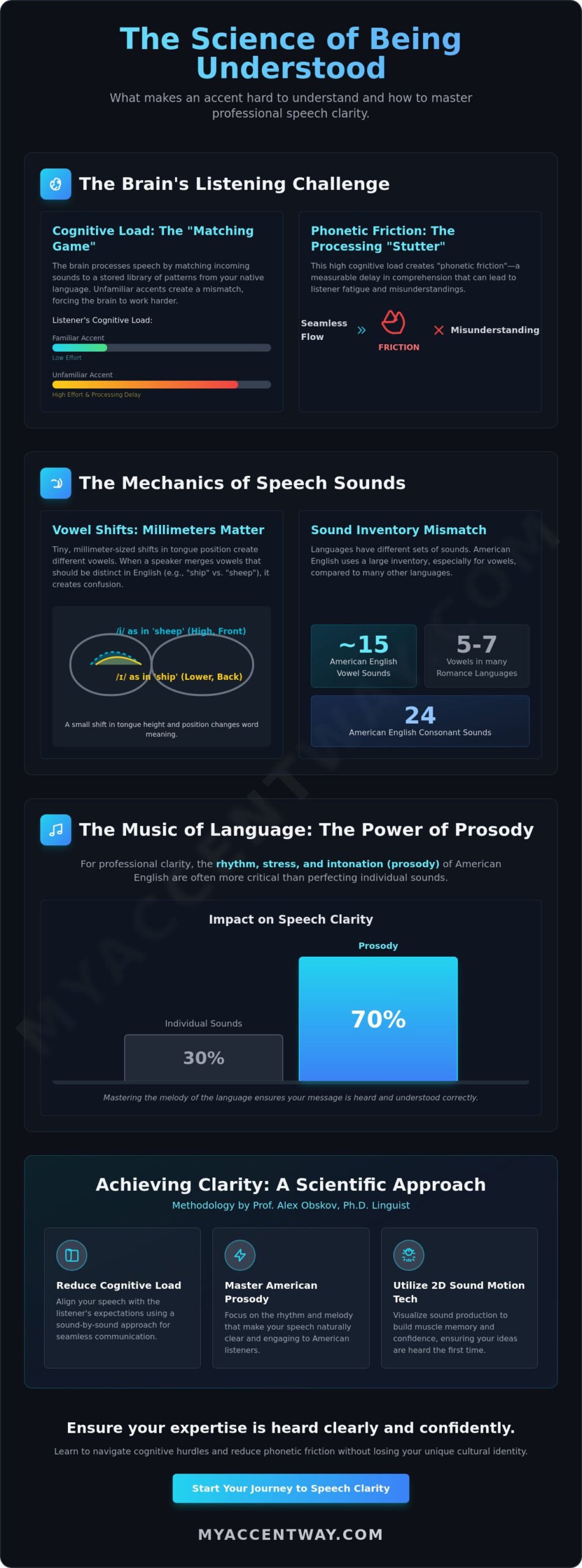
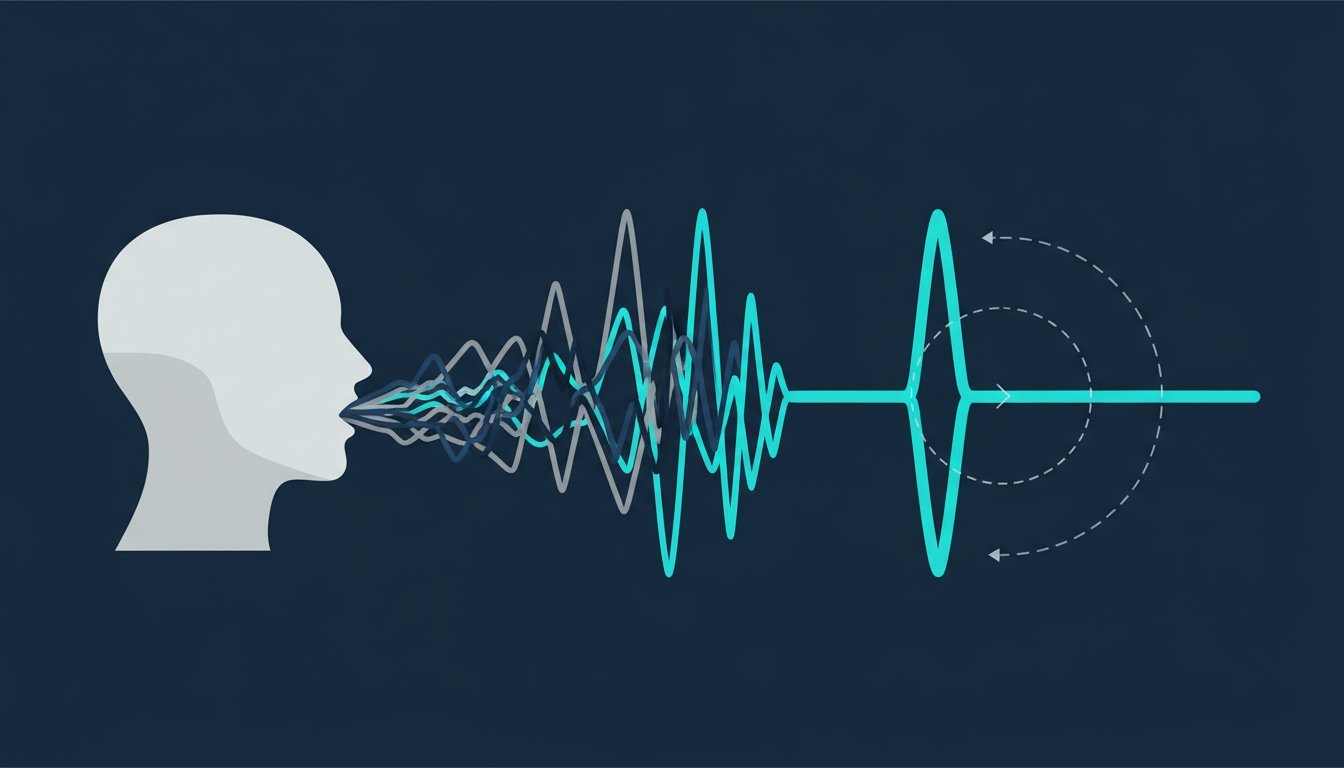
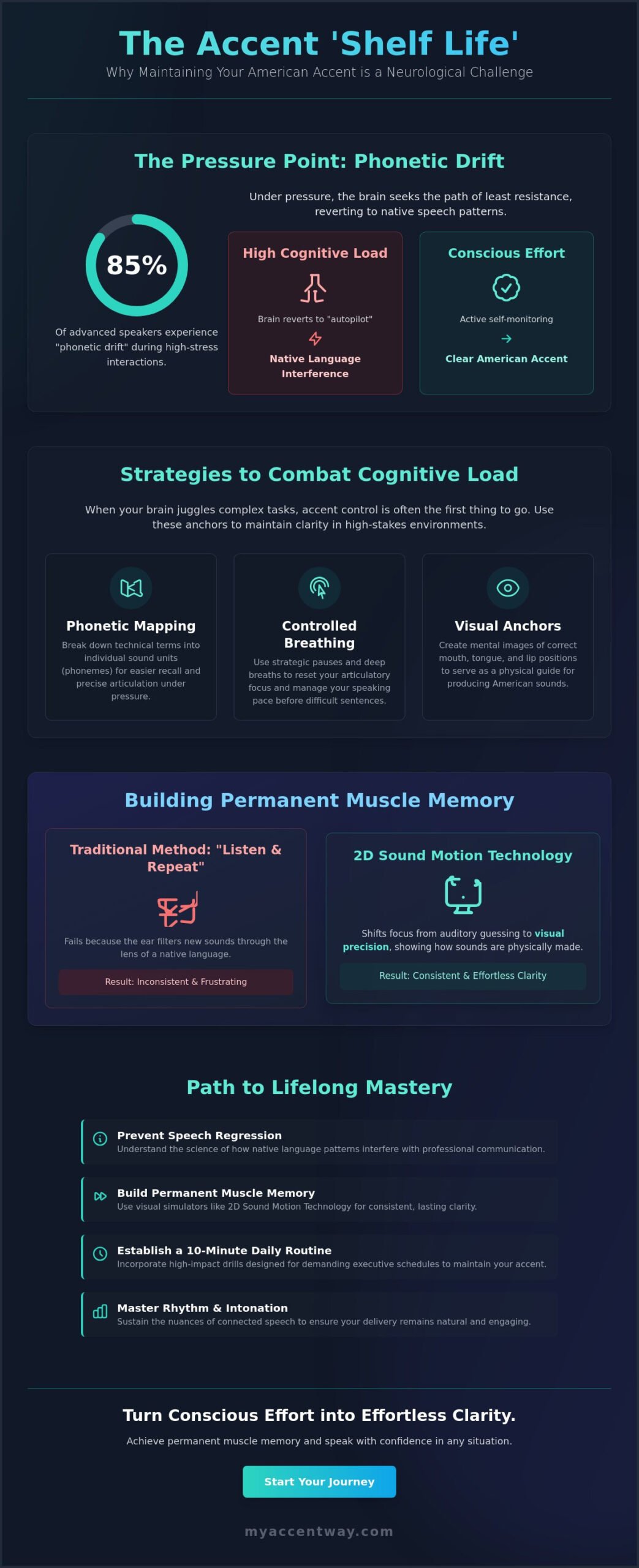
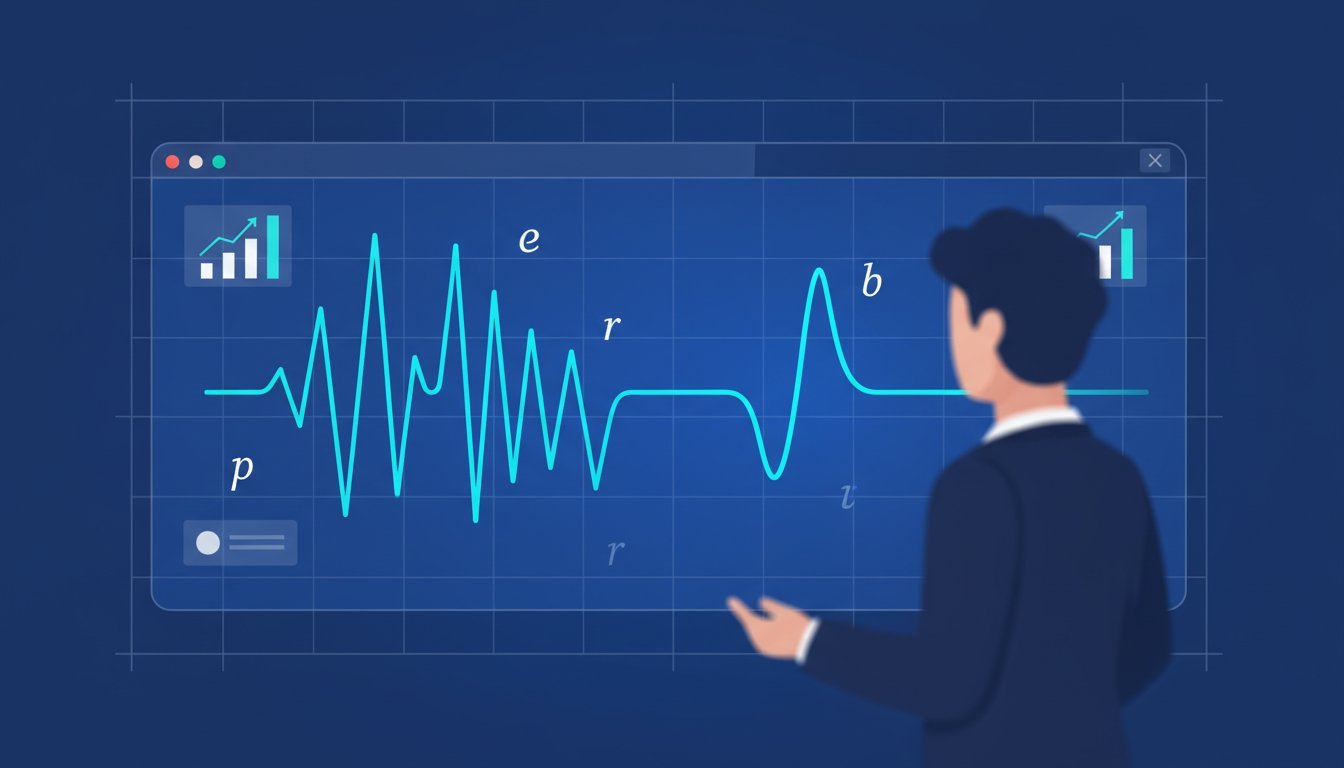
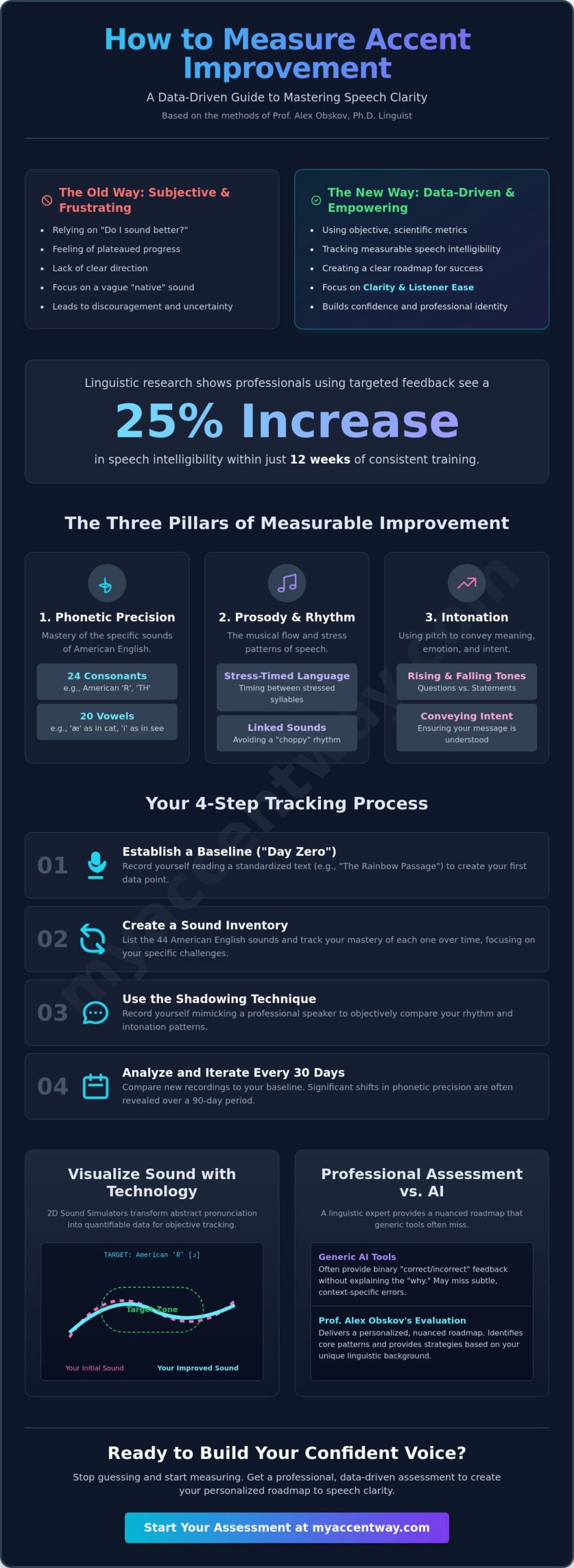
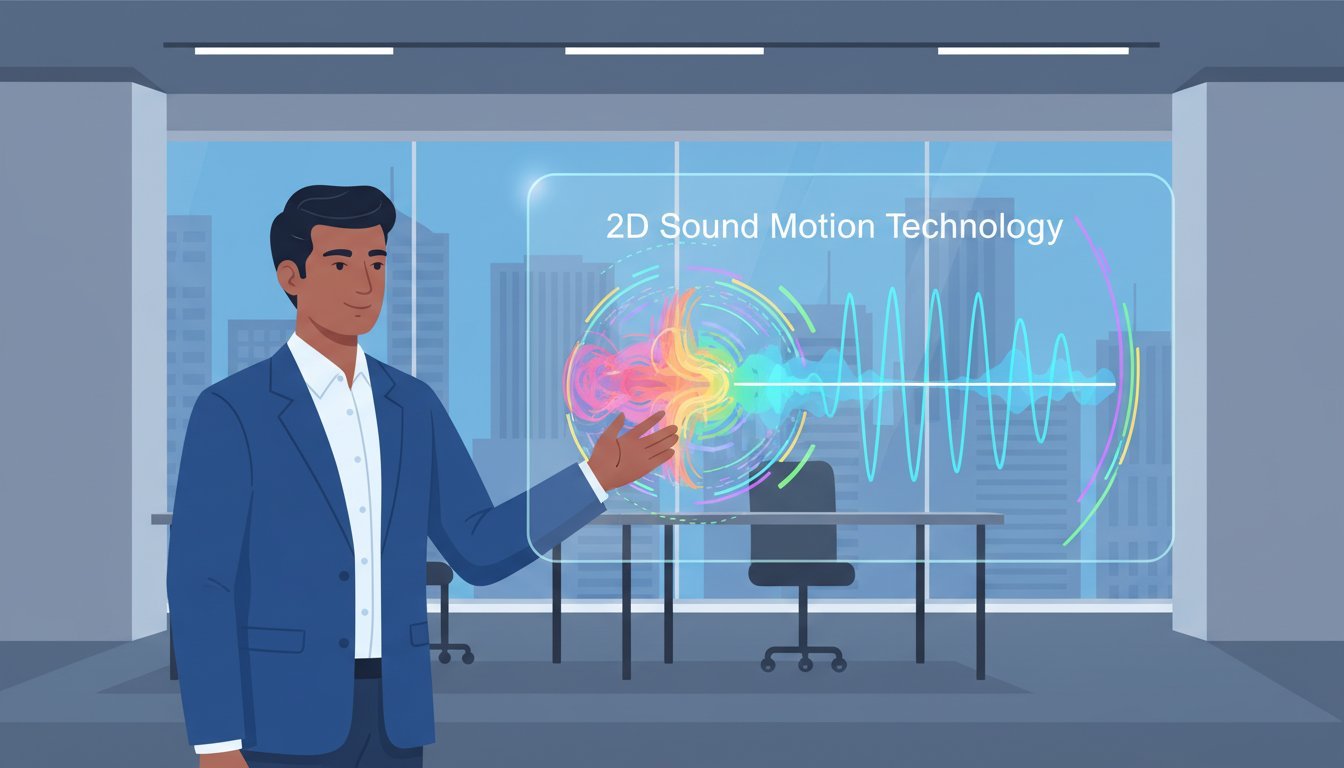
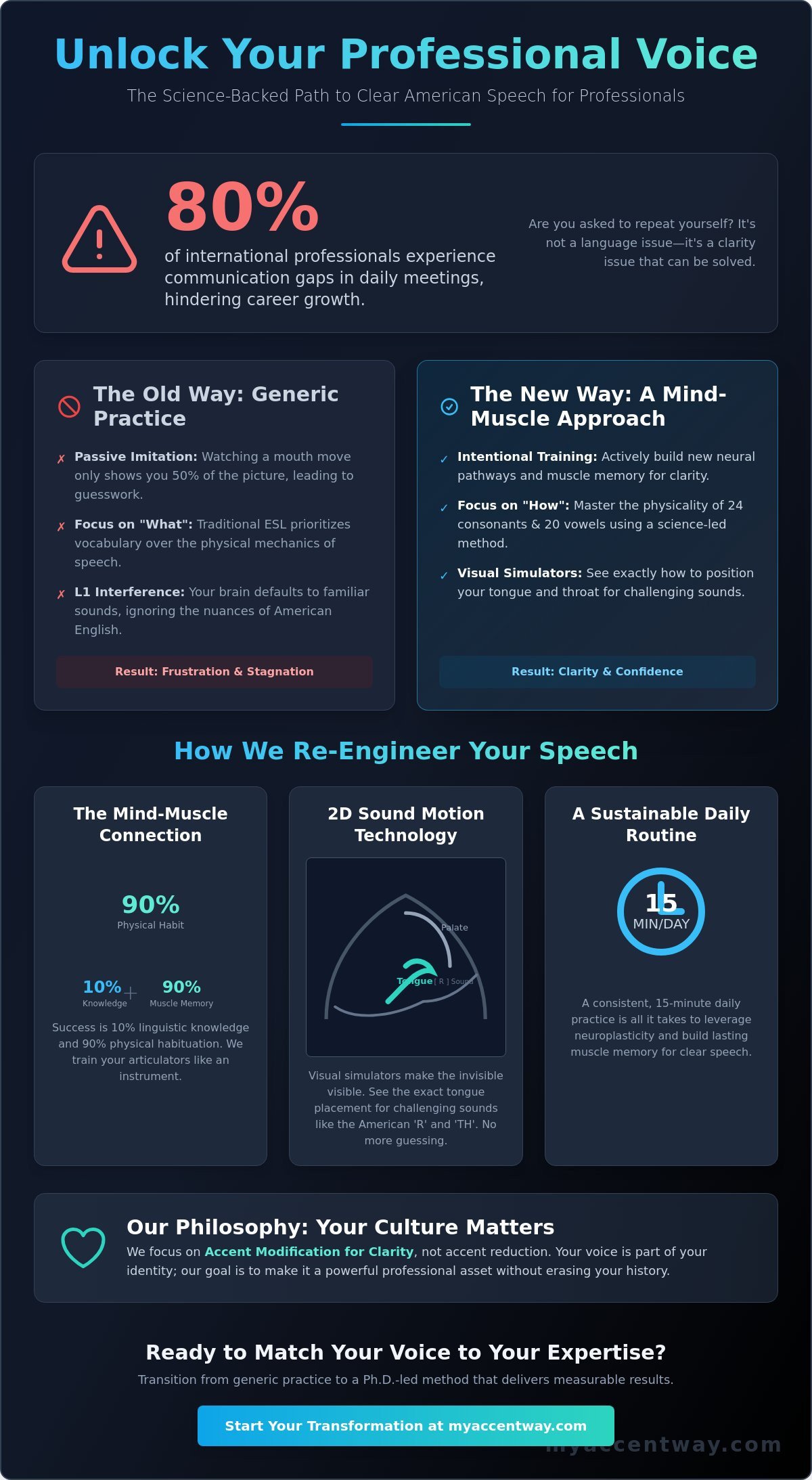
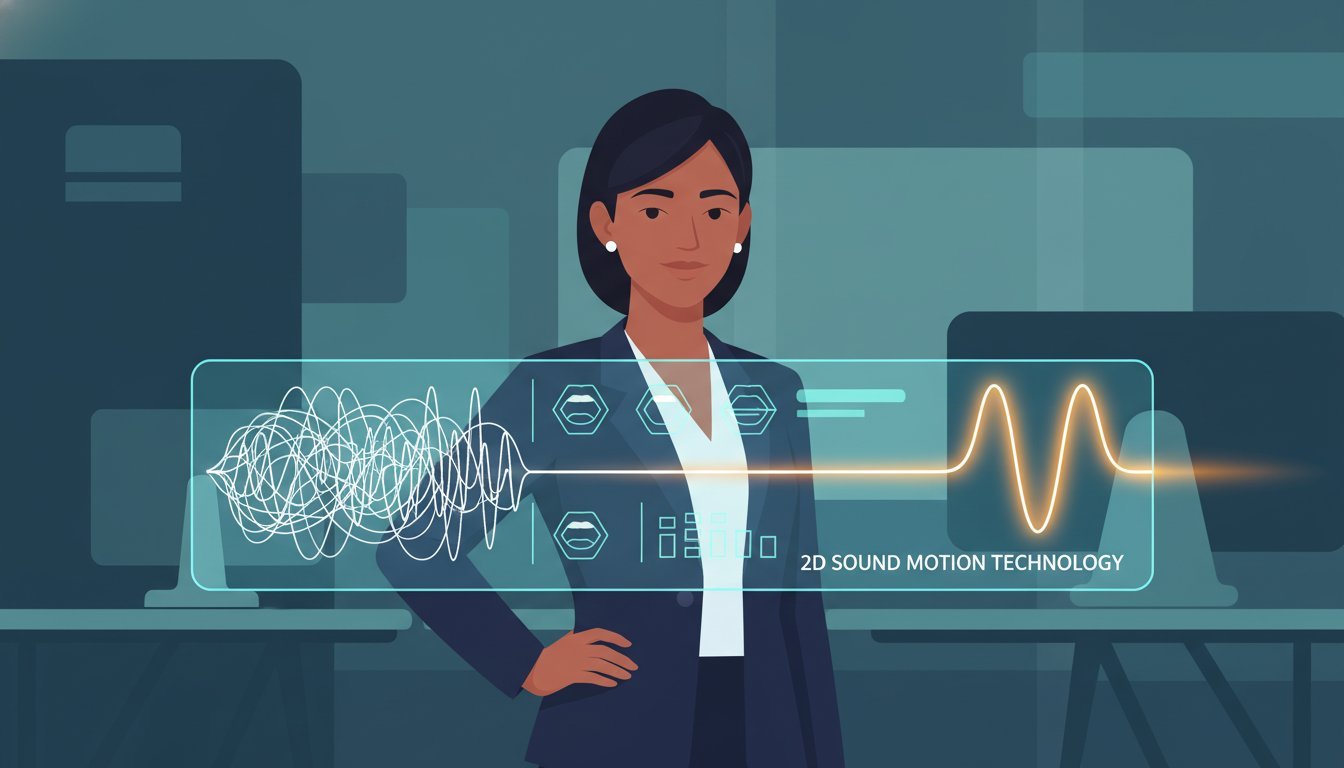
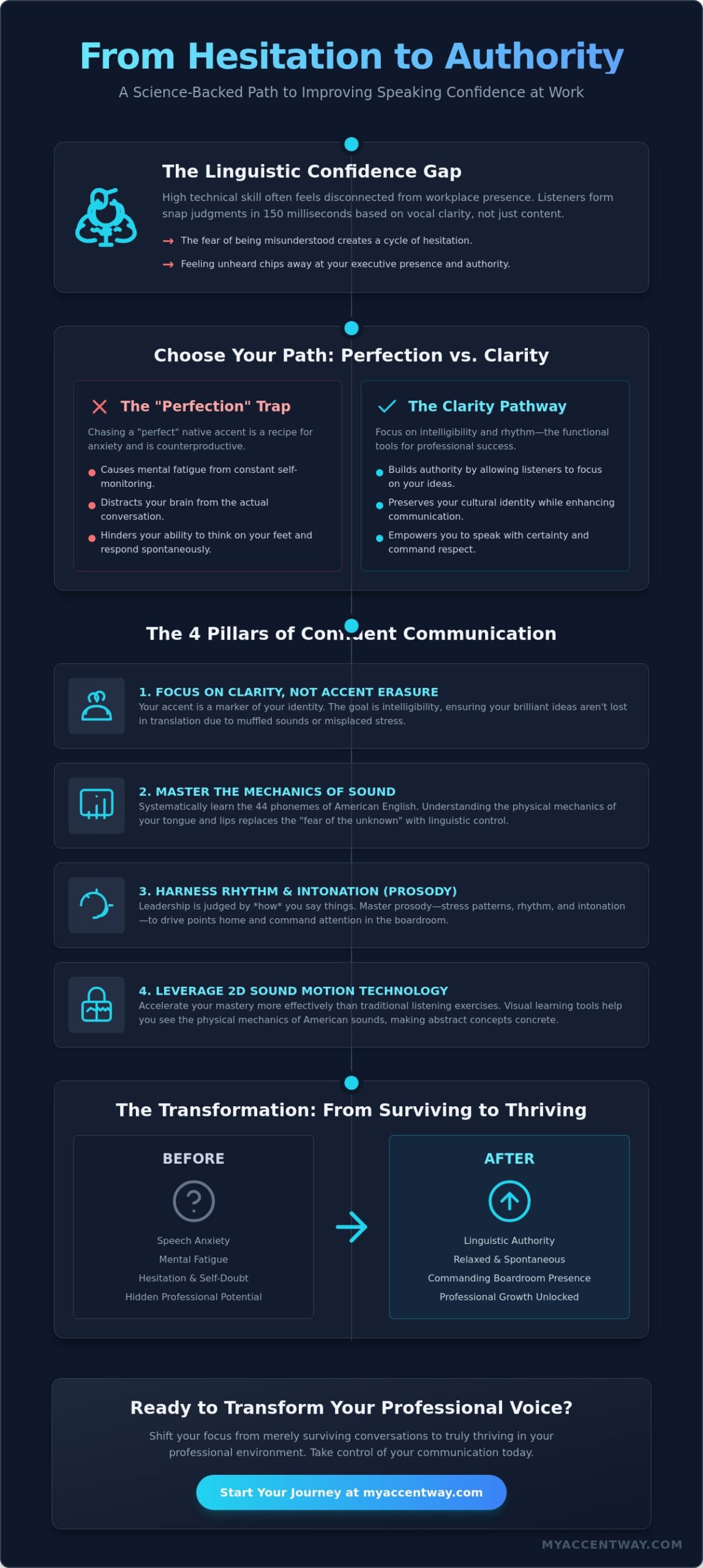
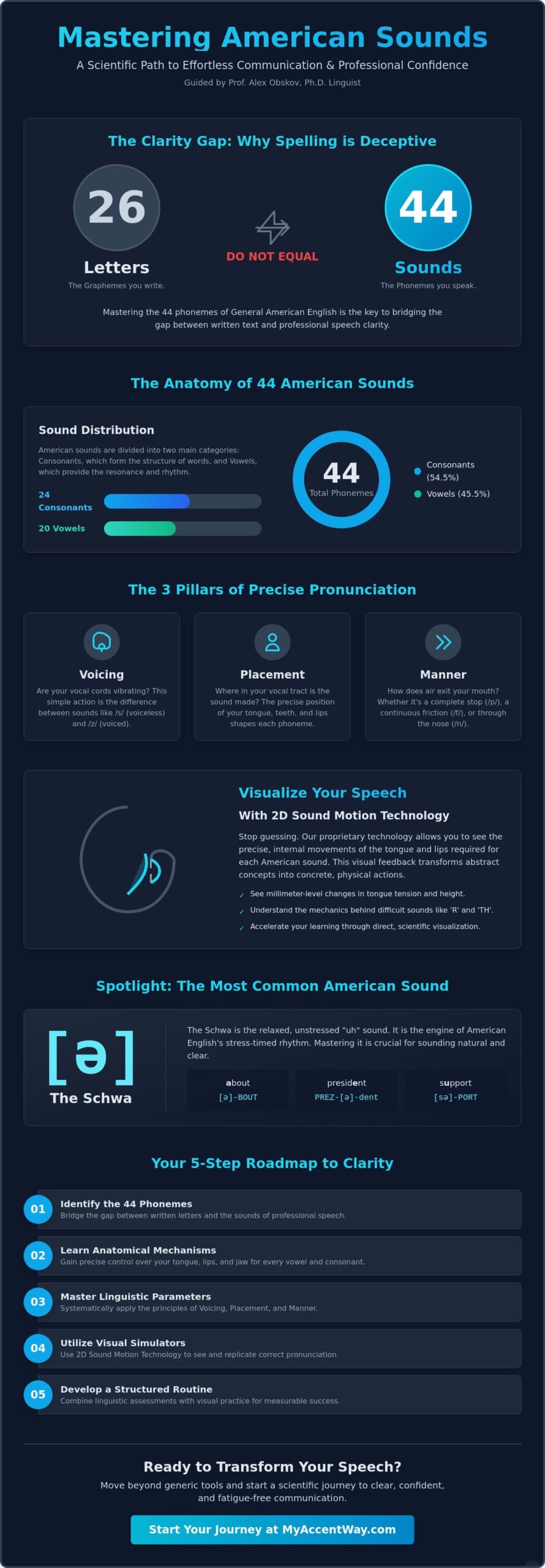
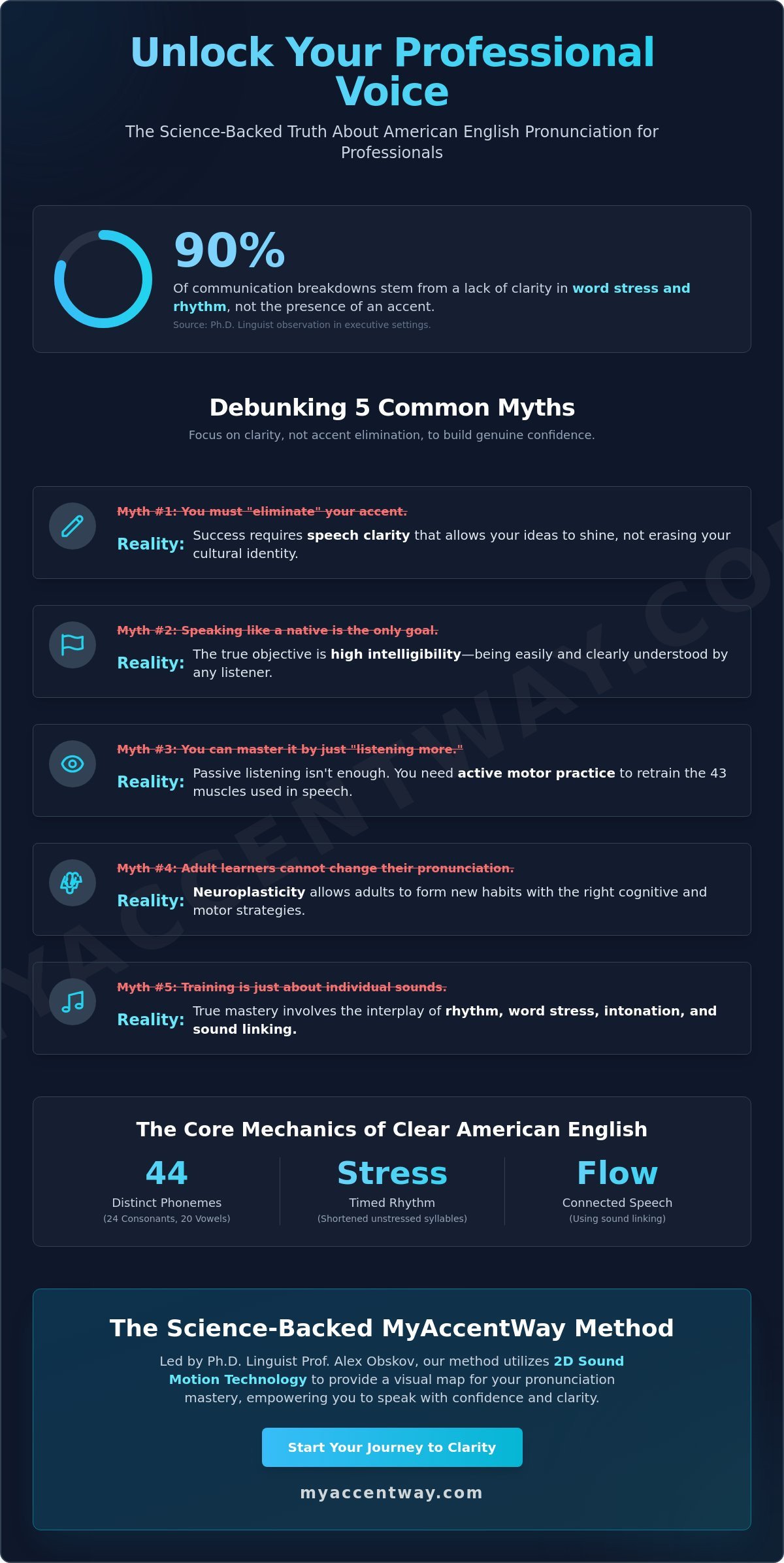
![Practice American Sound [t] with 2D Sound Motion Simulator: A Professional Guide](https://myaccentway.com/wp-content/uploads/2026/05/Practice-American-Sound-t-with-2D-Sound-Motion-Simulator-A-Professional-Guide-Hero-Image.jpg)
![Practice American Sound [t] with 2D Sound Motion Simulator: A Professional Guide](https://myaccentway.com/wp-content/uploads/2026/04/Practice-American-Sound-t-with-2D-Sound-Motion-Simulator-A-Professional-Guide-Infographic-scaled.jpg)