TL;DR:
- American English intonation patterns include falling, rising, and rise-fall, each conveying distinct meanings. Mastering these patterns helps non-native speakers sound confident and communicate clearly. Consistent practice with rhythm-focused exercises and feedback accelerates improvement in professional settings.
American English intonation patterns are the melodic pitch contours that carry meaning, attitude, and intent across every sentence you speak. Linguists define intonation as the rise and fall of pitch across phrases, and in American English, these patterns signal whether you are making a statement, asking a question, or emphasizing a key idea. For non-native professionals, mastering american english intonation patterns practice is the difference between sounding confident and sounding uncertain, even when your grammar is perfect. Professor Alex, Ph.D., Linguist and Accent Coach at Myaccentway, works with professionals from dozens of language backgrounds to build exactly this skill.
What are the main American English intonation patterns?
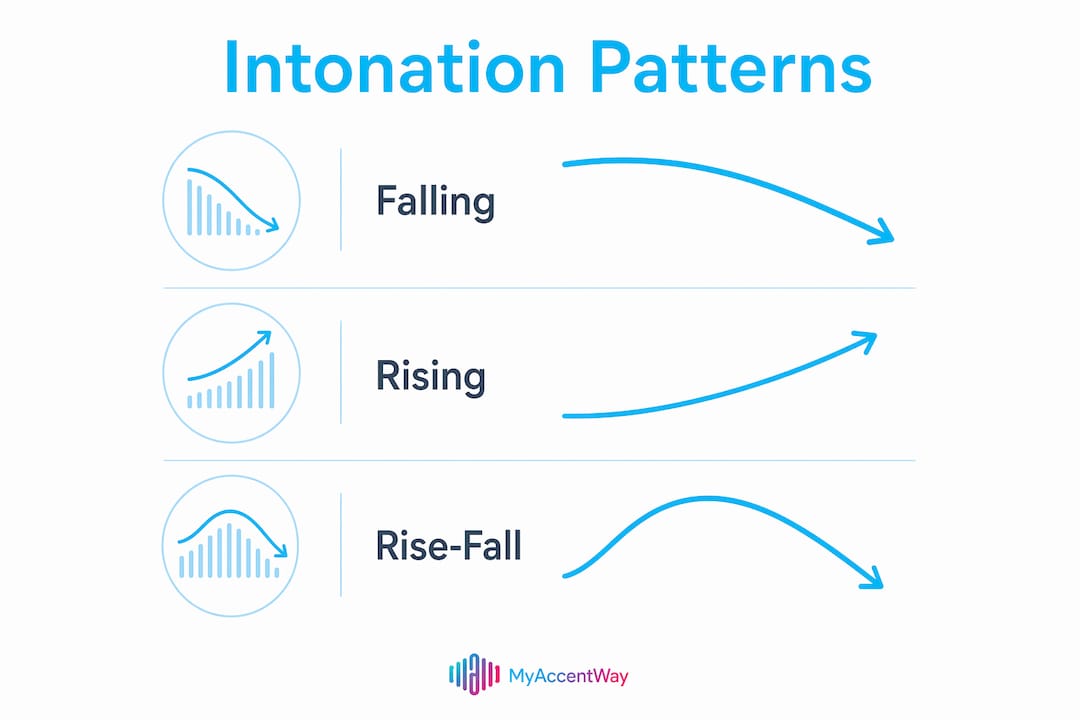
American English uses three primary intonation patterns: falling, rising, and rise-fall. Each one sends a distinct signal to your listener, and using the wrong pattern creates confusion even when your words are correct.

Falling intonation drops in pitch at the end of a phrase. You use it for definitive statements (“She left at noon.”) and wh-questions (“Where did you go?”). The drop signals that your thought is complete.
Rising intonation moves upward at the end. It marks yes/no questions (“Are you coming to the party?”) and signals that you expect a response. Rising intonation signals engagement and uncertainty, not just grammar.
Rise-fall intonation goes up and then comes back down within a single phrase. You use it for lists, strong emphasis, and emotional expression. It is the pattern that makes American speech sound expressive and alive.
One critical point: pitch in American English does not change word meaning the way it does in tonal languages like Mandarin or Vietnamese. Instead, pitch conveys attitude, social signals, and the speaker’s intent. That distinction matters because it frees you to focus on communication rather than memorizing pitch-to-meaning charts.
| Pattern | When to use it | Example |
|---|---|---|
| Falling | Statements, wh-questions | “She works in Dallas.” |
| Rising | Yes/no questions, uncertainty | “Did you call him?” |
| Rise-fall | Lists, emphasis, strong feeling | “I need coffee, water, and sleep.” |
Pro Tip: Record yourself reading three sentences, one for each pattern. Play them back and listen for whether your pitch actually moves. Most professionals are surprised to hear how flat their delivery sounds on the first recording.
How to practice American English intonation patterns effectively
The most common mistake professionals make is jumping straight to pitch practice before mastering stress. Stress acts as a rhythmic anchor in American English. Practicing intonation without it produces speech that sounds mechanical and unnatural.
Start with these foundational steps before you add pitch work:
- Learn the clap-on-content-word method. Read a sentence aloud and clap on content words like nouns, verbs, and adjectives. Function words like “the,” “a,” and “is” get no clap. This builds the stress-timed rhythm that American English runs on.
- Use a recording device every session. Your ear adjusts to your own voice within seconds. A recording gives you honest feedback. Use your phone, a laptop microphone, or any basic audio app.
- Practice with authentic American speech samples. Podcasts, news broadcasts, and professional presentations give you real models of intonation patterns in speech at natural speed.
- Add mirror practice. Watch your mouth, jaw, and lip movement as you speak. Physical awareness accelerates learning because you connect what you feel with what you hear.
- Set a consistent schedule. Fifteen focused minutes daily produces better results than two hours once a week. Consistency builds the neural pathways that make patterns automatic.
Myaccentway’s 2D Sound Motion Technology takes this physical awareness further. It shows exactly how the tongue, lips, jaw, and airflow move during American sounds, so you train the movement, not just the sound. Watch this 2D Sound Simulator for the American [T] to see how it works:
https://youtu.be/3EzjosgnzJE
Pro Tip: Before your first pitch drill, spend five minutes clapping through a paragraph. If you cannot feel the rhythm yet, your intonation practice will not stick.
Step-by-step intonation practice exercises for professionals
These exercises target the three core patterns and build from rhythm into full pitch control. Work through them in order.
- Minimal pair stress drills. Choose pairs of sentences where stress placement changes meaning. Say “I didn’t say she stole it” with stress on each different word. Notice how the meaning shifts. This trains your ear to hear stress as a signal.
- Sentence clapping with recording. Read five sentences aloud, clap on every content word, and record yourself. Play it back and check whether your stressed words are louder and longer. Adjust until the rhythm feels natural.
- Yes/no question rising drills. Write ten yes/no questions. Read each one and consciously push your pitch up on the final word. Record and compare your pitch to a native speaker model. The rise should be clear, not subtle.
- Wh-question falling drills. Write ten wh-questions. Read each one and let your pitch drop on the final content word. “Where did you go?” The drop signals that you want a real answer, not a yes or no.
- Rise-fall list practice. Read lists of three items aloud: “I need to call the client, review the contract, and send the report.” Rise on each item and fall on the last. This pattern tells your listener the list is complete.
- Connected speech tongue twisters. Minimal pair drills and tongue twisters improve both rhythm and flow. Try “She sells seashells” with full American stress and intonation, not just articulation speed.
“The goal is not to sound like someone else. The goal is to be understood clearly and to project the confidence your ideas deserve. Intonation is the tool that makes that possible.”
After each session, listen to your recordings and mark where your pitch felt flat or wrong. Self-evaluation builds the critical ear you need for long-term improvement. You can also find focused falling vs. rising practice exercises designed specifically for professionals at Myaccentway.
What are the most common intonation mistakes and how do you fix them?
Common challenges include flat intonation, incorrect rising or falling tones, and unnatural stress patterns. These problems are especially frequent for speakers of syllable-timed languages like Spanish or French, and tonal languages like Mandarin or Thai.
Here is what goes wrong most often and how to correct it:
- Flat pitch across the whole sentence. This happens when speakers focus entirely on pronunciation of individual sounds. Fix it by exaggerating your pitch movement during practice, then pulling back to a natural level once the pattern is in your muscle memory.
- Rising tone on statements. Many speakers unconsciously end statements with a rising pitch, which makes them sound uncertain or like they are asking for approval. Record yourself and flag every statement that rises. Retrain those sentences with a deliberate fall.
- Stress on the wrong word. Placing stress on function words instead of content words flattens the rhythm and confuses listeners. The clap-on-content-word method corrects this directly.
- Ignoring emotional nuance. Intonation carries attitude. A flat “Thank you” sounds dismissive. A rise-fall “Thank you” sounds warm and genuine. Practice the same phrase with different intonation patterns and notice how the meaning shifts.
Understanding pitch and stress for natural rhythm is the foundation that makes all other intonation work land correctly. Skipping this step is the single most common reason professionals plateau.
Pro Tip: Exaggerate your pitch movement by 50% during practice drills. It will feel unnatural. That is the point. Your brain needs to experience the full range before it can find the natural middle.
Key Takeaways
Mastering American English intonation requires learning the three core pitch patterns, building stress-timed rhythm first, and using consistent recording-based self-evaluation to correct flat or misplaced pitch.
| Point | Details |
|---|---|
| Three core patterns | Falling, rising, and rise-fall each signal a distinct communicative function. |
| Stress before pitch | Master content-word stress rhythm before adding intonation variation. |
| Record every session | Playback reveals flat pitch and wrong tones your ear misses in real time. |
| Exaggerate to learn | Push pitch movement beyond natural range during drills, then normalize. |
| Consistent daily practice | Short daily sessions build automatic patterns faster than long weekly ones. |
What I have learned teaching intonation to professionals
After working with professionals from Russia, China, Brazil, India, and across Europe, I have noticed one consistent pattern: most students arrive thinking intonation is a finishing touch. They believe grammar and vocabulary are the real work, and intonation is something you pick up naturally over time. That belief costs them years.
Intonation is not decoration. It is the signal layer that tells your listener how to interpret everything else you say. A perfectly grammatical sentence with flat intonation reads as robotic or cold. The same sentence with correct pitch movement sounds authoritative and clear. In professional settings, that difference shapes how colleagues, clients, and managers perceive your competence.
What actually works is the sequence: rhythm first, then pitch. Students who skip straight to pitch drills produce speech that sounds like a performance rather than natural communication. The clap-on-content-word method feels almost too simple, but it is the fastest path to internalizing American stress-timed rhythm. Once that rhythm is in place, pitch patterns layer on naturally.
I also tell every student: watch Vlad’s results. He is a Russian speaker who came to Myaccentway with strong grammar but flat, hard-to-follow speech. After structured intonation and rhythm training, his clarity changed completely. You can hear the difference yourself: https://youtube.com/shorts/OE0q7Y8cV74?si=xxmZVxedUPbunfdZ
The results are achievable. They require the right sequence, consistent practice, and honest feedback. That is exactly what structured training provides.
— Prof.
How Myaccentway trains American English intonation for professionals
Myaccentway’s approach to intonation training goes beyond listening and repeating. Professor Alex begins with a one-on-one assessment to identify your specific pitch and rhythm patterns, then builds a training plan around your actual speech, not a generic template.
The program uses 2D Sound Motion Technology to make sound visible. You see exactly how the tongue, lips, and jaw move during American intonation and stress patterns, so you train the physical movement, not just the sound. This approach produces faster, more durable results than audio-only methods. Professionals working on science-backed accent training can Book Your 1 Hour Accent Training Session to get a personalized assessment and start building real intonation clarity from the first session.
FAQ
What is an American English intonation pattern?
An American English intonation pattern is the rise and fall of pitch across a phrase or sentence. These patterns signal whether a statement is complete, a question is being asked, or a word is being emphasized.
How do falling and rising intonation differ in American English?
Falling intonation signals a complete statement or wh-question, while rising intonation marks yes/no questions and uncertainty. Using the wrong pattern can change how your listener interprets your intent.
Why do non-native speakers struggle with American English intonation?
Speakers of syllable-timed languages like Spanish and tonal languages like Mandarin apply different pitch rules to English. American English is stress-timed, so mastering stress placement before pitch is the most effective correction strategy.
How long does it take to improve intonation with daily practice?
Consistent daily practice of 15 minutes, focused on stress rhythm and pitch drills with recording and self-evaluation, produces noticeable improvement within weeks. The timeline depends on your starting point and how closely you follow structured feedback.
Can intonation practice help in professional settings specifically?
Yes. Correct intonation signals confidence, clarity, and authority to listeners. Professionals who use pitch effectively are perceived as more credible and easier to follow in meetings, presentations, and client conversations.
Recommended
- Master English Intonation Patterns: The Ultimate Guide to Sounding Natural
- Rising vs. Falling Intonation: The Ultimate Guide to Sounding Natural in American English
- Mastering American Intonation: Falling vs. Rising Practice for Professionals
- American English Pronunciation Practice: The 2026 Expert Guide
Speech clarity check
The problem is not always grammar or vocabulary.
If people understand your words but still miss your message, the deeper issue may be speech clarity, rhythm, intonation, and American pronunciation habits. MyAccentWay helps students retrain the sound system with professional 1-on-1 guidance, so English can feel clearer, freer, and more natural in real communication.
Why MyAccentWay works
Two training methods that make speech change active.
MyAccentWay is not passive listen-and-repeat coaching. Prof. Alex, Ph.D. Accent Coach, creates a learning situation where students become active learners and active participants in changing their own speech patterns.
Interactive training
Students do not just receive pronunciation instructions passively. They listen, think, compare, adjust, and understand their own speech patterns while Prof. Alex guides the correction process.
U.S. & Canada online accent training
American English Intonation Patterns Practice Guide for professionals in the United States and Canada
This guide is useful for advanced English speakers, entrepreneurs, international professionals, and students in the U.S. and Canada who want clearer American pronunciation, stronger rhythm, better intonation, and more confident communication in meetings, interviews, presentations, and client conversations.
Prof. Alex, Ph.D. Accent Coach, teaches online 1-on-1 American accent training for learners in major professional markets including New York, Los Angeles, San Francisco Bay Area, Seattle, Austin, Dallas, Houston, Chicago, Boston, Washington, D.C., Miami, Toronto, Vancouver, Montreal, Calgary, and Ottawa.
1-on-1 Accent Reduction Training helps students move beyond self-practice and build clearer American speech habits through interactive and cognitive accent training.
Cognitive accent training
Students learn to notice and correct the speech patterns that affect American pronunciation, then implement new American speech patterns into their code-switching process for more natural, long-lasting change.
Your next step
Build speech habits people can hear in real conversations.
A stronger American accent is not built by memorizing topics or chasing quick pronunciation tips. It comes from structured training, professional feedback, active correction, and repeated application until clearer speech becomes easier to keep.




One Response