Have questions before starting accent training?
Students can contact the MyAccentWay Support Center to ask questions, learn how the program works, and get connected with Professor Alex.
MyAccentWay Journal Interview
“I Thought It Was Too Late”
Jane, an ESL teacher in her 40s, shares how she overcame doubt and discovered that American accent training is possible at any age with professional, sound-by-sound guidance.
American Accent Training
Accent Reduction
Adult Pronunciation Transformation
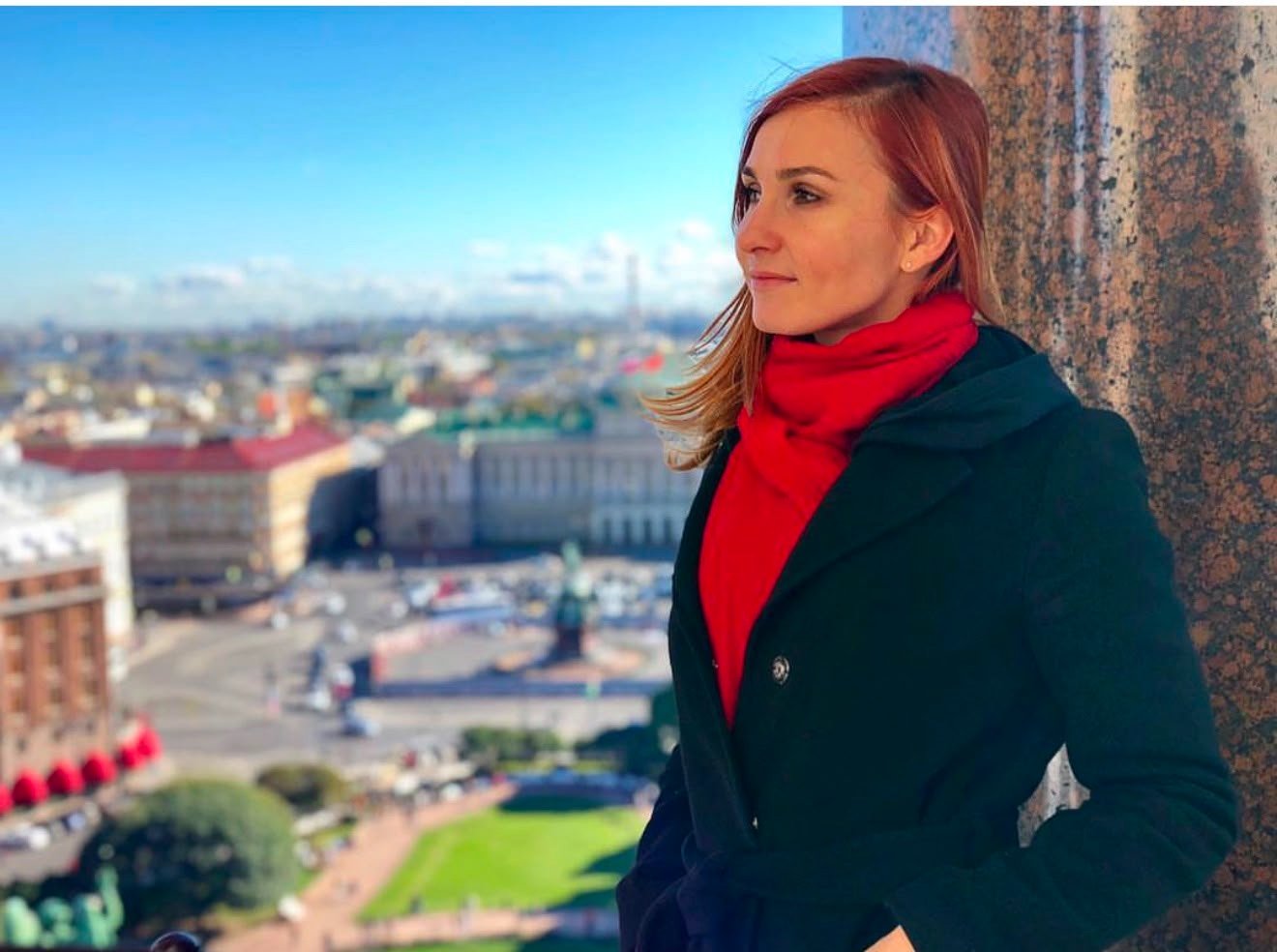
An ESL teacher who once doubted whether American accent training was possible after 40.
Before the interview
The doubt many adults never say out loud.
Jane’s story begins with a feeling I hear from many adult learners: the fear that their accent is already permanent. She was not a beginner. She was an ESL teacher, a professional, and a person who understood language learning deeply. Still, she wondered whether her own American pronunciation could truly change at 40.
“Is it too late for me to improve my accent?”
A question many successful adults quietly carry
This interview is about the moment adult learners realize that pronunciation is not fixed. With professional linguistic guidance, the speech system can be re-educated sound by sound until American pronunciation, rhythm, and clarity become more natural.
What changed for Jane
From doubt to a clearer, more confident American sound.
Instead of trying to copy sounds, Jane learned how American consonants, vowels, rhythm, and intonation are physically produced.
Professional correction helped her identify the exact pronunciation patterns affecting clarity and rebuild them with structure.
As her speech became clearer, Jane felt more comfortable speaking English as a professional and as an ESL teacher.
Interview with Jane
A journal-style conversation about age, doubt, professional identity, and what happens when accent training becomes precise, personal, and linguistic.
I am an ESL teacher, and I have worked with non-native English speakers for many years. English has always been part of my professional life, but I still felt that my own pronunciation did not fully represent who I was as a teacher and as a professional.
I wanted to feel clearer and more confident when I spoke. I knew grammar, vocabulary, and teaching methods, but I also knew that pronunciation, intonation, and rhythm affect how people hear you. I wanted my spoken English to sound more natural and closer to American pronunciation.
My biggest doubt was my age. I was around 40, and I thought maybe accent training was something people had to do when they were young. I wondered if my pronunciation habits were already too strong to change.
Yes. I felt nervous because I did not want to be judged. I already taught English, so it was difficult to admit that I still wanted help with my own pronunciation. But the sample class made me feel that the process was not about judgment. It was about understanding my speech patterns.
I realized that my accent was not random. There were specific sounds, patterns, and habits that could be identified. When Prof. Alex explained what was happening in my speech, I felt relieved because there was finally a clear path.
It was not just repetition. I had repeated words before, but I did not always know what to change. In this training, I learned what my tongue, lips, jaw, and voice needed to do. It felt much more scientific and personal.
The 2D Sound Motion Technology helped me see the sound. It was not just a picture or a video demonstration. It showed me how to simulate the movement of the speech organs, so I could train the sound with my mouth instead of only trying to hear it.
I started to feel it during the first exercises. When I understood how one sound worked and then repeated it correctly, I thought: maybe this is possible. That was a powerful moment because it changed my mindset.
I noticed more clarity. I became more aware of American sounds, rhythm, and intonation. I also became more confident because I could hear my mistakes and understand how to correct them.
It gave me a deeper understanding of pronunciation. I had taught English for years, but this helped me understand speech from another level. It also helped me connect with my own students because I understood their doubts even more.
I would say it is not too late. Adults can change their pronunciation when they have the right method, a professional coach, and consistent practice. You need guidance, but it is possible.
If your speech affects your confidence, your presentations, or how people understand you, it is worth working on. Accent training is not about losing yourself. It is about making your English clearer and more powerful.
I came in with doubt, but I left with hope. I learned that my pronunciation could change. I also learned that professional training can help adults feel more confident and more connected to the way they speak English.
Training method
Not just listening. Not just copying.
Jane’s progress came from structured American accent training that combines professional correction, phonetic exercises, and speech-organ awareness.
In traditional pronunciation practice, many students are asked to listen and repeat. That can help, but it often leaves the student guessing. At MyAccentWay, 2D Sound Motion Technology works as a sound training simulator. It helps students see and simulate tongue, lip, jaw, and speech-organ movement while following professional instructions.
This matters because adult learners often need more than information. They need a way to retrain the physical pattern of sound production. The goal is to help students pronounce American sounds faster, more accurately, and with a more natural American quality.
Students can explore the complete American Accent Program curriculum and begin with a 1-on-1 sample class to identify the exact sound patterns that may be affecting clarity.
Real accent training begins when instruction becomes precise.
Jane’s story shows why adult pronunciation improvement needs more than motivation or repetition. A student must understand what is happening in the speech system, then receive professional instructions that connect sound, movement, rhythm, and correction.
In a real training session, every sound is treated as a learnable pattern. The student hears the target sound, studies the placement, practices the phonetic exercise, and receives guidance until the movement becomes more natural.
Inside a Live Pronunciation Session
When students see the exact sound pattern, hear professional correction, and repeat the movement with guidance, confidence begins to grow faster.
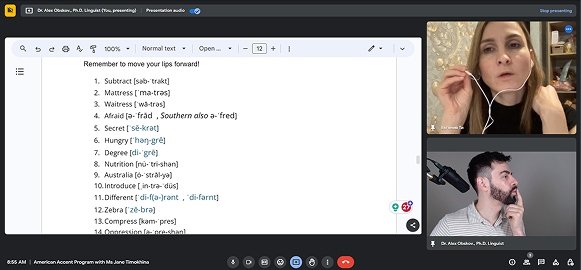
American accent training for professionals in the United States
Clearer pronunciation, stronger speech, and more confident American English
MyAccentWay helps non-native English-speaking professionals across the United States improve American pronunciation, accent reduction, speech clarity, rhythm, intonation, and professional communication. The training is designed for adults who want to be understood more easily in meetings, interviews, presentations, healthcare communication, technology teams, academic settings, and everyday professional life.
Instead of generic conversation practice, Prof. Alex uses a linguistics-based method that trains American consonants, American vowels, connected speech, sentence stress, and intonation patterns sound by sound. Students learn how their current accent affects English pronunciation, then practice a more precise American sound system through professional correction and structured phonetic exercises.
Search topics covered in this story: American accent training for adults, accent reduction for professionals, online pronunciation coaching, American pronunciation improvement, speech clarity coaching, American English intonation, connected speech practice, ESL pronunciation training, business English pronunciation, professional speech improvement, 1-on-1 accent training, American vowels and consonants, pronunciation training for non-native English speakers, and American accent coaching for work communication.
Student questions
Is it too late to improve your American accent?
These are the questions many adult learners ask before beginning a professional training program.
Can adults improve their American accent?
Yes. Adults can improve pronunciation, rhythm, stress, and intonation with professional phonetic training, feedback, and consistent practice.
Is this only English conversation practice?
No. This is American accent training. The focus is pronunciation, consonants, vowels, rhythm, intonation, connected speech, and professional clarity.
What happens in the sample class?
Prof. Alex evaluates your speech, identifies your main clarity blockers, and shows how the training method works using phonetic exercises and 2D Sound Motion Technology.
Who is this program for?
It is designed for non-native English-speaking professionals who want clearer speech for work, interviews, presentations, and everyday communication.
Where should I start?
Start with the American accent training overview or book a sample class to receive a personalized speech evaluation.
Discover more from MyAccentWay
Subscribe to get the latest posts sent to your email.