
What if the reason your brilliant ideas get lost in meetings has nothing to do with your grammar and everything to do with your melody? You’ve likely spent years perfecting your vocabulary, yet you still feel ignored or fear being misunderstood due to a flat intonation. It’s exhausting to focus so hard on the mechanics of English while your delivery fails to capture the room. Mastering the art of using vocal variety to be more engaging is the key to ensuring your professional success depends on more than just words; it requires a command of the prosody behind the language.
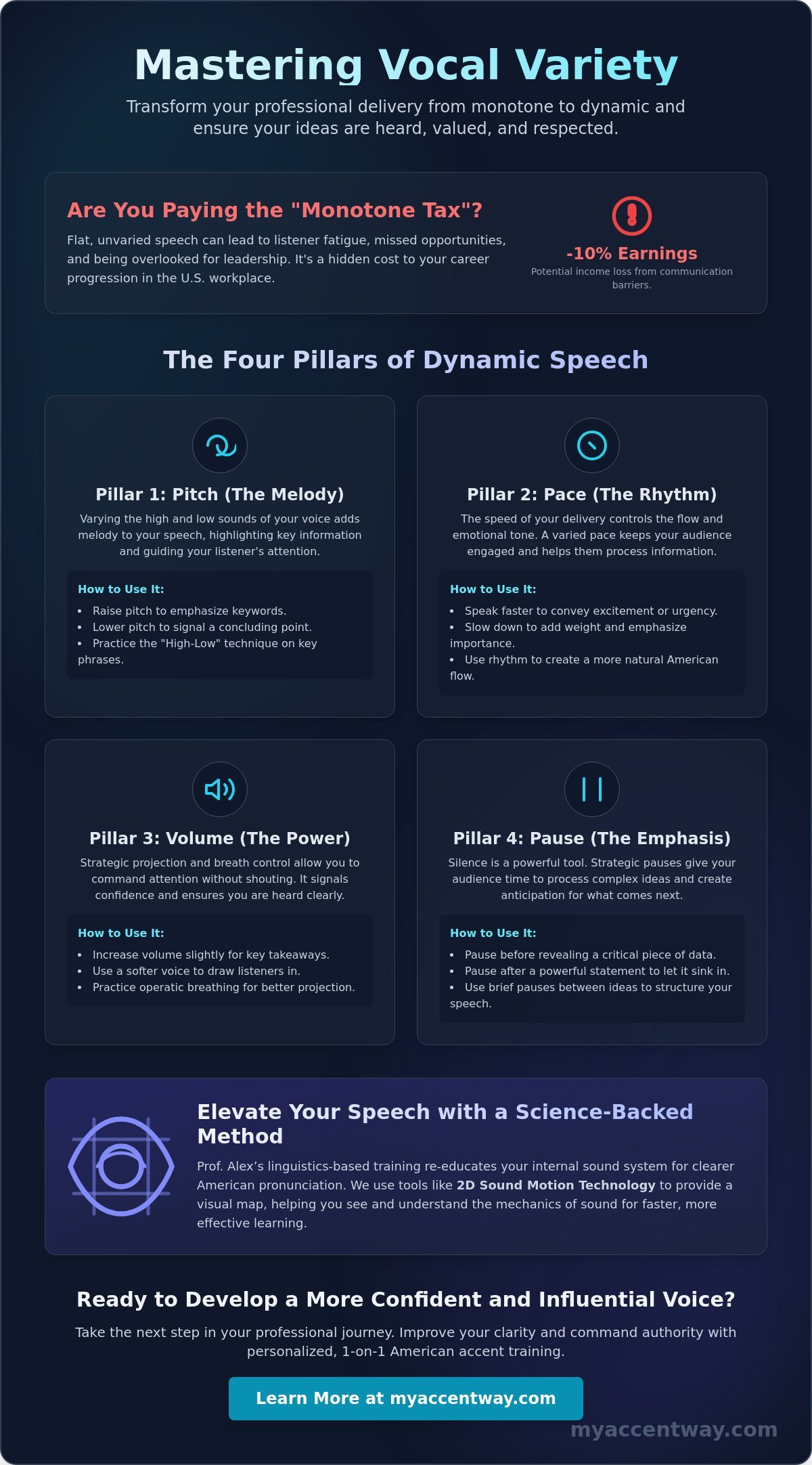
In this guide, you’ll learn how to transform your speech from a monotone drone into a dynamic professional asset. This is a critical investment in your career, as individuals struggling with communication barriers can earn 10% less on average than their peers. By re-educating your internal sound system through Prof. Alex’s structured, linguistics-based method, you can move closer to a natural American speech rhythm. We’ll explore how adjusting your pitch, pace, and volume allows you to sound more persuasive and command authority in any workplace setting. This guide provides the roadmap to becoming a more confident and influential communicator in 2026.
Key Takeaways
- Identify the four pillars of pitch, pace, volume, and tone to transform your professional delivery and move closer to natural American speech.
- Learn how to avoid the “monotone tax” by using vocal variety to be more engaging during high-stakes presentations and workplace meetings.
- Discover how to overcome linguistic interference and cultural barriers that often lead to flat, unpersuasive intonation in professional English.
- Apply practical exercises like the “High-Low” pitch technique and operatic breathing to project confidence and command authority in every conversation.
- Explore how Prof. Alex’s linguistics-based method and 2D Sound Motion Technology provide a visual map for re-educating your internal sound system.
Why Vocal Variety is the Secret to Professional Engagement
Professional communication is a structured process of re-educating your sound system. It’s not just about the words you choose, but the way those words travel through the air. When we discuss using vocal variety to be more engaging, we’re referring to the strategic variation of pitch, pace, volume, and tone. These are the linguistic elements of speech that dictate how your message is received in a high-stakes environment. Without these variations, your speech becomes a flat line that is difficult for the human brain to follow for extended periods.
In the U.S. business culture, professionals often encounter what we call the “Monotone Tax.” This isn’t a literal fee, but the cost of lost opportunities. When your delivery lacks variety, your audience must work harder to stay focused. This leads to listener fatigue, where your colleagues or clients might miss key data points simply because their brains have tuned out the repetitive sound waves. Over time, this can result in being overlooked for leadership roles or feeling ignored during critical strategy sessions.
The psychological impact of vocal variety is profound. Dynamic speech patterns signal confidence, expertise, and emotional intelligence. It builds trust because it shows you’re present and certain of your message. It’s vital to distinguish this from “performing.” You aren’t putting on a theatrical show; you’re developing an authentic professional expression. You’re aligning your vocal energy with the actual importance of the technical or strategic insights you’re sharing.
The ROI of Engaging Speech in the U.S. Workplace
Clarity in online meetings is now a baseline requirement for career growth. Using vocal variety to be more engaging ensures your audience stays connected to your message even through a digital screen. There’s a direct connection between dynamic speech and perceived leadership authority. When you vary your pace and pitch, you sound more persuasive and commanding. Many learners worry about their native accent, but in the modern workplace, clarity and engagement are far more influential than sounding like a native speaker.
Moving Beyond Simple Pronunciation
Knowing the dictionary definition of words isn’t enough if the melody is missing. If your speech is flat, you’re only using a fraction of the tools available to you. This is why mastering American English connected speech rules is so important. These rules help you understand how sounds link together to create a natural flow. Vocal variety signals meaning just as much as vocabulary does. A slight shift in pitch can highlight a specific keyword, turning a standard update into a powerful call to action.
The Four Pillars of Vocal Variety: A Linguistic Breakdown
To move beyond the monotone tax mentioned earlier, we must look at the specific linguistic mechanics of speech. Developing your voice isn’t about acting or pretending to be someone else; it’s about re-educating your vocal muscles to follow American prosody. Mastering Vocal Variety requires a deep understanding of four distinct pillars. These elements work together to ensure your message is received with the same intent you had when writing it.
- Pitch: This is the melody of your speech. By using the highs and lows of the American sound system, you can highlight key information and guide your listener through your logic.
- Pace: Controlling the speed of your delivery allows you to create suspense or emphasize urgency. A fast pace can signal excitement, while a slower pace adds weight to a serious conclusion.
- Volume: Strategic projection allows you to command attention without shouting. It’s about the energy behind the breath, ensuring your voice reaches the back of the room or the other side of a digital call.
- Pause: Silence is a tool. Strategic pauses allow U.S. audiences to process complex data and anticipate your next point.
Mastering these pillars is the foundation of using vocal variety to be more engaging in any professional setting. If you’re ready to move closer to a natural American speech rhythm, personalized American accent training can provide the feedback needed to master these pillars effectively.
Mastering Pitch and Intonation
In American English, pitch is a primary signal of meaning. You use rising intonation at the end of a question and falling intonation to signal a finished statement. A common pattern is staircase intonation, where the pitch drops slightly on each word until the end of the thought. Robotic speech often occurs due to three mistakes: a “monotone plateau” where pitch never changes, “upspeak” where every sentence sounds like a question, or failing to jump to a higher pitch on the most important noun in a sentence.
Strategic Pacing and the Power of the Pause
Non-native speakers often speak too fast because of nervousness or a desire to get through the sentence quickly. However, rushing makes it difficult for your audience to follow your logic. Using vocal variety to be more engaging means embracing the pause. Silence can effectively replace filler words like “um,” “uh,” or “like,” which often distract from your expertise. For a quick practice tip, record a 30-second introduction of yourself and count how many times you actually stopped talking for at least one full second. Most professionals find they rarely pause enough.
Common Barriers: Why Professionals Struggle with Monotone Speech
Many professionals mistakenly believe that sounding monotone is a permanent personality trait. In reality, it’s often a result of specific linguistic and physical factors that can be addressed through structured training. Understanding the concept of Vocal Variety in Speech helps identify where these communication breakdowns occur. For non-native speakers, the challenge of using vocal variety to be more engaging usually stems from how their first language influences their English delivery.
One major obstacle is the “Grammar Trap.” When you focus too much on perfect sentence structure, your cognitive energy is diverted away from your delivery. You might be saying the right words, but your voice remains flat because your brain is busy processing verb tenses and prepositions. This mental heavy lifting often results in a lack of intonation, making you sound less certain than you actually are. It’s a common struggle for those who prioritize accuracy over the melody of the language.
Physical tension also limits your vocal range. If you’re nervous or trying too hard to be precise, your throat and chest muscles naturally tighten. This restriction prevents proper breath support, which is essential for varying your volume and tone. Without a relaxed diaphragm, your voice lacks the power needed to command a room or sound persuasive in a meeting. This tension is often what creates that “robotic” sound many professionals fear.
First Language Interference and Rhythm
English is a stress-timed language, meaning we vary the length and emphasis of our syllables. Many other languages, such as Spanish or Mandarin, are syllable-timed, where each beat gets roughly equal time. When these native rhythms transfer into English, it creates a repetitive pattern that sounds monotone to U.S. ears. Breaking these old habits requires American accent training for U.S. professionals. This process involves re-educating your sound system to recognize and produce the specific rhythm of American English, ensuring your message isn’t lost in a flat delivery.
Overcoming the Fear of “Over-Acting”
Many students fear that using vocal variety to be more engaging will make them sound theatrical or unprofessional. However, American English naturally requires a wider vocal range than many other languages. What feels like “over-acting” to you often sounds like “clarity” and “confidence” to your U.S. colleagues. There’s a significant difference between being theatrical and being clear. Embracing a new vocal identity isn’t about being fake; it’s about developing the tools necessary to thrive and be understood in the U.S. market. Don’t let the fear of expression hold back your professional authority.
Practical Techniques for More Engaging Professional Communication
Transforming your delivery requires more than just awareness; it demands active, physical practice. To move closer to natural American speech, you must treat your voice as a professional asset that can be tuned and refined. Developing these skills is a structured process of re-educating your sound system. By applying specific linguistic exercises, you can ensure your expertise is heard clearly in every interaction.
Word Stress Mapping is a foundational skill for any professional. Before a high-stakes meeting, take your notes and underline the single most important word in each sentence. Usually, this is a keyword noun or a verb. When you reach that word, use the “High-Low” technique: jump to a higher pitch and hold the vowel slightly longer. This simple shift is a powerful way of using vocal variety to be more engaging without feeling like you’re performing.
Operatic Breathing isn’t just for singers; it’s for leaders. By engaging your diaphragm, you provide the air pressure needed to support volume variety. Without this support, your voice will naturally trail off at the end of sentences, which can make you sound less confident. Pair this with the “Smile Technique.” Slightly lifting your facial muscles while speaking physically brightens your sound, adding a layer of warmth and approachability to your professional tone. To ensure progress, create a self-feedback loop. Record your practice sessions. Auditing your own variety allows you to hear the difference between how you think you sound and how you actually come across.
If you’re looking for professional guidance to refine these techniques and build lasting confidence, consider enrolling in 1-on-1 American accent training with Prof. Alex.
Applying Variety to Presentations
Presentations demand a strategic use of pace. Start your first slide with a “hook” pace: speak slightly faster to signal energy, then slow down significantly for your thesis statement. Use volume drops to share high-value insights. When you lower your voice, your audience leans in, perceiving the information as exclusive or confidential. Try reading a single data point three different ways to feel the impact of these shifts on your listeners’ attention.
Engaging During Online Meetings
Digital platforms often flatten your audio range, making you sound more monotone than you are in person. To compensate, you must slightly exaggerate your intonation. Using vocal variety to be more engaging in a virtual space helps you command authority when your physical presence is limited. Use a sharp drop in pitch at the end of your points. This signals that you’re finished speaking, which helps you avoid awkward interruptions and keeps the meeting flow professional.
Elevating Your Speech with Science-Backed Accent Training
Mastering the techniques of pitch and pacing is a vital step, but true transformation happens when you address the underlying mechanics of your speech. Prof. Alex, Ph.D., approaches American accent training as a rigorous, linguistics-based science. It’s not about mimicking a sound; it’s about re-educating your entire sound system. This includes consonants, vowels, and the complex intonation patterns we’ve discussed throughout this guide. By using vocal variety to be more engaging through this systematic method, you build the English fluency required to move closer to natural American speech with a level of precision that general practice cannot provide.
A central component of this methodology is 2D Sound Motion Technology. This proprietary innovation provides a visual way to understand sound movement, which is uniquely helpful for both non-native speakers and those with hearing challenges. By seeing the physical path of a sound, you can better internalize the rhythm and flow of the language. It’s essential to clarify that while this technology serves as a powerful visual map for vocal movement, it is not a medical treatment. Unlike automated apps that offer generic feedback, this tool is used within a personalized framework to address specific phonetic interference from your native language. You can explore the impact of this individualized approach by viewing our student reviews and results.
The 2D Sound Video Training Simulator
The ability to visualize sound movement is especially helpful for mastering the rhythm and stress of American English. For example, the provides a clear look at unvoiced precision. This technology helps you understand the physical “swing” of the language, which is a key part of accent reduction. It’s a systematic approach designed for long-term clarity, ensuring your message is heard with the authority you’ve worked hard to build in your professional field.
Real Results: Before and After Progress
Many learners develop clearer speech and stronger workplace presence when they combine these visual tools with consistent, guided practice. Using vocal variety to be more engaging becomes second nature when you can see and hear your progress. You can witness this transformation in our student progress shorts, which highlight the meaningful improvement possible through structured training. These examples show how professionals have successfully refined their delivery:
- Professional speech refinement example 1
- Professional speech refinement example 2
- Professional speech refinement example 3
Results show progress in real-world scenarios, from commanding authority in meetings to delivering persuasive presentations. If you’re ready to transform your monotone speech into a dynamic professional asset, the next step is to seek expert guidance tailored to your unique linguistic background. Take the first step toward more confident communication by seeking a personalized assessment that addresses your specific needs.
Command the Room with Dynamic Speech
Your journey toward professional influence depends on more than just the technical accuracy of your words. By mastering the four pillars of pitch, pace, volume, and pause, you can transform your communication from a flat delivery into a persuasive asset. We’ve explored how using vocal variety to be more engaging is a systematic process of re-educating your sound system to overcome linguistic interference and physical tension. Whether you’re leading a high-stakes meeting or presenting complex data, your vocal melody signals your authority and helps build trust with your U.S. audience.
If you’re ready to move closer to natural American speech rhythm, personalized guidance is the most effective path forward. Prof. Alex, Ph.D., uses a linguistics-based methodology supported by proprietary 2D Sound Motion Technology to provide a visual and scientific map for mastering these complex patterns. You don’t have to navigate this transformation alone. Take the next step toward clearer, more confident workplace communication by choosing a program with a proven track record among non-native professionals. Book a 1-on-1 American Accent Training 1-hour accent training session with Prof. Alex today. It’s time to let your expertise be heard with the clarity and impact it deserves.
Frequently Asked Questions
What is vocal variety and why is it important for public speaking?
Vocal variety is the strategic variation of your pitch, pace, volume, and tone during a presentation. It’s essential for public speaking because it prevents listener fatigue and ensures your audience remains focused on your message. By moving beyond a flat delivery, you signal confidence and emotional intelligence. These traits are critical for building trust with U.S. audiences during high-stakes professional interactions and leadership communication.
How can I stop sounding monotone when speaking English as a second language?
You can stop sounding monotone by re-educating your internal sound system to match American English prosody. This involves practicing the staircase intonation pattern and learning to jump to a higher pitch on key nouns. Using vocal variety to be more engaging requires breaking the habit of syllable-timed rhythm from your native language. Embracing the stress-timed nature of American speech is a core component of effective workplace communication coaching.
Does vocal variety mean I have to change my personality?
Developing vocal variety doesn’t require a personality change; it’s about adding professional tools to your communication toolkit. American English naturally uses a wider vocal range than many other languages to signal meaning. Think of it as a specialized skill for the U.S. market. It allows your authentic expertise to be heard more clearly without being theatrical. This approach respects your background while improving your workplace communication.
How can I practice vocal variety at home without a coach?
You can practice at home by recording your speech and auditing your delivery for pauses and pitch shifts. Use word stress mapping by underlining the most important word in a sentence and purposefully increasing your volume on that word. While self-practice is helpful, 1-on-1 pronunciation coaching provides the precise phonetic feedback necessary to identify subtle errors. It helps you understand how sounds move using tools like 2D Sound Motion Technology.
Will improving my vocal variety help people understand my accent better?
Improving your vocal variety significantly enhances speech clarity because prosody provides the road map for your listeners. Even if your individual sounds are imperfect, a natural American rhythm helps U.S. listeners follow your logic more easily. Using vocal variety to be more engaging reduces the cognitive load on your audience. This makes your communication more efficient and professional during meetings and presentations.
How long does it take to see progress in my vocal engagement?
Many learners develop clearer speech and noticeable progress in as little as ten hours of targeted American accent training. While mastery is a long-term process of re-educating your vocal muscles, you’ll often see immediate improvements in how colleagues respond to you. Applying basic pitch and pace techniques makes an instant impact. Consistent practice with personalized guidance from Prof. Alex ensures these results show progress over time.
Is vocal variety different in American English compared to other languages?
Yes, American English is a stress-timed language, which differs from syllable-timed languages like Spanish or Mandarin. In the U.S., we vary the length and emphasis of syllables much more dramatically. This specific rhythm is a core focus of American accent training. Mastering the American melody is just as important as perfecting individual consonants and vowels for workplace communication. It’s a structured process of re-educating the sound system.
Can I use vocal variety in professional emails or written communication?
While you can’t use your voice in an email, the principles of vocal variety can inform your writing style. You can create rhythm in text by varying sentence length and using bolding to mirror vocal emphasis. However, the most critical application remains verbal. Your live delivery in interviews and presentations determines how your leadership authority is perceived. This is why accent reduction focuses so heavily on oral communication.
Disclaimer – American Accent Program
The American Accent Program available through Visit Program Website
is an educational and coaching service designed to support pronunciation, accent reduction, and spoken English fluency. All training materials, including lessons, exercises, audio content, visual simulations, coaching methods, and digital resources, are the intellectual property of American Accent Program, LLC and are protected by applicable copyright and intellectual property laws.
By using this website and participating in the program, you acknowledge that all content is provided for personal, non-commercial, educational use only. Users are granted a limited, non-transferable license to access the materials strictly for individual learning purposes. Redistribution, reproduction, recording, modification, sharing, or commercial use of any program content without prior written consent is strictly prohibited.
The program may include live coaching sessions, digital tools, and instructional materials intended to improve pronunciation and communication skills. However, individual results may vary, and no specific level of fluency, accent reduction, or communication outcome is guaranteed.
The American Accent Program and its instructors do not provide medical, therapeutic, or clinical speech-language pathology services. All training is intended for educational purposes only.
By accessing or using the program, you agree to comply with all applicable terms, including the platform’s Terms of Use and Course Policies, and acknowledge that misuse of materials may result in termination of access without refund.
Speech clarity check
The problem is not always grammar or vocabulary.
If people understand your words but still miss your message, the deeper issue may be speech clarity, rhythm, intonation, and American pronunciation habits. MyAccentWay helps students retrain the sound system with professional 1-on-1 guidance, so English can feel clearer, freer, and more natural in real communication.
Why MyAccentWay works
Two training methods that make speech change active.
MyAccentWay is not passive listen-and-repeat coaching. Prof. Alex, Ph.D. Accent Coach, creates a learning situation where students become active learners and active participants in changing their own speech patterns.
Interactive training
Students do not just receive pronunciation instructions passively. They listen, think, compare, adjust, and understand their own speech patterns while Prof. Alex guides the correction process.
U.S. & Canada online accent training
Mastering the Art of Engagement: A Professional Guide to Using Vocal Variety in 2026 for professionals in the United States and Canada
This guide is useful for advanced English speakers, entrepreneurs, international professionals, and students in the U.S. and Canada who want clearer American pronunciation, stronger rhythm, better intonation, and more confident communication in meetings, interviews, presentations, and client conversations.
Prof. Alex, Ph.D. Accent Coach, teaches online 1-on-1 American accent training for learners in major professional markets including New York, Los Angeles, San Francisco Bay Area, Seattle, Austin, Dallas, Houston, Chicago, Boston, Washington, D.C., Miami, Toronto, Vancouver, Montreal, Calgary, and Ottawa.
1-on-1 Accent Reduction Training helps students move beyond self-practice and build clearer American speech habits through interactive and cognitive accent training.
Cognitive accent training
Students learn to notice and correct the speech patterns that affect American pronunciation, then implement new American speech patterns into their code-switching process for more natural, long-lasting change.
Your next step
Build speech habits people can hear in real conversations.
A stronger American accent is not built by memorizing topics or chasing quick pronunciation tips. It comes from structured training, professional feedback, active correction, and repeated application until clearer speech becomes easier to keep.