Prof. Alex’s Doctoral Research: Instructional Conditions and Forms of Interactive Foreign Language Instruction for Engineering University Students
(512) 265-9515
Updated October 30, 2026
This page presents the full text of Prof. Alex’s doctoral research by Prof. Alex, Ph.D. Accent Coach, Doctor of Education, and professional linguist. The research (2017) studied how interactive teaching works in university foreign-language classes with engineering students (2011-2014), and found interactive teaching more effective than traditional, teacher-centered teaching. It identified four teaching conditions, including the change of the teacher’s role from director to organizer and participant. These conditions became the foundation of Interactive American Accent Training. Research record: DOI 10.13140/RG.2.2.25046.20809 and ORCID.
Abstract
Changes in the professional demands placed on engineering graduates have made foreign language communicative competence an essential part of their professional preparation. University foreign language instruction, however, often remains built on an authoritarian model in which the teacher directs and the student executes. This study provided a theoretical rationale for, and tested experimentally, a set of instructional conditions and forms for implementing interactive English as a foreign language (EFL) instruction for engineering university students, within the framework of the pedagogy of joint teacher–student activity.
The literature review defined interactive learning as the joint educational activity of teacher and students in which students are meaningful and influential participants and the teacher acts as organizer and participant. A 2015 survey of 58 university foreign language teachers showed that many teachers used interactive methods rarely and some viewed them as entertainment unrelated to professional education. Four instructional conditions were identified: (a) activating students’ academic and professional activity by building motivation for professional activity in the foreign language; (b) shifting the teacher’s role from director to the dual role of organizer and participant; (c) using interactive methods and forms of class sessions; and (d) developing the content of the Foreign Language course toward interactive learning. Three forms of interactive instruction were tested: the class session, the online course Practical English Phonetics (LMS Moodle), and Conference Week.
The experimental teaching was conducted from 2011 to 2016 at a national research engineering university with first-year engineering students (N = 110). Data sources included the university English progress test, the university’s rating system, students’ reflective writing, and an adapted diagnostic test of models of joint activity completed by experimental (n = 20) and control (n = 17) groups of teachers. Mann-Whitney U tests showed no difference between the experimental and control groups at baseline and a difference favoring the experimental group at the final stage (p ≤ .01). Students identified interactive skills, such as communication, teamwork, and public speaking, as important outcomes, and teachers in the experimental group relied more often on leadership and partnership models of joint activity. The results support the research hypothesis.
Keywords: interactive learning, EFL, engineering education, instructional conditions, joint activity, Conference Week, online course
Chapter 1. Introduction
1.1 Background of the Study
Far-reaching economic, political, and social changes in Russia, together with global change, have placed new demands on the personal qualities and professional competencies of engineering graduates, who must keep pace with the rapidly changing expectations of employers and the labor market. A number of documents now regulate the preparation of bachelor’s degree students in engineering programs in Russia: the Federal Law “On Education in the Russian Federation” [84], the “Strategy for the Innovative Development of the Russian Federation to 2020” [118], the third-generation Federal State Educational Standard of Higher Professional Education [126], and the model syllabus for the course “Foreign Language” for non-linguistic universities and departments, approved by the Ministry of Education and Science of the Russian Federation in 2011 [105]. On the basis of these documents, each university develops its own regulatory and instructional framework, the central document of which is the institutional standard for its core degree programs. At a national research engineering university, for example, an institutional standard for core degree programs has been in force since 2010 and is updated every year. Among other things, this standard regulates foreign language instruction at the university.
The syllabus for the course “Foreign Language” in the university’s engineering programs was developed on the basis of this institutional standard and the national model syllabus for non-linguistic universities, and it takes into account the Council of Europe’s Common European Framework of Reference for Languages [90]. The syllabus defines foreign language proficiency as a component of general cultural competence: the graduate’s ability to communicate orally and in writing in the state language, to structure spoken and written discourse logically, clearly, and persuasively, and to use a foreign language as a means of communication. The goal of the course “Foreign Language” is to develop students’ foreign language communicative competence [105], that is, their readiness and ability to communicate orally and in writing in everyday, academic, and professional settings, including the use of the core terminology of the foreign language in the scientific field of their degree program.
These new requirements, which expect students to graduate with up-to-date professional competencies, including foreign language communicative competence, have drawn research attention to approaches, technologies, and conditions that can raise the quality of higher education. With the development of competency-based, activity-based, practice-oriented, and learner-centered approaches, the interactive approach has attracted particular interest, both in higher education in general and in the teaching of English as a foreign language to engineering students in particular.
In its most general sense, interactive learning [37] refers to the interaction of all participants in the educational process with one another and with the learning environment, in which the teacher creates conditions that activate students’ learning and acts as the organizer of that learning.
Interactive learning has been examined in the scholarly and pedagogical work of both Russian and international researchers. Almazova [4], Badmaev [15], Barybin [17], Gaysina [35], Evdokimova [46], Ermolaeva [48], Korotaeva [63], Krupchenko [67], Makhotin [75], Kolesnikova [140], Filatova and Berezhnaya [141], and others have studied aspects of interactive learning such as verbal interaction, the psychology of teacher–student relationships, dialogic communication, joint inquiry through dialogue and polylogue, and student engagement in learning activity and reflection on it. These authors also examined how interactive methods can be integrated with traditional ones and how interactive learning influences the development of students’ creative abilities.
Among international scholars, Abrahamson [154], Bloom [165], Brown [168], Burns and Myhill [169], Fleming and Baume [176], Hall and Verplaetse [177; 178], Bransford [180], Jones [182], Lowe [188], Mario [190], Rivers [199], and others have examined interactive learning in terms of speech acts; analyzed the teacher’s role in organizing interactive learning; studied interactive learning from the perspective of motivating students to engage in joint cognitive activity and to master competencies; described interactive learning as a two-way process in which the teacher encourages students to become more active; and focused on technologies for interactive foreign language instruction.
1.2 Statement of the Problem
Despite this substantial body of work on various aspects of interactive learning, several questions remain insufficiently studied in both the Russian and the international literature: how the content of the course “Foreign Language” changes when instruction becomes interactive; how the roles of the participants in the educational process change; and how interactive forms and methods of instruction influence the professional and personal motivation of students at engineering universities.
In university practice, only elements of interactive learning or isolated interactive forms and methods are typically used, for example, the case-study method, the research method, discussion, the Conference Week, and the Moodle learning management system (LMS), also known as a virtual learning environment. This is because teachers tend to favor an authoritarian model of organizing joint activity with students and are less inclined toward leadership and partnership models. Although teachers view interactive forms and methods positively, they lack a deep understanding of how the interactive approach is implemented in instruction in general and in English instruction for engineering students in particular. A survey of 58 teachers that we conducted in 2015, for example, showed that only 66% (38 teachers) reported a positive effect of interactive learning on the level of students’ professional preparation. Only 41% (24 teachers) paid sufficient attention to interactive methods and tools in university foreign language instruction, 26% (15 teachers) used them occasionally, and 32% (19 teachers) did not use them at all. By contrast, the overwhelming majority of students expressed a positive attitude toward interactive methods and forms of instruction in their reflective writing; in particular, 93% (66 students) reported that these methods helped them develop the ability to use the foreign language in practice.
Pedagogical theory and practice in organizing interactive foreign language instruction at engineering universities therefore face the following contradictions:
- between current requirements for the level of foreign language communicative competence that engineering students must achieve and the limited research on how the interactive approach contributes to developing it;
- between students’ desire for interactive methods in class and teachers’ insufficient readiness to use forms of instruction that require moving from an authoritarian model of joint activity to leadership and partnership models;
- between the need to use the interactive approach as an innovative direction in foreign language instruction and the limited research on the instructional conditions and forms through which it can be implemented at an engineering university.
These contradictions led to the research problem of this study: What instructional conditions and forms of instruction make it possible to implement interactive English as a foreign language (EFL) instruction at an engineering university?
1.3 Purpose of the Study
The purpose of this study was to provide a theoretical rationale for, and to test experimentally, a set of instructional conditions and forms for implementing interactive EFL instruction for engineering university students.
The focus of the study was interactive EFL instruction for engineering university students. Specifically, the study examined how instructional conditions and forms of interactive EFL instruction are implemented at an engineering university.
1.4 Research Hypothesis
The study tested the following hypothesis. Interactive foreign language instruction at an engineering university is implemented effectively when it involves:
- developing students’ positive motivation toward professional activity in the foreign language;
- expanding the content of the course “Foreign Language” toward interactive learning;
- shifting the teacher’s role from director to the dual role of organizer and participant in joint educational activity with students; and
- implementing forms of instruction within leadership and partnership models of organizing the joint activity of teacher and students.
1.5 Research Objectives
To achieve the purpose of the study and test the hypothesis, the following objectives were addressed:
- To analyze the approaches and concepts that define the nature of interactive learning in the Russian and international traditions.
- To identify effective forms of organizing interactive foreign language instruction in higher education, both in class and outside class.
- To provide a rationale for the instructional conditions of interactive EFL instruction for engineering students within the framework of the pedagogy of joint teacher–student activity.
- To test experimentally the effectiveness of implementing these instructional conditions and forms of interactive learning within leadership and partnership models of joint activity.
1.6 Theoretical Framework
The study drew on the following theoretical and methodological approaches: the pedagogy of joint activity (Pozdeeva [99; 100]; Prozumentova [104]); the competency-based approach (Khutorskoy [64]; Lashley [184]; and others); the systemic activity approach (Vygotsky [34]; Leontiev [72]; Shchedrovitsky [132]; Elkonin [133]; Galperin [136]); the dialogic approach to foreign language instruction (Perfilova [96]; Hall [178]; and others); and research on foreign language methodology and intercultural communication using learner-centered instructional technologies (Voronina [33]; Gubina [40]; Lewis [73]; Passov [95]; Polat [101]; Ter-Minasova [122]; Khaleeva [3]; Heller and Hindle [208]; Rivers [199]; and others).
1.7 Significance of the Study
1.7.1 Contribution to the Field
The study makes the following original contributions:
- It identifies the defining characteristics of interactive foreign language instruction: a change in the nature of teacher–student interaction and in their roles; the development of professional and personal motivation; the use of interactive forms of instruction that implement leadership and partnership models of joint activity; and a change in course content toward developing general cultural competencies and foreign language communicative competence.
- It proposes conditions for implementing interactive foreign language instruction: activating students’ academic and professional activity by increasing their motivation toward professional activity in the foreign language; shifting the teacher’s role from director to the dual role of organizer and participant in joint educational activity; using interactive methods and forms of instruction in class; and expanding the content of the course “Foreign Language” toward interactive learning.
- It establishes a relationship between the teacher’s use of forms of interactive instruction (an online course, the Conference Week, and the interactive class session) and the teacher’s mastery of leadership and partnership models of organizing joint activity.
1.7.2 Theoretical Significance
- The study refines the concept of interactive learning as joint educational activity of teacher and students, based on leadership and partnership models of organizing that activity and on the forms of instruction that correspond to these models in class and outside class.
- It examines the mechanisms through which students develop a positive attitude toward professional activity in the foreign language: participation in interactive forms, methods, and tools of instruction; the development of the teacher’s professional role as organizer and participant in joint activity; and students’ reflective attitude toward their own educational practice.
- It expands the content of EFL instruction by making general cultural competencies and foreign language communicative competence the object of interactive learning. These include navigating foreign language information sources for self-study or for finding professionally relevant information; communicating in everyday settings; professional and business communication; and sociocultural awareness.
- It examines forms of interactive foreign language instruction in three formats: class sessions, educational events (the Conference Week), and independent study outside class (an online course).
1.7.3 Practical Significance
- A set of instructional conditions for interactive foreign language instruction was implemented with attention to the specific field of study, namely EFL instruction for engineering students.
- A system of practical recommendations was developed for conducting an interactive class session and an interactive assessment event, using the Conference Week as an example.
- The author developed and piloted original instructional materials designed to organize students’ independent work in an interactive format: the online course Practical English Phonetics on the Moodle LMS and the textbook Business English Communication.
- Forms of interactive instruction were developed and introduced into the educational practice of an engineering university: the model class session, the educational event, and independent study of an online course.
1.8 Principal Claims of the Study
The study advances the following claims:
- Current professional education aims to develop competencies in students that go beyond narrow technical expertise, including students’ professional self-development, which involves, among other things, mastering foreign language communicative competence. These aims can be achieved by organizing interactive foreign language instruction as joint educational activity of teacher and students, in which the teacher plays the dual role of organizer and participant who motivates and activates students’ learning.
- Implementing the interactive approach requires a rationale for, and the introduction of, instructional conditions, understood as a set of interrelated factors needed to develop students’ general cultural and professional competencies and their professional and personal qualities (readiness for self-development, cooperation, and social interaction). These conditions are: activating students’ academic and professional activity; shifting the teacher’s role from director to organizer and participant in joint educational activity; using interactive methods and forms of instruction in class; and changing the content of the course “Foreign Language.”
- In interactive EFL instruction for engineering students, professional and personal motivation develops effectively when the learning materials give students a picture of their future profession and of opportunities for self-realization and career and professional growth (audio materials, films, authentic texts, presentations, online forums, and information resources). It also develops through forms of instruction such as the Conference Week, online learning, and practical class sessions organized within leadership and partnership models of joint activity.
- Interactive learning depends on a change in the functional and semantic content of joint activity and in the teacher’s role, from director to the dual role of organizer and participant in joint educational activity. It also depends on a change in students’ role, from passive executors to active, engaged participants who can influence the choice of content and forms of educational activity. For this reason, interactive learning cannot be built on an authoritarian model of joint activity alone. It requires authoritarian, leadership, and partnership elements to be organized together, as in the model class session, the educational event, and the online course. These forms integrate in-class and out-of-class, face-to-face and distance learning.
1.9 Author’s Contribution
The author’s personal contribution consists of the theoretical rationale for the set of instructional conditions for interactive learning and their experimental implementation in different forms of university foreign language instruction; the introduction of the study’s findings into foreign language teaching practice at an engineering university; and the development of the online course Practical English Phonetics on the Moodle LMS and the textbook Business English Communication, both designed around the instructional conditions for implementing the interactive approach in English instruction identified in this study.
1.10 Dissemination of Findings
The main theoretical claims and practical results of the study were presented at annual national and international conferences: “Designing the Educational Space: Current Problems of Pedagogy and Psychology” (2010); the 2nd International Scientific and Practical Conference “Scientific Progress at the Turn of the Millennium” (Prague, 2011); the 14th All-Russian Conference with International Participation of Students, Graduate Students, and Young Scientists “Science and Education” (2011); the 14th Siberian School of Young Scientists “Problems of Improving the Quality and Effectiveness of Research Activity of Academic Staff” (2011); the 8th International Scientific and Practical Conference “The Future of Research” (Sofia, 2012); the 13th International Scientific and Practical Conference “Linguistic and Cultural Traditions and Innovations” (2014); and the 15th International Scientific and Practical Conference “Linguistic and Cultural Traditions and Innovations” (2015).
The results were discussed at meetings of the Department of Linguistics and Language Teaching Methodology of the Faculty of Foreign Languages at a pedagogical university (2010–2014) and at graduate research seminars of the Department of Foreign Languages of the Institute of Power Engineering at the university (2013–2015).
The findings were published in international journals indexed in Scopus and Web of Science (Rome, Italy, 2014–2015; Amsterdam, the Netherlands, 2016) and in peer-reviewed Russian journals (2010–2016). The author has published twenty works on the topic of the dissertation.
1.11 Organization of the Dissertation
This dissertation is organized in five chapters. Chapter 1 introduces the study, its purpose, hypothesis, and significance. Chapter 2 reviews the literature on interactive learning and presents the theoretical rationale for the set of instructional conditions and forms of interactive foreign language instruction. Chapter 3 describes the research design, setting, participants, the instructional intervention (interactive class sessions, the online course, and the Conference Week), and the data collection instruments. Chapter 4 presents the results of the English progress test, the analysis of students’ reflective writing, and the analysis of the functional and semantic content of joint activity and the teacher’s role in class. Chapter 5 discusses the findings and presents the conclusions of the study. The References and Appendices follow.
Chapter 2. Literature Review and Theoretical Framework
This chapter reviews the literature on interactive learning and builds the theoretical rationale for a set of instructional conditions and forms of interactive foreign language instruction at the university level. Section 2.1 defines the key concepts of interactive foreign language instruction. Section 2.2 reviews the state of research on, and practice in, organizing interactive foreign language instruction at universities. Section 2.3 presents the rationale for the set of instructional conditions and forms that the study tested. Section 2.4 summarizes the chapter.
2.1 Key Concepts of Interactive Foreign Language Instruction at the University Level
This section examines the meaning of the key concepts of interactive learning: interaction, interactivity, interactive learning, interactive methods and techniques of instruction, and interactive forms of instruction.
The concept of interaction [50] was first used in social psychology. The definition of interactive methods combines the definitions of method and interactive (from interaction). The word interaction has two parts: inter, meaning “between,” and action, understood as intensified activity. Interaction can therefore be understood as “intensified” activity that takes place between people. Accordingly, interactive methods can be seen as a means of intensified, purposeful interaction between students and teacher as subjects of the learning process [56]. In pedagogy, interaction is considered a way of learning that takes place in forms of joint activity in which all participants in the educational process actively interact with one another: they exchange information, solve problems together, simulate situations, evaluate their peers’ actions and their own behavior, and immerse themselves in a real atmosphere of professional collaboration aimed at solving problems [106].
In pedagogy, interactivity includes the ability of participants in the learning process to interact actively in a dialogue (conversation) with someone (a person) or something (for example, a computer). Interactivity involves developing a strategy and tactics for organizing joint activity. According to Kolesnikova [140], interactivity in English as a foreign language instruction is understood as verbal interaction between two or more people in the course of communication.
In interactive learning, the student becomes a full participant in the learning process, and the content of that process is the main source of the language competencies being developed. The teacher’s function is to encourage students to search for knowledge on their own. Unlike traditional instruction, interactive learning changes the nature of teacher–student interaction: the teacher’s activity gives way to the students’ activity, and the teacher’s task becomes creating conditions for students’ initiative [41].
According to the New Dictionary of Methodological Terms and Concepts (Theory and Practice of Language Teaching), interactive learning refers to instruction built on the student’s interaction with the learning environment, which serves as the source of the experience being acquired. Students become full participants in the learning process, and its content is the main source of the language competencies being developed. In foreign language classes, this type of instruction has become widespread within the so-called student-centered approach [142], the essence of which is to hand over the initiative for learning to the students themselves as fully as possible and to learn through collaboration.
Russian scholars describe the nature and aims of interactive learning as follows.
According to Korotaeva [63], interactive learning aims to accomplish three tasks at once: a cognitive learning task (highly specific), a communicative and developmental task (related to the general emotional and intellectual climate), and a socially oriented task (whose results appear outside the classroom and beyond class time). Korotaeva notes that interactive learning is a process of joint inquiry in which knowledge is acquired through joint activity, through students’ communication with one another and with the teacher (dialogue and polylogue) [63].
For Ostapenko [93], interactive learning is instruction that ensures active interaction among the subjects of the educational process. Interactive learning is based on the participants’ own experience and on their direct engagement with the field of knowledge being mastered. In learning tasks such as games or case analyses, for example, the teacher does not give students ready-made knowledge but encourages them to search for information on their own with a variety of instructional tools. Filatova and Berezhnaya [141] argue that the essence of interactive learning is that the learning process should be organized so as to involve practically all students in the process of inquiry and to give them the opportunity to reflect on what they know.
International researchers have also paid considerable attention to defining interactive learning and to its place and role in the educational process. Abrahamson [154], for example, notes that a teacher is already teaching interactively when asking a question in a practical class or leading a group discussion.
Fahim and Seidi [175] argue that a teacher should plan an interactive practical class so as to motivate students, encourage them to be active in the learning process, and draw on the knowledge they will need for future tasks. Because students’ existing knowledge of the subject is not always accurate, the teacher needs to provide corrective feedback to address gaps in that knowledge.
Burns and Myhill [169] emphasize the teacher’s particular role in interactive learning, which is oriented primarily toward motivating students to engage in cognitive activity. In this way, the interactive model of instruction shows students how to master particular competencies.
According to van Lier [186], interactive language learning assumes that learning takes place during, and through, participation in speech events. One tenet of speech act theory is that the minimal unit of human communication is not a sentence or an utterance but “the performance of certain kinds of acts, such as making statements, asking questions, giving orders, describing, explaining, apologizing, thanking, congratulating, etc.” [51].
Table 1 summarizes these approaches.
Table 1
Definitions of Interactive Learning
| Author(s) | Definition of interactive learning | Key concepts |
|---|---|---|
| International scholars | ||
| van Lier | Learning takes place during, and through, participation in language acts [186] | The speech act as the minimal unit of speech activity |
| Fahim and Seidi | The teacher’s role is to provide ample opportunities during learning activity and to motivate students to use the knowledge they acquire to solve learning tasks [175] | Opportunities, motivation, use of knowledge |
| Burns and Myhill | Teacher activity aimed at motivating students to master particular competencies through cognitive activity [169] | Student motivation, mastery of competencies |
| Wang and Zhu | A two-way process in which the teacher encourages students to be more active in cognitive activity [205] | Encouraging activity |
| Abrahamson | A process of communication, active interaction, and discussion between the teacher as organizer and the students, in which the students play the main role in learning activity [154] | Active interaction |
| Russian scholars | ||
| Kolesnikova | Verbal interaction between two or more people in the course of communication [140] | Verbal interaction |
| Badmaev | “Instruction based on the psychology of human relationships and interactions” [15] | Psychology of relationships |
| Makhotin | Communication that leads to mutual understanding, interaction, and joint solution of common tasks that are meaningful to each student [75] | Interaction as joint problem solving |
| Korotaeva | A joint process of inquiry through dialogue and polylogue among students and with the teacher; a special form of organizing instruction based on interpersonal interaction among subjects, aimed at ensuring their self-activity and mutual activity in solving cognitive, communicative-developmental, and socially oriented tasks [63] | Joint cognitive activity |
| Ostapenko | Instruction that ensures interaction among active subjects of the educational process [93] | Interaction, subject |
| Filatova and Berezhnaya | A specially organized process in which all students are engaged in learning activity and have the opportunity to reflect on their knowledge, thoughts, and ideas [141] | Engagement, reflection |
| Kondratenko | Dialogic instruction involving interaction between teacher and students or among students. Interactive learning is a type of active learning [62] | Interaction |
| Working definition of this study | Interactive EFL instruction is educational communication in which students are motivated toward joint inquiry, information seeking, and interaction in class. Interactive learning is a new approach to foreign language instruction that helps students master foreign language competence through joint educational activity of teacher and students, in which students are meaningful and influential participants and the teacher acts as organizer and participant in the interaction. |
In defining interactive methods of instruction, it should be noted that in pedagogy method refers to a way of organizing learning activity, a mode of instruction (practical, visual, or verbal), and a way of interaction between teacher and students through which the knowledge, skills, and abilities specified by the curriculum are transmitted and acquired. The concept of interactive methods is broader than that of active methods. Interactive learning involves not only interaction and conversation (dialogue) between students and teacher and among students, but also a higher degree of student activity in educational practice [67]. In our view, unlike an active method, an interactive method focuses on organizing the joint activity of teacher and student, specifically within leadership and partnership models of organizing that activity (Prozumentova [104]). Active methods are possible within an authoritarian model as well, in which case the activity is reproductive or executive. Interactive methods, by contrast, can be used only within leadership and partnership models, in which activity is constructive and creative. The teacher’s role in interactive classes is to direct students’ activity toward the goals of the lesson [64].
Interactive methods of foreign language instruction have been classified on different grounds. Arutyunov [11] divides interactive methods into non-simulation and simulation methods. Non-simulation methods include problem-based learning, the practical class, the seminar, discussion, the problem-based lecture, and the conference. Simulation methods are divided into non-game methods (analysis of specific situations, simulation exercises, and acting on instructions) and game methods (business games, game-based design, and role-play). Note that this classification mixes methods with forms of instruction.
Nikolina [83] and Kulinich [68] distinguish game-based interactive methods according to two functions: games based on clear rules (board games, computer games, and physical games) and creative games (competitions, computer games, and role-play).
Panina and Vavilova [94] identify three groups of interactive methods. The first group consists of discussion methods, such as dialogue, group discussion, and discussion of practical situations. The second group consists of game-based methods, including creative, instructional, business, role-play, and organizational-activity games. The third group consists of training methods: communication training and sensitivity training.
Kurysheva [69] divides all interactive methods into three large groups according to the environment of interaction: (a) participant–computer–teacher; (b) participant–student–textbook; and (c) participant–participant–teacher.
Anisimov [10] classifies interactive methods according to their intended outcome (the purpose of the method). In this classification, interactive methods fall into three groups: (1) methods that transmit content (traditional seminars, lectures, training sessions, and practical classes); (2) new, or simulation, methods that strengthen the role of thinking and develop learners’ motivation; and (3) organizational-thinking and organizational-activity methods and innovation games, which develop students’ intellectual culture and culture of self-development. Kashlev [58] classified interactive methods according to their leading function in pedagogical interaction. In his view, interactive methods fall into several groups: methods that organize the exchange of activity; methods that create a favorable atmosphere and organize communication; methods that organize reflective activity; methods that organize thinking activity; methods whose main purpose is to organize meaning-making; and integrative methods (interactive games).
Unlike interactive methods, forms of instruction can be considered in terms of the nature of interaction between teacher and students (whole-class, individual, pair, and group work) and as types of class sessions, that is, as forms of organizing instruction. In educational theory, a form of instruction is the external expression of the joint activity of teacher and learners, carried out in a particular mode, space, and sequence. Interactive forms of instruction rely on psychological mechanisms that intensify (continuously strengthen and accelerate) participants’ mastery of the experience of interaction and mutual learning [76]. Interactive forms combine whole-class, group, pair, and individual learning [109] and build subject-to-subject relationships. Interactive forms of instruction thus involve the use of interactive methods. It is also important to consider how forms differ across modes of instruction: in-class work (the class session), out-of-class work (preparing educational events), and independent work (for example, work in an online course).
An analysis of foreign language teaching experience at the Institute of Power Engineering at the university identified the interactive methods most in demand in EFL teaching practice: discussion, creative tasks, educational games, the lecture-conversation, the lecture-discussion, and the case-study method. The case-study method and autonomous learning are examined in more detail below.
The case-study method, or the method of specific situations, is an interactive method based on active analysis of a specific problem situation (solving cases). It allows learners to become familiar with a description of a problem situation, diagnose and analyze it on their own, and then propose ideas for solving it in discussion with other participants in the educational process. The case-study method stimulates cognitive learning activity, raises students’ motivation to learn, and helps develop information competence, communicative competence, and competence in joint activity [110]. It also develops analytical skills and systemic, “panoramic,” and critical thinking [6], as well as the skills of solving specific real-world problems by applying theoretical knowledge in practice [92] and through self-analysis. The method also aims to develop participants’ research and creative abilities [80].
Fedorinova’s dissertation research [127], conducted at the university, showed, first, that students were highly interested in the use of the case-study method in foreign language instruction and, second, that the method had a positive effect on the quality of communication and its emotional tone. Participants’ inclusion in a shared context of activity and their involvement in the situation and in the task to be solved through the case study (that is, their “ownership” of its goals and objectives) make communication in class more productive. This later appears as greater readiness to speak, improved heuristic ability, and the emergence of a communicative intention that enables “…the transition from ‘stock’ phrases and timid attempts to build one’s own sentences, full of grammatical and stylistic errors, to the ability to take in information and respond to it appropriately, supporting one’s response with sound arguments” [127].
One way of implementing an interactive approach to instruction is autonomous EFL learning. The goal of autonomous learning is to develop learners’ ability to set their own learning goals, choose ways of working, plan learning actions, reflect and self-reflect, take responsibility for the results, and transfer those results to new learning contexts. Anikina [9] identifies three main components of learner autonomy: a methodological component (mastering techniques and strategies of learning activity), a psychological component (reflection and motivation), and a social component (interaction in learning activity). She identifies four skills that make up learner autonomy: planning, organizing, evaluating, and adjusting learning activity. Learner autonomy in foreign language learning rests on command of metacognitive strategies, that is, actions that allow learners to monitor their own cognitive processes and coordinate their foreign language activity. Metacognitive strategies develop in four stages: (1) becoming familiar with learning strategies; (2) acquiring and accumulating learning strategies and acting on them; (3) applying learning strategies and evaluating their effectiveness; and (4) internalizing, applying, and developing learning strategies. Instruction that uses podcasts has a strong influence on the development of learner autonomy skills [9]. Podcasts are audio or video files widely distributed online for download to a computer or any other device. They can be used to put the necessary instructional conditions in place: for theoretical preparation in developing metacognitive strategies, for creating an effective learning environment, and for instructional support of the learning process.
Learner autonomy skills therefore develop through mastery of the different language skills (listening, speaking, reading, and writing), which allows learners to develop the ability to manage their own foreign language learning [9].
As this review shows, theorists and practitioners have developed a variety of classifications of interactive methods and forms of instruction, and only some of them have been presented here. A great many interactive methods exist today, and extensive experience in using them has been accumulated. In the course of their teaching, teachers are free to choose the methods they consider most suitable both for themselves and for their students. In this study, an interactive method is a way of organizing the joint educational activity of teacher and learners, and a form of interactive instruction is the external expression of joint activity, characterized by (a) its location (in class or outside class), (b) its time frame, (c) the nature of the interaction (face-to-face or virtual), and (d) the roles of the participants in the joint activity.
2.2 State of Research and Practice in Organizing Interactive Foreign Language Instruction at the University Level
As Russia takes part in international cooperation in politics, the economy, education, and culture, it has come to need highly mobile, competitive, and competent specialists. Joint trade and industrial companies, representative offices of foreign firms, and educational and research institutions need competent specialists who can solve professional problems independently at the international level and who understand the national and personal importance of the economic, political, and cultural development of society. Preparing specialists who meet these demands is a complex task that requires changes in approaches to the educational process as a whole. Contemporary education is characterized by openness, innovation, and interactivity, and it makes use of modern instructional technology. Command of a foreign language plays a key role and is an essential attribute of future specialists’ professional success.
This section describes the current state of interactive foreign (English) language instruction, which intensifies the learning process, supports working cooperation between teacher and students, and helps students develop their creative abilities. Contemporary education offers many interactive technologies and methods that help teachers make instruction productive. It should be remembered, however, that only those changes count as innovations that apply a new teaching methodology comprehensively (holistically) and aim to restructure the learning process in order to make it more effective.
The current stage in the development of interactive learning technologies is characterized by the use of active methods that organize the joint activity of teacher and students. In this context, the teacher organizes the process, and the students are expected to be interested participants who take an active part in learning [91]. Such instruction involves exchanging information, searching for solutions to tasks, discussion, problem solving, growth in the teacher’s capacities, and development of the students’ capacities.
Recent years have seen a shift in foreign language teaching from the communicative approach to an interactive approach, proposed by international methodologists (McClelland, Mansfield, Rey, Shaw, and others) [198].
The most pressing problem for foreign language teachers in higher education has become the search for new and more effective methods and techniques that raise students’ interest in, and motivation for, learning a foreign language. The author’s own experience and that of his colleagues show that student motivation declines when learning material is presented in a dull, monotonous way, does not draw on students’ personal experience, and is not connected with their professional aspirations and future professional work. Motivation also declines when there is no dialogue and interaction is reduced to the teacher acting upon the students, relaying information, and having it reproduced, that is, when the teacher works only within the authoritarian model of organizing joint activity. To reveal the full meaning of interactive learning and its methods, active (interactive) learning and traditional learning must be compared on the following main parameters: goals, teaching methods, the positions of student and teacher, the principles of active (interactive) learning, and the organization of communication in the educational process [87].
First, the main goal of traditional instruction is to transmit a large body of subject knowledge to students and to develop narrow subject-specific skills. The students’ main task in this approach is to reproduce knowledge created by others and to demonstrate the skills they have developed under habitual (familiar) conditions. The competencies acquired through traditional instruction are academic in nature. They rest on a certain amount of information from various academic subjects, which exists in students’ minds as subject-and-topic blocks that do not always have meaningful connections with one another [15]. In traditional instruction, most teachers find that they cannot connect the content of their subject with students’ knowledge [89] of other subjects, and they have little understanding of the specific nature of the future professional work of students in a given engineering field. This raises doubts about whether students have understood the material in depth, made it their own, and can use it not only in learning situations but also in professional ones. These doubts are hard to dispel, above all because the feedback channel from student to teacher is itself the reproduction of the learning material. Amonashvili’s words [5] confirm this: “Back then, in that distant past when I was an imperative teacher, I did not share a single creative fire with my pupils, and the difficulties they faced remained unknown to me. To them I was only an inspector, and to me they were only correctly or incorrectly solved problems.”
In interactive learning, mastering foreign language competence takes on a different meaning: students receive information not as a structured system prepared by the teacher but as the result of their own learning activity [89]. To make this possible, the teacher must create situations in which students are active, in which they ask, act, and reflect. In such situations the learner, “together with others, masters the competencies that make it possible to turn into knowledge what was initially a problem or an obstacle” [38]. At the same time, through interaction with one another and with the teacher, students master a system of ways of acting actively in relation to society, the world in general, and themselves, ways they have tested for themselves; they learn (and make their own) various mechanisms for seeking knowledge [37].
The goal of interactive learning, then, is for the teacher to create conditions under which learners are able to acquire, discover, and create new knowledge on their own. Interactive learning methods achieve these goals more effectively than traditional methods. It is no accident that teachers working within the traditional didactic system increasingly feel the need to use some elements of interactive learning to help students take in information better. In that case, we speak of optimizing the traditional educational process.
The goals of interactive learning also include higher-order goals that the use of interactive methods makes attainable in the educational process. These methods also include a further set of goals that support the development of students’ social competence [47]: the ability to work in a group, hold a discussion, listen to others, resolve conflicts, and so on.
The pedagogical literature generally uses two terms: methods of interactive learning and interactive methods. The two terms differ in content. Speaking of interactive methods places the emphasis on the interactivity of the method itself; the student’s own activity is then secondary, so that if the method stops working, the student stops being active. In interactive learning, by contrast, learner activity is the foundation, and it is initiated not only by the method itself but also by other factors, such as the learning environment, the positions of the participants in the educational process, and the forms of instruction [88].
The second parameter of comparison between traditional and interactive learning is the organization of communication in the learning process. Today the predominant form of information transfer is one-way communication, which reflects the reproductive nature of instruction [88]. In other words, instruction is built on the authoritarian model of organizing joint activity, in which the teacher plays the leading role and relays information to the learners. The learner only receives and reproduces information, playing the role of executor. This is one-way communication, which can be interrupted when a learner asks a question, at which point two-way communication arises.
Characteristically, one-way communication (teacher as director, student as executor) [69] is present in traditional instruction not only in lectures but also in seminars. The only difference is that the information is delivered by a student rather than by the teacher, in the form of answers to questions the teacher assigned before the practical class, reproduction of lecture material, presentation of research papers, or reports. This long-standing form of interaction is now unacceptable for many reasons. Its main drawback is the learner’s passivity in class: the learner’s role is reduced to listening, whereas pedagogical and sociological research holds that passive participation in an activity is ineffective. This claim is supported by a pattern of learning described by the American researchers Karnikau and McElroy [183]: people remember 10% of what they read, 20% of what they hear, 30% of what they see, 50% of what they see and hear, 80% of what they say themselves, and 90% of what they arrive at through their own active work.
One-way communication can be justified only when information is scarce or when the student has no way of obtaining it other than from the lecturer. It is no accident that the profession of lecturer (the teacher as “loudspeaker”) has been placed on the list of so-called obsolescent professions: it is expected that in the near future lectures will be given only by teachers who have unique experience and knowledge, including knowledge gained through their own research. Most teachers today use traditional material, and only the way it is structured, its logic, and the manner of presentation may be original. It should be remembered, however, that although the teacher’s work on the material certainly reflects the teacher’s level and skill, it does not allow students to learn and take ownership of knowledge or competencies on their own.
Multi-way communication in the educational process is fundamentally different. It is organized so that every subject of the educational process engages in learning activity on the basis of parity rather than coercion. This model of communication not only leads to more intensive interaction between teacher and students, and especially among students; it also involves the use of students’ knowledge and experience in the educational process, which is the most important feature of this model of organizing joint activity.
In our view, this is ensured not only by the teacher’s “permissive” actions, which let students feel free and comfortable in class, but also by “constructive-organizing” actions, in which situations of choice, inquiry, reflection, and so on are deliberately created (Pozdeeva). The authoritarian model, unlike the communicative one, does not allow students to use their own knowledge and experience, because doing so would break the traditional communicative pattern of “the teacher’s opinion, the student’s additions” and would change the subject of discussion. In that model, the student’s subject knowledge, opinions, and personal judgments must pass through the communication filter of the teacher’s perception and understanding. Building multi-way communication therefore requires the leadership and partnership models of joint activity, in which students are active participants in learning and the teacher acts as the organizer of their activity.
The third parameter of comparison is the methodological principles of the two approaches. Many authors include the following among the main methodological principles of the interactive approach to foreign language teaching: (a) a focus on mutual communication among participants in the foreign language in order to create and receive authentic information that is equally interesting to all participants, in a situation that is meaningful to them; (b) the organization of joint activity characterized by the interrelation of three elements: the producer of information, the recipient of information, and the situational (including professional) context; (c) a change in the teacher’s traditional role in the learning process, a move to non-didactic interaction, and a shift in the teacher’s position from director to organizer and participant in joint educational activity; and (d) reflective learning, in which both teacher and learners are encouraged to consider an action, its motives, its quality, and its results consciously and critically (Krupnov [66]; Zhuk and Koshel [50]; Gulyaeva [41]; Geikhman [37; 38]; Allwright [156; 157]; Caprio [190]; Wang and Zhu [205], who draw on Butefish, Teo, Wei et al., and Zhao; and others).
These authors also note that the effectiveness of the learning process depends on the following factors:
- An integrated approach to the learning process on a communicative-situational basis, using a set of communicative situations aimed at developing students’ speech. This smooths the abrupt transition from classroom conditions to natural communication by building strong associative links in students’ minds [85].
- Differentiated and individual approaches. Combining them gives the teacher more freedom in choosing the techniques and stimuli that sustain students’ motivation and learning activity.
- Variety in modes of work. This involves communication (the exchange of professionally relevant and learning information) at both the group and the individual level and makes it possible to combine independent work with classroom work using modern means of communication.
- A problem-based orientation, in both the organization of learning materials and the learning process itself. A problem-based orientation means that “knowledge is not presented to students in a determined, finished form intended only for memorization, but is given in the dynamics of the transition from not knowing to knowing, with students actively taking part in obtaining part of this knowledge through their own work on solving specially selected problem tasks” [89].
Interactive methods, of course, do not allow a large volume of material to be presented to students (with the possible exception of some forms of the active lecture). This raises the question of how necessary it is to introduce interactive methods into education. From the standpoint of traditional educational values, what matters is the amount of information transmitted and absorbed in class, whereas interactive learning is concerned with how students obtain knowledge, how they apply it, and whether it is professionally and personally meaningful to them. Teachers therefore need to decide for themselves why, or for what purpose, they use interactive methods. If the purpose is to help students remember the material better, this is an optimization of the traditional educational process. If the purpose is for students to master professional competencies, this requires a change in students’ learning activity and, in turn, a serious and consistent change in the teacher’s professional thinking and practice.
Teacher Survey on the Use of Interactive Learning
At the first stage of the study, we sought to determine and analyze how interactive learning was being implemented in universities in the region. In 2015, we surveyed teachers of the Faculty of Foreign Languages at a pedagogical university and teachers of the Department of Foreign Languages of the Institute of Power Engineering at the university (N = 58). The purpose of the survey was to determine how effectively interactive learning was being used in higher education, specifically: (a) the outcomes of interactive learning; (b) how regularly and systematically interactive learning methods were used; (c) learners’ attitudes toward the use of interactive methods and tools in the educational process; and (d) teachers’ understanding of the nature and features of interactive learning.
The questionnaire included the following questions:
- In your view, does the use of interactive learning affect the level of students’ professional preparation? (Yes / No / Unsure)
- In your view, how does the effectiveness of interactive learning show itself? (Select all that apply.) (a) It teaches students to be active in learning; (b) it gives learners the opportunity to work independently; (c) it makes classes engaging and interesting; (d) it promotes polylogue and dialogue in communication; (e) it supports intensive thinking activity by teacher and learner; (f) it teaches self-analysis (reflection) of one’s knowledge and experience; (g) the methods are not effective, because they are a game or entertainment not directly related to the tasks of professional education; (h) it promotes the development of the learner’s agency; (i) it supports problem-based learning; (j) it allows learners to express their individuality; (k) it teaches productive interaction with others; (l) unsure.
- Do you pay enough attention to using interactive learning (interactive teaching methods) in your classes? (Select one.) (a) I pay a great deal of attention to it; (b) only in certain courses and on certain topics; (c) not at all.
- Based on your observations, how do learners feel about the use of interactive teaching methods in class? (Select one.) (a) Learners like interactive classes; they find them interesting, and the classes help them learn the material better; (b) learners do not particularly like interactive classes, because they require some effort, but I consider them necessary in certain courses; (c) learners do not like interactive classes; the traditional (monologic) form of presentation suits them better; (d) learners do not care which methodology is used in class; (e) unsure.
- Complete the sentence: “I understand interactive learning as…”
Processing the 58 questionnaires produced the following results.
To the question “Does the use of interactive learning affect the level of learners’ professional preparation?” 66% (38 respondents) answered “yes,” 28% (16) answered “unsure,” and 7% (4) answered “no.” The large number of respondents who did not give a definite answer may indicate that these teachers do not see the educational potential of interactive learning and do not understand what makes it effective. Because the survey was anonymous, we can only suppose that this answer came from teachers who have been teaching for a long time and do not wish to replace traditional instruction with a more effective approach.
To the question “In your view, how does the effectiveness of interactive learning show itself?” respondents answered as follows: 52% (30) said it supports learners’ independent cognitive activity; 50% (29), that it teaches productive interaction with others; 48% (28), that it promotes polylogue and dialogue in communication; 45% (26), that it makes classes engaging and interesting; 40% (23), that it allows students to express their individuality; 38% (22), that it supports intensive thinking activity by teacher and learner; 29% (17), that it teaches students to be active in learning; 27% (16), that it teaches self-analysis (reflection) of one’s knowledge and experience; 26% (15), that it gives students the opportunity to work independently; 24% (14) were unsure; 17% (10) said it promotes the development of the student’s agency; 15% (9) said the methods are not effective because they are a game or entertainment not directly related to the tasks of professional education; and 15% (9) said it supports problem-based learning. The answers show that 15% of teachers do not consider interactive foreign language instruction effective because, in their view, it offers “entertainment” more than a purposeful educational process. On the other hand, a substantial share of respondents believe that interactive learning allows learners to express their individuality, promotes polylogue and dialogue in communication, teaches productive creative work in the learning environment, and supports learners’ independent cognitive activity.
Answers to the question “Do you pay enough attention to using interactive methods and tools?” were distributed as follows: 41% (24) pay a great deal of attention to it; 32% (19) do not use interactive methods at all; and 26% (15) use them only in certain courses and on certain topics. The fact that 26% of respondents use interactive methods only occasionally and 32% do not use them at all is a cause for concern, because the very nature of a foreign language course presupposes communication.
To the question “Based on your observations, how do students feel about the use of interactive teaching methods in class?” respondents gave the following answers: 31% (18) said that students like interactive classes, find them interesting, and learn the material better through them, although such classes require additional effort from the teacher; 29% (17) were unsure; 17% (10) said that students do not particularly like interactive classes because they require some effort, although the teachers consider them necessary in certain courses; 17% (10) said that students do not care which methodology is used in class; and 5% (3) said that students do not like interactive classes and that the traditional (monologic) form of presentation suits them better.
In the final item, which asked respondents to give their own understanding of interactive learning, respondents offered the following answers, which we grouped as follows. First group: “…teaching students with the computer as a tool”; “…interaction between teacher and students using active teaching methods…”; “…active interaction between teacher and students…”; “…learning built on interaction that results in conscious, meaningful mastery of subject content…”; “…dialogic communication…”; “…learning built on the interaction of all students, including the teacher…”; “…learning in the form of dialogue”; “…a return to the good old tradition of interpersonal communication”; “…learning in the form of dialogue, role-play, and group discussion.” Second group: “…a method of teaching students’ independent work…”; “the use of information and communication technologies; interactivity as the user’s interaction with a computer…”; “…a way of actively involving students in the communicative process…”; “…a special form of organizing the educational process aimed at optimizing it…”; “…one of the promising directions in education…”; “…a modern method in the educational process…”; “…teaching students in groups using interactive tools”; “…a new achievement of modern teaching methodology.” Third group: “…a process aimed at building students’ motivation through the use of techniques and technologies and through involving students in the process. This approach should be effective and appropriate”; “…a means of increasing students’ motivation”; “…an effective means of motivating students.”
Teachers’ understanding of interactive learning can thus be summarized as follows: first, interactive learning is educational communication, interaction, dialogue, and interpersonal communication; second, it is a means of motivating and activating students; and third, it is a new direction in teaching (modern, promising, effective).
Conclusions from the survey. Interactive learning methods and tools are being used successfully and introduced actively into practice, because many teachers are firmly convinced of the effectiveness and productivity of the main tenets of this innovative approach. At the same time, a substantial share of teachers view interactive learning negatively as a whole and do not use its elements in class, preferring traditional methods and tools. Teachers’ negative or neutral attitudes toward interactive methods and tools may stem from a conservative approach to foreign language teaching and an unwillingness to change their practice. In other words, these teachers are not inclined to change the functional and semantic content of their joint activity with learners or their own position within it. A substantial share of teachers are rather wary of these methods and consider them insufficiently effective for students’ professional preparation because they are a game or entertainment not directly related to the tasks of professional education, a view that we consider mistaken. The surveyed teachers also noted that interactive learning results in conscious, meaningful mastery of subject content. In our view, the difficulty some respondents had in describing the characteristics and features of interactive learning reflects some university teachers’ limited familiarity with current innovative teaching technologies and their potential, and a lack of understanding of the practical significance of interactive learning in foreign language teaching. We conclude that teachers understand interactive learning as a purposeful process of communication that builds interests, motives, and the desire to master a foreign language successfully and intensively, and that increases students’ engagement in the educational process. All of this is an effective condition for developing educational and communicative competencies in higher education.
Overall, interactive learning is in demand for the following reasons. First, foreign language teachers face the pressing problem of finding new, improved methods and techniques that increase students’ cognitive interest in learning a foreign language and strengthen their motivation. One way of addressing this problem is to use interactive methods of foreign (English) language instruction, in our case methods designed for students in engineering programs.
Second, interactive learning is an effective means of optimally intensifying academic work. Intensification means reaching the goals of instruction with the least expenditure of effort by students and teachers, taking into account indicators such as the quality of instruction and time savings. The main components of such intensification are making instruction more purposeful, strengthening motivation, increasing the information capacity of educational content, using modern teaching methods, activating teaching methods and the pace of learning actions, developing reflective work skills, and using computer technology and other new information technologies in the educational process.
Third, interactive methods make it possible to plan and structure instruction so that all learners, regardless of the size of the group, can take part in the educational process, that is, be genuinely engaged in active language practice in class.
2.3 Rationale for the Set of Instructional Conditions and Forms of Interactive Foreign Language Instruction
An instructional system can function and develop successfully only when certain conditions are met. A distinctive feature of the concept of instructional conditions is that it includes elements of all the components of teaching and upbringing: goals, content, methods, forms, and tools. The success of developing students’ competencies and professionally relevant qualities depends on instructional conditions that can make this development effective. We understand conditions as circumstances and factors that influence a given process. Instructional conditions are not themselves causes of events; rather, they strengthen or weaken the action of a cause. From this standpoint, conditions are the factors, circumstances, and set of measures on which the effectiveness of an instructional system depends. Instructional conditions in foreign language teaching are a set of interrelated factors needed for students to develop foreign language communicative competence effectively and to develop the qualities that are important for success in their professional work. In building the rationale for the set of conditions for interactive learning, we were guided by the following premises [19].
1. The changing place of foreign language competence in the professional preparation of today’s engineering specialist. This premise follows from the need to meet the current demands that employers and the labor market place on specialists. In the past, foreign language competence in engineering education was understood rather narrowly, mainly as translating and reading technical texts. Today, under conditions of international openness and cooperation and of academic and professional mobility, the understanding of foreign language competence must be broadened substantially. It now includes the ability to communicate in professional and everyday social settings, to hold a dialogue on general and scientific topics, to give talks and presentations, and to conduct written business communication of a professional and personal nature. Foreign language competence thus becomes a necessary component of professional and personal communication and therefore requires an interactive mode of development.
2. The changing content and nature of foreign language competence toward a stronger social orientation. An important part of the change in the content and nature of foreign language competence is its social orientation. This refers to a specialist’s communicative capacities, which presuppose fluent command of the foreign language in everyday social, business, and scientific and technical settings. The content of foreign language competence therefore consists not only of knowledge of the grammatical and lexical aspects of the language and the ability to express one’s thoughts logically, persuasively, and clearly in speech and writing, but also of the ability to analyze socially significant problems, find the necessary information, and engage actively in social and professional interaction. Underdeveloped foreign language competence can narrow a specialist’s circle of communication and range of social contacts, which in turn impoverishes the personal sphere and erodes professional skills.
The changing place and content of foreign language competence make it necessary to use nontraditional, active (interactive) forms and methods of organizing the learning process at the university. These forms and methods presuppose close interaction among all participants in educational activity, students’ position as agents of their own learning, and their high level of activity and motivation to learn the foreign language.
3. The growing role of active (interactive) teaching methods and their educational potential in foreign language learning. Active (interactive) forms and methods of instruction are now in greater demand at all stages of education. This is because interaction between teacher and student in today’s higher education is becoming non-didactic: not only can the teacher teach the student, but the student can also teach the teacher something. Transmission methods, with the learner in a passive position and engaged in reproductive activity, are therefore not merely becoming outdated; they conflict with the new attitudes and motives of students, who are interested not only in knowledge itself but also in the way it is obtained. In other words, the learner’s educational experience is enriched not only by new knowledge but also by the methods of obtaining it. In addition, in our democratic society, students increasingly need closer and more democratic interaction with the teacher.
4. Teachers’ and students’ attitudes toward active (interactive) methods and forms of instruction. The survey showed that interactive learning methods and tools are being introduced into practice with some difficulty and to varying degrees. Teachers’ opinions on the productivity and effectiveness of active (interactive) methods were divided. Some teachers believe that interactive forms and methods have a positive effect on the mastery of foreign language communicative competence (“interactive learning results in conscious, meaningful mastery of subject content”). Other teachers consider these methods insufficiently effective and unproductive, calling them “…a game or entertainment not directly related to the tasks of professional education…” The overwhelming majority of students, by contrast, express a positive attitude toward the use of active (interactive) methods in class: 98% of the students surveyed said that they like “…analyzing and reasoning together, in interaction with the teacher and other learners, trying to solve a problem.”
5. Analysis of foreign language teaching experience at the university. the university is one of Russia’s leading national research universities and has strong international ties. The university is therefore interested in actively introducing modern, innovative forms and methods of instruction, including in foreign (English) language teaching. Foreign language teaching practice there uses interactive forms and methods such as autonomous learning, project-based learning, the case-study method, and e-learning. These forms have stood the test of time and have proven their effectiveness not only in developing subject-specific foreign language competencies but also in students’ cognitive, social, and communicative development.
On the basis of these premises and of an analysis of foreign language teaching practice at the Institute of Power Engineering of the university, we consider the following set of instructional conditions for interactive English instruction at an engineering university to be important.
Condition 1: Activating Students’ Academic and Professional Activity
The first condition is activating students’ academic and professional activity in the university’s educational process by building positive motivation for professional activity in the foreign language. This professional activity includes several main types: production, organization and management, research, and design and engineering. To carry out their future professional work, students must master professional competencies, which are developed in the first years of study and strongly influence both the acquisition of basic knowledge of the foreign (English) language and preparation for professional work. The course Foreign Language is taught precisely in the first two years. Although the foreign language is a general education course rather than a major course, students must master foreign language competencies as part of their professional competencies in order to succeed in their future professional work. These include the ability to read and understand various texts in the foreign language; express their opinions freely; take part in dialogue and polylogue; justify their decisions; produce texts in various genres according to the formatting conventions of the target-language country; use the main strategies for working with the various kinds of authentic texts specified in the curriculum; use the compensatory skills needed in oral and written communication in the foreign language; and recognize the sociocultural markers of their own and the foreign-language environment [105].
Having mastered these competencies, the future specialist will be able to use foreign-language literature freely (that is, to read, understand, and translate it), read instructions for various kinds of technical equipment, communicate and share experience with international specialists, and write research articles in the foreign language for professional and scientific journals. First- and second-year students, however, still have only a limited understanding of the specific nature of their future professional work. Implementing this condition therefore involves:
- connecting the material studied with future practical work;
- aligning the content of instruction with the main directions of development in science and technology;
- giving students the opportunity to satisfy their cognitive interests;
- orienting the learning process toward developing students’ independence and responsibility for the results of their work;
- engaging both external and internal motivation; and
- reflective learning, that is, conscious and critical consideration of learning actions, their motives, quality, and results by both teacher and students.
Condition 2: Shifting the Teacher’s Role From Director to Organizer and Participant
The second condition is shifting the teacher’s role from director to the dual role of organizer and participant in joint educational activity with students. Activating students’ academic and professional activity requires a change in the teacher’s role and position. In traditional instruction, the teacher’s role is to organize the relationship between an active side and a passive side; the teacher “tries to ‘stuff’ students with a standard set of ready-made knowledge,” often using the most common explanatory-illustrative method, which requires only the memorization and reproduction of knowledge. In the authoritarian model of organizing joint activity (Prozumentova [104]), the teacher is in the position of director, and the learners are in the position of executors of the teacher’s requirements and norms.
Interactive learning changes the teacher’s role and place in the learning process dramatically. The teacher is no longer the central and dominant figure but becomes the regulator of the process: the teacher handles its overall organization, plans the necessary tasks, formulates questions and topics for later group discussion, holds consultations, and monitors the timing and order in which the plan is carried out. In this case, a leadership or partnership model of joint activity is organized in class. A teacher in the position of organizer and participant in joint activity always works with students’ educational initiatives (their wishes, interests, requests, and expectations) and helps students turn these initiatives into independent learning actions.
Using interactive forms and methods of instruction at the university involves:
- a democratic style of behavior on the part of teacher and students, based on trusting and positive relationships;
- implementation of the leadership and partnership models of teacher–student interaction;
- active use of vivid images, examples, and facts, and reliance on students’ knowledge and personal experience;
- a variety of forms and methods of presenting information and of student activity, and flexibility in using them;
- multifaceted communication in the foreign language aimed at receiving and producing authentic information that is equally interesting to all participants; and
- building on the content learned at the previous level of education (school, college, vocational school, or lyceum).
In their survey responses, students noted that their interest and engagement in the educational process increase when a variety of forms and methods of interaction are used among students and between students and the teacher, and they emphasized the positive effect of trusting and positive relationships between students and the teacher.
Condition 3: Using Interactive Methods and Forms of Class Sessions
The third condition is the use of interactive methods and forms of class sessions. The teacher’s changed role, which assumes greater student activity in the learning process, makes it necessary to use special interactive methods and forms that lead to greater student activity, independence, and motivation.
These forms include small-group work; creative tasks; discussion; learning and consolidating new material in an interactive lecture (the lecture-conversation, the lecture with analysis of specific situations, the lecture-discussion, the lecture with deliberately planned errors, the mini-lecture, and the anti-lecture); the heuristic conversation; educational games (simulations, role-plays, business games, and learning games); discussion and problem solving (“brainstorming,” “decision tree,” “case analysis,” “negotiation and mediation,” and “snakes and ladders”); and social projects and other out-of-class methods (field trips, viewing and discussing films, inviting a specialist, and theater performances).
In our view, the online course is a special form of interactive instruction. As a form of interactive instruction, it is characterized by participants’ work in a virtual learning environment, with the teacher in the position of moderator and expert and the students in the position of participants. An online course is an electronic educational resource designed to supplement the learning process in institutions of general, specialized, and professional education and to organize students’ independent work within various curricula, including programs for continuing education. An online course performs all the basic methodological functions of electronic publications: demonstration, assessment, modeling, simulation, reference, and practice (training) functions. From the standpoint of information and communication technology, an online course is a multipurpose information system (a software implementation) that, through a single computer program and without recourse to paper, realizes the didactic potential of ICT at every stage of the didactic cycle of instruction [91]:
- setting the cognitive task;
- presenting the necessary learning material;
- organizing the application of newly acquired knowledge (organizing work on individual tasks through which scientific knowledge is formed);
- feedback and monitoring of learners’ activity; and
- preparing learners for further learning (providing guidance for self-education, in particular for further reading).
In addition, an online course makes the didactic cycle of instruction continuous and complete: it provides the necessary theoretical material, organizes and monitors practice activities, and is a convenient means of assessing the level of knowledge. An online course involves students in information-seeking activity and combines simulation and mathematical modeling with computer visualization and service functions. Each online course can be adapted to the needs of a particular student, individualizing the learning process and thereby making it more effective. An online course makes it possible to take into account differences among students, including differences in how they perceive learning material.
The most current interactive learning methods include the case-study method, learner-autonomy training, and projects.
The case method (case study, the method of specific situations) deserves particular mention. It is a teaching technique that uses descriptions of real situations. Students analyze the situations, immerse themselves in a real problem, develop possible solutions in a group, and find the best way forward. A case study is usually based on real factual material or on situations as close to reality as possible. The method of specific situations rests on a description of a specific professional activity or of the emotional and behavioral aspects of human interaction. Analysis of a specific situation is group work, which logically involves an open discussion. What matters most in using case studies is the development of cognitive activity and the acceptance, without bias, of other people’s solutions to a problem. The method thus develops students’ ability to analyze various problem situations and to find solutions independently, which every specialist today needs.
Condition 4: Developing the Content of the Foreign Language Course Toward Interactive Learning
The fourth condition is developing the content of the course Foreign Language toward interactive learning, with an emphasis on mastering general cultural and foreign language communicative competencies. In traditional instruction, the main content is reduced to the study of vocabulary and grammar, that is, to developing the abilities to read, write, and translate. In interactive learning, the main content becomes the following foreign language communicative competencies:
- the ability to navigate the foreign-language information space freely, for self-education or to find professionally relevant information;
- the ability to communicate at the level of everyday social interaction;
- skills at the level of professional and business communication (oral and written communication, conference presentations, and exchange of views on scientific and professional tasks); and
- sociocultural awareness.
The content of the course Foreign Language under an interactive approach can be illustrated with one topic from the curriculum of the Institute of Power Engineering at the university, “Higher Education in Russia and Abroad.” The study of this topic has the following goals:
- studying and comparing the systems of higher education in Russia and abroad: studying the students’ own university (subjects, examinations, levels of higher education, the university’s history and traditions, and its well-known and outstanding scholars and graduates) and educational programs in Russia and abroad (qualifications and certificates, grants, exchange programs, and academic mobility);
- studying the lexical and grammatical aspects of the foreign (English) language within this topic; and
- students’ mastery of the competencies needed for successful professional work.
In teaching this topic, we draw on interactive forms, methods, and tools such as discussion, the method of imitative repetition, autonomous learning, e-learning, and Conference Week as a form of organizing instruction (an implementation of the interactive approach). In preparing for Conference Week (see Section 3.4.3 for details), students take an active role: they choose topics that interest them, search for information on their own, organize and systematize it, and prepare a presentation. The teacher’s role here is limited to organizing, coordinating, and consulting. In preparing and holding Conference Week, students not only acquire specific information and knowledge of the lexical and grammatical aspects of the language and practice listening, speaking, and pronunciation; above all, they master foreign language communicative competencies and the ability to navigate the foreign-language information space freely.
This example shows that, in interactive learning, the form in which the joint educational activity of teacher and student is organized matters a great deal: during Conference Week students learn one thing, in projects another, and in autonomous work yet another. It should be emphasized that, in interactive learning, not only does the content of instruction determine the choice of a particular form, but the form of organizing joint activity also influences the content of instruction.
The instructional conditions presented here are therefore a necessary component of the professional preparation of engineering students. They must be taken into account in organizing the instructional process and in choosing forms and methods.
2.4 Chapter Summary
In this study, interactive learning is understood as the joint educational activity of teacher and students in which the students are meaningful and influential participants and the teacher is the organizer of, and a participant in, the interaction. This differs from traditional instruction in the authoritarian model, which assigns the teacher the leading role of director and the student the position of executor.
Although both students and teachers see a need for interactive learning, the author’s survey showed that only a small share of teachers actively introduce and use interactive learning methods and tools and are convinced of their effectiveness and productivity. At the same time, a large share of teachers view interactive learning negatively as a whole and, as a result, do not use its elements in their classes. This stems from a conservative approach to teaching and from the mistaken view of interactive methods as a game or entertainment not directly related to the tasks of professional education.
Interactive learning is implemented through corresponding methods and forms. In our understanding, an interactive method is a way of organizing the joint educational activity of teacher and students, and a form of interactive instruction is the external expression of joint activity, characterized by its location (in class or outside class), its time frame, the nature of the interaction (face-to-face or virtual), and the positions of the participants in the joint activity.
The set of conditions for organizing interactive learning is shaped by the following factors: the changing place of foreign language competence in the professional preparation of today’s engineering specialist; the changing content and nature of foreign language competence toward a stronger social orientation; the growing role of active (interactive) teaching methods and their educational potential in foreign language learning; and teachers’ and students’ attitudes toward active (interactive) methods and forms of instruction.
The analysis of the theoretical literature, the results of the teacher survey, the experience of foreign language teaching at the university, and the author’s own experience made it possible to identify the following conditions for interactive learning: (a) activating students’ academic and professional activity in the university’s educational process by increasing their motivation for professional activity in the foreign language; (b) shifting the teacher’s role from director to the dual role of organizer and participant in joint educational activity with students; (c) using interactive methods and forms of class sessions; and (d) developing the content of the course Foreign Language toward interactive learning.
Chapter 3. Methodology
This chapter describes how the study was designed and carried out. Section 3.1 presents the research design and stages. Section 3.2 describes the setting and participants. Section 3.3 lists the research methods. Section 3.4 describes the instructional intervention: the model interactive class session, the online course, and Conference Week. Section 3.5 describes the data collection instruments and the procedures for analysis.
3.1 Research Design and Stages
The study combined theoretical analysis with a field experiment (in the Russian tradition, opytno-eksperimental’naya rabota, or experimental teaching) conducted in regular English courses. The purpose of the experimental teaching was to implement the set of conditions and forms for organizing interactive instruction for engineering students. It addressed the following tasks:
- designing and implementing interactive forms of foreign language instruction at an engineering university, in class and outside class (the online course and Conference Week);
- designing and conducting class sessions that implement the instructional conditions of interactive learning; and
- identifying changes in students’ activity, motivation, and academic success, as well as changes in the teacher’s position in class, under the influence of interactive learning.
The study as a whole was conducted in three stages:
- Stage 1 (2011–2013): review of the literature on the research topic and definition of the key concepts of the study.
- Stage 2 (2013–2014): theoretical rationale for the instructional conditions for implementing interactive learning, taking into account the characteristics of the specific university.
- Stage 3 (2014–2016): implementation of the instructional conditions of interactive foreign (English) language instruction in teaching practice, evaluation of their effectiveness, and write-up of the results.
The experimental teaching itself followed three phases: a preparatory phase, a formative (intervention) phase, and a final (evaluation) phase. In the preparatory phase, the experience of organizing interactive foreign language instruction at the university was studied empirically, teachers’ and students’ attitudes toward interactive learning were analyzed (see Section 2.2), and the set of conditions and forms for implementing interactive learning was justified theoretically and empirically (see Section 2.3). In the formative phase, the conditions and forms of interactive learning were tested in class and outside class (the structure of the class session, the organization of Conference Weeks, and the use of online courses). In the final phase, diagnostic instruments were selected and administered to record and interpret the results of the experimental teaching.
3.2 Setting and Participants
The study was conducted at the Department of Foreign Languages of a national research engineering university in Russia. Participants were first-year students of the Institute of Power Engineering who entered in 2011, 2012, 2013, 2014, and 2015 (N = 110), and foreign language teachers at the university. In addition, 58 foreign language teachers at a pedagogical university and the engineering university took part in the 2015 survey described in Section 2.2.
3.3 Research Methods
The study used the following methods:
- theoretical analysis of the philosophical, psychological, pedagogical, and methodological literature;
- description of the experience of using interactive methods, tools, and forms of instruction at the Institute of Power Engineering of the university;
- questionnaire surveys of teachers and students;
- observation of students’ and the teacher’s activity;
- diagnosis of the functional and semantic content of joint activity;
- analysis of students’ reflective writing; and
- an English language progress test.
3.4 The Instructional Intervention
3.4.1 Interactive Class Sessions
Because class sessions remain the main form of university instruction, it was important to examine how the instructional conditions of interactive learning are implemented in a model class session devoted to teaching students professional reading in the foreign language. Traditionally, teaching foreign language reading comes down to one main task: complete, accurate translation and comprehension of the whole text. According to Folomkina’s classification [128], there are four types of reading: intensive (study) reading, reading for general understanding, skimming, and scanning. These types of reading serve different communicative tasks, involve different degrees of comprehension and different kinds of speech activity, are carried out in different ways, and pursue different learning goals. Practicing all types of reading within a single class session is usually considered the key to developing students’ professional reading skills in a foreign language. Teachers, however, do not always take into account the interactive aspect of the class session, which, in our view, reduces its subject-specific and educational effectiveness.
Compared with traditional forms of teaching foreign language reading, interactive learning changes the quality of interaction between student and teacher: student activity takes the place of teacher activity, and the teacher’s task becomes creating instructional conditions that activate students and encourage their initiative. Students’ learning activity is activated through their personal and professional motivation to master foreign language reading skills. When reading is taught interactively, students learn to use their analysis of the text they have read, or of the information they have received, to solve complex problems, think critically, weigh alternative opinions, reach well-considered decisions, take part in discussions, and communicate with one another. To make this possible, the teacher organizes students’ joint work in foreign language classes and takes the specifics of the students’ future profession into account in choosing texts for reading.
The texts may concern the study of English as a foreign language at engineering universities abroad, international experience of higher professional education at engineering universities, or career and professional opportunities in Russia and abroad. They may also be research articles related to students’ future professional work. Sources include foreign textbooks, Russian and international internet resources, the university library of online courses, and official university websites.
The implementation of the instructional conditions is illustrated here with a class session on foreign language reading for first-year students of the Institute of Power Engineering at the university. As the main form of organizing interactive instruction, the class session follows the logic of organizing the joint educational activity of teacher and students and includes the following stages.
Stage 1: Immersion in the topic and in joint activity. The main task of the first stage is to immerse students in educational communication and prepare them to receive and study a new text in the foreign language. After announcing the topic, the teacher asks questions intended to activate students’ personal and learning experience and motivate them to study the topic. For example, within the topic “Higher Education in Russia and Abroad,” the subtopic “Learning English as a Foreign Language at Different Universities or Language Schools” is offered, using the example of English language learning in South Korea. Questions include “Do you think it is necessary to study English at university? (Yes or no, and why?),” “How relevant do you think learning English at university is in today’s world?,” “How is learning English connected with your future profession?,” and “Are you familiar with any systems of teaching English as a foreign language?” At the immersion stage, then, students’ knowledge is activated through a free exchange of opinions, and students are motivated to read and to treat the text as a source of new, useful information.
Stage 2: Developing joint activity in working with the foreign language text. The main task of this stage is to develop educational communication among the participants in joint activity through reading, analyzing, and understanding a professional text in the foreign language. The stage includes two steps: PRE-READING (preparation for receiving the text) and READING FOCUS (reading the text with an audio recording).
In preparing to receive the text, the teacher and the students go over words and phrases that will appear in the text together (see Appendix F). The result of this work is a reference “cheat sheet” listing the difficult words and phrases and their meanings. Reading the text with an audio recording includes the following activities:
- Reading. The teacher hands out the text, divided into paragraphs, and explains the main tasks. Students first listen to an audio recording of the text and follow the written text visually along with the speaker.
- Find the connectors in the passage. After listening, students identify aloud the key words and phrases that express the main idea of each paragraph. Each student first identifies these words and phrases independently, and then students discuss them in pairs, adding to or refining each other’s choices. The teacher’s role is limited to organizing the group’s work and consulting with students.
- Passage retelling. Students divide into small groups of three or four. The goal of the group work is to produce a brief paragraph-by-paragraph retelling of the text, using the words and phrases that express its meaning, together with the dictionary and the reference “cheat sheet.” Students divide the text among the group members and then present their retelling to the class. After all groups have presented, the class discusses the retellings and produces a single (optimal) retelling with clarifications and additions. The teacher’s role is limited to organizing the discussion and explaining the choice of the most accurate retelling.
Stage 3: Reflection on text comprehension and on joint activity in class. The tasks of this stage are to consolidate text-analysis skills, improve skills in conducting dialogues and discussions in English, and assess students’ level of foreign language communicative skills. The teacher asks students to form pairs and compose a dialogue based on suggested questions related to the topic of the session. The result of the task is a presentation of the dialogue. The teacher acts as organizer, consultant, and expert.
It should be emphasized that the class session, as a form of organizing interactive instruction, assigns different positions to the participants in joint activity at each stage (see Table 2).
Table 2
Positions of the Teacher and Students at Different Stages of the Class Session
| Stage | Teacher’s position | Student’s position |
|---|---|---|
| Stage 1: Immersion in the topic and in joint activity | Organizer | Co-performer |
| Stage 2: Developing joint activity in working with the foreign language text | Consultant, moderator | Participant (whole-class and group work) |
| Stage 3: Reflection on text comprehension and on joint activity | Organizer-consultant, expert | Participant (pair work) |
The class session, as the main form of students’ classroom work, thus makes interactive learning possible through (a) a sequence of stages built around the joint activity of teacher and students; (b) the particular positions of the participants in joint activity; (c) the integration of academic, communicative, and professional skills; and (d) the use of different ways of grouping participants (individually, in pairs, in groups, and as a whole class) (see Table 3). We regard this class session as a model, because all class sessions in the formative phase of the experimental teaching followed this logic, regardless of their subject focus.
Table 3
Implementation of the Instructional Conditions in a Foreign Language Class Session
| Instructional condition | Implementation in the class session |
|---|---|
| Activating students’ academic and professional activity by increasing their motivation for professional activity in the foreign language | Choice of discussion topics; exchange of opinions; group work; dialogue; discussion in pairs |
| Shifting the teacher’s role from director to the dual role of organizer and participant in joint educational activity with students | Organizer, participant, consultant, expert |
| Using interactive methods and forms of class sessions | Pair work; small-group work; problem-based method; role-play; the imitation method (a specific technique used in listening to a text in the foreign (English) language, in which students reproduce the audio recording they have heard); independent work |
| Developing the content of the course Foreign Language toward interactive learning | The ability to retell a text clearly and precisely; to express one’s opinion and conduct a dialogue in the foreign (English) language; to give a talk or presentation; to work in a group; and to work with information sources, extract the necessary information, and organize and present it competently |
3.4.2 The Online Course and Its Use in Interactive Learning
Current requirements for professional education call for mastery not only of narrowly specialized professional competencies but also of foreign language communicative competencies. This creates a need for new instructional tools that intensify education and improve its quality. One such tool is distance (online) learning, which is based on a modular organization of material and involves students’ interaction in an online environment, with opportunities for self-monitoring and for assessing how well they have mastered the material. The LMS Moodle platform provides a general-purpose foundation for developing online courses in many disciplines.
LMS Moodle is the distance learning system on which the university’s virtual information and learning environment is built, and it is designed for students’ independent work. The system offers wide opportunities for communication both among students and between students and the teacher. The virtual environment makes it possible to organize collaborative learning as students solve learning tasks. The system supports the exchange of files of any format among all participants in the educational process, and its mailing service makes it possible to inform all course participants, or particular groups, promptly about current events and assignments.
Studying the material and completing assignments are not strictly tied to time and place; students can work in the online environment whenever it suits them. The online course provides for discussion and peer review of assignments in a specially organized forum. Discussion may take place with the whole class or in groups. The discussion forum includes functions for evaluating posts (reviews, feedback, and comments). In addition to the forum, a chat allows learning discussions, consultations, and exchanges of opinion in real time. The “messaging” and “comment” services are designed for individual communication between teacher and students. An important feature of LMS Moodle is that it creates and stores a portfolio for each learner: all work the student has submitted, all the teacher’s grades and comments, and all forum posts are saved. Within a course, the teacher can create and use any grading system, and all grades for each course are stored in a summary gradebook. LMS Moodle also tracks students’ “attendance” and activity and shows how much time they have spent on learning activities online.
In an online course in LMS Moodle, the teacher can use a wide range of course elements: glossary, assignment, wiki, lesson, quiz, workshop, survey, forum, and chat. At the university, online courses are developed on the server design.lms.tpu.ru (Moodle 2.6), and instruction takes place on the servers stud.lms.tpu.ru (Moodle 2.6), mdl.lcg.tpu.ru (Moodle 1.9), and lms.tpu.ru (Moodle 2.0).
Online courses are developed to improve the quality and effectiveness of English instruction and are an excellent complement to classroom sessions. Each teacher chooses how to combine classroom work with the online course. The advantages of an online course lie not only in the opportunity to practice lexical, grammatical, and phonetic knowledge and skills and to develop foreign language communicative competencies, but also in the opportunity to develop general cultural competencies, including communication, cooperation, collaborative learning, discussion, peer review, assessment and self-assessment, text production, online information search, and interactive engagement. One of the main advantages of an online course is its shift of emphasis toward independent learning. An online course is a system of logically interconnected modules, accompanied by a course description, an introduction, a glossary, and links to information sources, which makes it easy for students to find their way through the course.
The author developed the online course PRACTICAL ENGLISH PHONETICS for first-year students of the Institute of Power Engineering at the university to help them master phonetic, lexical, and grammatical skills. The main aim of the course is to improve the pronunciation skills that students develop when authentic English pronunciation is established in the introductory phonetics course. The online course consists of the following elements (see Appendix B):
- INTRODUCTION
- MODULE 1: LESSON ONE
- MODULE 2: LESSON TWO
- MODULE 3: LESSON THREE
- REFERENCES
The INTRODUCTION section has several subsections. In MODULES SPECIFICATION, students can read the course description and the assessment and scoring system. In SCIENTIFIC REFERENCES, students can read research publications on the subject and use this information to prepare their own research projects; the articles posted for students in this section were published in journals indexed in Scopus and Web of Science. In INTRODUCTION IN MODULES, students can become familiar with the content of the course and understand its main aspects. This section is preparatory, helps students understand the main terms used in the course, and explains all aspects of the course in video format. The sections open on the platform one after another, which makes it easy for students to understand and follow the sequence of the course. The order in which sections open was designed to ensure that students do not skip any section (see Appendix B).
The sections MODULE ONE, MODULE TWO, and MODULE THREE contain materials for learning the foreign (English) language, quizzes after the oral topics, practice in test mode, and final tests. Each lesson is supplemented with additional information on the topic: articles, presentations, and video and audio materials.
The main feature of these sections is that they contain components designed specifically to organize interactive learning:
- ACTIVE FORUM. This forum is intended for active interaction and communication among students in the foreign (English) language and aims to improve written communication skills in online environments (in particular, on social forums). It is intended above all for students’ free communication in English on any topics that interest them. This is the essential purpose of the Active Forum as a tool for improving communicative and social skills. The teacher also uses the forum as a means of learning interaction with all students.
- DISCUSSION FORUM. This forum provides for discussion of an assigned topic, which may be presented in different forms: text files, video clips, or audio files. For example, the online course includes the topic TRAVELLING, which offers “video journeys” to cities around the world: London, Paris, Rome, New York City, Singapore, Dubai, Rio de Janeiro, Tokyo, Berlin, and others.
Students are asked to vote for one of the video journeys (see Appendix C), watch it carefully, and leave a detailed review of it (an essay). For example: “Hello, I would like to share my impressions after watching the video ‘A Journey to London.’ I would like to say that this film impressed me because in it I learned about the history of the city and its sights…” (see Appendix D).
In the next step of work in the Discussion Forum, students read the reviews of the video and comment on other students’ essays. The comments address not only the lexical and grammatical aspects of the text, the level of comprehension of the video, and the logical structure of the text, but also the overall impression the essay makes.
The discussion forum is interactive in form, because it:
- allows students to choose a topic for discussion;
- uses methods of independent work (autonomous learning);
- makes it possible to organize effective communication among all participants;
- gives students immediate responses to, or evaluations of, their posts, statements, or essays, not only from other students but also from the teacher; and
- places the teacher in the role of moderator and expert.
The online course is therefore an effective tool, both on its own and as a supplement, for teaching the foreign (English) language to engineering students, because it implements the instructional conditions of interactive foreign (English) language instruction identified in this study most fully.
To determine students’ attitudes toward the use of the online course in learning the foreign (English) language, a survey was conducted at the end of the first semester of the 2016/2017 academic year among first-year students of the Institute of Power Engineering at the university (n = 21). The questionnaire contained several multiple-choice questions: (1) which activities or assignments did you complete in the online course; (2) how did the teacher interact with you; (3) rate, on a 5-point scale, how useful the following features of the online course were for your learning; (4) what difficulties did you experience during the course, and to what extent; (5) on average, how much time per week did you spend working in the online course; (6) do you think the online course will help you prepare better for the course credit examination; and (7) do you think online courses are necessary in all courses.
The results show that 52% (11 students) believe the online course helps them prepare better for the credit examination, and only 19% (4 students) believe it will not help them prepare. Of the respondents, 62% (13 students) spend 1 to 3 hours per week in the online course, 19% (4 students) spend more than 3 hours, and 14% (3 students) spend less than 1 hour. To the question “Do you think online courses are necessary in all courses?” 43% (9 students) answered yes, 48% (10 students) answered no, and 9% (2 students) were unsure.
On the question asking students to rate the usefulness of the course features on a 5-point scale (very useful; somewhat useful; not very useful; not at all useful; unsure), the answers were distributed as follows: 14 respondents rated constant access to learning materials and assignments as very useful, 13 rated the opportunity to earn extra points as very useful, and 11 rated the opportunity to ask the teacher a question at any time as very useful. Eight students considered taking online tests and completing other assignments somewhat useful; 8 considered the opportunity to communicate and interact with other students useful; 7 considered the opportunity to post completed assignments for group discussion somewhat useful; and 6 considered reviewing or commenting on classmates’ work a somewhat useful activity.
On the question “Which activities or assignments did you complete in the online course?” the answers were as follows: 81% (17 students) studied lecture materials, 67% (14) submitted individual homework assignments, 48% (10) studied additional materials, 48% (10) commented on (evaluated) classmates’ work, 43% (9) interacted with the teacher through the consultation forum, 19% (4) took part in a joint or group assignment, and 14% (3) took part in a forum discussion.
On the question “How did the teacher interact with you?” the results were as follows: 77% (16 students) said that the teacher commented in class on the assignments to be completed; 43% (9) said that the teacher regularly answered questions in the forums; 43% (9) said that the teacher commented in class on the grades given for work in the online environment; 33% (7) said that the teacher regularly supported their learning through the news forum; 24% (5) said that the teacher encouraged them to make 300 visits (clicks) to course materials during the semester; and 19% (4) said that the teacher took part in forum discussions.
Conclusions from the survey. Given that first-year students encounter online learning for the first time, we conclude that they have, on the whole, developed a positive attitude toward this form of learning as a supplement to classroom sessions. Online learning allows students to master theoretical and practical material independently outside class time, which is significant given the limited number of class hours. For example, 81% of respondents (17 students) studied lecture materials. About half of the students noted such features of the online course as the study of additional material and interaction with classmates and the teacher in completing joint or group assignments.
Students also found access to learning materials and assignments useful, as well as the opportunity to take online tests for self-monitoring and self-assessment. Online learning is therefore an effective form of organizing blended learning (classroom and out-of-class work) that makes it possible to implement an interactive approach to foreign (English) language instruction (see Table 4).
Table 4
Instructional Conditions and Their Implementation in LMS Moodle
| Instructional condition | Implementation in LMS Moodle |
|---|---|
| Activating students’ academic and professional activity by increasing their motivation for professional activity in the foreign language | Independent work; online discussions; exchange of opinions in chat and forums; opportunities for self-monitoring (taking tests); opportunities to comment on and evaluate answers and texts; access to additional recommended external internet resources |
| Shifting the teacher’s role from director to the dual role of organizer and participant in joint educational activity with students | Moderator, expert, participant |
| Using interactive methods and forms of class sessions | Autonomous learning; online discussions; online testing; online consultations; the imitation method (a specific technique used in learning the phonetics of the foreign (English) language, in which students reproduce the audio recording they have heard) |
| Developing the content of the course Foreign Language toward interactive learning | Interactive forms, methods, and tools of English instruction serve to develop not only foreign language communicative competencies but also general cultural competencies: working in an information environment; conducting online discussions; exchanging opinions; peer review; working with various information sources (video, audio, and text files); independent work skills; and time management skills |
3.4.3 Conference Week as a Form of Interactive Foreign Language Instruction
To address the third research objective, we analyzed Conference Week as a form of organizing educational activity whose aim is to improve students’ general cultural and foreign language communicative competencies. Conference Week is a form of organizing students’ independent cognitive activity and of realizing their educational initiatives through interactive teaching methods and a change in the teacher’s position (organizer, expert, moderator, and consultant). During the experiment, from the 2011 to the 2015 academic year, more than 150 students took part in Conference Weeks organized by the author.
Conference Week is an integral part of the academic calendar for the core degree programs at a national research engineering university. It is a form of interim (ongoing) assessment of the competencies students have acquired and is held twice per semester. Conference Week was introduced as an innovative format intended to improve the quality of language education at an engineering university. During Conference Week, students demonstrate the learning outcomes they have achieved (the general cultural competencies they have acquired) for grading, show the level of their communicative competence, and gain experience of professional communication in the foreign language in various forms. During this period, teachers are the organizers of, and active participants in, Conference Week. The teacher’s main task is to create conditions for students to improve their general professional and foreign language communicative competencies. Organizing Conference Week involves three main stages.
Stage 1: Preparation
The tasks of the preparatory stage are:
- To motivate students to learn new material by letting them choose the topic of their future presentation, and to give shape to students’ educational initiatives.
- To improve independent work skills, thereby activating students’ cognitive activity.
- To develop general cultural competencies, such as working with and analyzing information, working with foreign-language literature, and drafting the outline and text of a presentation.
The preparatory stage of Conference Week includes the following steps: (a) choosing the topic of the future presentation, (b) consultation, and (c) students’ independent work.
Choosing the presentation topic. Conference Week topics are set by the syllabus of the course Foreign Language at the Institute of Power Engineering of the university. The preparatory stage begins with an orientation seminar at which the teacher announces the topic, goals, and objectives of Conference Week, its procedure, and its organizational conditions. Presentation topics are then chosen on the basis of the students’ own interests and preferences. The syllabus provides for several main topics, within which students choose (refine, formulate) subtopics for their presentations. One topic offered to students, for example, is “Higher Education in Russia and Abroad.” Within this main topic, students and the teacher together decide on the topics of their presentations for Conference Week. The list of topics is deliberately longer than needed, to leave ample room for choice. A sample list of topics and subtopics for Conference Week follows.
- Education in the United States of America: American Schools; Understanding the American Education System; American Education: How the System Works; Universities in America: Top Universities in the USA; State University of New York Polytechnic Institute (SUNY Poly); California State Polytechnic University, Pomona (Cal Poly Pomona); The University of Texas at Austin; Washington State University; University Education; Education in the USA.
- Education System in the United Kingdom: British Education; Studying English Grammar; British Private Education; The Educational System of Great Britain; Higher Education in the UK.
- Education System in Russia: Education in Russia; The Way You Are Taught English; History of Russian Education; The School of My Dreams; Studying English Grammar; Foreign Languages in Our Life; Do We Still Need Literature at School?
Consultation. Consultations may be held for the whole group or individually. They address the following issues: the organization of Conference Week; preparing and formatting presentations according to the university requirements; the content of the presentation and how to develop it; the use of information sources; vocabulary and grammar; a rehearsal of the presentation; the criteria for evaluating the presentation; the rules for formatting the presentation; and the English title of the topic (topics are initially formulated in Russian). In organizing consultations, the teacher usually draws on the experience of the previous Conference Week, paying particular attention to students’ typical difficulties and errors.
Independent work. This step includes independently searching for and analyzing information on the chosen topic, working with reference literature, including internet sources, and preparing the presentation and the plan for presenting it.
In the preparatory stage, students develop the topic of their presentation independently. During independent work, students most often face problems such as finding, selecting, and identifying information relevant to the chosen topic, as well as difficulties with the grammatical and stylistic form of the presentation in the foreign (English) language. These difficulties are addressed in the consultations provided for in the syllabus, which are allotted four academic hours per week. Consultations are held individually, including at a distance, on a wide range of issues as they arise. Students often ask, for example, how to select and shape the content of their presentation from a large and varied body of information. In such cases, the teacher may recommend techniques for working with information, such as choosing main and supplementary sources; narrowing the information to the topic of the presentation; analyzing texts using different types of reading (skimming, reading for general understanding, scanning, and intensive reading); compressing the text by selecting the main information and leaving out secondary details; and writing a brief and a detailed outline of the presentation.
Students also ask about the grammatical correctness of their topic titles and of the sentences and phrases they write in the foreign (English) language. These difficulties arise because students cannot simply quote, copy, or translate a text from Russian into English; they must creatively rework the information to meet the requirements of the presentation topic. Such learning difficulties can be partly resolved in class or in group or individual consultations. As a rule, the final consultation reviews the finished presentation, and the teacher can point out what still needs work and how.
Stage 2: The Main Stage
The main stage (delivery of the presentations) has three parts: (a) opening, (b) student presentations, and (c) joint discussion of the presentations. This stage has several objectives:
- developing a culture of public speaking in the foreign language;
- improving foreign language skills: building oral and written speech logically, persuasively, and clearly;
- developing the ability to understand and analyze information in the foreign language and to conduct a dialogue and polylogue; and
- developing communicative skills: listening to and understanding one another, asking and answering questions, and adding to one another’s answers.
At this stage, the teacher acts as a moderator who ensures that the conference follows its procedure: the teacher gives the opening remarks, announces the topic of Conference Week, sets out the goals and objectives of the final presentations, explains the schedule, organizes the discussions, and takes part in them. The teacher also acts as an expert, expressing an opinion, taking part in discussing the results of the conference, and evaluating students’ presentations together with the other students, using an evaluation sheet.
The general sequence of work at this stage is as follows.
Opening. The moderator (the teacher) welcomes participants, sets out the goals and objectives of the conference, and discusses the criteria for evaluating presentations. Discussing the criteria is necessary to focus students’ attention on the components of foreign language communicative competence and of general cultural competencies.
Student presentations. In the five minutes allotted, each student must present the content of the presentation on the chosen topic, demonstrating both lexical, grammatical, and phonetic skills in English and general cultural skills: the ability to work with information sources and to shape the information into an extended talk. The main task of the other students is to listen carefully to the presentation in order to discuss and evaluate it later according to the evaluation sheet.
Joint discussion. At the end of the presentation, the student thanks the audience and prepares for further questions. During the discussion, students ask questions, clarify the information they have received, add to it, and express their views on what they have heard. Students may ask questions about the content of the presentation itself or about related matters within the topic. Most questions seek clarification, because the students are at the first stage of their studies and therefore have limited knowledge of the culture of the foreign (English) language and limited practice in communication. From time to time, however, deeper questions arise that address the meaning and substance of the presentation topic. For example, the presentation shown in Appendix A prompted the following questions: “Could you highlight the visible differences between the Russian and the American education systems?” and “Based on your presentation, could you comment on the structure of the American education system?”
The main interaction takes place between the presenter and the conference participants. In this context, the teacher acts as a moderator who also participates in the discussion. The teacher keeps to the schedule, sets the direction of the discussion, monitors the accuracy of answers and questions, and can take part in the discussion on an equal footing with the students. During the discussion, the teacher fills out feedback cards. A feedback card notes the student’s errors and is given to each student at the end of the conference. At the close of the conference, the teacher draws particular attention to the most serious or most typical errors and asks students which errors they noticed in one another’s presentations (errors of content, vocabulary, grammar, and pronunciation).
Stage 3: Evaluation and Reflection
The aim of this stage is to assess the level of students’ foreign language communicative competence. Its main objectives are to assess lexical, grammatical, and phonetic skills in the foreign language; to assess the skills (competencies) involved in preparing a presentation and conducting a discussion; and to develop skills of evaluation and reflection. Just before students give their presentations, they receive evaluation sheets (see Table 5) listing the evaluation criteria. Using this sheet, students give points both to themselves (self-assessment) and to each presenter (peer assessment) after each presentation and the discussion that follows it. After all presentations have been heard and all points have been entered on the evaluation sheet, the teacher asks students to give their opinions of the presentations in English and to evaluate them. The main difficulties at this stage are listening comprehension of English speech, pronunciation of English words and phrases, and argumentation.
Table 5
Conference Week Participant Evaluation Sheet
Conference Week, English Language: Evaluation Sheet (Presentation). Student name: ________ Group no.: ________
| No. | Vocabulary | Grammar | Pronunciation | Working with information sources | Conducting a discussion | Presenting material | Evaluating one’s own and others’ academic and professional activity |
|---|---|---|---|---|---|---|---|
| 1. |
Note. Columns 2–4 assess communicative competencies; columns 5–8 assess general cultural competencies. Rate the presentation on a scale from 1 to 10, where 1 = poor, 5 = good, and 10 = excellent.
At the evaluation stage, the teacher moderates the discussion and gives an expert opinion only at the end. The teacher thanks the students for taking part in Conference Week and points out typical grammatical, lexical, and phonetic errors, as well as errors in the form, content, and delivery of the presentations. The teacher then sets objectives for further improving students’ foreign language communicative competencies.
The positions of the participants at the different stages of organizing and holding Conference Week are shown in Table 6.
Table 6
Positions of the Participants at Different Stages of Conference Week
| Stage | Teacher’s position | Student’s position |
|---|---|---|
| Stage 1: Preparation | Organizer-consultant | Co-performer |
| Stage 2: Main stage (delivery of presentations) | Moderator | Participant (in the process) |
| Stage 3: Evaluation and reflection | Expert | Participant (in reflection and evaluation) |
Conference Week cannot be classified simply as either classroom or out-of-class work. It can be regarded as an educational event that integrates in-class activity and students’ independent work. Educational events are precisely the form of instruction in which students show interest and initiative and the greatest independence, in which both general cultural and professional competencies develop, and in which students gain important experience of public speaking in the foreign language. In other words, Conference Week simulates a quasi-professional situation that comes as close as possible to the future professional work of a specialist.
Table 7 summarizes how the instructional conditions for organizing interactive learning are implemented in Conference Week.
Table 7
Instructional Conditions and Their Implementation in Conference Week
| Instructional condition | Implementation in Conference Week |
|---|---|
| Activating students’ academic and professional activity by increasing their motivation for professional activity in the foreign language | Use of interactive methods and forms of instruction: independent work; discussions; choice of presentation topic; connection with future professional work; connection with students’ personal preferences and interests in a general educational and cultural context |
| Shifting the teacher’s role from director to the dual role of organizer and participant in joint educational activity with students | Organizer, consultant, moderator, expert |
| Using interactive methods and forms of class sessions | Learner-autonomy training; consultation; presentation; small-group work; discussion; peer assessment |
| Developing the content of the course Foreign Language toward interactive learning | Navigating the foreign-language information space for self-education or to find professionally relevant information; communication at the level of everyday social interaction; professional and business communication; sociocultural awareness |
3.5 Data Collection Instruments and Analysis
Three main instruments were used to evaluate the experimental teaching: (a) the university English progress test and the university’s rating (point-based) grading system, analyzed with the Mann-Whitney U test; (b) students’ reflective writing, based on the unfinished-sentences technique; and (c) a diagnostic test of the functional and semantic content of joint activity and of the teacher’s position in class, adapted from Prozumentova [104]. The 2015 teacher survey (Section 2.2) and the 2016/2017 online course survey (Section 3.4.2) supplemented these instruments.
3.5.1 Language Training Monitoring and the English Progress Test
The analysis of the experimental work was carried out at the Department of Foreign Languages of the Institute of Power Engineering at the university. The purpose of the university’s monitoring of the effectiveness of language training within its core degree programs (hereafter, the Monitoring) is to obtain objective and reliable information on the process and results of language training and to manage its quality. The tasks of the Monitoring are:
- systematic collection of information on the process and results of language training;
- analysis of indicators of the effectiveness of language training on the basis of the information collected;
- identification of problem areas in language training;
- improvement of the language training process; and
- corrective management decisions.
The method for calculating the overall indicator rests on the following main criteria of the effectiveness of language training:
- C1. Students’ academic success
- C1.1. Results of assessments (credit examinations and examinations)
- C1.2. Certificates of foreign language proficiency at level B1 or higher (university certificates and international certificates)
- C1.3. Results of the Progress Test (the Progress Test specification was approved by the Rector of the university on August 23, 2012)
The purpose of monitoring through the Progress Test is to determine objectively the level of students’ command of foreign language material at each stage of study. At different stages, both the form and the content of communication are assessed, that is, how well students have mastered the language material and how well they command speech skills. Mastery of the language material includes:
- knowledge of vocabulary (home and living conditions, hobbies, sports and fitness, my university, educational programs in Russia and abroad (grants and academic mobility), transportation, and natural and environmental phenomena), of grammar, and command of pronunciation skills;
- command of speech skills [105], that is, the ability to read; to produce texts of various genres on the topics of the course according to the formatting conventions of the target-language country; and to understand monologic and dialogic texts by ear in line with a given communicative task;
- knowledge of the structure and principles of building written and oral texts on everyday social and academic topics;
- knowledge of the basic terminology of the student’s field of professional study;
- knowledge of the rules of speech etiquette in everyday social situations;
- knowledge of basic information about the country or countries of the target language;
- the ability to conduct a dialogue or polylogue and to produce a monologue within the topics specified in the curriculum; and
- the ability to express one’s opinion, evaluate actions, and justify one’s own decision [105].
Two versions of the TOEFL are currently used in Russia: the Paper-Based Test (PBT) and the Internet-Based Test (iBT) [219]. Many universities now prefer the iBT, because it includes not only reading, listening, and writing tasks but also speaking and integrated tasks. On the basis of the iBT, the university developed the “English Progress Test for University Students,” which has four parts: Listening, Structure and Written Expression (grammar), Reading, and the Test of Written English (essay).
- Part 1: Listening. This part assesses students’ ability to perceive and understand foreign speech by ear, grasp the main idea and significant details, and draw conclusions from what they have heard. It has three groups of items: (1) mini-dialogues, in which students hear a dialogue and a related question and choose the correct answer from several options; (2) a long dialogue, in which students hear a dialogue and several questions closely related to its content and choose the correct answers; and (3) short monologues, in which students hear a monologue on a given topic and a series of related questions and choose one correct answer for each.
- Part 2: Structure and Written Expression. This part assesses the ability to understand written language and grammar: students fill gaps in sentences so that the sentences are grammatically correct, and they identify the incorrect part (the error) among several underlined parts of a sentence.
- Part 3: Reading. Students read five or six passages of academic text and answer questions on them, including questions on the meaning of words.
- Part 4: Test of Written English. Students write an essay on an assigned topic, agreeing or disagreeing with a statement and supporting their answer with evidence and examples.
Entry and final testing of students followed the format of the TOEFL international examination and covered Listening Comprehension, Reading Comprehension, and the Test of Written English (see Section 4.1).
3.5.2 The Rating System and the Comparison of Experimental and Control Groups
Within the experimental work, the results of the control and experimental groups for the 2011–2014 academic years were analyzed within the rating system for grading learning outcomes adopted at the university, which allows students’ foreign language competence to be evaluated objectively. The rating system consists of two checkpoints (Checkpoint 1 and Checkpoint 2) and a final score. The system was introduced to increase students’ activity during the semester, strengthen their motivation to acquire knowledge, and monitor their ongoing performance.
To test the statistical significance of differences between the experimental group (EG) and the control group (CG) at the baseline and final stages of the experimental teaching (see Appendix G), we used the Mann-Whitney U test. This test makes it possible to evaluate differences between two small samples (fewer than 60 participants each) on a quantitatively measured characteristic. The calculation procedure is as follows:
- Combine the data into a single series, marking which sample each value belongs to.
- Rank the values (the smallest value receives the lowest rank).
- Calculate the sum of ranks separately for each sample.
- Identify the larger of the two rank sums.
- Calculate the empirical value of U using the formula
Uemp = n1 · n2 + nx(nx + 1) / 2 − Tx
where n1 is the number of students in sample 1, n2 is the number of students in sample 2, Tx is the larger of the two rank sums, and nx is the number of students in the sample with the larger rank sum.
- Set the significance level α and find the critical value Ucr in the standard table. If Uemp > Ucr, H₀ is retained; if Uemp ≤ Ucr, H₀ is rejected. The smaller the value of U, the more reliable the difference [121].
Two hypotheses were formulated: H₀, the EG does not exceed the CG in the level of foreign language competence; and H₁, the EG exceeds the CG in the level of foreign language competence. For each stage, the levels of foreign language competence in the EG and the CG were classified as low, intermediate, or high, and these levels were then ranked (low = 1, intermediate = 2, high = 3). The significance level was set at .01.
3.5.3 Students’ Reflective Writing
To identify students’ attitudes toward foreign language classes and Conference Week and to determine where students saw their academic and educational value, students completed a questionnaire based on the unfinished-sentences technique. It was administered in 2015 to 72 engineering students. The reflective text consisted of the following sentence stems:
- In our foreign (English) language classes, we learned not only grammar and vocabulary but also…
- From the very first class, we learned to work in pairs. When we worked in pairs…
- We also worked in groups. In groups, we not only completed tasks but also…
- After finishing a topic, for Conference Week we had to…
- I liked Conference Week as a form of interim assessment because…
- I did not like Conference Week as a form of interim assessment because…
- What I liked most in class was… because…
- What I liked least in class was… because…
Responses were grouped by content, and the share of students giving each type of response was calculated (see Section 4.2).
3.5.4 Diagnosis of the Functional and Semantic Content of Joint Activity and the Teacher’s Position
On the basis of a modification of Prozumentova’s test [104], we diagnosed the functional and semantic content of joint activity and the teacher’s position in foreign language classes at an engineering university. The purpose of the diagnosis was to identify teachers’ actual and preferred professional actions and models of organizing the joint activity of teacher and learners.
Prozumentova’s test, “Diagnosis of the Functional and Semantic Content of Joint Activity and of the Teacher’s Position as Participant and Organizer,” is based on distinguishing three models of joint activity: authoritarian, leadership, and partnership. The test consists of a series of statements describing possible actions of a teacher that reflect the teacher’s position in each model (director, leader, or partner). Teachers classify these actions (1) by frequency of use (use most often, use infrequently, do not use at all) and (2) by preference (would like to use more often, would prefer not to use). Processing the data makes it possible, first, to record the actual content of the teacher’s activity in class and the model of joint activity the teacher relies on most and, second, to identify gaps between teachers’ intentions and their actual practice.
We adapted the test to the specifics of the teacher’s joint activity in foreign language classes at an engineering university by selecting actions that correspond to the authoritarian, leadership, and partnership models. Actions typical of the different models were mixed and presented in random order (21 actions in total, 7 for each model). Teachers were asked to read the list of actions, classify each action by frequency of use by marking it in one column only (use most often, use infrequently, do not use at all), and mark the actions they would like to use more often or would prefer not to use.
The experimental group consisted of 20 teachers from the Department of Foreign Languages of the Institute of Power Engineering (15 women and 5 men), all with higher education in pedagogy (foreign language teachers). These teachers had completed professional development in interactive learning in various forms (seminars, training sessions, and roundtables) and had experience in implementing the conditions and forms of interactive instruction. The control group consisted of 17 teachers from the Department of Foreign Languages of the Institute of Natural Resources (14 women and 3 men), also all with higher education in pedagogy (foreign language teachers). Respondents in both groups were 25 to 40 years old.
Chapter 4. Results
This chapter presents the results of the experimental teaching. Section 4.1 reports the results of the English progress test and the comparison of the experimental and control groups. Section 4.2 reports the analysis of students’ reflective writing. Section 4.3 reports the diagnosis of the functional and semantic content of joint activity and of the teacher’s position in class.
4.1 English Progress Test Results
Figure 1 shows the mean scores of the experimental groups on the language test from the 2011 to the 2014 academic year for first-year students of the Department of Foreign Languages of the Institute of Power Engineering at the university (N = 110). The gain in students’ language training was 6.66% for 2011–2012, 2.78% for 2012–2013, and almost 10% for 2013–2014.
Figure 1
Entry and Final Indicators of the Effectiveness of Language Training, Institute of Power Engineering, 2011–2014
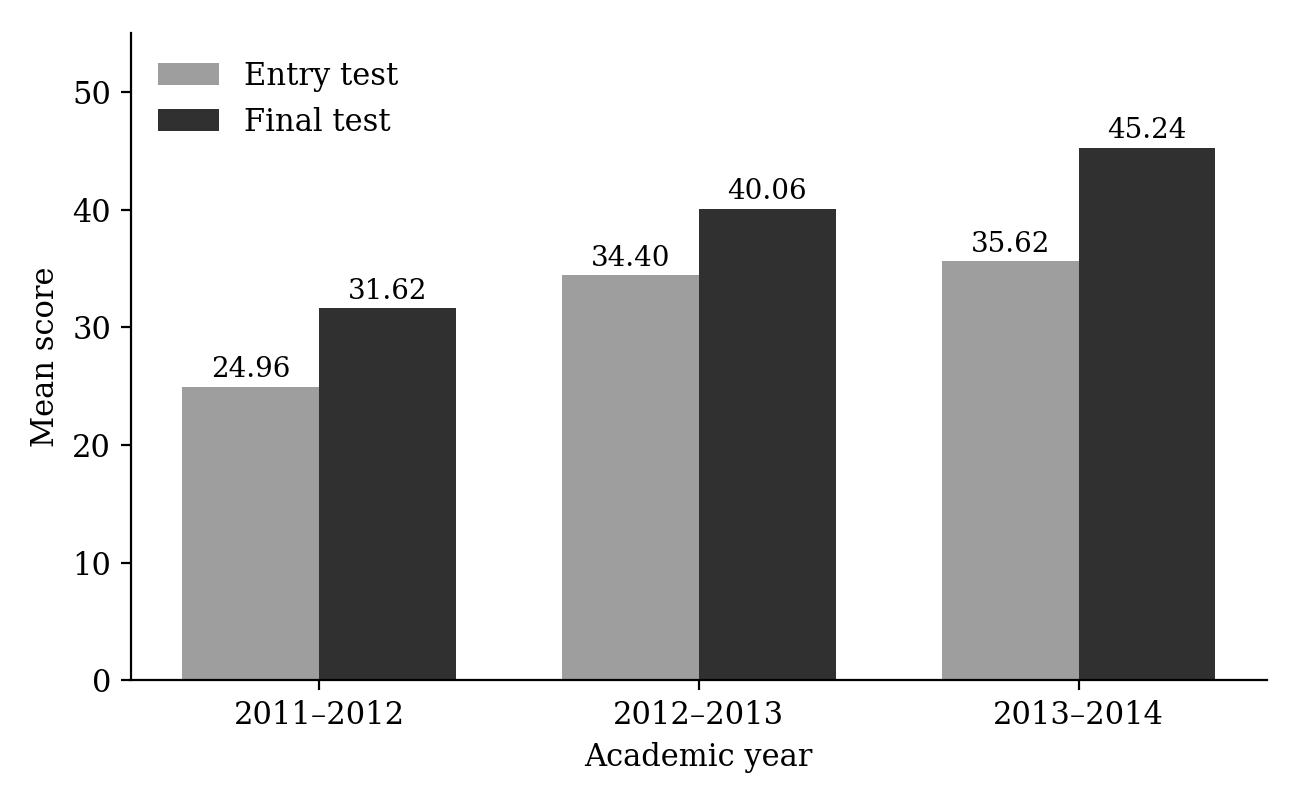
The main aspects of foreign language proficiency were then analyzed on the basis of the entry and final tests. The entry and final tests followed the TOEFL format and covered Listening Comprehension, Reading Comprehension, and the Test of Written English. The entry and final testing (see Table 8) revealed the strengths and weaknesses of the language training of first-year students at the Institute of Power Engineering.
Table 8
Test Results by Section
| Group | Test | Listening Comprehension | Reading | Structure and Written Expression |
|---|---|---|---|---|
| Group I | ET 2011–2012 | 3.10% | 7.10% | 10.20% |
| FT 2011–2012 | 5.60% | 9.02% | 17.00% | |
| Total gain | 2.50% | 1.92% | 6.80% | |
| Group II | ET 2012–2013 | 4.20% | 13.10% | 17.10% |
| FT 2012–2013 | 7.06% | 14.00% | 19.00% | |
| Total gain | 2.86% | 0.90% | 1.90% | |
| Group III | ET 2013–2014 | 5.30% | 14.10% | 16.22% |
| FT 2013–2014 | 9.04% | 16.10% | 20.10% | |
| Total gain | 3.74% | 2.00% | 3.88% |
Note. ET = entry test; FT = final test.
Listening Comprehension. Progress in Listening Comprehension was observed every year from 2011 to 2014. On the final test at the end of the basic Foreign Language course, the gain in Listening Comprehension reached 3.74%. We conclude that, in all groups, in a non-English-speaking environment, that is, in English classes, too little attention had been paid to pronunciation and to the rhythmic and intonational aspects of language training. As a result, students make substantial errors in this section of the test. In 2011–2012, the entry test result was 3.10% and the final result was 5.6%, a gain of 2.5%. A pattern can be seen: the higher the initial level of listening skills, the higher the final gain.
Reading. In the 2011–2012 and 2013–2014 groups, the gain was about 1.92%, and only in 2012–2013 was the gain less than 1%. This is because the entry test showed a relatively high level of lexical and grammatical skills in that group. At the same time, there were gaps that had to be filled before students could move to a new level of study of the lexical and grammatical aspects of the language. More attention was paid to phonetic, rhythmic, and intonational skills, which was necessary because of the initially low entry results in listening. The final gain of the 2012–2013 group was therefore about 3% in listening and about 1% in reading.
Structure and Written Expression. The figures show that the school system places particular emphasis on grammar rather than on speaking and pronunciation, so entry test results in grammar are higher than in the other aspects of the language. At the same time, the level of students’ language training differs from year to year.
At the end of the year, the final test showed that the largest gain was in the first group (2011–2012), at 6.8%, with an entry level of grammatical skills of 10.2%. The smallest gain was in the second group (2012–2013), at 1.9%, with an entry level of 17.1% (the highest entry result of the three groups). The third group (2013–2014) showed a final gain of 3.88% and the highest final result, 20.10%.
Conclusion. The analysis of the test results in all three groups shows positive dynamics in the language training of the EG students, with uneven development of the different components.
4.1.1 Comparison of Experimental and Control Groups
Figures 2–4 show the development of foreign language competence in the control and experimental groups of first-year students at the Institute of Power Engineering of the university from 2011 to 2014, by academic year.
Figure 2
Development of Foreign Language Competence in the Control and Experimental Groups, First-Year Students, Institute of Power Engineering (2011–2012)
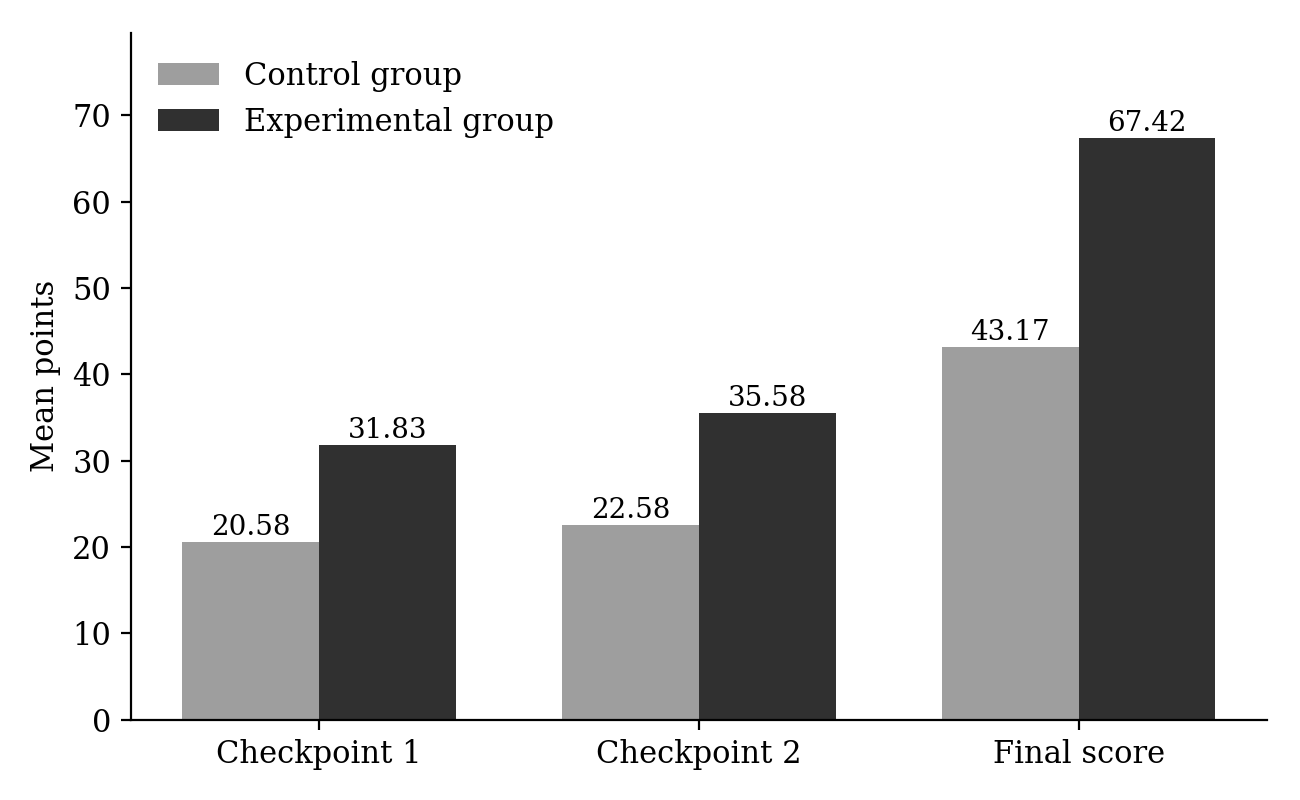
Note. Mean points on the university rating system at Checkpoint 1, Checkpoint 2, and the final score.
Figure 3
Development of Foreign Language Competence in the Control and Experimental Groups, First-Year Students, Institute of Power Engineering (2012–2013)
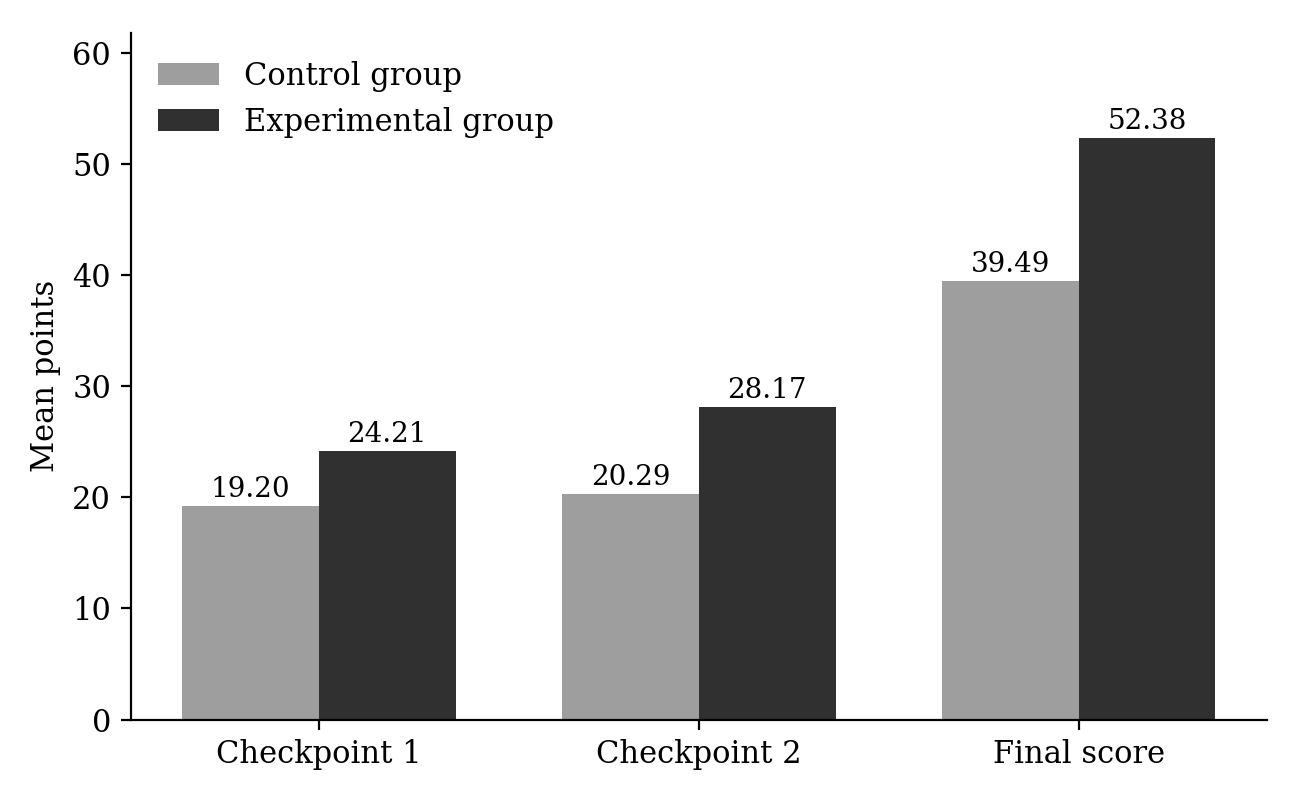
Figure 4
Development of Foreign Language Competence in the Control and Experimental Groups, First-Year Students, Institute of Power Engineering (2013–2014)
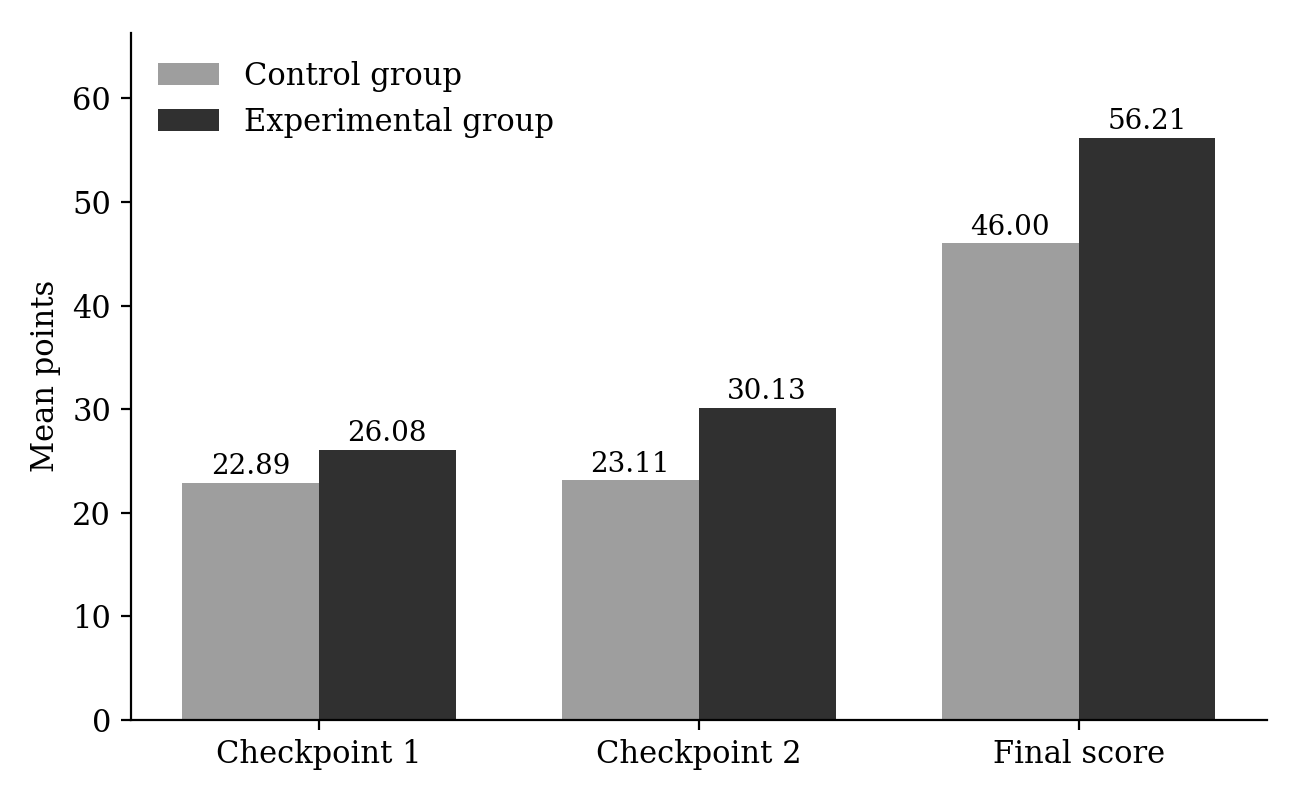
These figures show the difference between the experimental and control groups in mastering foreign language competence: each experimental group shows a larger gain in foreign language competence than the corresponding control group. At the same time, the final scores show that the difference between the EG and the CG decreases somewhat from year to year. This reflects the different initial levels of foreign language preparation of first-year students at the Institute of Power Engineering, as revealed by the entry English progress test.
These results indicate that interactive learning at the university, organized according to the instructional conditions and forms identified and justified in this study, is effective.
Baseline stage. Table 9 shows the levels of foreign language competence in the EG and the CG at the baseline stage, grouped as low, intermediate, and high.
Table 9
Levels of Foreign Language Competence at the Baseline Stage
| Competence | Level | EG (n) | EG (%) | CG (n) | CG (%) |
|---|---|---|---|---|---|
| Foreign language competence | High | 5 | 21 | 3 | 13 |
| Intermediate | 13 | 54 | 12 | 50 | |
| Low | 6 | 25 | 9 | 37 |
To determine whether the experimental group exceeded the control group in the level of foreign language competence, the Mann-Whitney test was applied to two small samples (sample 1 = EG, sample 2 = CG) of equal size, n1 = 24 and n2 = 24. Table 10 shows the individual ranks and the rank sum for each sample.
Table 10
Ranks of the Experimental and Control Groups at the Baseline Stage
| No. | Sample 1 (EG) | Rank 1 | Sample 2 (CG) | Rank 2 |
|---|---|---|---|---|
| 1 | 1 | 8 | 1 | 8 |
| 2 | 1 | 8 | 1 | 8 |
| 3 | 1 | 8 | 1 | 8 |
| 4 | 1 | 8 | 1 | 8 |
| 5 | 1 | 8 | 1 | 8 |
| 6 | 1 | 8 | 1 | 8 |
| 7 | 2 | 28 | 1 | 8 |
| 8 | 2 | 28 | 1 | 8 |
| 9 | 2 | 28 | 1 | 8 |
| 10 | 2 | 28 | 2 | 28 |
| 11 | 2 | 28 | 2 | 28 |
| 12 | 2 | 28 | 2 | 28 |
| 13 | 2 | 28 | 2 | 28 |
| 14 | 2 | 28 | 2 | 28 |
| 15 | 2 | 28 | 2 | 28 |
| 16 | 2 | 28 | 2 | 28 |
| 17 | 2 | 28 | 2 | 28 |
| 18 | 2 | 28 | 2 | 28 |
| 19 | 2 | 28 | 2 | 28 |
| 20 | 3 | 44.5 | 2 | 28 |
| 21 | 3 | 44.5 | 2 | 28 |
| 22 | 3 | 44.5 | 3 | 44.5 |
| 23 | 3 | 44.5 | 3 | 44.5 |
| 24 | 3 | 44.5 | 3 | 44.5 |
| Sum | 634.5 | Sum | 541.5 |
Note. Levels: 1 = low, 2 = intermediate, 3 = high. Uemp = 241.5. Critical values: Ucr = 174 (p ≤ .01) and 207 (p ≤ .05).
In ranking, the two samples are combined into one, and the lowest value receives the lowest rank. For example, a score of 1 was received by 6 students in the EG and 9 students in the CG, so the score of 1 occupies the first 15 positions. The rank for a score of 1 is therefore the mean of positions 1 through 15, which is 8.
The rank sum for sample 1 (EG) is 634.5, and the rank sum for sample 2 (CG) is 541.5. The larger sum, Tx, is 634.5. Applying the formula:
Uemp = 24 · 24 + 24(24 + 1) / 2 − 634.5 = 241.5
The critical value at the .01 significance level is 174. Because Uemp = 241.5 > 174, we conclude that at the baseline stage the EG did not exceed the CG in the level of foreign language competence.
Final stage. The same procedure was applied to the data from the final stage (Tables 11 and 12).
Table 11
Levels of Foreign Language Competence at the Final Stage
| Competence | Level | EG (n) | EG (%) | CG (n) | CG (%) |
|---|---|---|---|---|---|
| Foreign language competence | High | 18 | 75 | 7 | 29 |
| Intermediate | 4 | 17 | 10 | 42 | |
| Low | 2 | 8 | 7 | 29 |
Table 12
Ranks of the Experimental and Control Groups at the Final Stage
| No. | Sample 1 (EG) | Rank 1 | Sample 2 (CG) | Rank 2 |
|---|---|---|---|---|
| 1 | 1 | 5 | 1 | 5 |
| 2 | 1 | 5 | 1 | 5 |
| 3 | 2 | 16.5 | 1 | 5 |
| 4 | 2 | 16.5 | 1 | 5 |
| 5 | 2 | 16.5 | 1 | 5 |
| 6 | 2 | 16.5 | 1 | 5 |
| 7 | 3 | 36 | 1 | 5 |
| 8 | 3 | 36 | 2 | 16.5 |
| 9 | 3 | 36 | 2 | 16.5 |
| 10 | 3 | 36 | 2 | 16.5 |
| 11 | 3 | 36 | 2 | 16.5 |
| 12 | 3 | 36 | 2 | 16.5 |
| 13 | 3 | 36 | 2 | 16.5 |
| 14 | 3 | 36 | 2 | 16.5 |
| 15 | 3 | 36 | 2 | 16.5 |
| 16 | 3 | 36 | 2 | 16.5 |
| 17 | 3 | 36 | 2 | 16.5 |
| 18 | 3 | 36 | 3 | 36 |
| 19 | 3 | 36 | 3 | 36 |
| 20 | 3 | 36 | 3 | 36 |
| 21 | 3 | 36 | 3 | 36 |
| 22 | 3 | 36 | 3 | 36 |
| 23 | 3 | 36 | 3 | 36 |
| 24 | 3 | 36 | 3 | 36 |
| Sum | 724 | Sum | 452 |
Note. Levels: 1 = low, 2 = intermediate, 3 = high. Uemp = 152. Critical values: Ucr = 174 (p ≤ .01) and 207 (p ≤ .05).
At the end of the experimental teaching, Uemp was 152, with a critical value at the .01 level of 174. Because 152 < 174, we conclude that the EG exceeded the CG in the level of foreign language competence. The null hypothesis was therefore rejected, and the alternative hypothesis was accepted.
4.2 Analysis of Students’ Reflective Writing
The results for each sentence stem completed by the 72 students are presented below.
“In our foreign (English) language classes, we learned not only grammar and vocabulary but also…” 93% (66 students): “…to apply the language in practice”; 81% (58): “…to speak in public”; 70% (50): “…we studied the pronunciation of words in conversational style and learned texts that strengthened our knowledge and pronunciation”; 66% (47): “…we talked about various news stories (media) from that day”; 64% (46): “…we learned ‘speaking’ (conversational English), learned various phrases, and learned to express our thoughts logically”; 57% (41): “…to work in a team”; 53% (38): “…we communicated on various topics in English”; 47% (33): “…we learned to communicate freely in English”; 40% (29): “…to approach problem solving creatively”; 35% (25): “…we broadened our horizons”; 30% (21): “…we analyzed difficult texts and tried to retell them in our own words, and learned a lot about the English language itself”; and 20% (14): “…to use English in life.”
The responses fall into two groups according to the skills students emphasized: subject-specific academic skills or interactive skills (Table 13).
Table 13
Groups of Skills Students Identified as Important
| Subject-specific academic skills | Interactive skills |
|---|---|
| 70% (50) …we studied the pronunciation of words in conversational style and learned texts that strengthened our knowledge and pronunciation | 93% (66) …to apply the language in practice |
| 64% (46) …we learned “speaking” (conversational English), learned various phrases, and learned to express our thoughts logically | 81% (58) …to speak in public |
| 30% (21) …we analyzed difficult texts and tried to retell them in our own words, and learned a lot about the English language itself | 66% (47) …we talked about various news stories (media) from that day |
| 57% (41) …to work in a team | |
| 53% (38) …we communicated on various topics in English | |
| 47% (33) …we learned to communicate freely in English | |
| 40% (29) …to approach problem solving creatively | |
| 35% (25) …we broadened our horizons | |
| 20% (14) …to use English in life |
The results show that students more often identify as important the interactive skills connected with communication, teamwork, conversation, and public speaking, and that they also note the classes’ focus on broadening their horizons and on creativity. The predominance of this group of skills over subject-specific skills suggests that the skills of interactive learning may become the foundation for subject learning. The responses show that students focus on the teacher’s use of interactive forms, methods, and tools of foreign (English) language instruction and emphasize their effectiveness.
“From the very first class, we learned to work in pairs. When we worked in pairs…” 83% (60): “…we held discussions not only with each other but also with other groups and with the teacher”; 76% (55): “…we had to interact in English and look for ways to complete the task”; 68% (49): “…it was easier to learn the language, because we could point out each other’s mistakes”; 66% (48): “…it was very interesting; many interesting situations arose that made us interested in the subject”; 57% (41): “…we exchanged information we had learned earlier and reinforced correct pronunciation”; 53% (38): “…we practiced speaking and pronunciation”; 46% (33): “…we composed dialogues and performed them for each other”; 37% (27): “…we learned conversational English”; 33% (24): “…it was interesting and easy”; and 30% (22): “…we developed the ability to communicate in English.”
Most responses show that students identify interactive skills, that is, skills of interaction, such as discussing and exchanging information. These skills are linked to subject-specific skills: learning conversational language, pronunciation skills, composing dialogues, and so on. A second group of responses shows that students find this way of working interesting (interesting situations, interest in the subject), and in a third group students note that working in pairs is easier than working alone.
“We also worked in groups. In groups, we not only completed tasks but also…” 95% (68): “…actively discussed the problem in our group and with the teacher, held discussions, and learned to work in a team”; 85% (61): “…learned to communicate as a team”; 70% (50): “…communicated in English”; 68% (49): “…practiced conversational speech”; 47% (33): “…learned to improvise in English”; 45% (32): “…made up dialogues and tasks for each other”; 40% (29): “…discussed various topics and analyzed the material”; 37% (27): “…practiced communication skills under time pressure”; and 10% (7): “…held ‘duels’ between groups.”
Most students noted that group work, as a form of interactive learning, was an excellent opportunity for conversation practice in the foreign (English) language. Many students also noted that group interaction helps develop teamwork and discussion skills and is a good way to broaden their horizons and deepen their knowledge of the topic. Some students also noted opportunities for creativity, such as improvising in English, making up dialogues and tasks for each other, and “duels” between groups.
“I liked Conference Week as a form of interim assessment because…” 97% (70): “…we could choose a topic we liked and prepare an interesting presentation”; 92% (66): “…we had to look for additional information on the topic, which deepened our knowledge of the field”; 85% (61): “…you can gain public speaking skills”; 84% (60): “…we could see the different work of the participants and ask them questions”; 77% (55): “…we learned to present the material properly”; 73% (53): “…I find the presentation format itself interesting”; 72% (52): “…it is an excellent way to test the knowledge we have gained and to learn many interesting things”; 69% (50): “…this format developed a creative approach to the work”; and 57% (41): “…it is another way to improve my English and practice conversation.”
The analysis of these responses shows that Conference Week, as a form of interactive learning, is a motivating factor that activates students’ independent cognitive and creative activity. Students noted as positive the opportunity to choose a presentation topic according to their interests and the need to search for additional information that broadens and deepens their knowledge of the field. Many students saw Conference Week as a good opportunity to learn to present material competently and to gain experience of public speaking and discussion. Many students were also interested in the opportunity to become familiar with the work of other conference participants. There were no negative evaluations of Conference Week. Only three students made critical remarks: “…all the assessment events in all subjects were concentrated in a short period of time”; “…because it took place only twice a semester”; and “…I was a little afraid of giving my presentation.”
“What I liked most in class was…” 95% (68): “…talking on a free topic, because it will be useful to me in the future, and classes on such topics were fun and very informative”; 93% (67): “…I liked giving presentations, analyzing and learning texts, and working in pairs and groups”; 90% (65): “…the way the teacher presented the material; the presentation was simple and accessible to people with different levels of English”; 84% (60): “…giving presentations, because they showed what I had learned during the semester”; 83% (60): “…the teacher’s approach to teaching, because we studied specific topics that we will encounter in real life”; 80% (58): “…individual assignments, because they turned out to be the most effective”; 73% (53): “…working with texts, because they were interesting and helped effectively in learning English”; 68% (49): “…the teacher’s positive attitude and ability to present the material”; 60% (43): “…simply communicating in English, which allowed me to learn more words that will be useful later”; 58% (42): “…discussing topics in English, because the teacher has a sense of humor and asks interesting questions”; and 47% (34): “…retelling texts, because we improved our skills and vocabulary.”
Students thus believe that in class they had the opportunity to improve foreign language communicative skills that may be useful to them in the future; to broaden their horizons and their knowledge of the foreign (English) language; to acquire public speaking skills; to acquire skills of communication in pairs and groups; to acquire skills of self-monitoring and self-assessment; and to develop independent work skills. Students evaluated positively the relationship between teacher and students and the teacher’s approach to classes.
“What I liked least in class was…” “…the small number of hours allotted to the subject, because life in today’s world requires deeper knowledge of English”; and “…getting low scores, because I sometimes forgot to do my homework.”
Table 14 summarizes these results.
Table 14
Evidence of the Implementation of the Instructional Conditions of Interactive Learning in Students’ Reflective Writing
| Instructional condition | Evidence in students’ reflective writing |
|---|---|
| Activating students’ academic and professional activity by increasing their motivation for professional activity in the foreign language | Opportunity to choose the topic and material for a talk or presentation; opportunity to gain public speaking skills; opportunity to broaden one’s horizons both during the conference and during independent preparation for Conference Week; opportunity to communicate and practice in the foreign (English) language |
| Shifting the teacher’s role from director to the dual role of organizer and participant in joint educational activity with students | Friendly atmosphere; individual approach to students; democratic communication style; the teacher’s ability to present material clearly |
| Using interactive methods and forms of class sessions | Conference Week as a form of organizing learning activity; pair work; group work; dialogue; discussions; debate |
| Developing the content of the course Foreign Language toward interactive learning | Subject-specific academic competencies: lexical, grammatical, phonetic. Interactive competencies: public speaking in the foreign (English) language; group conversation |
Conclusions. The most important outcome for students is command of communicative competencies, which can be divided into subject-specific academic competencies and interactive competencies.
Positive responses are associated with the use of pair and group work. As students note, these forms of work motivate them, increase their interest in the subject, and develop communication and interaction skills.
Students also valued the opportunity, both in class and in independent work, for creativity and for broadening their professional and general horizons.
4.3 Functional and Semantic Content of Joint Activity and the Teacher’s Position in Class
Table 15 shows the distribution of responses of teachers in the experimental group (n = 20).
Table 15
Results of the Identification and Diagnostic Test, Experimental Group of Teachers
| Possible teacher action | Use most often | Use infrequently | Do not use at all | Would like to use more often | Would prefer not to use |
|---|---|---|---|---|---|
| Authoritarian model of organizing joint activity | |||||
| 1. I present the new topic and explain the new material | 11 (55%) | 8 (40%) | 1 (5%) | 0 | 4 (20%) |
| 4. I check students’ homework | 8 (40%) | 9 (45%) | 2 (10%) | 1 (5%) | 6 (30%) |
| 7. I present a model of how to complete the task | 1 (5%) | 17 (85%) | 1 (5%) | 2 (10%) | 6 (30%) |
| 10. I set out the procedure (algorithm) for the work | 7 (35%) | 9 (45%) | 0 | 7 (35%) | 0 |
| 13. I have students practice completing tasks | 8 (40%) | 10 (50%) | 2 (10%) | 0 | 3 (15%) |
| 16. I monitor the accuracy and correctness of students’ use of procedures and models | 4 (20%) | 11 (55%) | 3 (15%) | 2 (10%) | 4 (20%) |
| 19. I evaluate whether tasks have been completed correctly | 7 (35%) | 10 (50%) | 3 (15%) | 0 | 5 (25%) |
| Leadership model of organizing joint activity | |||||
| 2. I provide topics for presentations, papers, and reports | 15 (75%) | 5 (25%) | 0 | 4 (20%) | 0 |
| 5. I create a problem situation | 12 (60%) | 8 (40%) | 0 | 6 (30%) | 0 |
| 8. I allow and “provoke” different positions and lines of reasoning | 12 (60%) | 7 (35%) | 0 | 6 (30%) | 0 |
| 11. I organize online discussions (exchange of opinions in forums) | 6 (30%) | 9 (45%) | 3 (15%) | 10 (50%) | 0 |
| 14. I justify the correct way of solving the assigned task | 7 (35%) | 11 (55%) | 2 (10%) | 0 | 3 (15%) |
| 17. I encourage students’ independent work | 14 (70%) | 5 (25%) | 0 | 4 (20%) | 0 |
| 20. I use small-group work | 16 (80%) | 3 (15%) | 1 (5%) | 0 | 0 |
| Partnership model of organizing joint activity | |||||
| 3. I develop the criteria for assessment (self-assessment and peer assessment) together with students | 9 (45%) | 11 (55%) | 0 | 5 (25%) | 0 |
| 6. I encourage and support students’ initiatives | 16 (80%) | 3 (15%) | 0 | 4 (20%) | 0 |
| 9. I involve all the different participants in joint work | 10 (50%) | 9 (45%) | 0 | 7 (35%) | 0 |
| 12. In difficult situations, I propose that we work out and make decisions together | 11 (55%) | 8 (40%) | 1 (5%) | 6 (30%) | 0 |
| 15. I organize discussion and teach students to listen to and understand one another | 16 (80%) | 3 (15%) | 0 | 3 (15%) | 0 |
| 18. I organize consultation and support for students | 4 (20%) | 14 (70%) | 1 (5%) | 9 (45%) | 0 |
| 21. I use students’ life experience in working with the material and topic of the lesson | 19 (95%) | 1 (5%) | 0 | 0 | 0 |
The diagnosis of the experimental group (Department of Foreign Languages, Institute of Power Engineering) showed the following distribution of actions by frequency of use and by preference within the three models of joint activity (Table 16).
Table 16
Distribution of Experimental Group Teachers’ Responses by Actions Typical of Each Model of Joint Activity
| Model of joint activity | Use most often | Use infrequently | Do not use at all | Would like to use more often | Would prefer not to use |
|---|---|---|---|---|---|
| Authoritarian | 32% | 53% | 9% | 9% | 20% |
| Leadership | 59% | 34% | 4% | 21% | 2% |
| Partnership | 61% | 35% | 1.4% | 24% | 0% |
Only 32% of EG teachers use actions typical of the authoritarian model of organizing joint activity in their practice, and 20% would prefer not to use such actions. Fifty-three percent of teachers use actions of the authoritarian model infrequently, and only 9% would like to use them more often. The actions of this model in greatest use are “I present the new topic and explain the new material” (55%), “I check students’ homework” (40%), “I have students practice completing tasks” (40%), and “I set out the procedure for the work” (35%). Thirty percent of teachers would prefer not to check students’ homework or present a model of how to complete a task. As the responses show, teachers use the actions needed to organize the instructional mode of the class: explanation, monitoring, and the setting of procedures for students’ actions, which are necessary to build solid subject-specific skills. These actions save time in introducing students to a new topic, consolidating skills, and assessing the current level of those skills.
Fifty-nine percent of teachers use actions within the leadership model of organizing joint activity, and only 2% would prefer not to use them. Thirty-four percent of teachers use leadership actions infrequently, and 21% would like to use them more often. The actions in greatest demand are organizing small-group work (80%), providing topics for reports and presentations (75%), and encouraging students’ independent work (70%). In our view, the demand for actions typical of the leadership model reflects teachers’ desire to develop general cultural competencies, such as the capacity for independent learning, which involves setting goals, working with information sources, producing texts for reports, presentations, and talks, conducting discussions, and working in groups. In addition, the teacher’s position as leader makes it possible to activate students’ thinking and communicative resources in class.
The largest share of teachers, 61%, use actions within the partnership model of organizing joint activity. Thirty-five percent of teachers use partnership actions infrequently, and 24% would like to use the partnership model of interaction more often. No teacher expressed opposition to using this model. The actions in greatest demand are using students’ life experience in working with the material and topic of the lesson (95%), encouraging and supporting students’ initiatives (80%), and organizing discussion and teaching students to listen to and understand one another (80%). Most teachers thus regard partnership as a condition of interactive learning and see in this model the resources for students’ agency in learning.
Conclusion. The diagnosis of the functional and semantic content of joint activity and of the teacher’s position in foreign language classes in the experimental group clearly demonstrates teachers’ commitment to the leadership and partnership models of organizing joint activity.
Table 17 shows the distribution of responses of teachers in the control group (n = 17).
Table 17
Results of the Identification and Diagnostic Test, Control Group of Teachers
| Possible teacher action | Use most often | Use infrequently | Do not use at all | Would like to use more often | Would prefer not to use |
|---|---|---|---|---|---|
| Authoritarian model of organizing joint activity | |||||
| 1. I present the new topic and explain the new material | 12 (70.6%) | 5 (29.4%) | 0 | 0 | 2 (11.8%) |
| 4. I check students’ homework | 12 (70.6%) | 3 (17.6%) | 0 | 0 | 2 (11.8%) |
| 7. I present a model of how to complete the task | 14 (82.4%) | 2 (11.8%) | 0 | 1 (5.9%) | — |
| 10. I set out the procedure (algorithm) for the work | 14 (82.4%) | 3 (17.6%) | 0 | 0 | 0 |
| 13. I have students practice completing tasks | 16 (94.1%) | 0 | 0 | 1 (5.9%) | 1 (5.9%) |
| 16. I monitor the accuracy and correctness of students’ use of procedures and models | 13 (76.5%) | 3 (17.6%) | 0 | 1 (5.9%) | 1 (5.9%) |
| 19. I evaluate whether tasks have been completed correctly | 16 (94.1%) | 1 (5.9%) | 0 | 0 | 0 |
| Leadership model of organizing joint activity | |||||
| 2. I provide topics for presentations, papers, and reports | 5 (29.4%) | 11 (64.7%) | 0 | 6 (35.3%) | 0 |
| 5. I create a problem situation | 2 (11.8%) | 10 (58.8%) | 2 (11.8%) | 10 (58.8%) | 0 |
| 8. I allow and “provoke” different positions and lines of reasoning | 4 (23.5%) | 10 (58.8%) | 1 (5.9%) | 8 (47.1%) | 1 (5.9%) |
| 11. I organize online discussions (exchange of opinions in forums) | 0 | 8 (47.1%) | 6 (35.3%) | 7 (41.2%) | 3 (17.6%) |
| 14. I justify the correct way of solving the assigned task | 7 (41.2%) | 9 (52.9%) | 0 | 2 (11.8%) | 0 |
| 17. I encourage students’ independent work | 7 (41.2%) | 9 (52.9%) | 1 (5.9%) | 4 (23.5%) | 1 (5.9%) |
| 20. I use small-group work | 6 (35.3%) | 10 (58.8%) | 1 (5.9%) | 7 (41.2%) | 0 |
| Partnership model of organizing joint activity | |||||
| 3. I develop the criteria for assessment (self-assessment and peer assessment) together with students | 2 (11.8%) | 5 (29.4%) | 7 (41.2%) | 7 (41.2%) | 3 (17.6%) |
| 6. I encourage and support students’ initiatives | 7 (41.2%) | 9 (52.9%) | 0 | 6 (35.3%) | 1 (5.9%) |
| 9. I involve all the different participants in joint work | 4 (23.5%) | 12 (70.6%) | 0 | 8 (47.1%) | 1 (5.9%) |
| 12. In difficult situations, I propose that we work out and make decisions together | 3 (17.6%) | 10 (58.8%) | 3 (17.6%) | 5 (29.4%) | 0 |
| 15. I organize discussion and teach students to listen to and understand one another | 6 (35.3%) | 9 (52.9%) | 1 (5.9%) | 7 (41.2%) | 0 |
| 18. I organize consultation and support for students | 4 (23.5%) | 13 (76.5%) | 0 | 1 (5.9%) | 0 |
| 21. I use students’ life experience in working with the material and topic of the lesson | 4 (23.5%) | 11 (64.7%) | 1 (5.9%) | 5 (29.4%) | 0 |
Note. A dash indicates that no value was reported in the original table.
The diagnosis of the control group (Department of Foreign Languages, Institute of Natural Resources) showed the following distribution of actions by frequency of use and by preference within the three models of joint activity (Table 18).
Table 18
Distribution of Control Group Teachers’ Responses by Actions Typical of Each Model of Joint Activity
| Model of joint activity | Use most often | Use infrequently | Do not use at all | Would like to use more often | Would prefer not to use |
|---|---|---|---|---|---|
| Authoritarian | 81.5% | 14.2% | 0% | 2.5% | 5% |
| Leadership | 26% | 56.2% | 8.4% | 36.9% | 4% |
| Partnership | 25.2% | 58.7% | 10% | 32.7% | 4.2% |
The overwhelming majority of teachers, 82%, most often use actions of the authoritarian model of organizing joint activity. For example, 94% of teachers have students practice completing tasks, 82% set out the procedure for the work, and 77% monitor the accuracy and correctness of students’ use of procedures and models. Fourteen percent of teachers use these actions infrequently, and 3% would like to use them more often. Only 5% of all teachers would prefer not to use the actions of this model. No clear gaps between actual and preferred actions in the authoritarian model were found among CG teachers.
Of the CG teachers, 26% said that they use actions of the leadership model fairly often, and 56.2% use them infrequently. Four percent of teachers would prefer not to use the actions of this model, and 36.9% would like to use them more often. This indicates a fairly large gap between actual and preferred actions in the leadership model among CG teachers (the level of desired actions is higher than the level of actual actions). For example, 58.8% of teachers would like to create problem situations more often, 47.1% would like to allow and “provoke” different positions and lines of reasoning more often, and 41.2% would like to use small-group work more often. This gap shows teachers’ aspiration toward actions of the leadership model of organizing joint activity. It should be noted that 8.4% of teachers do not use actions typical of the leadership model at all.
Of the CG teachers, 25.2% said that they often use actions within the partnership model of organizing joint activity, and 58.7% use actions of this model infrequently; only 4.2% would prefer not to use them, and 32.7% expressed a desire to use actions typical of partnership more often. There is thus a large gap between actual and preferred actions among CG teachers. As with the leadership model, there is a desire to use actions typical of the partnership model. For example, 47.1% of teachers would like to involve all the different participants in joint work, 41.2% would like to organize discussion and teach students to listen to and understand one another, and 29.4% would like to propose, in difficult situations, that decisions be worked out and made together. Ten percent of teachers said that they do not use actions within this model at all.
The diagnosis of the functional and semantic content of joint activity and of the teacher’s position in foreign language classes in the control group thus clearly demonstrates teachers’ commitment to the authoritarian model of organizing joint activity, as well as large gaps (in which the desired level exceeds the actual level) within the leadership and partnership models. Table 19 compares the results of the experimental and control groups.
Table 19
Comparison of Results: Institute of Power Engineering (EG) and Institute of Natural Resources (CG)
| Model | Use most often (EG) | Use most often (CG) | Use infrequently (EG) | Use infrequently (CG) | Do not use at all (EG) | Do not use at all (CG) | Would like to use more often (EG) | Would like to use more often (CG) | Would prefer not to use (EG) | Would prefer not to use (CG) |
|---|---|---|---|---|---|---|---|---|---|---|
| Authoritarian | 32% | 81.5% | 53% | 14.2% | 9% | 0% | 9% | 2.5% | 20% | 5% |
| Leadership | 59% | 26% | 34% | 56.2% | 4% | 8.4% | 21% | 36.9% | 2% | 4% |
| Partnership | 61% | 25.2% | 35% | 58.7% | 1.4% | 10% | 24% | 32.7% | 0% | 4.2% |
The comparison shows that actions typical of the leadership and partnership models predominate in the EG, whereas CG teachers more often use actions typical of the authoritarian model. The CG also shows a large gap between a high desired level and a low actual level within the leadership and partnership models of joint activity. Only 26% of CG teachers use actions typical of the leadership model, while 37% would like to use the leadership model more often. The same gap appears in the CG for actions typical of the partnership model: 25% actually use them, while 33% would like to. No such gaps appear in the EG: teachers readily use actions typical of the leadership and partnership models and would like to use them more often.
Chapter 5. Discussion and Conclusions
This chapter summarizes the findings of the experimental teaching, discusses them in relation to the research objectives, and presents the conclusions of the study, its limitations, and directions for further research.
5.1 Summary of the Findings
The experimental teaching that implemented the instructional conditions and forms of interactive foreign (English) language instruction showed the following.
Condition 1: Activating students’ academic and professional activity. This condition was implemented through discussions (including online discussions); exchanges of opinion (in chat and forums); opportunities for self-monitoring and self-assessment; students’ choice of the topic and material for a talk or presentation; connections between the subject material and students’ future professional work; and access to various additional, recommended, and external information sources (internet resources). Conference Week became an educational event designed specifically to develop motivation for professional and quasi-professional activity.
Condition 2: Shifting the teacher’s role from director to the dual role of organizer and participant. This condition appeared as an expansion of the teacher’s role repertoire, which came to include the positions of organizer-consultant, organizer-expert, and moderator-participant. The choice of position depended both on the features of the particular form of interactive instruction and on the stage of its implementation. Students, in turn, became meaningful and influential participants in the activity, as shown in actions such as initiating, choosing, designing, reflecting, and peer and self-assessment.
Condition 3: Using interactive methods and forms of class sessions. This condition was implemented through the following forms and methods: Conference Week, autonomous learning, consultation (including online consultations), discussion (including online discussion), presentations, small-group work, peer assessment, and the imitation method.
Condition 4: Developing the content of the course Foreign Language toward interactive learning. This condition was implemented through students’ navigation of the foreign-language information space for self-education or to find professionally relevant information; work in an information environment; online discussions on professional topics; peer review; and work with various information sources (video, audio, and text files).
The experimental teaching led to the following conclusions. First, progress was observed in lexical, grammatical, and phonetic skills: the average gain was 7% in 2011–2012, 3% in 2012–2013, and almost 10% in 2013–2014. Second, in their reflective writing, students identified interactive skills as important to them: skills related to communication, teamwork, public speaking, and conducting a dialogue or conversation. Notably, these skills ranked higher in importance than subject-specific skills. Third, the comparative diagnosis of the functional and semantic content of joint activity and of teachers’ positions in foreign language classes showed that actions typical of the leadership and partnership models predominated in the experimental group, whereas control group teachers more often used actions typical of the authoritarian model. The control group also showed a large gap between a high desired level and a low actual level of leadership and partnership actions.
5.2 Discussion
The need to identify instructional conditions for implementing interactive learning arises from the need to make foreign language instruction for engineering students more effective, in line with current requirements for command of foreign language communicative competencies. These competencies are an integral part of engineering students’ professional education today and increase their professionalism and competitiveness in the labor market. The findings are discussed below in relation to the research objectives.
Defining interactive learning. The analysis of interpretations of concepts related to interactive learning in the Russian and international literature made it possible to define interactive learning as an educational process built on dialogic communication, communication, or speech acts, in which students are motivated toward a joint process of inquiry, information seeking, and interaction in foreign (English) language classes. Interactive learning is thus the joint educational activity of teacher and students in which the students are meaningful and influential participants and the teacher is the organizer of, and a participant in, the interaction. This differs from traditional instruction, which assigns the teacher the leading role of director of the learning process and transmitter of knowledge and the student the position of executor. Interactive learning cannot be implemented without the leadership and partnership models of organizing joint activity.
Teachers’ and students’ attitudes at the baseline stage. The surveys of teachers and students at the baseline stage showed that teachers rarely use interactive forms, methods, and tools in their teaching and doubt their effectiveness, regarding them as merely a form of entertainment (a decoration of the learning process). Students, by contrast, viewed the use of interactive methods and tools in English classes positively. In their survey responses, students noted that the educational process becomes more effective, interesting, and informative when active methods of foreign (English) language instruction predominate over traditional ones. These results point to the need for a set of conditions and forms for implementing interactive instruction in foreign (English) language teaching for engineering students.
Instructional conditions. The study identified and justified theoretically the instructional conditions for implementing interactive foreign language instruction for engineering students: activating students’ academic and professional activity in the university’s educational process by increasing their motivation for professional activity in the foreign language; shifting the teacher’s role from director to the dual role of organizer and participant in joint educational activity with students; using interactive methods and forms of class sessions; and developing the content of the course Foreign Language toward interactive learning.
Forms of interactive instruction. The study tested three forms of interactive foreign (English) language instruction: the class session as joint activity of teacher and students based on the partnership and leadership models of organizing it; Conference Week as an interactive form of interim and final assessment of general cultural and foreign language communicative competencies; and the online course as an interactive form of organizing students’ independent work.
Effectiveness of the set of conditions. The empirical study of the implementation of the set of instructional conditions of interactive learning showed that they were effective. First, the experimental groups showed progress in lexical, grammatical, and phonetic skills (attributed to the online course and other interactive forms of work). Second, the student survey showed that the skills students consider important are interactive skills: skills related to communication, teamwork, public speaking, and conducting a dialogue or conversation. This suggests that the skills of interactive learning become a foundation for more effective subject learning. Third, the diagnosis of the functional and semantic content of joint activity and of teachers’ positions in foreign language classes showed that teachers in the experimental group more often use actions typical of the leadership and partnership models of organizing joint activity, thereby implementing an interactive approach to instruction. In the control group, where actions of the authoritarian model predominate, teachers expressed a strong desire to use the leadership and partnership models.
5.3 Conclusions
The results of the study support the research hypothesis. They indicate that effective interactive foreign language instruction at an engineering university requires developing students’ positive motivation; developing the content of the course Foreign Language toward interactive learning and toward students’ professional competencies; and shifting the teacher’s position from director to organizer and participant within the leadership and partnership models of organizing the joint activity of teacher and students.
5.4 Limitations of the Study
Several features of the study’s design should be considered in interpreting its results.
- Single institution. The experimental teaching took place at one engineering university, within one institute, and in one course. The results may not transfer directly to other institutions, disciplines, or levels of study.
- Sample size and group assignment. The statistical comparison of experimental and control groups was based on two samples of 24 students each, and the teacher diagnosis on groups of 20 and 17 teachers. The groups were formed from existing academic groups and departments rather than by random assignment.
- Level of measurement. For the Mann-Whitney U test, foreign language competence was classified into three levels (low, intermediate, and high), which produced many tied ranks. A finer-grained measure of proficiency would allow more precise comparison.
- Self-report data. The teacher surveys, the online course survey, students’ reflective writing, and the teacher diagnostic test are based on self-report and may reflect what respondents considered desirable answers.
- Researcher role. The author designed the pronunciation-focused online course PRACTICAL ENGLISH PHONETICS, organized the Conference Weeks, and taught in the experimental groups. This allowed close implementation of the intervention but may also have influenced the outcomes.
5.5 Directions for Further Research
Further research could examine the instructional conditions identified in this study in other universities, disciplines, and student populations; compare interactive and traditional instruction using randomized or matched groups and finer-grained proficiency measures; follow students over a longer period to see how interactive skills developed in the first years of study are used in later professional training; and study how teachers who wish to move from the authoritarian model toward the leadership and partnership models can be supported through professional development.
References
Note. Sources are numbered in the order of the original reference list, and in-text citations use these numbers in square brackets. Titles of Russian-language sources are given in English translation.
Russian-Language Sources
- Abels, H. (1999). Interaction, identity, presentation: An introduction to interpretive sociology [in Russian]. Aleteiia.
- Avetisian, N. G., & Pivovarova, T. D. (2000). Teaching English for business communication in the context of intercultural communication [in Russian]. In Intercultural communication: Theory and practice (pp. 54–65). State University–Higher School of Economics.
- Khaleeva, I. I. (Ed.). (1999). Current problems of intercultural communication: Collected research papers (Issue 444) [in Russian]. Moscow State Linguistic University.
- Almazova, N. I. (2003). Cognitive aspects of developing intercultural competence in foreign language teaching at a non-linguistic university [Doctoral dissertation; in Russian]. St. Petersburg.
- Amonashvili, Sh. A. (1984). The educational and developmental function of assessing schoolchildren’s learning [in Russian]. Pedagogika.
- Andreev, V. I. (1996). The dialectics of education and self-education of the creative personality [in Russian]. Kazan University Press.
- Andreeva, G. M. (2000). The psychology of social cognition: A textbook [in Russian]. Aspekt Press.
- Andreeva, G. M. (2004). Social psychology: A textbook for higher education institutions [in Russian]. Aspekt Press.
- Anikina, Zh. S. (2013). Developing university students’ learner-autonomy skills in foreign language learning with podcasts [Doctoral dissertation abstract; in Russian]. Nizhny Novgorod.
- Anisimov, O. S. (2006). Developmental games. Game techniques. Methodology (Vol. 1) [in Russian]. Russian Academy of Advanced Training.
- Arutiunov, Iu. S., Birshtein, M. M., & Burkov, V. N. (1980). Methodological guidelines for classifying active learning methods [in Russian]. Kyiv Civil Engineering Institute.
- Aslamova, T. V. (2001). Methods of organizing student interaction in teaching oral communication: English at a non-linguistic university [Doctoral dissertation; in Russian]. Moscow.
- Aslamova, T. V. (2002). An interactive model of teaching oral foreign language communication at a non-linguistic university [in Russian]. In Modern means of achieving the goals of foreign language teaching under the new program (non-linguistic universities) (No. 467, pp. 48–60). Moscow State Linguistic University.
- Babanskii, Iu. K. (1991). Optimizing the teaching and upbringing process [in Russian]. Prosveshchenie.
- Badmaev, B. Ts. (1998). The psychology and methodology of accelerated high-quality learning [in Russian]. Vlados.
- Barr, R. B., & Tagg, J. (2001). From teaching to learning: A new paradigm for higher education (R. E. Gailevich, Trans.) [in Russian]. In University education: From effective teaching to effective learning (pp. 13–39). Center for Problems of Education Development.
- Barybin, A. V. (1982). Instructional conditions for foreign language learning in the system of continuing professional education for adults [in Russian]. New Research in Psychology, (1), 56.
- Bezrukova, V. S. (1996). Pedagogy. Projective pedagogy: A textbook [in Russian]. Delovaia kniga.
- Belikov, V. A. (1995). Didactic foundations of organizing schoolchildren’s learning and cognitive activity [Doctoral dissertation; in Russian]. Magnitogorsk.
- Belich, V. V. (1991). Cognitive reflection [in Russian]. Chelyabinsk State University Press.
- Belova, S. V. (2002). Dialogue as the basis of the teaching profession: A teaching guide [in Russian]. APKiPRO.
- Benin, V. L. (Comp.). (2009). Culture and education: A terminological dictionary (2nd ed.) [in Russian]. Magnitogorsk State University Press.
- Burns, R. (1986). Developing the self-concept and education [in Russian]. Progress.
- Biziaeva, S. A. (2007). Game-based forms of interactive learning as a means of developing students’ cognitive interest [Doctoral dissertation; in Russian]. Yaroslavl.
- Birshtein, M. M., & Bel’chikov, Ia. M. (1989). Business games [in Russian]. Avots.
- Boguslavskii, M. V. (1994). The development of general secondary education: Problems and solutions. From the history of Russian pedagogy of the 1920s (Z. I. Ravkin, Ed.) [in Russian]. Institute of Theoretical Pedagogy and International Research in Education, Russian Academy of Education.
- Bonwell, C. C., & Sutherland, T. E. (2001). The active learning continuum: Choosing activities to engage students in the classroom [in Russian]. In University education: From effective teaching to effective learning (pp. 47–66). Minsk.
- Bratchenko, S. L. (2001). The existential psychology of deep communication: Lessons of James Bugental [in Russian]. Smysl.
- Vachkov, I. V. (1999). Foundations of group training technology. Psychotechniques: A textbook [in Russian]. Os’-89.
- Verbitskii, A. A. (1991). Active learning in higher education: A contextual approach [in Russian]. Vysshaia shkola.
- Volina, M. G. (2008). The school psychological service for young people’s self-determination: A textbook [in Russian]. Ural State University of Physical Culture.
- Vorob’ev, A. I. (2009). Intelligence training [in Russian]. Lesnaia promyshlennost’.
- Voronina, G. I. (1991). Report on the research-to-practice conference “Early Foreign Language Learning: Problems and Prospects” [in Russian]. Foreign Languages at School, (5), 85–90.
- Vygotsky, L. S. (1968). The psychology of art [in Russian]. Iskusstvo.
- Gaisina, A. Ia. (1997). Teaching professional communication through text: English at a non-linguistic university [Doctoral dissertation; in Russian]. Moscow.
- Gal’skova, N. D., & Nikitenko, Z. N. (2004). Theory and practice of foreign language teaching [in Russian]. Airis-Press.
- Geikhman, L. K. (2002a). Interactive teaching of communication: Approach and model [in Russian]. Perm State University Press.
- Geikhman, L. K. (2002b). Teaching communication through interaction: An interactive approach [in Russian]. Education and Science, (3), 135.
- Grigal’chik, E. K., & Gubarevich, D. I. (2003). Teaching differently: A strategy of active learning [in Russian]. Minsk.
- Gubina, N. M. (2004). Developing students’ intercultural competence in teaching business English in an elective special course [Doctoral dissertation; in Russian]. Moscow.
- Guliaeva, I. V. (2006). Developing student agency in interactive learning [in Russian]. Bulletin of Orenburg State University, (10), 31–35.
- Dvulichanskaia, N. N. (2011). Organizational and instructional conditions for improving learners’ professional competence in continuing science education [in Russian]. Science and Education, (3), 2.
- Diesterweg, A. (1956). A guide to the education of German teachers [in Russian]. In Selected pedagogical works (pp. 136–203). Uchpedgiz.
- Dobroliubov, N. A. (1934). Complete works (Vol. 1) [in Russian]. GIKhL.
- Dewey, J., & Dewey, E. (1922). Schools of tomorrow [in Russian]. Gosizdat.
- Evdokimova, M. G. (2007). A system of foreign language teaching based on information and communication technology [Doctoral dissertation abstract; in Russian]. Moscow.
- Emelina, M. V. (n.d.). Interactive learning in a school’s system of methodological work [in Russian]. Retrieved January 10, 2016, from http://festival.1september.ru/articles/313034/
- Ermolaeva, L. M. (1975). Methods of teaching the reading of specialized texts at the advanced (elective) stage of a non-linguistic university [Doctoral dissertation abstract; in Russian]. Moscow.
- Andrianova, L. N., Bagrova, N. Iu., & Ershova, E. V. (2007). An English course for evening and distance-learning engineering universities [in Russian]. Vysshaia shkola.
- Zhuk, A. I., & Koshel’, N. N. (2004). Active teaching methods in the system of teachers’ professional development [in Russian]. Aversev.
- Zankov, L. V. (1994). On types of communication in learning [in Russian]. Voprosy Psikhologii, (6), 174–179.
- Zakharov, V. P. (1990). Practical recommendations for leading social-psychological training groups: Guidelines [in Russian]. Leningrad State Technical University.
- Zimniaia, I. A. (2004). Educational psychology: A textbook for universities [in Russian]. Logos.
- Il’in, E. P. (2006). Motivation and motives: A textbook for universities [in Russian]. Piter.
- University document. (n.d.). Instructions for working in the Moodle learning environment [in Russian]. Retrieved January 10, 2016, from http://stud.lms.tpu.ru/pluginfile.php/51/block_html/content/instrukcia_moodle.pdf
- Information and analytical review: Interactive teaching methods in institutions of higher professional education [in Russian]. (n.d.). Retrieved January 10, 2016, from http://do.gendocs.ru/docs/index-235347.html
- Kalmykova, E. I. (2000). Developing communicative competence for oral professional communication [in Russian]. In Professional communication as a goal of foreign language teaching at a non-linguistic university (Issue 454, pp. 44–53). Moscow State Linguistic University.
- Kashlev, S. S. (2005). The technology of interactive learning [in Russian]. Minsk.
- Kozlenkova, E. A. (2009). Methodological foundations for creating a distance course in written translation in continuing education: English at a non-linguistic university [Doctoral dissertation; in Russian]. Moscow.
- Kolesnik, N. P. (2007). Using interactive forms of studying pedagogy at the university [Doctoral dissertation abstract; in Russian]. St. Petersburg.
- Comenius, J. A. (1996). An anthology of humane pedagogy [in Russian]. Shalva Amonashvili Publishing House.
- Kondratenko, E. V. (2011). Implementing interactive learning technologies in university instruction: The example of the Moodle platform [in Russian]. In Current problems of professional technical education: Proceedings of the international scientific and methodological conference, October 20–21, 2011 (pp. 86–90). Mari State Technical University.
- Korotaeva, E. V. (2003). Teaching technologies in schoolchildren’s cognitive activity [in Russian]. Sentiabr’.
- Kraevskii, V. V., & Khutorskoi, A. V. (2007). Foundations of instruction. Didactics and methodology: A textbook [in Russian]. Akademiia.
- Krichevskii, R. L., & Dubovskaia, E. M. (1991). The psychology of the small group: Theoretical and applied aspects [in Russian]. Moscow State University Press.
- Krupnov, A. I., & Priadein, A. K. (1977). On the concept of “activity” [in Russian]. In Personality and activity (pp. 23–25). Moscow.
- Krupchenko, A. K. (2007). The formation of professional linguodidactics as a theoretical and methodological problem in professional education [Doctoral dissertation; in Russian]. Moscow.
- Kulinich, G. S., & Nikolina, V. V. (1991). Geography games at school [in Russian]. Geography at School, (1), 35–38.
- Kurysheva, I. V. (2009). A classification of interactive teaching methods in the context of personal self-realization [in Russian]. Izvestia: Herzen University Journal of Humanities and Sciences, (112), 160–164.
- Latyshina, D. I. (2008). The history of pedagogy. The history of education and pedagogical thought: A textbook [in Russian]. Gardariki.
- Lebedev, A. S. (2001). Developing a subject position in creative activity among students of a teacher-training college [Doctoral dissertation abstract; in Russian]. Moscow.
- Leont’ev, A. A. (1974). The psychology of communication [in Russian]. Znanie.
- Lewis, R. D. (2001). When cultures collide [Russian translation: Business cultures in international business]. Delo.
- Makarenko, A. S. (1957–1960). Collected works (Vols. 1–7) [in Russian]. Moscow.
- Makhotin, D. A. (n.d.). Interactive learning in economics lessons [in Russian]. Eidos. Retrieved July 18, 2016, from http://www.eidos.ru/journal
- Mashura, E. A., & Semchuk, N. M. (2012). A classification of interactive techniques in teaching biology [in Russian]. Yaroslavl Pedagogical Bulletin, 2(1). http://vestnik.yspu.org/releases/2012_1pp/20.pdf
- Mekeko, N. M. (2008). Teaching English to distance-learning students (methodological problems) [in Russian]. Academy of Economic Security of the Ministry of Internal Affairs of Russia.
- Withington, R., et al. (1993). The world begins with me [in Russian]. Association of Social Pedagogues and Social Workers.
- Mikhailova, E. A. (1999). The case and the case method: General concepts [in Russian]. Marketing, (1), 109–117.
- University document. (n.d.). Monitoring the quality of language training of university students and staff [in Russian]. Retrieved January 10, 2016, from http://portal.tpu.ru/departments/otdel/omkyap
- Nain, A. Ia. (2006). Reflective management of a professional pedagogical educational institution: A monograph [in Russian]. Cheliabinskii rabochii.
- Nemov, R. S. (1997). Psychology: Book 1. General foundations of psychology [in Russian]. Prosveshchenie.
- Nikolina, V. V. (2008). Interactive pedagogical technologies in teacher education as a means of developing professional competence [in Russian]. Rossica Olomucensia, 46(2), 241–244.
- On amendments to certain legislative acts regarding the concept and structure of the State Educational Standard [Federal Law of December 1, 2007; in Russian]. (2007). Vagrius.
- Government of the Russian Federation. (2011). On the Concept of the Federal Target Program for the Development of Education for 2010–2015 [Decree No. 163-r of February 7, 2011; in Russian]. ConsultantPlus legal database.
- Obrydina, T. I. (2010). Developing the professional competencies of future teachers in foreign language instruction [in Russian]. Pedagogical University Bulletin, (1), 32–35.
- Prof. Alex (2012). On the problem of organizing interactive foreign language instruction at the university [in Russian]. Pedagogical University Bulletin, (11), 120–124.
- Prof. Alex, & Glukhii, Ia. A. (2014). The use of interactive foreign language instruction in higher education institutions [in Russian]. Modern Problems of Science and Education, (3), 267.
- Prof. Alex (2014). University teachers’ attitudes toward interactive foreign language instruction [in Russian]. Pedagogical University Bulletin, (1), 90–93.
- Council of Europe. (2003). Common European Framework of Reference for Languages: Learning, teaching, assessment (K. M. Iriskhanova, Ed.; Russian version). Moscow State Linguistic University.
- Orlova, E. B. (1991). Ascent to individuality [in Russian]. Prosveshchenie.
- Panfilova, A. P., et al. (2004). Fundamentals of management: A complete guide to case technologies [in Russian]. Piter.
- Ostapenko, A. A. (2007). Modeling pedagogical reality: Theory and technologies [in Russian]. Narodnoe obrazovanie.
- Panina, T. S., & Vavilova, L. N. (2008). Current ways of activating learning: A textbook for university students [in Russian]. Akademiia.
- Passov, E. I., Kuzovlev, V. P., & Korostelev, V. S. (1991). The goal of foreign language teaching at the present stage of social development. General methodology of foreign language teaching: A reader [in Russian]. Moscow.
- Perfilova, G. V. (1977). Methods of teaching structural words for reading scientific and technical literature at a non-linguistic university (German) [Doctoral dissertation abstract; in Russian]. Moscow.
- Povshednaia, F. V. (2002). Methodological foundations of the future teacher’s professional self-determination: A monograph [in Russian]. Nizhny Novgorod State Pedagogical University Press.
- Podlasyi, I. P. (1999). Pedagogy. A new course: Book 1. General foundations. The learning process [in Russian]. Vlados.
- Pozdeeva, S. I. (2004). The educational content of joint activity in primary school [in Russian]. Del’taplan.
- Pozdeeva, S. I. (2012). The primary school as a space of joint activity [in Russian]. Pedagogical University Bulletin, (2), 58–67.
- Polat, E. S. (2002). The project method: Typology and structure [in Russian]. Lyceum and Gymnasium Education, (9), 9–17.
- Pomelova, M. S., & Artiukhin, O. I. (2012). Interactive forms of instruction in a system of elective courses [in Russian]. World of Science, Culture, and Education, (3), 59–61.
- Privalova, I. V. (2005). Interculture and the verbal sign: Linguocognitive foundations of intercultural communication: A monograph [in Russian]. Gnozis.
- Prozumentova, G. N. (2005). Strategy and program for humanities research on educational innovations [in Russian]. In G. N. Prozumentova (Ed.), Transition to an open educational space: Part 1. The phenomenology of educational innovations (pp. 15–138). University Press.
- University document. (n.d.). Syllabus of the course “Foreign Language” [in Russian]. http://portal.tpu.ru/fond/download_doc/8310/In_Jaz.doc
- Rousseau, J.-J. (1981). Pedagogical works (Vol. 2) [in Russian]. Pedagogika.
- Safonova, V. V. (2008). Methods of foreign language teaching. Language pedagogy in diagrams and tables. Developing the communicative and speech culture of 8th- and 9th-grade students [in Russian]. Evroshkola.
- Sivitskaia, L. A., Smyshliaeva, L. G., & Smyshliaev, A. V. (2010). Implementing the competency-based approach in higher education: Gaps in teachers’ methodological readiness [in Russian]. Pedagogical University Bulletin, (12), 52–55.
- Sinkina, E. A. (2012). Organizational and instructional conditions for developing the professional competencies of engineering university students [in Russian]. PNRPU Bulletin. Mechanical Engineering, Materials Science, (1), 121–126.
- Surmin, Iu. P. (Ed.). (2002). Situational analysis, or the anatomy of the case method [in Russian]. Center for Innovation and Development.
- Smirnova, M. S. (1991). The use of games in teaching economic and social geography [Doctoral dissertation abstract; in Russian]. Moscow.
- Sokolova, I. I. (2010). Teacher education: The challenges of today [in Russian]. Pedagogika, (5), 18–23.
- Sokolova, I. Iu. (2000). A psychological and pedagogical concept for improving the quality of instruction and specialist training, and quality diagnostics [in Russian]. Pedagogical University Bulletin, (8), 33–36.
- Sokolova, I. Iu. (2004). Psychological and pedagogical conditions for activating learners’ cognitive activity and making it effective [in Russian]. Pedagogical University Bulletin, (5), 152–155.
- Soldatova, M. V. (2007). Productive communication as the basis for educating the creative personality: Methodological recommendations [in Russian]. Barnaul.
- Sokolova, E. N. (2004). An integrative-reflective approach to developing the methodological competence of foreign language teachers in continuing professional education [Doctoral dissertation abstract; in Russian]. Moscow.
- Stoliarenko, L. D. (1997). Foundations of psychology (pp. 276–277) [in Russian]. Rostov-on-Don.
- Government of the Russian Federation. (2011). Strategy for the innovative development of the Russian Federation to 2020 [Decree No. 2227-r of December 8, 2011; in Russian]. ConsultantPlus legal database.
- Sungurova, N. L. (2013). Social and psychological features of students’ network interaction in the information and educational space [in Russian]. In The category of “the social” in modern pedagogy and psychology: Proceedings of a research-to-practice conference with international participation (pp. 425–430).
- Sukhomlinskii, V. A. (1979). Selected pedagogical works (Vol. 1) [in Russian]. Pedagogika.
- Tarasevich, N. N. (1990). Acquiring pedagogical mastery [in Russian]. Soviet Pedagogy, (4), 19–22.
- Ter-Minasova, S. G. (2007). War and peace of languages and cultures: Issues in the theory and practice of interlingual and intercultural communication [in Russian]. Astrel’.
- Tolstoy, L. N. (2011). On education [in Russian]. Tula State Pedagogical University.
- Tunda, V. A. (n.d.). A beginner’s guide to working in Moodle 2.5 [in Russian]. http://portal.tpu.ru/f_el/pdf/2015/Moodle_2_5.pdf
- Fatykhova, R. M. (2008). The culture of pedagogical communication and its development in future teachers [in Russian]. Bashkir State Pedagogical University.
- University document. (n.d.). Federal state educational standards of higher professional education [in Russian]. http://portal.tpu.ru:7777/departments/otdel/oauup/akkreditation/up/Tab5
- Fedorinova, Z. V. (2014). Creating and using the educational potential of case-study technology in class (the example of foreign language classes) [Doctoral dissertation abstract; in Russian].
- Folomkina, S. K. (1974). Principles of teaching reading in a foreign language [in Russian]. In Collected research papers of the Maurice Thorez Moscow State Pedagogical Institute of Foreign Languages (Issue 85, pp. 5–36). Moscow.
- Fomin, A. V. (1989). The influence of a teacher’s communicative skills on the level of professional mastery [in Russian]. Soviet Pedagogy, (3), 14–16.
- Tseruniian, V. A. (2002). Instructional conditions for developing the personality of a specialist [Doctoral dissertation; in Russian]. Moscow.
- Shliakhova, V. A. (2002). Organizational and instructional conditions of contemporary distance learning for engineering students (the example of foreign language) [Doctoral dissertation; in Russian]. Moscow.
- Shchedrovitskii, G. P. (1995). Selected works [in Russian]. School of Cultural Policy.
- El’konin, D. B. (1989). Selected psychological works [in Russian]. Pedagogika.
Dictionaries, Encyclopedias, and Reference Works
- Apresian, Iu. D., et al. (1998). English-Russian dictionary of synonyms. Russkii iazyk.
- Mueller, V. K. (1998). English-Russian dictionary. Kannon.
- Galperin, I. R. (Ed.). (1972). The comprehensive English-Russian dictionary (Vols. 1–2). Sovetskaia entsiklopediia.
- Meshcheriakov, B. G., & Zinchenko, V. P. (Eds.). (2004). The comprehensive dictionary of psychology [in Russian]. Praim-EVROZNAK.
- Room, A. R. W., et al. (1978). Great Britain: A linguistic and cultural dictionary. Russkii iazyk.
- Petrusinskii, V. V. (Ed.). (1994–2000). Games: Learning, training, leisure (Books 1–4) [in Russian]. Moscow.
- Kolesnikova, I. L., & Dolgina, O. A. (2008). English-Russian terminological reference guide to foreign language teaching methodology. Drofa.
- Filatova, O. G., Berezhnaia, M. A., et al. (n.d.). The concept of interactive forms of instruction [in Russian]. http://www.bj.pu.ru/method/4-13.html
- Azimov, E. G., & Shchukin, A. N. (2009). New dictionary of methodological terms and concepts (theory and practice of language teaching) [in Russian]. IKAR.
- Slastenin, V. A. (Ed.). (2004). Pedagogy of professional education [in Russian]. Akademiia.
- Pidkasistyi, P. I. (Ed.). (1998). Pedagogy: A textbook for students of pedagogical universities and colleges [in Russian]. Pedagogical Society of Russia.
- Pedagogical encyclopedia (Vol. 2) [in Russian]. (1994). Sovetskaia entsiklopediia.
- Bim-Bad, B. M. (Ed.). (2003). Pedagogical encyclopedic dictionary [in Russian]. Bol’shaia Rossiiskaia entsiklopediia.
- Pidkasistyi, P. I. (Ed.). (1998). Psychological and pedagogical dictionary for teachers and heads of general education institutions [in Russian]. Rostov-on-Don.
- Davydov, V. V. (Ed.). (1993). Russian pedagogical encyclopedia (Vol. 1, p. 97) [in Russian]. Bol’shaia Rossiiskaia entsiklopediia.
- Smirnitskii, A. I. (Ed.). (1990). Russian-English dictionary. Russkii iazyk.
- Hornby, A. S. (1995). Oxford advanced learner’s dictionary of current English. Oxford University Press.
- Jones, D. (1997). English pronouncing dictionary. Cambridge University Press.
- Longman dictionary of contemporary English: The guide to written and spoken English. (1995). Longman.
- Longman dictionary of English language and culture. (1992). Longman.
English-Language and Other Foreign-Language Sources
- Abrahamson, L. (n.d.). What is interactive teaching? Retrieved January 28, 2016, from http://www.bedu.com/interactive.html
- Alexander, R. (2001). Culture and pedagogy: International comparisons in primary education. Wiley.
- Allwright, D. (1988). Observation in the language classroom. Taylor and Francis.
- Allwright, D., & Bailey, K. M. (1991). Focus on the language classroom: An introduction to classroom research for language teaching. Cambridge University Press.
- Amabile, T. M. (1996). Creativity in context: Update to the social psychology of creativity. Westview Press.
- Andersen, H. C. (1949). The emperor’s new clothes. Houghton Mifflin.
- Andrewes, S. (2005). The CLT police: Questioning the communicative approach. Modern English Teacher, 14(2), 5–12.
- Aspinall, P., & Hashemi, L. (1994). CAE practice tests 1. Cambridge University Press.
- Baer, J. (2003). The impact of the core knowledge curriculum on creativity. Creativity Research Journal, 15(2–3), 297–300.
- Bakhtin, M. M. (1981). The dialogic imagination: Four essays. University of Texas Press.
- Banich, M. T. (1997). Neuropsychology: The neural bases of mental function. Houghton Mifflin.
- Bloom, B. S. (1956). Taxonomy of educational objectives: The classification of educational goals. Handbook I: Cognitive domain. Longman.
- Bonamy, D. (1984). English for technical students. Longman.
- Bower, B. (2003). Learning to read evokes hemispheric trade-off. Science News, 163(21), 324–325.
- Brown, H. D. (1994). Teaching by principles: An interactive approach to language pedagogy. Longman.
- Burns, C., & Myhill, D. (2004). Interactive or inactive? A consideration of the nature of interaction in whole class teaching. Cambridge Journal of Education, 34(1), 35–49.
- Clarke, P. (2001). Teaching and learning: The culture of pedagogy. Sage Publications.
- Doman, E. (2000). Current debates in SLA. Asian EFL Journal, 7(4), 131–143.
- Eckersley, C. E. (1967). Essential English for foreign students (Books 1–4). Foreign Languages Press.
- Prof. Alex, et al. (2015). Educational aspects of interactive foreign language learning in high schools. Mediterranean Journal of Social Sciences, 6(4), 319–323.
- English-Russian dictionary of metal working and general engineering shop terms. (1961). Fizmatgiz.
- Fahim, M., & Seidi, A. (2013). Interaction and interactive English teaching in the high school level. Theory and Practice in Language Studies, 3(6), 932–937.
- Fleming, N., & Baume, D. (2006). Learning styles again: VARKing up the right tree! Educational Developments, 7(4), 4–7.
- Hall, J. K., Vitanova, G., & Marchenkova, L. (2006). Dialogue with Bakhtin on second and foreign language learning: New perspectives. Linguistics and the Human Sciences, 2(1), 169–175.
- Hall, J. K., & Verplaetse, L. S. (2000). Second and foreign language learning through classroom interaction. TESL-EJ, 5(2), 314.
- Hashemi, L. (1995). CAE practice tests 2. Cambridge University Press.
- Bransford, J. D., et al. (1999). How people learn: Brain, mind, experience, and school. National Academy Press.
- Jones, L. (1998). New progress to First Certificate: Self-study student’s book. Cambridge University Press.
- Jones, M. G. (2002). The impact of constructivism on education: Language, discourse and meaning. American Communication Journal, 5(3), 1.
- Karnikau, R., & McElroy, R. (1975). Communication for the safety professional. Sosinska.
- Lashley, C. (1996). Improving study skills: A competence approach. Thomson Learning.
- Lee, C. (2004). Language output, communication strategies and communicative tasks: In the Chinese context. University Press of America.
- van Lier, L. (1996). Interaction in the language curriculum: Awareness, autonomy and authenticity. Longman.
- Littlejohn, A. (1992). Company to company: A new approach to business correspondence in English. Cambridge University Press.
- Lowe, M. (2005). The shibboleths of TEFL: Straightening out our thinking. Modern English Teacher, 14(1), 5–15.
- Mansfield, B. (2004). Competence in transition. Journal of European Industrial Training, 28(2–4), 296–309.
- Caprio, M. W. (n.d.). Interactive classroom techniques. Retrieved October 14, 2015, from http://www.msmc.la.edu/include/provost_office/PKAL/pkal_chapter09.pdf
- McClelland, J. L., Mirman, D., & Holt, L. L. (2006). Are there interactive processes in speech perception? Trends in Cognitive Sciences, 10(8), 363–369.
- Michaels, S. (1981). “Sharing time”: Children’s narrative style and differential access to literacy. Language in Society, 10(4), 423–442.
- Minin, M. G., Safyannikov, I. A., & Vyuzhanina, N. Y. (2009). Teaching foreign languages for technical university pedagogical staff by the example of the professional development system of the university. In Q2 of E2: Quality and Quantity of Engineering Education. 38th International IGIP Symposium, Graz, Austria, September 6–9, 2009 (pp. 130–131).
- Nagy, A. (2005). The impact of e-learning. In E-content: Technologies and perspectives for the European market (pp. 79–96). Springer.
- Naterop, B. J., & Revell, R. (1992). Telephoning in English. Cambridge University Press.
- Prof. Alex, & Glukhii, Y. (2015). The using of interactive foreign language teaching at the universities. Modern Problems of Science and Education, (2), 194–195.
- Pozdeeva, S. I., & Prof. Alex (2015). Justification of the main pedagogical conditions of interactive teaching a foreign language in high school. Procedia – Social and Behavioral Sciences, 206, 166–172.
- Rey, B. (2000). L’éducabilité cognitive est-elle vraiment cognitive? [Is cognitive educability really cognitive?]. LCP, (381), 12–14.
- Rivers, W. M. (1987). Interaction as the key to teaching language for communication. In W. M. Rivers (Ed.), Interactive language teaching (pp. 3–16). Cambridge University Press.
- Savignon, S. J. (2002). Interpreting communicative language teaching: Contexts and concerns in teacher education. Yale University Press.
- Savvontchic, S., & Ronet, U. (1995). Dictionnaire pratique du système de l’enseignement en France [Practical dictionary of the French education system]. Orel.
- Spratt, M., & Taylor, L. B. (1997). The Cambridge CAE course. Cambridge University Press.
- Studienordnung des Faches Erziehungswissenschaft im Studiengang für das Lehramt für die Sekundarstufe und für die Primarstufe [Study regulations for education science in teacher training for secondary and primary schools]. (1983). Münster.
- Wallrabenstein, W. (1992). Offene Schule – offener Unterricht [Open school – open teaching]. Rowohlt Taschenbuch.
- Wang, S. Y., & Zhu, P. J. (2013). Interactive teaching in classroom. International Journal of Modern Education, (2), 71–75.
- Widdowson, H. G. (1981). English for specific purposes: Criteria for course design. Oxford University Press.
- Wood, D. J. (1980). Teaching the young child: Some relationships between social interaction, language and thought (pp. 30–51). Norton.
- Heller, R., & Hindle, T. (1998). Essential manager’s manual. DK Publishing.
Internet Sources
- Expedia. (2013, March 7). Amsterdam vacation travel guide [Video]. YouTube. https://www.youtube.com/watch?v=ey_L_VzPwEI
- Expedia. (2013, April 1). Berlin vacation travel guide [Video]. YouTube. https://www.youtube.com/watch?v=hVfBQNENS9s
- Choe, S.-H. (2006, March 24). A hunger for English lessons. The New York Times. http://www.nytimes.com/2006/03/24/world/asia/a-hunger-for-english-lessons.html
- Expedia. (2014, July 17). Dubai vacation travel guide [Video]. YouTube. https://www.youtube.com/watch?v=nPOO1Coe2DI
- Expedia. (2015, August 12). Ho Chi Minh City vacation travel guide [Video]. YouTube. https://www.youtube.com/watch?v=35Z4GGvCmlU
- Expedia. (2013, March 6). New York City vacation travel guide [Video]. YouTube. https://www.youtube.com/watch?v=MtCMtC50gwY
- Expedia. (2013, March 6). Paris vacation travel guide [Video]. YouTube. https://www.youtube.com/watch?v=AQ6GmpMu5L8
- Expedia. (2014, February 20). Prague vacation travel guide [Video]. YouTube. https://www.youtube.com/watch?v=idg6vW3vXtE
- Expedia. (2014, June 12). Rio de Janeiro vacation travel guide [Video]. YouTube. https://www.youtube.com/watch?v=ieWNzZPfZzk
- Expedia. (2013, June 16). Singapore vacation travel guide [Video]. YouTube. https://www.youtube.com/watch?v=P_q3BdrFsLI
- TOEFL (Test of English as a Foreign Language). (2008). Retrieved August 14, 2016, from http://www.toefl.ru/toefl.shtml
- Expedia. (2014, October 1). Tokyo vacation travel guide [Video]. YouTube. https://www.youtube.com/watch?v=cS-hFKC_RKI
Appendices
Appendix A
Conference Week: Sample Student Presentation
Figure A1
Title Slide
Figure A2
Presentation Outline
Figure A3
Slide 1
Figure A4
Slide 2
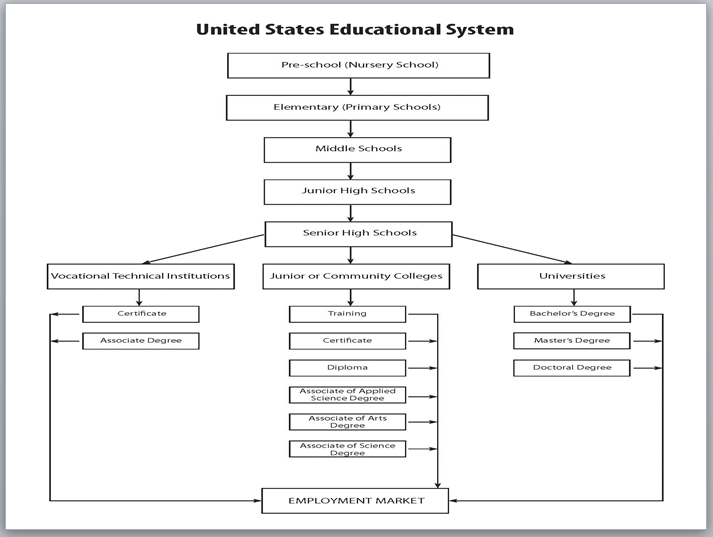
Figure A5
Slide 3

Figure A6
Slide 4
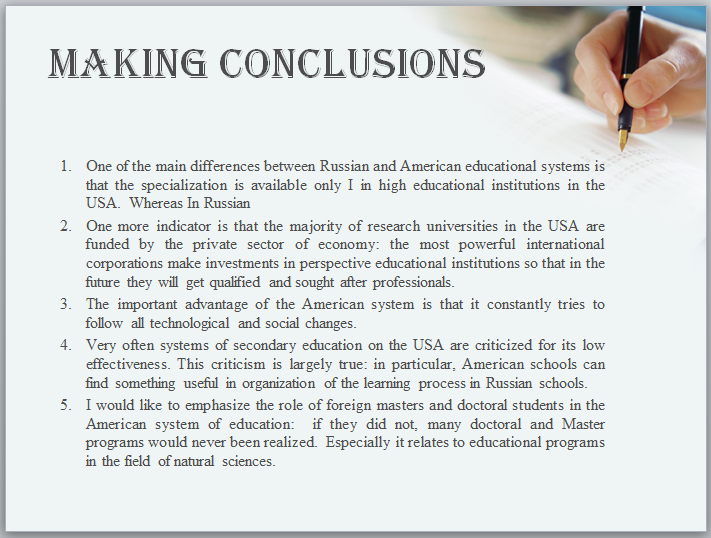
Supplement to Appendix A: Conference Week Presentation Paper
Note. The student’s paper is reproduced as written, in English, without corrections.
Russian & USA Educational System: The Comparative Research
Stepan N., student
National Research the university
Introduction
Both systems have either advantages or disadvantages.
I think that those who are aware of it and really care about this topic will probably agree that it is important to use the advantages of the each system to improve the educational system no matter where – in Russia or in the USA.
Consider the American educational system.
The structure of the educational system of the USA:
Primary school
Secondary school
1)Junior
2)High
high educational institution
There is no clear definition of the term “high educational institution” in the USA. Actually, any educational institution providing further studying after the graduation of secondary school, known as postsecondary school , could be equally named “college”, “school”, “institution” or even “university”. Higher education is one of the most expensive facilities in the USA.
Receiving and sampling procedure of matriculates in the USA depends on their type and the level of prestige. Some universities make selection by the competitive exams, interviews, tests. Others accept just if you have finished secondary education. The most prestigious organize a competition due to the number of applicants is much higher than the number of vacancies. The main form of classes is lecture which is read for flows of students. The term “academic group” (in Russian understanding) does not exist in American universities. Every student studies the individual program and attends lectures according to his own choice.
During four years a student has to listen to a cycle of disciplines and then he will be awarded the academic degree of Bachelor. For this a student has to score the definite number of credits and pass required exams.
Getting the level of master a specialist could continue the education in the doctoral program. These programs focus on specialized studies and independent scientific research. Upon completion of doctoral studies (from 2 until 3 years) an aspirant presents his scientific project, protects it and awarded the degree of doctor of philosophy – PhD.
Consider the Russian educational system.
The structure of the educational system of the Russia:
Structure:
Common:
primary school (1-4 grades)
secondary school (5-9 grades)
high school (10-11 grades)
Professional:
Secondary (College, technical school)
Higher (Undergraduate, Speciality, MA)
Postgraduate (Postgraduate ,doctoral programs)
Nowadays there are three steps in the structure of Russian “higher technical education”
The first step is incomplete higher education receipt of which allows you to continue education at the next stages.
The second stage with the studying period no less than 4 years provides getting the academic degree of Bachelor of Science in the chosen direction. Everyone who got the degree of Bachelor can continue their education for achieving the qualification or level required for the third step.
The third step of higher education allows qualifying for an engineer in the chosen specialty or Master of Science degree in the direction.
Secondary education
2 years. The first step of higher education.
4 years. The second step of higher education.
6 years. The third step of higher education.
Master of the direction An Engineer
In the Russian Federation there are three types of educational institutions where you can get higher education: institute, academy, university. An academy has a more narrow range of specialties usually for the same sector of the economy. A university covers wider range of specialties from different spheres. For example, technical or classic university. Either of these two statuses can be assigned to an educational institution just in case conducting extensive and recognized at a certain level of scientific research. Getting the education according to the program of Master of Science every student may receive a diploma of engineer as soon as all necessary tasks and thesis are done. In the other cases, if you already have a diploma and you to want to get the second higher education in another direction, you are capable of doing it on a fee basis.
Conclusion:
One of the main differences between Russian and American educational systems is that the specialization is available only I in high educational institutions in the USA. Whereas In Russian and The Soviet Union the specialization began in high school.
One more indicator is that the majority of research universities in the USA are funded by the private sector of economy: the most powerful international corporations make investments in perspective educational institutions so that in the future they will get qualified and sought after professionals.
The important advantage of the American system is that it constantly tries to follow all technological and social changes.
Very often systems of secondary education on the USA are criticized for its low effectiveness. This criticism is largely true: in particular, American schools can find something useful in organization of the learning process in Russian schools.
I would like to emphasize the role of foreign master’s and doctoral students in the American system of education: if they did not, many doctoral and Master programs would never been realized. Especially it relates to educational programs in the field of natural sciences.
Sources Used in the Student’s Paper (transliterated, with English translations in brackets)
- Doronova, M. Iu. “N’iu-iorkskaia gosudarstvennaia shkola” [The New York public school]. Nachal’naia shkola [Primary School], No. 10, 2008.
- Likhachev, B. T. Pedagogika [Pedagogy]. Moscow, 1998.
- Podlasyi, I. P. Pedagogika. Novyi kurs: Uchebnik: V 2 kn. [Pedagogy. A new course: A textbook in 2 books]. Moscow: Vlados, 2001.
- Tarasiuk, L. N., & Tseikovich, K. N. “Obrazovanie v SShA” [Education in the USA]. Sotsial’no-politicheskii zhurnal [Socio-Political Journal], 1997.
- Kharlamov, I. F. Pedagogika v voprosakh i otvetakh [Pedagogy in questions and answers]. Moscow, 2001.
Appendix B
The Online Course Practical English Phonetics (LMS Moodle)
Figure B1
Course Home Page (Welcome Screen and Course Specification)
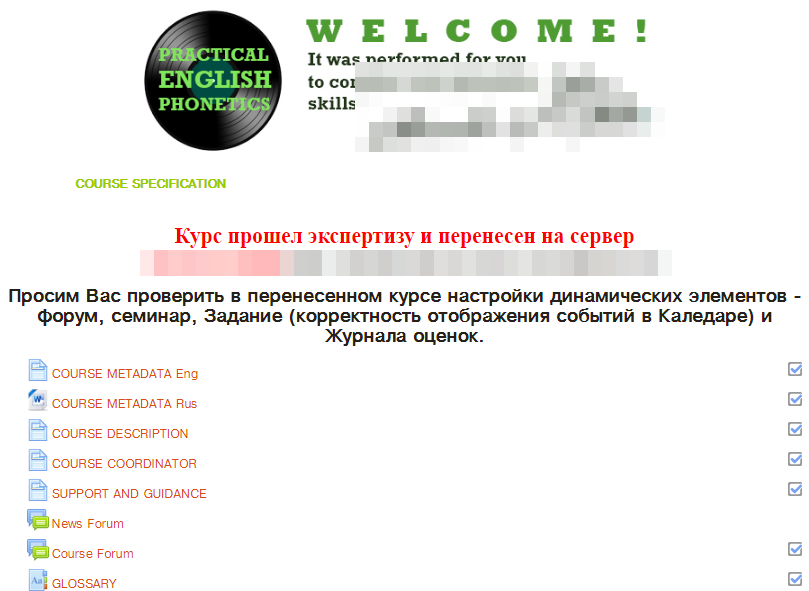
Note. The text in Russian at the top of the screen is a request to the course administrator to check the forum, seminar, and assignment settings after the course was moved to the server stud.lms.tpu.ru.
Figure B2
Introduction Section
Figure B3
Module 1: Lesson One
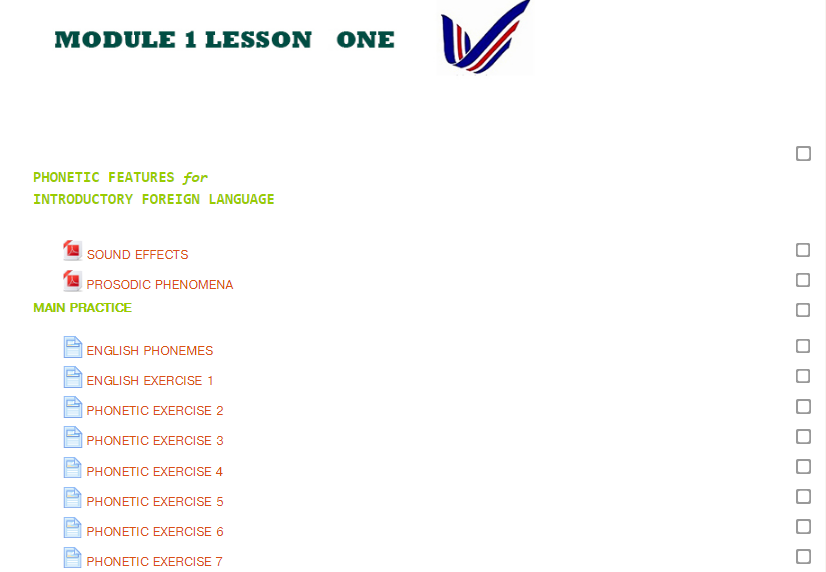
Figure B4
Module 1: Phonetic Exercises, Final Testing, and Multimedia References
Figure B5
Module 1: Additional Resources and Forums
Figure B6
Module 2: Lesson Two
Figure B7
Module 2: Final Testing and Multimedia References
Figure B8
Module 2: Additional Resources

Figure B9
Module 3: Lesson Three
Figure B10
Module 3: Additional Resources and Discussion Forum

Figure B11
References Section
Appendix C
Working With a Film in the Forum of the Online Course Practical English Phonetics
Figure C1
Forum Assignment: A Short Travel Guide to the City of London

Note. Video resource provided by YouTube.com: https://www.youtube.com/watch?v=45ETZ1xvHS0
Appendix D
Review Essay on the Film Viewed (Online Course Practical English Phonetics)
Figure D1
Student Review Essay, Page 1

Figure D2
Student Review Essay, Page 2

Figure D3
Student Review Essay, Page 3

Appendix E
Working With Reviews and Peer Comments (Online Course Practical English Phonetics)
Figure E1
Assignment Submissions With Peer Reviews in the Moodle Gradebook
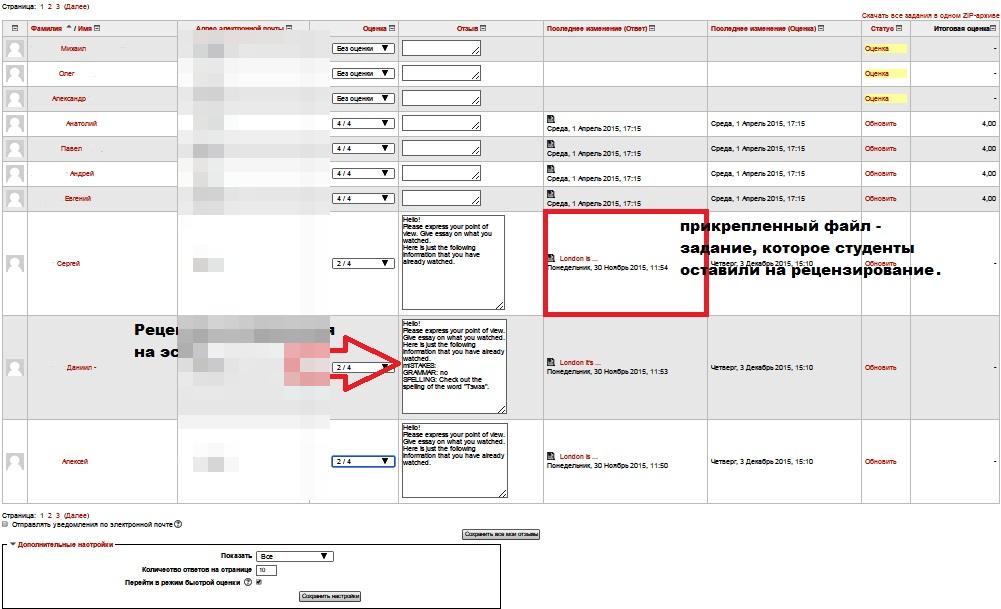
Note. The Russian annotations on the screenshot read, approximately, “attached file: the text that students submitted for review” and “reviews left on the work.”
Appendix F
Organizing a Foreign Language Class Session at an Engineering University: Sample Lesson Materials
Note. The lesson materials were written in English and are reproduced as used in class.
A Hunger for English Lessons
PRE-READING TASKS
- Focus on language learning. Give the definition to the word combinations:
| ENUNCIATED ENGLISH | GOVERNMENT-SUBSIDIZED LANGUAGE CAMP |
|---|---|
| MASTERING ENGLISH | NATIVE ENGLISH SPEAKERS |
| LANGUAGE COPS | FALTER IN CHATS WITH SOMEBODY |
| A NATIVE ACCENT | STRESSE READING & ROTE MEMORIZATION |
[2] Define the following words.
| WORDS | DEFINITION |
|---|---|
| hunger | |
| fidgeting | |
| beaming | |
| demolishing | |
| competitiveness | |
| scooped up from | |
| transplanted into | |
| punishing | |
| village currency | |
| natural resources | |
| detour | |
| abroad | |
| international conferences |
READING FOCUS

A hunger for English lessons.
ADAPTED FROM A HUNGER FOR ENGLISH LESSONS BY CHOE SANG-HUN
Published in NEW YORK TIMES Friday, March 24, 2006
[1] Kim Hyo Jin, a timid junior high school student, stood before her American teacher fidgeting. The smiling teacher held up a green pepper and asked in clear, enunciated English: “What is this?”
[2] “Peemang!” the South Korean teens blurted out, then covered her mouth with a hand as if to stop – too late – the Korean word that had left her mouth. Mortified, she tried again. Without looking the teacher in the eye, she held both her hands out and asked, this time in English: “May I have green pepper?”
[3] Kim took the vegetable with a bow, and darted back to her giggling classmates – beaming and feeling relieved that she had successfully taken a small first step toward demolishing what South Koreans consider one of their biggest weaknesses in the competitiveness world: the fear of speaking in English to Westerners.
[4] Kim was among 300 junior high school pupils going through a weeklong training in this new “English Village.” Built a few kilometers from the western border with North Korea, the government-subsidized language camp is, at 280,000 square meters, or 3 million square feet, the largest of its kind in the world, officials say.
[5] The complex – where the slogan is, “We produce global Koreans!” – looks like a mini-town scooped up from a European country and transplanted into this South Korean countryside dotted with pine groves, rice paddies and military barbed-wire fences. It has its own immigration office, city hall, bookstore, cafeteria, gym, a main street with Western storefronts, police officers and a live-in population of 160 native English speakers. All signs are in English, the only language allowed.
[6] Here, on a six-day obsession course that charges students 80,000 won, or $82, apiece, pupils check in to a hotel, shop, take cooking lessons and make music videos – all in English. There are language cops around, punishing students speaking Korean with a fine in the village currency or red dots on their village passports. To relieve the stress, the authorities do permit students to speak their native language a few times during their stay, usually at mealtimes.
[7] Across South Korea, the English Villages are sprouting up. Ten are already operating, with more on the way. They represent the latest big push in South Korean parents’ multibillion-dollar-a- year campaign to give their children a leg up in conquering English skills.
[8] With few natural resources, South Korea realized early on that it must push exports and produce high-quality work forces. Education is an obsession. Mastering English is a nationwide quest from kids to office minions in corporate giants like Samsung and Hyundai.

[9] “It’s funny because Koreans know English,” said Jeffrey Jones, former president of the American Chamber of Commerce in Korea who heads the Paju complex. “They spend a lot of time learning English. They can read, probably better than I can. But they have trouble speaking.”
[10] Jones, a longtime resident of South Korea, says that when many Koreans see a Westerner coming their way on the street, they detour or run away. “They are afraid that they might have to speak English,” Jones said. “So one of the things we do here is to break the wall of fear. And students come away not being afraid of foreigners and Westerners particularly.”
[11] South Korea has become one of the most aggressive countries in Asia at teaching English to its citizens. The language is taught from the third year of school; beginning in 2008 it will begin in the first year. Outside the school system, parents are paying an estimated 10 trillion won a year to help their children learn English at home or abroad.
[12] Yet many college graduates falter in chats with native speakers. South Korean officials are often accused of grouping together in international conferences, afraid to mix with native English speakers. That, linguists say, is a result of a national school system that traditionally stresses reading and rote memorization of English grammar and vocabulary at the expense of conversation.
[13] The public sector in this highly competitive society is racing to address the problem. The country is building a $15 billion international economic free zone on the coast west of Seoul, where English will be a common language. The southern port city of Busan is planning a town where English is an official language.
[14] In Korea University of Seoul, 30 percent of all classes are now in English. Speaking English with a native accent has become such a status symbol that some parents reportedly put their children through the clinically questionable surgery of snipping the thin tissue under the tongue to make it longer and supposedly nimbler, helping the children to pronounce the R sound better.
DISCUSSION OPTION
- In your opinion, will English help you in your future profession?
- Would you like to have the opportunities to study abroad?
- What is the best way for you to study English language?
Appendix G
Testing Statistical Differences Between the Experimental and Control Groups
Table G1
Levels of Foreign Language Competence (Final Scores) of the Experimental and Control Groups
| Level | EG 2011–2012 (n) | EG 2011–2012 (%) | EG 2012–2013 (n) | EG 2013–2014 (n) | EG 2013–2014 (%) | CG 2011–2012 (n) | CG 2011–2012 (%) | CG 2012–2013 (n) | CG 2013–2014 (n) | CG 2013–2014 (%) |
|---|---|---|---|---|---|---|---|---|---|---|
| High | 5 | 21 | 12 | 18 | 75 | 3 | 13 | 8 | 7 | 29.2 |
| Intermediate | 13 | 54.2 | 10 | 4 | 16.6 | 12 | 50 | 10 | 10 | 41.7 |
| Low | 6 | 25 | 2 | 2 | 8.3 | 9 | 37 | 6 | 7 | 29.2 |
Note. EG = experimental group (Group 5A46); CG = control group (Group 5G45 in 2011–2012; the original table labels the later CG columns as Group 5A46). Each group had 24 students. Percentages were calculated as follows: 24 students = 100%, so 1 student = X, where X = (100 × 1) / 24 = 4.16%. No percentages were reported in the original for 2012–2013.



