Word Stress Rules in American English: A Linguist’s Guide to Speech Clarity
(512) 265-9515Updated October 16, 2026 ◆ 17 min read
Mastering the word stress rules in american english is an effective way to achieve immediate speech clarity by emphasizing one primary syllable through increased pitch, length, and volume. This rhythmic pattern acts as a landmark for your listeners, allowing them to process your ideas without effort. You’ve likely felt the frustration of having perfect grammar while still being asked to repeat yourself in meetings. This disconnect happens because English is a stress-timed language. By focusing on accent reduction and pronunciation coaching, you can transform your professional communication and ensure your message is received with authority.
Real student result

“I feel confident enough to speak American English!”
Interactive American Accent Training9monthsof hard work and dedication
Listen to the starting point0:00
Listen to the result0:00
“Many of my students once believed they could never sound like this. School taught them grammar and vocabulary, but not how to train their English speech. That is what we do together, step by step, until you speak English independently and with confidence.”
Abishek’s result was achieved through Prof. Alex’s research-based Interactive 1-on-1 American Accent Training. His doctoral research found this interactive method more effective than traditional, teacher-centered methods. See the research basis →
I’m Prof. Alex, Ph.D. Accent Coach, and I’ve designed this guide to help you master the musical DNA of American speech through a science-backed approach. You’ll learn how to navigate the specific rules for nouns and verbs, understand how suffixes shift emphasis, and discover the vital role of the reduced schwa sound. By moving beyond traditional American accent training at the American Accent Program, we’ll explore how 2D Sound Motion Technology can help you practice these patterns. This method builds the muscle memory required for professional communication and lasting personal growth.
What is Word Stress? The Three Dimensions of American Speech
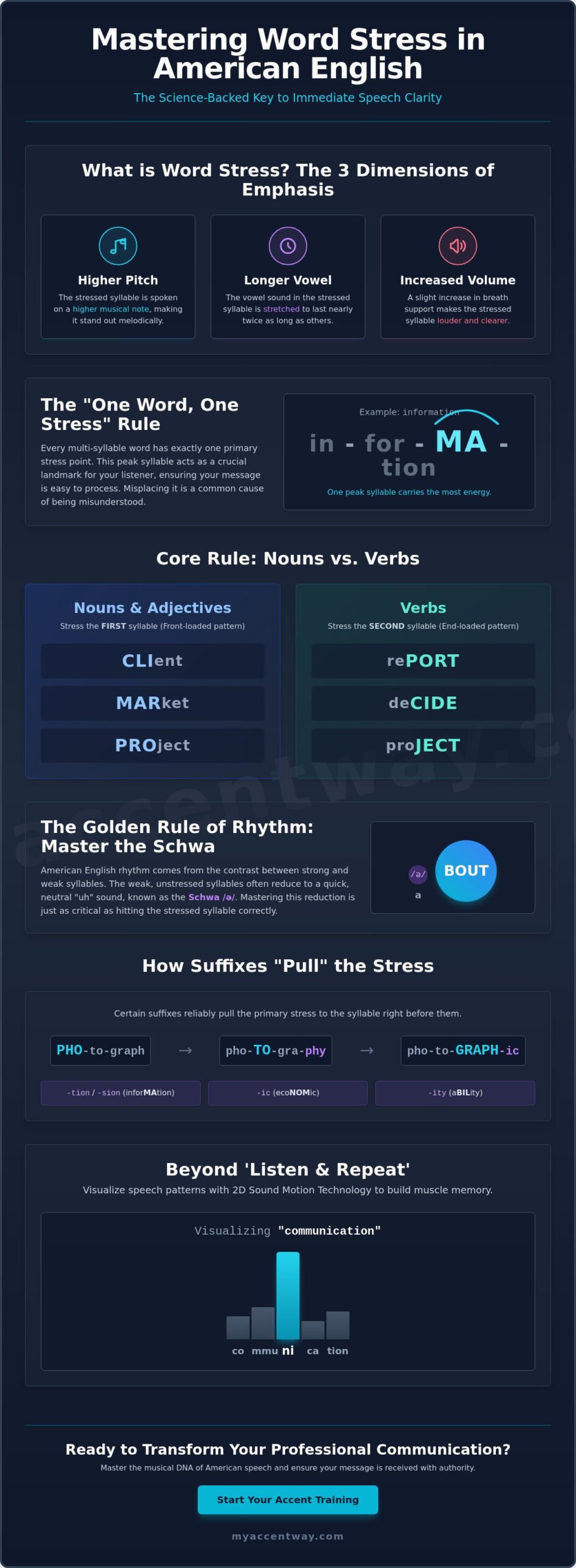
Word stress is the specific emphasis placed on one syllable within a multi-syllable word. Think of it as the “heartbeat” of your speech. Mastering the word stress rules in american english is essential because English is a stress-timed language. This means we rely on the contrast between strong and weak syllables to create a predictable rhythm. Without this contrast, speech sounds flat or monotone, which forces your listener to work much harder to understand your meaning.
Every English word has exactly one primary stress point. This is known as the “One Word, One Stress” rule. Even in long, complex words, there’s only one peak that stands out above the rest. These peaks act as vital landmarks for comprehension. When you place the stress correctly, you provide a clear map for your audience. Misplacing that stress is often why highly skilled professionals are asked to repeat themselves, even when their grammar and vocabulary are perfect.
Many learners believe that stressing a word simply means saying it louder. However, true speech clarity comes from balancing three physical pillars: higher pitch, longer vowel duration, and increased volume. By adjusting these three dimensions, you create the “musical DNA” that native speakers expect to hear. When you hit that stress peak correctly, the rest of the word falls into place naturally.
The Physical Mechanics of a Stressed Syllable
To produce a stressed syllable correctly, you must engage your voice in three specific ways. First, you shift your pitch. Your voice should move to a higher musical note on the stressed vowel. Second, you must focus on length. You need to stretch the vowel sound so it lasts nearly twice as long as the unstressed ones. Finally, you increase volume by using slightly more breath support. This combination ensures the syllable is prominent and clear.
This physical shift is the foundation of Stress and vowel reduction in English. When one syllable becomes long and high, the surrounding syllables must become short and low. This contrast is what creates the “bouncing” rhythm of American English. If you want to master these mechanics in a professional setting, seeking American accent training near me can provide the individualized coaching necessary to build these habits into your daily communication.
Vowels vs. Consonants in Stress Patterns
We only stress vowels. While consonants provide the structural skeleton of a word, vowels carry the music and the energy. During a stressed syllable, your vocal cords vibrate with more intensity and for a longer duration. You can’t truly stress a consonant like “s” or “t” because they lack the melodic quality of a vowel. The energy of the word always lives within the vowel sound of the primary syllable.
A simple way to find the stress peak is to hum the word. If you hum the word “information,” you’ll hear your voice jump up and hold on the “ma” syllable (in-for-MA-tion). That peak is your primary stress. By focusing your energy on the vowel in that specific spot, you align your speech with the natural word stress rules in american english that drive clarity and professional confidence.
Core Word Stress Rules for Two-Syllable Words
In the high-stakes environment of a corporate boardroom, the difference between a clear command and a confusing statement often hinges on a single syllable. Understanding the word stress rules in american english for two-syllable words provides you with a reliable framework for professional communication. Most two-syllable nouns and adjectives follow a front-loaded pattern. You’ll find the stress on the first syllable in words like “CLIENT,” “MARKET,” or “ACTION.” This initial burst of energy signals the subject to your listener immediately, providing the landmark they need to follow your train of thought.
Verbs, however, typically follow a different path. Most two-syllable verbs shift their primary stress to the second syllable. Words such as “rePORT,” “deCIDE,” and “conFIRM” require that higher pitch and longer vowel duration at the end. Linguistically, this happens because verbs often imply action or movement toward a specific goal. That forward-shifting stress physically reflects the kinetic nature of the word itself. If you’re looking for personalized guidance on these shifts, exploring American accent training near me can help you master these nuances in real-time conversations.
Mastering Heteronyms: Same Spelling, Different Stress
Heteronyms are words where stress determines the part of speech. These words look identical on the page but sound different depending on their function in a sentence. For instance, you might “preSENT” (verb) a “PRESent” (noun) to a colleague. In a presentation, you might discuss a “CONtract” (noun) that you hope the client will “conTRACT” (verb). Misplacing the stress on these words can momentarily confuse your audience and interrupt the flow of your ideas. By following the standard rules of word stress, you can ensure your meaning is always transparent.
Stress in Compound Words
Compound words have their own internal logic that often trips up international professionals. For compound nouns, the stress almost always falls on the first word. You’ll hear this in “NOTEbook,” “WORKplace,” and “KEYboard.” This helps the listener identify the specific object you’re referring to right away. Conversely, compound verbs like “underSTAND,” “overCOME,” or “outPERFORM” usually place the stress on the second word. While there are occasional exceptions in technical professional terminology, sticking to these core word stress rules in american english will significantly improve your overall clarity and confidence during presentations.
Suffixes and the ‘Pull’ of Stress in Complex Words
Suffixes in English act like phonetic magnets. They don’t just add grammatical meaning to a root word; they often physically reposition the primary emphasis of the entire word. This “pull” is one of the most dynamic word stress rules in american english. When you add certain endings, the stress jumps from its original home to a new syllable, creating a shift that can be confusing if you aren’t prepared for it. Understanding these predictable patterns allows you to approach complex, multi-syllabic vocabulary with total confidence.
The Penultimate Rule is perhaps the most useful tool for any professional. Words ending in -ic, -sion, and -tion almost always place the primary stress on the second-to-last syllable. For example, the word “ECONomy” (stress on the second syllable) transforms into “ecoNOMic” (stress on the third syllable) once the suffix is added. Similarly, the Ante-penultimate Rule applies to words ending in -cy, -ty, -phy, and -gy. In these cases, the stress lands on the third syllable from the end. Think of words like “biOLogy” or “creaTIVity.”
Fortunately, not every suffix causes a disruption. Some are “neutral” and never change the stress of the root word. Endings like -ly, -ment, -ness, and -er allow the original stress to stay exactly where it is. If you can say “MANage,” you can say “MANagement” without shifting your energy. Recognizing which suffixes are active and which are neutral is a core pillar of word stress rules in american english that leads to immediate speech clarity.
The ‘IC’ and ‘TION’ Rule for Tech Professionals
In technical fields, your speech is often filled with words like “straTEgic,” “reveLAtion,” and “eduCAtion.” These terms are the building blocks of technical documentation and high-level presentations. To find the stress peak quickly, use a simple backward-counting method. Look at the end of the word. If you see -ic or -tion, count back two syllables. That second-to-last vowel is where you must apply your pitch and length. This small adjustment ensures your technical explanations are easy for your colleagues to follow.
Handling Multi-Syllabic Academic Terms
Longer jargon often feels intimidating because of the sheer number of syllables. Words like “deMOcracy” or “dependaBIlity” require a steady, predictable rhythm to remain clear. When you encounter these academic terms, remember that the stress pattern provides the listener with a roadmap. If the stress is misplaced, the roadmap is broken. For those seeking a deeper dive into these mechanics, our American Accent Training for U.S. Professionals offers a science-backed approach to mastering these long-form rhythms. By focusing on the “pull” of the suffix, you can maintain your flow even during the most complex professional discussions.
The Secret to Stress: Vowel Reduction and the Schwa
Contrast is the defining characteristic of American speech. To master the word stress rules in american english, you must embrace a counterintuitive truth: you cannot have a strong, clear stressed syllable without equally weak, unstressed ones. Many international professionals try to achieve clarity by pronouncing every single letter with equal force. This actually has the opposite effect. When every syllable is emphasized, your speech sounds robotic and lacks the rhythmic “landmarks” that American listeners use to process information.
This brings us to the concept of vowel reduction. In American English, vowels in unstressed positions lose their original sound and “reduce” to a neutral, relaxed state. This is the scientific basis for the rhythmic flow of the language. If you don’t reduce your unstressed vowels, your primary stress won’t stand out, and your message will feel flat. Achieving true speech clarity requires you to intentionally “de-emphasize” the unimportant parts of a word so the important parts can shine.
The most important tool in your linguistic toolkit for this process is the Schwa [ə]. It’s the most common sound in American English, yet it’s often the most overlooked by learners. The schwa is a short, neutral “uh” sound made with a completely relaxed jaw and tongue. By mastering this sound, you align your speech with the natural word stress rules in american english that govern professional communication. If you’re ready to practice these reductions, you can explore our accent reduction training to train these reductions using 2D Sound Motion Technology.
Identifying the Schwa in Unstressed Syllables
The schwa can be represented by any vowel letter, making it tricky to spot on paper. Look at the word “baNANA.” The first and last “a” sounds are both schwas, while the middle “a” is the stressed vowel. Similarly, in “SOfa,” the final “a” is a schwa. In “presiDENT,” the “i” and the “e” in the final syllable often reduce. This creates a “bumpy” or “mountainous” rhythm rather than a flat line. Finding these “lazy” vowels in your daily vocabulary is the first step toward building a more natural American rhythm.
Common Pitfalls: Stressing the Unstressable
A frequent mistake in corporate environments is “equal stress” or “over-articulation.” When you give every syllable the same weight, it creates listener fatigue. Your audience has to work harder to find your main point, which can diminish your executive presence. Clarity comes from the contrast between long and short sounds. By allowing unstressed vowels to turn into the schwa, you demonstrate a sophisticated command of American rhythm. This mastery signals confidence and authority, ensuring your ideas are the focus of the conversation rather than the mechanics of your speech.
MyAccentWay · 2D Sound Motion Technology
American English Pronunciation: Consonant and Vowel Sounds with 2D Sound Motion Technology
Learning American English pronunciation and the American accent is more effective when you train your speech organs, not only listen and repeat. 2D Sound Motion Technology and Interactive Visual 2D Sound Simulators, developed in 2020 by Prof. Alex, Ph.D. Accent Coach, Doctor of Education, and professional linguist, as part of his interactive teaching model based on his Ph.D. research in interactive teaching methods, train your tongue, lips, jaw, teeth, airflow, and voice step by step. They train each American sound and more than 30 sound combinations through Interactive 2D video simulation.
What 2D Sound Motion Technology is
2D Sound Motion Technology is an advanced accent reduction and articulation training tool by Prof. Alex. It corrects, develops, and trains each American sound and more than 30 sound combinations through Interactive 2D video simulation.
What Interactive Visual 2D Sound Simulators do
Interactive Visual 2D Sound Simulators are part of 2D Sound Motion Technology, the articulation-training method Prof. Alex created by applying his Ph.D. research in interactive teaching to American pronunciation. Instead of listening and repeating, students actively train their speech organs. Each simulator uses Interactive 2D mouth movement to train the speech organs (tongue, lips, jaw, teeth, airflow, and voice) to produce each American sound correctly. Every consonant has its own simulator: explore American consonants trained with 2D Sound Motion Technology.
Sample training: the American t sound (aspirated [t])
Practice
Record yourself speaking these words:
Tab · Tacos · Time · Tub · Hotel · Motel · Sit · Pit · Net
Instructions
Play the Interactive Visual 2D Sound Simulator for the American t sound below several times and follow it step by step. Move your tongue, jaw, and airflow together with the simulator and train your articulation.
Interactive Visual 2D Sound Simulator: American unvoiced sound [t]
Practice
Record yourself again speaking these words, but this time focus on the movement of your tongue. Go slow, and you will hear the difference. You’ve got this!
Tab · Tacos · Time · Tub · Hotel · Motel · Sit · Pit · Net
How Interactive Visual 2D Sound Simulators solve pronunciation and speaking problems
- Wrong articulationMost pronunciation problems start with the tongue, lips, jaw, or teeth in the wrong position. Each Interactive Visual 2D Sound Simulator trains the correct articulation of one American sound, so the student corrects the cause of the problem, not only the result.
- Airflow and voicingMany accent problems come from wrong airflow or voicing: sounds that are too weak, too strong, or voiced when they should be unvoiced. The simulators train airflow and voice together with articulation, step by step, for each American sound and more than 30 sound combinations.
- Clear speech and confidenceWhen each sound is trained correctly, words connect into clear American English speech. Listeners can understand you more easily, and speaking at work, in meetings, and on calls becomes more confident.

If you start hearing the aspiration, the short airstream after [t], with one simulator, you can only imagine how successful you can be in 1-on-1 Interactive American Accent Training with Prof. Alex, Ph.D. Accent Coach, where your whole American sound system is trained sound by sound.
In MyAccentWay, the Interactive Visual 2D Sound Simulators are only available in 1-on-1 accent coaching sessions with Prof. Alex.
Mastering Word Stress with 2D Sound Motion Technology
Traditional “listen and repeat” methods often fail when it comes to mastering the word stress rules in american english because they rely solely on the ear. For many adult learners, the auditory system is already “tuned” to the rhythms of their native language. This makes it difficult to perceive the subtle shifts in pitch and duration that define American speech. If you cannot hear the difference, you cannot reproduce it. This is where a science-backed approach becomes necessary to bridge the gap between understanding a rule and applying it in a high-pressure meeting.
As a linguist, I focus on the physical mechanics of speech. I use Interactive Visual 2D Sound Simulators for American Sounds to help my students move beyond auditory guesswork. 2D Sound Motion Technology trains your speech organs to produce the stress peak of a word as it happens. This training feedback allows you to map the physical movements of your mouth to the resulting sound. Prof. Alex, Ph.D. Accent Coach, has designed this method to build muscle memory, turning theoretical knowledge into an intuitive, automatic habit. When you practice a word’s stress pattern, you no longer have to wonder if you’ve hit the right note.
Visualizing Pitch and Duration
2D Sound Motion Technology maps the “mountain” of a stressed syllable in real time. Instead of just hearing a word like “ecoNOMic,” you see the visual representation of the pitch rising and the vowel stretching on that third syllable. This creates a powerful visual anchor. For adult learners who are often visual thinkers, this approach is far more effective than traditional auditory drills. It allows you to synchronize your breath and jaw movement with the specific word stress rules in american english that drive clarity. If you are ready to start this visual journey, you can find accent training near me to get started with these advanced digital tools.
Your Path to Speech Mastery
Choosing to pursue accent modification is a powerful step toward personal growth and career advancement. It is about equipping yourself with the tools to be heard and understood the first time you speak. It is essential to remember that this process is not about changing who you are. Improving your speech clarity respects and preserves your cultural identity while giving you the confidence to lead presentations and influence stakeholders. By mastering the rhythm of American English, you ensure that your expertise and unique perspective are never lost in translation.
Mastering these rules is a journey of transformation. I invite you to explore the science-backed MyAccentWay method and discover how our Interactive Visual 2D Sound Simulators can accelerate your progress. Whether you are preparing for a keynote speech or simply want to feel more present in daily conversations, our systematic approach provides the clarity you deserve. Book Your 1 Hour Evaluation Session today to experience how visual muscle training can redefine your professional communication.
Transform Your Communication with Rhythmic Precision
Mastering the word stress rules in american english is about more than just sounds; it’s about the strategic distribution of energy that defines professional speech. You now understand that clarity stems from the physical contrast between long, high-pitched stressed vowels and the short, relaxed schwa. By shifting your focus from individual letters to the overall musical DNA of the language, you provide your audience with the landmarks they need to follow your expertise without effort.
At MyAccentWay, we don’t just teach you to listen; we teach you to see the mechanics of your voice. Founded by Prof. Alex, Ph.D. Accent Coach, our program utilizes proprietary 2D Sound Motion Technology to give you the visual feedback necessary for building permanent muscle memory. This science-backed approach ensures your executive presence matches the high quality of your ideas. If you’re ready to achieve immediate speech clarity and advance your career, Book Your 1 Hour Evaluation Session with Prof. Alex, Ph.D. Accent Coach to master your American accent. Your cultural identity is a strength, and your clear communication will only amplify it. You have the tools; now it’s time to use them.
American Intonation and Rhythm Training for Foreign-Born Professionals in the United States
Foreign-born professionals in the United States often know their field and speak advanced English. Yet American listeners may still struggle with their stress, rhythm, and intonation. MyAccentWay offers private online intonation training through Interactive American Accent Training.
Interactive American Accent Training is led by Prof. Alex, Ph.D. Accent Coach, Doctor of Education, and professional linguist. He first diagnoses each speaker’s native-language patterns. Then he trains American word stress, sentence stress, rhythm, and intonation for real meetings and presentations.
Who this training is for
- Engineers, IT specialists, and data professionals presenting to U.S. teams and clients
- Doctors, nurses, and healthcare professionals explaining care to American patients
- Managers, executives, and founders leading meetings, pitches, and briefings
- Consultants, researchers, and academics speaking at conferences and webinars
- Professionals preparing for interviews, promotions, or client-facing roles
Online training across the U.S.
MyAccentWay is based in Austin, Texas, and all training is online. The program is especially relevant for professionals in Austin, Dallas, Houston, New York City, the San Francisco Bay Area, Los Angeles, Seattle, Boston, Chicago, Miami, Washington DC, Atlanta, and Raleigh.
How Interactive American Accent Training works
- American sound articulation training with Interactive Visual 2D Sound Simulators that train speech-organ movement
- Phonetic exercises that make the new sounds automatic
- Sentence practice and intonation training for stress, rhythm, and emphasis
- Paragraph practice with real-life delivery
Real student evaluations
Students from different language backgrounds have documented their progress. Abishek, a Tamil and Indian English speaker, moved from 62 to 84 in 9 months. Tian, a Mandarin speaker, moved from 58 to 85 in 8 months. Vlad, a Russian speaker, moved from 60 to 83 in 5 months.
The first step is a 1 Hour Evaluation Session with Prof. Alex.
Frequently Asked Questions
Can a single word have more than one primary stress point?
No, every English word has exactly one primary stress point. While longer words may contain secondary stress to maintain rhythm, the primary stress is the unique peak of the word. This syllable is always longer, higher in pitch, and clearer than the others. Trying to emphasize two syllables with equal force will disrupt the natural flow and make you harder for colleagues to understand.
How can I predict the stress in unfamiliar professional vocabulary?
You can often determine the correct emphasis by looking at the word’s suffix or its grammatical category. Most two-syllable nouns are stressed at the beginning, while specific endings like -tion or -ic pull the stress to the syllable immediately preceding them. Learning these underlying word stress rules in american english provides a reliable framework for pronouncing new technical terms correctly without needing to hear them first.
Why is word stress more vital for speech clarity than individual letter sounds?
American listeners rely on the “musical” profile of a word to identify it during fast-paced conversations. If you pronounce every consonant perfectly but misplace the stress, the listener’s brain cannot quickly find the landmark it needs to process the word. Correct stress patterns provide the rhythmic structure that allows for effortless comprehension in high-stakes meetings and professional presentations.
Does word stress differ significantly between British and American English?
Yes, many words shift their emphasis depending on the regional dialect. For instance, Americans typically stress the second syllable in “gaRAGE,” while British speakers stress the first. If your goal is to integrate into a U.S. corporate environment, focusing on American-specific patterns is a key part of your accent modification journey. These subtle shifts can significantly impact how naturally you’re perceived by North American audiences.
How do Interactive Visual 2D Sound Simulators help with word stress practice?
Traditional auditory methods often fail because they don’t train the physical effort required for a stressed syllable. Prof. Alex, Ph.D. Accent Coach, uses Interactive Visual 2D Sound Simulators for American Sounds as part of his interactive teaching model, based on his Ph.D. research in interactive teaching methods, to help you actively train the movement of your tongue, lips, jaw, teeth, and airflow while he corrects you live. This helps you build the muscle memory needed to make these patterns automatic and intuitive in your daily speech.
The problem is not always grammar or vocabulary.
If people understand your words but still miss your message, the deeper issue may be speech clarity, rhythm, intonation, and American pronunciation habits. MyAccentWay helps students retrain the sound system with professional 1-on-1 guidance, so English can feel clearer, freer, and more natural in real communication.
Two training methods that make speech change active.
MyAccentWay is not passive listen-and-repeat coaching. Prof. Alex, Ph.D. Accent Coach, Doctor of Education, and professional linguist, creates a learning situation where students become active learners and active participants in changing their own speech patterns.
Interactive training
Students do not just receive pronunciation instructions passively. They listen, think, compare, adjust, and understand their own speech patterns while Prof. Alex guides the correction process.
Cognitive accent training
Students learn to notice and correct the speech patterns that affect American pronunciation, then implement new American speech patterns into their code-switching process for more natural, long-lasting change.
Build speech habits people can hear in real conversations.
A stronger American accent is not built by memorizing topics or chasing quick pronunciation tips. It comes from structured training, professional feedback, active correction, and repeated application until clearer speech becomes easier to keep.
Continue learning how MyAccentWay connects American sound articulation, Interactive Visual 2D Sound Simulators, accent reduction, student proof, and 1-on-1 training.
- Prof. Alex and the MyAccentWay MethodLearn how Prof. Alex, Ph.D. Accent Coach, Doctor of Education, and professional linguist, created and leads the structured MyAccentWay American accent training system.
- Accent Reduction Curriculum and English Articulation TrainingSee how MyAccentWay trains accent reduction, accent modification, American pronunciation, English articulation, rhythm, and professional speech clarity.
- 2D Sound Motion Technology for American Accent TrainingUnderstand Prof. Alex’s Interactive Visual 2D Sound Simulators for American sound articulation.
- Before-and-After American Accent Training ResultsListen to real before-and-after student proof and accent training outcomes.
- Student Reviews and Accent Training ResultsRead student reviews, testimonials, and trust signals from MyAccentWay learners.
- Book a 1-Hour 1 Hour Evaluation SessionStart with a 1-hour accent evaluation session with Prof. Alex.
Disclaimer – American Accent Program
The American Accent Program available through Visit Program Website
is an educational and coaching service designed to support pronunciation, accent reduction, and spoken English fluency. All training materials, including lessons, exercises, audio content, visual simulations, coaching methods, and digital resources, are the intellectual property of American Accent Program, LLC and are protected by applicable copyright and intellectual property laws.
By using this website and participating in the program, you acknowledge that all content is provided for personal, non-commercial, educational use only. Users are granted a limited, non-transferable license to access the materials strictly for individual learning purposes. Redistribution, reproduction, recording, modification, sharing, or commercial use of any program content without prior written consent is strictly prohibited.
The program may include live coaching sessions, digital tools, and instructional materials intended to improve pronunciation and communication skills. However, individual results may vary, and no specific level of fluency, accent reduction, or communication outcome is guaranteed.
The American Accent Program and its instructors do not provide medical, therapeutic, or clinical speech-language pathology services. All training is intended for educational purposes only.
By accessing or using the program, you agree to comply with all applicable terms, including the platform’s Terms of Use and Course Policies, and acknowledge that misuse of materials may result in termination of access without refund.