Tag: acting tips

  • American Accent Training for Actors: A Professional How-To Guide
    American Accent Training for Actors: A Professional How-To Guide

    Prof. Alex., Ph.D. Accent Coach

    Article by

    Prof. Alex., Ph.D. Accent Coach

    Doctor of Education, Professional Linguist,
    Creator of 2D Sound Motion Technology,
    Creator of “InPronunci:" American Accent Program App,
    Professor of English as a Second Language,
    American Accent Coach,
    Life Coach.

    What if the secret to a flawless performance isn’t just “doing the voice,” but retraining your brain to map sounds through visual motion? Many performers find that traditional mimicry fails under the pressure of a long take, leading to inconsistent vowels or a robotic delivery that pulls the audience out of the story. If you’ve ever feared being “found out” during a high-stakes audition, you’re not alone. Professional american accent training for actors is no longer about trying to change who you are; it’s about adding a precise, scientific toolset to your professional craft.

    I understand the unique pressure to deliver clarity without losing your artistic soul. As Prof. Alex Obskov, Ph.D. Linguist, I’ve seen how a science-backed approach can transform an actor’s career by moving beyond simple imitation. This guide promises to show you how to master the mechanics of Standard American Speech using cognitive processes that build genuine confidence. You’ll gain a repeatable system for script preparation that moves your accent from a conscious effort to a subconscious performance habit.

    We’ll explore the specific vowels and rhoticity patterns that often trip up international talent while introducing you to the visual power of 2D Sound Motion Technology. You’ll learn how to build a performance that feels authentic and grounded, ensuring you’re ready to compete in the $1.99 billion online acting education market of 2026.

    Key Takeaways

    • Learn why professional american accent training for actors relies on linguistic mastery rather than unreliable mimicry to ensure consistent performance during long takes.
    • Discover the scientific breakdown of the 44 core phonemes of American English to achieve precision in every vowel and consonant you deliver.
    • Understand how to “see” sound production using proprietary 2D Sound Motion Technology to bridge the gap between hearing a sound and producing it accurately.
    • Master a repeatable three-stage script preparation process designed to move your delivery from conscious effort to a subconscious, automatic habit.
    • Explore how a personalized approach to accent modification honors your cultural background while providing the professional clarity needed for career growth.

    Mastering Standard American Speech for Performance

    Professional american accent training for actors is the intentional modification of speech patterns to ensure consistency across every take and every scene. It’s a technical skill, much like stage combat or period dance, that allows you to deliver a performance without your voice becoming a distraction. Instead of trying to “lose” your identity, you are simply expanding your phonetic range. The goal is always speech clarity and communication; we want the audience to connect with your character’s soul, not wonder where you’re from in the middle of a dramatic monologue.

    Linguistic mastery is quite different from simple mimicry. Mimicry is an impression, which is often fragile and prone to breaking under the high-pressure environment of a film set. As Prof. Alex Obskov, Ph.D. Linguist, I teach that true mastery comes from an analytical understanding of how sounds are physically produced. When you understand the mechanics, you can repeat the performance exactly the same way at 4:00 AM as you did at noon. This reliability is what casting directors look for when they hire international talent for major U.S. productions.

    Why Actors Need More Than Just Mimicry

    The “mimicry trap” occurs when an actor’s brain is too busy “listening” to their own voice to stay present in the scene. This creates a heavy cognitive load. When you’re in the middle of a high-stakes emotional moment, your brain will naturally prioritize feeling over phonetic accuracy. If you haven’t built deep muscle memory, your native speech patterns will likely resurface. By using a science-backed method, you move the accent from your conscious thought into your physical muscles. You don’t have to “think” about the sounds because your articulators are already trained to find the correct placement automatically.

    The Role of General American (GenAm) in Modern Media

    In the current casting environment, General American English serves as the standard for the majority of film and television auditions. It’s a non-regional, neutral dialect that allows an actor to fit into almost any setting. With the online acting education market projected to reach $3.75 billion by 2031, the competition for these roles is intense. Having a reliable “switch” into GenAm provides you with a competitive edge that many others lack.

    Mastering these foundational sounds is a journey that many international professionals take to improve their career prospects. In fact, American Accent Training for U.S. Professionals often utilizes these same core principles to help learners achieve professional clarity. Whether you’re performing on stage or in a boardroom, the ability to communicate with confidence is a transformative asset. Remember, your culture matters and adds unique depth to your acting; american accent training for actors is simply the tool that ensures your voice is heard clearly by every audience.

    The Science of Sound: Phonemes and Intonation for the Stage

    In my work as Prof. Alex Obskov, Ph.D. Linguist, I approach american accent training for actors through a philosophy I call “Intellectual Interaction.” Unlike traditional methods that treat speech as a collection of theatrical tricks, this scientific approach focuses on the cognitive and analytical processes behind sound production. We don’t just mimic; we analyze. The American sound system is comprised of 44 core phonemes, including 24 consonants and 20 distinct vowels. Mastering these isn’t just about positioning your tongue; it’s about understanding the acoustic properties of each sound so you can replicate them under any performance condition.

    One of the most critical elements for international actors is rhoticity, the distinct American “R” sound. Many languages produce the “R” at the front of the mouth or with a trill, but the American “R” is produced further back. This single sound often acts as a “tell” in auditions. To truly grasp these mechanics, you can reference resources like the American English Speech Course from Carnegie Mellon University, which provides a deep dive into these phonetic foundations. Understanding the science makes your performance repeatable and resilient.

    Decoding American Vowels and Consonants

    The 20 American vowels are the primary source of accent variation. While other English variants might rely on pure, clipped vowels, the American accent uses specific diphthongs and the “Schwa” sound as its anchor. The Schwa is the most common sound in American speech, representing the neutralized vowel in unstressed syllables. If you don’t master the Schwa, your speech will sound over-enunciated and robotic. Additionally, the American [t] is rarely a crisp, aspirated sound. Instead, it often becomes a “flap t” in words like “water” or a “glottal stop” in words like “button.” Mastering these nuances is essential for accent reduction that feels authentic to a U.S. audience.

    Intonation and Rhythm: The Actor’s Secret Weapon

    If phonemes are the notes, intonation and rhythm are the music. American speech has a specific “staircase” rhythm where we step down in pitch during a sentence. This flow is maintained through “linked sounds,” where the end of one word blends into the beginning of the next. For an actor, intonation is how you convey subtext and emotion. By shifting sentence stress to highlight specific words, you can change a character’s objective instantly. Try this: record yourself saying a line and purposely stress a different word each time. You’ll hear how the character’s intention shifts along with the pitch. This level of control is the ultimate goal of professional american accent training for actors, separating an amateur impression from a grounded, believable performance.

    American Accent Training for Actors: A Professional How-To Guide

    Why 2D Sound Motion Technology is a Game-Changer for Actors

    Traditional coaching often relies on the “watch my mouth” approach. While well-intentioned, this method is fundamentally limited because the most important articulatory movements happen inside the oral cavity, hidden from view. As Prof. Alex Obskov, Ph.D. Linguist, I’ve observed that actors often struggle to replicate the American “R” or the “TH” sound because they simply cannot see the internal mechanics. My proprietary 2D Sound Motion Technology solves this problem by providing a clear, visual map of the vocal tract. This isn’t about simple mimicry; it’s about using visual data to inform your physical performance.

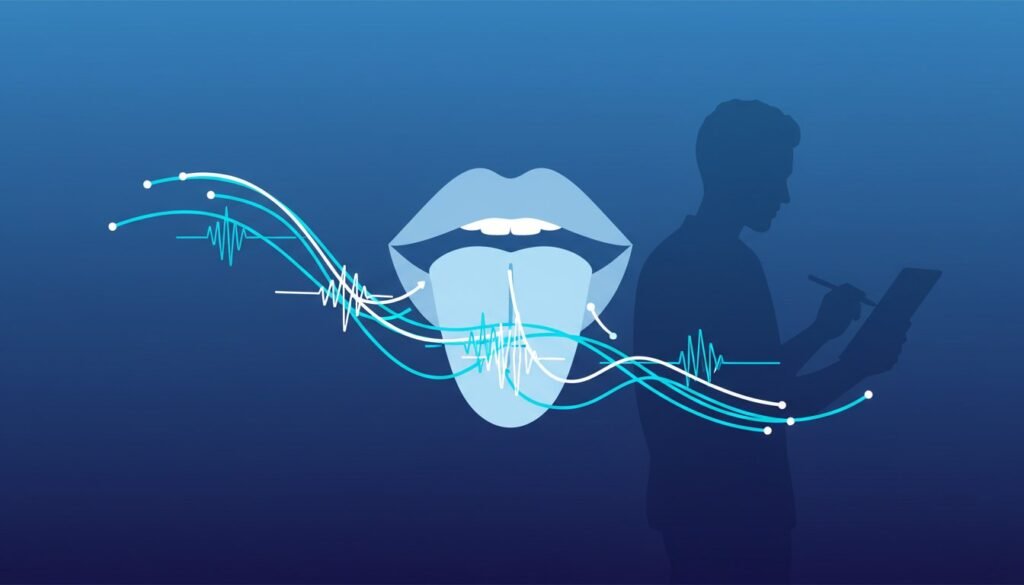
    The 2D Sound Simulators for American Sounds allow you to witness exactly how the tongue, lips, and soft palate interact to create specific phonemes. For many performers, this bridges the gap between hearing a sound and physically producing it. This approach aligns with modern research on sensory-based pronunciation instruction, which emphasizes the importance of multi-sensory feedback in speech acquisition. When you can “see” the airflow and tongue placement for a sound like [ɹ], the guesswork disappears.

    Visualising the Vocal Tract

    The simulator provides a real-time cross-section of the mouth. You’ll see the subtle difference between a voiced and unvoiced consonant, or how the tongue arches for specific American vowels. This is a massive advantage for visual learners who find abstract phonetic descriptions confusing. By removing the ambiguity of tongue placement, performers can focus on the emotional truth of their scene. It turns a complex linguistic task into a clear, manageable visual target. This level of precision is exactly what distinguishes professional american accent training for actors from generic accent modification tips.

    Accelerating Muscle Memory for the Set

    The goal of any american accent training for actors is to reach a point where the speech pattern is automatic. Seeing a sound allows your brain to map the physical sensation much faster than auditory feedback alone. Once you’ve “seen” the sound on the simulator, your brain creates a stronger neural pathway for that specific motion. This accelerates the development of muscle memory, which is vital when you’re under the pressure of a live set. For a high ROI on your professional preparation, effective American accent training must include these visual components. It ensures that when the director calls “action,” your American accent is grounded, consistent, and completely subconscious.

    How to Prepare a Script Using American Accent Modification Techniques

    Generic advice often tells performers to “just listen” to native speakers, but professional american accent training for actors requires a more rigorous, structured framework. When you receive your sides for an audition, you can’t leave your phonetic accuracy to chance. You need a repeatable system that moves from intellectual understanding to physical automation. This three-stage process ensures that by the time you’re on camera, your focus remains entirely on your character’s emotional truth rather than your tongue placement.

    I always emphasize that the goal isn’t to think about the sounds while you’re acting; the goal is to have practiced them so thoroughly that they happen by themselves. This transition from conscious effort to subconscious habit is the hallmark of a professional performer. By following a scientific workflow, you eliminate the fear of being “found out” and replace it with the confidence of a master technician.

    Stage 1: Phonetic Script Analysis

    The first step is a deep dive into the text. Use phonetic notation to mark up your script, highlighting specific “problem sounds” that tend to trigger your native speech patterns. Pay close attention to vowels and the rhotic “R” sounds we’ve discussed. You should also mark the “staircase” intonation points and where words must link together to maintain a natural flow. Even within General American, consider the character’s background; a character from a corporate environment in Houston might have a slightly different rhythm than one from a tech startup in Austin. Mapping these sounds early prevents “accent bleed” during high-stress takes.

    Stage 2: Practice with 2D Simulators

    Once you’ve analyzed the text, use the 2D Sound Simulators for American Sounds to drill the specific phonemes found in your dialogue. This isn’t about reading the whole script at once. Instead, isolate the trickiest sentences and perform what I call the “Slow-Motion Drill.” Practice the dialogue at 50% of your normal speaking speed. This forced deceleration allows you to monitor every articulatory movement and ensure total phonetic accuracy. As you build muscle memory at this speed, gradually increase the tempo until the American rhythm feels effortless and grounded.

    Stage 3: Performance and Feedback

    Record your rehearsals and listen back specifically for inconsistencies. This “Ear Training” is vital for identifying where your native intonation might be creeping back in. While self-correction is a great start, professional feedback from an expert like Prof. Alex Obskov, Ph.D. Linguist, is critical for catching the subtle nuances that a non-expert ear might miss. Maintaining the accent between takes on a 12-hour shoot day is exhausting, so having a solid, practiced foundation is your best defense against fatigue. To start building this foundation today, you can enroll in a professional accent reduction program tailored specifically for the needs of modern performers.

    Elevating Your Acting Career with Prof. Alex Obskov, Ph.D.

    Mastering a new speech pattern is one of the most empowering steps you can take for your professional development. Choosing a science-backed, individual approach is the most efficient path to long-term success. As Prof. Alex Obskov, Ph.D. Linguist, I believe that your cultural background is an asset, not a hurdle. My method focuses on adding a new skill to your repertoire rather than asking you to change who you are. This philosophy, “Your Culture Matters,” ensures that you maintain your unique artistic voice while gaining the speech clarity required for the most competitive U.S. roles.

    By moving beyond simple imitation and utilizing the analytical tools we’ve discussed, you’re investing in a repeatable system. This isn’t just about one audition; it’s about building a career that spans decades. The precision of 2D Sound Motion Technology allows you to master the American accent with a level of detail that traditional drama schools often overlook. When you can see the mechanics of your own voice, the path to booking more roles becomes clear and predictable.

    The MyAccentWay Success Guarantee

    I stand behind the effectiveness of this method with a bold Success Guarantee. This commitment builds the confidence you need to invest fully in your training, knowing that your progress is prioritized. My “Individual Approach” means we don’t use a one-size-fits-all curriculum. Instead, I tailor the training to your specific native language and phonetic habits. Whether you’re based in Austin, Texas, or working remotely from London, the training is designed to meet your specific needs. To support your daily practice between our sessions, the MyAccentWay app provides on-the-go access to drills and simulators, ensuring your muscle memory stays sharp even on busy shoot days.

    Your Next Steps: From Audition to Booking

    Professional american accent training for actors is a long-term investment in your craft. With the online acting education market projected to reach $3.75 billion by 2031, there has never been a better time to refine your technical skills. The ability to switch into a grounded General American accent at a moment’s notice will set you apart in a crowded casting field. It changes the conversation from “can they do the accent?” to “is this the right person for the character?”

    I invite you to experience the power of 2D Sound Motion Technology firsthand. Taking the first step is often the hardest part of the journey, but the rewards for your career are immense. You can book your American accent assessment session today to receive a professional evaluation of your current speech patterns. Let’s work together to unlock your full potential on the global stage. Remember my core mission for every student: Speak English Confidently & Fluently.

    Step Into Your Next Role with Confidence

    Transitioning from a conscious phonetic struggle to a subconscious performance habit is the key to thriving in the $3.75 billion online acting education market of 2031. By applying the science of phonemes and intonation, you ensure that your delivery remains grounded and authentic under the pressure of any take. Professional american accent training for actors is about more than just sounds; it is a career-defining investment in your communication clarity and artistic range.

    Led by Prof. Alex Obskov, Ph.D. Linguist, the MyAccentWay program provides the proprietary 2D Sound Motion Technology you need to visualize your progress in real time. With our Success Guarantee, you can focus entirely on your craft, knowing that your linguistic foundation is secure. You are adding a powerful tool to your skillset while honoring your unique cultural identity and personal heritage.

    Ready to transform your auditions and increase your callbacks? Master your American accent with Prof. Alex Obskov—Book a Sample Class!

    Your journey toward professional clarity starts with a single sound. I look forward to helping you speak English confidently and fluently on every stage.

    Frequently Asked Questions

    How long does it take for an actor to master an American accent?

    Mastering a consistent American accent typically requires 10 to 15 sessions of focused, science-backed training to move from phonetic awareness to subconscious performance. While many performers notice significant improvements in speech clarity after just 5 sessions, the total time depends on your initial phonological awareness and daily practice habits. Using 2D Sound Motion Technology often accelerates this process by providing immediate visual feedback on tongue placement and airflow.

    Will I lose my natural accent if I undergo American accent training?

    No, you won’t lose your native accent; instead, you are adding a new phonetic skill to your professional repertoire. My philosophy as Prof. Alex Obskov, Ph.D. Linguist, is that your culture matters and adds unique depth to your acting. Think of american accent training for actors as learning a new instrument. You can choose to use the “American sound” for a role while retaining your native voice for personal life and other characters.

    What is the difference between “accent reduction” and “accent modification” for actors?

    The term “accent reduction” often refers to the process of making speech more intelligible to a U.S. audience, whereas “accent modification” focuses on the intentional shift toward a specific dialect. For performers, modification is the more precise term because you’re adapting your speech to meet the specific requirements of a script. Both approaches aim for professional clarity without erasing your unique linguistic identity or your personal history.

    Is online American accent training effective for stage and screen actors?

    Online american accent training for actors is highly effective and often more practical for working professionals than in-person classes. The online acting education market was valued at $1.99 billion in 2026, proving that remote learning is now the industry standard for talent worldwide. With high-definition video and 2D Sound Simulators, I can monitor your articulatory movements with the same precision as a face-to-face session in an Austin studio.

    Can I learn a specific regional American accent with this method?

    Yes, you can learn specific regional accents like New York or Southern once you’ve mastered the foundations of General American. We use the same scientific approach to analyze the specific vowel shifts and rhythmic patterns of these localized dialects. Mastering the standard, neutral accent first provides you with the necessary phonetic control to branch out into more specialized speech patterns for diverse character work across the United States.

    Do I need to be an advanced English speaker to start actor-specific accent training?

    Having an advanced level of English proficiency is highly recommended before starting specialized training for the stage or screen. This work involves a deep analysis of subtext, intonation, and emotional nuance, which requires a strong grasp of the language’s vocabulary and grammar. If you can confidently navigate a script and understand your character’s objectives, you’re ready to begin the technical process of refining your American sounds.

    Disclaimer – American Accent Program

    The American Accent Program available through Visit Program Website
    is an educational and coaching service designed to support pronunciation, accent reduction, and spoken English fluency. All training materials, including lessons, exercises, audio content, visual simulations, coaching methods, and digital resources, are the intellectual property of American Accent Program, LLC and are protected by applicable copyright and intellectual property laws.

    By using this website and participating in the program, you acknowledge that all content is provided for personal, non-commercial, educational use only. Users are granted a limited, non-transferable license to access the materials strictly for individual learning purposes. Redistribution, reproduction, recording, modification, sharing, or commercial use of any program content without prior written consent is strictly prohibited.

    The program may include live coaching sessions, digital tools, and instructional materials intended to improve pronunciation and communication skills. However, individual results may vary, and no specific level of fluency, accent reduction, or communication outcome is guaranteed.

    The American Accent Program and its instructors do not provide medical, therapeutic, or clinical speech-language pathology services. All training is intended for educational purposes only.

    By accessing or using the program, you agree to comply with all applicable terms, including the platform’s Terms of Use and Course Policies, and acknowledge that misuse of materials may result in termination of access without refund.