Mastering the Mechanics: A Professional Guide to Pronouncing American English Consonants
(512) 265-9515Updated October 16, 2026 ◆ 18 min read
To succeed at pronouncing american english consonants, you must master the physical coordination of your tongue, teeth, and airflow with scientific precision. Through specialized American accent training and targeted accent reduction, you can learn to position your articulators with total accuracy. Professional pronunciation coaching moves beyond simple mimicry, providing you with the exact coordinates for every sound to ensure you are understood in every high-stakes corporate meeting.
Real student result

“I feel confident enough to speak American English!”
Interactive American Accent Training9monthsof hard work and dedication
Listen to the starting point0:00
Listen to the result0:00
“Many of my students once believed they could never sound like this. School taught them grammar and vocabulary, but not how to train their English speech. That is what we do together, step by step, until you speak English independently and with confidence.”
Abishek’s result was achieved through Prof. Alex’s research-based Interactive 1-on-1 American Accent Training. His doctoral research found this interactive method more effective than traditional, teacher-centered methods. See the research basis →
As Prof. Alex, Ph.D. Accent Coach, I’ve spent years developing a systematic, sound-by-sound method that helps international professionals overcome the physical frustration of sounds like the American “R” or “TH.” You don’t have to guess where to place your tongue or how to restrict airflow; instead, you can rely on research-based linguistic science to guide your progress. This guide explains how 2D Sound Motion Technology and Interactive Visual 2D Sound Simulators for American Sounds train the speech organs and guide vocal tract practice. By mastering the mechanics of American sounds, you will achieve the speech clarity required to lead presentations and high-stakes discussions with absolute confidence.
The Role of Consonants in American Accent Training
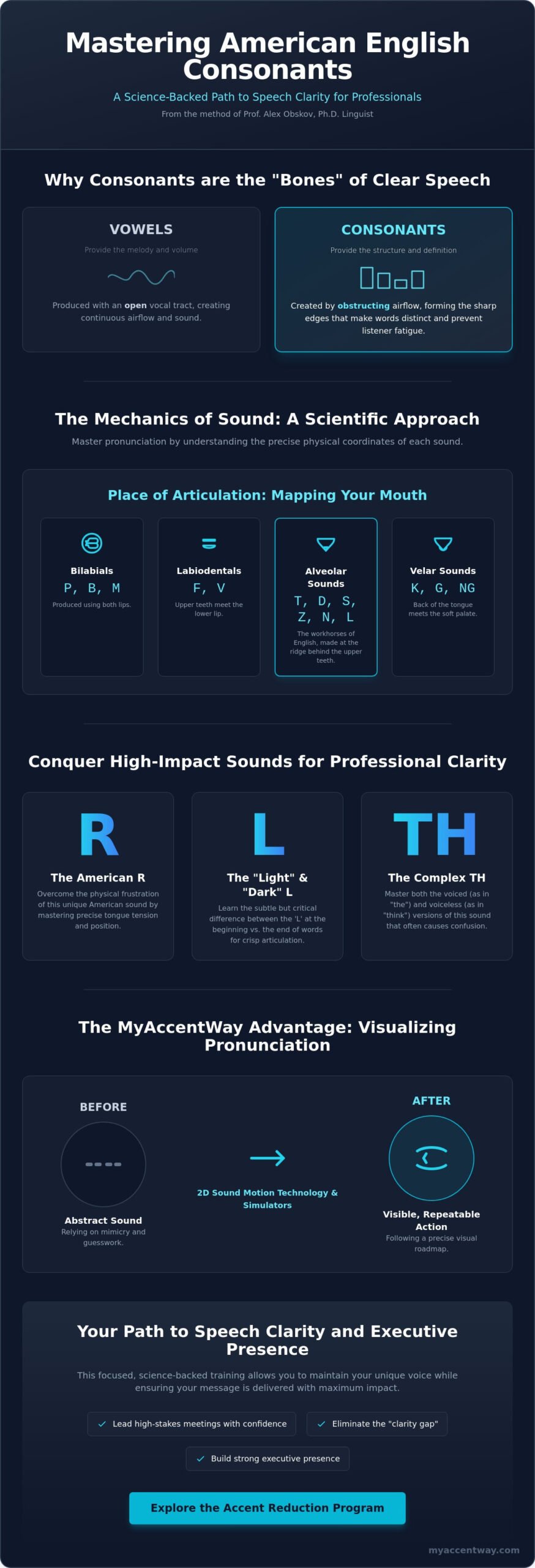
Think of consonants as the structural bones of the English language. While vowels provide the melody and volume of your speech, consonants provide the essential framework that makes words recognizable. For international professionals, the journey toward speech clarity begins with a shift in focus. It’s a common misconception that vowels are the primary culprit behind communication barriers. In reality, mastering the art of pronouncing american english consonants is often the most direct path to being understood in high-stakes environments. When your consonants are crisp and precise, your audience doesn’t have to work as hard to follow your logic.
As Prof. Alex, Ph.D. Accent Coach, I approach accent modification through the lens of physical science. My method doesn’t rely on simple mimicry or “listening and repeating.” Instead, we analyze the specific mechanics of how sounds are produced. This science-backed approach ensures that you aren’t just guessing how to shape your mouth; you’re learning the exact coordination required for professional clarity. This is about personal growth and career empowerment, providing you with the tools to lead meetings and presentations with newfound self-assurance.
Why Consonants Matter for Speech Clarity
Consonants function as the “stoppers” and “shapers” of airflow. Unlike vowels, which are produced with an open vocal tract, consonants involve specific points of contact between your tongue, teeth, and lips. If you examine the complexities of English Phonology, you’ll see how these sounds create the sharp edges of language. In a busy U.S. corporate setting, a “clarity gap” often emerges when these edges are blurred. If your consonants are too soft, words can bleed into one another, causing listener fatigue. When you articulate consonants with precision, you reduce the cognitive load on your colleagues, allowing them to focus entirely on your expertise rather than decoding your pronunciation.
Moving Beyond Generic ESL Methods
Most general English programs focus heavily on grammar and vocabulary. While those are important, they don’t address the physical habits that affect your professional delivery. Specialized American accent training is different. It’s a sound-by-sound mastery process designed for the adult learner. We don’t aim to change your cultural identity or “fix” who you are. Instead, we treat pronouncing american english consonants as a high-level skill, much like public speaking or strategic management. This focused training allows you to maintain your unique voice while ensuring your message is delivered with maximum impact and clarity.
The Mechanics of Sound: Categorizing American Consonants
To master pronouncing american english consonants, you must look at your mouth as a high-precision instrument. As a linguist, I categorize sounds not by how they “feel,” but by the physical coordinates they occupy within the vocal tract. Every one of the 24 consonant sounds in American English is the result of three specific factors: Place, Manner, and Voicing. When you understand these mechanics, you gain the ability to troubleshoot your own speech in real-time, moving away from frustration and toward intentional communication.
Place of Articulation: Mapping Your Mouth
The “Place” is the physical geography of where a sound is created. For many international professionals, small shifts in placement can lead to massive gains in clarity. By identifying exactly where the tongue or lips should meet, you remove the guesswork from your daily interactions.
- Bilabials (P, B, M): These sounds are produced using both lips. They are foundational and are often the first sounds we master in any accent training program.
- Labiodentals (F, V): These require your upper teeth to make light contact with your lower lip, allowing air to pass through.
- Alveolar Sounds (T, D, S, Z, N, L): These are created at the alveolar ridge, the small bony bump just behind your upper teeth. These are the workhorses of professional English. Because they appear so frequently, mastering the tongue’s agility in this area is vital for executive presence.
- Velar Sounds (K, G, NG): These occur at the back of the mouth, where the back of the tongue meets the soft palate.
Manner of Articulation: Controlling Airflow
The “Manner” describes how you restrict or release air to create sound. It’s the difference between a sharp “pop” and a steady “hiss.” Mastery here allows you to control the rhythm and impact of your words.
- Stops (Plosives): You briefly block the airflow entirely before releasing it in a controlled burst, such as in the sounds P, T, and K.
- Fricatives: You create a narrow opening, forcing air through to produce continuous friction. This category includes S, F, and the crucial TH sounds.
- Nasals: You lower the soft palate, allowing air to escape through the nasal cavity. This gives sounds like M and N their distinct resonance.
Voicing adds the final layer of precision. It’s the simple vibration of the vocal folds. For example, the sounds “S” and “Z” share the exact same place and manner, but “Z” is voiced while “S” is not. You can test this by placing your fingers on your throat; you should feel a distinct buzz during a “Z.” Mismanaging voicing can lead to word confusion, such as mistaking “price” for “prize” in a business proposal. If you want to refine these skills further, consider looking into American accent training to see these mechanics in action. Categorizing sounds this way allows you to move beyond simple imitation and toward true phonetic mastery.
Mastering High-Impact Consonants for Professional Clarity
While all 24 consonants contribute to the structure of your speech, a specific group of sounds often determines how colleagues perceive your professional authority. These high-impact sounds, particularly the “Big Three” professional hurdles, are TH, R, and L. Mastering the art of pronouncing american english consonants involves more than just mouth positions; it requires a diagnostic understanding of how these sounds interact with your native phonetic habits. When you refine these specific markers, your executive presence becomes much more pronounced.
The American R: A Phonic Challenge
The American R is unique because it is an approximant, meaning the tongue gets close to the roof of the mouth without actually touching it. Most languages use a rolled or tapped R, but in American English, contact is the enemy of clarity. You can produce this sound in two ways: the retroflex R, where the tongue tip curls up, or the bunched R, where the body of the tongue raises toward the back teeth. The key is maintaining lateral tongue tension. If your R feels too soft or disappears into the following vowel, you’re likely experiencing the “R-colored” effect where the consonant loses its distinct boundary. Keep the tongue strong and avoid any trilling to ensure your professional delivery remains crisp.
Voiced vs. Unvoiced Consonant Pairs
A common “clarity gap” in corporate communication occurs when speakers fail to distinguish between voiced and unvoiced pairs. These are sounds produced in the exact same position, differentiated only by the vibration of your vocal folds. As Prof. Alex, Ph.D. Accent Coach, I often see professionals struggle with pairs like S and Z, or T and D. To master this, try a simple “throat check” exercise: place your hand on your neck and say “Sss,” then “Zzz.” You should feel a distinct buzz during the “Z.”
- S vs. Z: “Price” (unvoiced) vs. “Prize” (voiced).
- T vs. D: “Sent” (unvoiced) vs. “Send” (voiced).
- Final Consonant De-voicing: Many speakers accidentally unvoice the end of words. Saying “jop” instead of “job” can subtly change the meaning of your sentence and distract your listeners.
The TH Sounds: Overcoming the Obstacle
The TH sounds are notoriously difficult because they require an interdental position, where the tongue tip peeks slightly between the teeth. There are two versions you must master for pronouncing american english consonants effectively: the unvoiced TH (as in “think”) and the voiced TH (as in “those”). Professionals often substitute a “D” for the voiced TH, saying “dis” instead of “this,” or an “S” for the unvoiced TH. These substitutions are highly noticeable in presentations. To fix this, focus on a steady flow of air over the tongue tip. If you find these specific mechanics difficult to maintain during fast-paced meetings, exploring American Accent Training near me can provide the personalized, sound-by-sound feedback necessary to make these movements second nature.
Finally, consider the diagnostic difference between L and R. While both are liquids, the L requires firm tongue-tip contact with the alveolar ridge, whereas the R requires no contact at all. Distinguishing these two is vital for word pairs like “light” and “right.” By focusing on these high-impact areas, you move beyond generic advice and toward a sophisticated, science-backed mastery of your professional speech.
MyAccentWay · 2D Sound Motion Technology
American English Pronunciation: Consonant and Vowel Sounds with 2D Sound Motion Technology
Learning American English pronunciation and the American accent is more effective when you train your speech organs, not only listen and repeat. 2D Sound Motion Technology and Interactive Visual 2D Sound Simulators, developed in 2020 by Prof. Alex, Ph.D. Accent Coach, Doctor of Education, and professional linguist, as part of his interactive teaching model based on his Ph.D. research in interactive teaching methods, train your tongue, lips, jaw, teeth, airflow, and voice step by step. They train each American sound and more than 30 sound combinations through Interactive 2D video simulation.
What 2D Sound Motion Technology is
2D Sound Motion Technology is an advanced accent reduction and articulation training tool by Prof. Alex. It corrects, develops, and trains each American sound and more than 30 sound combinations through Interactive 2D video simulation.
What Interactive Visual 2D Sound Simulators do
Interactive Visual 2D Sound Simulators are part of 2D Sound Motion Technology, the articulation-training method Prof. Alex created by applying his Ph.D. research in interactive teaching to American pronunciation. Instead of listening and repeating, students actively train their speech organs. Each simulator uses Interactive 2D mouth movement to train the speech organs (tongue, lips, jaw, teeth, airflow, and voice) to produce each American sound correctly. Every consonant has its own simulator: explore American consonants trained with 2D Sound Motion Technology.
Sample training: the American TH sound [th]
Practice
Record yourself speaking these words:
Think · Three · Thank · Method · Both
Instructions
This Interactive Visual 2D Sound Simulator for the American TH sound is part of 1-on-1 Interactive American Accent Training with Prof. Alex. Tap the simulator to book your session.
Interactive Visual 2D Sound Simulator: American unvoiced [th]
Practice
Record yourself again, this time focusing on the movement of your tongue and lips. Go slow, and you will hear the difference. You’ve got this!
Think · Three · Thank · Method · Both
How Interactive Visual 2D Sound Simulators solve pronunciation and speaking problems
- Wrong articulationMost pronunciation problems start with the tongue, lips, jaw, or teeth in the wrong position. Each Interactive Visual 2D Sound Simulator trains the correct articulation of one American sound, so the student corrects the cause of the problem, not only the result.
- Airflow and voicingMany accent problems come from wrong airflow or voicing: sounds that are too weak, too strong, or voiced when they should be unvoiced. The simulators train airflow and voice together with articulation, step by step, for each American sound and more than 30 sound combinations.
- Clear speech and confidenceWhen each sound is trained correctly, words connect into clear American English speech. Listeners can understand you more easily, and speaking at work, in meetings, and on calls becomes more confident.

If you start hearing the difference in your American TH sound with one simulator, you can only imagine how successful you can be in 1-on-1 Interactive American Accent Training with Prof. Alex, Ph.D. Accent Coach, where your whole American sound system is trained sound by sound.
In MyAccentWay, the Interactive Visual 2D Sound Simulators are only available in 1-on-1 accent coaching sessions with Prof. Alex.
MyAccentWay · 2D Sound Motion Technology
Train the American TH sound with Prof. Alex
In MyAccentWay, the Interactive Visual 2D Sound Simulators are only available in 1-on-1 accent coaching sessions with Prof. Alex, Ph.D. Accent Coach.
One public sample, the Interactive Visual 2D Sound Simulator for the American [t] sound, is available here.
Training Pronunciation with 2D Sound Motion Technology
Traditional coaching often relies on the “watch my mouth” method, which is fundamentally limited. While you can see the lips and jaw, the most critical components for pronouncing american english consonants are hidden from view. As Prof. Alex, Ph.D. Accent Coach, I’ve developed a more effective way to bridge this gap. By using 2D Sound Motion Technology, we take the guesswork out of speech by making the internal movements of the tongue and soft palate completely visible. This visualization allows you to build a reliable mental map of your mouth, turning abstract sounds into concrete, repeatable actions. You’re no longer shooting in the dark; you’re following a precise visual roadmap.
Interactive Visual 2D Sound Simulators for American Sounds train the speech organs to coordinate speech in real-time. This is particularly transformative for mastering complex sounds like the “dark L” or the “flapped T.” In these cases, the tongue’s movement happens too quickly or too far back to see on a human face. By using the InPronunci software, you can practice these hidden mechanics and understand exactly how to position your articulators for maximum clarity. This research-based approach is much faster than traditional “listen and repeat” methods because it removes the trial-and-error phase that often leads to frustration. Instead of guessing, you develop a deep, physical awareness of your speech mechanics.
How Interactive Visual 2D Sound Simulators Accelerate Learning
The Interactive Visual 2D Sound Simulators for American Sounds create a powerful training loop: practice the movement, then hear the sound. This approach reduces the cognitive load on the learner. You aren’t just trying to copy a sound; you’re learning to execute a physical maneuver. By practicing the “dark L,” for example, you train the back of the tongue to raise, a movement that is impossible to detect simply by watching a coach’s face. This level of detail is what makes accent modification a science. When you understand the internal physics of your voice, you gain the confidence to speak clearly in any professional setting.
A Daily Practice Routine Using Simulators
To get the most out of these digital tools, I recommend a structured daily practice routine that focuses on deliberate repetition. This visual guide is the most efficient way to master the physical side of pronouncing american english consonants with consistency. I suggest following these steps:
- Step 1: Observe. Practice the 2D motion of a target consonant on the simulator. Pay close attention to the tongue’s height, tension, and contact points.
- Step 2: Mimic. Replicate the internal tongue position shown on the screen, focusing on the physical sensation of the placement rather than just the sound.
- Step 3: Compare. Record your own speech and compare your output to the professional model. This objective analysis helps you refine your articulation.
By integrating these visual tools into your routine, you turn abstract phonetic concepts into manageable physical skills. If you’re ready to see your progress in a new light, explore our American accent training options and learn how the InPronunci platform can accelerate your journey toward speech clarity. This technology isn’t just a learning aid; it’s a revolutionary way to master your professional voice and ensure your expertise is heard clearly in every meeting.
Your Path to Speech Clarity and Executive Presence
Mastering the art of pronouncing american english consonants is a journey that begins with mechanical understanding and ends with effortless executive presence. You’ve moved beyond the “listen and repeat” approach, replacing it with a science-backed awareness of how your mouth functions as a tool for communication. This transformation is about more than just phonetics; it’s a vital component of career empowerment. When you speak with clarity, you command the room and ensure your expertise is the focal point of every conversation.
This process is an art as much as a science. As you continue to refine your skills, I encourage you to view accent modification as a way to enhance your professional toolkit while honoring your unique cultural identity. For a deeper look at how these methods integrate into a broader strategy, explore our comprehensive American Accent Training for U.S. Professionals guide. It’s time to bridge the gap between your technical brilliance and your spoken delivery.
Integrating Consonant Mastery into Daily Meetings
Real-world application is where your training truly pays off. During high-stakes presentations, make a conscious effort to slow down when delivering key technical terms or data points. This gives your articulators the time they need to hit the correct positions. Use the “Big Three” consonants we discussed earlier to anchor your sentences, providing the structural clarity your listeners need to follow complex logic. Remember that consistency is your greatest ally. Short, focused practice sessions of 10 to 15 minutes each day will yield better results than a single two-hour session once a week. This steady approach builds the muscle memory required for fluency.
Next Steps with MyAccentWay
If you’re ready to take the next step in your professional development, I invite you to experience our personalized coaching methodology firsthand. Our approach is tailored to your specific linguistic background, focusing on the sounds that will have the greatest impact on your career. You can begin by booking a 1 Hour Evaluation Session or a comprehensive speech assessment to identify your unique focus areas. We’ll work together sound-by-sound to ensure you have the tools to lead with confidence in any environment, from Austin, Texas, to global boardrooms.
My goal as Prof. Alex, Ph.D. Accent Coach, is to provide you with the most advanced tools, including our Interactive Visual 2D Sound Simulators, part of my interactive teaching model based on my Ph.D. research in interactive teaching methods, to help you actively train the movement of your tongue, lips, jaw, teeth, and airflow while I correct you live. Don’t let communication barriers hold back your professional growth. Enhance your professional voice today by exploring our specialized American accent training programs. Your expertise deserves to be heard with total clarity. I look forward to supporting your journey toward becoming a more confident, impactful communicator.
Empower Your Professional Voice with Precision
You now possess the scientific framework to transform your communication from a source of frustration into a powerful asset. We have explored how consonants serve as the structural framework for speech and why understanding the physical mechanics of the vocal tract is far more effective than simple repetition. By utilizing 2D Sound Motion Technology, you can train the internal choreography of your mouth, making the process of pronouncing american english consonants both predictable and achievable.
This journey is about career empowerment and personal growth. Under the guidance of Prof. Alex, Ph.D. Accent Coach, you’ll follow a research-based method that has helped U.S. professionals achieve lasting speech clarity without sacrificing their unique cultural identities. Your expertise deserves to be heard with total confidence. Explore our American Accent Training program and Book Your 1 Hour Evaluation Session today. I look forward to helping you master the mechanics of your voice and lead with new authority.
American Consonant Training for Foreign-Born Professionals in the United States
Foreign-born professionals in the United States often know their field and speak advanced English. Yet American listeners may still struggle with their consonant sounds. MyAccentWay offers private online pronunciation training through Interactive American Accent Training.
Interactive American Accent Training is led by Prof. Alex, Ph.D. Accent Coach, Doctor of Education, and professional linguist. He first diagnoses each speaker’s native-language patterns. Then he trains American consonant articulation and clear word endings for real meetings and presentations.
Who this training is for
- Engineers, IT specialists, and data professionals presenting to U.S. teams and clients
- Doctors, nurses, and healthcare professionals explaining care to American patients
- Managers, executives, and founders leading meetings, pitches, and briefings
- Consultants, researchers, and academics speaking at conferences and webinars
- Professionals preparing for interviews, promotions, or client-facing roles
Online training across the U.S.
MyAccentWay is based in Austin, Texas, and all training is online. The program is especially relevant for professionals in Austin, Dallas, Houston, New York City, the San Francisco Bay Area, Los Angeles, Seattle, Boston, Chicago, Miami, Washington DC, Atlanta, and Raleigh.
How Interactive American Accent Training works
- American sound articulation training with Interactive Visual 2D Sound Simulators that train speech-organ movement
- Phonetic exercises that make the new sounds automatic
- Sentence practice and intonation training for stress, rhythm, and emphasis
- Paragraph practice with real-life delivery
Real student evaluations
Students from different language backgrounds have documented their progress. Abishek, a Tamil and Indian English speaker, moved from 62 to 84 in 9 months. Tian, a Mandarin speaker, moved from 58 to 85 in 8 months. Vlad, a Russian speaker, moved from 60 to 83 in 5 months.
The first step is a 1 Hour Evaluation Session with Prof. Alex.
Frequently Asked Questions
Can I really improve my pronunciation of American English consonants as an adult?
Yes, you can absolutely improve your speech clarity at any age. While children acquire sounds intuitively, adults succeed by using their analytical skills to understand the science behind sound production. By focusing on the specific mechanics of pronouncing american english consonants, you can retrain your articulators and build lasting muscle memory through a systematic, sound-by-sound approach.
What is the most difficult American English consonant to pronounce?
For many professionals, the American “R” is the most challenging sound to master. This is because it’s an approximant that requires precise tongue tension without touching the roof of the mouth. Unlike the rolled or tapped “R” found in many other languages, the American version relies on a specific “bunched” or “retroflex” position that can feel counterintuitive until you see the internal mechanics.
How is accent reduction different from learning English as a second language?
Accent reduction is a specialized training that focuses on the physical delivery of speech rather than language rules. While traditional English learning covers grammar and vocabulary, our American accent training focuses on the rhythm, intonation, and physical mechanics of sounds. It’s a performance-based skill designed to enhance professional communication and executive presence in the workplace.
What are Interactive Visual 2D Sound Simulators, and how do they help with pronunciation?
Interactive Visual 2D Sound Simulators are advanced tools that train the speech organs. They train the tongue, lips, and palate as they move during speech. This technology trains the “hidden” movements required for pronouncing american english consonants, making it much easier to replicate the sounds correctly than by simply listening and repeating.
How long does it take to see results in American accent training?
Most professionals notice a significant increase in their phonetic awareness within the first few weeks of training. However, achieving consistent, automatic clarity in high-stakes meetings typically takes three to six months of daily practice. This timeline allows your brain and muscles to move from conscious effort to natural, subconscious execution during fast-paced, high-pressure conversations.
Will I lose my native accent if I undergo accent modification?
You won’t lose your native accent or your cultural identity during this process. The goal of accent modification is to provide you with a “professional voice” that you can use when clarity is the highest priority. Think of it as gaining a new skill or becoming bi-dialectal. You’re simply adding more tools to your communication toolkit to ensure your expertise is always understood.
The problem is not always grammar or vocabulary.
If people understand your words but still miss your message, the deeper issue may be speech clarity, rhythm, intonation, and American pronunciation habits. MyAccentWay helps students retrain the sound system with professional 1-on-1 guidance, so English can feel clearer, freer, and more natural in real communication.
Two training methods that make speech change active.
MyAccentWay is not passive listen-and-repeat coaching. Prof. Alex, Ph.D. Accent Coach, Doctor of Education, and professional linguist, creates a learning situation where students become active learners and active participants in changing their own speech patterns.
Interactive training
Students do not just receive pronunciation instructions passively. They listen, think, compare, adjust, and understand their own speech patterns while Prof. Alex guides the correction process.
Cognitive accent training
Students learn to notice and correct the speech patterns that affect American pronunciation, then implement new American speech patterns into their code-switching process for more natural, long-lasting change.
Build speech habits people can hear in real conversations.
A stronger American accent is not built by memorizing topics or chasing quick pronunciation tips. It comes from structured training, professional feedback, active correction, and repeated application until clearer speech becomes easier to keep.
Continue learning how MyAccentWay connects American sound articulation, Interactive Visual 2D Sound Simulators, accent reduction, student proof, and 1-on-1 training.
- Prof. Alex and the MyAccentWay MethodLearn how Prof. Alex created and leads the structured MyAccentWay American accent training system.
- Accent Reduction Curriculum and English Articulation TrainingSee accent reduction, accent modification, American pronunciation, English articulation, rhythm, and professional speech clarity.
- 2D Sound Motion Technology for American Accent TrainingUnderstand Interactive Visual 2D Sound Simulators for American sound articulation.
- Before-and-After American Accent Training ResultsListen to real before-and-after student proof and outcomes.
- Student Reviews and Accent Training ResultsRead student reviews and trust signals.
- Book a 1-Hour 1 Hour Evaluation SessionStart with a 1-hour interactive session with Prof. Alex.
Disclaimer – American Accent Program
The American Accent Program available through Visit Program Website
is an educational and coaching service designed to support pronunciation, accent reduction, and spoken English fluency. All training materials, including lessons, exercises, audio content, visual simulations, coaching methods, and digital resources, are the intellectual property of American Accent Program, LLC and are protected by applicable copyright and intellectual property laws.
By using this website and participating in the program, you acknowledge that all content is provided for personal, non-commercial, educational use only. Users are granted a limited, non-transferable license to access the materials strictly for individual learning purposes. Redistribution, reproduction, recording, modification, sharing, or commercial use of any program content without prior written consent is strictly prohibited.
The program may include live coaching sessions, digital tools, and instructional materials intended to improve pronunciation and communication skills. However, individual results may vary, and no specific level of fluency, accent reduction, or communication outcome is guaranteed.
The American Accent Program and its instructors do not provide medical, therapeutic, or clinical speech-language pathology services. All training is intended for educational purposes only.
By accessing or using the program, you agree to comply with all applicable terms, including the platform’s Terms of Use and Course Policies, and acknowledge that misuse of materials may result in termination of access without refund.