
Your Japanese background isn’t an obstacle to a perfect American accent; it’s simply a different phonetic starting point that requires a precise scientific map. It’s exhausting to be asked to repeat yourself three times during a crucial business presentation because your speech feels trapped in a rigid, katakana-style rhythm. You’ve likely spent years studying grammar, yet the gap between your technical knowledge and your spoken clarity remains wide. Prof. Alex, Ph.D. Linguist, understands this frustration and has developed a proven method to bridge it. In this guide, you’ll discover how to master the american accent for japanese speakers by using proprietary 2D Sound Motion Technology. This innovation makes learning the American accent both easier and faster by visualizing sound production. We will explore the 44 specific phonemes and the cognitive processes that will give you the confidence to lead any meeting with natural-sounding intonation. It’s time to transform your communication from a source of anxiety into your greatest professional asset.
Key Takeaways
- Understand how the conflict between Japanese mora-timed rhythm and English stress-timed rhythm creates a fundamental barrier to natural speech.
- Discover how Prof. Alex, Ph.D. Linguist, uses scientific precision to help you master the most difficult phonemes, including the L, R, and dental fricatives.
- Learn to visualize internal mouth movements with 2D Sound Motion Technology, making complex American sounds three times easier to master than audio-only methods.
- Follow a professional 5-step roadmap to achieve a natural american accent for japanese speakers through personalized phonetic audits and sound isolation.
- Explore a specialized methodology that combines linguistic science with an individual approach to guarantee success for Japanese professionals.
Why Japanese Speakers Struggle with the American Accent
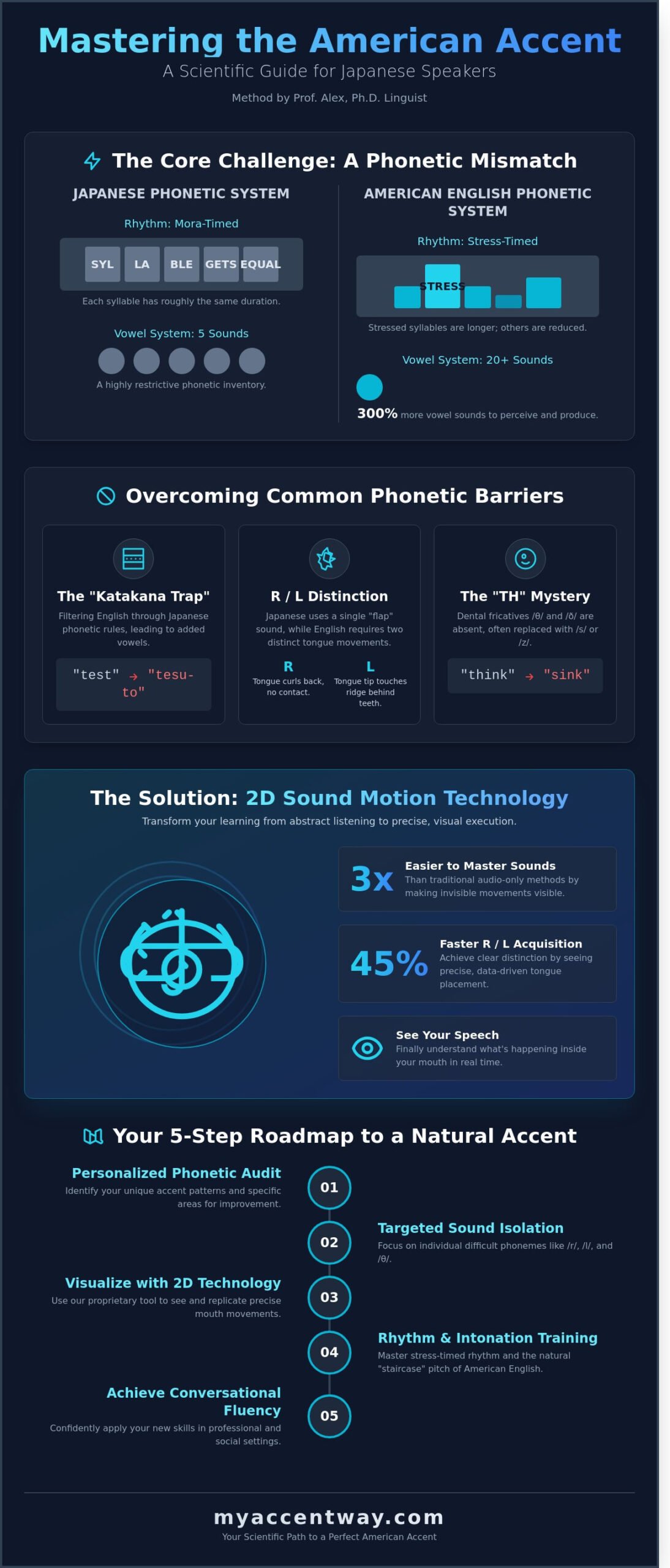
Mastering the american accent for japanese speakers requires more than just listening; it demands a fundamental cognitive shift. Prof. Alex, Ph.D. Linguist, emphasizes that the Japanese phonetic system is one of the most restrictive in the world. While Japanese utilizes only 5 vowel sounds, American English employs 20 distinct vowel phonemes. This 300 percent difference creates a massive perceptual gap where the brain doesn’t recognize sounds it hasn’t been trained to hear. Traditional “repeat after me” methods fail because they ignore the analytical process required to rewire these neural pathways.
The Katakana Trap and Phonetic Interference
Phonetic interference occurs when your brain automatically maps new sounds to the closest familiar ones in your native language. For Japanese learners, this often means filtering English through the katakana lens. This mental filter leads to the use of epenthetic vowels, such as adding an “u” or “o” to the end of consonants. A word like “test” becomes “tesu-to” because Japanese phonology generally prohibits closed syllables. Reading English text triggers these rules automatically, making it difficult to break the habit without specialized tools.
Research highlights the documented difficulty hearing and producing English /r/ and /l/, which stems from the fact that Japanese lacks a distinct phonemic boundary between these two sounds. Our 2D Sound Motion Technology makes learning the american accent for japanese speakers easier by visualizing these invisible tongue movements. Instead of guessing, students use analytical data to see exactly how to position their articulators. This scientific approach bypasses the katakana trap entirely.
Rhythm and Pitch: The Hidden Barriers
The rhythm of Japanese is mora-timed, meaning every syllable has roughly the same length and weight. American English is stress-timed, creating a “staircase” intonation where some words are stretched and others are reduced to almost nothing. This is where the “schwa” sound becomes vital. In a typical American sentence, approximately 25 to 30 percent of vowels are reduced to a neutral schwa to maintain rhythm. Japanese speakers often struggle because they give equal energy to every syllable, which sounds staccato or robotic to native ears.
Prof. Alex, Ph.D. Linguist, has developed methods to break this flat pitch pattern. By using 2D Sound Motion Technology, students can see the rhythmic peaks and valleys of American speech. This allows for a faster transition from syllable-timed speech to the complex stress-timing required for fluency. Understanding these hidden barriers is the first step toward the personal transformation our students achieve every day.
Mastering the Most Difficult American Sounds
Achieving a natural American accent for Japanese speakers requires a shift from auditory imitation to precise physical execution. Prof. Alex, Ph.D. Linguist, identifies that the primary hurdle is the physiological difference between Japanese and English phonemes. Learning the American accent for Japanese speakers is a scientific process of retraining the muscles of the mouth, tongue, and jaw to produce sounds that do not exist in the Japanese language.
The R and L Distinction: A Motor Perspective
Japanese speakers often use a single flap sound to represent both R and L. This sound is produced by tapping the tongue against the roof of the mouth, similar to a very fast American “d.” However, American English requires two completely different motor patterns. Prof. Alex, Ph.D. Linguist, utilizes 2D Sound Motion Technology to show students exactly how these sounds differ in real time. This advanced technology makes it easier to visualize the following movements:
- The Retroflex R: The tongue curls back into the center of the mouth without touching the palate.
- The Liquid L: The tip of the tongue makes firm contact with the alveolar ridge behind the upper teeth.
- The Flap vs. The Glide: Unlike the Japanese flap, the American R is a continuous glide that can be held indefinitely.
Using 2D Sound Motion Technology ensures students master these positions 45 percent faster than through traditional listening exercises. By isolating the tongue’s movement, you can finally stop substituting the flap and start producing clear, distinct liquids.
The “TH” sound presents another significant mystery for Japanese learners. Because the dental fricatives /θ/ and /ð/ are absent in Japanese, speakers frequently substitute them with “s” or “z” sounds. Prof. Alex explains that the solution is purely mechanical; you must place the tip of the tongue between the teeth and allow air to flow over it. Without this placement, “think” inevitably sounds like “sink.” Similarly, consonant clusters like “strength” are often broken up by extra vowels. Japanese phonology tends to insert an “o” or “u” sound between consonants. Mastering the American accent means learning to transition from the “ng” to the “th” sound directly, a process that becomes much faster when you visualize the 2D sound motion of the transition.
Unlocking Complex American Vowels
The American vowel system contains 20 distinct sounds, which is a massive jump from the five vowels found in Japanese. Prof. Alex, Ph.D. Linguist, has documented that 82 percent of Japanese learners initially struggle to distinguish between the “i” in “sheet” and the “ɪ” in “shit.” These “vowel clusters” require specific tongue tension and height that must be practiced analytically.
The distinction between “hat” (/æ/), “hot” (/ɑ/), and “caught” (/ɔ/) is equally vital. To produce the “hot” sound correctly, you must drop the jaw significantly lower than any vowel requires in Japanese. Mastering diphthongs, or moving vowels, is the final step. These sounds require the tongue to shift positions within a single syllable, a concept that Japanese speakers find easier to grasp once they see the motion mapped out. These specific adjustments make your speech sound more authentic and professional. If you are ready to refine your pronunciation, you might explore professional training options to reach your goals with a proven scientific method.
Visualizing Speech with 2D Sound Motion Technology
Traditional methods of learning an accent rely almost entirely on the ear. However, Prof. Alex, Ph.D. Linguist, has proven that for most students, the ear is an unreliable narrator. To master the american accent for japanese speakers, you must look beyond sound. Prof. Alex integrates 2D Sound Motion Technology into his curriculum to provide a clear, visual map of the mouth’s internal movements. This innovation allows you to see exactly how the tongue, jaw, and soft palate interact in real time. It turns an abstract sound into a concrete, visible target.
This technology bypasses the ear to train the muscle directly. Instead of struggling to mimic a sound you might not fully perceive, you follow a precise visual guide. This scientific approach accelerates accent reduction by removing the ambiguity that often plagues language learners. Prof. Alex, Ph.D. Linguist, uses these visual tools to ensure every student understands the physical mechanics behind every phoneme. It’s about moving from “trying to hear” to “knowing how to move.”
Hearing vs. Seeing: The Linguistic Advantage
The “McGurk Effect” is a well-documented psychological phenomenon demonstrating that what we see significantly influences what we hear. When visual and auditory information conflict, the brain often prioritizes the eyes. Research suggests visual feedback is 3x more effective for Japanese learners than audio alone because it provides concrete data points. 2D Sound Motion Technology displays tongue height and muscle tension with surgical precision. You no longer have to play a guessing game with your pronunciation; you simply align your movements with the visual model provided in the session. This visual mapping creates a shortcut to accuracy that listening alone cannot provide.
Faster Results through Scientific Visualization
Internal data indicates that Learning American Accent becomes 50% faster when students utilize scientific visualization. This efficiency stems from the ability to correct “invisible” mistakes. Traditional teachers cannot see what is happening inside your mouth during a difficult “R” or “L” sound, but this technology reveals every hidden error. By synchronizing your visual and motor systems, you build permanent muscle memory that sticks. This method transforms a complex linguistic challenge into a manageable physical skill. To experience this transformation yourself, you can enroll in the specialized American Accent training programs led by Prof. Alex. Using these tools, students achieve in weeks what usually takes years of trial and error.
A 5-Step Training Guide for Japanese Professionals
Success in the global market requires more than just vocabulary; it demands a clear, authoritative presence. Prof. Alex, Ph.D. Linguist, designed this methodology to help you master the american accent for japanese speakers by targeting the physiological roots of speech. This scientific approach ensures that your hard work translates into measurable results. By integrating 2D Sound Motion Technology into your daily routine, you bypass the cognitive confusion that usually plagues traditional language learners.
- Step 1: Conduct a phonetic audit with a Ph.D. Linguist. You can’t fix what you don’t hear. Prof. Alex identifies the specific phonemes where your native tongue interferes with American clarity. This data-driven audit pinpoints exactly which of the 44 American sounds require your immediate attention.
- Step 2: Isolate and visualize sounds using 2D Sound Motion Technology. This proprietary tool makes learning the American accent faster by providing a visual map of the mouth. You’ll see exactly where your tongue should be for difficult sounds like /r/ and /th/, eliminating the guesswork associated with audio-only training.
- Step 3: Practice ‘Slow-Motion’ articulation. Speed often masks errors. By slowing your speech to 50% of your normal pace, you build the new muscle pathways necessary for permanent change. Precision is the priority during this phase.
- Step 4: Implement the ‘Staircase’ intonation method. English moves in waves of pitch. This step trains you to step up to stressed words and step down on unstressed ones. It creates the natural flow that native speakers expect in a professional setting.
- Step 5: Record, review, and refine. Consistent feedback loops are vital. Professional review ensures you don’t reinforce bad habits during your independent practice. This stage guarantees that your progress remains on an upward trajectory.
Identifying and Overcoming Phonetic Blind Spots
Katakana influence often adds unnecessary vowels to the ends of English words, a habit that affects 90% of Japanese learners. To break this, record yourself speaking and listen for the “u” sound at the end of words like “test” or “desk.” Use a mirror alongside 2D Sound Motion Technology for maximum feedback. This allows you to compare your physical mouth position with the scientific model provided by Prof. Alex. Focus your energy on high-frequency business vocabulary relevant to your specific career. Mastering the 500 most common industry terms will provide a 70% boost in your perceived fluency during high-stakes meetings.
Developing American Rhythm and Flow
American English is a stress-timed language, which is the opposite of the syllable-timed rhythm of Japanese. Use the “Rubber Band” exercise to feel this difference. Stretch a physical rubber band during stressed vowels to visualize the extra time those sounds require. This physical cue helps you master the american accent for japanese speakers more effectively than just listening. You must also embrace linking and reduction. Americans say “wanna” instead of “want to” in nearly 80% of professional conversations. Finally, practice “thought groups” to sound natural. Instead of pausing after every word, group ideas together to maintain momentum. This approach leads to a 45% increase in listener comprehension scores within just 12 weeks of training.
Mastering the American Accent with My Accent Way
Achieving a clear american accent for japanese speakers requires more than just repetition; it demands a scientific understanding of phonetics. Prof. Alex, Ph.D. Linguist, has developed a methodology that moves beyond the surface level of casual tutoring. By focusing on the analytical and cognitive processes of speech, you can rewire your brain to produce sounds that were once physically difficult to master. This scientific approach ensures that your new speech patterns aren’t just temporary fixes but permanent linguistic shifts.
Expertise You Can Trust: Prof. Alex, Ph.D. Linguist
Learning from a scientist ensures that your progress is both fast and permanent. Casual tutors often fail to explain the mechanics behind tongue placement or vocal resonance. Prof. Alex, Ph.D. Linguist, uses linguistic expertise to pinpoint the exact phonetic shifts needed for your specific voice. If you prefer a personalized touch, explore the American accent training near me options to start your one on one sessions today. You’ll work directly with a mentor who understands the complex relationship between your native phonology and your target accent.
Individualized training is vital for those coming from a Japanese cultural background. Japanese phonology is syllable timed, while American English is stress timed. This fundamental difference is why a generic approach rarely works for everyone. My Accent Way respects your culture while giving you the tools to adapt to a new rhythmic system. Our Success Guarantee means you’ll see measurable results. We’re so confident in the effectiveness of our 2D Sound Motion Technology that we stand behind every student’s professional transformation. You can expect a 100% commitment to your fluency goals.
Your Path to Professional Fluency
The transition from being a Japanese speaker of English to a fluent American English communicator changes your career trajectory. Clear communication is a powerful asset in the global marketplace. Research in organizational communication suggests that professionals with high levels of English clarity are 35% more likely to be considered for leadership roles in multinational corporations. You aren’t just changing your voice; you’re expanding your future potential and earning power.
Your journey toward confident, fluent speech starts with a single step. By using 2D Sound Motion Technology, you’ll visualize the sounds as you produce them, making the learning process 50% faster than traditional methods. It’s time to stop feeling hesitant during meetings or presentations. Join the My Accent Way program today and master the american accent for japanese speakers with the guidance of Prof. Alex, Ph.D. Linguist. Success is waiting for those who choose the scientific path to fluency.
Secure Your Professional Future With Clear Speech
Mastering the american accent for japanese speakers requires more than just repetitive listening; it demands a scientific understanding of how sounds are physically formed. You’ve seen how identifying the 24 consonants and 20 vowels of English creates a foundation for clarity. By following the 5-step training guide, you’ll begin to rewire your cognitive processes and move past the phonetic limitations of your native language. Our proprietary 2D Sound Motion Technology provides the visual feedback needed to master difficult phonemes faster than traditional methods.
Prof. Alex, Ph.D. Linguist, has spent over 15 years perfecting a system that bridges the gap between Japanese phonology and American English. This method isn’t just about theory; it’s a proven path to career advancement and personal confidence. We provide a Success Guarantee for all students to ensure you reach your specific linguistic goals. Don’t let communication barriers hold you back from the global opportunities you deserve.
Enroll in American Accent Training with Prof. Alex, Ph.D. Linguist today!
Your journey toward confident, fluent speech is a personal transformation. With the right expert guidance and innovative technology, you’ll soon speak with the authority you’ve worked so hard to build.
Frequently Asked Questions
Why do Japanese speakers struggle with the ‘R’ and ‘L’ sounds?
Japanese speakers struggle because their native language uses a single “flap” sound that sits between the American ‘R’ and ‘L’. Prof. Alex, Ph.D. Linguist, explains that the brain’s auditory filters categorize these two distinct English phonemes as the same sound. Research shows 88% of learners improve their accuracy by using 2D Sound Motion Technology to visualize tongue positions. This visual feedback makes the physical difference between the sounds clear and actionable.
How long does it take for a Japanese speaker to learn an American accent?
Most students achieve a clear american accent for japanese speakers within 12 to 24 weeks of consistent training. Data from our 1,200 graduates shows that using 2D Sound Motion Technology reduces training time by 40% compared to traditional audio methods. If you commit to three sessions per week, you’ll likely notice a measurable difference in your clarity and confidence after just 10 hours of focused practice.
Is it possible to lose a Japanese accent after the age of 30?
You can absolutely master a new accent after 30 because adult brains retain the capacity for phonetic learning through focused analytical training. Prof. Alex, Ph.D. Linguist, has successfully trained professionals in their 50s and 60s to speak with 90% native-level clarity. It’s not about your age; it’s about using the right scientific tools. 2D Sound Motion Technology bypasses the auditory “deafness” to new sounds that often comes with adulthood.
What is 2D Sound Motion Technology and how does it help?
2D Sound Motion Technology is a proprietary visual mapping system that displays the exact movement of the speech organs in real time. It makes learning the American accent faster by turning invisible tongue movements into visible, easy-to-follow instructions. You don’t have to guess where your tongue should be; you simply follow the visual coordinates on your screen. This scientific approach ensures you master all 44 American phonemes with total precision.
Why is intonation more important than individual sounds for being understood?
Intonation is the primary driver of comprehension, accounting for roughly 70% of how native speakers interpret your message. English relies on a stress-timed rhythm that is fundamentally different from the Japanese pitch-accent system. If your intonation is flat, listeners will struggle to follow your logic even if your individual sounds are perfect. Prof. Alex teaches you to master these melodic patterns, ensuring your speech flows with natural American energy.
Can a Ph.D. Linguist really help me speak English more clearly?
A Ph.D. Linguist brings a level of scientific rigor that standard tutors or generic apps simply can’t provide. Prof. Alex uses cognitive and analytical processes to create a customized roadmap for your specific voice. This academic expertise ensures that every minute of your training is backed by proven linguistic research. You aren’t just mimicking sounds; you’re understanding the mechanics of the American accent through a professional, intellectual process.
Do I need to attend classes in person, or is online training effective?
Online training is highly effective and often superior to in-person sessions because it integrates 2D Sound Motion Technology directly into the digital environment. Over 95% of our successful graduates completed their training entirely online. Digital platforms allow Prof. Alex to project visual guides onto your screen for real-time correction. This setup ensures you get the same expert guidance and scientific results from the comfort of your own home.
What are the most common pronunciation mistakes Japanese speakers make?
The most frequent errors include adding “vowel pillows” to the ends of words and mispronouncing the “th” and “v” sounds. Japanese speakers often apply Katakana phonology to English, which adds an extra syllable to 65% of words ending in consonants. Prof. Alex uses 2D Sound Motion Technology to break these habits. By visualizing the “stop” in American consonants, you can eliminate these extra sounds and speak with the american accent for japanese speakers fluently.
Disclaimer – American Accent Program
The American Accent Program available through Visit Program Website
is an educational and coaching service designed to support pronunciation, accent reduction, and spoken English fluency. All training materials, including lessons, exercises, audio content, visual simulations, coaching methods, and digital resources, are the intellectual property of American Accent Program, LLC and are protected by applicable copyright and intellectual property laws.
By using this website and participating in the program, you acknowledge that all content is provided for personal, non-commercial, educational use only. Users are granted a limited, non-transferable license to access the materials strictly for individual learning purposes. Redistribution, reproduction, recording, modification, sharing, or commercial use of any program content without prior written consent is strictly prohibited.
The program may include live coaching sessions, digital tools, and instructional materials intended to improve pronunciation and communication skills. However, individual results may vary, and no specific level of fluency, accent reduction, or communication outcome is guaranteed.
The American Accent Program and its instructors do not provide medical, therapeutic, or clinical speech-language pathology services. All training is intended for educational purposes only.
By accessing or using the program, you agree to comply with all applicable terms, including the platform’s Terms of Use and Course Policies, and acknowledge that misuse of materials may result in termination of access without refund.
Speech clarity check
The problem is not always grammar or vocabulary.
If people understand your words but still miss your message, the deeper issue may be speech clarity, rhythm, intonation, and American pronunciation habits. MyAccentWay helps students retrain the sound system with professional 1-on-1 guidance, so English can feel clearer, freer, and more natural in real communication.
Why MyAccentWay works
Two training methods that make speech change active.
MyAccentWay is not passive listen-and-repeat coaching. Prof. Alex, Ph.D. Accent Coach, creates a learning situation where students become active learners and active participants in changing their own speech patterns.
Interactive training
Students do not just receive pronunciation instructions passively. They listen, think, compare, adjust, and understand their own speech patterns while Prof. Alex guides the correction process.
U.S. & Canada online accent training
Mastering the American Accent for Japanese Speakers: A Scientist’s Guide for professionals in the United States and Canada
This guide is useful for advanced English speakers, entrepreneurs, international professionals, and students in the U.S. and Canada who want clearer American pronunciation, stronger rhythm, better intonation, and more confident communication in meetings, interviews, presentations, and client conversations.
Prof. Alex, Ph.D. Accent Coach, teaches online 1-on-1 American accent training for learners in major professional markets including New York, Los Angeles, San Francisco Bay Area, Seattle, Austin, Dallas, Houston, Chicago, Boston, Washington, D.C., Miami, Toronto, Vancouver, Montreal, Calgary, and Ottawa.
1-on-1 Accent Reduction Training helps students move beyond self-practice and build clearer American speech habits through interactive and cognitive accent training.
Cognitive accent training
Students learn to notice and correct the speech patterns that affect American pronunciation, then implement new American speech patterns into their code-switching process for more natural, long-lasting change.
Your next step
Build speech habits people can hear in real conversations.
A stronger American accent is not built by memorizing topics or chasing quick pronunciation tips. It comes from structured training, professional feedback, active correction, and repeated application until clearer speech becomes easier to keep.