Mastering the American Accent for Hindi Speakers: A Linguistic Guide to Speech Clarity
(512) 265-9515Updated October 16, 2026 ◆ 16 min read
Did you know that while Hindi speakers represent the second-largest immigrant group in the United States, many highly skilled professionals still face linguistic profiling that impacts their career growth? With over 865,000 Hindi speakers currently living in the U.S. according to 2024 data, the struggle to be heard clearly in a boardroom or during a high-stakes presentation is a common challenge. You’ve likely mastered English grammar and vocabulary, yet you still find yourself being asked to repeat your sentences in important meetings. It’s frustrating when your professional expertise feels masked by the rhythm of your speech or specific sounds that don’t quite translate.
Real student result

“I feel confident enough to speak American English!”
Interactive American Accent Training9monthsof hard work and dedication
Listen to the starting point0:00
Listen to the result0:00
“Many of my students once believed they could never sound like this. School taught them grammar and vocabulary, but not how to train their English speech. That is what we do together, step by step, until you speak English independently and with confidence.”
Abishek’s result was achieved through Prof. Alex’s research-based Interactive 1-on-1 American Accent Training. His doctoral research found this interactive method more effective than traditional, teacher-centered methods. See the research basis →
I understand that your culture matters, and the goal of training is never to lose your identity. Instead, I’ll show you how mastering an american accent for hindi speakers is a physical and cognitive process of re-mapping sound production. By using science-backed linguistic techniques and our proprietary 2D Sound Motion Technology, you can bridge the gap between Hindi and American English pronunciation. In this guide, we’ll examine how to master specific American phonemes and the unique “musicality” of American speech so you can finally communicate with the authority and confidence you deserve.
Bridging the Linguistic Gap: Why Hindi Speakers Face Unique Challenges with the American Accent
Transitioning from Hindi to American English is a complex linguistic journey that involves more than just expanding your vocabulary. Hindi is a phonetic language with a rich set of sounds that don’t always align with the Germanic roots of American English. For many professionals, this gap results in being misunderstood during meetings despite having an advanced grasp of the language. Mastering the american accent for hindi speakers isn’t about erasing your identity; it’s about expanding your communicative reach. Prof. Alex, Ph.D. Accent Coach, emphasizes that your culture matters, and the goal of accent reduction is to provide you with the tools to express your expertise with total speech clarity.
Adult learners often struggle with “mother tongue influence” (MTI). This happens because your brain has been wired to prioritize the sounds of your native language since childhood. In Hindi, many sounds are produced with a retroflex tongue position, which can make American consonants sound heavy or dark to a U.S. listener. By treating this as a scientific process of re-mapping sound production, we can create new neural pathways for clearer communication. This accent modification approach focuses on the physical mechanics of speech, ensuring you feel empowered rather than restricted by your linguistic background.
The Science of Sound Perception
Your brain acts as a filter. If your native language doesn’t differentiate between two specific phonemes, you might not even hear the difference when an American speaks. This is why many Hindi speakers find specific American vowels or the distinction between /v/ and /w/ particularly challenging. We use cognitive and analytical processes to help you recognize these subtle shifts. Once you can perceive the sound accurately, you can begin the physical work of reproducing it. This is where 2D Sound Motion Technology becomes essential, allowing you to practice the otherwise invisible internal movements of the mouth.
Moving Beyond Generic ESL
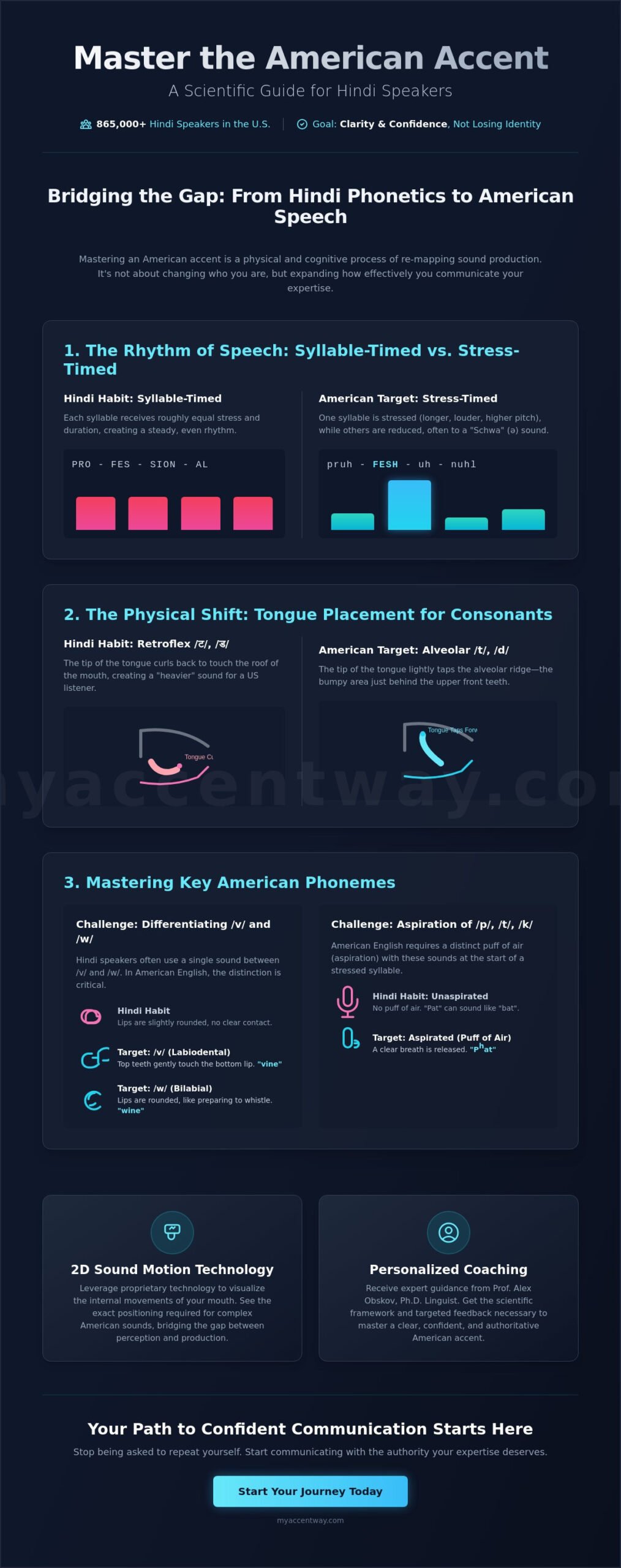
Traditional English classes focus on grammar and syntax, but they rarely address the mechanics of sound production. This is why many high-level professionals still struggle with being asked to repeat themselves. Unlike generic courses, specialized American accent training focuses on the physical placement of the tongue and the specific airflow required for American sounds. Because Hindi is one of the syllable-timed languages, where each syllable receives roughly equal stress, the transition to the stress-timed rhythm of American English requires a targeted approach. Prof. Alex, Ph.D. Accent Coach, uses Interactive Visual 2D Sound Simulators for American Sounds to provide the roadmap you need to succeed in the U.S. corporate environment.
Mastering the Mechanics: Key American Sounds for Hindi Speakers
Prof. Alex, Ph.D. Accent Coach, teaches that achieving speech clarity requires a physical shift in how you produce sound. For many, the biggest hurdle in an american accent for hindi speakers is the habit of using retroflex consonants. In Hindi, the tongue often curls back to touch the roof of the mouth. In American English, sounds like [t], [d], and [n] are produced by touching the alveolar ridge, the bumpy area just behind your upper teeth. This small physical adjustment makes a massive difference in how clear you sound to a native listener.
Clarity also hinges on distinguishing between [v] and [w]. Hindi speakers often use a single sound that sits between the two. In American English, [v] is a labiodental sound, meaning your top teeth must touch your bottom lip. In contrast, [w] is bilabial and requires rounded lips. Additionally, American [p], [t], and [k] require a puff of air, known as aspiration. Without this specific breath, a word like “pat” can sound like “bat” to an American ear, leading to confusion in professional contexts. If you want to refine these specific mechanics, our specialized American accent training provides the individual feedback you need to succeed.
Vowel quality is equally vital for professional communication. Distinguishing between the tense vowel in “sheep” and the lax vowel in “ship” prevents common misunderstandings. Similarly, the difference between “bat” and “bet” requires a specific jaw drop that isn’t present in many Indian dialects. By using 2D Sound Motion Technology, you can practice these subtle differences in mouth positioning and adjust your habits accordingly.
The American [r] and [l] Dynamics
The American [r] is perhaps the most distinct phoneme. Unlike the flipped or rolled R found in Hindi, the American version is a liquid sound created with tongue tension in the middle of the mouth. The “Dark L,” found at the ends of words like “cool” or “possible,” requires the back of the tongue to lift toward the soft palate. You can train these mechanics through Interactive Visual 2D Sound Simulator, which guides speech-organ practice with audio waveforms and spectrograms. Training tongue tension with Interactive Visual 2D Sound Simulators for American Sounds makes these invisible movements tangible.
Aspiration and Breath Control
American English is a breathy language. Voiceless stops like [p] and [k] need a visible burst of air at the start of a syllable to be perceived correctly. During high-stakes presentations, controlling this airflow ensures your speech doesn’t sound flat or clipped. We use practical exercises to help you distinguish between voiced and unvoiced stops, ensuring your professional speech has the necessary punch and clarity for the U.S. workplace.
MyAccentWay · 2D Sound Motion Technology
American English Pronunciation: Consonant and Vowel Sounds with 2D Sound Motion Technology
Learning American English pronunciation and the American accent is more effective when you train your speech organs, not only listen and repeat. 2D Sound Motion Technology and Interactive Visual 2D Sound Simulators, developed in 2020 by Prof. Alex, Ph.D. Accent Coach, Doctor of Education, and professional linguist, as part of his interactive teaching model based on his Ph.D. research in interactive teaching methods, train your tongue, lips, jaw, teeth, airflow, and voice step by step. They train each American sound and more than 30 sound combinations through Interactive 2D video simulation.
What 2D Sound Motion Technology is
2D Sound Motion Technology is an advanced accent reduction and articulation training tool by Prof. Alex. It corrects, develops, and trains each American sound and more than 30 sound combinations through Interactive 2D video simulation.
What Interactive Visual 2D Sound Simulators do
Interactive Visual 2D Sound Simulators are part of 2D Sound Motion Technology, the articulation-training method Prof. Alex created by applying his Ph.D. research in interactive teaching to American pronunciation. Instead of listening and repeating, students actively train their speech organs. Each simulator uses Interactive 2D mouth movement to train the speech organs (tongue, lips, jaw, teeth, airflow, and voice) to produce each American sound correctly. Every consonant has its own simulator: explore American consonants trained with 2D Sound Motion Technology.
Sample training: the American L sound [l]
Practice
Record yourself speaking these words:
Feel · Light · Clear · Really · School
Instructions
This Interactive Visual 2D Sound Simulator for the American L sound is part of 1-on-1 Interactive American Accent Training with Prof. Alex. Tap the simulator to book your session.
Interactive Visual 2D Sound Simulator: American lateral voiced [l]
Practice
Record yourself again, this time focusing on the movement of your tongue and lips. Go slow, and you will hear the difference. You’ve got this!
Feel · Light · Clear · Really · School
How Interactive Visual 2D Sound Simulators solve pronunciation and speaking problems
- Wrong articulationMost pronunciation problems start with the tongue, lips, jaw, or teeth in the wrong position. Each Interactive Visual 2D Sound Simulator trains the correct articulation of one American sound, so the student corrects the cause of the problem, not only the result.
- Airflow and voicingMany accent problems come from wrong airflow or voicing: sounds that are too weak, too strong, or voiced when they should be unvoiced. The simulators train airflow and voice together with articulation, step by step, for each American sound and more than 30 sound combinations.
- Clear speech and confidenceWhen each sound is trained correctly, words connect into clear American English speech. Listeners can understand you more easily, and speaking at work, in meetings, and on calls becomes more confident.

If you start hearing the difference in your American L sound with one simulator, you can only imagine how successful you can be in 1-on-1 Interactive American Accent Training with Prof. Alex, Ph.D. Accent Coach, where your whole American sound system is trained sound by sound.
In MyAccentWay, the Interactive Visual 2D Sound Simulators are only available in 1-on-1 accent coaching sessions with Prof. Alex.
MyAccentWay · 2D Sound Motion Technology
Train the American L sound with Prof. Alex
In MyAccentWay, the Interactive Visual 2D Sound Simulators are only available in 1-on-1 accent coaching sessions with Prof. Alex, Ph.D. Accent Coach.
One public sample, the Interactive Visual 2D Sound Simulator for the American [t] sound, is available here.
The Rhythm of Clarity: Shifting from Syllable-Timed to Stress-Timed Speech
Many professionals struggle with being understood not because of their vocabulary, but because of their rhythm. If you’ve been told your speech sounds “staccato” or too fast, you’re likely experiencing the natural transition from a syllable-timed language to a stress-timed one. In Hindi, each syllable typically receives equal duration and weight. American English works differently. It relies on a specific musicality where we stretch out important “content” words and squeeze “function” words into smaller spaces. Mastering the american accent for hindi speakers requires a shift in how you perceive time within a sentence.
To communicate with authority in a U.S. boardroom, you must identify which words carry the most meaning. Nouns, main verbs, adjectives, and adverbs are your content words. They need more volume, a higher pitch, and a longer duration. Conversely, words like “of,” “the,” “to,” and “is” should be reduced. This contrast creates the natural “flow” that American listeners expect. Without this variation in stress, your speech can sound flat or robotic, making it harder for colleagues to track your main points during long presentations.
The Power of the Schwa [ə]
The Schwa is the secret sauce of accent reduction. It’s the most frequent sound in the American accent, yet it’s often the most overlooked by learners. It’s a neutral, relaxed “uh” sound that replaces vowels in unstressed syllables. Hindi speakers often over-pronounce every vowel in a word, which disrupts the stress-timed rhythm. For example, in the word “company,” the second syllable isn’t a full “pa” sound; it’s a quick schwa. By reducing these vowels, you create the necessary space for stressed syllables to stand out. Prof. Alex, Ph.D. Accent Coach, uses 2D Sound Motion Technology to train you to relax the tongue at the right time to achieve this efficient sound.
Intonation Patterns for Professional Leaders
Intonation is the “melody” of your speech, and it directly affects how others perceive your confidence. Many learners unintentionally use rising intonation at the end of statements, which makes a factual claim sound like a hesitant question. This can undermine your professional expertise. In American English, we generally use falling intonation for statements to convey certainty. During corporate reports, you can also use pitch to highlight key data points. A slight jump in pitch on a specific number or trend ensures your audience hears the most critical information. If you’re looking for a personalized roadmap to master these patterns, American accent training provides the scientific feedback necessary for lasting growth.
Practical Strategies: From Intonation to 2D Sound Training
Moving from linguistic theory to everyday application requires more than just listening; it requires a scientific approach to muscle memory. Most traditional methods rely on “listen and repeat” exercises, but these often fail because your brain continues to filter sounds through your native phonetic habits. To achieve true speech clarity, you need to engage both your ears and your eyes. This is where the visual-acoustic connection becomes a game-changer for professionals seeking an american accent for hindi speakers.
Building a new way of speaking is like training for a sport. You’re teaching your jaw, lips, and tongue to move in ways they haven’t before. By combining auditory shadowing with visual technology, you can identify exactly where your tongue is “tripping” on specific American phonemes. This dual-sensory approach ensures that your practice sessions are accurate and effective, preventing the reinforcement of old habits. If you’re ready to stop guessing and start seeing results, American accent training with a specialist provides the targeted feedback you need.
The Advantage of Interactive Visual 2D Sound Simulators
Prof. Alex, Ph.D. Accent Coach, pioneered the use of 2D Sound Motion Technology to solve a common problem: it’s difficult to understand what’s happening inside someone else’s mouth. When a coach produces a sound, the most important movements occur behind the teeth and lips. Our Interactive Visual 2D Sound Simulators for American Sounds train the speech organs through fluid sound motion, rather than relying on a static, misleading image. This technology is particularly helpful for analytical learners who want to understand the “why” behind the “how,” speeding up progress significantly compared to traditional auditory-only methods.
The Shadowing Technique for Hindi Speakers
Shadowing is a powerful tool for mastering the stress-timed rhythm of American English. To begin, select a 2-minute audio clip of an American professional whose communication style you admire. Listen to a single sentence, then repeat it immediately, mimicking the pitch and timing exactly. Don’t worry about individual words at first; focus on the “wave” of the sentence. Use a recording app to capture your voice and play it back alongside the original. This self-assessment allows you to hear where your rhythm deviates from the American standard, making your accent modification journey a conscious, measurable process.
Your Path to Confident Communication: Professional Coaching for Hindi Speakers
Mastering the american accent for hindi speakers isn’t a one-size-fits-all endeavor. While technology like 2D Sound Motion provides the visual map, a professional linguist provides the navigation. Prof. Alex, Ph.D. Accent Coach, understands that your specific linguistic background influences your phonetic habits differently. An individual approach is essential because generic programs often overlook the subtle nuances of your regional dialect. For instance, a speaker from North India may face different vowel challenges than someone from the South.
The American Accent Program is based on the scientific validity of our method. This isn’t about trial and error; it’s about a systematic breakdown of the 24 American consonants and 20 vowels. When you understand the “why” behind the sound, the “how” becomes much easier to master. By focusing on your unique speech patterns, we tailor every session to your goals. You’ll move beyond the frustration of being asked to repeat yourself and begin to command the room with authority.
Professional Accent Training for U.S. Professionals
In the U.S. corporate world, clarity is a form of professional currency. Clear communication often correlates with higher leadership ratings and faster promotion cycles. Our American Accent Training for U.S. Professionals is designed to help you overcome the psychological barriers of speech modification. We don’t want you to change who you are. We want to give you the choice of how you sound in high-stakes environments. This empowerment lets you focus on your expertise and influence key stakeholders.
Getting Started with American Accent Program
Your journey begins with a comprehensive accent assessment. We analyze your current sound production, rhythm, and intonation to create a personalized roadmap. Whether you’re in Austin, San Antonio, or Houston, you can access our specialized coaching online. Finding American accent training near me has never been easier through our virtual platform. Your voice is your most powerful tool for success in the United States. Let’s work together to ensure your growth reflects your true professional expertise and cultural pride.
Step Into Your Future with Professional Speech Clarity
You’ve explored how shifting from a syllable-timed rhythm to a stress-timed one creates the professional “flow” necessary for U.S. boardrooms. By mastering the mechanics of an american accent for hindi speakers, you move from simply being understood to truly commanding the room. Prof. Alex’s proprietary 2D Sound Motion Technology and Interactive Visual 2D Sound Simulators are part of his interactive teaching model, based on his Ph.D. research in interactive teaching methods. They train you to move your tongue, lips, jaw, and teeth and control airflow while Prof. Alex corrects you live, helping you refine your speech with scientific precision and build lasting muscle memory.
Your journey toward accent modification is personal. Our Individual Approach ensures your cultural identity remains intact while your professional influence grows. Led by Prof. Alex, Ph.D. Accent Coach, the American Accent Program uses science-backed methods to support your training. It’s time to let your expertise shine through clear, authoritative speech. Book Your 1 Hour Evaluation Session with Prof. Alex, Ph.D. Accent Coach, and start your journey to speech clarity today! You have the talent and the knowledge; now give yourself the voice to match your ambitions.
American Accent Training for Indian Professionals in the United States
Foreign-born professionals in the United States often know their field and speak advanced English. Yet American listeners may still struggle with their sounds, stress, and rhythm. MyAccentWay offers private online American accent training through Interactive American Accent Training.
Interactive American Accent Training is led by Prof. Alex, Ph.D. Accent Coach, Doctor of Education, and professional linguist. He first diagnoses each speaker’s native-language patterns. Then he trains American sound articulation, stress, rhythm, and intonation for real meetings, calls, and presentations.
Who this training is for
- Engineers, IT specialists, and data professionals presenting to U.S. teams and clients
- Doctors, nurses, and healthcare professionals explaining care to American patients
- Managers, executives, and founders leading meetings, pitches, and briefings
- Consultants, researchers, and academics speaking at conferences and webinars
- Professionals preparing for interviews, promotions, or client-facing roles
Online training across the U.S.
MyAccentWay is based in Austin, Texas, and all training is online. The program is especially relevant for professionals in Austin, Dallas, Houston, New York City, the San Francisco Bay Area, Los Angeles, Seattle, Boston, Chicago, Miami, Washington DC, Atlanta, and Raleigh.
How Interactive American Accent Training works
- American sound articulation training with Interactive Visual 2D Sound Simulators that train speech-organ movement
- Phonetic exercises that make the new sounds automatic
- Sentence practice and intonation training for stress, rhythm, and emphasis
- Paragraph practice with real-life delivery
Real student evaluations
Real students have documented their progress. Abishek, a Tamil and Indian English speaker, moved from 62 to 84 in 9 months.
The first step is a 1 Hour Evaluation Session with Prof. Alex.
Frequently Asked Questions
Is it possible to reduce my Hindi accent as an adult?
Yes, adults can achieve significant results in accent reduction through the science of neuroplasticity. While your native phonetic habits are deeply ingrained, your brain remains capable of building new motor pathways for speech at any age. By using a sound by sound approach, you can learn to re-map the physical movements of your vocal tract to produce American phonemes with clarity and precision.
How long does it take for a Hindi speaker to see results in American accent training?
Most students experience a shift in their sound awareness within the first 2 sessions of a targeted program. For lasting results in an american accent for hindi speakers, a commitment of 3 to 6 months is typically required to solidify muscle memory. This timeframe allows you to transition from conscious effort to natural, automatic speech during high-stakes professional meetings.
Will I lose my Indian identity if I modify my accent?
Modifying your accent is about adding a professional tool to your communication toolkit, not erasing your cultural heritage. We focus on speech clarity and “code-switching,” which allows you to choose an effective way to communicate in different environments. Your identity remains intact; you’re simply expanding your ability to be understood by a wider audience in the U.S. workplace.
Why do Hindi speakers struggle with the “v” and “w” sounds in English?
Hindi often uses a single dental-labial sound that sits between the American [v] and [w]. In American English, these are two distinct phonemes with different physical requirements. The [v] requires your top teeth to touch your bottom lip, while the [w] is bilabial and requires rounded lips. Distinguishing these sounds prevents common misunderstandings in professional contexts where precision is vital.
What is the best way to practice the American “r” sound?
An effective method is to focus on tongue retraction and tension rather than the “tapped” or “rolled” R common in Hindi. You must pull the body of the tongue back toward the throat while keeping the tip from touching the roof of the mouth. Using Interactive Visual 2D Sound Simulators for American Sounds trains you in this internal positioning, making a difficult sound much easier to master.
Can 2D Sound Motion Technology really help me improve my pronunciation?
Yes, the Interactive Visual 2D Sound Simulators provide the essential active training loop that traditional “listen and repeat” methods lack. You actively train the movement of your tongue, lips, jaw, teeth, and airflow with the simulators while Prof. Alex corrects you live. This interactive teaching model, based on his Ph.D. research in interactive teaching methods, can support progress by removing the guesswork from accent modification training.
The problem is not always grammar or vocabulary.
If people understand your words but still miss your message, the deeper issue may be speech clarity, rhythm, intonation, and American pronunciation habits. MyAccentWay helps students retrain the sound system with professional 1-on-1 guidance, so English can feel clearer, freer, and more natural in real communication.
Two training methods that make speech change active.
MyAccentWay is not passive listen-and-repeat coaching. Prof. Alex, Ph.D. Accent Coach, Doctor of Education, and professional linguist, creates a learning situation where students become active learners and active participants in changing their own speech patterns.
Interactive training
Students do not just receive pronunciation instructions passively. They listen, think, compare, adjust, and understand their own speech patterns while Prof. Alex guides the correction process.
Cognitive accent training
Students learn to notice and correct the speech patterns that affect American pronunciation, then implement new American speech patterns into their code-switching process for more natural, long-lasting change.
Build speech habits people can hear in real conversations.
A stronger American accent is not built by memorizing topics or chasing quick pronunciation tips. It comes from structured training, professional feedback, active correction, and repeated application until clearer speech becomes easier to keep.
Continue learning how MyAccentWay connects American sound articulation, Interactive Visual 2D Sound Simulators, accent reduction, student proof, and 1-on-1 training.
- Prof. Alex and the MyAccentWay MethodLearn how Prof. Alex created and leads the structured MyAccentWay American accent training system.
- Accent Reduction Curriculum and English Articulation TrainingSee accent reduction, accent modification, American pronunciation, English articulation, rhythm, and professional speech clarity.
- 2D Sound Motion Technology for American Accent TrainingUnderstand Interactive Visual 2D Sound Simulators for American sound articulation.
- Before-and-After American Accent Training ResultsListen to real before-and-after student proof and outcomes.
- Student Reviews and Accent Training ResultsRead student reviews and trust signals.
- Book a 1-Hour 1 Hour Evaluation SessionStart with a 1-hour interactive session with Prof. Alex.
Disclaimer – American Accent Program
The American Accent Program available through Visit Program Website
is an educational and coaching service designed to support pronunciation, accent reduction, and spoken English fluency. All training materials, including lessons, exercises, audio content, visual simulations, coaching methods, and digital resources, are the intellectual property of American Accent Program, LLC and are protected by applicable copyright and intellectual property laws.
By using this website and participating in the program, you acknowledge that all content is provided for personal, non-commercial, educational use only. Users are granted a limited, non-transferable license to access the materials strictly for individual learning purposes. Redistribution, reproduction, recording, modification, sharing, or commercial use of any program content without prior written consent is strictly prohibited.
The program may include live coaching sessions, digital tools, and instructional materials intended to improve pronunciation and communication skills. However, individual results may vary, and no specific level of fluency, accent reduction, or communication outcome is guaranteed.
The American Accent Program and its instructors do not provide medical, therapeutic, or clinical speech-language pathology services. All training is intended for educational purposes only.
By accessing or using the program, you agree to comply with all applicable terms, including the platform’s Terms of Use and Course Policies, and acknowledge that misuse of materials may result in termination of access without refund.