How to pronounce the American R sound clearly
The American R is not just a tongue-position trick. It is a speech-control pattern that needs listening awareness, articulation training, guided practice, and real sentence work so the sound becomes easier to use when you speak.

Article by
Prof. Alex, Ph.D. Accent Coach
Doctor of Education, professional linguist,
Creator of 2D Sound Motion Technology,
Founder of MyAccentWay: American Accent Program,
Professor of English as a Second Language,
American Accent Coach,
Life Coach.
Is the notorious american r sound the one thing standing between you and a truly confident American accent? If you’ve ever felt frustrated by a tongue that won’t cooperate, or worried that your ‘R’ is being misunderstood as a ‘W’, you are not alone. This single, powerful phoneme is often the biggest hurdle for dedicated English learners aiming for clarity and fluency.
But mastering it is not a mystery-it’s a science. As a Ph.D. Linguist, I’ve designed this guide to move beyond simple imitation and give you the concrete tools for success. We will demystify the exact physical mechanics behind a perfect American R, breaking down the complex movements into simple, achievable steps grounded in linguistic principles.
You’ll learn specific, actionable exercises to retrain your tongue and gain the muscle memory you need for consistent, clear pronunciation. By the end of this guide, you will have a clear roadmap to correct common errors, be understood with ease, and speak with newfound confidence.
Key Takeaways
Prof. Alex, Ph.D. Accent Coach
Do you want to keep collecting pronunciation tips, or actually change how you speak?
The American R sound is not fixed by hearing “move your tongue back” again and again. Students need to feel, hear, compare, and control the new sound pattern.

Student proof
Abishek changed the way he speaks by training with Prof. Alex.
“Thank you, Alex! You taught me, pushed me off of my limits, and I love how I speak today!”
This is the result-focused side of Interactive Accent Training: students do not just collect pronunciation tips. They learn to listen, adjust, and build speech control they can keep.
With Prof. Alex’s interactive method and 2D Sound Motion Technology, the R sound becomes a trainable speech habit, not a guessing game.
The goal is not to copy a native speaker mechanically. The goal is to become an independent English speaker with clearer American pronunciation, stronger rhythm, better intonation, and speech clarity you can use in professional communication.
- Discover the two core tongue positions native speakers use to produce a perfect R, and find the method that works best for your mouth.
- Build muscle memory with a progressive practice plan designed by a linguist to master the american r sound from single words to flowing sentences.
- Identify and fix the most common pronunciation mistakes with our troubleshooting guide, empowering you to self-correct for faster progress.
- Learn why pronunciation is a physical skill and how mastering this one sound can transform the overall rhythm and clarity of your American accent.
Why the American R is So Tricky (And How You Can Master It)
If you’ve ever felt that the American ‘R’ is the one sound standing between you and a clear, confident American accent, you are not alone. From native Spanish speakers to those from East Asia and Europe, learners universally find it challenging. Why? Because mastering this sound is a physical skill, much like learning to play the guitar. It’s not about knowing the rule; it’s about training your tongue to perform a new, precise movement. This guide, grounded in linguistic science, will provide a clear, proven path to help you master the iconic american r sound.
What Makes the American ‘R’ Unique? The Science of Rhoticity
The core of the American ‘R’ lies in a linguistic concept called rhoticity. In simple terms, a rhotic accent is one where the /r/ is pronounced wherever it appears in writing (e.g., in “car” and “hard”). This is the standard in General American English. The specific nature of Rhoticity in English is what distinguishes it from many non-rhotic accents, like standard British English, where the ‘R’ in those words is silent. Phonetically, the American ‘R’ is an “approximant,” meaning your tongue gets close to the roof of the mouth to shape the sound, but it doesn’t actually touch. It’s a continuous, flowing sound, not a sharp, abrupt one.
Common ‘R’ Sounds in Other Languages (And Why They Don’t Work)
Your native language has already trained your tongue to produce a specific type of ‘R’. These habits are strong, but they create interference when aiming for the American ‘R’. Common variations include:
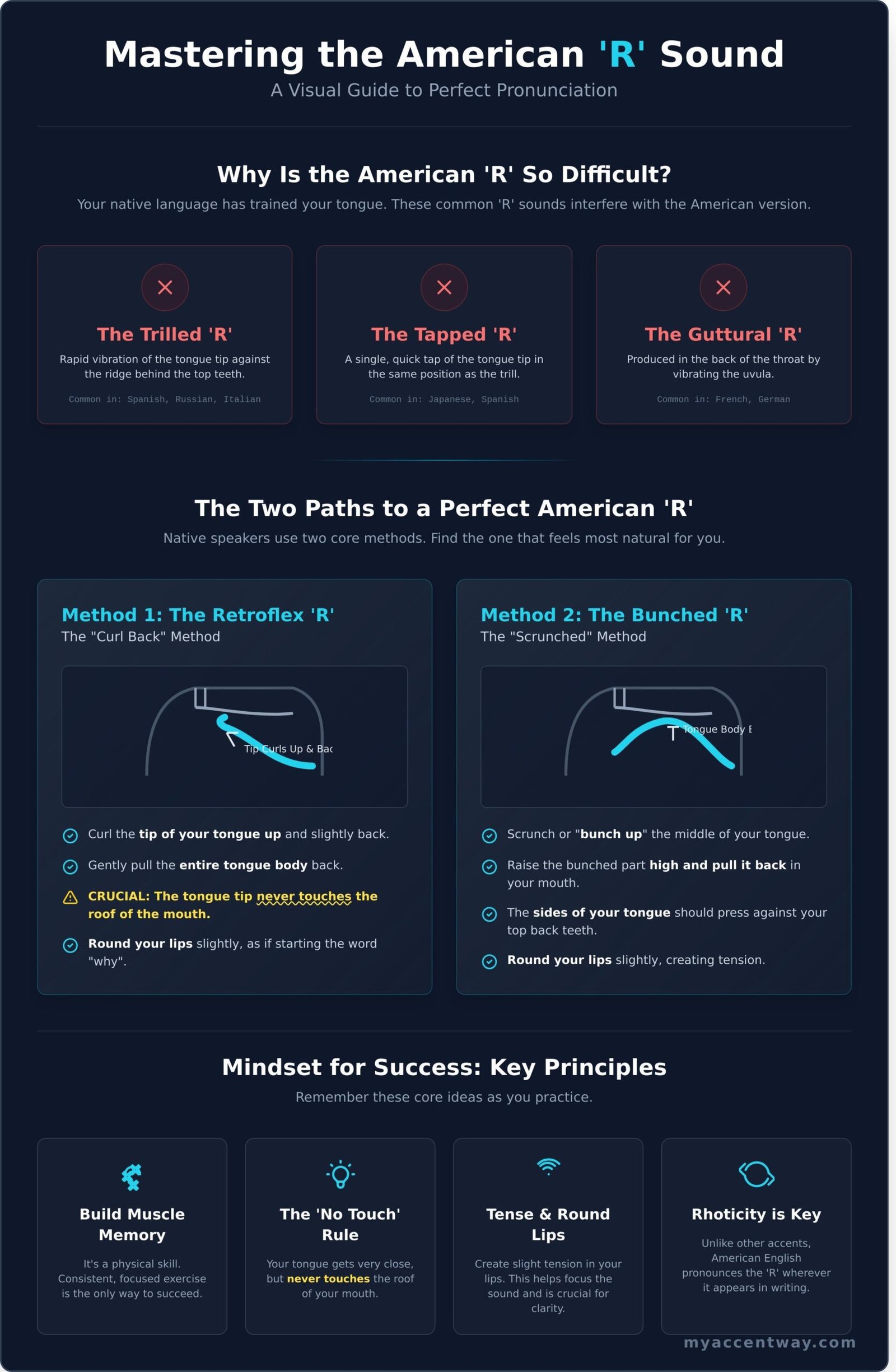
- The Trilled ‘R’: Found in Spanish, Russian, and Italian, this sound is made by rapidly vibrating the tip of the tongue against the alveolar ridge (the bump behind your top teeth).
- The Tapped ‘R’: Common in Japanese and also in Spanish (as the single ‘r’), this is a single, quick tap of the tongue in the same position as the trill.
- The Guttural ‘R’: Used in French and German, this sound is produced in the back of the throat by vibrating the uvula.
These sounds are incorrect for American English because they involve either tapping, trilling, or vibrating a part of the mouth that should remain still. The American ‘R’ is produced with tension in the body of the tongue, not the tip or the throat.
The Mindset for Success: It’s All About Muscle Memory
Feeling frustrated is a normal part of this process. Remember, you are not failing; you are building new neuromuscular pathways. Think of your tongue as a muscle you are taking to the gym for the first time. It requires consistent, focused exercises to build the strength and coordination needed for the correct articulation. Raw talent is a myth in accent training; success comes from dedicated practice. With the right techniques and a growth mindset, you can and will develop the muscle memory to produce a perfect american r sound automatically and confidently.
The Core Mechanics: How to Position Your Tongue for the Perfect ‘R’

Practice the American R
Use the 2D Sound Simulator to train your American R sound.
Imagine seeing every movement of your mouth and tongue for this sound. Would that make the American R easier to train? Yes. The Interactive 2D Sound Video Simulator helps students understand and train the articulation of the American sound [r] with clearer mouth control.
Mastering the american r sound begins with understanding the physical movements inside your mouth. Interestingly, there isn’t just one “right” way to do it. From a linguistic perspective, there are two primary, equally correct tongue positions that native speakers use, often switching between them without a second thought. The unique quality of this sound is a defining feature of the accent, and understanding the history of the American R reveals why it is so distinct. Your goal is not to learn both methods, but to discover which one feels most natural and effective for you.
Method 1: The Retroflex ‘R’ (The ‘Curl Back’ Method)
This is often the first method people learn, focusing on the action of the tongue tip. Think of it as a gentle stretch for your tongue. To achieve this position, follow these steps:
- Curl the very tip of your tongue up and slightly back, as if pointing toward the bumpy ridge behind your top front teeth (the alveolar ridge).
- Gently pull the entire body of your tongue back into your mouth.
- Crucial tip: Your tongue tip should get close, but never touch the roof of your mouth. Contact will produce a different sound, like an ‘L’ or ‘D’.
- Finish by rounding your lips slightly, making them a bit tense, similar to the starting position for the word “why.”
Method 2: The Bunched ‘R’ (The ‘Scrunched’ Method)
If curling your tongue feels awkward, the Bunched ‘R’ may be your key to success. This method focuses on the body of the tongue, not the tip. Imagine trying to bunch up a small rug with your tongue.
- Instead of curling the tip, scrunch or “bunch up” the middle part of your tongue, raising it high and pulling it back in your mouth.
- The sides of your tongue should make firm contact with your upper back teeth (your molars). This contact helps create the necessary tension for the sound.
- Your tongue tip can point straight ahead or even slightly down, resting behind your bottom front teeth.
Finding Your Method: Which Tongue Position is Easier for You?
Both the Retroflex and Bunched methods produce the exact same correct american r sound. The best one is simply the one that clicks for you. Stand in front of a mirror and try making a low growling sound, like a tiger: “grrrrr.”
First, attempt the growl using the ‘Curl Back’ method. Then, try it with the ‘Scrunched’ method. Which one feels more comfortable? Which one allows you to hold the sound with more stability? Once you find a preference, commit to it. Focusing your energy on mastering one technique is the fastest path to building muscle memory and achieving consistent, clear pronunciation. You’ve got this!
Your Practice Plan: From Single Sounds to Fluent Sentences
Mastering the american r sound is a physical skill, much like learning an instrument or a sport. This section is designed as a progressive workout for your mouth, building muscle memory through deliberate, focused repetition. The key to success is starting slowly; prioritize accuracy and the correct physical sensation over speed. We strongly recommend using a voice recorder to listen back to your pronunciation, as this is the most effective way to self-correct and track your incredible progress.
This structured plan will guide you from isolated sounds to complex words, building your confidence at every stage. Remember, consistent practice is the foundation of clear, fluent American speech.
Stage 1: Mastering the ‘R’ in Initial Word Positions
We begin by isolating the sound at the start of a word. This allows you to focus solely on forming the ‘R’ correctly without the complexity of transitions. As you practice, slightly exaggerate and hold the ‘R’ sound, feeling the tension in the back of your tongue before you release the vowel. Think: “RRRed.”
- red
- run
- right
- rich
- road
- race
Stage 2: Conquering ‘R’ in the Middle of Words
Transitioning into the ‘R’ from a preceding vowel is often the most challenging step. Your goal here is a smooth, fluid movement. To master this, break the word down and focus on moving your tongue into the ‘R’ position from the vowel. For example, pronounce “around” as two distinct parts: “a-RRRound.” This drill builds the motor patterns needed for fluency. For a deeper analysis of these transitions, remember to record yourself and listen back carefully to refine your technique.
- arrow
- very
- correct
- marry
- around
Stage 3: Perfecting ‘R’ Blends and Vocalic ‘R’
In this final stage, we integrate the ‘R’ into more complex phonetic environments. First, practice consonant blends (e.g., ‘br’, ‘dr’, ‘tr’), where the ‘R’ immediately follows another consonant. Then, tackle the vocalic ‘R’, where the ‘R’ sound merges with and colors the preceding vowel. This is a defining characteristic of the American accent.
Consonant Blends Practice:
- bring
- drive
- tree
- great
- price
- from
Vocalic ‘R’ Practice:
- car
- for
- her
- bird
- air
- fear
Troubleshooting: How to Fix the Most Common ‘R’ Sound Mistakes
Mastering a new sound is a process of fine-tuning. Even the most dedicated students encounter challenges, but every mistake is an opportunity for correction and growth. Think of this section as your personal diagnostic guide. By identifying exactly why your ‘R’ isn’t sounding native, you can make precise physical adjustments and accelerate your progress toward a clear, confident American accent.
Problem: Your ‘R’ Sounds Like a ‘W’ (e.g., ‘wed’ for ‘red’)
Diagnosis: This is one of the most frequent errors. It happens when your lips are too rounded and pushed forward, and your tongue is too relaxed. The sound is being initiated at the front of your mouth (lips) instead of the middle and back (tongue).
The Fix: The power of the american r sound comes from a tense tongue. Actively pull the body of your tongue back and up. Use a mirror to check your lips-they should be neutral or tense, not puckered into a small circle as they are for ‘W’. To build this new habit, practice contrasting pairs:
- wake / rake
- west / rest
- wine / rhine
Problem: Your ‘R’ Sounds Like a Tapped or Trilled ‘R’
Diagnosis: If you hear a quick ‘tap’ or a rolling ‘trill’ in your ‘R’, it’s a definite sign that the tip of your tongue is striking the roof of your mouth just behind your top teeth (the alveolar ridge). This is often a direct transfer from the phonetics of your native language.
The Fix: The golden rule of the American ‘R’ is that the tip of the tongue touches nothing. The sound is created by airflow over the tense body of the tongue. If you’re using the retroflex method, ensure the curled tip points backward without making contact. If you prefer the bunched method, double-check that your tongue tip is pointing down and away from the alveolar ridge.
Problem: Your Vocalic ‘R’ is Weak (e.g., ‘cah’ for ‘car’)
Diagnosis: This happens when you drop the ‘R’ sound at the end of a word or syllable. While characteristic of many other English accents, a strong vocalic ‘R’ is a non-negotiable feature of Standard American English.
The Fix: Don’t cut the sound short. First, produce the vowel sound, and then smoothly transition into your strong ‘R’ tongue position, holding the ‘R’ sound for a moment. To build the muscle memory, practice exaggerating the ending of these words:
- caRRR
- foRRR
- biRRRd
- tea-cheRRR
Focusing on these details is what transforms your speech. For personalized feedback using our advanced diagnostic tools, explore the programs at myaccentway.com.
Beyond a Single Sound: Integrating the ‘R’ for Total Fluency
Congratulations! You have taken the crucial first steps to produce the American ‘R’ in isolation. But true mastery isn’t about a single sound-it’s about weaving that sound seamlessly into the fabric of your speech. The goal is integration, where the ‘R’ flows so naturally that you don’t even have to think about it. This final step is what transforms your pronunciation and helps you capture the authentic rhythm and melody of American English.
Making the american r sound feel effortless in conversation involves understanding how it connects with other sounds. These advanced techniques will help you move from careful practice to confident, everyday speech.
Linking the ‘R’ Sound Between Words
One of the keys to fluent, connected speech is linking. When a word ends in an ‘R’ sound and the next word begins with a vowel, native speakers don’t pause. They connect them, making the ‘R’ sound like the beginning of the second word. For example, “far away” is pronounced smoothly as “fa-raway.” Mastering this will dramatically improve your flow.
Practice these phrases, focusing on a smooth connection:
- her own (he-rown)
- car is (ca-ris)
- four eggs (fo-reggs)
- more ice (mo-rice)
When You Need Expert Guidance for Faster Results
While self-study is an admirable and important part of your journey, it can be slow and sometimes frustrating. It’s incredibly difficult to hear your own mistakes, especially with a sound as complex as the American ‘R’. You might be reinforcing an incorrect habit without even realizing it.
This is where personalized feedback from a trained linguist becomes a game-changer. A professional coach can provide a detailed analysis of your speech, pinpointing the subtle issues that are holding you back and giving you a clear, effective path to improvement. For a structured program designed for guaranteed success, consider our American Accent Training with experts who can accelerate your progress and help you achieve your fluency goals with confidence.
From Practice to Perfection: Master Your American Accent
You’ve now explored the intricate mechanics of the american r sound, from the two primary tongue positions to a structured plan that takes you from isolated practice to fluent conversation. We’ve shown you how to troubleshoot common errors and integrate this pivotal sound seamlessly into your speech. This journey is about more than just a single phoneme; it’s about unlocking a new level of clarity and confidence in every word you speak.
But theory without practice and expert guidance can be a slow path. True mastery is achieved when you combine your dedication with a proven methodology. With the American Accent Program, the system developed by Prof. Alex, a Ph.D. Linguist, provides that scientific foundation. We accelerate your progress with personalized feedback tailored to your unique speech patterns, and we stand by our commitment with a success guarantee for every dedicated student.
You have the knowledge and the roadmap. Now it’s time to take action. Embrace the challenge and transform your pronunciation with an expert by your side. Start Your Journey to a Confident American Accent Today!
Frequently Asked Questions About the American R Sound
What is the difference between a rhotic and a non-rhotic accent?
A rhotic accent, like General American English, pronounces the /r/ sound wherever it appears in a word’s spelling, such as in car or hard. In contrast, a non-rhotic accent, common in Britain, omits the /r/ sound unless it is followed by a vowel. For example, they pronounce the /r/ in red but drop it in car. Understanding this core phonetic distinction is a critical first step in mastering the American accent and achieving clarity.
How long does it take to learn the American R sound correctly?
The timeline for mastering the American R varies for each student. Factors like your native language and the consistency of your practice play a major role. While some learners see significant improvement in a few weeks with dedicated coaching, for others it may take several months. The key isn’t speed, but the quality of your practice. With a proven method and expert guidance, you can confidently build the muscle memory required for a perfect American R.
Is the ‘bunched’ or ‘retroflex’ R more common among native speakers?
Both the ‘bunched’ and ‘retroflex’ tongue positions are used by native American English speakers, and neither is considered more correct than the other. The ‘bunched’ R is produced by pulling the body of the tongue up and back, while the ‘retroflex’ R involves curling the tip of the tongue backward. As your accent coach, we focus on helping you find the position that produces the most natural and accurate sound for you, ensuring authentic pronunciation.
Can I really learn the American R as an adult, or is it too late?
It is absolutely not too late! While children learn accents implicitly, adults can master them through conscious, analytical processes. Your brain’s ability to learn new motor skills doesn’t disappear with age. With precise instruction from a Ph.D. Linguist and advanced tools like our 2D Sound Motion Technology, you can retrain your tongue to produce a perfect American R. We guarantee your success, regardless of your age or background, empowering you to speak with confidence.
Why are words like ‘girl’, ‘world’, and ‘rural’ so extremely difficult to pronounce?
Words like ‘girl’, ‘world’, and ‘rural’ are challenging because they contain complex phonetic clusters. Your tongue must move rapidly and precisely between three difficult positions: a vowel sound, followed by the American R, and then immediately into another complex consonant like the /l/ or a second /r/. This sequence requires significant muscular control and coordination. Our program breaks down these transitions step-by-step, making these “impossible” words achievable and natural for you.
Do I need to learn the American R to be understood in the United States?
You can certainly be understood in the U.S. without a perfect American R. However, mastering this core sound is key to achieving a high level of clarity and fluency. A correctly produced american r sound reduces the cognitive load on your listener, making your speech sound more natural and effortless. It’s a crucial step not just for being understood, but for speaking with the confidence and authority you deserve in any professional or social situation.
Disclaimer – American Accent Program
The American Accent Program available through Visit Program Website
is an educational and coaching service designed to support pronunciation, accent reduction, and spoken English fluency. All training materials, including lessons, exercises, audio content, visual simulations, coaching methods, and digital resources, are the intellectual property of American Accent Program, LLC and are protected by applicable copyright and intellectual property laws.
By using this website and participating in the program, you acknowledge that all content is provided for personal, non-commercial, educational use only. Users are granted a limited, non-transferable license to access the materials strictly for individual learning purposes. Redistribution, reproduction, recording, modification, sharing, or commercial use of any program content without prior written consent is strictly prohibited.
The program may include live coaching sessions, digital tools, and instructional materials intended to improve pronunciation and communication skills. However, individual results may vary, and no specific level of fluency, accent reduction, or communication outcome is guaranteed.
The American Accent Program and its instructors do not provide medical, therapeutic, or clinical speech-language pathology services. All training is intended for educational purposes only.
By accessing or using the program, you agree to comply with all applicable terms, including the platform’s Terms of Use and Course Policies, and acknowledge that misuse of materials may result in termination of access without refund.
Speech clarity check
The problem is not always grammar or vocabulary.
If people understand your words but still miss your message, the deeper issue may be speech clarity, rhythm, intonation, and American pronunciation habits. MyAccentWay helps students retrain the sound system with professional 1-on-1 guidance, so English can feel clearer, freer, and more natural in real communication.
Why MyAccentWay works
Two training methods that make speech change active.
MyAccentWay is not passive listen-and-repeat coaching. Prof. Alex, Ph.D. Accent Coach, Doctor of Education, and professional linguist, creates a learning situation where students become active learners and active participants in changing their own speech patterns.
Interactive training
Students do not just receive pronunciation instructions passively. They listen, think, compare, adjust, and understand their own speech patterns while Prof. Alex guides the correction process.
U.S. & Canada online accent training
Master the American R Sound: Your Ultimate Guide for Clear Pronunciation for professionals in the United States and Canada
This guide is useful for advanced English speakers, entrepreneurs, international professionals, and students in the U.S. and Canada who want clearer American pronunciation, stronger rhythm, better intonation, and more confident communication in meetings, interviews, presentations, and client conversations.
Prof. Alex, Ph.D. Accent Coach, Doctor of Education, and professional linguist, teaches online 1-on-1 American accent training for learners in major professional markets including New York, Los Angeles, San Francisco Bay Area, Seattle, Austin, Dallas, Houston, Chicago, Boston, Washington, D.C., Miami, Toronto, Vancouver, Montreal, Calgary, and Ottawa.
1-on-1 Accent Reduction Training helps students move beyond self-practice and build clearer American speech habits through interactive and cognitive accent training.
Cognitive accent training
Students learn to notice and correct the speech patterns that affect American pronunciation, then implement new American speech patterns into their code-switching process for more natural, long-lasting change.
Your next step
Build speech habits people can hear in real conversations.
A stronger American accent is not built by memorizing topics or chasing quick pronunciation tips. It comes from structured training, professional feedback, active correction, and repeated application until clearer speech becomes easier to keep.