How to Pronounce the TH Sound: A Complete Guide for English Learners
(512) 265-9515Updated October 16, 2026 ◆ 16 min read
Do you ever feel a moment of hesitation before saying words like “three,” “think,” or “the”? For many English learners, this common sound-a phoneme that may not even exist in your native language-can be a frustrating barrier to speaking confidently. If you feel self-conscious or worry that others can’t understand you, know that you are not alone. Mastering the articulation is a crucial step toward fluency, and this guide will show you exactly how to pronounce the th sound with precision. This isn’t just about imitation; it’s about understanding the science of the sound.
Real student result

“I feel confident enough to speak American English!”
Interactive American Accent Training9monthsof hard work and dedication
Listen to the starting point0:00
Listen to the result0:00
“Many of my students once believed they could never sound like this. School taught them grammar and vocabulary, but not how to train their English speech. That is what we do together, step by step, until you speak English independently and with confidence.”
Abishek’s result was achieved through Prof. Alex’s research-based Interactive 1-on-1 American Accent Training. His doctoral research found this interactive method more effective than traditional, teacher-centered methods. See the research basis →
As a Ph.D. Linguist, I’m here to demystify this challenge once and for all. In this complete guide, we will break down the exact tongue and teeth positions for both the unvoiced /θ/ (as in *think*) and the voiced /ð/ (as in *this*). You will receive step-by-step instructions, expert tips, and effective practice exercises designed to build muscle memory and make the sound automatic. Prepare to transform your pronunciation, boost your conversational confidence, and achieve the clear American accent you’ve been working toward.
The Two TH Sounds: Understanding Voiced vs. Unvoiced
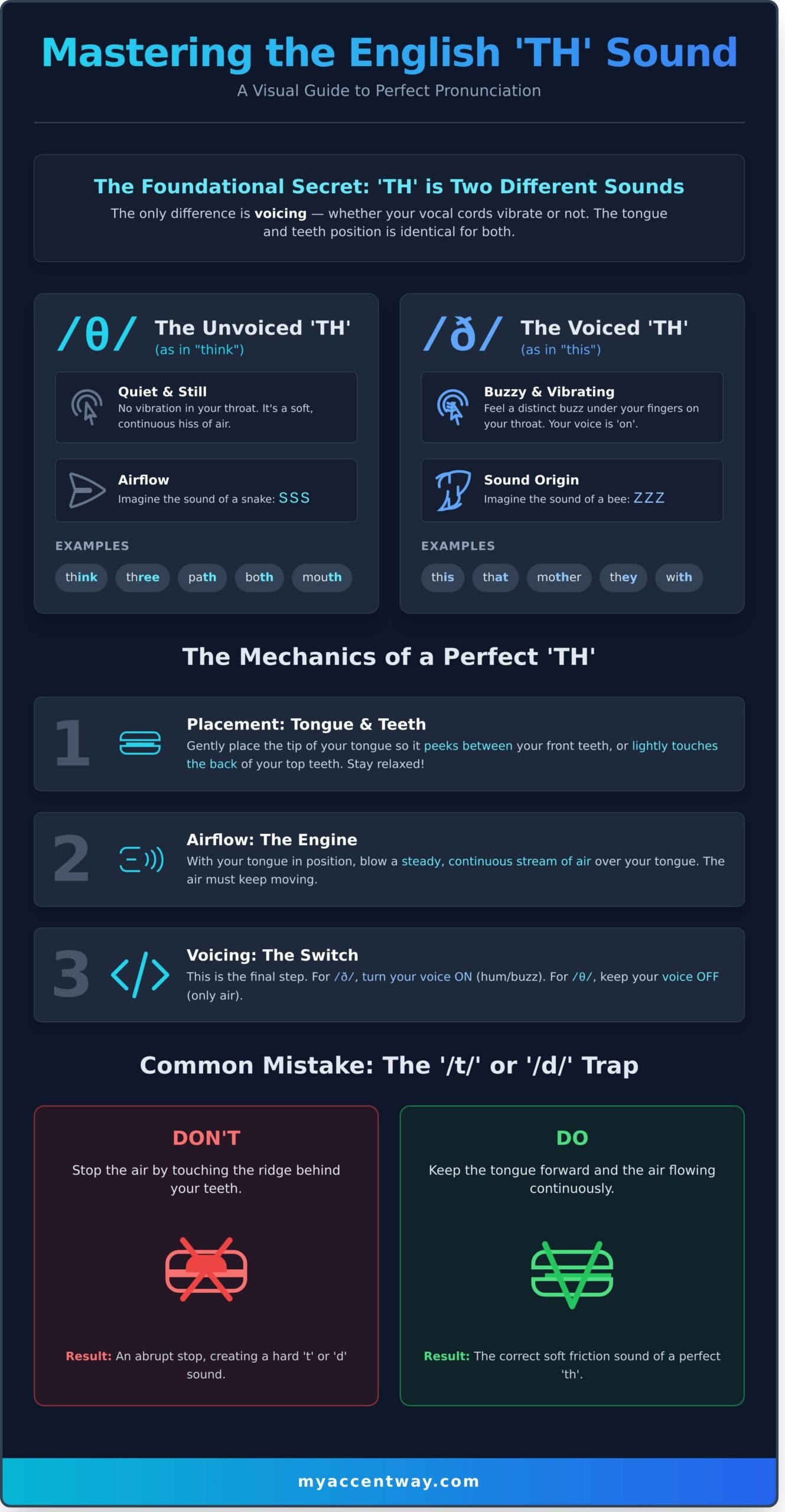
Your journey to confidently pronounce the TH sound begins with a foundational secret: the letters ‘TH’ actually represent two completely different sounds in the American accent. The key difference isn’t in your mouth, but in your throat. One sound uses your vocal cords, and the other does not. We call this ‘voicing,’ and mastering it is the first step to success.
Let’s discover this feeling right now. Place two fingers gently on the front of your throat, on your voice box. First, make a long ‘SSS’ sound, like a snake. Feel that? There should be no vibration. Now, make a long ‘ZZZ’ sound, like a bee. You should feel a distinct buzzing under your fingers. That buzz is voicing-it’s your vocal cords at work!
The crucial insight here is that the position of your tongue and teeth is identical for both TH sounds. The only difference is whether you ‘turn on’ that buzzing vibration. In linguistics, these two phonemes are represented by the symbols /θ/ and /ð/. Understanding the phonetics of the English TH sounds is essential for anyone learning how to pronounce th sound accurately and consistently.
The Unvoiced TH /θ/ (as in ‘think’)
This is the ‘quiet’ TH sound. It is a soft stream of air passing between your tongue and teeth, with no vibration from your vocal cords. Imagine the gentle hiss of air escaping a tire. As you practice the words below, keep your fingers on your throat to ensure it remains still and quiet.
- think
- three
- thank
- path
- both
The Voiced TH /ð/ (as in ‘this’)
This is the ‘buzzy’ TH sound. To produce this phoneme, you must engage your vocal cords to create that same vibration you felt with the ‘ZZZ’ sound. The sound originates in your throat, creating a buzzing sensation you can feel. This sound is critical for many of the most common words in English.
- this
- that
- the
- they
- with
- mother
The Mechanics of a Perfect TH: Your Step-by-Step Physical Guide
Think of this section as a targeted workout for your mouth. Mastering the American Accent requires precision, and the TH sound is a fundamental exercise. We recommend grabbing a mirror-it will be your most valuable training partner, providing instant visual feedback on your technique. At first, these movements will feel unnatural, and that’s perfectly normal! Your mouth is learning a new, sophisticated skill. With focused practice, you will build the muscle memory needed for an effortless and accurate pronunciation.
This process breaks down into three core stages: Placement, Airflow, and Voicing.
Step 1: Correct Tongue and Teeth Placement
Precision begins with placement. To correctly position your mouth, follow this simple sequence:
- Open your mouth just slightly.
- Gently place the very tip of your tongue so it peeks out between your top and bottom front teeth.
- Alternatively, you can rest your tongue tip lightly against the back of your top front teeth.
The key is to be gentle. Avoid pressing hard or sticking your tongue out too far. This light, relaxed contact is crucial for producing the correct friction sound instead of a hard stop.
Step 2: Mastering the Airflow
With your tongue in place, the next step is controlling your breath. This is the engine that powers the sound. For a deep dive into the physical movements, many students find visual aids incredibly helpful. Observing your own mouth in the mirror, as recommended earlier, can provide excellent slow-motion examples of your progress. The core of learning how to pronounce the th sound is managing this airflow:
- For the voiceless /θ/ sound (as in ‘think’): Gently blow air over your tongue. It should create a soft, continuous hissing sound. There is no vibration in your throat.
- For the voiced /ð/ sound (as in ‘this’): Hum as you blow air over your tongue. You should feel a distinct buzzing or vibration in your throat and on your tongue.
Common Mistakes and How to Fix Them
It’s easy to fall into old habits. Here are the most common errors and how to correct them using your mirror:
- Mistake: Saying /t/ or /d/. This happens when your tongue tip touches the ridge behind your top teeth and stops the air completely.
- Fix: Ensure your tongue tip is further forward, either between your teeth or touching the back of them. Keep the air flowing!
- Mistake: Saying /f/ or /v/. This occurs when your top teeth make contact with your bottom lip instead of your tongue.
- Fix: Watch in the mirror. Make sure your bottom lip is relaxed and out of the way, allowing your teeth to connect with your tongue.
- Mistake: Saying /s/ or /z/. This sound is made when the tongue tip is pulled back from the teeth, creating a sharper hiss.
- Fix: Keep the tongue tip forward and relaxed. The TH sound is much softer and less “sharp” than an /s/ or /z/.
Why Is the TH Sound So Difficult? A Linguist’s Perspective
If you’ve ever felt frustrated trying to master the English ‘th’ sound, you are not alone. From a linguistic standpoint, this is one of the most common hurdles for English learners worldwide. The difficulty doesn’t stem from a lack of ability, but from a powerful, subconscious process known as first language (L1) interference.
The two ‘th’ sounds in English-the voiceless /θ/ in think and the voiced /ð/ in this-are actually quite rare. A vast number of the world’s languages simply do not have these specific phonemes in their sound inventory. Languages that typically lack ‘th’ sounds include:
- Most Slavic languages (e.g., Russian, Polish, Czech)
- Many Germanic languages (e.g., German, Dutch)
- Romance languages (e.g., French, Spanish, Italian)
- Many Asian languages (e.g., Mandarin, Japanese, Korean, Vietnamese)
If your native language is on this list, your mouth has simply never been trained to produce this sound. The challenge is purely physical-a matter of building new muscle memory, not a reflection of your language skills.
Your Brain on Autopilot: How Your Native Language Interferes
When confronted with an unfamiliar sound, your brain’s natural instinct is to substitute it with the closest, most familiar sound from your native language. This is an automatic process. For example, a native German speaker might substitute the /ð/ sound with a /z/ sound, saying “zis” instead of “this.” A French speaker might use an /s/ sound for /θ/, saying “sink” instead of “think.” Overriding this autopilot requires conscious, focused effort to forge a new neural pathway.
Overcoming the Challenge: Awareness and Repetition
The journey to mastering this sound begins with two critical steps. First is awareness: learning to consciously hear the distinct difference between the ‘th’ and the sound you substitute it with. The second step is physical repetition. By practicing the correct tongue and mouth placement, you are essentially rewiring your brain and building new muscle memory. This is the key to understanding how to pronounce th sound correctly and consistently.
Feeling stuck in this process? Our American Accent training can provide the personalized feedback and expert guidance needed to build that new habit with confidence.
MyAccentWay · 2D Sound Motion Technology
American English Pronunciation: Consonant and Vowel Sounds with 2D Sound Motion Technology
Learning American English pronunciation and the American accent is more effective when you train your speech organs, not only listen and repeat. 2D Sound Motion Technology and Interactive Visual 2D Sound Simulators, developed in 2020 by Prof. Alex, Ph.D. Accent Coach, Doctor of Education, and professional linguist, as part of his interactive teaching model based on his Ph.D. research in interactive teaching methods, train your tongue, lips, jaw, teeth, airflow, and voice step by step. They train each American sound and more than 30 sound combinations through Interactive 2D video simulation.
What 2D Sound Motion Technology is
2D Sound Motion Technology is an advanced accent reduction and articulation training tool by Prof. Alex. It corrects, develops, and trains each American sound and more than 30 sound combinations through Interactive 2D video simulation.
What Interactive Visual 2D Sound Simulators do
Interactive Visual 2D Sound Simulators are part of 2D Sound Motion Technology, the articulation-training method Prof. Alex created by applying his Ph.D. research in interactive teaching to American pronunciation. Instead of listening and repeating, students actively train their speech organs. Each simulator uses Interactive 2D mouth movement to train the speech organs (tongue, lips, jaw, teeth, airflow, and voice) to produce each American sound correctly. Every consonant has its own simulator: explore American consonants trained with 2D Sound Motion Technology.
Sample training: the American TH sound [th]
Practice
Record yourself speaking these words:
Think · Three · Thank · Method · Both
Instructions
This Interactive Visual 2D Sound Simulator for the American TH sound is part of 1-on-1 Interactive American Accent Training with Prof. Alex. Tap the simulator to book your session.
Interactive Visual 2D Sound Simulator: American unvoiced [th]
Practice
Record yourself again, this time focusing on the movement of your tongue and lips. Go slow, and you will hear the difference. You’ve got this!
Think · Three · Thank · Method · Both
How Interactive Visual 2D Sound Simulators solve pronunciation and speaking problems
- Wrong articulationMost pronunciation problems start with the tongue, lips, jaw, or teeth in the wrong position. Each Interactive Visual 2D Sound Simulator trains the correct articulation of one American sound, so the student corrects the cause of the problem, not only the result.
- Airflow and voicingMany accent problems come from wrong airflow or voicing: sounds that are too weak, too strong, or voiced when they should be unvoiced. The simulators train airflow and voice together with articulation, step by step, for each American sound and more than 30 sound combinations.
- Clear speech and confidenceWhen each sound is trained correctly, words connect into clear American English speech. Listeners can understand you more easily, and speaking at work, in meetings, and on calls becomes more confident.

If you start hearing the difference in your American TH sound with one simulator, you can only imagine how successful you can be in 1-on-1 Interactive American Accent Training with Prof. Alex, Ph.D. Accent Coach, where your whole American sound system is trained sound by sound.
In MyAccentWay, the Interactive Visual 2D Sound Simulators are only available in 1-on-1 accent coaching sessions with Prof. Alex.
MyAccentWay · 2D Sound Motion Technology
Train the American TH sound with Prof. Alex
In MyAccentWay, the Interactive Visual 2D Sound Simulators are only available in 1-on-1 accent coaching sessions with Prof. Alex, Ph.D. Accent Coach.
One public sample, the Interactive Visual 2D Sound Simulator for the American [t] sound, is available here.
Practice Makes Perfect: Drills to Master the TH Sound
Understanding the theory is the first step, but physical practice is what builds muscle memory for clear, confident speech. This progressive workout is designed to give you a clear, effective path for mastering how to pronounce th sound. For the best results, dedicate just 5-10 minutes daily to these drills. We strongly encourage you to record yourself on your phone; listening back is a powerful tool to compare your sounds and track your incredible progress. Remember to focus on the physical sensations you learned in the previous section-the tongue position and the airflow.
Minimal Pair Drills: Training Your Ear and Mouth
Minimal pairs are two words that differ by only a single sound. This research-based linguistic technique sharpens your phonetic awareness, training your ear to hear the difference and your mouth to produce it accurately. Focus on the contrast between the target TH sound and the sound you might accidentally substitute.
- Unvoiced /θ/ vs. /s/: think/sink, thin/sin, path/pass
- Unvoiced /θ/ vs. /f/: thought/fought, three/free, thin/fin
- Voiced /ð/ vs. /d/: then/den, they/day, breathe/breed
Practice Sentences for Real-World Context
Once you feel comfortable with individual words, it’s time to integrate them into the natural flow of speech. Start slowly, exaggerating the TH sound slightly, and then increase your speed to a normal conversational pace. This is a critical step in learning how to pronounce th sound in everyday situations.
- Unvoiced /θ/ Sentences: I think it’s the third Thursday of the month. He threw three things.
- Voiced /ð/ Sentences: This, that, these, and those are the other ones. My father is with my brother.
- Mixed Sentences: My brother and his mother went there together on the thirteenth.
- Tongue Twister Challenge: I thought a thought, but the thought I thought wasn’t the thought I thought I thought.
Consistent, focused practice is a key to success. By moving from isolated sounds to full sentences, you are building a strong foundation for fluent, American-style pronunciation. For a guided, research-based approach to mastering every sound, explore the comprehensive programs at MyAccentWay.
Putting It All Together: Using TH in Fluent Conversation
You have diligently practiced the mechanics of the voiced /ð/ and voiceless /θ/ sounds. Now, the final and most rewarding step is to integrate this skill into your natural, everyday speech. This is the transition from conscious practice to unconscious competence, where you no longer have to think about tongue placement-it just happens. Remember, the goal isn’t robotic perfection; it’s clear, confident communication that allows your ideas to shine.
As you move into fluent speech, you will notice how sounds link together in a concept known as connected speech. This is a key element of a natural American accent, where the end of one word flows seamlessly into the beginning of the next. Mastering individual sounds is the foundation for mastering this flow.
Mastering High-Frequency Words
The fastest way to improve your fluency is by mastering the TH sound in the most common English words. Function words like the, this, that, they, them, there, and than appear in nearly every conversation. By mastering these high-impact words, you solve a huge percentage of your TH challenges at once. Practice them in short, common phrases to build muscle memory:
- with the family
- over there
- this one or that one
- smoother than that
Building Confidence for Everyday Speech
Begin using your practiced TH words in low-stakes conversations, perhaps with a friend or colleague. Don’t be afraid to slow down slightly to ensure your pronunciation is clear. Each successful conversation is a victory that builds momentum. As you continue, your brain will automate the process, and the question of how to pronounce th sound will fade into the background. This is where true mastery begins.
Celebrate your progress! Every time you correctly use “this,” “that,” or “the” without thinking, you are one step closer to your goal of speaking English with clarity and confidence. When you’re ready to master not just the TH, but all the nuanced phonemes of the American accent, our guided training can accelerate your journey.
Master the TH Sound and Speak with Confidence
You now have a clear roadmap for how to pronounce th sound correctly. The journey begins with understanding the crucial difference between the voiced /ð/ in “this” and the unvoiced /θ/ in “think.” By consciously practicing the physical mechanics-placing your tongue gently between your teeth-you are building the muscle memory required for natural, fluent conversation. This foundational knowledge is your first major victory.
While these techniques provide a powerful foundation, personalized feedback is the key to rapid, lasting improvement. The training at MyAccentWay, designed by a Ph.D. Linguist, offers exactly that. We combine research-based methods with individualized guidance to support your progress. Stop guessing and start speaking with clarity. Start your journey to a confident American accent today! Remember, every sound you master brings you closer to the clear, confident English you deserve to speak.
American TH Sound Training for Foreign-Born Professionals in the United States
Foreign-born professionals in the United States often know their field and speak advanced English. Yet American listeners may still struggle with their TH sounds. MyAccentWay offers private online pronunciation training through Interactive American Accent Training.
Interactive American Accent Training is led by Prof. Alex, Ph.D. Accent Coach, Doctor of Education, and professional linguist. He first diagnoses each speaker’s native-language patterns. Then he trains the American TH sounds and clear consonants for real meetings and presentations.
Who this training is for
- Engineers, IT specialists, and data professionals presenting to U.S. teams and clients
- Doctors, nurses, and healthcare professionals explaining care to American patients
- Managers, executives, and founders leading meetings, pitches, and briefings
- Consultants, researchers, and academics speaking at conferences and webinars
- Professionals preparing for interviews, promotions, or client-facing roles
Online training across the U.S.
MyAccentWay is based in Austin, Texas, and all training is online. The program is especially relevant for professionals in Austin, Dallas, Houston, New York City, the San Francisco Bay Area, Los Angeles, Seattle, Boston, Chicago, Miami, Washington DC, Atlanta, and Raleigh.
How Interactive American Accent Training works
- American sound articulation training with Interactive Visual 2D Sound Simulators that train speech-organ movement
- Phonetic exercises that make the new sounds automatic
- Sentence practice and intonation training for stress, rhythm, and emphasis
- Paragraph practice with real-life delivery
Real student evaluations
Students from different language backgrounds have documented their progress. Abishek, a Tamil and Indian English speaker, moved from 62 to 84 in 9 months. Tian, a Mandarin speaker, moved from 58 to 85 in 8 months. Vlad, a Russian speaker, moved from 60 to 83 in 5 months.
The first step is a 1 Hour Evaluation Session with Prof. Alex.
Frequently Asked Questions About the TH Sound
Which TH sound is used in the word ‘the’?
The word ‘the’ uses the voiced TH sound, phonetically written as /ð/. This means your vocal cords vibrate as you produce the sound. You can feel this vibration by gently placing your fingers on your throat as you say it. This is the same sound found in other common words like ‘this,’ ‘that,’ ‘mother,’ and ‘breathe.’ It is distinct from the voiceless TH sound /θ/, as in ‘think,’ where there is no vibration.
How do I know if I’m pronouncing the TH sound correctly?
For instant feedback, use a mirror and record yourself. Visually, your tongue tip should be gently touching or peeking between your upper and lower front teeth. For the voiced TH /ð/ in a word like ‘they,’ you should feel a distinct vibration in your throat. For the voiceless TH /θ/ in ‘three,’ you should only feel a stream of air. Comparing your recording to a native speaker’s is a powerful way to refine your pronunciation.
Are there any English words where the ‘th’ is silent?
Yes, but this is very rare. In a few specific words, the ‘th’ is not pronounced as a TH sound. The most common examples are ‘thyme’ (pronounced like ‘time’) and ‘asthma’ (pronounced ‘az-ma’ in American English). This also occurs in some proper nouns, such as the name ‘Thomas’ or the River ‘Thames’ in London. These are exceptions you will master through exposure, not a general rule for pronunciation.
Why do some native speakers say ‘f’ instead of ‘th’?
This is a linguistic feature called “TH-fronting,” which is characteristic of certain English dialects, such as Cockney in London or some varieties of African American Vernacular English (AAVE). In these dialects, the /θ/ sound is replaced by /f/ (‘think’ becomes ‘fink’) and the /ð/ sound by /v/ (‘brother’ becomes ‘bruvver’). While it is a natural and valid feature of those dialects, it is not part of a General American Accent.
How long does it take to learn the TH sound?
The time it takes to master the TH sound is highly personal and depends on several factors. Your native language, the consistency of your practice, and the quality of your instruction all play a role. Some learners feel confident in a few weeks with dedicated effort, while for others it takes longer to become automatic in fluent speech. The key to accelerating your progress is consistent, focused practice and expert feedback to ensure you are training correctly.
Is it better to put my tongue between my teeth or behind them?
This is an excellent question about the specifics of how to pronounce the TH sound. Both tongue positions can be correct. Placing your tongue tip *between* your teeth (an interdental position) is often the easiest for learners to feel and master first. However, many native speakers place their tongue tip just *behind* the top teeth (a dental position) for faster, more fluid speech. We recommend starting with the tongue between the teeth to master the sound first.
The problem is not always grammar or vocabulary.
If people understand your words but still miss your message, the deeper issue may be speech clarity, rhythm, intonation, and American pronunciation habits. MyAccentWay helps students retrain the sound system with professional 1-on-1 guidance, so English can feel clearer, freer, and more natural in real communication.
Two training methods that make speech change active.
MyAccentWay is not passive listen-and-repeat coaching. Prof. Alex, Ph.D. Accent Coach, Doctor of Education, and professional linguist, creates a learning situation where students become active learners and active participants in changing their own speech patterns.
Interactive training
Students do not just receive pronunciation instructions passively. They listen, think, compare, adjust, and understand their own speech patterns while Prof. Alex guides the correction process.
Cognitive accent training
Students learn to notice and correct the speech patterns that affect American pronunciation, then implement new American speech patterns into their code-switching process for more natural, long-lasting change.
Build speech habits people can hear in real conversations.
A stronger American accent is not built by memorizing topics or chasing quick pronunciation tips. It comes from structured training, professional feedback, active correction, and repeated application until clearer speech becomes easier to keep.
Continue learning how MyAccentWay connects American sound articulation, Interactive Visual 2D Sound Simulators, accent reduction, student proof, and 1-on-1 training.
- Prof. Alex and the MyAccentWay MethodLearn how Prof. Alex created and leads the structured MyAccentWay American accent training system.
- Accent Reduction Curriculum and English Articulation TrainingSee accent reduction, accent modification, American pronunciation, English articulation, rhythm, and professional speech clarity.
- 2D Sound Motion Technology for American Accent TrainingUnderstand Interactive Visual 2D Sound Simulators for American sound articulation.
- Before-and-After American Accent Training ResultsListen to real before-and-after student proof and outcomes.
- Student Reviews and Accent Training ResultsRead student reviews and trust signals.
- Book a 1-on-1 American 1 Hour Evaluation SessionStart with a 1-hour interactive session with Prof. Alex.
Disclaimer – American Accent Program
The American Accent Program available through Visit Program Website
is an educational and coaching service designed to support pronunciation, accent reduction, and spoken English fluency. All training materials, including lessons, exercises, audio content, visual simulations, coaching methods, and digital resources, are the intellectual property of American Accent Program, LLC and are protected by applicable copyright and intellectual property laws.
By using this website and participating in the program, you acknowledge that all content is provided for personal, non-commercial, educational use only. Users are granted a limited, non-transferable license to access the materials strictly for individual learning purposes. Redistribution, reproduction, recording, modification, sharing, or commercial use of any program content without prior written consent is strictly prohibited.
The program may include live coaching sessions, digital tools, and instructional materials intended to improve pronunciation and communication skills. However, individual results may vary, and no specific level of fluency, accent reduction, or communication outcome is guaranteed.
The American Accent Program and its instructors do not provide medical, therapeutic, or clinical speech-language pathology services. All training is intended for educational purposes only.
By accessing or using the program, you agree to comply with all applicable terms, including the platform’s Terms of Use and Course Policies, and acknowledge that misuse of materials may result in termination of access without refund.