Accent Reduction for Pharmacists: A Guide to Clear Patient Communication in 2026
(512) 265-9515Updated October 16, 2026 ◆ 16 min read
Imagine you’re in the middle of a frantic shift in 2026, and a patient asks you to repeat critical side effect warnings for the third time. It’s frustrating when your professional expertise is overshadowed by a breakdown in speech clarity, which is why accent reduction for pharmacists has become a vital safety protocol. We understand that being asked to repeat yourself isn’t just a minor annoyance. It’s a barrier to the high-quality care you’re trained to provide. Communication failures can contribute to patient safety incidents, making clear speech a literal clinical requirement.
Real student result

“I feel confident enough to speak American English!”
Interactive American Accent Training9monthsof hard work and dedication
Listen to the starting point0:00
Listen to the result0:00
“Many of my students once believed they could never sound like this. School taught them grammar and vocabulary, but not how to train their English speech. That is what we do together, step by step, until you speak English independently and with confidence.”
Abishek’s result was achieved through Prof. Alex’s research-based Interactive 1-on-1 American Accent Training. His doctoral research found this interactive method more effective than traditional, teacher-centered methods. See the research basis →
You can transform these interactions into moments of absolute trust by mastering the nuances of the American accent. In this guide, Prof. Alex, Ph.D. Accent Coach, explains how utilizing 2D Sound Motion Technology helps you lead clearer consultations and feel more confident during doctor handovers. You’ll learn how to refine your intonation so your expertise is never in question again, ensuring every patient leaves your counter with total clarity and confidence in your care.
What is Accent Reduction for Pharmacists and Why is it Essential?
Prof. Alex, Ph.D. Accent Coach, defines accent reduction for pharmacists not as an attempt to erase your heritage, but as a science-backed process for modifying speech patterns to ensure your message is received exactly as intended. Broadly speaking, What is Accent Reduction involves the systematic study of American sounds, rhythm, and intonation to improve intelligibility. For healthcare providers, this process is less about “sounding American” and more about clinical precision. If a patient misinterprets a dosage instruction because of a dropped consonant or misplaced word stress, the clinical outcome is immediately at risk.
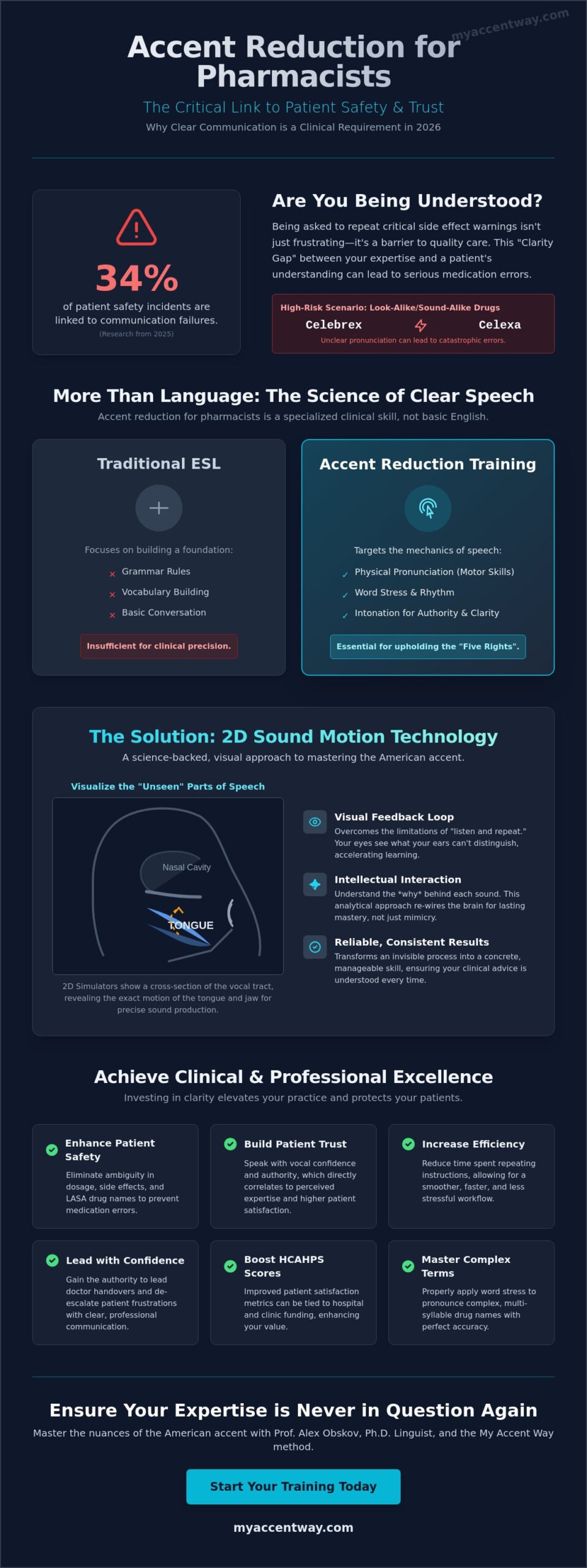
Many professionals confuse this training with traditional ESL. While ESL focuses on grammar and vocabulary, American accent training targets the physical mechanics of speech. It treats pronunciation as a motor skill. By focusing on how the tongue and jaw move, you bridge the gap between knowing the right word and saying it clearly enough for a busy patient to understand. This is essential for upholding the “Five Rights” of medication administration: the right patient, drug, dose, route, and time. Without clarity, the “right dose” can easily become the “wrong dose” in the patient’s mind.
The Impact of Speech Clarity on Patient Safety
In the pharmacy, “close enough” isn’t good enough. Unclear pronunciation of look-alike/sound-alike (LASA) drugs, such as Celebrex and Celexa, can lead to catastrophic errors. The Clarity Gap is the distance between a pharmacist’s intent and a patient’s understanding. When this gap is wide, errors increase. If you find yourself repeating instructions multiple times, it’s a signal that your workflow is being throttled by a communication breakdown. Implementing accent reduction for pharmacists ensures that the 100,000 medication errors reported to the FDA annually don’t happen on your watch.
Building Trust Through Professional Communication
Patients look to you as a clinical authority. There’s a direct psychological link between vocal confidence and perceived expertise. When you speak with clear intonation, you naturally de-escalate frustrated patients who might be stressed by wait times or insurance issues. This professional polish directly impacts patient satisfaction metrics, such as HCAHPS scores, which are increasingly tied to hospital and clinic funding. Investing in specialized training isn’t just about personal growth; it’s a strategic move to enhance your professional standing and the safety of every person you serve.
The Science of Sound: 2D Sound Motion Technology in Pharmacy
Traditional “listen and repeat” methods often fail adult learners because our brains are already hard-wired for the phonemes of our native language. Prof. Alex, Ph.D. Accent Coach, addresses this biological hurdle with a science-backed approach that treats speech as both a physical and analytical process. In a pharmacy setting, where precise communication is crucial for patient safety, relying on mimicry isn’t enough. You need to understand the mechanics of the American accent to ensure your clinical advice is never misunderstood. His proprietary 2D Sound Motion Technology serves as a visual map for the tongue and jaw, providing the clarity needed to master sounds that don’t exist in your first language.
Visual feedback is significantly more effective for professionals than traditional auditory coaching. While your ears might struggle to distinguish subtle differences between American vowels, your eyes can immediately recognize the correct physical positioning. By using Interactive Visual 2D Sound Simulators for American Sounds, you can train the speech organs to produce the exact placement required for every phoneme. This targeted training is why accent reduction for pharmacists through the MyAccentWay method yields such reliable results. It transforms an invisible process into a concrete, manageable skill.
Training Speech Organs: How Interactive Visual 2D Sound Simulators Work
The “Intellectual Interaction” method focuses on understanding the mechanics of speech before you ever attempt to speak. Simply looking at a coach’s mouth is ineffective because the most important movements happen inside the oral cavity. Interactive Visual 2D Sound Simulators train the speech organs by guiding the tongue and jaw through the mechanics of speech. This lets you practice the mechanics of speech, making it much easier to replicate complex American consonants during a busy shift.
Cognitive Processing and Sound Mastery
Mastering a new accent is an analytical process that requires re-wiring the brain’s cognitive pathways. Through an Individual Approach, Prof. Alex identifies specific linguistic interferences where your native language might be “blocking” your ability to produce American sounds. This scientific focus on phonetics and intonation ensures you aren’t just memorizing words, but mastering the system of the language. Research into our methodology shows that 2D technology reduces the time needed to master complex American vowels by providing immediate, objective feedback. If you’re ready to experience this scientific shift, you can explore American accent training designed for the unique needs of U.S. healthcare professionals.
MyAccentWay · 2D Sound Motion Technology
American English Pronunciation: Consonant and Vowel Sounds with 2D Sound Motion Technology
Learning American English pronunciation and the American accent is more effective when you train your speech organs, not only listen and repeat. 2D Sound Motion Technology and Interactive Visual 2D Sound Simulators, developed in 2020 by Prof. Alex, Ph.D. Accent Coach, Doctor of Education, and professional linguist, as part of his interactive teaching model based on his Ph.D. research in interactive teaching methods, train your tongue, lips, jaw, teeth, airflow, and voice step by step. They train each American sound and more than 30 sound combinations through Interactive 2D video simulation.
What 2D Sound Motion Technology is
2D Sound Motion Technology is an advanced accent reduction and articulation training tool by Prof. Alex. It corrects, develops, and trains each American sound and more than 30 sound combinations through Interactive 2D video simulation.
What Interactive Visual 2D Sound Simulators do
Interactive Visual 2D Sound Simulators are part of 2D Sound Motion Technology, the articulation-training method Prof. Alex created by applying his Ph.D. research in interactive teaching to American pronunciation. Instead of listening and repeating, students actively train their speech organs. Each simulator uses Interactive 2D mouth movement to train the speech organs (tongue, lips, jaw, teeth, airflow, and voice) to produce each American sound correctly. Every consonant has its own simulator: explore American consonants trained with 2D Sound Motion Technology.
Sample training: the American t sound (aspirated [t])
Practice
Record yourself speaking these words:
Tab · Tacos · Time · Tub · Hotel · Motel · Sit · Pit · Net
Instructions
Play the Interactive Visual 2D Sound Simulator for the American t sound below several times and follow it step by step. Move your tongue, jaw, and airflow together with the simulator and train your articulation.
Interactive Visual 2D Sound Simulator: American unvoiced sound [t]
Practice
Record yourself again speaking these words, but this time focus on the movement of your tongue. Go slow, and you will hear the difference. You’ve got this!
Tab · Tacos · Time · Tub · Hotel · Motel · Sit · Pit · Net
How Interactive Visual 2D Sound Simulators solve pronunciation and speaking problems
- Wrong articulationMost pronunciation problems start with the tongue, lips, jaw, or teeth in the wrong position. Each Interactive Visual 2D Sound Simulator trains the correct articulation of one American sound, so the student corrects the cause of the problem, not only the result.
- Airflow and voicingMany accent problems come from wrong airflow or voicing: sounds that are too weak, too strong, or voiced when they should be unvoiced. The simulators train airflow and voice together with articulation, step by step, for each American sound and more than 30 sound combinations.
- Clear speech and confidenceWhen each sound is trained correctly, words connect into clear American English speech. Listeners can understand you more easily, and speaking at work, in meetings, and on calls becomes more confident.

If you start hearing the aspiration, the short airstream after [t], with one simulator, you can only imagine how successful you can be in 1-on-1 Interactive American Accent Training with Prof. Alex, Ph.D. Accent Coach, where your whole American sound system is trained sound by sound.
In MyAccentWay, the Interactive Visual 2D Sound Simulators are only available in 1-on-1 accent coaching sessions with Prof. Alex.
Pharmacy-Specific Challenges: Why Generic ESL Fails
General language classes often prioritize basic survival skills, but the pharmacy counter requires a different level of precision. While a tourist might be forgiven for a minor pronunciation slip, a pharmacist’s clarity is directly tied to patient safety. Generic programs simply don’t address the phonetic complexity of medical terminology. This is where accent reduction for pharmacists becomes indispensable. It moves beyond basic grammar to tackle the specific phonetic hurdles found in a clinical setting, ensuring that your expertise is never lost in translation.
One of the most significant challenges is mastering word stress in multi-syllabic drug names. For example, the rhythm of “Atorvastatin” differs greatly from “Amlodipine.” If the primary stress is misplaced, the patient’s brain may fail to recognize the drug name entirely. Similarly, the “Rhythm of Dosing” is vital for preventing medication errors. Misplacing sentence stress when saying “Take it TWICE a day” versus “Take it every TWO hours” can lead to dangerous confusion. Clear communication ensures that the emphasis stays on the most critical information, protecting the patient and your professional reputation.
Mastering Pharmaceutical Terminology
Many drug names contain complex consonant clusters that can cause even advanced speakers to trip. Words like “strength,” “prescription,” or “symptom” require precise tongue placement that generic classes often ignore. Understanding the role of the Schwa sound is also vital. In American English, the Schwa allows you to de-emphasize unstressed syllables, making long medical terms sound fluid rather than robotic. For a deeper dive into these mechanics, see our guide on American Accent Training for U.S. Professionals.
The Nuances of Patient Counseling
Effective counseling relies on “Linked Sounds.” In common pharmacy phrases like “Take it with food” or “Side effects include,” the words should flow together naturally. If they’re spoken as isolated units, the speech sounds choppy and becomes much harder for a patient to follow. Intonation also plays a psychological role in the pharmacy. Using a falling intonation at the end of a clinical instruction projects authority, while a specific pitch in a question shows genuine empathy. Mastering these patterns through accent reduction for pharmacists helps reduce patient skepticism and builds immediate professional trust during every consultation.
4 Steps to Improving Clarity in Patient Consultations
Mastering accent reduction for pharmacists is not about changing who you are. It’s about ensuring your clinical expertise is never hindered by a simple misunderstanding. While our previous sections explored the science behind speech, this section provides the actionable framework you need to apply those principles during a busy shift. By following these four steps, you’ll bridge the gap between technical knowledge and clear patient delivery.
Step 1: Isolate Your High-Frequency Pharmacy Vocabulary
Start by identifying the 50 most common drug names and phrases you use daily. Generic training won’t help you with “Hydrochlorothiazide,” but targeted practice will. Use Interactive Visual 2D Sound Simulators for American Sounds to master the physical mechanics of these specific words first. Pay special attention to the “flap T” in words like “water” or “bottle.” In the American accent, this T often sounds like a soft D, which is essential for sounding natural when giving instructions for liquid medications.
Step 2: Master the ‘Rhythm of Instructions’
English is a stress-timed language, meaning the rhythm comes from emphasizing specific “content” words. In a pharmacy setting, these are your action verbs: Take, Avoid, Stop, or Call. Prosody is the musicality of speech that conveys meaning beyond words. If your delivery is too choppy, elderly patients may struggle to follow the sequence of your directions. Practice linking sounds together so that “Take it with food” sounds like one fluid thought rather than four isolated units.
Step 3: Target High-Frequency Consonants
The “American R” and “TH” sounds appear in nearly every medical direction, from “three times daily” to “refill.” These sounds are often the most difficult for international professionals to master because they require specific tongue positions that don’t exist in many other languages. Prof. Alex, Ph.D. Accent Coach, recommends using 2D Sound Motion Technology to train these sounds. When you train the tongue to retract for the R or peek between the teeth for the TH, you stop guessing and start speaking with precision.
Step 4: Implement Shadowing and Feedback
The “Shadowing Technique” involves listening to a professional pharmacy script and repeating it simultaneously, matching the speaker’s speed and intonation. This builds the muscle memory needed for high-pressure situations. Where privacy laws and company policies allow, record your own practice consultations. Analyzing these recordings helps you identify recurring clarity gaps that you might not notice in the moment. If you’re ready to move beyond generic advice, you can explore our specialized accent reduction program designed specifically for U.S. professionals.
Master Your American Accent with Prof. Alex, Ph.D. Accent Coach
Choosing the right path for your linguistic development is a major career milestone. MyAccentWay stands as the gold standard for healthcare providers because it combines academic rigor with a deeply personal touch. Prof. Alex, Ph.D. Accent Coach, has developed a method that moves beyond simple mimicry. By focusing on “Intellectual Interaction,” you learn the scientific “why” behind every American sound. This analytical approach ensures that your progress is permanent. You aren’t just making temporary adjustments; you’re mastering a new physical skill that stays with you during every high-pressure shift.
We believe that “Your CULTURE MATTERS.” Our goal isn’t to erase the identity reflected in your speech or remove your cultural heritage. Instead, we provide the tools to add a layer of clarity that ensures your clinical expertise is always the focus. This philosophy reflects our focus on helping you build clear, confident communication. When you master the American accent, you remove the friction from every patient interaction. It’s about empowering you to lead your pharmacy with authority and warmth.
The MyAccentWay Difference
What sets our program apart is the expertise of Prof. Alex, Ph.D. Accent Coach. Unlike generic coaches, a professional linguist understands the cognitive and analytical processes required for adult speech modification. We recognize that pharmacists have demanding schedules. That’s why our American accent training for professionals is designed for maximum flexibility. Students have 24/7 access to our dedicated app and proprietary Interactive Visual 2D Sound Simulators for American Sounds. This allows you to practice the physical mechanics of speech between consultations, ensuring that accent reduction for pharmacists fits seamlessly into your professional life.
Start Your Journey to Confident Communication
Your first step toward mastery begins with an initial assessment. This diagnostic session identifies your specific sound gaps and linguistic interferences. Clear speech is a long-term investment in your career longevity and patient safety. By reducing the clarity gap, you ensure that every dosing instruction and side effect warning is understood the first time. Join the growing community of international healthcare professionals who have used our research-based method to speak with absolute confidence. We invite you to explore our specialized accent reduction program and Book Your 1 Hour Evaluation Session today to see the impact of science-backed coaching.
Empower Your Clinical Voice and Ensure Patient Safety
Clear communication is the foundation of modern healthcare. We have explored how 2D Sound Motion Technology bridges the gap between clinical knowledge and vocal clarity. By mastering the specific phonemes and rhythms of American English, you ensure that every dosing instruction is understood without hesitation. This journey is an analytical process that respects your culture while enhancing your professional authority. You don’t have to guess how to produce American sounds when you can visualize them with scientific precision.
Investing in accent reduction for pharmacists is a strategic move for your career longevity and personal confidence. With a curriculum tailored specifically to pharmaceutical terminology and a focus on steady progress, you can confidently lead your team and serve your patients. Prof. Alex, Ph.D. Accent Coach, provides the expert guidance necessary to master these complex speech patterns. It’s time to bridge the clarity gap and speak with the authority your expertise deserves.
Book your 1-hour sample session with Prof. Alex, Ph.D. Accent Coach today!
You have the medical expertise. Now, let’s make sure your patients hear it clearly. Your journey to mastery is a personal one, and we are here to support you every step of the way.
Pronunciation Training for Foreign-Born Healthcare Professionals in the United States
Foreign-born professionals in the United States often know their field and speak advanced English. Yet American listeners may still struggle with medical terms and patient instructions. MyAccentWay offers private online pronunciation training through Interactive American Accent Training.
Interactive American Accent Training is led by Prof. Alex, Ph.D. Accent Coach, Doctor of Education, and professional linguist. He first diagnoses each speaker’s native-language patterns. Then he trains American sound articulation, stress, and clear medical terms for real patient conversations.
Who this training is for
- Doctors, nurses, and healthcare professionals explaining care to American patients
- Engineers, IT specialists, and data professionals presenting to U.S. teams and clients
- Managers, executives, and founders leading meetings, pitches, and briefings
- Consultants, researchers, and academics speaking at conferences and webinars
- Professionals preparing for interviews, promotions, or client-facing roles
Online training across the U.S.
MyAccentWay is based in Austin, Texas, and all training is online. The program is especially relevant for professionals in Austin, Dallas, Houston, New York City, the San Francisco Bay Area, Los Angeles, Seattle, Boston, Chicago, Miami, Washington DC, Atlanta, and Raleigh.
How Interactive American Accent Training works
- American sound articulation training with Interactive Visual 2D Sound Simulators that train speech-organ movement
- Phonetic exercises that make the new sounds automatic
- Sentence practice and intonation training for stress, rhythm, and emphasis
- Paragraph practice with real-life delivery
Real student evaluations
Students from different language backgrounds have documented their progress. Abishek, a Tamil and Indian English speaker, moved from 62 to 84 in 9 months. Tian, a Mandarin speaker, moved from 58 to 85 in 8 months. Vlad, a Russian speaker, moved from 60 to 83 in 5 months.
The first step is a 1 Hour Evaluation Session with Prof. Alex.
Frequently Asked Questions
Will accent reduction make me lose my natural cultural identity?
No, our method doesn’t erase your cultural identity or heritage. We focus on adding a layer of speech clarity so your professional expertise is heard and understood by every patient. Prof. Alex, Ph.D. Accent Coach, operates on the philosophy that “Your CULTURE MATTERS,” meaning we aim for effective communication rather than the removal of your unique personal background.
How long does it take for a pharmacist to see results in speech clarity?
Most pharmacists notice a significant improvement in their speech clarity within 4 to 8 weeks of consistent practice. By using 2D Sound Motion Technology, you bypass the slow process of auditory mimicry and actively train the movement of your tongue, lips, jaw, teeth, and airflow with the Interactive Visual 2D Sound Simulators as part of Prof. Alex’s interactive teaching model, based on his Ph.D. research in interactive teaching methods, while Prof. Alex corrects you live. While every student’s journey is personal, the analytical approach we use ensures that you’ll hear a reduction in patient misunderstandings early in your training.
Is 2D Sound Motion Technology effective for older professionals?
Yes, this technology is highly effective for professionals at any stage of their career. Neuroplasticity allows the adult brain to form new linguistic connections regardless of age. Because Interactive Visual 2D Sound Simulators provide a visual map of the tongue and jaw, they offer a concrete way for experienced pharmacists to master American sounds that might have felt “stuck” for years.
Can we practice specific drug names and pharmacy scripts during the sessions?
Absolutely, practicing accent reduction for pharmacists means we focus on the specific vocabulary you use every day. You can bring your actual pharmacy scripts, high-frequency drug names, and common counseling phrases into our sessions. We prioritize the multi-syllabic terms that cause the most “tripping” to ensure your training has an immediate impact on your professional confidence and patient safety.
What is the difference between accent reduction and traditional ESL classes?
Traditional ESL focuses on grammar and vocabulary, while accent training targets the physical mechanics of American sounds. If you’ve already mastered English grammar but patients still ask you to repeat yourself, the issue is likely phonetic. We use a science-backed method to address intonation, rhythm, and the specific American phonemes that are not covered in a standard language classroom.
Do I need to live in a specific city to join the MyAccentWay program?
You don’t need to live in a specific city to access our training. While we offer local coaching in Austin, Texas, our online program serves pharmacists in San Antonio, Houston, and across the United States. Our 2D Sound Motion Technology and digital curriculum are available 24/7, allowing you to master the American accent from any location with an internet connection.
The problem is not always grammar or vocabulary.
If people understand your words but still miss your message, the deeper issue may be speech clarity, rhythm, intonation, and American pronunciation habits. MyAccentWay helps students retrain the sound system with professional 1-on-1 guidance, so English can feel clearer, freer, and more natural in real communication.
Two training methods that make speech change active.
MyAccentWay is not passive listen-and-repeat coaching. Prof. Alex, Ph.D. Accent Coach, Doctor of Education, and professional linguist, creates a learning situation where students become active learners and active participants in changing their own speech patterns.
Interactive training
Students do not just receive pronunciation instructions passively. They listen, think, compare, adjust, and understand their own speech patterns while Prof. Alex guides the correction process.
Cognitive accent training
Students learn to notice and correct the speech patterns that affect American pronunciation, then implement new American speech patterns into their code-switching process for more natural, long-lasting change.
Build speech habits people can hear in real conversations.
A stronger American accent is not built by memorizing topics or chasing quick pronunciation tips. It comes from structured training, professional feedback, active correction, and repeated application until clearer speech becomes easier to keep.
Continue learning how MyAccentWay connects American sound articulation, Interactive Visual 2D Sound Simulators, accent reduction, student proof, and 1-on-1 training.
- Prof. Alex and the MyAccentWay MethodLearn how Prof. Alex, Ph.D. Accent Coach, Doctor of Education, and professional linguist, created and leads the structured MyAccentWay American accent training system.
- Accent Reduction Curriculum and English Articulation TrainingSee how MyAccentWay trains accent reduction, accent modification, American pronunciation, English articulation, rhythm, and professional speech clarity.
- 2D Sound Motion Technology for American Accent TrainingUnderstand Prof. Alex’s Interactive Visual 2D Sound Simulators for American sound articulation.
- Before-and-After American Accent Training ResultsListen to real before-and-after student proof and accent training outcomes.
- Student Reviews and Accent Training ResultsRead student reviews, testimonials, and trust signals from MyAccentWay learners.
- Book a 1-Hour 1 Hour Evaluation SessionStart with a 1-hour accent evaluation session with Prof. Alex.
Disclaimer – American Accent Program
The American Accent Program available through Visit Program Website
is an educational and coaching service designed to support pronunciation, accent reduction, and spoken English fluency. All training materials, including lessons, exercises, audio content, visual simulations, coaching methods, and digital resources, are the intellectual property of American Accent Program, LLC and are protected by applicable copyright and intellectual property laws.
By using this website and participating in the program, you acknowledge that all content is provided for personal, non-commercial, educational use only. Users are granted a limited, non-transferable license to access the materials strictly for individual learning purposes. Redistribution, reproduction, recording, modification, sharing, or commercial use of any program content without prior written consent is strictly prohibited.
The program may include live coaching sessions, digital tools, and instructional materials intended to improve pronunciation and communication skills. However, individual results may vary, and no specific level of fluency, accent reduction, or communication outcome is guaranteed.
The American Accent Program and its instructors do not provide medical, therapeutic, or clinical speech-language pathology services. All training is intended for educational purposes only.
By accessing or using the program, you agree to comply with all applicable terms, including the platform’s Terms of Use and Course Policies, and acknowledge that misuse of materials may result in termination of access without refund.