TL;DR:
- Mastering American English consonant clusters is crucial for clear, professional speech. This requires systematic buildup, co-articulation awareness, and targeted correction based on native language influence.
Consonant clusters in American English are defined as two or more consecutive consonants produced without an intervening vowel, and mastering them is the single most direct path to clearer, more professional speech. Words like strengths (/strɛŋkθs/), splash, and texts pack three or four consonants together, and 78% of upper-intermediate learners omit at least one consonant in high-frequency complex clusters. That statistic means most advanced students are already losing clarity on some of the most common words in English. The good news is that structured, phonetics-based training fixes this systematically, not through guesswork or endless repetition.
Explore Curriculum | Book Your Sample Class | Read Reviews
How to pronounce consonant clusters in American English: cluster types and challenges
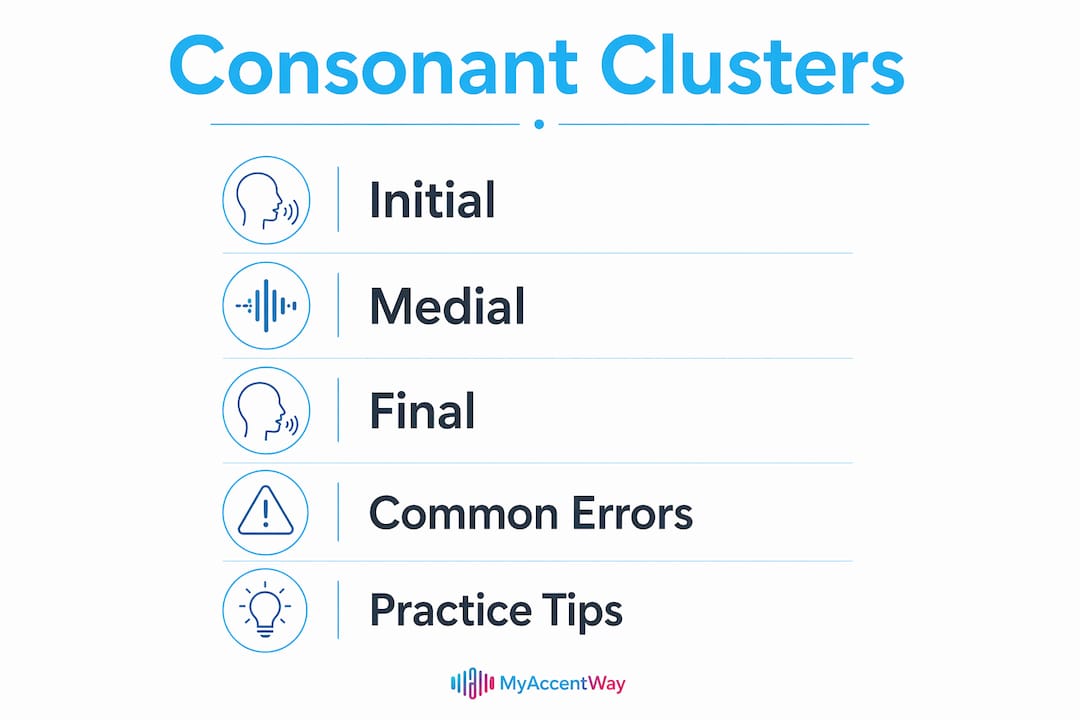
American English consonant clusters fall into three positions: initial, medial, and final. Each position creates a different type of articulatory demand, and each one trips up learners in a distinct way.

Initial clusters appear at the start of a word. Common examples include /str/ in street, /spl/ in splash, and /spr/ in spring. These three-consonant sequences require the tongue, lips, and airflow to coordinate before the vowel even begins. Learners who skip this coordination produce a vowel sound before the cluster, turning street into estreet.
Medial clusters appear inside a word, as in complex or instruct. These are often overlooked in practice because learners focus on word beginnings and endings. Medial clusters demand smooth transitions between syllables, and dropping a consonant here often goes unnoticed by the speaker but is clearly heard by a native listener.
Final clusters are the most demanding. American English allows up to four consecutive consonants at the end of a word, as in strengths (/strɛŋkθs/) and prompts (/prɑmpts/). The /tj/ to /tʃ/ palatalization rule in American English adds another layer: clusters like /tj/ in tune shift to /tʃ/, and learners who miss this sound foreign even when their individual consonants are correct.
The most common error types across all three positions are:
-
Vowel insertion (epenthesis): Adding a vowel between consonants, as in buh-lue for blue
-
Consonant deletion: Dropping one consonant entirely, as in tes for texts
-
Consonant simplification: Merging two similar sounds into one, as in /ts/ replacing /θs/ in strengths
-
Equal force production: Applying the same pressure to every consonant in a cluster, which sounds unnatural and mechanical
What are the most effective techniques for cluster pronunciation?
The buildup technique is the most reliable method for learning to pronounce consonant clusters in American English. Starting with two-consonant groups and progressing to three and four-consonant clusters over several weeks reduces both failure and frustration. This is not a shortcut. It is the method that produces durable muscle memory.
Here is how to apply the buildup technique step by step:
-
Isolate the final consonant first. For street, start with /t/, then add /iː/, then /triːt/, then /striːt/. Work backward into the cluster.
-
Practice the two-consonant version until it feels automatic. For /str/, first master /tr/ in tree, then add /s/ in front.
-
Add rhythm. Tap your finger or use a metronome. Rhythm-based drills improve cluster retention by 41% over six weeks compared to articulation-only practice. Rhythm forces the mouth to move at a natural pace rather than pausing between sounds.
-
Use co-articulation awareness. Successful cluster pronunciation depends on co-articulation: your tongue begins moving toward the next consonant while you are still producing the current one. This overlap is what makes clusters sound fluid rather than choppy.
-
Apply the cluster in a full sentence. Move from isolated practice to phrases and then to paragraphs. The goal is for the cluster to become automatic in connected speech.
Pro Tip: Record yourself saying a target word, then listen back without reading along. You will hear vowel insertions and dropped consonants that you cannot detect while speaking. This self-monitoring step accelerates correction faster than any other single habit.
Mirror practice adds a second layer of feedback. Practicing with a mirror and recording yourself are the two most effective methods for identifying unwanted vowel insertion. Watching your mouth confirms whether your lips and tongue are moving in the right sequence before the sound even leaves your mouth.
How does your native language shape your cluster errors?
Your native language is the single strongest predictor of the errors you make with American English consonant clusters. Native language heavily influences error types: vowel insertion is the dominant pattern for Spanish and Portuguese speakers, while simplification prevails among Mandarin speakers. Knowing your error type is the missing link to targeted improvement.
Here is a breakdown by language background:
-
Spanish and Portuguese speakers: Add extra vowels before initial /s/ clusters, turning school into eschool and street into estreet. The fix is to practice blocking the vowel by keeping the lips closed until the /s/ begins.
-
Mandarin speakers: Simplify final clusters by dropping the last consonant or merging sounds. Texts becomes tex, and strengths loses two or three consonants. The fix is to practice final cluster drills with exaggerated articulation first, then reduce to natural speed.
-
French speakers: Add a schwa between consonants, producing buh-lue for blue or guh-reen for green. The fix is to practice the two consonants with no air gap between them, using a sustained airstream.
Identifying your own error pattern, whether vowel insertion or consonant deletion, is the key missing link to targeted improvement. Generic cluster practice wastes time. Targeted error correction, matched to your native language background, produces measurable results in weeks rather than months.
Myaccentway’s pronunciation guide for Spanish speakers and the guide for Chinese speakers address these specific interference patterns in detail. Knowing where your errors come from lets you practice with precision instead of repetition.
What are the most common mistakes and how do you fix them?
Three errors account for the majority of cluster problems in advanced learners:
-
Dropping consonants in final clusters. Texts becomes tex, prompts becomes prom. These deletions change meaning and reduce professional credibility.
-
Adding vowels inside clusters. This is the most common error across all language backgrounds and the hardest to self-detect without recording.
-
Over-articulating every consonant equally. Learners often produce equal force for all consonants in a cluster, but natural American English speech subtly overlaps articulators for fluidity. Equal force sounds robotic.
The goal is not textbook perfection. Some cluster reductions are socially acceptable in natural speech, such as dropping /t/ in last night. But dropping /s/ in lists causes genuine confusion and must be corrected. The standard to aim for is perceptual robustness: the listener understands the word without effort.
Minimal pairs are the most efficient drill for fixing specific errors. Practice text versus tex, strengths versus strength, and prompts versus prom until the distinction is automatic. Progressive drills, moving from slow and exaggerated to natural speed, build the muscle memory needed for consistent accuracy.
Pro Tip: Do not try to perfect a four-consonant cluster in one session. Gradual buildup over days ensures better learning and less frustration than forcing the full cluster immediately.
Key takeaways
Mastering American English consonant clusters requires systematic buildup, co-articulation awareness, and error correction matched to your native language background.
| Point | Details |
|---|---|
| Cluster types matter | Initial, medial, and final clusters each demand different articulatory coordination and practice strategies. |
| Use the buildup technique | Start with two-consonant groups and add one consonant at a time over several weeks for durable muscle memory. |
| Rhythm accelerates learning | Rhythm-based drills improve cluster retention significantly more than articulation-only practice over six weeks. |
| Know your error type | Spanish and Portuguese speakers insert vowels; Mandarin speakers simplify; French speakers add schwas. Target your specific pattern. |
| Aim for perceptual clarity | The goal is listener understanding, not textbook perfection. Some reductions are natural; others destroy meaning. |
What I have learned from 20+ years of teaching consonant clusters
Most students come to me convinced that their cluster problem is a matter of not trying hard enough. That belief is wrong, and it is also the reason so many learners plateau. The real issue is that they have never been shown what their mouth is supposed to do inside a cluster. Repeating a word fifty times does not teach your tongue where to go. It just reinforces the wrong movement fifty times.
What actually works is organ awareness first. Before a student practices /str/, I show them exactly where the tongue tip sits for /s/, how it shifts for /t/, and where it lands for /r/. When the movement is visible and understood, the sound follows. This is why Myaccentway’s Interactive 2D Sound Video Simulators change the outcome for students who have been stuck for years. Sound becomes visible. Doubt becomes clarity.
I also want to reassure you about something: native American English speakers reduce clusters constantly. They drop /t/ in last call, merge sounds in strengths, and shorten clusters in fast speech. The goal is not to sound like a textbook recording. The goal is to be clearly understood and to sound natural. Once your sound system is retrained, you will make these reductions naturally, just as you do in your native language, without overthinking every word.
Watch this demonstration of how the method works in practice:
https://youtu.be/3EzjosgnzJE
— Prof. Alex., Ph.D. Accent Coach
Myaccentway’s structured approach to American accent training
Myaccentway’s American accent training program is built specifically for non-native professionals who need measurable results, not generic repetition exercises. Prof. Alex’s method begins with speech-organ awareness, moves through structured consonant and vowel retraining, and applies every sound in connected speech until it becomes habitual.

The program’s Interactive 2D Sound Video Simulators give you a precise visual map of how each American sound is physically produced. Thiago, a Portuguese speaker, used this method to correct the vowel insertion errors that had affected his speech for years. Watch his progress here:
Thiago’s results. Every session with Prof. Alex is 1-on-1, personalized to your native language background, and focused on the specific clusters and sounds that affect your clarity most.
FAQ
What is a consonant cluster in American English?
A consonant cluster is two or more consecutive consonants produced without a vowel between them, as in street (/str/) or texts (/ksts/). American English has some of the most complex clusters of any major language.
Why do non-native speakers struggle with consonant clusters?
Native language phonology causes interference: Spanish and Portuguese speakers insert vowels, Mandarin speakers simplify clusters, and French speakers add schwas. Each error type requires a different correction strategy.
What is the buildup technique for cluster practice?
The buildup technique starts with a two-consonant cluster and adds one consonant at a time over several weeks. This approach reduces frustration and builds the muscle memory needed for accurate, fluent production.
Do native American English speakers always pronounce every consonant in a cluster?
No. Native speakers regularly reduce clusters in natural speech, such as dropping /t/ in last night. The key distinction is that reductions that cause listener confusion, such as dropping /s/ in lists, must be preserved for clear communication.
How long does it take to improve consonant cluster pronunciation?
Progress depends on the complexity of the target clusters and the consistency of practice. Rhythm-based drills show measurable improvement over six weeks. Structured 1-on-1 coaching with targeted error correction accelerates that timeline significantly.
Recommended
-
Mastering the Mechanics: A Professional Guide to Pronouncing American English Consonants
-
The Building Blocks of Clarity: A Reference Guide to American Sounds
-
Speech Sounds: Vowels and Consonants in American English – MyAccentWay
-
American Accent Vowels and Consonants: A Complete Linguistics Guide – MyAccentWay