Abishek’s Story: From Voice Insecurity to Confident English Speech
A MyAccentWay Journal interview about voice, pronunciation, professional confidence, identity, and the courage to change the way English represents you.
American accent training
Voice confidence
Professional communication

Machine Learning Engineer · MyAccentWay Student Story
This story is not only about accent. It is about voice confidence.
Many advanced professionals know English, but still feel that their voice does not represent their intelligence, warmth, or confidence.
Abishek’s story is about more than pronunciation. It is about what happens when a highly educated professional knows English, works in advanced technical environments, but still feels that his voice does not represent his confidence, intelligence, and personality.
Publicly, Abishek’s professional background includes work as a Machine Learning Engineer and experience in data science, analytics, and engineering, with education connected to Purdue University and Anna University through his professional profile on LinkedIn.
Before the Program: A Strong Professional With a Private Speaking Fear.
Behind this strong professional background, Abishek carried a very personal communication challenge. He knew English. He could understand complex ideas, solve problems, and contribute professionally. However, the way he sounded in English did not always match the confidence he wanted people to hear.
When Abishek came to Professor Alex, he was not simply asking for “accent reduction.” He wanted to change the way he spoke because he felt insecure about his voice. In many situations, people asked him to repeat himself, and over time that experience affected his confidence.
He even described his own voice as sounding like a “Mickey Mouse voice,” which showed how uncomfortable he felt with the way his English voice represented him.
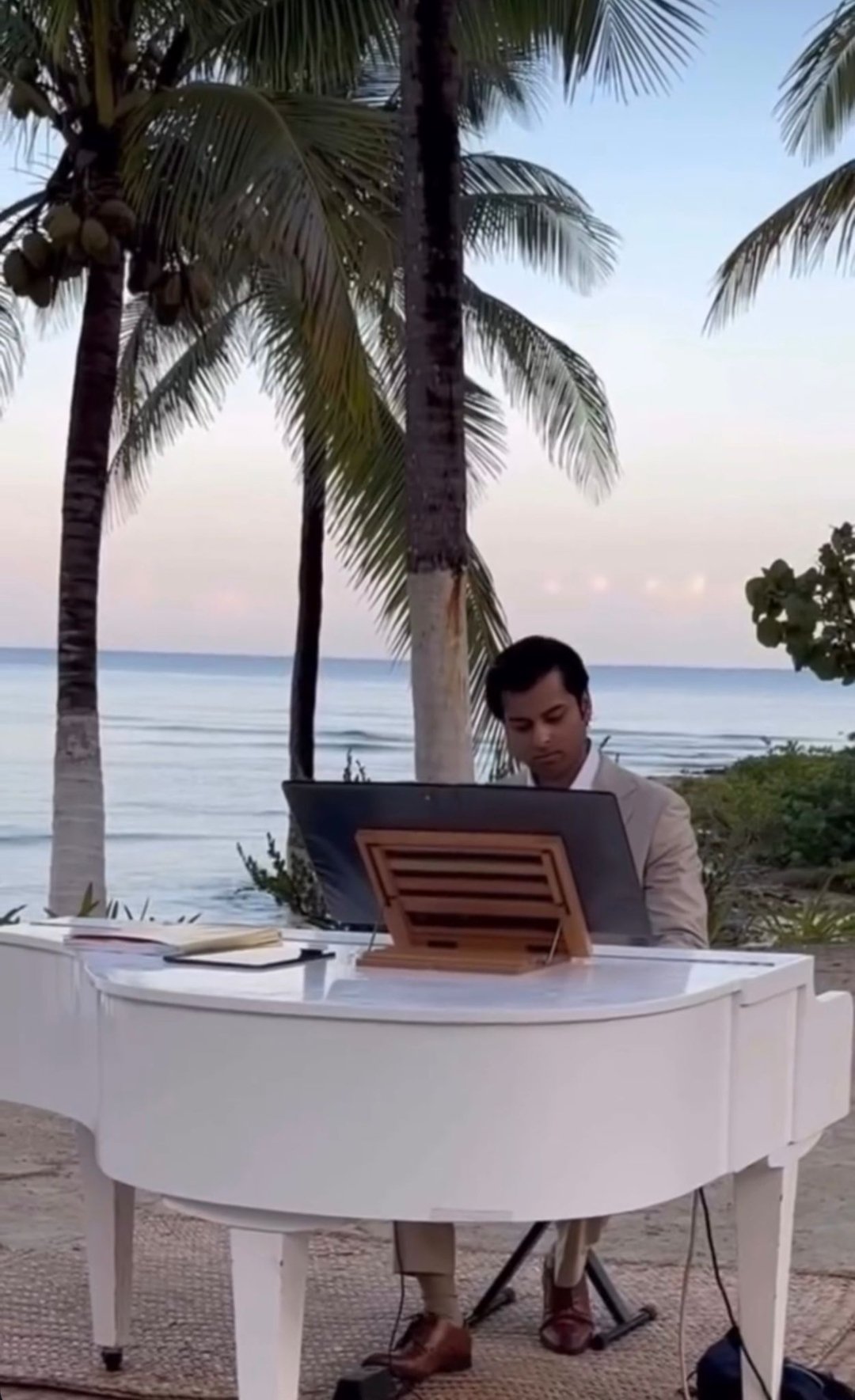
The white piano became the right visual for Abishek’s story.
His transformation was not only about pronunciation. It was about learning to control the way his voice carried meaning, confidence, and professional presence.
Like music, clear English speech requires rhythm, timing, breath, sound placement, and physical coordination. That is why Professor Alex approached Abishek’s training as a voice-confidence journey, not a generic accent lesson.
Professor Alex’s View: This Was a Speech-Confidence Problem.
For Professor Alex, this was not only a pronunciation issue. It was a speech-confidence issue. Abishek needed to understand how American English sounds are physically produced, how voice placement affects professional presence, and how rhythm, intonation, and connected speech can make English sound clearer and more natural.
Abishek’s story begins where many professional communication stories begin: with a highly educated, intelligent person whose speech did not fully reflect his abilities. The goal was not to erase his identity or make him sound like someone else. The goal was to help his voice become clearer, stronger, and more confident so people could hear the professional behind the accent.
Real student result

“I feel confident enough to speak American English!”
Interactive American Accent Training9monthsof hard work and dedication
62 → 84+22 points
“Many of my students once believed they could never sound like this. School taught them grammar and vocabulary, but not how to train their English speech. That is what we do together, step by step, until you speak English independently and with confidence.”
The Interview: Professor Alex and Abishek.
Two voices. One transformation.
This interview is the emotional center of Abishek’s story: Professor Alex explains the training process, while Abishek describes what it felt like to change his relationship with his own English voice.
Abishek, when you first came to me, what was the main reason you wanted American accent training?
I wanted to change the way I was speaking. It was not only about pronunciation. I felt insecure about my voice. Many times people asked me to repeat myself, and sometimes I felt like they were not taking my voice seriously.
I remember you told me something very honest in the beginning. You said, “I feel like I have a Mickey Mouse voice.” What did you mean by that?
Yes, that is how I felt. I did not like the way my voice sounded in English. I felt my voice was too high, not strong enough, and not confident. Sometimes I felt people were making fun of the way I sounded, and that made me even more uncomfortable speaking.
That is a very common feeling for many non-native English speakers. The problem is not only accent. It is also voice confidence, rhythm, intonation, and how the sound comes out physically. What was the hardest part for you?
The hardest part was feeling confident when I spoke. I could understand English, and I knew what I wanted to say, but when I started speaking, I felt nervous. If someone asked me to repeat, I immediately felt embarrassed.
And that is exactly why pronunciation training has to be personal. We cannot only say, “Repeat after me.” We need to understand what is happening with the voice, the sound placement, the rhythm, and the way the mouth produces American sounds.
That helped me because I started to understand that my voice was not “bad.” I just needed to learn how to use it differently in English.
Exactly. Your voice is part of your identity, but the way you produce English sounds can be trained. We worked on pronunciation, sound placement, intonation, rhythm, and stronger speech delivery. What started changing for you?
I started feeling more control. I was not just guessing anymore. I understood what I was doing wrong and how to fix it. I also started feeling more comfortable speaking because I knew I had a system to follow.
After almost a year: how life changed.
Abishek, you committed almost a year to this program. How has your life changed after American accent training?
My life changed because I started feeling more comfortable with my own voice. Before the program, I often felt nervous when I had to speak, especially when people asked me to repeat. After working on pronunciation, voice confidence, rhythm, and intonation, I felt more control over the way I sounded.
I also became more confident in professional communication. I was not constantly thinking, “Do they understand me?” or “Do I sound strange?” I could focus more on my ideas instead of worrying about my accent. That gave me more freedom when speaking English.
The biggest change was emotional. I started believing that my voice could improve. I realized I was not stuck with the way I sounded before. The program helped me speak more clearly, but it also helped me feel more confident as a person.
What would you tell another professional who feels insecure about their voice or accent?
I would say, don’t ignore it. If the way you speak makes you feel uncomfortable, you can work on it. It is not impossible. You just need the right guidance.
Professor Alex’s Closing Message.
Many students believe they are stuck with the way they speak, but pronunciation, voice confidence, rhythm, and intonation can be trained. Abishek’s story is important because it shows that speech confidence is not only about language. It is about how you feel when your voice finally represents you better.
Scream it if you need to: “There is a real solution to your speaking problem.” Your voice, pronunciation, rhythm, and confidence can improve when you have the right system, the right guidance, and the right tools.
At MyAccentWay, Professor Alex uses modern linguistic tools, structured pronunciation training, and 2D Sound Motion Technology to help students understand their speech patterns and work on the exact problems that are holding them back.
Invest in your speaking. Invest in your confidence. Speak clearly, confidently, and beautifully.
MyAccentWay · 2D Sound Motion Technology
American English Pronunciation: Consonant and Vowel Sounds with 2D Sound Motion Technology
Learning American English pronunciation and the American accent is more effective when you train your speech organs, not only listen and repeat. 2D Sound Motion Technology and Interactive Visual 2D Sound Simulators, created and developed by Prof. Alex, Ph.D. Accent Coach, Doctor of Education, and professional linguist, train your tongue, lips, jaw, teeth, airflow, and voice step by step. They train each American sound and more than 30 sound combinations through Interactive 2D video simulation.
What 2D Sound Motion Technology is
2D Sound Motion Technology is an advanced accent reduction and articulation training tool by Prof. Alex. It corrects, develops, and trains each American sound and more than 30 sound combinations through Interactive 2D video simulation.
What Interactive Visual 2D Sound Simulators do
Interactive Visual 2D Sound Simulators are a part of Interactive American Accent Training to make the learning experience more interactive, not visual or repeat-after-me. Each simulator uses Interactive 2D mouth movement to train the speech organs (tongue, lips, jaw, teeth, airflow, and voice) to produce each American sound correctly. Every consonant has its own simulator: explore American consonants trained with 2D Sound Motion Technology.
Sample training: the American t sound (aspirated [t])
Practice
Record yourself speaking these words:
Tab · Tacos · Time · Tub · Hotel · Motel · Sit · Pit · Net
Instructions
Play the Interactive Visual 2D Sound Simulator for the American t sound below several times and follow it step by step. Move your tongue, jaw, and airflow together with the simulator and train your articulation.
Interactive Visual 2D Sound Simulator: American unvoiced sound [t]
Practice
Record yourself again speaking these words, but this time focus on the movement of your tongue. Go slow, and you will see the difference. You’ve got this!
Tab · Tacos · Time · Tub · Hotel · Motel · Sit · Pit · Net
How Interactive Visual 2D Sound Simulators solve pronunciation and speaking problems
- Wrong articulationMost pronunciation problems start with the tongue, lips, jaw, or teeth in the wrong position. Each Interactive Visual 2D Sound Simulator trains the correct articulation of one American sound, so the student corrects the cause of the problem, not only the result.
- Airflow and voicingMany accent problems come from wrong airflow or voicing: sounds that are too weak, too strong, or voiced when they should be unvoiced. The simulators train airflow and voice together with articulation, step by step, for each American sound and more than 30 sound combinations.
- Clear speech and confidenceWhen each sound is trained correctly, words connect into clear American English speech. Listeners can understand you more easily, and speaking at work, in meetings, and on calls becomes more confident.
If you start hearing the aspiration, the short airstream after [t], with one simulator, you can only imagine how successful you can be in 1-on-1 Interactive American Accent Training with Prof. Alex, Ph.D. Accent Coach, where your whole American sound system is trained sound by sound.
Interactive Visual 2D Sound Simulators are only available in 1 on 1 accent coaching session with Prof. Alex.
Who Abishek’s Before and After Story Helps
This MyAccentWay Journal story is helpful for non-native English-speaking professionals in the United States and worldwide who are searching for American accent training, accent reduction, pronunciation coaching, speech clarity training, connected speech practice, and a more confident professional English voice.
Abishek’s background as a Tamil speaker makes this story especially relevant for Indian professionals and South Asian professionals who want clearer American English pronunciation for meetings, interviews, presentations, daily conversations, and career communication in US companies.
If you are comparing ESL classes, English speaking courses, free accent training videos, or free American accent practice online, this story explains why many advanced speakers still need pronunciation coaching: grammar and vocabulary alone do not solve rhythm, intonation, sound placement, connected speech, or voice confidence.
Can Indian professionals improve their American accent?
Yes. With structured American accent training, Indian professionals can work on sounds, rhythm, stress, intonation, connected speech, and speech clarity so their English becomes easier to understand in professional communication.
Is accent training different from ESL?
Yes. ESL usually focuses on grammar, vocabulary, reading, and general language use. Accent training focuses on the physical production of American sounds, speech rhythm, pronunciation patterns, and confident spoken delivery.
Who is this article for?
This article is for Chinese, Japanese, Korean, Hindi, Tamil, Telugu, Malayalam, Kannada, Bengali, Punjabi, Gujarati, Marathi, Urdu, and other non-native English speakers who want clearer American English pronunciation.
What can a 1 Hour Evaluation Session show?
A 1 Hour Evaluation Session with Professor Alex can identify pronunciation patterns, accent barriers, voice-confidence challenges, and the type of American accent program that may fit the student’s speaking goals.
Ready to Change the Way English Represents You?
A 1-hour 1 Hour Evaluation Session with Professor Alex can help identify your pronunciation patterns, voice-confidence challenges, rhythm, intonation, and connected speech needs.
U.S. & Canada online accent training
Abishek’s American Accent Training Results for professionals in the United States and Canada
This guide is useful for advanced English speakers, entrepreneurs, international professionals, and students in the U.S. and Canada who want clearer American pronunciation, stronger rhythm, better intonation, and more confident communication in meetings, interviews, presentations, and client conversations.
Prof. Alex, Ph.D. Accent Coach, Doctor of Education, and professional linguist, teaches online 1-on-1 American accent training for learners in major professional markets including New York, Los Angeles, San Francisco Bay Area, Seattle, Austin, Dallas, Houston, Chicago, Boston, Washington, D.C., Miami, Toronto, Vancouver, Montreal, Calgary, and Ottawa.
1-on-1 Accent Reduction Training helps students move beyond self-practice and build clearer American speech habits through interactive and cognitive accent training.
Tamil and Indian English speaker proof
Abishek’s before-and-after pronunciation evaluation
For Indian professionals, Tamil speakers, and Indian English speakers, read the detailed Abishek pronunciation evaluation for Tamil and Indian English speakers to see the sound-by-sound American pronunciation changes, including vowels, R, TH, stress, rhythm, intonation, and connected speech.
Speech clarity check
The problem is not always grammar or vocabulary.
If people understand your words but still miss your message, the deeper issue may be speech clarity, rhythm, intonation, and American pronunciation habits. MyAccentWay helps students retrain the sound system with professional 1-on-1 guidance, so English can feel clearer, freer, and more natural in real communication.
Why MyAccentWay works
Two training methods that make speech change active.
MyAccentWay is not passive listen-and-repeat coaching. Prof. Alex, Ph.D. Accent Coach, Doctor of Education, and professional linguist, creates a learning situation where students become active learners and active participants in changing their own speech patterns.
Interactive training
Students do not just receive pronunciation instructions passively. They listen, think, compare, adjust, and understand their own speech patterns while Prof. Alex guides the correction process.
Cognitive accent training
Students learn to notice and correct the speech patterns that affect American pronunciation, then implement new American speech patterns into their code-switching process for more natural, long-lasting change.
Your next step
Build speech habits people can hear in real conversations.
A stronger American accent is not built by memorizing topics or chasing quick pronunciation tips. It comes from structured training, professional feedback, active correction, and repeated application until clearer speech becomes easier to keep.
AI-assisted listening estimate
A major perceived shift in Abishek’s American accent
In a subjective AI-assisted listening comparison of Abishek’s published before-and-after recording, the before sample was estimated around 50–55/100 for American-accent similarity, while the after sample was estimated around 80–85/100.
This is not a clinical, acoustic, or scientific measurement. It is a listening impression that helps describe the size of the perceived change: Abishek’s speech moved from a clearly Indian-accented English delivery toward clearer, more Americanized pronunciation, rhythm, intonation, and overall speech quality.
The result should not be interpreted as “perfect native speech” or as a guarantee for every student. It is best understood as one strong before-and-after example of how structured 1-on-1 American accent training with Prof. Alex can support meaningful pronunciation change for a motivated professional learner.
Detailed pronunciation evaluation: Read the separate before-and-after analysis of Abishek’s vowels, American R, TH, consonants, stress, rhythm, intonation, connected speech, and fluency.