Approximately 46% of professionals now attend three or more virtual meetings every single day, yet for many non-native speakers, each “unmute” brings a wave of anxiety. Have you ever shared a complex technical solution only to be met with a request for repetition, or worse, found yourself being interrupted before you could finish your thought? It’s disheartening when your expertise feels undervalued because of the “audio filter” of digital platforms. You deserve to have your contributions recognized with the same clarity you bring to your work.
We understand that mastering how to be understood in online meetings is about more than just volume; it’s about the precise science of American English rhythm, stress, and intonation. This professional guide will empower you to re-educate your sound system and communicate with absolute confidence in any virtual American business setting. We’ll break down the linguistic strategies and technical adjustments you need to reduce requests for repetition and finally start leading your presentations with the authority you’ve worked so hard to earn.
Key Takeaways
- Learn how to be understood in online meetings by overcoming the “audio filter” effect that compresses the frequencies needed for clear American pronunciation.
- Discover why mastering the specific rhythm and stress patterns of American English is the most effective way to reduce requests for repetition in professional settings.
- Explore how 2D Sound Motion Technology provides a visual roadmap to re-educate your sound system for more precise consonant and vowel production.
- Identify high-impact “anchoring” techniques, such as mastering the unvoiced American [T], to project authority and stop being talked over during virtual calls.
- Understand the difference between general ESL and linguistics-based training designed to help high-stakes professionals achieve clearer workplace communication.
Why Online Meetings Create a Communication Barrier for Non-Native Speakers
Digital platforms aren’t neutral carriers of your voice. They act as a sophisticated filter that can strip away the nuances of your speech. Many professionals with excellent English fluency find that their expertise is lost in translation during virtual calls. This happens because platforms like Zoom or Microsoft Teams are designed to prioritize data efficiency over high-fidelity sound. When the software compresses your audio, it creates a unique challenge for anyone learning how to be understood in online meetings. It’s not just a technical glitch; it’s a linguistic barrier that requires a strategic approach to overcome.
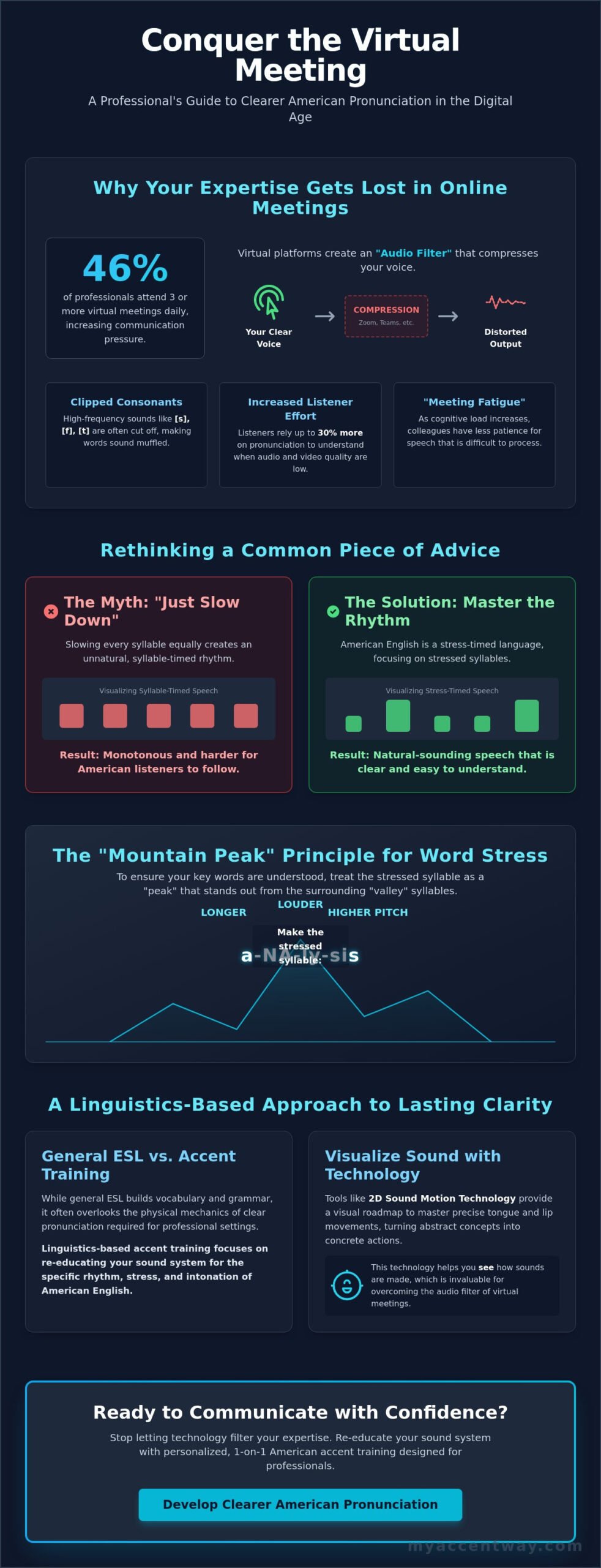
Research into virtual communication suggests that when audio quality drops, listeners rely significantly more on phonetic precision. Without the full range of sound, your colleagues’ brains have to work harder to fill in the gaps. In fact, when visual cues are limited, listeners may rely up to 30% more on your actual pronunciation to decode meaning. If your speech patterns don’t align with the expected American rhythm and stress, they simply stop trying. This is exacerbated by “Meeting Fatigue,” a documented phenomenon where cognitive load leads to a sharp decline in listener patience and comprehension. As the day progresses, your audience is less likely to work through “difficult” audio to find your message.
The Science of Virtual Audio Compression
Digital platforms utilize aggressive codecs to ensure a smooth connection. These codecs often clip high-frequency sounds, specifically unvoiced consonants like [s], [f], and [t]. For a non-native speaker, these sounds are the anchors of clarity. When background noise cancellation kicks in, it can accidentally suppress the subtle endings of your words. The result is a “muffled” or “choppy” sound that disproportionately affects non-native phonetic patterns. This makes it nearly impossible for U.S. colleagues to follow complex technical explanations, no matter how good your grammar is.
The Role of Visual-Linguistic Cues
In-person communication allows for the McGurk Effect, where our brains combine what we see with what we hear to decode speech. Online, low-resolution video and lag disrupt this process. If your video freezes or your mouth movements are blurry, your listener loses their primary backup for understanding your words. This makes your command of American intonation and vowel placement more critical than ever. To bridge this gap, you must move beyond general ESL and focus on the precise mechanics of American accent training. Developing clearer American pronunciation ensures your message survives the digital filter, even when your camera is off.
Mastering American Rhythm and Stress for Virtual Clarity
Generic advice often tells non-native speakers to “just slow down” to improve clarity. However, slowing down every syllable equally can actually make your speech harder to follow. American English is fundamentally a stress-timed language, not a syllable-timed one. This means that the rhythm of your speech is determined by the intervals between stressed syllables, rather than the total number of syllables spoken. When you apply the same timing to every sound, you strip away the musical “heartbeat” that U.S. listeners use to decode your message. Learning how to be understood in online meetings requires you to master this specific rhythmic structure.
Incorrect word stress is frequently the primary cause of misunderstandings in professional settings. If you place the emphasis on the wrong part of a word like “analysis,” “alternative,” or “efficiency,” a listener’s brain may fail to recognize the word entirely, even if your individual sounds are correct. To combat this, we use the “Mountain Peak” principle. Think of the stressed vowel in a key word as a peak; it must be longer, louder, and higher in pitch than the surrounding “valley” syllables. This contrast signals meaning and helps your colleagues follow your logic through the digital filter of a video call.
When you are sharing slides or data, your vocal variety becomes your audience’s only roadmap. You can use pitch and volume strategically to highlight critical data points. By slightly increasing your pitch on a specific number or a key outcome, you draw the listener’s attention to the most important part of the sentence. If you’re ready to move beyond generic tips, specialized American accent training can help you master these rhythmic nuances and build lasting professional confidence.
Re-Educating Your Internal Sound System
Success in virtual communication follows a specific hierarchy: Stress and Intonation are more vital for clarity than individual consonants. You must move away from “flat” speech, which can sound monotonous or even uninterested to U.S. ears. Practice multi-syllabic professional vocabulary by identifying the primary stress and stretching that vowel. This creates the characteristic American “melody” that keeps listeners engaged and reduces the cognitive load on your audience.
Intonation Patterns in U.S. Business Culture
Your tone of voice conveys authority as much as your words do. Avoid “Up-talk,” which is the habit of ending statements with a rising pitch. In U.S. business culture, this can make you sound uncertain or as if you’re asking for permission. Instead, use falling intonation at the end of your sentences to signal completion and expertise. Additionally, utilize “chunking” by pausing at natural thought boundaries. This gives the digital lag a chance to catch up and allows your listeners to process your information in digestible pieces.
Accent Training vs. General Communication Skills: What Works Online?
Many professionals mistakenly believe that working on their speech means erasing their cultural identity. In reality, accent reduction is a strategic tool for professional presence. It’s about removing the obstacles between your expertise and your audience. When you master how to be understood in online meetings, you aren’t changing who you are; you’re ensuring your voice carries the weight it deserves. This clarity leads to a significant return on investment, manifesting in more successful interviews, faster promotions, and the ability to lead diverse teams with confidence.
While generic communication courses might teach you the “MVP” rule for slides or how to structure a webinar, they often ignore the physical mechanics of speech. You can have the most beautiful presentation in the world, but if your listeners are struggling to decode your sounds, your message fails. This is where specialized American accent training differs from general ESL. It moves beyond the rules of the language and focuses on the precise execution of the sound system.
Relying on automated AI apps also has its limits. While these tools can provide basic feedback, they lack the diagnostic depth of a professional coach. An AI cannot see the positioning of your tongue or understand the subtle cultural nuances of a high-stakes board meeting. Personalized guidance from an expert like Prof. Alex ensures that you’re not just practicing, but practicing the right things for your specific linguistic background.
The Limitations of Traditional ESL
Traditional English classes focus heavily on grammar and vocabulary. This creates a gap where you “know” the word but cannot “execute” the American sound in real-time. Many professionals find they plateau after reaching a certain level of English fluency. They understand the rules, yet they still face requests for repetition in virtual settings. This plateau occurs because the brain’s internal sound system hasn’t been re-educated for the specific phonetic demands of American speech.
Linguistics-Based Training: A Structured Process
Success requires moving beyond “trying harder” to “training smarter.” Our method views speech as a physical skill mastered through a systematic approach:
- Step 1: Diagnostic Assessment. We identify the specific phonetic errors that cause the most disruption in comprehension for U.S. listeners.
- Step 2: Physical Re-Education. Students develop a deep awareness of mouth and tongue positioning to produce clearer sounds.
- Step 3: Real-World Integration. We move these new sounds into fast-paced workplace communication, ensuring you can maintain clarity even under pressure.
This structured process allows you to move closer to natural American speech without feeling like you’re performing a character. It’s about developing the vocal flexibility to be heard and respected in every digital interaction.
Practical Strategies to Improve Speech Clarity Instantly
Many professionals fall into the trap of thinking that a better microphone or a quieter room will solve their communication challenges. While hardware is helpful, a high-end mic only makes unclear pronunciation louder. It doesn’t fix the way digital codecs compress your speech. To master how to be understood in online meetings, you have to look beyond the technology and focus on the phonetic root of the problem. You must learn to produce sounds that are robust enough to survive the digital filter.
One of the most powerful tools in our curriculum is the “Anchoring” technique. This involves focusing on unvoiced consonants, specifically the American [T]. In many languages, final consonants are softened or dropped entirely. However, in a U.S. business setting, a crisp, aspirated [T] at the end of a word like “product” or “result” acts as a signal of clarity. It provides a sharp boundary for your words, preventing them from bleeding together when the software experiences latency. Practicing these crisp endings ensures your colleagues don’t have to strain to follow your technical updates.
Visualizing Sound with 2D Motion
Traditional accent training relies almost exclusively on hearing, but virtual audio is often too compressed for the ear to catch subtle distinctions. Our 2D Sound Video Training Simulator changes the game by providing a visual roadmap for your vocal muscles. By seeing the exact motion and placement required for difficult American vowels, you can re-train your tongue and lips with scientific precision. This visual feedback loop is essential for non-native speakers who need an objective way to verify their pronunciation when the audio quality is less than perfect.
Phonetic Drills for High-Stakes Meetings
Success in virtual presentations often depends on your ability to “front-load” your clarity. Focus intensely on your pronunciation and rhythm during the first 30 seconds of your update. This initial burst of precision allows your audience’s ears to calibrate to your unique speech pattern before you move into faster, more complex data. Additionally, you should incorporate strategic pausing to compensate for software lag. A brief pause after a key point gives the listener’s brain time to catch up and process your information, effectively neutralizing the impact of digital delays.
Vocal variety is a dynamic tool for persuasive leadership that utilizes shifts in pitch, volume, and pace to command attention and emphasize key insights. Using this variety prevents your voice from becoming part of the “background noise” of a long meeting. If you’re ready to see how these techniques apply to your specific role, our 1-on-1 American accent training offers the personalized feedback needed to master these strategies in real-time workplace scenarios.
Achieving Professional Fluency with Personalized Training
Reaching a level of “good enough” English is a significant milestone, but for high-stakes professionals, it’s rarely sufficient. In a virtual environment, the gap between general fluency and professional mastery becomes visible every time you unmute. If you’ve ever felt that your technical expertise was being overshadowed by speech clarity issues, you’re not alone. Mastering how to be understood in online meetings requires a shift from general language study to a precise, linguistics-based re-education of your sound system. This isn’t about changing your identity; it’s about developing the articulatory awareness needed to ensure your message is received with the authority you intend.
The MyAccentWay approach, led by Prof. Alex, Ph.D. Accent Coach, is rooted in the rigorous science of phonetics and prosody. Unlike automated apps that offer generic feedback, 1-on-1 coaching provides a diagnostic depth that identifies your specific linguistic “leaks.” We don’t just tell you to speak more clearly; we show you exactly how to adjust your tongue positioning, refine your vowel length, and master the rhythmic heartbeat of American English. This personalized attention is essential for professionals in leadership roles who must command attention during complex presentations and high-pressure negotiations.
Evidence of Progress
Meaningful improvement is a structured process, not a sudden transformation. By reviewing student results and reviews, you can see the typical improvement arcs of professionals who have committed to this systematic training. Many learners develop clearer speech and a significant boost in workplace confidence after just a few sessions of focused practice. Analyzing these “Before and After” results helps set realistic professional goals, moving you closer to natural American speech through consistent, expert-guided drills. Results show progress because the training addresses the physical mechanics of sound production rather than just vocabulary memorization.
Your Next Steps to Meeting Mastery
The journey to clearer communication begins with an objective assessment of your current speech patterns. A sample class is the most effective way to identify the specific phonetic challenges that may be hindering your clarity in virtual settings. From there, we build a personalized roadmap for American accent modification tailored to your professional needs, whether you’re leading board meetings or interviewing for your next executive role. You don’t have to settle for being “good enough” when professional mastery is within reach.
Ready to lead with confidence and ensure your voice is heard in every digital interaction? Book your 1-on-1 session with Prof. Alex today and take the first step toward stronger workplace communication.
Elevate Your Professional Presence in Every Virtual Interaction
Navigating the complexities of virtual communication is a skill that distinguishes global leaders from their peers. We’ve explored how digital audio compression distorts speech and why mastering American rhythm and stress is the most effective way to bridge that gap. By moving beyond general fluency and focusing on the precise mechanics of sound production, you ensure your expertise is never lost behind a muffled microphone or software lag. Mastery of how to be understood in online meetings is the final step in aligning your professional voice with your technical brilliance.
Realizing this level of clarity requires more than just practice; it requires a scientific, personalized approach. Our linguistics-based method, developed by Prof. Alex, Ph.D., leverages proprietary 2D Sound Motion Technology to provide the visual feedback necessary for lasting change. We’ve seen proven results for non-U.S. professionals who have transformed their workplace communication through structured guidance. You don’t have to navigate this journey alone.
Master your professional American accent with 1-on-1 coaching from Prof. Alex
It’s time to unmute with confidence and lead your next presentation with the authority you deserve. Your expertise is too valuable to be misunderstood.
Frequently Asked Questions
How can I tell if my accent is causing misunderstandings in meetings?
Look for specific behavioral cues from your colleagues, such as frequent requests for repetition or people “talking over” you after a key point. If you notice a gap between your technical expertise and the group’s response, it’s often a sign that phonetic clarity is an issue. You can also record your meetings and listen for word endings that sound muffled or rhythmic patterns that feel flat. Identifying these clarity leaks is the first step toward improvement.
Does American accent training mean I have to lose my native identity?
No, accent reduction is about adding a professional tool to your communication kit, not erasing your cultural background. We focus on improving clarity and intelligibility so that your expertise is heard without distraction. Think of it as learning the musical “key” of American business settings. You’re simply gaining the flexibility to switch between your natural speech and a clearer American pronunciation when the stakes are high.
Why do I sound clearer in person than in online meetings?
Digital platforms compress your audio and remove the high-frequency sounds that define clear consonants. In person, listeners benefit from 3D sound and subtle non-verbal cues that help them decode your meaning. Online, these cues are lost, and the software’s audio filter can make non-native phonetic patterns sound muffled. This is why mastering how to be understood in online meetings requires a specific focus on crisp articulation and rhythm.
Can I improve my pronunciation without an expensive course?
You can make initial progress by recording yourself and practicing specific American rhythm patterns found in high-quality educational videos. However, solo practice often leads to a plateau because the ear cannot always detect its own errors. While self-study is a great starting point, most professionals find that personalized American accent training provides the diagnostic precision needed to break through persistent communication barriers and achieve measurable workplace results.
How long does it take to see results in my speech clarity?
Many learners develop clearer speech and increased confidence within the first few weeks of consistent, guided practice. While significant modification of the sound system is a gradual process, you’ll likely notice fewer requests for repetition almost immediately as you apply basic rhythm and stress techniques. Lasting professional mastery typically requires several months of structured training to ensure new sounds become automatic during high-pressure virtual presentations.
What is the most important part of the American accent to learn first?
Mastering American rhythm and word stress is the most critical step for professional intelligibility. Because English is a stress-timed language, U.S. listeners rely on the contrast between long and short syllables to recognize words. If you get the rhythm right, people will understand you even if your individual consonants aren’t perfect. Focusing on the “melody” of the language provides the highest immediate return on your training time.
Is there a specific microphone that helps with accent clarity?
A high-quality cardioid or condenser microphone can reduce background noise, but it won’t fix underlying pronunciation issues. While a better mic makes your voice louder and crisper, it also amplifies any phonetic errors. Instead of relying solely on hardware, focus on the physical mechanics of your speech. Clearer American pronunciation is what truly overcomes the limitations of meeting software, regardless of the equipment you use. Investing in your skills provides a better long-term return than hardware.
How do I handle it when someone asks me to repeat myself?
Use it as an opportunity to apply “chunking” and emphasize your word stress rather than just speaking louder. Briefly pause, break your sentence into smaller thought groups, and stretch the stressed vowels in your key technical terms. This gives the listener’s brain and the digital software time to catch up. Handling these moments with calm, rhythmic precision projects confidence and ensures your message is eventually understood.
Disclaimer – American Accent Program
The American Accent Program available through Visit Program Website
is an educational and coaching service designed to support pronunciation, accent reduction, and spoken English fluency. All training materials, including lessons, exercises, audio content, visual simulations, coaching methods, and digital resources, are the intellectual property of American Accent Program, LLC and are protected by applicable copyright and intellectual property laws.
By using this website and participating in the program, you acknowledge that all content is provided for personal, non-commercial, educational use only. Users are granted a limited, non-transferable license to access the materials strictly for individual learning purposes. Redistribution, reproduction, recording, modification, sharing, or commercial use of any program content without prior written consent is strictly prohibited.
The program may include live coaching sessions, digital tools, and instructional materials intended to improve pronunciation and communication skills. However, individual results may vary, and no specific level of fluency, accent reduction, or communication outcome is guaranteed.
The American Accent Program and its instructors do not provide medical, therapeutic, or clinical speech-language pathology services. All training is intended for educational purposes only.
By accessing or using the program, you agree to comply with all applicable terms, including the platform’s Terms of Use and Course Policies, and acknowledge that misuse of materials may result in termination of access without refund.