Prof. Alex., Ph.D. Accent Coach

Article by

Prof. Alex., Ph.D. Accent Coach

Doctor of Education, Professional Linguist,
Creator of 2D Sound Motion Technology,
Creator of “InPronunci:" American Accent Program App,
Professor of English as a Second Language,
American Accent Coach,
Life Coach.

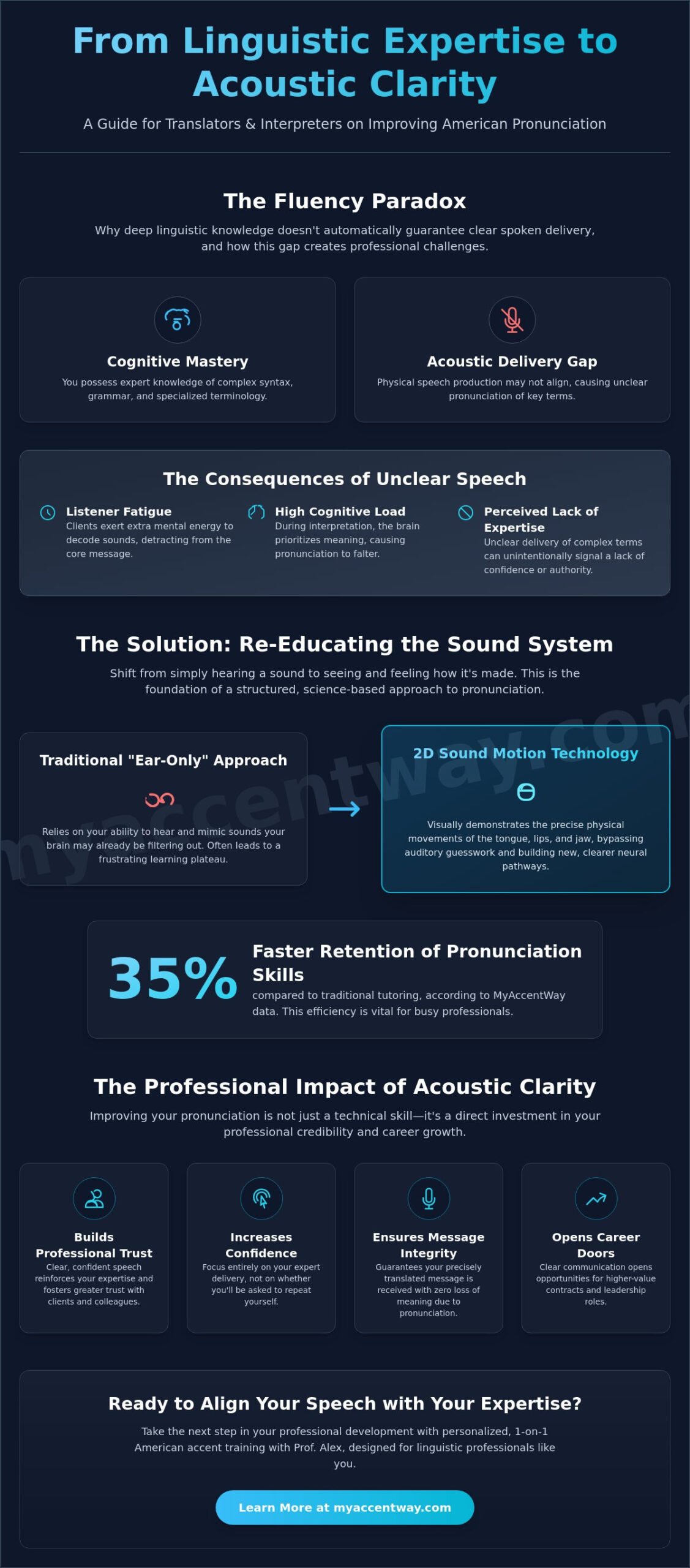
For a professional linguist, pronunciation isn’t a social accessory; it’s a technical optimization of the acoustic channel to ensure zero loss of meaning. You’ve likely spent years mastering complex syntax and specialized terminology, yet your spoken delivery might not always reflect your high level of English fluency. It’s frustrating when you face listener fatigue or find yourself repeating technical terms during high-stakes interpretations. Many professionals are now focusing on translators and interpreters improving american pronunciation to bridge this gap between cognitive mastery and physical speech production.

In this guide, you’ll discover how American accent training can help you align your expert linguistic knowledge with acoustic clarity through science-backed methods. We’ll explore why traditional training often overlooks the mechanics of phonetics and how accent reduction is actually a structured process of re-educating your sound system. You will learn about proprietary 2D technology and the intonation patterns that move you closer to natural American speech. By the end, you’ll have a clear roadmap for improving clarity in the booth and building higher confidence in every professional presentation.

Key Takeaways

  • Learn why expert linguistic knowledge doesn’t automatically ensure acoustic clarity and how to align your spoken delivery with your professional fluency.
  • Discover the science of 2D Sound Motion Technology, a visual method that helps you re-educate your mouth’s physical movements for more precise sound production.
  • Explore the critical role of rhythm and intonation for translators and interpreters improving american pronunciation to ensure your message is received with zero loss of meaning.
  • Gain a structured 5-step process to audit your speech and target high-frequency pronunciation errors within your specific technical or legal vocabulary.
  • Understand how clear communication builds professional trust, reduces listener fatigue, and opens doors to higher-value contracts and leadership roles.

The Fluency Paradox: Why Language Experts Struggle with American Pronunciation

Professional linguists often face a unique challenge. They’ve mastered the nuances of English syntax and specialized terminology, yet their spoken delivery doesn’t always reflect their written brilliance. This is The Fluency Paradox. Cognitive mastery of semantics is a completely different neurological process than the physical execution of speech. While traditional translation programs emphasize deep vocabulary and grammatical precision, they often bypass the physical mechanics of phonetics. This oversight leaves many experts with persistent first-language phonological interference, where the sounds of their native tongue bleed into their English speech.

The path for translators and interpreters improving american pronunciation starts with recognizing that speech is a physical skill, not just a mental one. When an interpreter’s pronunciation is unclear, it creates “listener fatigue.” Clients must exert significant mental energy just to decode the sounds, leaving less room to process the actual message. This can lead to a perceived lack of expertise, even when the translation is technically perfect. For professionals, accent reduction isn’t about erasing identity; it’s about optimizing the acoustic channel for maximum professional impact.

Cognitive Load and Speech Clarity

During simultaneous interpretation, the brain is under immense pressure. It prioritizes meaning and rapid word retrieval over the physical mechanics of speech. This high cognitive load often causes pronunciation to suffer. Listeners then pay a “re-processing cost” as they struggle to understand technical terms. Ironically, using high-level, expert vocabulary can make errors more confusing. The listener doesn’t expect a mismatch between complex concepts and unclear delivery, which can lead to misunderstandings in high-stakes environments.

Moving Beyond “Accent Removal”

We must reframe the conversation. It’s not about “removing” an accent or losing your cultural heritage. Instead, focus on improving acoustic clarity. When you develop clearer American pronunciation, you aren’t changing who you are; you’re sharpening your professional tools. This shift in perspective builds immense confidence. High-stakes communication requires you to speak with authority. Knowing your speech is clear allows you to focus entirely on your expert delivery rather than worrying if you’ll be asked to repeat yourself.

By focusing on translators and interpreters improving american pronunciation, you bridge the gap between your linguistic knowledge and your spoken impact. It’s a structured process of re-educating the sound system to ensure your voice is as professional as your expertise.

Re-Educating the Sound System with 2D Sound Motion Technology

Traditional auditory training relies on your ability to hear a difference that your brain might already be filtering out. For translators and interpreters improving american pronunciation, this “ear-only” approach often leads to a plateau. To break through, you must shift your focus from how a sound sounds to how it feels. This is the foundation of 2D Sound Motion Technology, a linguistics-based methodology that visualizes the precise physical movements of the mouth. By treating speech as a series of physical motions rather than abstract acoustic targets, you can bypass long-standing habits and build new, clearer neural pathways.

This technology uses 2D animations to show the exact positioning of the tongue, lips, and jaw. For a professional who already understands the theory of language, seeing the mechanics of a sound provides a “lightbulb moment” that hearing alone cannot replicate. Data from MyAccentWay: American Accent Training indicates that using 2D Sound Motion Technology can lead to 35% faster retention of pronunciation skills compared to traditional tutoring. This efficiency is vital for busy professionals who need results that translate directly to their workplace communication. While academic resources for Professional Accent Coaching offer a strong theoretical framework, the physical re-education of your sound system requires this type of targeted, visual feedback.

The Mechanics of American Vowels and Consonants

American English relies heavily on specific tongue placements and airflow patterns that differ significantly from other languages. For example, the American [R] and the various forms of the [T] require muscular coordination that many non-native speakers have never practiced. Using 2D visuals allows you to see how the tongue bunches or flicks, making it easier to integrate these movements into your daily practice routine. Instead of guessing if your placement is correct, you can compare your physical sensation to the visual model, ensuring every practice session moves you closer to natural American speech. If you’re ready to master these mechanics through guided practice, you might consider starting with personalized American accent training to refine your professional presence.

Visualizing the Unvoiced Sounds

Unvoiced sounds can be particularly challenging because they lack the vibration of the vocal cords, making them harder to “catch” by ear. The 2D Sound Video Training Simulator for the American [T] provides a visual way to understand how air is blocked and released. This simulator is a powerful tool for those with hearing or processing challenges, as it transforms an invisible acoustic event into a visible physical action. By understanding the science of mouth movement, you gain total control over your delivery, ensuring your professional communication is as precise as your linguistic expertise.

Translators and Interpreters Improving American Pronunciation: A Professional Guide

Professional Intonation: The “Melody” of Meaning in Interpreting

Meaning isn’t just carried by the words you choose; it lives in the melody of your speech. For translators and interpreters improving american pronunciation, mastering individual consonants and vowels is only half the battle. To be truly effective, you must master the “American Melody.” This involves understanding the specific pitch, emphasis, and sentence endings that signal professional authority and emotional nuance. If your intonation is flat or mimics the patterns of a syllable-timed language, your U.S. audience may perceive you as hesitant or even confused, regardless of your linguistic accuracy.

American English is a stress-timed language. This means we compress certain syllables and elongate others to create a specific rhythm. When an interpreter uses incorrect stress patterns, it can fundamentally change the meaning of a sentence. For instance, shifting the stress on a word like “project” can change it from a noun to a verb. In high-stakes environments, these tiny shifts create a cognitive burden for the listener. By aligning your intonation with American patterns, you reduce this burden, allowing your clients to focus entirely on your expert-level insights.

Word Stress for Technical Vocabulary

Technical and multisyllabic terms are often the biggest hurdles for language professionals. You might know the definition of “analytical” or “interpretation,” but if you place the stress on the wrong syllable, the word becomes unrecognizable to a native ear. Re-educating your sound system requires you to identify these high-frequency professional terms and practice shifting the stress to match natural American patterns. This isn’t just about “sounding better”; it’s about technical precision in the acoustic channel. Exercises that focus on jumping in pitch on the stressed syllable can help you move closer to natural American speech.

Rhythm and Pausing in Simultaneous Interpretation

Simultaneous interpretation is a high-pressure cognitive task. To manage the load for both yourself and your listener, you must use “thought groups.” These are short bursts of speech followed by strategic pauses. This rhythm allows the listener’s brain to process one chunk of information before the next arrives. A key component of this professional rhythm is the “schwa” sound, the most common vowel in American English. Mastering the schwa allows you to de-emphasize unimportant words, which highlights the key information. Using this type of vocal variety keeps a U.S. audience engaged and reinforces your role as a confident, authoritative communicator.

By focusing on translators and interpreters improving american pronunciation through intonation, you ensure your delivery is as sophisticated as your vocabulary. If you’re ready to see how these rhythms look in practice, you can explore student results and reviews to see how others have transformed their professional presence.

5 Steps for Translators to Improve American Pronunciation

Generic advice to “just practice more” often fails language professionals because it lacks a structured, scientific framework. For translators and interpreters improving american pronunciation, progress requires a systematic approach that respects your existing expertise while targeting specific physical habits. You don’t need to relearn the English language; you need to re-educate the muscles that produce it. Follow these five steps to move closer to natural American speech and ensure your spoken delivery matches your expert-level written fluency.

Auditing Your Professional Speech

When you review your recordings, look for patterns of phonological interference. Phonological interference is a physical habit of the mouth muscles rather than a lack of linguistic knowledge. It’s essential to distinguish between a natural accent and clarity issues that cause listener fatigue. If a client has to ask you to repeat a technical term, that’s a clarity issue that needs direct attention through structured practice. Identifying these moments is the first step toward building higher confidence in client-facing roles.

The Role of Expert Feedback

While AI-powered apps are popular, they often fail to catch the subtle nuances of professional interpreting. They cannot evaluate the emotional resonance of your intonation or how you handle complex stress patterns in real-time. This is where personalized guidance from a Ph.D. linguist like Prof. Alex becomes invaluable. Seeing is believing; many learners develop clearer speech by studying “Before and After” shorts that showcase progress in consonant precision and vowel clarity. These results show progress is achievable through consistent practice and personalized guidance. You can explore more student results and testimonials at MyAccentWay: American Accent Training. If you’re ready to stop guessing and start improving, you can sign up for personalized American accent training today to begin your transformation.

Elevating Your Career with Professional Accent Coaching

Investing in your speech is one of the most effective ways to increase your market value. For translators and interpreters improving american pronunciation, the benefits extend far beyond simple clarity. When you speak with the rhythmic precision of a native professional, you build immediate credibility. This acoustic authority often leads to higher-value contracts, better client reviews, and more frequent referrals. Clients aren’t just paying for the words you translate; they’re paying for the confidence and expertise you project through your delivery.

There’s a significant psychological shift that happens when you master your sound system. You move from “translating words” to “communicating expertise.” This transition is vital in high-stakes fields like legal, medical, or diplomatic interpreting, where every nuance matters. In these environments, your voice is your instrument. By 2026, the demand for specialized language professionals has only grown, and results show that many learners develop clearer speech when they treat pronunciation as a technical skill rather than a social hurdle. You’ve already mastered the cognitive side of language; now it’s time to align your physical delivery with that same level of excellence.

Tailored Solutions for High-Stakes Roles

Professional accent reduction isn’t a one-size-fits-all process. It should be customized for your specific field. If you’re preparing for technical presentations or international conferences, you need to focus on the specific terminology and intonation patterns of that niche. Reducing the “foreigner effect” helps you build immediate trust with U.S. teams, as it removes the acoustic distractions that can lead to listener fatigue. Even with a busy professional schedule, you can integrate these training principles into your daily routine, turning every meeting into a practice session for your professional growth.

Next Steps for Your Professional Transformation

Moving closer to natural American speech is a journey of refinement and structured practice. It begins with a shift in mindset, viewing your speech as a professional craft that’s worth perfecting. You don’t need to change your identity, but you can optimize your communication to ensure your message is always heard with absolute clarity. This process of re-educating your sound system is a powerful investment in your future, providing you with the tools to lead meetings, nail interviews, and deliver flawless presentations.

If you’re ready to bridge the gap between your written fluency and your spoken impact, the most effective path is through personalized guidance. Start your journey with a one-on-one assessment to identify your specific needs. Prof. Alex, Ph.D. Accent Coach, offers personalized American accent training designed specifically for high-level professionals like you. This supportive, linguistics-based approach ensures you develop the clarity and confidence required to excel in any U.S.-facing role. Take the next step toward professional mastery today.

Master Your Professional Presence Through Acoustic Clarity

You’ve spent years honing your linguistic expertise; now is the time to ensure your spoken delivery reflects that same level of mastery. By re-educating your sound system and embracing the specific rhythm of the American Melody, you bridge the gap between technical knowledge and listener impact. This focused journey of translators and interpreters improving american pronunciation is about more than just sounds; it’s about claiming your authority in every high-stakes meeting, interpretation booth, and client presentation. When you align your acoustic output with your cognitive fluency, you ensure your message is received with the precision it deserves.

Prof. Alex, Ph.D. Accent Coach, uses a proven, linguistics-based method at MyAccentWay: American Accent Training to help international professionals achieve measurable progress and lasting confidence. You can move closer to natural American speech through personalized, one-on-one guidance that respects your unique cultural background and professional goals. Results from our students show that meaningful improvement is possible through consistent practice and expert mentorship that addresses the physical mechanics of speech production.

Book your 1-on-1 American accent training with Prof. Alex at MyAccentWay: American Accent Training and begin your professional transformation today. Your voice is your most powerful tool. Perfecting it is a rewarding professional craft that will open new doors for your career and your self-assurance.

Frequently Asked Questions

Can translators and interpreters really improve their pronunciation after years of practice?

Yes, improvement is possible at any stage of your career because speech is a physical habit rather than a cognitive one. While you’ve already mastered the syntax and vocabulary of English, your mouth muscles may still follow the patterns of your native language. Through structured training, you can re-educate these muscles to produce the specific sounds and rhythms of American English with technical precision.

Is accent reduction different from general English fluency?

Accent reduction focuses on the physical mechanics of speech production, whereas general English fluency involves vocabulary, grammar, and sentence structure. You can be highly fluent in written and spoken English while still facing challenges with acoustic clarity. Training specifically targets consonants, vowels, and intonation to ensure your high-level linguistic knowledge is delivered clearly to a U.S. audience without causing listener fatigue.

How long does it take to see progress in American accent training?

Many learners develop clearer speech and see measurable progress within the first few weeks of consistent, guided practice. Achieving lasting results that feel natural in high-stakes environments typically requires several months of structured re-education. Your specific timeline depends on your starting point and your commitment to the daily exercises designed by your coach to build new, reliable muscle memory.

Will I lose my native identity if I improve my American pronunciation?

You won’t lose your cultural identity; instead, you’re gaining a professional tool for clearer communication. Our approach views American pronunciation as a set of skills you can use when needed, similar to switching between different registers of speech. You remain yourself while ensuring that your message is delivered with the acoustic clarity necessary for professional success and stronger workplace relationships.

Why do clients sometimes struggle to understand me even though my English is perfect?

Clients often struggle because of non-standard stress patterns and rhythm rather than a lack of vocabulary. For translators and interpreters improving american pronunciation, the goal is to reduce the “re-processing cost” for the listener. When your intonation doesn’t match American expectations, the listener’s brain must work harder to decode your sounds, which leads to fatigue and potential misunderstandings during technical discussions.

How does 2D Sound Motion Technology help with professional speech?

2D Sound Motion Technology helps by providing a visual way to understand exactly how American sounds move. Since you can’t see your own tongue or jaw movements during speech, these animations provide a clear model for you to replicate. This visual feedback is essential for re-educating the sound system, as it allows you to see the mechanics of unvoiced sounds and complex vowels.

Is 1-on-1 coaching better than using a pronunciation app for interpreters?

Personalized 1-on-1 coaching is far more effective for interpreters because an app can’t detect subtle errors in professional intonation or stress. A linguist like Prof. Alex provides real-time adjustments and individualized feedback that algorithms simply can’t replicate. This human guidance is critical for mastering the complex “American Melody” required for high-level workplace communication, technical presentations, and leadership roles.

Can accent training help with public speaking anxiety?

Yes, improving your pronunciation naturally reduces public speaking anxiety by giving you total control over your delivery. When you know your speech is clear and your intonation is professional, you can focus entirely on your expert-level message. This self-assurance is a key outcome for translators and interpreters improving american pronunciation, allowing you to participate in high-stakes meetings without the fear of being misunderstood.

Disclaimer – American Accent Program

The American Accent Program available through Visit Program Website
is an educational and coaching service designed to support pronunciation, accent reduction, and spoken English fluency. All training materials, including lessons, exercises, audio content, visual simulations, coaching methods, and digital resources, are the intellectual property of American Accent Program, LLC and are protected by applicable copyright and intellectual property laws.

By using this website and participating in the program, you acknowledge that all content is provided for personal, non-commercial, educational use only. Users are granted a limited, non-transferable license to access the materials strictly for individual learning purposes. Redistribution, reproduction, recording, modification, sharing, or commercial use of any program content without prior written consent is strictly prohibited.

The program may include live coaching sessions, digital tools, and instructional materials intended to improve pronunciation and communication skills. However, individual results may vary, and no specific level of fluency, accent reduction, or communication outcome is guaranteed.

The American Accent Program and its instructors do not provide medical, therapeutic, or clinical speech-language pathology services. All training is intended for educational purposes only.

By accessing or using the program, you agree to comply with all applicable terms, including the platform’s Terms of Use and Course Policies, and acknowledge that misuse of materials may result in termination of access without refund.

Leave a Reply

Your email address will not be published. Required fields are marked *

ACCENT PROGRAM

Speak English Confidently

Student

Student′s Portal

Program

Methodology & Pricing

Professor

Your Instructor

2D Sound

Motion Technology

eCourse

Available Course

American Accent Program
for Speakers of English as a Second Language