American English: Myths, Mechanics, and Mastering Speech Clarity
(512) 265-9515Updated October 12, 2026 ◆ 16 min read
What if the most significant barrier to your career growth isn’t your cultural background, but a simple misunderstanding of how American English mechanics actually work? You likely feel the pressure to “fix” your speech every time you have to repeat yourself in a high-stakes meeting or struggle with conflicting pronunciation rules. It’s frustrating to believe that your identity is something that needs to be erased to succeed in a professional environment; however, your culture matters and should be celebrated as part of your professional voice.
Real student result

“I feel confident enough to speak American English!”
Interactive American Accent Training9monthsof hard work and dedication
Listen to the starting point0:00
Listen to the result0:00
“Many of my students once believed they could never sound like this. School taught them grammar and vocabulary, but not how to train their English speech. That is what we do together, step by step, until you speak English independently and with confidence.”
Abishek’s result was achieved through Prof. Alex’s research-based Interactive 1-on-1 American Accent Training. His doctoral research found this interactive method more effective than traditional, teacher-centered methods. See the research basis →
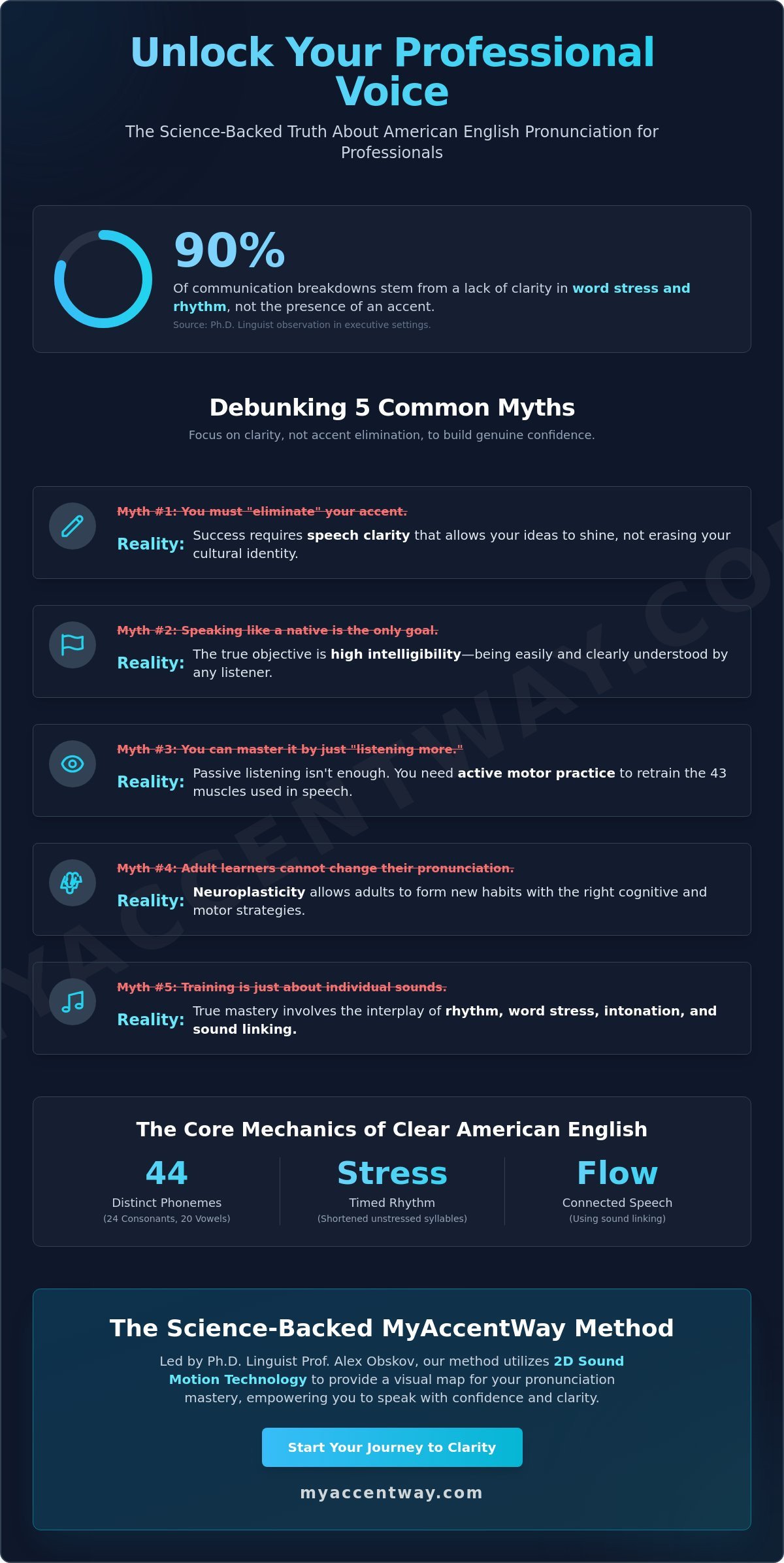
As a Ph.D. Linguist, I’ve observed that communication breakdowns in executive settings often stem from a lack of clarity in word stress and rhythm rather than the presence of an accent. In this guide, you’ll discover the science-backed truth about pronunciation and how to achieve professional speech clarity without losing your cultural identity. We’ll move past the harmful myth of “accent elimination” and focus on the technical mastery of sounds that builds genuine confidence in every interaction.
We’ll explore the specific mechanics of the 44 phonemes used in the American accent and how 2D Sound Motion Technology provides a visual map for your success. You’ll learn exactly how to navigate complex intonation patterns to ensure your message is heard and respected every time you speak.
What is American English? Understanding the Professional Standard
American English is a dynamic linguistic system used by over 330 million people, characterized by its unique phonology, vocabulary, and rhythmic patterns. While the United States is home to a rich tapestry of regional dialects, the corporate world typically looks to “General American” as the professional benchmark. This isn’t a single “perfect” accent but rather a continuum of speech that avoids distinct regional markers from the South or the Northeast. For those seeking American accent training, the goal is to master this clear, neutral sound to enhance professional presence.
Prof. Alex, Ph.D. Accent Coach, defines American English by its specific mechanics, such as rhoticity and a stress-timed rhythm. To understand the foundations of these features, it helps to look at the history and development of What is American English? and how it diverged from its British roots. In a professional setting, clarity is the priority. When a speaker uses consistent American vowel shifts and word stress, they reduce the listener’s effort, allowing the message to take center stage.
The Evolution of the American Sound
The American accent began diverging from British English in the 17th century. A defining feature is “rhoticity,” where the /r/ sound is clearly pronounced at the end of syllables, such as in “car” or “mother.” While 90% of U.S. broadcast media and corporate leadership roles utilize General American, regional variations still thrive. However, for international professionals, focusing on the standard phonology provides a reliable “bridge” for communication. This includes mastering the 24 consonants and 20 vowels that form the backbone of the American sound. Using 2D Sound Motion Technology can help learners train these physical movements to achieve a more authentic resonance.
Why Professionals Focus on Accent Modification
Speech clarity is a vital component of executive presence. In a 2022 study on workplace communication, researchers found that inconsistent pronunciation can increase the “cognitive load” on a listener, making it harder for them to retain information. Accent modification isn’t about changing who you are or hiding your culture. Instead, it’s a strategic professional tool. By refining intonation and rhythm, you ensure that colleagues in Austin, Texas, or global hubs can follow your insights without hesitation. Prof. Alex, Ph.D. Accent Coach, emphasizes that this journey is about empowerment. It’s about gaining the confidence to speak up in meetings, knowing your technical expertise won’t be overshadowed by a lack of phonetic clarity.
- Rhoticity: Pronouncing the “r” sound at the end of words.
- Stress-Timed Rhythm: Shortening unstressed syllables to create a specific “beat.”
- Vowel Clarity: Using Interactive Visual 2D Sound Simulators for American Sounds to master complex shifts.
Debunking 5 Common Myths About American English
Misconceptions about American English often prevent professionals from reaching their full potential. Many learners believe they must erase their heritage to succeed, but this isn’t true. Prof. Alex, Ph.D. Accent Coach, emphasizes that effective communication relies on clarity rather than the erasure of your personal history. Let’s dismantle the five most persistent myths that stall progress in accent modification.
- Myth 1: You must “eliminate” your accent. Success doesn’t require a blank slate. It requires speech clarity that allows your ideas to shine.
- Myth 2: Speaking like a native is the only goal. The real objective is “high intelligibility,” which means being understood easily by any listener.
- Myth 3: You can master the accent just by “listening more.” Passive listening doesn’t retrain the 43 muscles used in speech; you need active motor practice.
- Myth 4: Adult learners cannot change their pronunciation. Neuroplasticity remains active throughout life, allowing adults to override old habits with the right cognitive strategies.
- Myth 5: Accent training is just about individual sounds. Pronunciation involves rhythm, word stress, and intonation, not just isolated phonemes.
The Identity Fallacy: Accent vs. Clarity
The idea of “accent elimination” is linguistically impossible and unnecessary. Your accent is a reflection of your culture, and your culture matters in every professional setting. Prof. Alex, Ph.D. Accent Coach, views American English training as a tool for empowerment, not a way to hide your origins. By focusing on Understanding the Professional Standard for clarity, you ensure that your message is never lost. The goal is to move from being “hard to understand” to “effortlessly clear” while maintaining your unique identity.
The “Just Listen” Trap
Many students spend years in English-speaking environments without seeing improvement. This happens because passive listening fails to correct deep-seated motor habits. Adult brains require “intellectual interaction” and analytical training to override first-language interference. You can’t simply absorb the 20 American vowels and 24 consonants through osmosis. Instead, you must use cognitive strategies and 2D Sound Motion Technology to train your speech organs to produce sounds. This analytical approach helps you consciously control your speech organs until new patterns become automatic.
If you’re ready to move beyond these myths, exploring American accent training near me can provide the scientific structure needed for genuine speech transformation.
MyAccentWay · 2D Sound Motion Technology
American English Pronunciation: Consonant and Vowel Sounds with 2D Sound Motion Technology
Learning American English pronunciation and the American accent is more effective when you train your speech organs, not only listen and repeat. 2D Sound Motion Technology and Interactive Visual 2D Sound Simulators, developed in 2020 by Prof. Alex, Ph.D. Accent Coach, Doctor of Education, and professional linguist, as part of his interactive teaching model based on his Ph.D. research in interactive teaching methods, train your tongue, lips, jaw, teeth, airflow, and voice step by step. They train each American sound and more than 30 sound combinations through Interactive 2D video simulation.
What 2D Sound Motion Technology is
2D Sound Motion Technology is an advanced accent reduction and articulation training tool by Prof. Alex. It corrects, develops, and trains each American sound and more than 30 sound combinations through Interactive 2D video simulation.
What Interactive Visual 2D Sound Simulators do
Interactive Visual 2D Sound Simulators are part of 2D Sound Motion Technology, the articulation-training method Prof. Alex created by applying his Ph.D. research in interactive teaching to American pronunciation. Instead of listening and repeating, students actively train their speech organs. Each simulator uses Interactive 2D mouth movement to train the speech organs (tongue, lips, jaw, teeth, airflow, and voice) to produce each American sound correctly. Every consonant has its own simulator: explore American consonants trained with 2D Sound Motion Technology.
Sample training: the American t sound (aspirated [t])
Practice
Record yourself speaking these words:
Tab · Tacos · Time · Tub · Hotel · Motel · Sit · Pit · Net
Instructions
Play the Interactive Visual 2D Sound Simulator for the American t sound below several times and follow it step by step. Move your tongue, jaw, and airflow together with the simulator and train your articulation.
Interactive Visual 2D Sound Simulator: American unvoiced sound [t]
Practice
Record yourself again speaking these words, but this time focus on the movement of your tongue. Go slow, and you will hear the difference. You’ve got this!
Tab · Tacos · Time · Tub · Hotel · Motel · Sit · Pit · Net
How Interactive Visual 2D Sound Simulators solve pronunciation and speaking problems
- Wrong articulationMost pronunciation problems start with the tongue, lips, jaw, or teeth in the wrong position. Each Interactive Visual 2D Sound Simulator trains the correct articulation of one American sound, so the student corrects the cause of the problem, not only the result.
- Airflow and voicingMany accent problems come from wrong airflow or voicing: sounds that are too weak, too strong, or voiced when they should be unvoiced. The simulators train airflow and voice together with articulation, step by step, for each American sound and more than 30 sound combinations.
- Clear speech and confidenceWhen each sound is trained correctly, words connect into clear American English speech. Listeners can understand you more easily, and speaking at work, in meetings, and on calls becomes more confident.

If you start hearing the aspiration, the short airstream after [t], with one simulator, you can only imagine how successful you can be in 1-on-1 Interactive American Accent Training with Prof. Alex, Ph.D. Accent Coach, where your whole American sound system is trained sound by sound.
In MyAccentWay, the Interactive Visual 2D Sound Simulators are only available in 1-on-1 accent coaching sessions with Prof. Alex.
The Mechanics of American Sounds and Rhythm
Prof. Alex, Ph.D. Accent Coach, teaches that mastering American English requires a deep understanding of its 44 unique phonemes. This inventory consists of 24 consonants and 20 vowels, a high number compared to the five-vowel systems found in many other languages. To achieve speech clarity, you must learn the physical coordinates of these sounds. MyAccentWay uses Interactive Visual 2D Sound Simulators for American Sounds to train students in exactly where the tongue and jaw should be for every phoneme. This 2D Sound Motion Technology turns abstract acoustic concepts into repeatable physical actions.
While individual sounds matter, the “Schwa” (/ə/) is the undisputed secret to efficient speech. It’s the most common sound in the language, appearing in almost every multisyllabic word like “about” or “president.” The Schwa is a neutral, relaxed sound that allows speakers to move quickly through unstressed syllables. Mastering this “lazy” vowel is a cornerstone of effective accent reduction because it creates the necessary contrast between important and unimportant information in a sentence.
Vowel Mastery: The Core of American English
Vowels are the high-energy centers of words. Americans use a wide “vowel space” to create distinction between similar terms. Clarity often depends on tongue tension and position. For instance, many ESL speakers struggle with the tension difference between the “high-front” tense vowel in “leave” and the lax vowel in “live.” Using minimal pairs is a research-based method to train the brain to hear these differences. Consider these examples:
- Pool (/u/) vs. Pull (/ʊ/)
- Bed (/ɛ/) vs. Bad (/æ/)
- Sheep (/i/) vs. Ship (/ɪ/)
By focusing on these subtle shifts in the mouth, you develop the precision needed for professional accent modification. For a comprehensive breakdown of the physical movements behind each phoneme, the reference guide to American sounds provides an in-depth roadmap to mastering the full inventory of consonants and vowels.
Rhythm and Flow: The Stress-Timed Nature of English
American English is a stress-timed language, which means the rhythm is based on the interval between stressed syllables. This differs from syllable-timed languages, such as Spanish or Cantonese, where every syllable receives roughly equal timing. In English, we “reduce” or shorten unstressed syllables to maintain a consistent beat. This creates a natural “galloping” flow that is essential for being understood by native listeners.
Intonation also plays a functional role in professional communication. A falling intonation at the end of a sentence signals certainty and authority, while a rising intonation typically indicates a question or a lack of completion. For those seeking American accent training, learning to control these melodic patterns is just as vital as pronouncing individual consonants. It ensures your message isn’t just heard, but felt with the intended professional impact.
Practical Strategies to Improve Your Speech Clarity
Speech clarity isn’t about erasing your cultural identity; it’s about making your message accessible and impactful. Prof. Alex, Ph.D. Accent Coach, emphasizes that American English relies on a specific musicality that differs from many other languages. To master this, you need a consistent feedback loop. Start by recording yourself speaking for 60 seconds during a practice session. Listen specifically for where your breath stops or where sounds feel disconnected. This record-and-compare method identifies the precise gaps between your current speech patterns and your target clarity goals.
Mastering Linked Sounds for Natural Flow
Choppy speech often happens when speakers treat every word as an isolated island. In American English, sounds bleed into one another to create a fluid stream. This isn’t “mumbling,” it’s a linguistic rule called linking. If you fail to link, your speech can sound robotic or overly formal, which may unintentionally create distance in a professional setting.
- Consonant-to-Vowel Linking: When a word ends in a consonant and the next starts with a vowel, push the final consonant over. “Call it” should sound like “ca-lit.”
- Vowel-to-Vowel Linking: Insert a subtle /y/ or /w/ sound to bridge the gap. “See it” becomes “see-y-it,” while “go in” becomes “go-w-in.”
Try this practice exercise using common corporate phrases: “An analytical approach” should be practiced as “A-nan-aly-ti-ca-lap-proach.” Connecting these four words into a single breath unit immediately increases your perceived fluency.
The Shadowing Technique for Professionals
Shadowing is a psychological hack that bypasses the “translation” brain and engages the “mimicry” brain. It involves listening to a native speaker and repeating what they say with a delay of only 0.5 seconds. This technique forces your brain to adopt the rhythm, stress, and intonation of the speaker simultaneously, building muscle memory in your articulators.
- Select a 30-second clip of a professional American speaker.
- Listen once to grasp the overall meaning.
- Mimic the audio in real-time, focusing on the “music” and pitch changes rather than individual word meanings.
This process builds the cognitive agility required for spontaneous conversation. For those seeking guided practice and professional feedback, American accent training near me provides expert-led sessions that utilize 2D Sound Motion Technology to train these movements.
High-Stakes Meeting Preparation Checklist
Before your next presentation or interview, use this four-point checklist to ensure your speech remains clear under pressure:
- Identify three “key technical terms” you’ll use and verify their primary word stress.
- Practice your opening two sentences five times using the shadowing method to set your rhythm.
- Mark your notes with small “link” symbols between words ending in consonants and starting with vowels.
- Record a 30-second summary of your main point and listen for “stop-and-go” patterns that need smoothing.
By applying these scientific principles of accent modification, you can transform your communication from a source of anxiety into a professional asset. Learn more about the science of sound at MyAccentWay.
The MyAccentWay Method: Science-Backed Success
Mastering the nuances of American English requires more than just listening to audio clips or repeating words. It demands a structured, scientific approach that addresses how sounds are physically produced. Prof. Alex, Ph.D. Accent Coach, developed the MyAccentWay method to bridge the gap between linguistic theory and practical speech clarity. This program doesn’t rely on simple mimicry. Instead, it uses an individual approach to help professionals understand the mechanics of their own speech. By focusing on the scientific foundation of phonetics, students gain the tools to communicate with precision and authority in any professional setting.
2D Sound Motion Technology: Training Pronunciation
Traditional coaching often relies on watching a teacher’s face, but this only shows the external view. The proprietary 2D Sound Motion Technology changes this by providing Interactive Visual 2D Sound Simulators for American Sounds. These simulators train the internal movements of the tongue, soft palate, and jaw in real time. Training exactly where the tongue touches the roof of the mouth eliminates the guesswork common in standard language courses. This feedback significantly speeds up the cognitive and analytical processes required to build new muscle memory. It’s a precise way to master the 24 consonants and 20 vowels that define the American soundscape without the frustration of trial and error.
Expert Mentorship with Prof. Alex, Ph.D. Accent Coach
Working with a Ph.D. linguist offers a level of depth that a generic tutor cannot provide. Prof. Alex, Ph.D. Accent Coach uses a philosophy called Intellectual Interaction. This means the training is a two-way street where your specific cultural background and linguistic history are respected. You aren’t just learning to sound different; you’re gaining a deep understanding of why certain sounds are challenging for you specifically. The curriculum is tailored to your unique needs rather than a one-size-fits-all syllabus. It’s an opportunity to deepen your understanding of American English with an expert who views accent modification as a path to empowerment and confidence.
The journey to clearer communication is personal, and having the right technology and mentorship makes all the difference. If you’re ready to move beyond basic pronunciation and achieve true speech clarity, it’s time to experience this scientific method for yourself. You can see how these tools work by engaging in a personalized session. We invite you to Book Your 1 Hour Evaluation Session and discover how 2D Sound Motion Technology can transform your communication skills.
Elevate Your Professional Communication Today
Mastering the nuances of American English is a journey of both scientific understanding and practical application. You’ve learned that speech clarity isn’t about erasing your identity; it’s about refining the mechanics of your rhythm and sounds to ensure your message is heard. By focusing on the 24 consonants and 20 vowels that form the foundation of clear communication, you’re already ahead of the curve.
Real transformation happens when you move beyond theory into structured, expert-led practice. Prof. Alex, Ph.D. Accent Coach, developed a method that bridges the gap between linguistic science and professional success. Through the MyAccentWay program, you’ll use proprietary 2D Sound Motion Technology to train speech organs and make complex pronunciation intuitive. This is a structured system for professionals who need to lead with authority.
Take the next step in your professional development and see how precise training unlocks new opportunities. Your voice is your most powerful tool. It’s time to use it with the clarity and confidence you deserve.
Speech Clarity Training for Foreign-Born Professionals in the United States
Foreign-born professionals in the United States often know their field and speak advanced English. Yet American listeners may still struggle with the clarity of their sounds and rhythm. MyAccentWay offers private online speech clarity training through Interactive American Accent Training.
Interactive American Accent Training is led by Prof. Alex, Ph.D. Accent Coach, Doctor of Education, and professional linguist. He first diagnoses each speaker’s native-language patterns. Then he trains American sound articulation, stress, rhythm, and intonation for real conversations.
Who this training is for
- Engineers, IT specialists, and data professionals presenting to U.S. teams and clients
- Doctors, nurses, and healthcare professionals explaining care to American patients
- Managers, executives, and founders leading meetings, pitches, and briefings
- Consultants, researchers, and academics speaking at conferences and webinars
- Professionals preparing for interviews, promotions, or client-facing roles
Online training across the U.S.
MyAccentWay is based in Austin, Texas, and all training is online. The program is especially relevant for professionals in Austin, Dallas, Houston, New York City, the San Francisco Bay Area, Los Angeles, Seattle, Boston, Chicago, Miami, Washington DC, Atlanta, and Raleigh.
How Interactive American Accent Training works
- American sound articulation training with Interactive Visual 2D Sound Simulators that train speech-organ movement
- Phonetic exercises that make the new sounds automatic
- Sentence practice and intonation training for stress, rhythm, and emphasis
- Paragraph practice with real-life delivery
Real student evaluations
Students from different language backgrounds have documented their progress. Abishek, a Tamil and Indian English speaker, moved from 62 to 84 in 9 months. Tian, a Mandarin speaker, moved from 58 to 85 in 8 months. Vlad, a Russian speaker, moved from 60 to 83 in 5 months.
The first step is a 1 Hour Evaluation Session with Prof. Alex.
Frequently Asked Questions About American English
Can I really lose my foreign accent as an adult?
Yes, you can significantly improve your speech clarity regardless of your age. While the goal isn’t to erase your heritage, Prof. Alex, Ph.D. Accent Coach, uses cognitive and analytical processes to help you retrain your articulatory muscles. Research suggests that focused practice can lead to a 50 percent improvement in intelligibility for adult learners within a few months.
How is American accent training different from a standard ESL class?
Standard ESL courses focus on grammar and vocabulary, while American accent training targets the physical mechanics of sound. This specialized training uses 2D Sound Motion Technology to train tongue placement and airflow. You’ll learn the specific rhythm and intonation patterns of American English that textbooks often overlook.
What is the most difficult sound in American English to master?
The American “R” sound is widely recognized as the most challenging phoneme for 85 percent of non-native speakers. It requires a specific tongue shape that doesn’t exist in most other languages. Our Interactive Visual 2D Sound Simulators for American Sounds provide a visual map to help you master this complex articulation precisely and confidently.
How long does it take to see results in speech clarity?
You’ll likely see a measurable difference in your speech clarity after just 5 to 10 sessions of professional coaching. Achieving a high level of mastery usually takes between 6 and 12 months of consistent practice. This timeline depends on your starting point and how often you engage with the training materials.
Will I lose my cultural identity if I change my accent?
No, you won’t lose your identity because your culture matters and remains a core part of who you are. Accent reduction is simply a communication tool that gives you more control over how you’re perceived in professional environments. Think of it as learning a new skill that empowers you to share your ideas without the barrier of being misunderstood.
The problem is not always grammar or vocabulary.
If people understand your words but still miss your message, the deeper issue may be speech clarity, rhythm, intonation, and American pronunciation habits. MyAccentWay helps students retrain the sound system with professional 1-on-1 guidance, so English can feel clearer, freer, and more natural in real communication.
Two training methods that make speech change active.
MyAccentWay is not passive listen-and-repeat coaching. Prof. Alex, Ph.D. Accent Coach, Doctor of Education, and professional linguist, creates a learning situation where students become active learners and active participants in changing their own speech patterns.
Interactive training
Students do not just receive pronunciation instructions passively. They listen, think, compare, adjust, and understand their own speech patterns while Prof. Alex guides the correction process.
Cognitive accent training
Students learn to notice and correct the speech patterns that affect American pronunciation, then implement new American speech patterns into their code-switching process for more natural, long-lasting change.
Build speech habits people can hear in real conversations.
A stronger American accent is not built by memorizing topics or chasing quick pronunciation tips. It comes from structured training, professional feedback, active correction, and repeated application until clearer speech becomes easier to keep.
Continue learning how MyAccentWay connects American sound articulation, Interactive Visual 2D Sound Simulators, accent reduction, student proof, and 1-on-1 training.
- Prof. Alex and the MyAccentWay MethodLearn how Prof. Alex created and leads the structured MyAccentWay American accent training system.
- Accent Reduction Curriculum and English Articulation TrainingSee accent reduction, accent modification, American pronunciation, English articulation, rhythm, and professional speech clarity.
- 2D Sound Motion Technology for American Accent TrainingUnderstand Interactive Visual 2D Sound Simulators for American sound articulation.
- Before-and-After American Accent Training ResultsListen to real before-and-after student proof and outcomes.
- Student Reviews and Accent Training ResultsRead student reviews and trust signals.
- Book a 1-on-1 American 1 Hour Evaluation SessionStart with a 1-hour interactive session with Prof. Alex.
Disclaimer – American Accent Program
The American Accent Program available through Visit Program Website
is an educational and coaching service designed to support pronunciation, accent reduction, and spoken English fluency. All training materials, including lessons, exercises, audio content, visual simulations, coaching methods, and digital resources, are the intellectual property of American Accent Program, LLC and are protected by applicable copyright and intellectual property laws.
By using this website and participating in the program, you acknowledge that all content is provided for personal, non-commercial, educational use only. Users are granted a limited, non-transferable license to access the materials strictly for individual learning purposes. Redistribution, reproduction, recording, modification, sharing, or commercial use of any program content without prior written consent is strictly prohibited.
The program may include live coaching sessions, digital tools, and instructional materials intended to improve pronunciation and communication skills. However, individual results may vary, and no specific level of fluency, accent reduction, or communication outcome is guaranteed.
The American Accent Program and its instructors do not provide medical, therapeutic, or clinical speech-language pathology services. All training is intended for educational purposes only.
By accessing or using the program, you agree to comply with all applicable terms, including the platform’s Terms of Use and Course Policies, and acknowledge that misuse of materials may result in termination of access without refund.