 MYACCENTWAY
Vlad: After Training Pronunciation Evaluation
Word clarity shows how clearly the words were pronounced, whether each word can be recognized as the intended word. The other scores measure how close Vlad sounds to a native speaker of General American English. Overall is the average of Sound by sound, Sounds, Intonation, Connected speech and Measurements.
Word clarity
| Word | Result | Details (time) |
|---|---|---|
| Words recognized clearly | ||
| 47 of 56 words | Clear | recognized as the intended word with high confidence |
| Words not recognized clearly | ||
| the first “android” | Unclear | low recognition confidence (1.5 s) |
| “drives” | Unclear | heard as “raced”: the [aɪ] and the [v] are not heard (2.0 s) |
| the first “deliver” | Unclear | heard as “believer” when checked on its own (3.2 s) |
| “garden” | Unclear | low recognition confidence; heard as “gorgeous” when checked on its own (9.1 s) |
| “During” | Unclear | heard as “doing” when checked on its own (12.2 s) |
| “so” | Unclear | low recognition confidence (14.1 s) |
| “this” | Unclear | heard as “the” (16.0 s) |
| “important” | Unclear | “this important” was heard as “the symposium” (16.2 s) |
| “drone” | Unclear | low recognition confidence; heard as “drawn” (16.6 s) |
Word clarity score: 47 of 56 words recognized clearly = 84 / 100. Each unclear word counts as 0.
Sound-by-sound check in every word
This is the strictest check. Every sound of every word was compared with the American pronunciation of the word. A word can be recognized and still have sounds that differ.
| Word | Result | Details (time) |
|---|---|---|
| All sounds match the American pronunciation | ||
| 38 words | Close to General American | a, android, could, detective, device, down, drink, drive, drove, from, he, his, hot, in, it, of, ordered, some, street, the, to, too, was, water |
| Some sounds differ | ||
| “and” | Needs work | 2 of 3 sounds match: [d] is missing (6.1 s) |
| “dehydrated” | Needs work | 7 of 10 sounds match: [d] is heard as [ɪ]; [i] is missing; [d] is missing (7.1 s) |
| “bottle” | Partly | 3 of 4 sounds match: [ɾ] is heard as [t] (10.9 s) |
| “rehydrated” | Partly | 9 of 10 sounds match: [i] is heard as [ɪ] (13.4 s) |
| “continue” | Partly | 7 of 8 sounds match: [j] is missing (14.9 s) |
| the second “deliver” | Needs work | 4 of 6 sounds match: [ɪ] is heard as [eɪ]; [v] is heard as [b] (15.6 s) |
| “who” | Needs work | 0 of 2 sounds match: [h] is heard as [w]; [u] is missing (18.1 s) |
| the second “it” | Needs work | 1 of 2 sounds match: [ɪ] is missing (18.7 s) |
| Words not recognized clearly (every sound counts as 0) | ||
| the first “android” | Unrecognized | 5 sounds (1.6 s) |
| “drives” | Unrecognized | 4 sounds (2.1 s) |
| the first “deliver” | Unrecognized | 6 sounds (3.2 s) |
| “garden” | Unrecognized | 5 sounds (9.1 s) |
| “during” | Unrecognized | 5 sounds (12.2 s) |
| “so” | Unrecognized | 2 sounds (14.4 s) |
| “this” | Unrecognized | 3 sounds (16.1 s) |
| “important” | Unrecognized | 8 sounds (16.3 s) |
| “drone” | Unrecognized | 4 sounds (16.8 s) |
Sound-by-sound score: 142 of 196 sounds match = 72 / 100. The 42 sounds in words that were not recognized clearly count as 0. Sounds that the automatic check could not identify even in the General American model reading are not part of this count; they are checked by listening in the Sounds section.
Sound by sound
| Sound | Result | Example (time) |
|---|---|---|
| Vowels | ||
| [i] street, he | Close to General American | 2.9 s, 5.8 s, 8.3 s, 13.3 s |
| [ɪ] it, in, his, drink, device, the second “deliver” | Close to General American | 4.6 s, 5.5 s, 12.5 s, 9.7 s, 3.8 s, 15.6 s |
| [ɪ] the first “deliver” | Unrecognized | 3.2 s, the word was not recognized clearly |
| [ɛ] detective | Close to General American | 17.6 s |
| [æ] “and”, the second “android” | Close to General American | 6.1 s, 6.4 s |
| [æ] the first “android” | Unrecognized | 1.5 s, the word was not recognized clearly |
| [ɑ] hot, water (both), bottle | Close to General American | 5.2 s, 10.2 s, 11.4 s, 10.9 s |
| [ɑ] garden | Unrecognized | 9.1 s, the word was not recognized clearly |
| [ɔ] ordered | Close to General American | 18.2 s |
| [ɔ] important | Unrecognized | 16.2 s, the word was not recognized clearly |
| [ʊ] could | Close to General American | 14.7 s |
| [ʊ] during | Unrecognized | 12.2 s, the word was not recognized clearly |
| [u] too | Close to General American | 5.0 s |
| [u] who | Partly | the [h] is weak, so the word sounds closer to “oo” (17.8 s) |
| [ə] schwa in the, a, continue, to | Close to General American | 2.7 s, 3.7 s, 14.9 s, 9.5 s |
| [ʌ] some, from, of, was | Close to General American | 9.9 s, 10.7 s, 11.2 s, 4.8 s |
| [ɚ] water (both), the second “deliver” | Close to General American | 10.4 s, 11.6 s, 15.9 s |
| Diphthongs | ||
| [aɪ] device, drive, dehydrated, rehydrated | Close to General American | 4.0 s, 12.8 s, 7.3 s, 13.6 s |
| [aɪ] drives | Unrecognized | 2.0 s, the word was not recognized clearly |
| [aʊ] down (both) | Close to General American | 2.4 s, 8.8 s |
| [eɪ] dehydrated, rehydrated | Close to General American | 7.6 s, 13.9 s |
| [oʊ] drove | Partly | closer to a single long [o] without the glide to [ʊ] (8.5 s) · common for Russian speakers |
| [oʊ] so, drone | Unrecognized | 14.1 s, 16.6 s, the words were not recognized clearly |
| [ɔɪ] the second “android” | Close to General American | 6.7 s |
| [ɔɪ] the first “android” | Unrecognized | 1.5 s, the word was not recognized clearly |
| Consonants | ||
| American [ɹ] in street, drink, from, drove, drive, dehydrated, rehydrated, ordered | Close to General American | the rolled Russian [r] is gone; every recognized R is the American [ɹ] (2.9 s, 9.7 s, 10.6 s, 8.5 s, 12.7 s, 7.5 s, 13.4 s, 18.2 s) |
| [h] in he, his, hot, dehydrated, rehydrated | Close to General American | 8.3 s, 12.5 s, 5.2 s, 7.2 s, 13.6 s; the Russian [x] is gone |
| [h] in who | Partly | weak, close to missing (17.8 s) |
| [ɾ] flap T in water (both), dehydrated, rehydrated | Close to General American | 10.3 s, 11.6 s, 7.7 s, 14.1 s |
| [ɾ] flap T in bottle | Partly | voiced, but still closer to a full [t] (11.1 s) |
| [tʰ] puff of air in too, continue, detective | Partly | clearer than before, but still shorter than in General American in “too” and “detective” (4.9 s, 15.1 s, 17.6 s) · common for Russian speakers |
| [ð] the (all), this | Close to General American | 1.4 s, 2.6 s, 5.6 s, 6.2 s, 8.9 s, 17.3 s, 16.1 s |
| [j] continue | Partly | still blended into a soft Russian [nʲ]: “contin-oo” (15.3 s) · common for Russian speakers |
| [l] the second “deliver”, bottle | Close to General American | 15.7 s, 11.1 s |
| [v] device, drive, drove, of | Close to General American | 3.9 s, 13.0 s, 8.6 s, 11.2 s |
| [v] the second “deliver” | Partly | closer to [b]: “delayber” (15.9 s) |
| [z] was, his | Close to General American | 4.9 s, 12.6 s |
| [s] street, some, device | Close to General American | 2.8 s, 9.9 s, 4.2 s |
| [w] was, water | Close to General American | 4.7 s, 10.1 s |
| [d] device, detective, dehydrated | Close to General American | 3.8 s, 17.4 s, 7.5 s |
| [n] [ŋ] [k] [ɡ] [p] [f] [m] | Close to General American | down, drink, could, garden, important, from, some |
| Clusters and syllables | ||
| [ŋk] drink | Close to General American | 9.8 s |
| [kt] detective | Close to General American | 17.6 s |
| [st] [str] street | Close to General American | 2.8 s, 5.8 s |
| [dr] drove, drink, drive | Close to General American | 8.4 s, 9.6 s, 12.7 s |
| No extra vowels after consonants | Close to General American | no added vowels in street, drink, detective (2.9 s, 9.8 s, 17.6 s) |
| Word stress | ||
| dehydrated, rehydrated, detective | Close to General American | 7.1 s, 13.4 s, 17.4 s |
| continue, the second “deliver” | Partly | the stressed syllable is louder and longer, but not higher; General American also raises the pitch (14.8 s, 15.6 s) |
| garden, important, the first “deliver” | Unrecognized | 9.1 s, 16.2 s, 3.2 s, the words were not recognized clearly |
“Unrecognized” means the sound could not be identified clearly in this recording. Each unrecognized sound counts as 0 in the Sounds score. Results: 32 close to General American, 8 inconsistent or partly, 0 need work, 9 unrecognized. “Common for Russian speakers” marks differences that are typical when the first language is Russian.
Intonation compared with General American English pronunciation
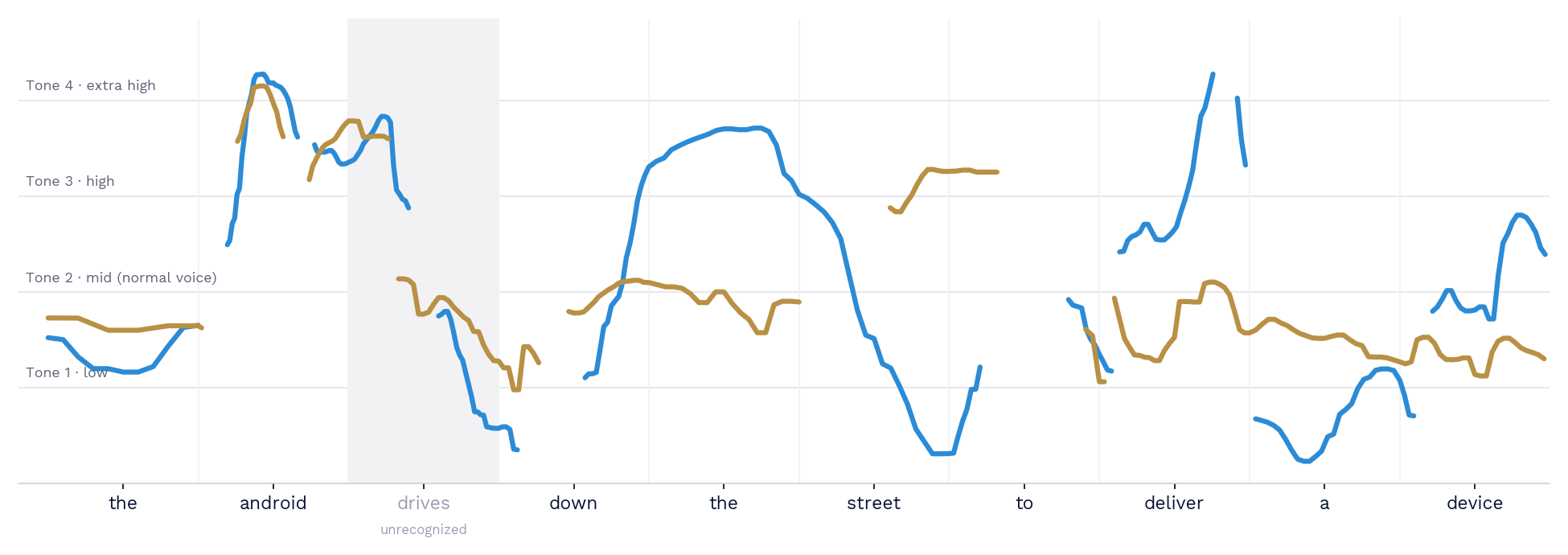
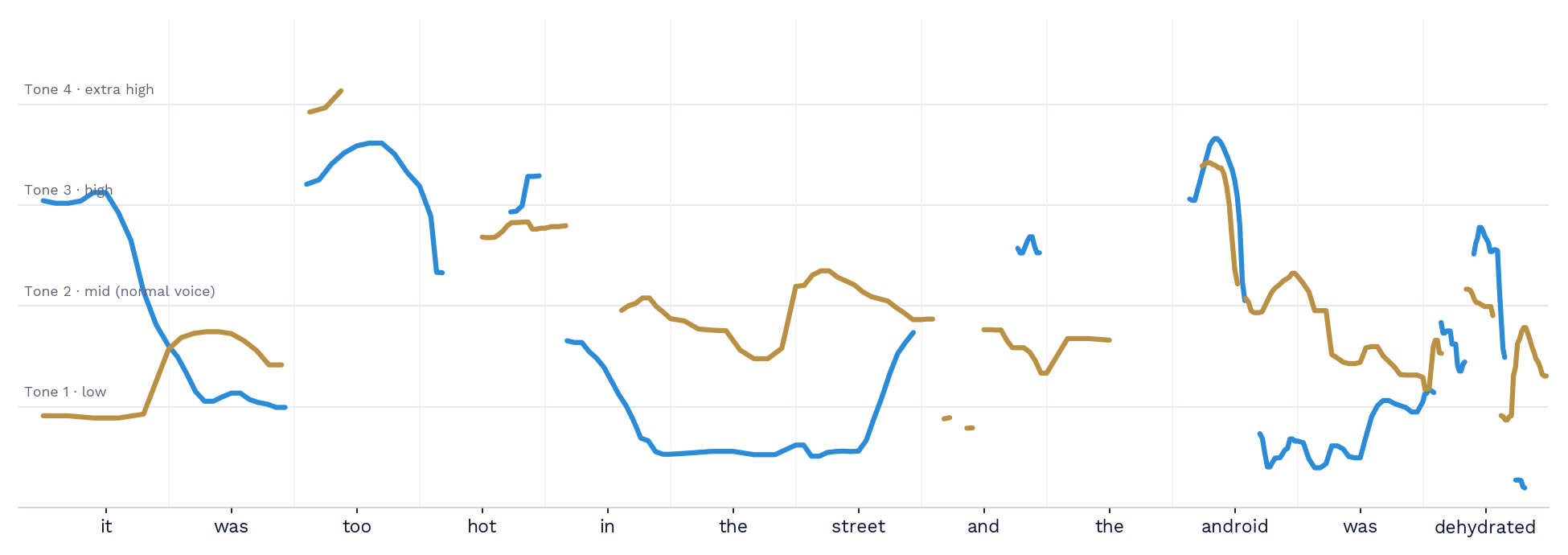
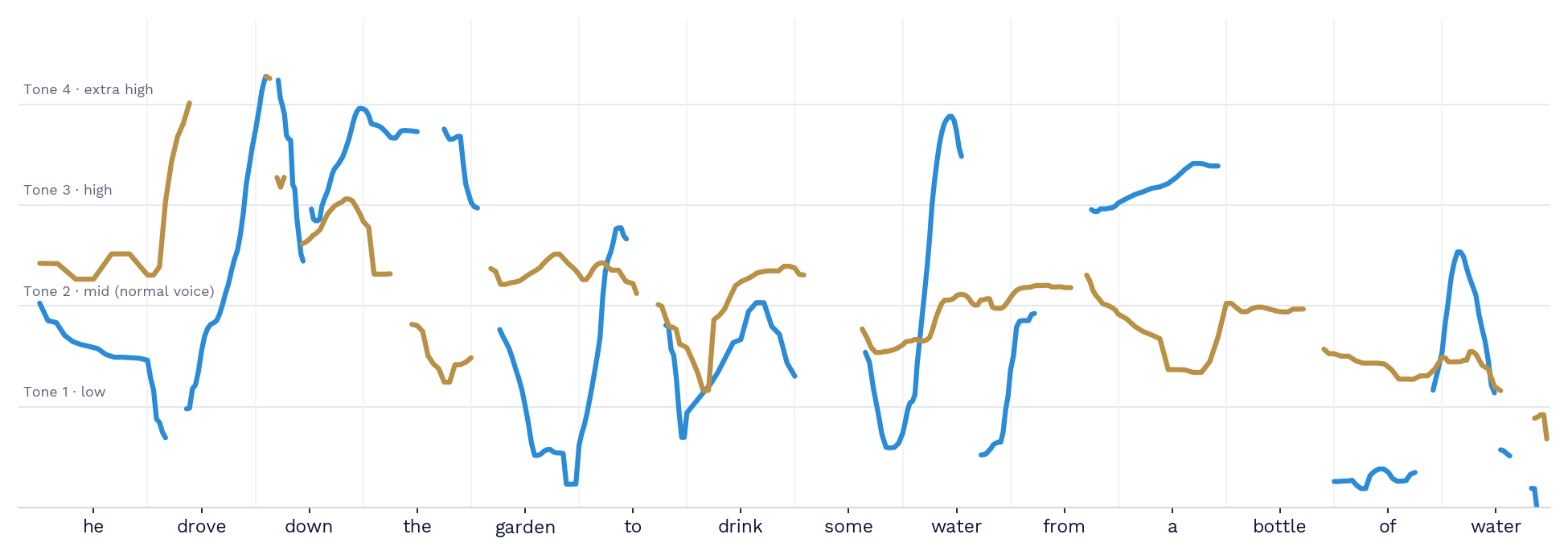
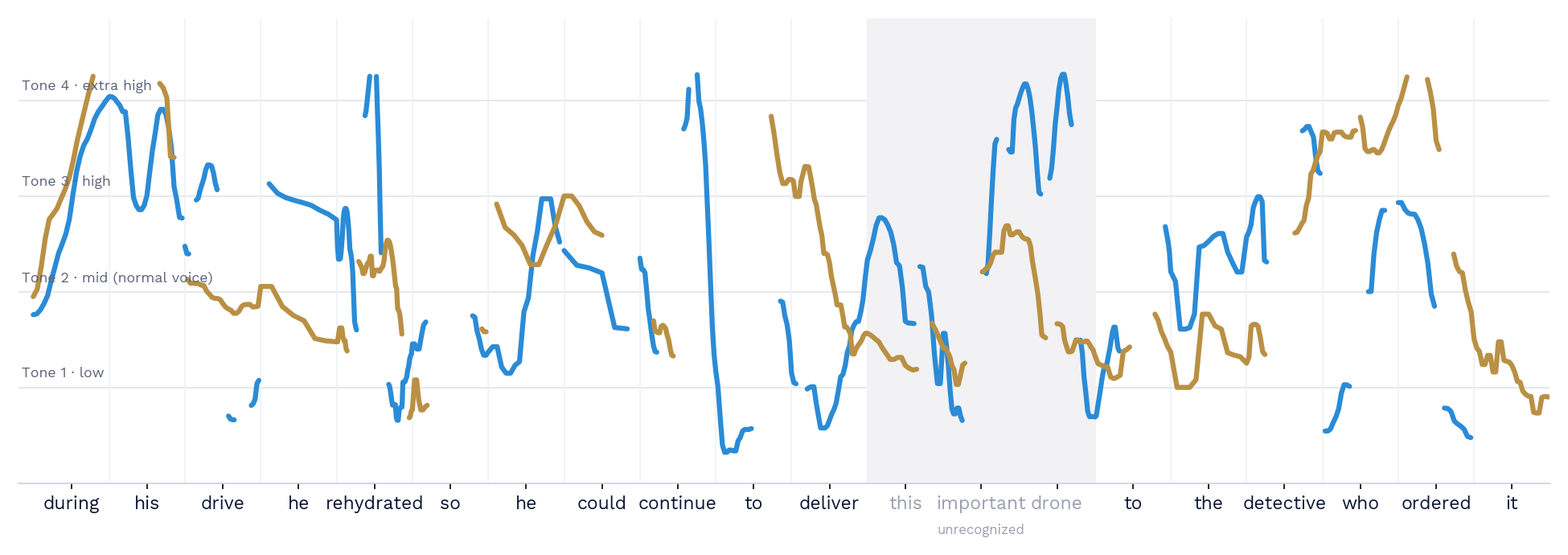
Vlad’s pitch range is about 9 semitones, wider than before training but still smaller than the General American range of about 11. Several key words now reach the high tones: “too”, “hot”, the second “android”, “drove down” and “detective”. Other key words still stay at his normal voice level (Tone 2): “down the street” in sentence 1, the first “water” and “from a” in sentence 3, and “rehydrated” and “continue” in sentence 4. Some small words that General American keeps low go up instead: “to” in sentences 1 and 4, “could” and “who ordered”. Sentences 1, 3 and 4 end with a clear fall; sentence 2 ends low but without a clear fall.
| Intonation point | Result | Details (time) |
|---|---|---|
| Whole reading | ||
| Pitch range | Partly | about 9 semitones (General American: about 11); wider than before training |
| Sentence 1 | ||
| Low start on “The” | Close to General American | 0.9 s |
| High tone on “android” | Unrecognized | 1.5 s, “android” was not recognized clearly |
| High tone on “drives” | Unrecognized | 2.0 s, “drives” was not recognized clearly |
| High tone on “down the” | Needs work | stays at Tone 2; General American goes up to Tone 3 and Tone 4 (2.3 s, 2.6 s) |
| Low tone on “to” | Needs work | goes up to Tone 3 on a small word; General American keeps it at Tone 1 (3.0 s) |
| High tone on “deliver” | Unrecognized | 3.2 s, “deliver” was not recognized clearly |
| Fall at the end (“device”) | Close to General American | 3.8 s |
| Sentence 2 | ||
| High tone on “too” | Close to General American | Tone 4 (4.8 s) |
| High tone on “hot” | Close to General American | 5.1 s |
| Low tone on “in the street” | Partly | stays at Tone 2; General American drops to Tone 1 (5.4 s) |
| High tone on “and” | Needs work | stays low; General American goes up to Tone 3 (6.0 s) |
| Low tone on “the” (the android) | Close to General American | 6.2 s |
| High tone on the second “android” | Close to General American | goes up to Tone 4 (6.4 s) |
| Low tone on “was” (was dehydrated) | Close to General American | 6.8 s |
| Fall at the end (“dehydrated”) | Partly | ends low but without a clear fall; General American falls to Tone 1 (7.1 s) |
| Sentence 3 | ||
| Low start on “He” | Partly | starts a little above his normal voice level; General American starts lower (8.2 s) |
| High tone on “drove down” | Close to General American | goes up to Tone 4 (8.4 s) |
| Low tone on “some” | Close to General American | 9.8 s |
| High tone on the first “water” | Needs work | stays at Tone 2; General American reaches Tone 4 (10.0 s) |
| High tone on “from a” | Needs work | stays at Tone 2; General American goes up to Tone 3 (10.4 s) |
| Fall at the end (“water”) | Close to General American | 11.3 s |
| Sentence 4 | ||
| High tone on “During his” | Unrecognized | 12.2 s, “During” was not recognized clearly |
| Phrase break after “During his drive” | Close to General American | short break (13.0 s) |
| High tone on “rehydrated” | Needs work | stays near Tone 2; General American reaches Tone 4 (13.4 s) |
| High tone on “so” | Unrecognized | 14.1 s, “so” was not recognized clearly |
| Low tones on “he could” | Partly | “could” goes up to Tone 3 on a small word; General American keeps it near Tone 2 (14.7 s) |
| High tone on “continue” | Needs work | stays at Tone 2; General American reaches Tone 4 (14.8 s) |
| Low tone on “to” (to deliver) | Needs work | goes up to Tone 4 on a small word; General American drops to Tone 1 (15.3 s) |
| High tone on “important” | Unrecognized | 16.2 s, “important” was not recognized clearly |
| High tone on “drone” | Unrecognized | 16.6 s, “drone” was not recognized clearly |
| Low tone on “the” (the detective) | Close to General American | 17.3 s |
| High tone on “detective” | Close to General American | goes up to Tone 4 (17.4 s) |
| Low tones on “who ordered” | Needs work | goes up to Tone 4; General American keeps “who” low and “ordered” at Tone 2 (17.8 s, 18.2 s) |
| Fall at the end (“it”) | Close to General American | 18.4 s |
“Unrecognized” means the words or the pitch could not be identified clearly, so the point could not be checked. Each unrecognized point counts as 0 in the Intonation score. Results: 14 close to General American, 5 partly, 9 need work, 7 unrecognized. Unrecognized words are shaded in gray on the diagrams.
Each line is measured from that speaker’s own normal voice level (Tone 2), so a higher or lower voice does not change the comparison.
Connected speech
| Feature | Result | Details (time) |
|---|---|---|
| Linking | ||
| “drink some water” | Close to General American | 9.6 s |
| “continue to deliver” | Close to General American | 15.3 s |
| “drove down” | Close to General American | 8.4 s |
| “bottle of water” | Close to General American | 10.9 s |
| “ordered it” | Close to General American | 18.2 s |
| “and the android” | Close to General American | 6.0 s |
| “drives down” | Unrecognized | 2.0 s, “drives” was not recognized clearly |
| Reduced small words | ||
| “to” → [tə] | Partly | [tə] in “to drink”, “to deliver” and “to the detective” (9.3 s, 15.3 s, 17.0 s); still [tʊ] in the first “to deliver” (3.0 s) · common for Russian speakers |
| “the” → [ðə] | Close to General American | 2.6 s, 8.9 s, 17.3 s |
| “of” → [əv] | Close to General American | 11.1 s |
| “a” → [ə] | Close to General American | 3.5 s, 10.7 s |
| “was”, “his” weak forms | Close to General American | 4.7 s, 6.8 s, 12.4 s |
| “could” weak form | Partly | a full [kʊd] (14.7 s); General American reduces it |
| Pausing and phrasing | ||
| Pauses between sentences | Close to General American | a short pause after every sentence (4.2 s, 7.7 s, 11.7 s) |
| Pauses inside phrases | Close to General American | no pauses inside phrases; the only other pause is the phrase break after “During his drive” (13.0 s) |
| Reading without restarts | Close to General American | no hesitations or restarts |
| Speed | ||
| Speaking rate | Partly | about 192 words per minute, faster than General American (about 147); at this speed “this important drone” was not heard clearly (16.0 s) |
“Unrecognized” means the feature could not be checked clearly. Each unrecognized point counts as 0 in the Connected speech score. Results: 13 close to General American, 3 inconsistent or partly, 0 need work, 1 unrecognized.
Speech measurements
These are acoustic measurements of the recording, compared with a General American model reading of the same story.
| Measurement | Vlad | General American | Result |
|---|---|---|---|
| Speed | |||
| Speaking rate | 192 words per minute | 147 words per minute | Partly |
| Speed while speaking (pauses not counted) | 4.5 syllables per second | 3.8 syllables per second | Partly |
| Pauses longer than 0.2 s | 4 pauses, 1.4 s in total | 5 pauses, 3.7 s in total | Close to General American |
| Vowel length | |||
| [aɪ] longer before a voiced sound: drive [v] vs. device [s] | 200 ms vs. 75 ms (2.7×) | 180 ms vs. 75 ms (2.4×) | Close to General American |
| [ɪ] longer before a voiced sound: his [z] vs. this [s] | his 90 ms; “this” was not recognized clearly | American English: clearly longer before [z], about 1.3× or more | Unrecognized |
| Stress strength (stressed vs. unstressed syllable in the same word) | |||
| Louder | +7.3 dB | +5.3 dB | Close to General American |
| Longer | 1.54× | 1.24× | Close to General American |
| Higher pitch | +2.4 semitones | +3.5 semitones | Partly |
| Rhythm | |||
| Contrast between long and short vowels | 50 | 46 | Close to General American |
| Small words (the, to, a, was, of, in) compared with stressed vowels | 60% of the length | 77% of the length | Close to General American |
| Pitch range | |||
| How far the voice goes up and down | 8.8 semitones | 11.3 semitones | Partly |
| Voice onset time (puff of air) | |||
| [t] at the start of a stressed syllable: too, continue, detective | 34–74 ms, a weak puff | 66–110 ms, a clear puff | Partly |
| Final consonants | |||
| Final consonants present | present in all recognized words | present | Close to General American |
| Final consonants in unclear words | drives, the first deliver, garden, important, drone | — | Unrecognized |
| Vowel placement (compared with General American vowels) | |||
| [i] street, he, rehydrated | distance 0.3 | 0 (reference) | Close to General American |
| [ɪ] it, in, drink, his | distance 0.9 (the mouth is more closed and the tongue is further forward) | 0 (reference) | Partly |
| [ɛ] detective | distance 1.8 (the mouth is more open) | 0 (reference) | Needs work |
| [æ] android | distance 1.6 (the mouth is more open) | 0 (reference) | Needs work |
| [ɑ] hot, bottle | distance 0.8 (the mouth is more open and the tongue is further back) | 0 (reference) | Partly |
| [ɑ] water | distance 0.6 | 0 (reference) | Close to General American |
| [ɔ] ordered | distance 0.7 | 0 (reference) | Close to General American |
| [ʌ] was, some, from, of | distance 0.5 | 0 (reference) | Close to General American |
| [u] too, continue | distance 0.9 (the tongue is further back) | 0 (reference) | Partly |
| [ɚ] water, ordered | distance 0.7 | 0 (reference) | Close to General American |
Vowel placement distance: 0 means the vowel sits in the same place in the mouth as the General American vowel; below 0.75 is close, 0.75 to 1.25 is partly, above 1.25 needs work. Each unrecognized point counts as 0. Results: 12 close to General American, 8 partly, 2 need work, 2 unrecognized.
Training plan
How this evaluation was done
Prof. Alex evaluated Vlad’s recording made after training, the same 4-sentence story read in about 19 seconds. Vlad’s first language is Russian, so the evaluation also checks the sound patterns that are common for Russian speakers, against General American English pronunciation.
- Word clarity. Each word was checked with automatic speech recognition to see whether it is recognized as the intended word of the story. Words that were misheard or recognized with low confidence are marked “Unclear”.
- Listening evaluation. Prof. Alex listened to the whole recording sound by sound. He rated each consonant, vowel, stress pattern, intonation pattern and connected-speech feature.
- American reference. Vlad’s reading was compared word by word with a General American English pronunciation model of the same story.
- Acoustic analysis. Prof. Alex checked his listening with acoustic measurements: pitch for intonation and tones; vowel resonance for vowels and the American R; voicing for the flap T and the final Z; loudness and length for stress and for reduced small words.
- Intonation diagrams. Pitch is shown in semitones from each speaker’s own normal voice level (Tone 2), so a higher or lower voice doesn’t change the comparison. Tone 1 is low, Tone 3 is high and Tone 4 is extra high. Each word takes the same space on the diagram, so the two voices line up word by word.
- Connected speech. Prof. Alex checked linking, reduced small words and where Vlad pauses.
- Sound-by-sound check. An automatic phoneme recognizer wrote down every sound Vlad produced, and each sound was compared with the American pronunciation of the word. The same check was run on the General American model reading.
- Speech measurements. Speaking rate, vowel length, stress strength, rhythm, pitch range, voice onset time, final consonants and vowel placement were measured in the recording and compared with the General American model reading.
- Scoring. Each area is scored from 0 to 100 for how close it sounds to General American English pronunciation, not for clarity. Sounds, intonation points and connected-speech features that could not be identified clearly are marked “Unrecognized” and count as 0. Where a word was recognized clearly and no acoustic problem was measured, the sound is rated close to General American; Prof. Alex confirms these ratings by listening.

Disclaimer and Terms of Use
This evaluation is provided for educational and informational purposes only. It reflects the professional opinion of Prof. Alex, Ph.D. Accent Coach, Doctor of Education, and professional linguist. It is based only on the single recording submitted for this evaluation (the recording made after training).
- Not proof or certification. This evaluation is not a certificate, credential, standardized test result or official language assessment. It may not be used as proof of language ability, accent, pronunciation level or progress, for any purpose. That includes employment, immigration, academic, legal, medical or business purposes.
- Published with permission. This evaluation is published on MyAccentWay with Vlad’s permission. It may not be copied or republished elsewhere without written permission from American Accent Program, LLC.
- No promise of results. Scores and findings describe this recording only, on the date it was made. They don’t predict future performance or promise any specific outcome from training.
- Limitation of liability. American Accent Program, LLC and Prof. Alex accept no liability for any decision made or action taken based on this evaluation.
- Ownership. © 2026 American Accent Program, LLC. All rights reserved.