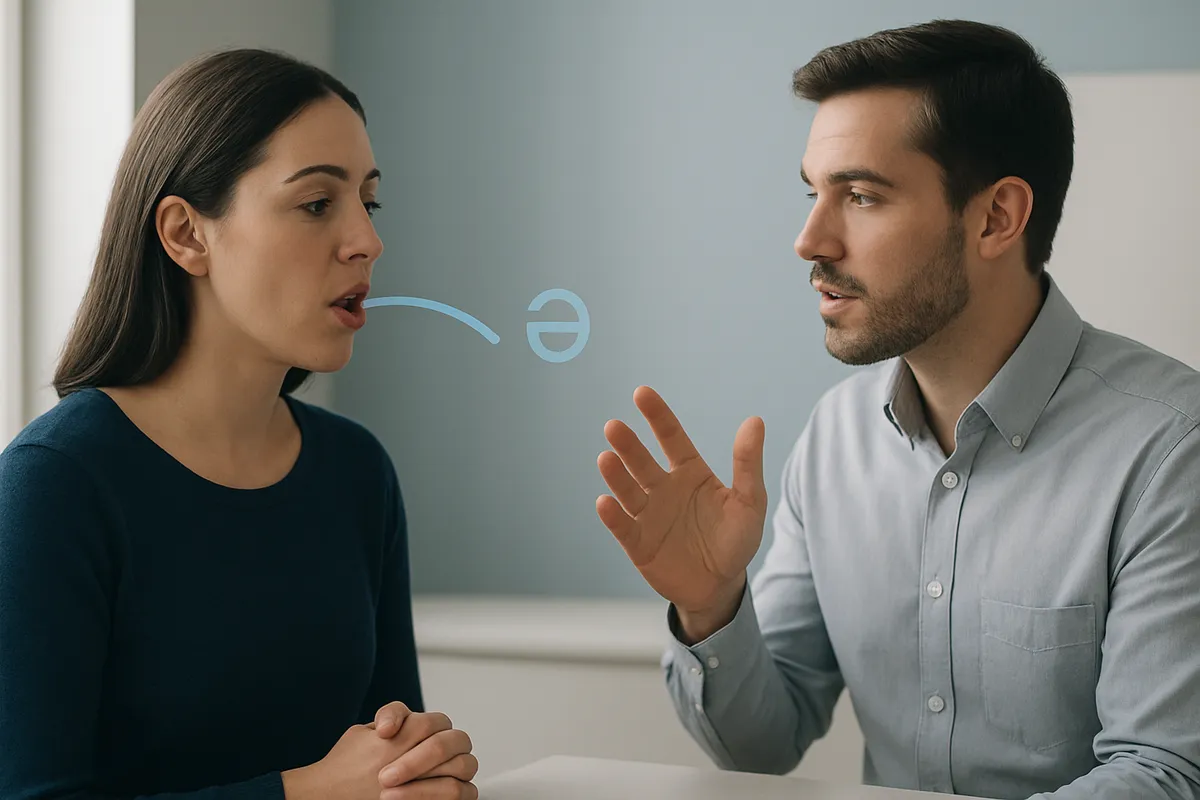
Understanding schwa sound american english is essential. The schwa sound (/ə/) is the relaxed, unstressed vowel heard in words like “ago,” “sofa,” and “about,” and it is the most frequent vowel sound in American English because unstressed syllables reduce to it constantly in natural speech. Non-native professionals who master schwa gain smoother rhythm, clearer connected speech, and more natural stress patterns, the core mechanics that separate technically correct English from fluent, native-like American speech. Training schwa requires active articulation practice, not just awareness, since most L1 sound systems don’t reduce vowels the same way.

Why Do Non-Native Professionals Struggle With the Schwa Sound in American English?
Advanced speakers struggle with the schwa sound American English relies on because their native sound systems never trained them to weaken unstressed vowels, so the ear misses it and the mouth over-articulates it.
What Is the Schwa Sound, and Why Is It So Common in American English?
Schwa (/ə/) is the relaxed, mid-central vowel that appears when a syllable loses stress and its full vowel quality collapses into a short, neutral “uh.” It shows up in words like “banana,” “problem,” and “photograph”, not because English speakers are being lazy, but because English is a stress-timed language that compresses unstressed syllables to keep sentence rhythm even [4]. Because most English words contain at least one unstressed syllable, schwa ends up as the most frequently occurring vowel sound in the language, appearing in common function words like “a,” “the,” and “was” as well as inside longer multisyllabic words [5]. This is particularly relevant for schwa sound american english.
This frequency is exactly why schwa carries so much weight in professional speech. Miss it consistently, and every sentence sounds mechanically even instead of naturally shaped.
How Does Your Native Language Sound System Interfere With Hearing and Producing Schwa Correctly?
Many languages, Spanish, Italian, Hindi, and Korean among them, assign full, consistent value to every vowel regardless of where stress falls in a word. Speakers of these languages transfer that habit directly into English, pronouncing each syllable with the same clarity they’d use in their first language. The result is over-pronunciation: unstressed syllables that should reduce to a quick “uh” instead get full vowel treatment, flattening the rhythm that native listeners expect.
The deeper issue happens before speech even starts. Many L1 sound systems filter schwa out during listening itself, so speakers often cannot consciously hear the reduction in native speech, which means they cannot yet reproduce it. The ear has to learn to detect schwa before the mouth can be trained to produce it, a perception-then-production sequence that generic pronunciation tips rarely address.
None of this reflects a gap in intelligence, grammar, or vocabulary. Professionals affected by this pattern often write flawless English and speak with strong technical fluency; what’s missing is a pronunciation and phonetics pattern that was simply never taught explicitly. At work, that gap compounds, speech comes across as overly formal, choppy, or foreign, even when every word choice and grammatical structure is correct.
How Does Schwa Reduction Affect Word Stress, Rhythm, and Connected Speech?
Schwa reduction sets the timing of American speech: stressed syllables anchor the rhythm while unstressed syllables compress toward /ə/, keeping sentences moving at an even pace.
American English is stress-timed, not syllable-timed [4]. That means the intervals between stressed syllables stay roughly equal, regardless of how many unstressed syllables sit between them. To make that timing work, unstressed vowels shrink toward the schwa sound, the language’s most frequent vowel [4][5], produced with minimal muscular effort and heard in words as different as “sofa,” “again,” and “problem” [5]. Professionals who studied grammar and vocabulary in a classroom setting rarely trained this mechanism directly, so their speech muscles default to giving every syllable equal weight. When considering schwa sound american english, this point stands out.
How Does Schwa Appear in Word Reductions and Connected Speech Patterns?
Function words like “to,” “of,” “and,” and “for” collapse toward schwa in fast connected speech because they carry grammatical weight, not meaning weight. A native speaker saying “give me a cup of coffee” reduces “of” to a near-silent /ə/, letting “coffee” carry the stress. This is the mechanism that makes fluent English sound connected rather than clipped into separate words. Skipping that reduction, pronouncing “of” as a full, unreduced vowel every time, is one of the clearest markers of a non-native rhythm pattern, even when every word is grammatically correct.
This is where the schwa sound american english relies on for its natural flow becomes a training issue, not just a listening issue. Students need to physically produce the reduced vowel, not just recognize it when they hear it.
Why Does Schwa Mastery Matter for Sentence Rhythm, Intonation, and Natural Speech Flow?
Failing to reduce unstressed syllables creates syllable-timed rhythm, and native listeners often perceive that pattern as slow, robotic, or overly formal, regardless of vocabulary accuracy or grammar. Every syllable competing for equal stress leaves no contrast for the ear to latch onto. Correct schwa reduction solves this by clearing space: when unstressed syllables shrink, stressed syllables and pitch changes stand out, and that contrast is exactly how American English signals emphasis, new information, and intent.
The effect runs both directions in the workplace. Professionals who don’t produce reduced forms sound deliberate in presentations. Professionals who don’t recognize reduced forms in others’ speech lose words during fast meetings, client calls, or shift handoffs, because contractions like “gonna,” “wanna,” or reduced “and” never register as the words they represent. Training schwa production and schwa recognition together closes both gaps at once, a distinction Prof. Alex addresses directly in MyAccentWay’s sentence practice and intonation training stage, where students drill reduction inside real sentence contexts rather than isolated word lists.
What Is the Difference Between Schwa and Other Reduced Vowels in American English?
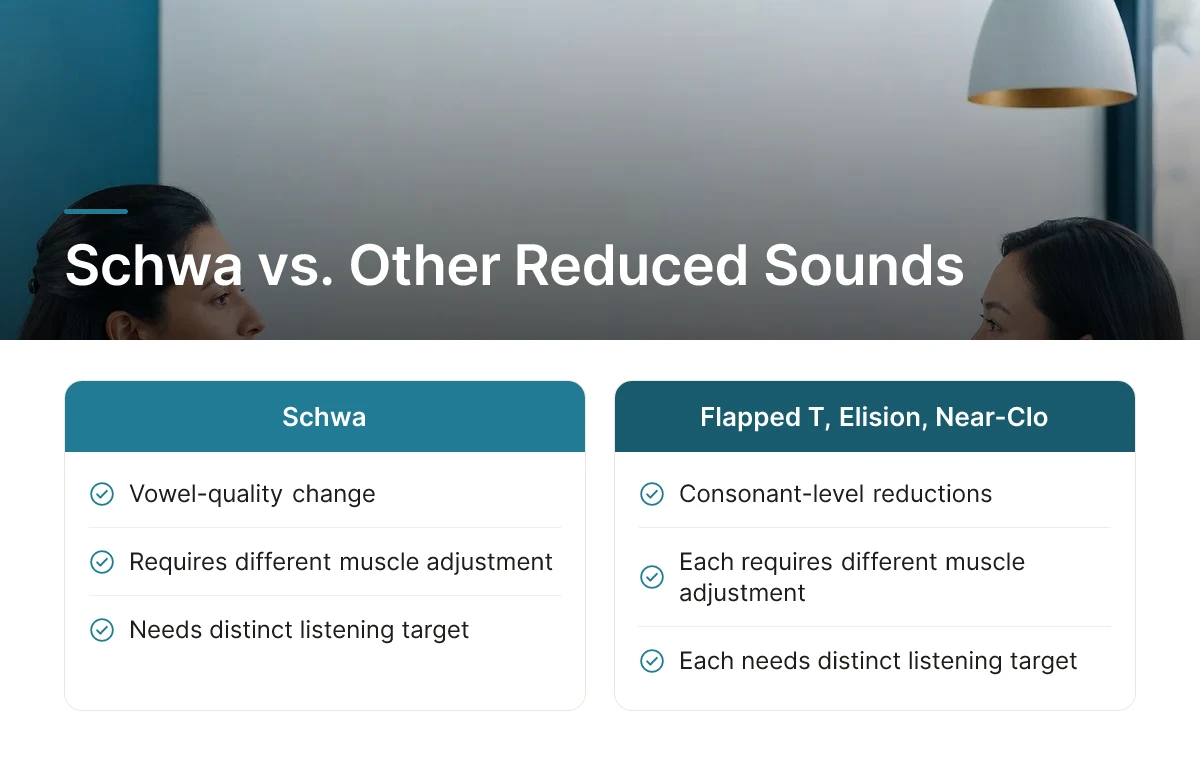
Schwa is a vowel-quality change, while flapped T and elision are consonant-level reductions, treating them as one category is why many professionals guess instead of correcting the right sound.
Non-native professionals working on the schwa sound american english learners struggle with often lump every “quick” or “swallowed” sound into a single mental bucket labeled reduction. That habit backfires. Schwa, near-close unstressed vowels, flapped consonants, and elision are four distinct phenomena, each requiring a different muscle adjustment and a different listening target.
How Do You Distinguish Schwa From Other Unstressed Vowels and Reduced Sounds in Connected Speech?
Schwa /ə/ is a mid-central, neutral vowel, but not every unstressed vowel in American English collapses to schwa. Some unstressed syllables reduce instead to a near-close vowel closer to /ɪ/. Compare “roses” and “Rosa’s”: both end in an unstressed syllable, but many speakers produce the final vowel in “roses” with a slightly higher, fronter quality than the pure schwa heard in “Rosa’s” [5]. The difference is subtle to the ear but matters for accuracy, students who assume every unstressed vowel is identical end up flattening word endings that actually carry a different vowel color, which can make plurals, possessives, and verb endings sound blurred together.
What Role Does Schwa Play Compared to Other Reduction Patterns Like Flapped T or Elision?
Schwa changes a vowel’s quality; flapped T and elision change or delete consonants and syllable boundaries instead. These are separate systems working at the same time in fluent speech, not variations of the same rule. Take the word “water”: the middle consonant becomes a quick flap (closer to a fast “d” than a crisp “t”), and the final syllable often reduces toward a near-schwa vowel, two different reduction types stacked in one word. Now compare “rock ‘n roll,” where “and” loses its vowel and most of its consonant structure entirely, shrinking to “‘n.” That is elision, a deletion pattern, not a vowel-quality shift, and it has nothing to do with schwa [4]. For those exploring schwa sound american english, this matters.
Confusing these categories creates two opposite errors. Some students over-generalize and reduce vowels that should stay clear, making their speech sound mumbled. Others miss consonant reductions entirely, keeping every T crisp and every word fully separated, which sounds stiff and overly formal for natural American rhythm [2]. In Interactive Accent Training sessions, Prof. Alex isolates each pattern separately, schwa placement, flapping, and elision, so students train the correct articulator movement and the correct listening cue for each one, rather than applying a single blurry rule to all of them.
How Can You Train Your Speech System to Produce Schwa Naturally in Real Conversation?
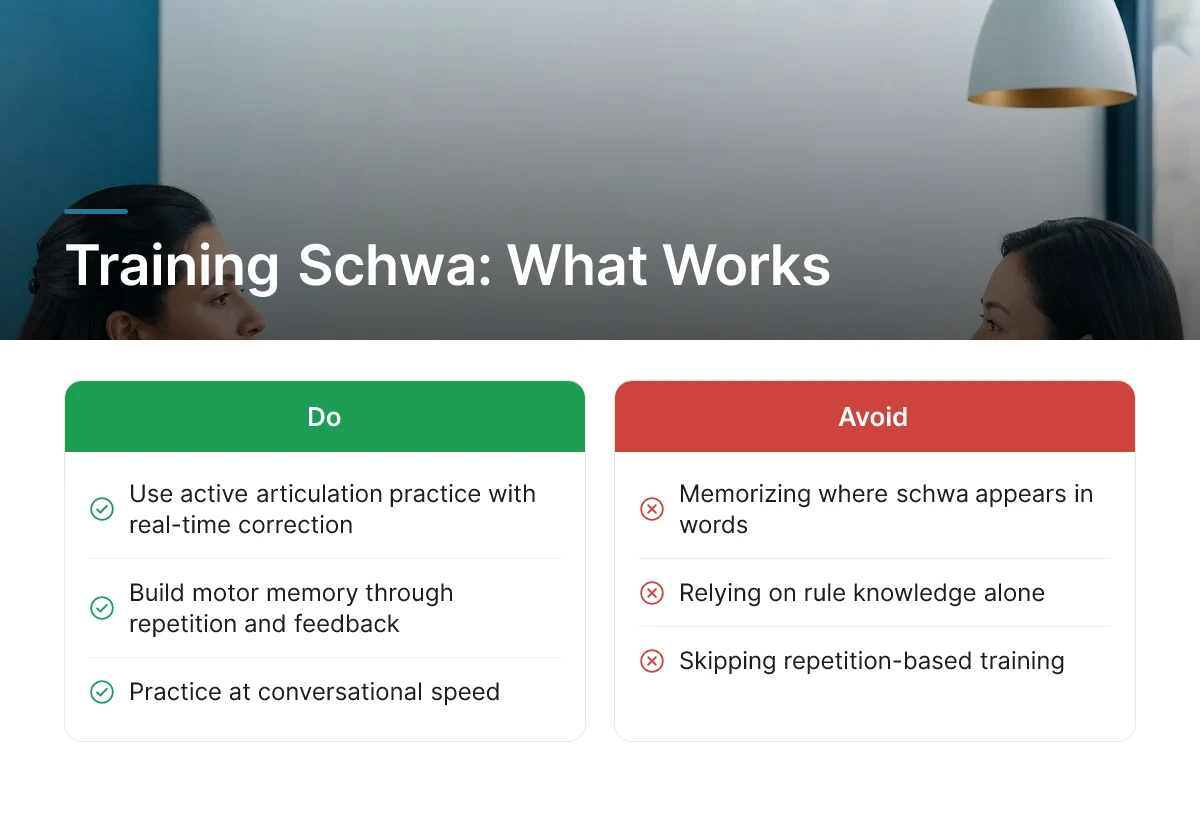
Training the speech system to produce schwa automatically requires active articulation practice under real-time correction, not memorizing where schwa appears in a word.
Knowing that the second syllable of “photograph” reduces to schwa does not change how a speaker’s tongue and jaw move when they say the word at conversational speed. Rule knowledge lives in the analytical part of the brain; automatic pronunciation lives in motor memory built through repetition and feedback. Many advanced professionals can explain the schwa sound American English speakers use in every unstressed syllable, yet their own speech still gives each vowel full weight, because no one corrected the muscle pattern while they were speaking. Closing that gap is the actual work of accent training, and it happens through guided practice, not description.
What Practical Exercises and Contrastive Listening Drills Help You Master Schwa Production?
Contrastive listening drills isolate the full-vowel and reduced-schwa versions of the same word so the ear learns the difference before the mouth attempts it. A word like “can” spoken as a modal auxiliary (“I can go”) reduces almost entirely to schwa, while the same spelling stressed for emphasis (“Yes, I CAN”) holds its full vowel quality [4]. Hearing both versions back-to-back, repeatedly, trains the ear to recognize reduction as a real, expected pattern rather than sloppy speech.
Once the ear can reliably detect the contrast, production practice follows: the student attempts both versions, gets immediate correction, and repeats until the reduced form becomes the default in unstressed positions. Skipping the listening stage and jumping straight to production tends to produce inconsistent results, since the speaker cannot self-correct what they cannot yet hear.
How Does Interactive Accent Training and 2D Sound Motion Technology Improve Schwa Articulation and Automaticity?
This listen-compare-speak-adjust cycle is the foundation of Prof. Alex’s Interactive Accent Training at MyAccentWay. Instead of repeating after a recording, students work live, 1-on-1, with Prof. Alex evaluating their vowel reduction in real time and correcting it as it happens, a process that builds automatic habits faster than self-guided repetition alone.
Precise articulation also depends on knowing exactly what the tongue, jaw, and lips are doing during reduction. Prof. Alex uses Interactive 2D Sound Motion Simulators to train that movement directly, the same simulation-based approach demonstrated in the Interactive 2D Sound Motion Simulator for the American unvoiced [t]. Applied to schwa, students follow a simulated movement pattern rather than guessing at mouth position, which shortens the distance between understanding a sound and producing it correctly. This directly impacts schwa sound american english outcomes.
This work fits into MyAccentWay’s four connected training stages. American sound articulation training stabilizes the schwa vowel itself; phonetic exercises make reduction automatic in word-level practice; sentence practice builds it into natural rhythm and intonation; and paragraph practice carries it into presentation-style delivery for meetings, interviews, and public speaking.
How Does Schwa Mastery Improve Clarity and Confidence in Workplace Presentations and Client Calls?
Accurate schwa reduction produces natural rhythm, and natural rhythm is what lets American colleagues and clients follow your speech without straining to decode it. When every vowel gets full stress, sentences sound choppy and mechanical, forcing the listener to work harder to extract meaning. Once the unstressed syllables fall into place, speech flows the way listeners expect, and comprehension becomes effortless rather than a task.
What Communication Outcomes Improve When Non-Native Professionals Master Schwa and Connected Speech?
Meetings, interviews, and client calls are judgment moments, and most judgments about clarity and fluency form within the first few seconds of speech. Unreduced vowels are among the fastest tells of a heavy accent, because they disrupt the stress-timed rhythm that American listeners rely on to track which words carry meaning [4]. A professional who stresses every syllable evenly may have flawless grammar and vocabulary, yet still get asked to repeat themselves, lose control of a call, or come across as less confident than they actually are. Correcting the schwa sound american english speakers rely on constantly changes that first impression: listeners stop working to decode the accent and start focusing on the message itself.
How Does Schwa Training Fit Into a Complete American Accent Training Program for Professional English Speakers?
Schwa work is not treated as an isolated fix inside the MyAccentWay Accent Program. It sits inside American sound articulation training and connects directly to Cognitive Accent Training, which builds awareness of how a student’s native sound system shapes their English pronunciation habits in the first place. Understanding why a Mandarin, Russian, or Spanish sound pattern resists vowel reduction makes the correction stick rather than fade after a session.
Real student proof shows how this plays out across different language backgrounds. Tian’s pronunciation evaluation documents rhythm and clarity gains for a Mandarin speaker, and Vlad’s pronunciation evaluation shows similar progress for a Russian speaker working through the same structured process. Both are part of the broader American accent training before-and-after results collection that MyAccentWay maintains as documented evidence, not marketing promises.
Outcomes vary by student and starting point, nobody should expect identical timelines or identical results. What the before-and-after evidence shows consistently is direction: clearer rhythm, easier listening comprehension, and steadier confidence in real professional situations.

Frequently Asked Questions
Is schwa the most common vowel sound in American English?
Yes, schwa is widely recognized as the most frequent vowel sound in spoken English [4]. It appears in unstressed syllables across everyday words like “a,” “the,” “about,” and “family” [5], and shows up in nearly every multisyllabic word professionals use in meetings, presentations, and patient conversations. Its frequency is exactly why untrained schwa production creates a persistent, recognizable accent pattern. This is particularly relevant for schwa sound american english.
Can adult professionals learn to produce schwa naturally, or is it too late after childhood?
Adult professionals can retrain schwa production at any career stage, this is not a skill limited to childhood language acquisition. Schwa is considered the easiest vowel sound to produce physically [4], since it requires a relaxed, neutral tongue and jaw position rather than a precise shape. What adults need is structured, guided practice that rebuilds the habit of reducing unstressed syllables automatically, which is exactly what Interactive Accent Training with Prof. Alex targets through American sound articulation work.
Does every unstressed syllable in American English reduce to schwa?
Not every unstressed syllable becomes schwa, but a large share of them do in fluent, connected speech. Schwa can sound like /ŭ/ in words such as “ahead” or /ĭ/ in words like “woman” and “mountain” [5], and nearly any vowel letter can represent it in writing [4]. The pattern is governed by stress placement, not spelling, which is why written English gives few reliable clues.
How long does it typically take to build automatic schwa reduction into natural speech?
Most professionals need consistent, guided practice over several weeks to make schwa reduction automatic rather than a conscious effort. Timelines vary by starting accent pattern, native-language background, and how often a student practices between sessions. MyAccentWay’s four-stage structure, American sound articulation, phonetic exercises, sentence practice and intonation training, then paragraph practice with presentation-style delivery, is designed to move schwa production from an isolated sound drill into natural, connected speech used in real meetings and presentations, with progress typically becoming noticeable within the program’s structured session sequence.
Do regional American accents use schwa differently?
Regional American accents can shift how strongly schwa is reduced, but the underlying stress-timed rhythm stays consistent nationwide [2]. Some dialects reduce unstressed vowels more aggressively than others, affecting speed and vowel color. MyAccentWay trains students toward General American pronunciation, the neutral, widely understood standard used in most U.S. professional and business settings.
Conclusion
Schwa reduction is not a minor pronunciation detail, it is the rhythmic engine behind natural-sounding American English, and mispronouncing it flattens speech into something harder for colleagues and patients to follow. The fix is not more vocabulary or grammar study; it is retraining how your speech organs handle unstressed syllables. That retraining happens most effectively through guided, interactive practice rather than passive listening.
Start by reviewing the American accent training before-and-after results to hear what structured schwa and rhythm training sounds like in real student speech, then book a 1-hour Interactive American Accent Training Session with Prof. Alex.
Sources & References
- Schwa Explained & How to Teach it | Phonics Hero
- Meet the Schwa, the Best Friend You Never Knew You Had
- Schwa, Logic Of English
Recommended Articles
Explore more from our content library: