
You’re in the middle of a high-stakes presentation when you realize that saying “I finished the report” sounded more like a three-syllable word than a professional statement. Learning how to pronounce past tense ‘-ed’ endings correctly is a core part of American accent training for international professionals who have mastered grammar but still struggle with the physical mechanics of speech. I’m Prof. Alex Obskov, Ph.D. Linguist, and I understand how frustrating it is when your hard-earned expertise feels overshadowed by small phonetic hurdles. You’ve put in the work to lead, and your speech clarity should reflect that authority.
Mastering the three distinct sounds of /t/, /d/, and /id/ is the fastest way to sound more fluid and confident in American English. Whether you’re focused on accent reduction or simply want to reduce the cognitive load of speaking during meetings, understanding these phonetic patterns is essential. In this guide, I’ll show you how to move beyond robotic pronunciation using a science-backed method. We’ll explore the linguistic rules behind these endings and provide practical tools, including a look at how 2D Sound Motion Technology helps you visualize the correct mouth movements for every word.
Key Takeaways
- Identify the three distinct phonetic paths—/t/, /d/, and /ɪd/—to understand exactly how to pronounce past tense ‘-ed’ endings in any professional context.
- Master the physical mechanics of the alveolar ridge to ensure your transitions between sounds are crisp, clear, and effortless.
- Avoid the common “over-enunciation trap” that leads to robotic speech and learn to maintain your authority by never dropping word endings.
- Leverage 2D Sound Motion Technology to visualize internal mouth movements, helping you internalize American accent training faster than traditional listening methods.
The Phonetic Science of Past Tense ‘-ed’ Endings
The way we write English often hides the way we actually speak it. When learning how to pronounce past tense ‘-ed’ endings, you must look past the letters and focus on the physics of sound. In American accent training, we categorize these endings into three distinct phonetic paths: /t/, /d/, and /ɪd/. This variation isn’t random. It’s governed by the principle of phonetic economy. This means your mouth naturally seeks the path of least resistance during speech. It’s much easier for your articulators to transition between sounds that share similar physical properties. Understanding the phonetic science of past tense endings helps you see that these shifts are practical adaptations rather than arbitrary rules.
The primary driver behind which sound you use is the state of your vocal cords. If the base verb ends in a voiceless sound, like the “k” in “work,” your vocal cords are still. To keep things efficient, the ‘-ed’ remains voiceless, resulting in a /t/ sound. Conversely, if the verb ends in a voiced sound where your vocal cords vibrate, like the “n” in “plan,” the ending becomes the voiced /d/. Prof. Alex Obskov, Ph.D. Linguist, teaches students that mastering this isn’t about memorizing a grammar table. It’s about building a mechanical habit through physical awareness and targeted repetition.
Why Spelling is Deceptive in American English
Non-native speakers often fall into the “one-to-one” spelling trap. You see the letters “e” and “d” and your brain wants to give each one its own syllable. In American English, the suffix is a shapeshifter. It adapts entirely to the consonant sound that comes right before it. If you focus on the letters, you’ll likely over-enunciate. This makes your speech sound choppy or “robotic.” Success in accent reduction comes from training your ears to hear the final sound of the root verb rather than looking at how it’s spelled on a presentation slide.
The Goal: Speech Clarity vs. Perfection
Professional presence is built on clarity, not the pursuit of a “perfect” accent. When you use the correct ‘-ed’ ending, you significantly reduce the cognitive load for your listeners. They don’t have to pause to translate “work-ed” into “worked” in their minds. This allows your audience to stay focused on your insights and your leadership. Viewing American accent training as a professional tool empowers you to communicate with precision. It’s about ensuring your message is heard exactly as you intended.
The Three Fundamental Rules for ‘-ed’ Pronunciation
To master how to pronounce past tense ‘-ed’ endings, you need a reliable diagnostic tool that works in real time. The “vocal cord vibration test” is the most effective way to identify which phonetic path to take. Simply place two fingers on your throat while saying the base form of a verb. If you feel a distinct “buzz” or vibration, the sound is voiced. If you only feel a rush of air, it’s voiceless. This simple mechanical check determines which of the following three rules you should apply to maintain speech clarity during your next meeting.
Mastering the Voiceless /t/ Ending
When the base verb ends in a voiceless consonant, the suffix becomes a crisp /t/ sound. In professional speech, this /t/ often requires a slight aspiration, a tiny puff of air, to be heard clearly. High-frequency professional verbs like asked, fixed, and produced all follow this rule. A common pitfall for many professionals is adding an extra syllable where it doesn’t belong. For instance, “fixed” should be one sharp syllable, never “fix-ed.” Mastering this specific sound is a core component of effective American accent training, as it prevents your speech from sounding heavy or unnatural.
The Smooth Transition of the Voiced /d/
If your vocal cords vibrate at the end of the base verb, the ending shifts to a voiced /d/. This sound is softer than the /t/ and allows for a smooth transition into the next word. Consider verbs like delivered, analyzed, and received. The goal here is fluidity. Instead of stopping abruptly after the verb, let the vibration of the /d/ carry you into the following vowel or consonant. This creates the natural rhythm characteristic of American English. Practicing this “linking” effect helps you sound more composed and less robotic when presenting complex data or project updates.
When to Add the Extra Syllable (/ɪd/)
The only time you should add a full extra syllable to the word is when the base verb already ends in a /t/ or /d/ sound. This is Rule 3. Because it’s physically difficult to pronounce two “t” or “d” sounds back-to-back, the mouth inserts a short vowel buffer, resulting in an /ɪd/ sound. For executives and leaders, this rule frequently applies to high-stakes verbs such as evaluated, coordinated, and distributed. Prof. Alex Obskov, Ph.D. Linguist, emphasizes that recognizing these “stopping points” is essential for maintaining a professional presence. It ensures you don’t accidentally swallow the past tense marker, which can lead to grammatical misunderstandings in high-stakes environments.
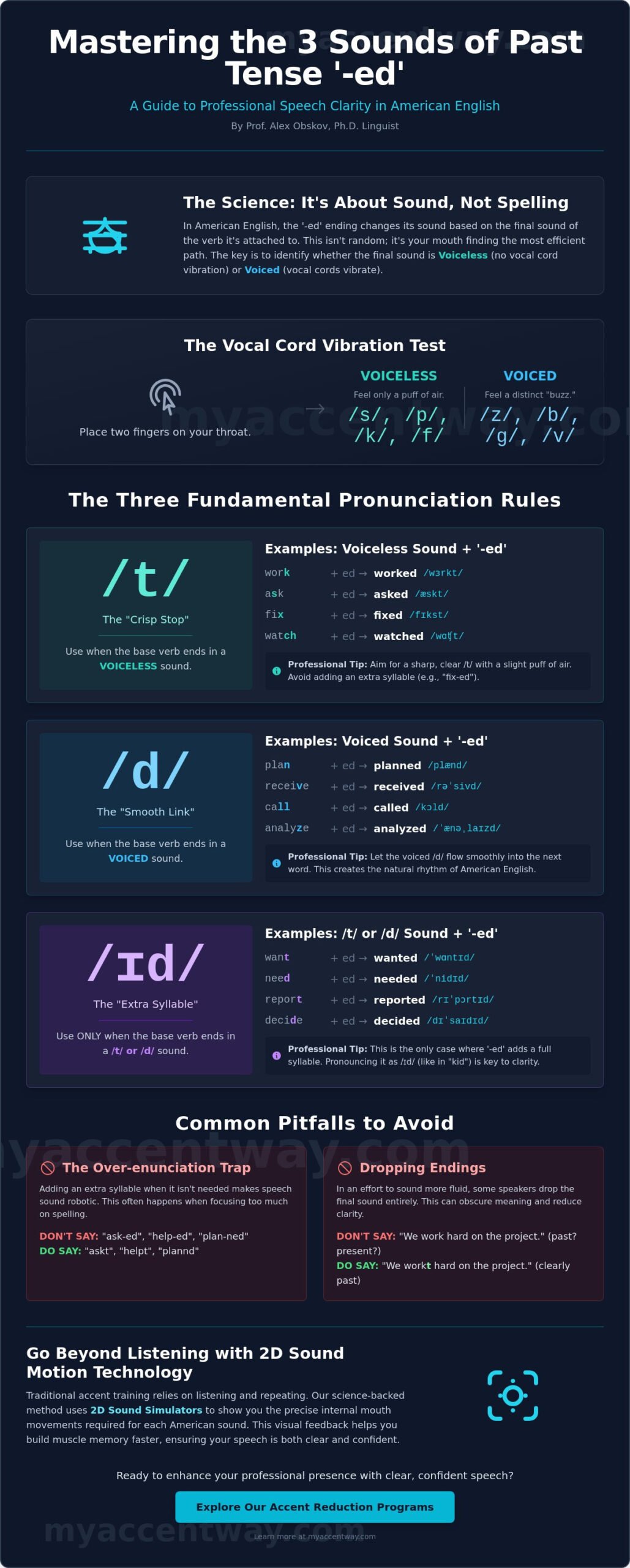
Voiced vs. Voiceless: The Physical Mechanics of Speech
Understanding the logic behind the rules is only the first step. To truly master how to pronounce past tense ‘-ed’ endings, you have to treat your mouth like an instrument. Sound production is a physical act that requires precise coordination between your breath, your vocal folds, and your articulators. One of the most important players in this process is the alveolar ridge. This is the small, bony bump located directly behind your upper front teeth. Whether you’re producing a /t/ or a /d/, your tongue must strike this specific spot with clarity and intention. If your tongue placement is lazy or slightly off, the ending will sound muffled or unclear.
You aren’t just memorizing grammar. You’re training your muscles. Prof. Alex Obskov, Ph.D. Linguist, emphasizes that this mechanical habit is what separates hesitant speech from professional presence. When you focus on the physical sensation of the tongue hitting the ridge, you build the muscle memory needed to switch between sounds without thinking. This shift from cognitive load to physical habit is the cornerstone of effective American accent training. It’s about moving the work from your brain to your body.
The Anatomy of a Voiced Consonant
Voiced consonants are produced when your vocal folds vibrate as air passes through them. If a verb ends in a voiced sound such as /b/, /g/, /v/, /z/, /m/, /n/, or /l/, your “voice engine” is already active. To maintain speech clarity, the ‘-ed’ ending adopts this vibration and becomes a /d/. Many professionals struggle with “de-voicing” at the end of a sentence. This occurs when you drop the vibration too early, making a word like “managed” sound like it ends in a weak /t/. In our accent reduction sessions, we focus on keeping that vibration consistent. This ensures your listener clearly hears the past tense marker, which is vital for accurate reporting in high-stakes meetings.
The Mechanics of Voiceless Airflow
Voiceless sounds are made of pure air, with no vibration from the throat. Sounds like /p/, /k/, /f/, /s/, /sh/, and /ch/ fall into this category. When you add the past tense suffix to these, the ending stays voiceless, resulting in a crisp /t/. This sound requires a tiny burst of air known as aspiration. It’s subtle but necessary. If you omit this final /t/, you might accidentally change the meaning of your sentence. “I check the files” sounds very different from “I checked the files.” Without that final mechanical “pop” of air, your audience may lose the timeline of your achievements. Mastering these physical mechanics is a transformative step toward professional confidence.
Common Pitfalls for Non-Native Professionals
Identifying how to pronounce past tense ‘-ed’ endings is just the beginning of your journey toward speech clarity. The real challenge lies in avoiding the subtle errors that can signal a lack of confidence in a boardroom. One of the most frequent hurdles is the “Over-enunciation Trap.” This occurs when a speaker treats every word as if it follows the /ɪd/ rule. Pronouncing “worked” as “work-ed” or “planned” as “plan-ned” creates a rhythmic mismatch. It sounds robotic and forces your listener to work harder to piece together your meaning. This extra effort can detract from the impact of your ideas during a presentation.
On the other end of the spectrum is the issue of dropping the ending entirely. In leadership, precision matters. If you fail to enunciate the final /t/ or /d/, your audience may perceive you as uncertain or grammatically inconsistent. It can even lead to confusion about whether an action is completed or ongoing. To address these nuances, many leaders turn to American Accent Training for U.S. Professionals, which provides a science-backed framework for achieving professional clarity.
Adjectives vs. Past Tense Verbs
English is full of linguistic fossils that don’t follow standard phonetic rules. This is especially true for specific adjectives. For instance, you “learned” (one syllable) a new skill, but you are a “learned” (two syllables) scholar. Similarly, words like “wicked,” “naked,” or “blessed” often require that extra /ɪd/ sound when used as adjectives, even if they don’t end in “t” or “d.” In high-stakes corporate communication, knowing these exceptions prevents small stumbles that might momentarily distract your audience from your core message. Prof. Alex Obskov, Ph.D. Linguist, teaches that identifying these shifts is part of the “art” of communication that complements the “science” of sounds.
Overcoming the Syllable Error
The “Ghost Syllable” phenomenon is a common habit where an extra vowel sound is inserted between the root verb and the suffix. Saying “ask-ed” instead of “asked” disrupts the natural flow of American English. This error usually stems from a desire to be clear, but it actually has the opposite effect. It increases the listener’s cognitive load. To eliminate this, we use rhythmic drills that focus on the “one-beat” nature of voiced and voiceless endings. By internalizing the correct syllable count, you ensure your speech has the professional cadence your role demands. If you’re ready to refine these subtle details, consider exploring our comprehensive accent reduction program.
Mastering ‘-ed’ with 2D Sound Motion Technology
Traditional methods of learning how to pronounce past tense ‘-ed’ endings often rely on listening and repeating. While audio feedback is valuable, it doesn’t reveal the complex internal mechanics of the mouth. This is where 2D Sound Simulators for American Sounds revolutionize the learning process. By providing a clear visual representation of sound production, this technology allows you to see exactly what is happening inside the oral cavity. Prof. Alex Obskov, Ph.D. Linguist, integrates these advanced tools into his coaching method to bridge the gap between theoretical knowledge and physical execution.
The Power of Visual Feedback
Watching a coach’s face can only tell you so much. Most of the action required for speech clarity happens out of sight. 2D Sound Motion Technology provides a transparent view of the articulators in motion. You can observe the precise moment the tongue tip makes contact with the alveolar ridge for a /t/ sound or how it maintains a softer touch for the voiced /d/. This visual data is crucial for professionals who want to move past the frustration of being misunderstood. Seeing the ‘invisible’ actions of the vocal cords and tongue helps transition your skills from a conscious effort to subconscious mastery. You stop guessing and start knowing exactly how to shape every sound.
Practical Exercises with 2D Simulators
Our sound-by-sound approach ensures that you don’t just learn the rules; you master the movements. Using the simulators, you can practice high-stakes professional scripts while receiving real-time visual guidance. This method is particularly effective for distinguishing between the /t/, /d/, and /ɪd/ endings in rapid conversation. You might practice a project update, ensuring that “managed,” “launched,” and “updated” each receive their correct phonetic treatment. This targeted practice builds the confidence needed for high-pressure meetings and leadership roles.
If you’re ready to enhance your professional presence through a science-backed method, we invite you to explore our comprehensive American accent training program. By combining expert linguistic coaching with proprietary technology, we help you achieve the clarity your career deserves. Your cultural identity is an asset. Our goal is to give you the tools to express your expertise with unwavering confidence in any American professional setting.
Elevate Your Professional Presence through Phonetic Mastery
Mastering the physical mechanics of speech is a transformative step for any international professional. By understanding the science of vocal cord vibration and the precise placement of the tongue against the alveolar ridge, you move beyond simple grammar rules. You’ve learned that knowing how to pronounce past tense ‘-ed’ endings is about creating a fluid, rhythmic flow that reduces the cognitive load for your audience. This clarity ensures your leadership and expertise remain the primary focus of every conversation. You’ve moved from the “over-enunciation trap” to a place of sophisticated, science-backed communication.
My method combines high-level linguistic expertise with proprietary 2D Sound Motion Technology to help you achieve lasting results. Whether you are addressing a boardroom in Austin, Texas, or leading a global team online, your speech should reflect your professional authority. I invite you to Explore the Accent Reduction Program and 2D Sound Simulators to see how visual feedback can accelerate your progress. Let’s work together to refine your communication and unlock new levels of confidence in your career. You have the expertise; now it’s time to ensure your voice carries it with precision and warmth.
Frequently Asked Questions
Why do I pronounce ‘ed’ as a separate syllable in every word?
This habit often stems from a desire for clarity by following English spelling too literally. In many languages, letters have a consistent one-to-one relationship with sounds. However, in American English, the suffix only adds a syllable after the sounds ‘t’ or ‘d’. Training your brain to focus on the final sound of the root verb rather than the letters is a central part of American accent training. It helps you avoid the choppy rhythm that can make your speech sound robotic.
Is there a trick to remember if a sound is voiced or voiceless?
The most effective mechanical trick is the “throat vibration test.” Place your hand on your throat and produce the final sound of the base verb. If you feel a distinct buzz, the sound is voiced; if you only feel a rush of air, it’s voiceless. Learning how to pronounce past tense ‘-ed’ endings depends entirely on this physical awareness. With consistent practice, this diagnostic check becomes a subconscious habit that ensures your speech remains clear and professional.
Can accent reduction coaching help me with these specific endings?
Yes, specialized accent reduction coaching provides the targeted, real-time feedback required to master these phonetic nuances. Prof. Alex Obskov, Ph.D. Linguist, uses a science-backed, sound-by-sound method to address these specific hurdles. By utilizing 2D Sound Motion Technology, you can visualize the internal movements of your mouth. This ensures you aren’t just memorizing grammar rules but are physically training your speech muscles to produce sounds with greater precision and confidence.
Do Americans always follow these rules in fast conversation?
These rules are fundamental to the phonetic structure of American English and are followed even in rapid, casual conversation. While sounds may link to the next word, the distinction between /t/, /d/, and /ɪd/ remains consistent. Skipping these endings can lead to confusion about the timeline of your actions. Maintaining these phonetic markers is vital for speech clarity in both informal chats and high-stakes professional environments across the United States.
Will mastering ‘-ed’ endings make me sound more professional?
Mastering these endings significantly enhances your professional presence by improving your speech rhythm and overall clarity. When you correctly apply the rules for how to pronounce past tense ‘-ed’ endings, you sound more fluid and composed. It reduces the cognitive load on your listeners, allowing them to focus entirely on your expertise rather than your pronunciation. This precision projects an image of authority and leadership in any professional setting.
What is the difference between accent reduction and accent modification?
These terms are often used interchangeably to describe the systematic process of improving speech clarity. Accent reduction traditionally focuses on minimizing phonetic patterns that may hinder understanding in a new environment. Accent modification is a more modern term that emphasizes adapting your speech for better communication while fully respecting your cultural identity. Both approaches are core elements of American accent training designed to help international professionals achieve their personal and career communication goals.
Disclaimer – American Accent Program
The American Accent Program available through Visit Program Website
is an educational and coaching service designed to support pronunciation, accent reduction, and spoken English fluency. All training materials, including lessons, exercises, audio content, visual simulations, coaching methods, and digital resources, are the intellectual property of American Accent Program, LLC and are protected by applicable copyright and intellectual property laws.
By using this website and participating in the program, you acknowledge that all content is provided for personal, non-commercial, educational use only. Users are granted a limited, non-transferable license to access the materials strictly for individual learning purposes. Redistribution, reproduction, recording, modification, sharing, or commercial use of any program content without prior written consent is strictly prohibited.
The program may include live coaching sessions, digital tools, and instructional materials intended to improve pronunciation and communication skills. However, individual results may vary, and no specific level of fluency, accent reduction, or communication outcome is guaranteed.
The American Accent Program and its instructors do not provide medical, therapeutic, or clinical speech-language pathology services. All training is intended for educational purposes only.
By accessing or using the program, you agree to comply with all applicable terms, including the platform’s Terms of Use and Course Policies, and acknowledge that misuse of materials may result in termination of access without refund.
Discover more from MyAccentWay
Subscribe to get the latest posts sent to your email.