
To master how to use pitch in american english, you must vary the frequency of your voice by jumping to a higher pitch on the stressed syllables of key words and using a falling glide at the end of statements. This strategic movement of the voice is a fundamental skill in American accent training, as it replaces a monotone rhythm with the melodic clarity expected in U.S. professional settings. Achieving this balance is essential for effective accent reduction and ensures that your listeners remain engaged with your message.
At MyAccentWay, I guide international professionals who often find that their expertise is overlooked because their speech sounds flat or robotic. As Prof. Alex Obskov, Ph.D. Linguist, I’ve developed a science-backed method to help you command authority in meetings while respecting your cultural identity. Our goal is personal growth and speech clarity, providing you with the tools to project confidence and lead with impact.
This article provides a practical framework for understanding the four levels of pitch and how to emphasize the right words in any sentence. We’ll also discuss how 2D Sound Motion Technology allows you to visualize these invisible vocal patterns. By refining your intonation, you can transform your voice into a strategic asset for your career success.
Key Takeaways
- Distinguish between individual pitch notes and overall sentence intonation to create a more melodic and natural speaking style.
- Discover how to use pitch in american english across four distinct levels to move away from robotic, monotone speech patterns.
- Master the art of pitch emphasis on content words to ensure your most important ideas stand out during high-stakes presentations.
- Use specific rising and falling pitch signals at the end of sentences to provide clear cues to your listeners and improve professional clarity.
- Leverage 2D Sound Motion Technology to visualize the physical movements behind pitch shifts for a more effective accent reduction experience.
Understanding Pitch: The Secret to American English Intonation
In the study of linguistics, pitch refers to the perceived frequency of your voice. It’s the “highness” or “lowness” of a sound. While many professionals focus on vocabulary or grammar, the real secret to clarity lies in the melody. Pitch functions as the individual notes you hit, while intonation represents the entire musical phrase. American English is a stress-timed language, meaning it relies heavily on these frequency shifts to highlight meaning. Without these variations, your speech becomes a flat line, leading to the common “monotone trap.”
Many non-native speakers fall into this trap because they’re concentrating intensely on technical accuracy. Unfortunately, a flat pitch does more than just sound boring. It often signals a lack of emotional intelligence or leadership presence to a listener. In a professional setting, people subconsciously equate a varied pitch with engagement and authority. Learning how to use pitch in american english helps you avoid sounding detached, ensuring your colleagues stay focused on your expertise rather than your delivery.
Why Pitch Matters for Speech Clarity
Pitch acts as a highlighter for your listener’s brain. When you raise your pitch, you alert the listener that the information you’re sharing is new or vital. This is a core component of American English intonation patterns, which guide the flow of conversation. Beyond just highlighting data, pitch shifts create a psychological connection. A dynamic voice suggests confidence and empathy, traits that are essential for commanding a room. It also serves a functional purpose; a simple rise in pitch at the end of a sentence can transform a statement into a question, preventing costly misunderstandings in fast-paced meetings.
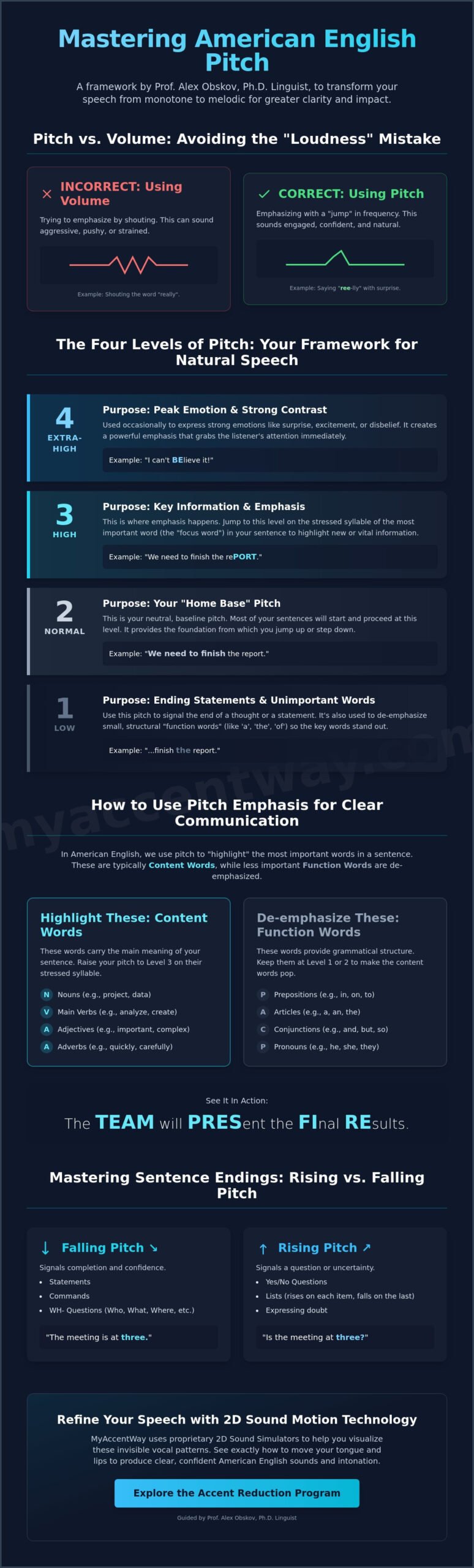
Pitch vs. Volume: Avoiding the “Loudness” Mistake
A common error I see in American accent training is the confusion between pitch and volume. Many professionals try to emphasize a word by speaking louder. This often backfires. Over-relying on volume can make you sound aggressive, pushy, or even physically tired to your audience. True emphasis in American English comes from a slight “jump” in frequency, not a blast of sound.
To feel the difference, try this simple exercise. Say the word “really” twice. The first time, shout it. Feel the strain in your throat. The second time, say it as if you’re surprised, letting the first syllable “ree” jump to a higher musical note while keeping your volume steady. That higher note is pitch. It’s a subtle shift, but it’s the difference between being heard and being truly understood. Mastering this distinction is a major step toward achieving the speech clarity required for high-level professional communication.
The Four Levels of Pitch: A Framework for Natural Speech
To move beyond a flat delivery, you need a structured way to visualize your voice. Linguists often use a four-level scale to map out understanding pitch in American English. Most standard communication happens within a predictable, three-note range. Expanding your reach into the fourth level occasionally adds the dynamic flair necessary for leadership. It turns your speech into a tool for engagement rather than a simple transmission of data.
When you understand how to use pitch in american english, you realize that your voice isn’t just a sound; it’s a system. This system allows you to categorize your range so you can intentionally choose where to land. This structure prevents the robotic feel often associated with non-native speech. By categorizing your voice into levels, you can command attention in a boardroom or connect more deeply during a one-on-one meeting.
Defining the 4 Basic Pitch Levels
- Level 1 (Low): Use this at the end of a statement. It signals that your thought is complete. It’s also useful for “dropping” unimportant function words like “of” or “the.”
- Level 2 (Normal): This is your “home” pitch. Most sentences begin here. It represents your neutral, baseline state and provides a foundation for the rest of your speech.
- Level 3 (High): This is where the magic happens. You jump to this level for the stressed syllable of your most important word. It provides immediate clarity and signals what the listener should remember.
- Level 4 (Extra High): Reserve this for extreme surprise or highlighting a massive contrast. In professional meetings, use it sparingly to show enthusiastic agreement or to emphasize a critical pivot in strategy.
Finding Your Optimal Pitch Range
Finding your baseline is the first step toward mastery. Hum a comfortable, middle-of-the-road note. This is usually your Level 2. From there, visualize a staircase. You start on the second step, jump up to the third for emphasis, and drop to the first to finish. This movement is a fundamental part of the method I teach at the American Accent Program. It keeps the listener’s ear tuned to your message. As a linguist, I always emphasize that these shifts should feel like a natural extension of your personality.
Maintaining vocal health is vital during this process. Don’t push your voice into a range that feels tight or forced. The transitions should be fluid, not jerky. If you find yourself straining, take a breath and reset to Level 2. Prof. Alex Obskov, Ph.D. Linguist, recommends practicing these shifts daily to build the muscle memory needed for speech clarity. If you’re ready to refine these levels with expert guidance, I invite you to explore our specialized 2D Sound Motion Technology to see these pitch changes in action. You can find tailored support through American accent training near me to ensure you’re using your voice effectively and safely.
How to Use Pitch Emphasis for Clear Communication
Understanding the mechanics of a frequency shift is essential for anyone learning how to use pitch in american english. Pitch emphasis occurs when you intentionally raise the frequency of your voice on a specific syllable. This isn’t a volume blast. It’s a musical jump. In my work as a linguist, I often see students struggle because they treat every word as equally important. This leads to a staccato rhythm that confuses listeners and dilutes your message.
American English relies on a hierarchy of sounds. Content words, like nouns, main verbs, and adjectives, are the pillars of your sentence. They deserve a Level 3 pitch to stand out. Function words, such as “the,” “of,” “to,” and “for,” are the glue. They should remain at a Level 1 or 2. By keeping these little words low and fast, you create the contrast necessary for speech clarity. This distinction allows your listener to focus on the information that actually matters.
Consider the flow of information in a professional conversation. When you introduce a new concept, your pitch should rise to signal its importance. Once that concept becomes old information, your pitch drops back down. This subtle shift tells your audience exactly what to prioritize. It prevents you from sounding monotone while ensuring your most critical points are highlighted naturally. Mastering this balance is a key part of effective American accent training.
Stressing the Right Words in a Sentence
To master how to use pitch in american english, you must identify the primary stress point in your message. Usually, this falls on the last content word of a phrase. Let’s practice. Say this out loud: “I need the REPORT by FRIDAY.” Notice how “REPORT” and “FRIDAY” receive that higher frequency jump, while “I,” “need,” “the,” and “by” stay lower. This hierarchy ensures your deadlines are never missed. It’s a practical way to use your voice to drive action in the workplace.
Using Pitch for Contrast and Clarification
Sometimes, you need to correct a misunderstanding or highlight a specific choice. This is where you use that Level 4 pitch. It acts as a vocal bold or italic font. If a colleague thinks a meeting is on Thursday, you might say: “No, I said TUESDAY, not Thursday.” By jumping to Level 4 on “TUESDAY,” you immediately resolve the conflict. This level of precision improves efficiency in professional environments. It projects authority and ensures your message is unmistakable, even in noisy or high-pressure situations.
Mastering Sentence Endings: Rising vs. Falling Pitch
The most critical signals in professional speech occur in the final seconds of your sentence. This is where you provide the vocal punctuation that tells your listener exactly how to interpret your message. Mastering how to use pitch in american english requires a deep understanding of these terminal glides. While our previous sections focused on internal word stress, the ending of your phrase determines whether you project authority or invite doubt.
One specific phenomenon I often address as Prof. Alex Obskov, Ph.D. Linguist, is “uptalk.” This is the habit of ending a declarative statement with a rising pitch, making it sound like a question. In a high-stakes meeting, uptalk can accidentally signal a lack of confidence or a need for constant validation. To command a room, you must replace that rise with a clean, authoritative downward glide. This shift in frequency is a hallmark of effective accent reduction and professional presence.
The Falling Pitch: Signaling Completion and Authority
A drop to Level 1 pitch acts as a verbal period. It tells your audience that your thought is complete and that you’re ready for their response or to move to the next point. This “Final Fall” is indispensable for making firm statements or giving directions. If you want to sound like a leader, your voice must land solidly at the bottom of your range. It provides a psychological sense of certainty that helps you command authority in meetings.
A frequent mistake among international professionals is “trailing off.” This happens when the volume drops but the pitch stays suspended in the middle of the range. This leaves the listener feeling as though the sentence is unfinished or that the speaker is unsure. By intentionally dropping your pitch, you provide a sense of closure that reinforces your expertise. It’s a simple change that yields immediate results in speech clarity.
The Rising Pitch: Questions and Uncertainty
The rising pattern is primarily reserved for Yes/No questions. For example, “Are you ready to start?” ends with a clear upward sweep. However, many learners are surprised to find that “Wh-” questions (Who, What, Where, Why, When) actually follow a “Rising-Falling” hybrid. You jump up on the stressed word and then fall at the end. Understanding these nuances is vital for anyone learning how to use pitch in american english correctly.
You can also use a very slight rise to indicate non-finality. This tells your listener, “I’m not done yet; there’s more coming.” It’s a useful tool for keeping the floor during a long presentation or when listing items. This subtle rise keeps the listener’s ear tuned to your voice. If you’re ready to master these authoritative glides with a science-backed method, I invite you to explore our American accent training to refine your professional communication today.
Refining Your Speech with 2D Sound Motion Technology
Pitch is an invisible element of linguistics. It’s often the hardest component to master because you can’t physically see the frequency of your voice. As Prof. Alex Obskov, Ph.D. Linguist, I’ve observed many international professionals struggle because they can’t bridge the gap between hearing a pitch shift and reproducing it correctly. This is why I developed the American Accent Program using 2D Sound Motion Technology. It transforms the abstract concept of American sounds into a clear, visual map that you can follow with precision.
By using these advanced tools, we move beyond the traditional “listen and repeat” model. We focus on the actual mechanics of speech. This approach ensures that you aren’t just guessing where your voice should land. You’re building a reliable foundation for accent reduction. When you understand how to use pitch in american english through a visual lens, the path to speech clarity becomes much shorter and more intuitive.
Visualizing Pronunciation with 2D Sound Simulators
Our 2D Sound Simulators for American Sounds show the physical “shape” of your intonation. When you’re learning how to use pitch in american english, seeing the pitch curve on a screen provides instant, objective feedback. You can see exactly when you’ve reached a Level 3 pitch for emphasis and when you’ve successfully executed a Level 1 downward glide. This visual confirmation accelerates the habit-building process significantly. It removes the frustration of uncertainty and replaces it with the confidence of visible progress.
This method is designed with the modern professional in mind. It respects your cultural identity by focusing on communication efficacy rather than trying to change who you are. By “seeing” the melody of your speech, you can adjust your patterns in real-time. This creates the muscle memory needed for commanding authority in meetings and presentations. It’s a precise, detail-oriented way to achieve the professional clarity you deserve.
Next Steps: Personalized American Accent Training
If you’re ready to transform your communication and project more confidence, it’s time to take the next step in your journey. I invite you to explore our American Accent Training for U.S. Professionals to see how our methodology supports your career goals. You can also Book Your 1 Hour Accent Training Session to experience the 2D Sound Motion Technology firsthand and see your own voice patterns in action.
Pitch isn’t a talent you’re born with; it’s a skill that grows with consistent, mindful practice. With the right tools and expert guidance, you can move from monotone speech to a dynamic, engaging professional presence. Your voice is your most powerful asset in the workplace. Let’s work together to ensure it’s heard with the clarity and authority you bring to your expertise.
Elevate Your Professional Presence through Pitch Mastery
Mastering the musicality of your voice is a transformative step toward professional influence. By internalizing the four levels of pitch and applying strategic emphasis to content words, you move beyond monotone delivery to a style that commands authority. You’ve learned that terminal glides are your vocal punctuation; they signal completion and confidence in every high-stakes meeting.
Understanding how to use pitch in american english is a journey of personal growth. It isn’t about hiding your background; it’s about ensuring your expertise is never lost due to a lack of speech clarity. My science-backed method, led by Prof. Alex Obskov, Ph.D. Linguist, uses proprietary 2D Sound Motion Technology to make these invisible frequency shifts tangible and easy to master. This visual approach provides the precision necessary for U.S. professionals to thrive in competitive environments.
Are you ready to project the confidence you feel inside? I invite you to master your pitch with our American Accent Training near you. Consistent, mindful practice with the right tools will turn these techniques into natural habits. Your voice is a powerful instrument. Let’s refine it together so you can lead with clarity and impact.
Frequently Asked Questions
How is pitch different from tone in English?
Pitch in English is used for intonation and stress patterns, whereas tonal languages use pitch to change the literal meaning of a word. While our focus is on English, those interested in the intricacies of tonal languages can explore adult mandarin classes singapore at Chinese Edge to see how pitch functions differently. In our American accent training, we treat pitch as the musicality of a sentence that conveys emotion and structural signals. This allows you to highlight content words without altering the vocabulary itself.
Can I change my pitch without sounding like a different person?
You can certainly vary your pitch while maintaining your authentic identity because American English intonation relies on relative frequency shifts rather than a fixed musical key. The goal of accent reduction is not to change your natural voice, but to expand your range so you can signal emphasis more effectively. This ensures you sound professional and authoritative while remaining true to yourself.
What are the most common pitch mistakes for non-native speakers?
The most frequent errors include speaking in a monotone rhythm, using volume instead of frequency for stress, and failing to drop the pitch at the end of statements. Many professionals also miss the jump to Level 3 pitch on important nouns and verbs. Mastering how to use pitch in american english helps you avoid these pitfalls, ensuring your listeners stay focused on your expertise.
How long does it take to master American English pitch and intonation?
Most professionals achieve significant speech clarity within three to six months of consistent, mindful practice. Using visual tools like 2D Sound Motion Technology can accelerate this process by allowing you to “see” invisible pitch patterns. This scientific approach helps build the muscle memory required for these frequency shifts to become automatic during high-pressure professional interactions.
Do I need a high-pitched voice to use American pitch patterns correctly?
No, you do not need a naturally high-pitched voice because the four levels of pitch are relative to your own baseline. Whether your voice is deep or high, the “high” notes are simply higher than your “normal” home pitch. This system is designed for every vocal range, focusing on the distance between your personal pitch levels to ensure professional clarity.
Disclaimer – American Accent Program
The American Accent Program available through Visit Program Website
is an educational and coaching service designed to support pronunciation, accent reduction, and spoken English fluency. All training materials, including lessons, exercises, audio content, visual simulations, coaching methods, and digital resources, are the intellectual property of American Accent Program, LLC and are protected by applicable copyright and intellectual property laws.
By using this website and participating in the program, you acknowledge that all content is provided for personal, non-commercial, educational use only. Users are granted a limited, non-transferable license to access the materials strictly for individual learning purposes. Redistribution, reproduction, recording, modification, sharing, or commercial use of any program content without prior written consent is strictly prohibited.
The program may include live coaching sessions, digital tools, and instructional materials intended to improve pronunciation and communication skills. However, individual results may vary, and no specific level of fluency, accent reduction, or communication outcome is guaranteed.
The American Accent Program and its instructors do not provide medical, therapeutic, or clinical speech-language pathology services. All training is intended for educational purposes only.
By accessing or using the program, you agree to comply with all applicable terms, including the platform’s Terms of Use and Course Policies, and acknowledge that misuse of materials may result in termination of access without refund.
Speech clarity check
The problem is not always grammar or vocabulary.
If people understand your words but still miss your message, the deeper issue may be speech clarity, rhythm, intonation, and American pronunciation habits. MyAccentWay helps students retrain the sound system with professional 1-on-1 guidance, so English can feel clearer, freer, and more natural in real communication.
Why MyAccentWay works
Two training methods that make speech change active.
MyAccentWay is not passive listen-and-repeat coaching. Prof. Alex, Ph.D. Accent Coach, creates a learning situation where students become active learners and active participants in changing their own speech patterns.
Interactive training
Students do not just receive pronunciation instructions passively. They listen, think, compare, adjust, and understand their own speech patterns while Prof. Alex guides the correction process.
U.S. & Canada online accent training
How to Use Pitch in American English for Professional Clarity for professionals in the United States and Canada
This guide is useful for advanced English speakers, entrepreneurs, international professionals, and students in the U.S. and Canada who want clearer American pronunciation, stronger rhythm, better intonation, and more confident communication in meetings, interviews, presentations, and client conversations.
Prof. Alex, Ph.D. Accent Coach, teaches online 1-on-1 American accent training for learners in major professional markets including New York, Los Angeles, San Francisco Bay Area, Seattle, Austin, Dallas, Houston, Chicago, Boston, Washington, D.C., Miami, Toronto, Vancouver, Montreal, Calgary, and Ottawa.
1-on-1 Accent Reduction Training helps students move beyond self-practice and build clearer American speech habits through interactive and cognitive accent training.
Cognitive accent training
Students learn to notice and correct the speech patterns that affect American pronunciation, then implement new American speech patterns into their code-switching process for more natural, long-lasting change.
Your next step
Build speech habits people can hear in real conversations.
A stronger American accent is not built by memorizing topics or chasing quick pronunciation tips. It comes from structured training, professional feedback, active correction, and repeated application until clearer speech becomes easier to keep.




One Response