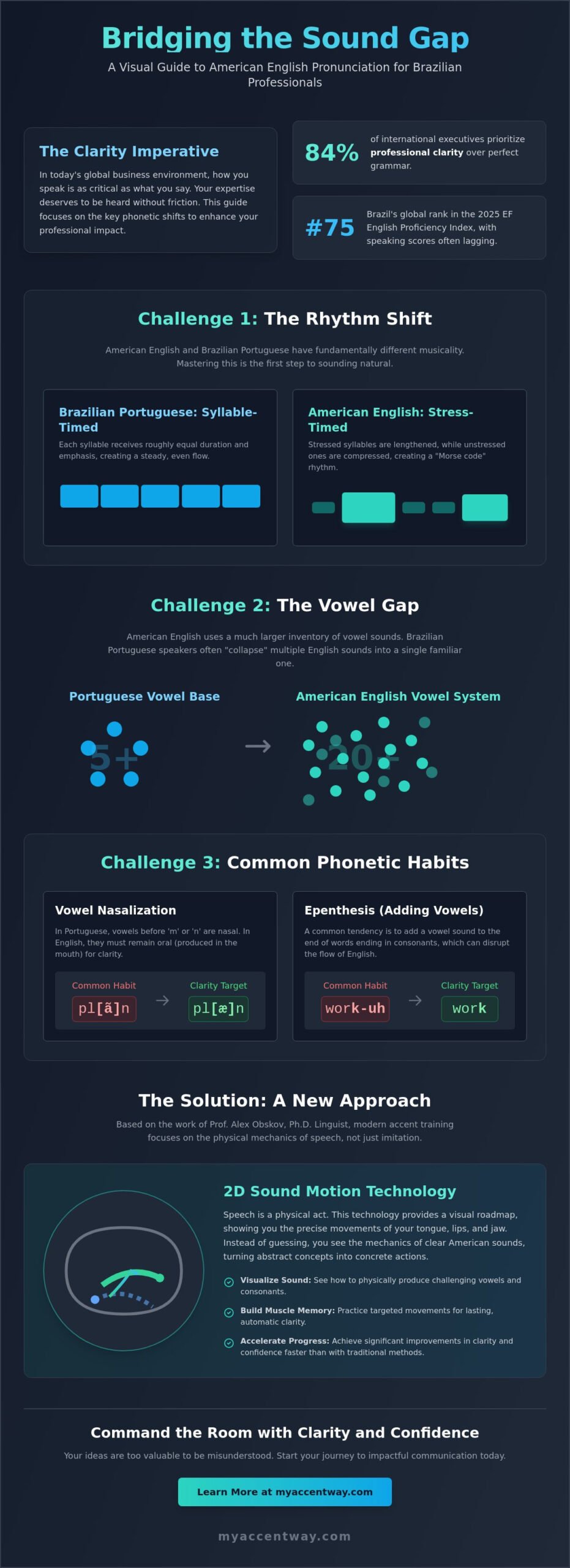
You’ve prepared for weeks and your data is flawless, but five minutes into your presentation, a colleague asks you to repeat yourself for the third time. It’s frustrating to feel your expertise is overlooked simply because the phonetic patterns of your native language don’t align with American English rhythms. Many Brazilian professionals face this exact barrier; the 2025 EF English Proficiency Index ranks Brazil 75th globally, with speaking scores often trailing significantly behind reading comprehension. You aren’t alone in feeling physical fatigue from over-enunciating or worrying that your accent overshadows your professional value.
I understand that 84% of international executives now prioritize professional clarity over grammatical perfection. This guide will show you how to bridge that gap using science-backed techniques developed by Prof. Alex Obskov, Ph.D. Linguist. You’ll learn to master english pronunciation for brazilian portuguese speakers by focusing on the specific phonetic shifts that create immediate clarity and confidence. We’ll explore the mechanics of American sounds, the power of word stress, and how our proprietary 2D Sound Motion Technology provides the visual roadmap you need to command any room with ease.
Key Takeaways
- Understand how the transition from syllable-timed Portuguese to the stress-timed rhythm of American English serves as the foundation for professional speech clarity.
- Master the distinction between “Lax” and “Tense” vowel sounds to significantly improve english pronunciation for brazilian portuguese speakers in high-stakes meetings.
- Learn to identify and correct “epenthesis,” the common habit of adding extra vowel sounds to the ends of words, to ensure your speech sounds natural and fluid.
- Apply specific rules for word stress and sentence intonation to command the room with the confidence of a seasoned American professional.
- Discover how 2D Sound Motion Technology provides the visual feedback necessary to physically master American sounds through a science-backed, analytical approach.
Why Brazilian Portuguese Speakers Face Unique English Pronunciation Challenges
When you speak, your brain relies on a deeply ingrained phonetic map. For Brazilians, this map is built on the specific rules of Portuguese phonology. This creates a phenomenon called phonetic interference, where your mind naturally tries to fit American English sounds into familiar Portuguese slots. It isn’t a lack of effort; it’s a cross-linguistic pattern. Prof. Alex Obskov, Ph.D. Linguist, has spent years identifying these specific intersections to help professionals move past these barriers. While traditional classes often prioritize grammar, effective accent modification focuses on the physical mechanics of sound production.
One of the most significant hurdles is the difference in linguistic rhythm. Portuguese is a syllable-timed language, meaning every syllable receives roughly the same amount of time. English, however, is stress-timed. In an American accent, we stretch out stressed syllables and compress unstressed ones. This creates a “Morse code” rhythm that can feel alien to those used to the staccato flow of Portuguese. Mastering english pronunciation for brazilian portuguese speakers requires more than just learning new words; it requires a complete recalibration of your internal metronome.
The Concept of Sound Motion in Accent Modification
Speech is a physical act. The way you position your tongue, lips, and jaw determines the clarity of your output. In Portuguese, the tongue often sits further back or flatter than it does in American English. When your brain encounters an unfamiliar phoneme, it often “substitutes” it with the closest Portuguese equivalent. This substitution is what leads to common clarity issues. Our approach uses 2D Sound Motion Technology to visualize these movements. The goal isn’t to change who you are or hide your background. Instead, we focus on speech clarity so your message is never lost. You’re simply adding a new set of physical skills to your professional toolkit.
Professional Impact of Speech Clarity in the U.S.
In a competitive corporate environment, clarity is a form of currency. Data from 2025 indicates that 84% of international executives now prioritize professional clarity over simple grammatical correctness. If you’re constantly asked to repeat yourself, it can erode your confidence and affect how others perceive your leadership potential. There is a direct psychological link between confident pronunciation and executive presence. By investing in American accent training, you ensure that your expertise is the focus of the conversation, not your accent. Moving toward professional mastery allows you to command a room with the authority your experience deserves.
Mastering the Vowel Gap: From Portuguese Nasals to American Clarity
The transition from Portuguese to English requires a significant expansion of your auditory and physical range. While Portuguese relies on five primary vowel letters to produce its sounds, American English utilizes over 20 distinct vowel phonemes. This discrepancy often leads to “vowel collapsing,” where a speaker uses one familiar Portuguese sound to represent three or four different English ones. Research into comparative phonological systems shows that this lack of distinction is a primary cause of listener fatigue in professional settings. Mastering english pronunciation for brazilian portuguese speakers starts with recognizing that your brain must learn to categorize sounds it previously ignored.
One of the first habits to address is vowel nasalization. In Portuguese, vowels followed by “m” or “n” are often produced through the nose. In American English, however, vowels remain oral and clear until the very last millisecond before the consonant. If you nasalize the vowel in a word like “plan,” it can sound muffled or indistinguishable to a colleague. Neutralizing this nasal quality requires conscious control of the soft palate. You can visualize this physical adjustment using 2D Sound Simulators for American Sounds, which show exactly how to keep the air flowing through the mouth for maximum resonance.
The most transformative sound you can master is the Schwa [ə]. This neutral, unstressed sound is the heartbeat of American English rhythm. Because Portuguese is syllable-timed, speakers often try to pronounce every vowel clearly. In English, we reduce almost all unstressed vowels to this quick, “uh” sound. Mastering the Schwa allows you to achieve a natural sounding rhythm, preventing the staccato effect that often makes Brazilian speakers sound overly formal or tired. If you’re ready to see how these sounds look in motion, you might consider exploring American accent training tailored to your specific linguistic background.
The Front Vowel Challenge: [i] vs [ɪ]
The distinction between the “tense” [i] in “sheep” and the “lax” [ɪ] in “ship” is a common hurdle. Portuguese speakers often substitute the tense sound for both, which can change the meaning of professional terms. Practice with minimal pairs like “leave” and “live” or “seat” and “sit.” In words like “business” or “fill,” focus on keeping the tongue relaxed and slightly lower in the mouth. This small physical shift ensures you’re heard correctly the first time.
The ‘Open A’ and the [æ] Sound
The [æ] sound in words like “manager,” “data,” and “asset” often doesn’t exist in the Portuguese sound map. Without training, “man” and “men” often sound identical, leading to confusion in group discussions. To produce this sound, you must drop your jaw significantly lower than you would for any Portuguese vowel. The [æ] sound is a uniquely American phoneme requiring specific jaw tension. Prof. Alex Obskov, Ph.D. Linguist, emphasizes that this “open” position is key to achieving the resonance expected in U.S. corporate environments.
Resolving Consonant Interference: The ‘ED’ and Final Sounds
Mastering consonants is the next logical step after you’ve begun to recalibrate your vowels. For many, the most persistent challenge in english pronunciation for brazilian portuguese speakers is the tendency to add a small “ee” sound to the end of words that finish in a consonant. This linguistic habit, known as epenthesis, occurs because Portuguese phonology rarely allows words to end in “hard” consonants like [k], [p], or [t]. When you say “book-ee” instead of “book,” it disrupts the natural flow of American English. Prof. Alex Obskov, Ph.D. Linguist, emphasizes that learning to “stop” the sound exactly on the consonant is vital for professional speech clarity.
The past tense “-ed” suffix is another area where Brazilian professionals often struggle, as it doesn’t follow a single rule. To achieve a natural American rhythm, you must master the three distinct ways we pronounce this ending:
- The [t] sound: Used after voiceless consonants (e.g., “walked,” “helped”).
- The [d] sound: Used after voiced consonants (e.g., “planned,” “robbed”).
- The [id] sound: Only used when the base word ends in a [t] or [d] (e.g., “started,” “needed”).
Incorrectly applying these rules can make your speech sound heavy or grammatically unclear, even when your writing is perfect. By focusing on these mechanics, you transition from basic communication to true professional mastery.
Eliminating the Added Final Vowel
To stop adding extra vowels, you must train your vocal apparatus to “cut off” the airflow immediately. Practice with words like “work,” “stop,” and “light.” Don’t let the tongue or lips move into a new position after the final consonant is released. Our 2D Sound Motion Technology is particularly effective here. It provides a visual map of the “cutoff” point, showing you exactly when to stay still. This physical discipline is a cornerstone of effective American accent training, helping you avoid the fatigue that comes from over-enunciating unnecessary sounds.
The American [r] and [l] Distinction
The Portuguese [r] often originates in the throat, similar to a French [r] or an English [h]. In contrast, the American [r] is a “retroflex” sound, created by curling the mid-tongue toward the roof of the mouth without touching it. Similarly, the “Dark L” at the end of words like “professional” or “call” often sounds like a “U” to Brazilian speakers (e.g., “profession-au”). To correct this, the back of the tongue must rise while the tip remains down. These subtle physical shifts in words like “world” or “girl” are what create the polished, resonant tone expected in U.S. corporate environments.
Adjusting Word Stress and Sentence Rhythm for Professional Clarity
If you’ve ever felt like your speech sounds robotic or staccato during a high-stakes presentation, you’re likely experiencing the clash between two very different linguistic rhythms. Prof. Alex Obskov, Ph.D. Linguist, points out that while Brazilian Portuguese is syllable-timed, American English is stress-timed. In Portuguese, every syllable roughly shares the same duration. In English, we prioritize “content words” like nouns and verbs, while “function words” like prepositions and articles are squeezed into the background. Mastering english pronunciation for brazilian portuguese speakers requires you to embrace this pulse, allowing your voice to flow with the natural “music” of American discourse.
Word stress is another critical component of a professional presence. In multi-syllabic professional terms like “alternative,” “analysis,” or “distributed,” one specific syllable must be longer, louder, and higher in pitch. Brazilian speakers often give equal weight to every syllable, which can make it difficult for a native listener to recognize the word immediately. This rhythmic mismatch is often what leads to the fatigue you feel after long meetings. To dive deeper into these mechanics, you can explore our American Accent Training for U.S. Professionals guide, which provides a science-backed framework for these phonetic shifts.
The Power of Intonation in Leadership
In a corporate setting, your intonation tells a story about your confidence. American English typically uses a falling intonation at the end of statements to signal authority and the completion of a thought. Many Brazilian speakers naturally use a rising intonation to sound polite or inclusive, but in a U.S. boardroom, this can inadvertently sound inquisitive or uncertain. Avoiding the monotone trap is essential; if you focus too hard on individual sounds, you might lose the melodic variation that keeps your audience engaged. Learning when to drop your pitch is a key step in commanding a room with executive presence.
Linking and Reduction: The Key to Fluency
Fluency doesn’t come from speaking faster; it comes from “linking” words together to create a smooth, uninterrupted stream of sound. Native speakers often reduce unstressed vowels and connect the final consonant of one word to the starting vowel of the next. For example, “an apple” sounds like “a-napple.” Linking is a sign of advanced proficiency, not lazy speech. When you master these connections, your speech loses the choppy quality that can sometimes obscure your expertise. If you’re ready to apply these rhythms to your daily work, you can Book Your 1 Hour Accent Training Session to see how these techniques transform your communication style.
Accelerating Progress with 2D Sound Motion Technology
Traditional “listen and repeat” methods often fail because they don’t address the physical mechanics of speech. For an adult professional, your brain has spent decades filtering out sounds that don’t exist in your native language. This is why mastering english pronunciation for brazilian portuguese speakers requires more than just audio feedback. At My Accent Way, we bridge this gap by combining the academic expertise of Prof. Alex Obskov, Ph.D. Linguist, with our proprietary 2D Sound Motion Technology. This science-backed approach provides a visual roadmap for your vocal apparatus, ensuring you aren’t just guessing how to produce American sounds.
Our 2D Sound Simulators for American Sounds offer instant visual feedback that audio-only apps simply cannot match. You can see the exact placement of the tongue, the tension in the jaw, and the shape of the lips for every phoneme. This analytical approach is why we offer a Success Guarantee. We don’t rely on simple mimicry; we rely on a proven method that respects the cognitive and analytical processes of the adult mind. If you’re looking for American Accent Training near me, you’ll find that our online sessions across Texas and beyond offer the precision needed for professional speech clarity.
The Science of Visual Pronunciation
Adult ESL learners often struggle because they can’t hear the subtle differences between two sounds until they understand how they’re physically made. Seeing the sound motion in a 2D simulator maps the physical movement to the auditory output, creating a stronger neural connection. Prof. Alex Obskov developed these proprietary tools specifically to address the cross-linguistic patterns we’ve discussed in previous sections. By visualizing the “sound motion,” you move from a state of confusion to one of analytical mastery. You’re no longer just trying to sound like someone else; you’re learning the mechanics of a new professional skill.
Your Next Steps Toward Mastery
Your cultural background is an asset, not a hurdle. Our individual approach ensures that your unique voice remains intact while your clarity improves. The goal of accent modification is to empower you to speak confidently in any setting, from a local meeting in Austin to a global executive summit. We invite you to experience this transformation firsthand. You can Book Your 1 Hour Accent Training Session to see the 2D Sound Motion Technology in action and begin your journey toward a natural sounding American rhythm. Clarity is a skill you can master with the right tools and expert guidance.
Command the Room with Professional Speech Clarity
Mastering english pronunciation for brazilian portuguese speakers is a journey of physical and cognitive recalibration. We’ve explored how the shift from syllable-timed rhythms to American stress patterns creates an immediate impact on how your expertise is perceived in the boardroom. By addressing vowel nasalization and final consonant sounds through analytical practice, you move beyond basic communication into true leadership presence. It isn’t just about sounds; it’s about the confidence that comes with being understood the first time you speak.
Our method, led by Prof. Alex Obskov, Ph.D. Linguist, utilizes proprietary 2D Sound Motion Technology to provide the visual feedback necessary for lasting results. Proven results for international professionals show that this science-backed approach is the most effective path to speech clarity. You don’t have to settle for physical fatigue or the frustration of being overlooked. You have the expertise; now it’s time to give it the resonant, authoritative voice it deserves. I’m excited to help you master these new patterns and succeed in your professional journey.
Frequently Asked Questions
Is it possible for a Brazilian adult to achieve high speech clarity in English?
Yes, it’s absolutely possible for Brazilian adults to achieve high speech clarity by focusing on phonetic mechanics. While children acquire sounds intuitively, adults succeed through analytical and cognitive processes. Prof. Alex Obskov, Ph.D. Linguist, uses a method that targets the specific muscular movements required for American sounds. This ensures that your expertise is communicated clearly without the frustration of being asked to repeat yourself in professional settings.
Why do I add an ‘i’ sound to the end of English words like ‘Facebook’ or ‘dog’?
You add an extra “ee” sound because Portuguese rarely allows words to end in a hard consonant. This habit, known as epenthesis, causes speakers to say “book-ee” or “dog-ee.” Mastering english pronunciation for brazilian portuguese speakers involves training your vocal apparatus to “stop” the airflow immediately. Our 2D Sound Motion Technology helps you visualize this cutoff point to eliminate these unnecessary final vowels and sound more fluid.
What is the difference between accent reduction and ESL classes?
Accent reduction focuses on the physical mechanics of sound production, while ESL classes typically prioritize grammar and vocabulary. If you already have strong writing skills but struggle with being understood in meetings, you need American accent training. This specialized coaching targets phonemes, intonation, and rhythm to improve your professional speech clarity rather than just teaching you the rules of a new language.
How long does it take to see results with American accent training?
Most students see a measurable improvement in their speech clarity within 12 to 24 weeks of consistent practice. Data from 2025 indicates that 84% of international executives now prioritize clarity over perfect grammar, making this a high yield professional investment. Using 2D Sound Simulators for American Sounds accelerates this process by providing instant visual feedback, allowing you to correct your tongue placement in real time.
Can I improve my pronunciation without losing my Brazilian identity?
You can significantly improve your clarity without losing your Brazilian identity or cultural heritage. The goal of accent modification isn’t to sound like someone else, but to ensure your message is heard without distraction. We view pronunciation as a professional tool, similar to public speaking or technical writing, that empowers you to command a room while remaining true to your roots and culture.
What are the most common pronunciation mistakes for Portuguese speakers?
The most common hurdles include vowel nasalization, syllable-timed rhythm, and the “Dark L” sound. Many professionals also struggle with the English [r] and the “TH” dental fricative. Mastering english pronunciation for brazilian portuguese speakers requires specific focus on these cross-linguistic patterns. By understanding the science behind these shifts, you can systematically replace old habits with clear, confident American English patterns that command respect.
Disclaimer – American Accent Program
The American Accent Program available through Visit Program Website
is an educational and coaching service designed to support pronunciation, accent reduction, and spoken English fluency. All training materials, including lessons, exercises, audio content, visual simulations, coaching methods, and digital resources, are the intellectual property of American Accent Program, LLC and are protected by applicable copyright and intellectual property laws.
By using this website and participating in the program, you acknowledge that all content is provided for personal, non-commercial, educational use only. Users are granted a limited, non-transferable license to access the materials strictly for individual learning purposes. Redistribution, reproduction, recording, modification, sharing, or commercial use of any program content without prior written consent is strictly prohibited.
The program may include live coaching sessions, digital tools, and instructional materials intended to improve pronunciation and communication skills. However, individual results may vary, and no specific level of fluency, accent reduction, or communication outcome is guaranteed.
The American Accent Program and its instructors do not provide medical, therapeutic, or clinical speech-language pathology services. All training is intended for educational purposes only.
By accessing or using the program, you agree to comply with all applicable terms, including the platform’s Terms of Use and Course Policies, and acknowledge that misuse of materials may result in termination of access without refund.
Speech clarity check
The problem is not always grammar or vocabulary.
If people understand your words but still miss your message, the deeper issue may be speech clarity, rhythm, intonation, and American pronunciation habits. MyAccentWay helps students retrain the sound system with professional 1-on-1 guidance, so English can feel clearer, freer, and more natural in real communication.
Why MyAccentWay works
Two training methods that make speech change active.
MyAccentWay is not passive listen-and-repeat coaching. Prof. Alex, Ph.D. Accent Coach, creates a learning situation where students become active learners and active participants in changing their own speech patterns.
Interactive training
Students do not just receive pronunciation instructions passively. They listen, think, compare, adjust, and understand their own speech patterns while Prof. Alex guides the correction process.
U.S. & Canada online accent training
English Pronunciation for Brazilian Portuguese Speakers: A Professional Guide to Speech Cl for professionals in the United States and Canada
This guide is useful for advanced English speakers, entrepreneurs, international professionals, and students in the U.S. and Canada who want clearer American pronunciation, stronger rhythm, better intonation, and more confident communication in meetings, interviews, presentations, and client conversations.
Prof. Alex, Ph.D. Accent Coach, teaches online 1-on-1 American accent training for learners in major professional markets including New York, Los Angeles, San Francisco Bay Area, Seattle, Austin, Dallas, Houston, Chicago, Boston, Washington, D.C., Miami, Toronto, Vancouver, Montreal, Calgary, and Ottawa.
1-on-1 Accent Reduction Training helps students move beyond self-practice and build clearer American speech habits through interactive and cognitive accent training.
Cognitive accent training
Students learn to notice and correct the speech patterns that affect American pronunciation, then implement new American speech patterns into their code-switching process for more natural, long-lasting change.
Your next step
Build speech habits people can hear in real conversations.
A stronger American accent is not built by memorizing topics or chasing quick pronunciation tips. It comes from structured training, professional feedback, active correction, and repeated application until clearer speech becomes easier to keep.