
Article by
Prof. Alex., Ph.D. Accent Coach
Doctor of Education, Professional Linguist,
Creator of 2D Sound Motion Technology,
Creator of “InPronunci:" American Accent Program App,
Professor of English as a Second Language,
American Accent Coach,
Life Coach.
Why does a lifetime of speaking English still result in colleagues asking you to repeat yourself during critical project updates? It’s a frustrating reality for many of the 1.9 million Tagalog speakers in the United States who possess technical mastery but struggle with the specific “flow” of American speech. You likely feel that your professional authority is undermined when listeners focus more on your syllable stress than your expertise. This occurs because Tagalog is syllable-timed, whereas American English relies on a complex, stress-timed rhythm that requires a different physical approach to every sentence.
I’m here to help you bridge this linguistic gap and master the american accent for tagalog speakers using science-backed techniques for professional clarity. You’ll learn how to transition from a staccato rhythm to the fluid, assertive flow required in high-stakes environments. We will explore how the method I’ve developed as Prof. Alex Obskov, Ph.D. Linguist, utilizes 2D Sound Motion Technology to visualize American sounds. This guide provides a clear roadmap to mastering vowel length and syllable stress so you can communicate complex ideas clearly while maintaining your unique cultural identity.
Key Takeaways
- Understand the shift from Tagalog’s syllable-timed rhythm to the stress-timed flow of American English to move beyond a choppy, staccato speech pattern.
- Identify and correct common vowel merges, such as the distinction between “seat” and “sit,” to ensure your technical ideas are communicated with precision.
- Master the use of the Schwa [ə] and word stress rules, which are the essential building blocks of the american accent for tagalog speakers.
- Utilize 2D Sound Motion Technology and 2D Sound Simulators to visualize the precise physical movements of the tongue and lips for challenging American sounds.
- Gain the confidence to lead high-stakes meetings by focusing on speech clarity as a tool for professional authority and personal growth.
Understanding the Linguistic Bridge Between Tagalog and American English
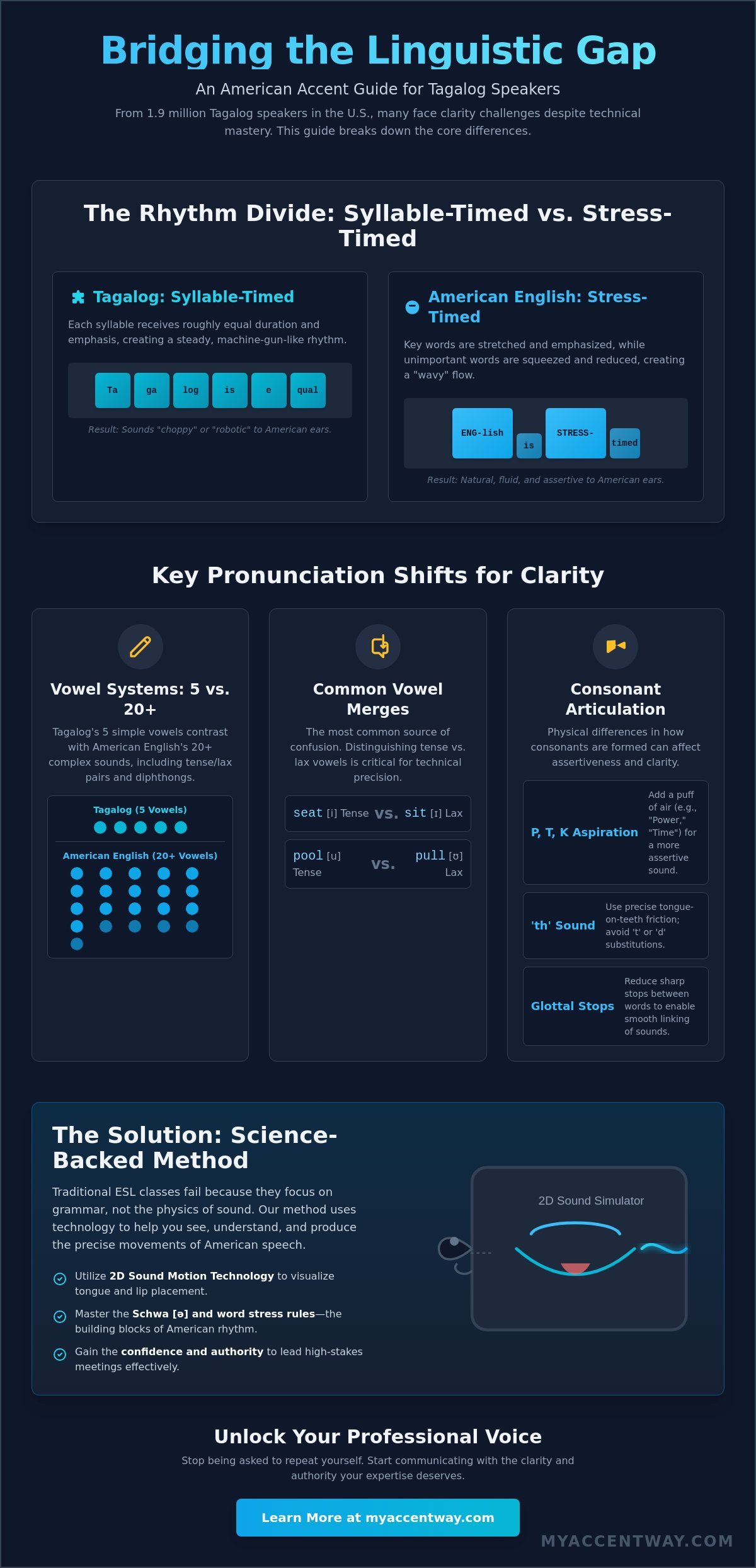
To master the american accent for tagalog speakers, we must first look at the architectural differences between the two languages. Tagalog is what linguists call a syllable-timed language. This means every syllable receives roughly the same amount of time and energy, creating a steady, rhythmic beat. In contrast, American English is stress-timed. We stretch out important content words and squeeze the function words. When you apply the equal timing of Tagalog to English, it creates a rhythm that sounds choppy or robotic to American ears. This isn’t a lack of fluency; it’s simply a carryover of your native linguistic rules.
Having an accent is a powerful sign of your bilingualism and intelligence. You’ve already mastered the complex rules of Tagalog phonology, which is a significant intellectual achievement. The goal of our work together isn’t to change who you are. Instead, we’re adding a new set of physical tools to your communication toolkit so you can switch into a professional American flow whenever the situation demands it. Understanding this linguistic bridge is the first step toward achieving the clarity you need in high-stakes meetings.
The Physics of the Filipino Accent in English
A key physical trait in Tagalog is the frequent use of the glottal stop, which is a sharp closure of the vocal folds. While this is essential in your native tongue, it can make English words sound disconnected or clipped. Additionally, the tongue usually rests in a more neutral, central position in Tagalog. American English requires more aggressive and precise tongue movements, especially for sounds like the American [r] or the varied vowel lengths. The staccato rhythm is the primary barrier to American speech flow, as it prevents the natural linking that native listeners expect.
Why Traditional ESL Classes Often Fail Tagalog Speakers
Many professionals find that general ESL classes don’t solve their clarity issues because those programs focus on grammar and vocabulary. If you’re a professional working in the U.S., you likely already have an excellent command of English grammar. What you need isn’t more words; it’s a sound-by-sound approach to American accent training. This is why my method as Prof. Alex Obskov, Ph.D. Linguist, focuses on the cognitive and analytical processes of speech. We treat pronunciation as a physical skill that can be mastered through precision and science rather than just “listening and repeating.”
Key Pronunciation Shifts: Vowels and Consonants for Filipino Professionals
Mastering the american accent for tagalog speakers requires a deep dive into the physical mechanics of sound production. While Tagalog provides a strong foundation for English, the vowel systems are vastly different. A recent Philippine English Phonology study highlights how these specific shifts impact clarity for professionals. Tagalog has only five vowel sounds, whereas American English has twenty. This discrepancy often leads to “vowel merging,” where distinct American words sound identical when spoken by a Filipino professional. For example, the distinction between the high-front [i] in “seat” and the lax [ɪ] in “sit” is critical for avoiding confusion during technical presentations.
Another common challenge involves the back vowels [u] and [ʊ]. In Tagalog, these often collapse into a single sound, making “pool” and “pull” indistinguishable. Beyond vowels, we must address consonant aspiration. In Tagalog, the sounds [p], [t], and [k] are unaspirated, meaning they lack a strong burst of air. In American English, these sounds require a noticeable “puff” at the start of words like “Power” or “Time.” Without this aspiration, your speech may sound softer or less assertive to American colleagues. Additionally, the [th] sound requires moving away from “t” or “d” substitutions toward a precise interdental friction, where the tongue gently touches the upper teeth.
Mastering the American Vowel Spectrum
The secret to clarity lies in understanding the “tense” versus “lax” vowel concept. Tense vowels like [i] involve more muscular effort, while lax vowels like [ɪ] require a relaxed tongue. To practice the “Short A” [æ] sound found in “cat,” try dropping your jaw lower than you would for “cot.” This physical shift creates the resonance necessary for professional speech clarity. You can explore these mechanics further in our guide to American vowel sounds for a more detailed breakdown.
Clearing Up Consonant Confusion
The American [r] is a frequent hurdle because it is not flapped or rolled like the Tagalog [r]. Instead, the tongue must pull back without touching the roof of the mouth. For the [f] and [v] sounds, focus on labiodental placement by resting your upper teeth on your lower lip. This prevents the common “p” or “b” substitutions that can occur when the lips close completely. If you’re ready to refine these physical movements, consider exploring our accent reduction program to see how we use 2D Sound Simulators for American Sounds to guide your progress.
Mastering American Rhythm: From Syllable-Timed to Stress-Timed Speech
The transition from Tagalog’s steady beat to the variable rhythm of American English is often the most significant challenge in american accent for tagalog speakers. While Tagalog gives equal weight to every syllable, American English relies on a stress-timed structure. This means we prioritize specific “content” words while reducing others to fit into a specific time interval. Mastering this rhythm allows you to sound more assertive and clear in professional settings. According to research from the University of San Diego, there are numerous professional benefits of accent modification, including improved executive presence and significantly reduced listener fatigue during long presentations.
Sentence stress involves choosing which word in a phrase carries the most meaning. In a meeting, you might say, “We need to increase the budget,” versus “We need to increase the budget.” Each shift in pitch changes the focus of your message. By mastering these intonation patterns, you move beyond mere vocabulary and begin to use your voice as a strategic tool. As Prof. Alex Obskov, Ph.D. Linguist, I help professionals identify these stress points to ensure their most important ideas aren’t lost in a flat delivery.
The Power of the Schwa in Corporate Communication
The Schwa [ə] is the most frequent sound in the American accent. It’s a neutral, relaxed vowel that occurs in almost every unstressed syllable. For Tagalog speakers, the instinct is to pronounce every vowel clearly and fully. However, in words like “Management,” “Important,” or “Development,” the unstressed vowels must shrink to a Schwa. If you pronounce “Management” as “man-age-ment” with three equal beats, it sounds choppy. By using the Schwa, you create the peaks and valleys that native listeners use to process information quickly. This “lazy” sound is actually a sophisticated tool for maintaining the American flow.
Intonation Patterns for Authority and Confidence
Your pitch tells a story about your confidence level. Many professionals inadvertently use rising intonation at the end of statements, which is known as “up-talking.” This can make your expertise sound like a question, undermining your authority. To project confidence, I teach my students to use falling intonation for declarations. This decisive drop in pitch signals that you’ve finished your thought and are sure of your data. Using “staircase intonation” allows you to step down through a sentence, guiding your audience through complex technical ideas without losing their attention. These rhythmic shifts are best mastered when you can visualize the sound through 2D Sound Motion Technology in our American Accent Training Program and Accent Reduction Curriculum.
Practical Exercises: How to Use 2D Sound Simulators for Speech Clarity
The biggest hurdle in mastering the american accent for tagalog speakers is that you cannot see what’s happening inside the mouth. Traditional methods rely on audio alone, but as Prof. Alex Obskov, Ph.D. Linguist, I know that sound is a physical motion. Our proprietary 2D Sound Motion Technology provides a visual map of these invisible movements. Instead of guessing where your tongue should go, you can watch a 2D Sound Simulator for American Sounds and mirror the exact placement of the tongue and lips in real time.
To achieve professional clarity, follow these four steps using our simulation technology:
- Step 1: Visualize the [r]. Tagalog speakers typically use a flap or a roll. The simulator shows the specific “bunched” or “retroflex” position required for the American [r] without touching the palate.
- Step 2: Differentiate Plural Endings. Use the simulator to see the vibration required for the [z] sound in “cars” versus the voiceless [s] in “cats.”
- Step 3: Compare Sound Motions. Record your own speech and overlay it against the expert model to identify physical discrepancies.
- Step 4: Real-Time Feedback. Use the visual loops to build muscle memory faster than traditional listening exercises.
Visualizing the American [t] and [d]
In Tagalog, the [t] and [d] are dental, meaning the tongue touches the back of the teeth. This creates a sharp sound that can disrupt the American flow. In words like “water” or “better,” Americans use a “Flap T,” where the tongue quickly taps the alveolar ridge. A simulator makes this subtle motion visible. You can replicate the soft, fast tap that characterizes professional speech. I invite you to try a 1-hour sample session to see this technology in action and experience how visual feedback changes your perception of sound.
Building Muscle Memory for Long-Term Success
Knowing the rules of phonetics is an intellectual exercise, but speaking clearly under pressure is a physical one. Adult learners often struggle because their neural pathways for their native language are so strong. 2D Sound Simulators shorten the learning curve by providing immediate visual correction. By practicing for just 15 minutes a day with these tools, you can achieve consistent accent reduction results. This daily commitment ensures that your new speech habits become automatic during high-stakes corporate meetings.
Elevating Your Professional Communication with Prof. Alex Obskov, Ph.D.
Investing in speech clarity is one of the most effective ways to increase your career ROI. For the 1.9 million Tagalog speakers currently living and working in the United States, technical skill is rarely the barrier to promotion; it’s the ability to project authority through sound. At MyAccentWay, my philosophy is built on a simple truth: Your culture matters, but clarity is power. We don’t aim to strip away your identity or change who you are. Instead, we provide the phonetic tools necessary for you to be understood effortlessly in high-stakes environments, ensuring your expertise is the focus of every conversation.
Personalized coaching is essential because it addresses the specific linguistic interference unique to your native tongue. While we’ve discussed the general staccato rhythm and vowel merges common in the american accent for tagalog speakers, every professional has a unique speech profile. As Prof. Alex Obskov, Ph.D. Linguist, I use a sound-by-sound method to pinpoint exactly where your Tagalog patterns intersect with American English. This tailored approach ensures you aren’t wasting time on sounds you’ve already mastered, focusing instead on the specific shifts that will yield the greatest impact on your professional presence.
I believe in the effectiveness of this scientific method so much that I offer a Success Guarantee. This isn’t a vague promise of “improvement.” It’s a commitment to measurable results in your accent modification journey. By combining cognitive-analytical processes with 2D Sound Motion Technology, we ensure the changes you make are permanent and reliable, even when you’re under the pressure of a tight deadline or a difficult executive negotiation.
The Executive Approach to Accent Modification
Professional communication isn’t just about being “correct.” It’s about being impactful. When you master the american accent for tagalog speakers, you gain the ability to use intonation and stress to lead a room. Whether you’re delivering a keynote or networking at a corporate event in Houston or Dallas, your voice should reflect your expertise. Working with a linguist allows you to bridge the gap between the science of phonemes and the art of persuasive speaking, making you a more assertive and confident leader.
Next Steps on Your Journey to Clarity
If you’re ready to transform your communication, I invite you to explore our comprehensive American Accent Training for U.S. Professionals guide. This resource dives deeper into the specific sounds and rhythms we’ve touched on today. Your next step is to book an initial assessment to identify your specific speech patterns and create a roadmap for your success. Clarity opens doors that fluency alone cannot. Don’t let a lack of speech clarity hold back your professional growth; start your journey toward assertive, confident communication today by exploring our accent reduction program.
Take Command of Your Professional Narrative
You’ve explored the scientific shift from syllable-timed beats to the fluid, stress-timed rhythm of American speech. By utilizing 2D Sound Motion Technology, you can finally see the physical mechanics of clarity that audio alone cannot provide. Mastering the american accent for tagalog speakers is not about changing your culture; it’s about ensuring your expertise is heard without distraction in every high-stakes meeting. This sound-by-sound method provides a reliable path to assertive communication for the 1.9 million Tagalog speakers in the U.S. as of May 2026. You now have the roadmap to move from a staccato delivery to a fluid, professional flow that commands respect.
I am committed to your success through a proven Success Guarantee that focuses on measurable results. Let’s work together to refine your intonation and vowel precision so you can lead with confidence. Book your personalized accent assessment with Prof. Alex Obskov, Ph.D. today!
Your journey toward impactful speech is a powerful investment in your professional growth and personal transformation. I’m ready to help you unlock the doors that clarity alone can open. You have the talent; now let’s ensure the world hears it clearly and confidently.
Frequently Asked Questions
Is it possible for a Tagalog speaker to achieve a clear American accent as an adult?
Yes, adults can absolutely achieve high levels of speech clarity through neuroplasticity and deliberate muscle memory training. While children learn through immersion, adults succeed by using an analytical approach to understand the physical mechanics of sound. By focusing on the cognitive processes behind the american accent for tagalog speakers, you can rewire your brain to produce new sounds with precision and confidence.
How long does it take to see results in American accent training?
Most professionals notice a significant improvement in their clarity within 12 to 16 weeks of consistent training. This timeline depends on your starting point and the frequency of your practice sessions. By committing to 15 minutes of daily practice using structured 2D Sound Simulators, you’ll start to feel more assertive and clear during your professional interactions in just a few months.
Will I lose my Filipino identity if I undergo accent reduction?
No, you won’t lose your Filipino identity; instead, you’re gaining a professional tool for clearer communication. My philosophy is that your culture matters, and the goal of accent modification is to bridge the linguistic gap, not to erase your heritage. You are simply learning to code-switch between your native rhythm and the stress-timed flow required in the American corporate environment.
What is the most common pronunciation mistake Tagalog speakers make in English?
The most frequent challenge is applying Tagalog’s syllable-timed rhythm to the stress-timed structure of American English. This often results in a choppy sound where every word receives equal weight. Additionally, merging the high front vowel in “seat” and the lax vowel in “sit” is a common hurdle for many Filipino professionals. Mastering these specific shifts is a core part of our american accent for tagalog speakers program.
Can 2D Sound Motion Technology really help me hear sounds I currently cannot distinguish?
Yes, this technology is designed to make the invisible movements of the tongue and lips visible. Since you often cannot hear sounds that don’t exist in your native language, the 2D Sound Simulators provide a visual reference point. This allows you to mirror the exact physical motions required for American sounds, which significantly accelerates the learning process compared to traditional audio-only methods.
What is the difference between an accent coach and an ESL teacher?
An ESL teacher primarily focuses on grammar, vocabulary, and sentence structure for language learners. In contrast, an accent coach like myself, a Ph.D. Linguist, focuses on the physics of speech and phonetics. We work on the rhythm, intonation, and specific muscle movements needed for clarity. This specialized training is an investment in your career ROI rather than a general language class.
Disclaimer – American Accent Program
The American Accent Program available through Visit Program Website
is an educational and coaching service designed to support pronunciation, accent reduction, and spoken English fluency. All training materials, including lessons, exercises, audio content, visual simulations, coaching methods, and digital resources, are the intellectual property of American Accent Program, LLC and are protected by applicable copyright and intellectual property laws.
By using this website and participating in the program, you acknowledge that all content is provided for personal, non-commercial, educational use only. Users are granted a limited, non-transferable license to access the materials strictly for individual learning purposes. Redistribution, reproduction, recording, modification, sharing, or commercial use of any program content without prior written consent is strictly prohibited.
The program may include live coaching sessions, digital tools, and instructional materials intended to improve pronunciation and communication skills. However, individual results may vary, and no specific level of fluency, accent reduction, or communication outcome is guaranteed.
The American Accent Program and its instructors do not provide medical, therapeutic, or clinical speech-language pathology services. All training is intended for educational purposes only.
By accessing or using the program, you agree to comply with all applicable terms, including the platform’s Terms of Use and Course Policies, and acknowledge that misuse of materials may result in termination of access without refund.
Speech clarity check
The problem is not always grammar or vocabulary.
If people understand your words but still miss your message, the deeper issue may be speech clarity, rhythm, intonation, and American pronunciation habits. MyAccentWay helps students retrain the sound system with professional 1-on-1 guidance, so English can feel clearer, freer, and more natural in real communication.
Why MyAccentWay works
Two training methods that make speech change active.
MyAccentWay is not passive listen-and-repeat coaching. Prof. Alex, Ph.D. Accent Coach, creates a learning situation where students become active learners and active participants in changing their own speech patterns.
Interactive training
Students do not just receive pronunciation instructions passively. They listen, think, compare, adjust, and understand their own speech patterns while Prof. Alex guides the correction process.
U.S. & Canada online accent training
Mastering the American Accent for Tagalog Speakers: A Professional Guide to Speech Clarity for professionals in the United States and Canada
This guide is useful for advanced English speakers, entrepreneurs, international professionals, and students in the U.S. and Canada who want clearer American pronunciation, stronger rhythm, better intonation, and more confident communication in meetings, interviews, presentations, and client conversations.
Prof. Alex, Ph.D. Accent Coach, teaches online 1-on-1 American accent training for learners in major professional markets including New York, Los Angeles, San Francisco Bay Area, Seattle, Austin, Dallas, Houston, Chicago, Boston, Washington, D.C., Miami, Toronto, Vancouver, Montreal, Calgary, and Ottawa.
1-on-1 Accent Reduction Training helps students move beyond self-practice and build clearer American speech habits through interactive and cognitive accent training.
Cognitive accent training
Students learn to notice and correct the speech patterns that affect American pronunciation, then implement new American speech patterns into their code-switching process for more natural, long-lasting change.
Your next step
Build speech habits people can hear in real conversations.
A stronger American accent is not built by memorizing topics or chasing quick pronunciation tips. It comes from structured training, professional feedback, active correction, and repeated application until clearer speech becomes easier to keep.